Welcome to this latest edition of our Workbench blog and all the news, updates, and modelling exclusives from the fascinating world of Airfix.
This week, we’re incredibly excited to be returning to the subject of new tooling additions to this year’s kit range, and a model subject which many probably felt wouldn’t ever make it as a larger scale, high quality model kit in an Airfix range, the Supermarine Spitfire Tr.9. Thankfully, our long wait is now over, and we’re pleased to report that this highly anticipated new kit is in our warehouse and shipping to modelling enthusiasts all over the world.
Our new Supermarine Spitfire Tr.9 kit has unquestionably been at the top of the new tooling pre-ordering charts since it was announced early this year, and along with the new SEPECAT Jaguar, have shown themselves to be the two new models we know people are most desperate to get their hands on. For this reason, we know that news of its release will come as a welcome development, and we hope this full project overview will serve as a fitting introduction for this highly anticipated new kit.
In addition to featuring an impressive selection of built model images, and supporting project artwork, we will be looking at how these Spitfires made for two were very much a post war phenomenon, and how in recent times, these former fighter aircraft have done much to preserve and enhance the iconic status of this most magnificent aircraft.
Strap yourself in for some time in a dual control Spitfire this Workbench weekend.
When the first Spitfires arrived at RAF Duxford during the summer of 1938, the young pilots of No.19 Squadron must have been a little trepidatious about flying these beautiful new fighters, aircraft which looked very different from their current Gloster Gauntlet biplanes.
When it comes to discussing the most famous fighting aeroplanes in the history of flight, we will all undoubtedly have our own particular favourites, with aircraft types such as the Messerschmitt Bf 109, North American Mustang and Mitsubishi Zero all benefiting from strong support, however, there’s one aircraft type which will almost always find itself at the head of any such list, the Supermarine Spitfire. Beautiful to look at, but deadly as a combat aircraft, the Spitfire represented the very pinnacle of world aviation technology when the first production aircraft arrived at RAF Duxford in early August 1938, the Spitfire went on to become arguably the most famous aircraft to ever take to the skies, one which is still instantly recognisable to millions of people to this day.
Despite both the stellar career the Spitfire had, and the affection in which the fighter continues to be held in, there is one aspect of its design and development which still continues to raise eyebrows, and that is why didn’t the RAF introduce a two seat training version of the aircraft during the Second World War? On the day Supermarine’s Chief Test Pilot Jeffrey Quill delivered Spitfire Mk.I K9789 to RAF No.19 Squadron at Duxford, the pilots looking on must have been impressed with their new fighter, if understandably a little trepidatious. They were flying Gloster Gauntlet biplane fighters at the time, aircraft which has fixed undercarriages, open cockpits and were more than 100 mph slower than the sleek new monoplane fighter they were about to convert to. That all being the case, why wouldn’t they have been worried?
In actual fact, some senior RAF pilots had been given time and instruction on flying the Spitfire, so it wasn’t quite as heartless as presenting the young pilots of No.19 Squadron with a Pilot’s Notes booklet and telling them to crack on, there was actually structure behind the process. Converting pilots could also expect to have time sat in the cockpit of a Spitfire, to familiarise themselves with the control layout and to be instructed on the startup procedure, and given some time to make their own notes, study, and ask further questions if required.
But what was the official reason for not producing a two-seat training Spitfire? Well, despite the fact that the Spitfire did represent a significant technological leap forward for any young RAF pilot to make in terms of performance and equipment, the aircraft had been tested extensively, and had been classified as ready for service use. In effect, when combined with the excellent level of training RAF student pilots had received, they were of the opinion that the skills they had been given positioned them to fly any aircraft type, following a period of introduction, and they had faith in both their system and their pilots.
A first look at built examples of this stunning new kit, finished in both of the scheme options available with the initial release.
In addition to this, the Air Ministry knew they were going to need as many Spitfires as they could get their hands on in the near future, so were never going to disrupt existing production lines to introduce what would have been a new aircraft type, let alone the time and resources needed to develop a training variant of the Spitfire. In any case, the Spitfire possessed exceptional low speed handling characteristics, and despite some pilots claiming that they thought the Spitfire was trying to kill them when attempting their first landing, they soon learned to love the aircraft, and fly it as if they were at one will it.
It appears the Air Ministry were correct in their original thinking.
As it was, by the time of the outbreak of the Second World War, it’s generally accepted that the RAF had just over 300 Spitfires in service, with around 70 held in reserve and over 2,000 remaining on outstanding order. An aircraft which was a sight to behold and surely too attractive to be sullied by the horrors of war, the Spitfire would prove as deadly as it was beautiful and would be instrumental in defending Britain in her darkest hours of need, which were just around the corner.
Following the service introduction of the first Spitfires, the aircraft would benefit from a host of modifications and improvements not only throughout its subsequent production run, but also retrospectively to those aircraft already in service. The changes were all intended to make the aircraft more combat capable and to glean every last ounce of speed from the fighter’s Merlin engine, which was similarly subjected to constant development. Significantly, those modifications didn’t include work to produce an official Vickers produced Spitfire trainer – the world was going to have to wait until after the war for that.
Although initially anticipated as a training option for the Royal Air Force, it would be overseas customers who bought these modified Spitfires, but how popular have these unique aircraft become over recent years?
Although the subject of producing a two-seat training variant of the Spitfire was first proposed by Vickers Armstrong as far back as early 1941, the Air Ministry had absolutely no intention of disrupting existing Spitfire production lines for an aircraft they deemed unnecessary at that time. Indeed, even though a handful of two-seat Spitfire ‘hacks’ were produced autonomously during WWII, no officially designed and developed aircraft of this kind were produced during the Second World War.
Vickers would resurrect the idea in early 1945, buying back Spitfire Mk.VIII MT818 from the Air Ministry to serve as their project donor airframe for their Type 502 Spitfire High Speed Trainer prototype. Making its first flight on 9th September 1946, the aircraft would embark on a rigorous period of testing and evaluation trials, in the hope that she would attract potentially sizeable orders from the Air Ministry.
Initially at least, they did show interest in the new aircraft, suggesting this might prove to be the ideal aircraft with which to bridge the gap between fighter types for pilots of the Auxiliary Air Force. A demonstration flight was arranged for them at White Waltham airfield on 11th April 1949, where G-AIDN (MT818) performed exceptionally, demonstrating the legendary agility of the Spitfire for those in attendance. Unfortunately, it appears that the Air Ministry may have just been humouring Vickers at the time, as they only appeared to have eyes for a jet training program, and therefore didn’t follow up their interest in the Spitfire trainer.
Thankfully, Vickers continued their support of the two-seat Spitfire project, something which would see MT818 participate in numerous demonstration flight and air race events over the next few years, something which would eventually result in several overseas orders being placed for these ‘official’ Vickers designed and produced two-seat Spitfires, and a new variant for aviation enthusiasts to embrace.
We know you’ve all been waiting patiently for the arrival of this spectacular addition to the current Airfix range, so know you won’t mind seeing a further selection of beautifully finished model examples, this time in close-up detail.
Orders were subsequently received from the Netherlands, India, Egypt and Ireland over the following three years, however, it would be the post war Warbird and Airshow movements which would really bring this interesting variant of Spitfire the commercial recognition it deserved.
Before moving on, it’s fascinating to learn that this very first Vickers produced two-seat Spitfire remains in airworthy condition to this day, and is an aircraft which holds unique status in the world of historic aviation – she is the ONLY surviving Spitfire prototype across all the many variants of this famous aircraft. Cared for by our friends down at the Biggin Hill Heritage Hangar, you can actually take an experience flight in this very aircraft, the one Vickers used to develop their two-seat trainer variant.
As the only aircraft of the type which started life as a Mk.VIII fighter variant, MT818 also exhibits several unique design features which set her apart from other two-seat Spitfires, such as having a retractable tailwheel, and the incorporation an anti-spin parachute, which is housed behind two doors on the rear dorsal spine of the aircraft. It would be easy to argue that amongst the world’s current collection of airworthy Spitfires, MT818 is the most super of all the Supermarines, and you can take a flight in her! She’s quite the aviation celebrity.
Now we’re talking! Although the Spitfire Tr.9 has been a long time coming to the Airfix range, it’s here now and it’s an absolute stunner.
This is probably a question many modellers will be asking – after all this time, why introduce a new tooling of the Spitfire Tr.9 now? I suppose the answer to this question has to be, why not! Primarily, the main reason has to be the fact that the modelling world has been underserved when it comes to quality scale plastic kits of this subject over the years, particularly in this larger 1/48th scale. When we have seen beautifully produced scratch-built examples at model shows up and down the country, they just look so magnificent, and from a historic perspective, are actually now rather contemporary subjects.
In addition to this, it remains an undeniable fact that despite the passage of time, the popularity of the Supermarine Spitfire shows absolutely no sign of abating anytime soon, and how the aircraft’s iconic status appears to have effortlessly traversed not only the passage of time over the past eighty-seven years, but also generational boundaries. When attending Airshows in an official capacity, it really is interesting to hear the responses of younger modelling enthusiasts when they’re asked to name their favourite aircraft. Despite the fact that most operational RAF examples of the aircraft (obviously not including the aircraft of the BBMF) were withdrawn from service several decades before they were even born, 'Spitfire' will invariably be the answer most will give you.
A beautiful design to look at either in the air or on the ground, the aura surrounding the Spitfire is as captivating today as it was when it was saving the nation during the Battle of Britain (let's not get into that discussion Hurricane fans), and the fact that we can all enjoy the sight of relatively large numbers of airworthy examples of these magnificent aircraft in Britain's skies today, means that the Spitfire is still relevant to grandparents, parents and children alike, very much the aviation icon for the ages.
With both scheme options having fascinating stories to tell, which scheme are you going to be finishing your new Spitfire Tr.9 in?
With all this being the case, if large sections of the population had the opportunity to take a once-in-a-lifetime flight experience in a famous World War 2 era aircraft, surely wouldn't that aircraft of choice be a Spitfire? Perhaps this was the reason why just a few short years ago, almost every Spitfire under restoration at that time was being converted to Tr.9 or two-seat variant standard, with their ability to offer Spitfire experience flights now becoming such a popular and extremely lucrative business. Let’s be honest here, for many of us, this is clearly the only way we’re ever going to have the chance to fly in this iconic aircraft.
With two seat Spitfires now such a common sight in Britain's skies and also appearing regularly as Airshow display acts in their own right, these aircraft are now a much loved variant of this most famous aircraft, effectively maintaining, and possibly even enhancing the legacy of this magnificent aeroplane, bringing R.J Mitchell’s classic design to the hearts and minds of a new generation of Spitfire devotees. Under such circumstances as these, who wouldn't want a beautifully detailed scale kit representation of a two-seat Spitfire as part of their own model collection, well, that was our thinking anyway.
Most Airfix fans will have noticed the fact that our January range launch included not one, but two newly designed and tooled kits of the Spitfire in 1/48th scale, the Tr.9 two-seat variant, and the Mk.IX fighter, the aircraft from which all two-seat Spitfires (other than the original MT818) were derived. Both of these new projects benefited from the availability of highly accurate LIDAR scans, including those of a Tr.9 owned and operated by our good friends down at Biggin Hill Heritage Hangar. As mentioned previously, our new two-seat Spitfire kit has proved incredibly popular from a pre-ordering perspective, only beaten into a close second place by the new SEPECAT Jaguar. The fact that this stunning new model is now in our warehouse and being shipped to all its new owners will therefore be of interest to many, so that being the case, let’s move on to look at the two scheme options included with this initial release of the kit.
We saw earlier that whilst the official Vickers-Armstrong two-seat Spitfire MT818 G-AIDN was demonstrated, but overlooked by officials from the British Air Ministry, she went on to serve for several additional years as both a demonstration aircraft, and an air racing aeroplane. One of the more significant appointments she had to attend was when she was dispatched to Baldonnel airfield in early January 1950, to allow members of the Irish Air Corps to examine and fly her.
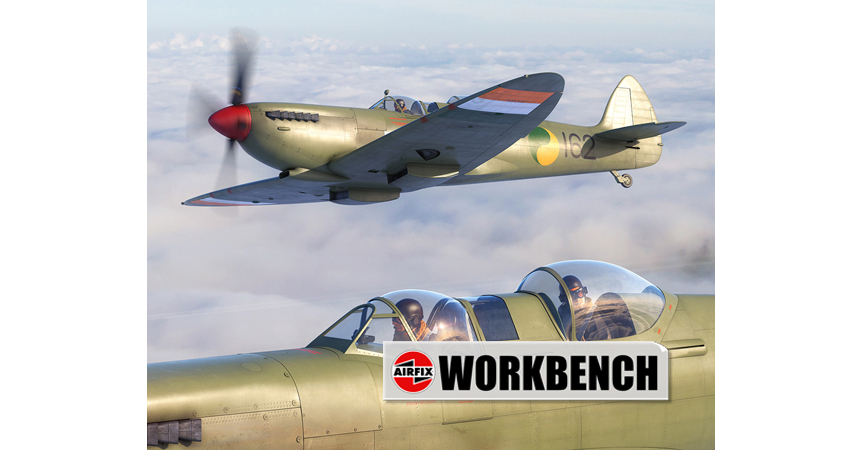
Late the previous year, the IAC retired the last of their Miles Master advanced training aircraft, leaving their student and refresher course pilots facing a gap in their training, and effectively having to jump from the basic Miles Magister trainers, to the much larger twin engined Avro 19 (Anson). Following the visit and a period of further consultation, the Irish Department of Defence placed an order for six Spitfire trainers, to carry the serial numbers 158 to 163, to be delivered starting from May 1951.
The aircraft were to be painted in an overall grey/green scheme which was similar to RAF cockpit green, with the first two aircraft being delivered in a matt finish, but the final four aircraft sporting a gloss sheen. Later, aircraft numbers 158, 161 and 162 would be finished in an extremely smart silver finish, sporting a large black cowling section which extended down past the aircraft’s exhaust manifolds, and from the front of the cockpit right up to behind the aircraft’s spinner.
These aircraft must have been a beautiful sight in the skies above the Dublin area, with the good people of Ireland gaining their appreciation of these two-seat training Spitfires much earlier than the rest of us did. Withdrawn from service in April 1960, these magnificent aircraft were transferred to the care of the Technical Training Squadron at Baldonnel, but when finally offered for sale from 1961 onwards, found themselves in the dawning of the UK Warbird movement, and the people who were thinking about producing a rather significant aircraft related movie.
Significantly, of the six aircraft purchased and operated by the Irish Air Corps, five remain in existence to this day, with all five either being in airworthy condition and offering air experience flights, or under restoration to do so soon. Only aircraft number 160 (MK721) doesn’t survive, as she was damaged beyond economical repair following a landing accident on the grass runway at Baldonnel on 15th February 1957.
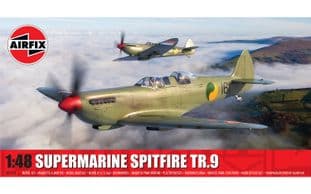
The Spitfire Tr.9 scheme shown above has quite a rich history and was originally built as a Mk.IX fighter during the late summer of 1944 and initially allocated to No.33 Squadron operating in Northern France in October the same year. During her time spent with No.33 Squadron in France and Belgium, she helped support the Allied drive towards Germany itself and flew 20 operational missions in the hands of 10 different pilots, men who heralded from Britain, Denmark, Holland and South Africa.
In early 1945, she was transferred to No.412 Sqn RCAF, in the colours of which she would go on to complete a further 76 operational sorties, and was credited with downing at least three Luftwaffe aircraft, two Focke Wulf Fw190s and a Messerschmitt Bf 109.
The end of the war brought about a slightly more sedate existence for this Spitfire, with a period of storage, before she was selected for conversion to Tr.9 standard and a new career with the Irish Air Corps, providing advanced flying training for pilots destined to fly their existing Seafire fighters. Although still PV202, she would operate under the serial IAC161 whilst in Ireland, but followed five of her fellow aircraft into the civilian market, following her withdrawal from service.
After passing through various private owners, she came into the hands of Historic Flying Limited (now ARCo), and following a period of restoration, emerged from their hangars resplendent in the Irish Air Corps scheme she had worn during the 1950s, making her first post restoration flight in March 2025. On that occasion, the aircraft was flown by company owner and accomplished Warbird pilot John Romain, with his passenger being none other than Alex Henshaw, a man who probably flew more individual Spitfires in his role as test pilot, than anyone else. It was thought that he flew 10 percent of all the Spitfire and Seafire fighters produced.
The aircraft has been repainted several times over the years, but is a stalwart of the UK Airshow scene, in addition to also allowing members of the public to fly in the world’s most famous aircraft, one which also possesses genuine WWII combat credentials. She is currently presented in the colours of Spitfire Mk.IX ML365, the personal aircraft of ace pilot Group Captain Peter Russell ‘Johnnie’ Walker CBE, DFC and DSO, and continues to allow Spitfire experience flights. These markings are similar to those the aircraft wore during her notable wartime service.
As with the vast majority of all the two-seat Spitfire conversions, this particular aircraft started life as TE308, a late production Mk.IXe variant of the fighter built at the massive Castle Bromwich factory during the spring of 1944, however, there are some gaps in her history records. The records show that she was allocated to No.39 Maintenance Unit, but would then spend the next five years held in storage, without undertaking any operational flying, which is a little confusing to say the least. No longer required by the Royal Air Force, she was sold to the Vickers-Armstrong Company during the summer of 1950, one of the aircraft destined for conversion to Tr.9 standard.
TE308 was rather a unique machine in this Vickers-Supermarine conversion process, as she had previously been a low-back fuselage, teardrop canopy equipped former RAF Spitfire Mk.IXs, and was the last of the six conversions destined for the Irish Air Corps. There is some suggestion that she may have been originally destined to fulfil an order for the Egyptian Air Force, however, evidence of this is again sketchy at best, and she definitely ended up as one of the six Irish Air Corps aircraft, and that’s good enough for us.
Following the end of her flying career with the IAC and a spirited final flight which almost got both aircraft and crew in hot water, she was sold in early 1968, having also spent time with the Technical Training Squadron at Baldonnel, where she was cared for extremely well. This aircraft, along with 161 and 162 were all subsequently purchased by the same private buyer, who arranged to have the aircraft completely overhauled whilst still at Baldonnel. Following the completion of a successful test flight, the aircraft was flown to Elstree via Speke by two members of the recently formed RAF Historic Flight.
Given the civil codes G-AWGB, she was flown to Henlow on 8th May 1968 and subsequently leased to ‘Spitfire Productions’, to be used in a rather ambitious project they had on the go at the time, the Guy Hamilton directed live action movie ‘Battle of Britain’. Flying down to Debden to join the rest of the aircraft amassed for this spectacle amongst the clouds, TE308 was one of two Tr.9 Spitfires to be used during filming, but with her contribution being the more significant.
During filming, the pilot would sit in the rear cockpit position, whilst the front cockpit was taken up with camera equipment, and much of the out of cockpit Spitfire footage used during the film was shot from this aircraft. For wider, formation aircraft shots, the two-seat Spitfires were always positioned on the outer edges of the frame, so their second cockpit was difficult, if not impossible to make out by those viewing the screen, or positioned specifically just to show only the front of the aircraft.
During the filming, it’s known that our two-seater TE308 was required to wear at least fourteen different permutations of RAF squadron code letters, to give movie goers the impression that producers had managed to amass an even greater number of historic aircraft for filming than they actually had. Interestingly, at some point during the filming, TE308 also ended up sporting a propeller and spinner from a Spanish Hispano Buchon, something she definitely didn’t leave Baldonnel with on 7th May!
Nevertheless, with over 100 aircraft at their disposal, the film’s producers had managed to create the world’s 35th largest air force at that time, and were responsible for presenting the world with one of the most spectacular aviation related movies ever conceived.
Following the screening of the Battle of Britain movie, a period of huge interest in owning and operating historic aircraft followed, and whilst many of the aircraft used in the film would be scattered across the world sold on to new owners, this period would plant the seeds for the vibrant world Airshow scene many millions of people enjoy to this day.
After playing her part in the making of the Battle of Britain movie, Spitfire Tr.9 TE308 would pass through the hands of several different owners over the next few years, spending time in France, Canada and America over the next few decades. More recently, she was acquired by Warbird Experiences at Biggin Hill, where she returned to British skies once more, initially wearing the famous standard RAF wartime day fighter scheme markings Spitfires are most closely associated with, but destined to be taking on a very different aviation persona.
In a development which saw this aircraft becoming one of the most distinctive airworthy Spitfires flying anywhere in the world today, TE308 was given a smart new scheme in honour of the fighters flown by the men of No.457 Squadron Royal Australian Air Force during the Second World War. With each of their aircraft sporting sinister looking shark mouths under their engine cowlings, the unit was known as the 'Grey Nurse' Squadron, and Spitfire TE308 now carries the registration A58-606 and the codes ZP-W in honour of Squadron Leader Bruce Watson, one of the inspirational pilots who flew with this unit in the Pacific.
If you would like to fly in one of the most distinctive Spitfires in the world today, you need to get in touch with our friends at the Biggin Hill Heritage Hangar and join the long queue of people hoping to enjoy this unique aviation experience in a truly historic aeroplane.
Although the initial release from this beautiful newly tooled kit release includes two very different scheme options for us to choose from, the details above show that both have been resplendent in a selection of different schemes over the years, including one which saw the aircraft claiming several air combat victories. Although initially castigated as the ugly duckling of the Spitfire family, the Tr.9s have become much loved in their own rights over time, particularly as each aircraft has its own engaging story to tell.
Surely these aircraft have to be regarded as some of the most interesting historic aircraft flying in the world today, each one starting life as a single engined fighter and some possessing genuine air combat provenance. Perhaps the most significant attraction these aircraft hold is the fact that if we have a fair wind in our direction, and a supporting bank balance, we can all fly in one of these beautiful aeroplanes, and experience what it’s like to fly in the world’s most famous and instantly recognisable aircraft. Now, where do I sign up!
Our beautiful new 1/48th scale Spitfire Tr.9 A05143 is available now.
In an interesting new development on the Airfix website, our media team have been working hard to create something different for Airfix and military history fans, an audio version of our weekly Workbench blog. Thankfully, it doesn’t require you all to endure the strains of my Northern accent, but employs clever technology and no little effort by our talented videographer Nathan, to transform the Workbench blog content we’re all so proud of, into a podcast we can all listen to when we can’t get to a computer.
Whether it’s driving to your latest Airshow, or enjoying some quiet modelling time alone, this new feature offers another way to listen to, and to hopefully enjoy our Workbench blog. I’m afraid you’re still going to have to give traditional Workbench a look if you want to see all those gorgeous Airfix pictures.
We’ve attached the first Boeing 314 Clipper version of the Workbench Podcast below for you to sample, and would love to hear your thoughts on the development. Please be kind, but if you think we can make improvements, or make it more enjoyable, please do let us know. We intend to update the link with this latest Spitfire Tr.9 edition of Workbench once the podcast has been uploaded to the site early on Friday morning.
We are afraid that's all we have for you in this latest edition, but we will be back next Friday with more project development updates and the very latest Airfix kit exclusives. In the meantime, we are always keen to hear your views on all things Airfix and in particular, any thoughts and opinions you may have regarding our Workbench blog. If you would like to drop us a quick line, could we please ask that you use our workbench@airfix.com email for all correspondence.
To re-visit any of the Airfix blogs we have produced over the past seven years or so, please head to our main Workbench hub, where you will find our entire blog back catalogue and all the Airfix design projects we have already covered.
All our dedicated official social media sites can be accessed by clicking the respective link icons at the foot of this page, or by heading to the Airfix homepage. Other useful Airfix links are:
Facebook, YouTube, Twitter and Instagram official sites
Please join us for more Airfix updates next week and thank you for your continued support.