

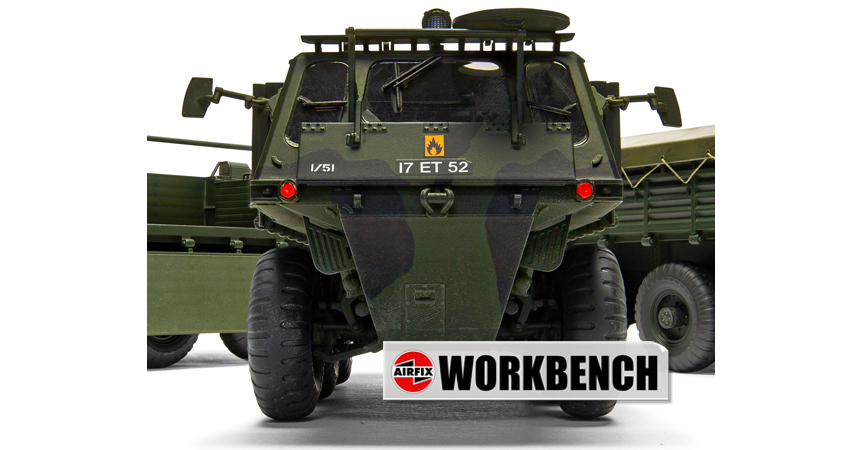
Welcome to this latest edition of our Workbench blog and all the news, updates, and modelling exclusives from the fascinating world of Airfix.
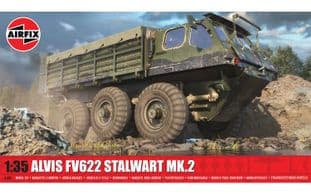
We’re delighted to be returning to the subject of new tooling additions to the current Airfix range in this latest edition of Workbench, as we prepare to welcome a highly anticipated new kit to our 1/35th scale military vehicle range, the Alvis FV622 Stalwart Mk.2. This second new 1/35th scale military vehicle subject to be tackled by the Airfix design team over recent years, if we were looking for a suitable follow-up subject to our popular Ferret Scout Car, could we have possibly chosen a more appropriate subject than the Stalwart. An unusual, but extremely capable looking vehicle, the Stalwart definitely has the appearance of a vehicle that can go anywhere and do anything, which is essentially what it did for the British Army from the mid 1960s, right through to the early 1990s. Be it by land or over water, if a military supply load needed to get through, the Stalwart was the prime mover for the job.
As we take this opportunity to introduce you to an exciting new kit which is scheduled to be joining the range in just a few week’s time, we will be including project development images, details behind the scheme/decoration options included with this initial release, in addition to showcasing a fine selection of built model images for your inspection. We know you’ve been waiting patiently for this update, so we will be having something of a ‘Stollyfest’ in this latest edition of Workbench.
It's military mobility on six wheels from the world of Airfix this Workbench weekend.
Such a futuristic looking vehicle, the Stalwart surely wouldn’t look out of place emerging from the pod carried by Thunderbird 2.
As we have just spent the past few days commemorating the logistics behind ‘Operation Dynamo’ and the evacuation of the British Expeditionary Force from the beaches of Dunkirk, we also saw the reasons behind it, and how Blitzkrieg was the main contributing factor to their plight. Well before the start of the Second World War, military planners were only too aware that any modern land war would be fought by highly mobile forces, and how both offensive combat units and their supply chains would need to be mechanised in the future.
In order to keep a modern army supplied efficiently, a huge force of reliable mechanised vehicles was going to be needed, particularly where the front lines in any combat zone were constantly moving, and how swift, decisive advances by reconnaissance units had to be quickly consolidated with troops and supplies. If not transporting weapons or troops to the front lines, support vehicles were needed to haul the vast amounts of fuel, ammunition, food and other vital commodities a modern army consumed, with this capability being crucial to the success of any military campaign. As the pace of modern warfare increased exponentially, so military supply lines started to lengthen as a consequence, with the most useful load carriers being those which could operate effectively in both on, and off road conditions.
As you may well imagine, as nations were preparing for war during the 1930s, military transport vehicles were mainly derivatives of commercial vehicles already in production, modified slightly for speed of production and military service. It's generally accepted that Britain was still significantly under-equipped when it came to numbers of military vehicles in service at the start of the Second World War, a situation which was just about to get much worse for them. Although the evacuation of almost 340,000 troops from the beaches of Dunkirk during the early summer of 1940 was a source of incredible national pride, the fact that the BEF had to leave the vast majority of their equipment behind in France was a huge setback for the nation, making an already dire mechanised logistics situation even worse.
A romp of Stalwarts. This new kit will be a fabulous addition to our in-house designed 1/35th scale Military Vehicle range.
Stalwart kits finished in all three of the scheme options available with the initial release from this appealing new kit.
If there was something of a make-do approach to military support vehicles during WWII, particularly from a British perspective, our American allies certainly brought a different approach to the same issue, with some of their impressive transport vehicles even being thought of as war winners. With this in mind, during the immediate post war years, Britain introduced an impressive range of purpose built military vehicles, ranging from tanks, specialist engineering vehicles and trucks, right through to armoured cars such as the Ferret, and six-wheeled Saladin and Saracen. These two vehicles would lead to the design of a rather distinctive new amphibious supply truck, one which is just about to join the Airfix range in scale kit form.
If you were tasked with designing a new amphibious cargo truck for the British Army, you may as well make one that’s a bit of an attention grabber. In fact, it could even be argued that when it came to the distinctive looks of the Alvis Stalwart Mk.2, this vehicle wouldn’t look out of place in an episode of Gerry Anderson’s Thunderbirds or UFO – You really could see one of these emerging from the pod underneath Thunderbird 2.
Without doubt, one of the most distinctive military vehicles to ever see British military service, the Alvis Stalwart Mk.2 was an extremely capable amphibious 6x6 cargo truck, introduced to keep Army units supplied with fuel, ammunition and general supplies during times of conflict. Initially developed as something of a private venture, the Stalwart can trace its lineage back through a series of successful 6x6 vehicles, the majority of which saw British military service, such as the Saladin armoured car and Saracen armoured personnel carrier. The Stalwart shared many components with its predecessors, but was charged with performing a very different role from them.
A computer rendered image of the new Stalwart produced from the kit’s CAD files.
Looking good from any angle, the Stalwart really was an impressive vehicle from an aesthetic perspective.
Entering service from 1966 onwards, the Stalwart certainly lived up to its name, with its impressive off-road performance giving it something of a go anywhere, fear nothing reputation. Featuring an intricate drive and suspension system, the Stalwart afforded its crew an extremely comfortable ride when operating over uneven terrain, however, even though the vehicle was capable of speeds approaching 40 mph on open roads, the handling of the Stalwart could be challenging, with each bank of wheels constantly trying to outpace those on the opposite side.
A true amphibian, the Stalwart boasted watertight seals to protect all vital components, enabling it to deliver its cargo across bodies of water not served by bridges or temporary crossings, climbing out of the water on the other side if the ground was shallow or compact enough to support its weight. In the water, the Stalwart Mk.2 featured improved waterjet power and could reach speeds of 16 km/h in optimum conditions.
To support the Stalwart's operation both in the UK and during extensive service in Europe, the driving position in the distinctive cab of the vehicle was centrally located and even though lugging cargo was the main role of the Stalwart, it could also be used to transport up to 38 fully equipped troops in the same amphibious manner. The Stalwart finally relinquished its support duties once the RAF's latest variants of heavy lift helicopters took over the vital role it had successfully performed for years.
This Stalwart CAD image is being shown here for the first time, giving us a good idea of the impressive levels of detail incorporated in this appealing new kit.
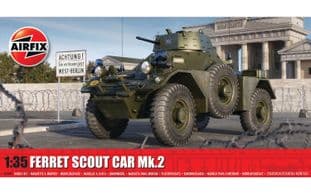
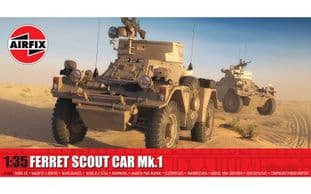
When the Airfix design team decided to start work on producing a 1/48th scale kit of the Ferret Scout Car in 2022, they knew this kind of subject would be of interest to a great many military modellers, but we could have hardly anticipated just how popular it was going to be. Following its release, and on venturing out to various events during the year of its release, we were overwhelmed with the level of support we received for the Ferret from modellers all over the country, who were not only delighted to have this exciting new kit on their workbenches, but were also keen to share their views on what other military subjects they would also like to see us cover.
We were also astonished at the number of people we subsequently met who either owned a Ferret, had served on Ferret’s, or in one rather memorable case, had been run over by a Ferret. Thankfully, this incident took place whilst the chap in question was asleep on exercise with the Army, but how he was in a ditch at the time, so didn’t feel a thing – it makes for a great Ferret story though.
Amongst the future kit subjects suggested by many of the people who complemented us on the Ferret, one name was quickly working its way to the top of that list, a post war vehicle which was as distinctive in appearance, as it was effective in operation – the Stalwart. Although clearly not in a position to either confirm nor deny anything at that stage, this did come as music to our ears, as the project had already been allocated to a member of the design team, and the CAD files had already been opened.
From the perspective of our Researcher, arranging to scan vehicles and aircraft in support of future new tooling projects can be somewhat problematic, particularly if this is done at a museum, and particularly if it’s on a normal opening day. Because of a certain TV programme, not to mention the popularity of our own social media channels, our team members have become familiar to a great many people over the past few years, and if they’re spotted with a LIDAR scanner in front of any subject these days, that particular new tooling cat may already be out of the bag.
More Stalwart CAD goodness, this screenshot shows how the complex drivetrain and torsion bar suspension arrangement of the vehicle has been replicated on the kit.
Those who have spent time in the cab of a Stalwart will appreciate how much detail the new kit boasts in this area.
The way to combat this issue is simply to have a scanning splurge, spending a few days at different venues scanning as many potential subjects as possible, thus throwing anyone who might spot the team at work off the scent somewhat. Sure, many of the subjects being scanned may support future new tooling projects in the fullness of time, but what order will they be released in, and a couple of potential red herrings thrown in there for good measure, should provide us with the subject confidentiality we need. We know you all like nothing more than a surprise Airfix new tooling announcement, so we have to protect that, don’t we.
With regard to the Stalwart project, the design lead on this project did have the benefit of scan data within his project brief files, which is just as well when looking at the details of this incredible looking machine. Although we will not be looking at the actual design details in this feature, purely because we have so many images to include due to the advanced status of this project, we will be sharing several CAD screenshots from the Stalwart files, just to add some interest and context. We are grateful to the design team for supplying us with these fascinating images.
As the Stalwart project is now at such an advanced stage that we are expecting it to arrive in our warehouse in the next couple of weeks, we’re going to jump straight into the scheme options on offer with this first release here, just by way of increasing those pre-release excitement levels a little further.
As one of the most impressive looking military vehicles to see service with the British Army during the Cold War years, the Stalwart earned a reputation for rugged effectiveness, however, as with all vehicles and AFVs in service at any one time, the important question needing to be answered was how would they perform in times of conflict, and under operational conditions. Despite the fact that our military forces train constantly to make sure they’re ready to answer the call as and when that might come, there’s nothing like planning a major international exercise to test the effectiveness of your forces, one which is specifically intended to simulate actual combat operations.
That was the thinking behind the significant Cold War Exercise Spearpoint 80, an operation which had been two years in the planning, and one which was intended to test NATO’s preparedness to meet and repel a military threat from the East. The largest British exercise of its kind to be held on German soil since the establishment of NATO, Spearpoint 80 also involved troops and equipment from other NATO nations, and was designed to simulate wartime conditions, where they were essentially looking to discover weak points, challenging not only front-line units in effectively meeting this simulated challenge, but also testing their supply lines and support network, going right back to the British mainland.
Built model images finished in this scheme of a Stalwart which was one of many taking part in Exercise Spearpoint 80.
Spearpoint 80 was essentially a massive wargame, simulating how an armoured engagement would be fought in that modern era (back then), not only to test the readiness of NATO forces, but also to assess where improvements in both infrastructure and training would need to be made. Clearly, NATO would have wanted to give a good account of themselves, not least because they knew the exercise would be played out under the full gaze of the Warsaw Pact nations, and in addition to testing their attack response plan, also knew that it would be serving as a considerable show of strength, and therefore an effective deterrent.
The operation took place between 11th and 26th of September 1980 in an area south of Hannover, which was flooded with troops, vehicles and equipment for the duration, and whilst this was far enough away from perceived Cold War front lines, it was close enough to operational conditions to allow military planners to fine tune their battle plans in preparation of any actual attack.
British Army Stalwarts would have been heavily involved in these exercises, following behind tracked vehicles in a supply and support capacity, with their excellent off-road performance allowing them to go everywhere where a tank could go. Able to transport 5 tons of cargo, they could transport anything from general supplies to shells and ammunition, but all with a view to keeping the Army on the move and fighting. Seeing so many impressive military vehicles operation in their area, Spearpoint 80 must have been a memorable occasion for the people of Hannover.
Described as a truck high mobility load carrier, the Stalwart may not have been armoured, but it was designed to provide effective logistical support and to do it well. To this end, the vehicle was powered by a Rolls Royce straight 8 cylinder, 6.5 litre 240 hp engine which could speed the vehicle along to an impressive 40 mph on roads, and not much slower than this off road. It was capable of carrying a load of around 5 tons, or towing double that amount, however, this impressive vehicle had another trick up its sleeve – it was amphibious.
A feature which gave the Stalwart its go anywhere, do anything reputation, was the fact that not only could it ford water hazards, but it could also float, equipped with a vectored thrust water jet propulsion system which gave it a water speed of between 6 and 9 knots, depending on the load and condition of the drive unit. The amphibious attributes of the Stalwart were partly responsible for giving the vehicle its science fiction design appearance, with the cab having no doors and needing to be accessed through two watertight ports in its roof.
Entry was gained by standing on the front wheel and pulling yourself up via the installed metal grab rails on the outside of the cab structure, which also acted as foot rails, and once on the roof, you had to lower yourself down through one of two watertight circular hatches. Interestingly, the driver’s position was located centrally in the cab, a clever feature which allowed the Stalwart to be driven easily on both British and European roads, therefore doing away with the need to have different vehicles for use in different countries, or endowing each vehicle with the mechanics to be modified for left and right hand driving, as and when required.
Lowering yourself into the cab would see you having to stand on either the right or left hand passenger seat, however, as these vehicles were often in use in off-road conditions, the boots of crews could be in all sorts of conditions, and you certainly wouldn’t want all that muck going on the seat you were about to use. To overcome this, the two passenger seats had backs which folded down when they were not in use, with the back of the folded section having a rugged textured metal finish, to prevent slipping and allowing dirt to fall off when the backrest was raised.
In normal operating conditions, the cab would be occupied by the driver and a single passenger, however, the third seat was there for occasions when it was needed. The vehicle benefitted from extensive rubber sealing, ensuring that everything that needed to stay dry did so, as the amphibious qualities of the Stalwart were intended to enhance its effectiveness, and not to see it having to undergo extensive maintenance following any watery incursion. In order to support amphibious operations, the vehicle’s exhaust was mounted high on the rear of the Stalwart, and always above any normal operating waterline. Although looking a little cumbersome when getting into the water, the Stalwart looked right at home once its wheels were no longer visible, although clearly the weight of load would be a major consideration for amphibious operations.
Due to its waterborne credentials, the Stalwart would see plenty of service with British Army units in Germany, where the resupply of forward units wouldn’t have to rely on bridges or the Royal Engineers in times of conflict.
Another feature of the Stalwart which gave it something of a futuristic appearance was its six mighty 20 inch road wheels, which used an innovative central inflation system, and gave the vehicle a similarly impressive off-road performance of a tracked design. The Stalwart employed a 6 X 6 drive system and used torsion bars and lots of shock absorbers on the wheels. Steering was achieved by the front and middle wheels turning at the same time, with the middle units turning to a lesser degree than those in front, but generally endowing the Stalwart with excellent manoeuvrability.
The Stalwart’s impressive off-road capabilities came as a result of the 6 wheel drive system lacking differentials, simply using a system of bevel gears to transmit the drive power. There was no allowance in the system for differences in wheel rotation speeds, so in certain muddy conditions, the vehicle could move with something of a crabbing motion, moving from side to side, however, whilst this may have looked a little odd, did make the Stalwart an excellent off-road performer.
When used on standard roads, this system did have an inherent deficiency, because with the wheels all designed to turn at exactly the same speed, the flat surface would not allow for the natural slippage a Stalwart would get on a muddy, undulating field, resulting in a transmission ‘wind up’ in the system. If unchecked, this could lead to breakage and extensive periods of maintenance, however in the field, crews devised an ingenious method of utilising railway sleepers laid on flat ground in a grid pattern, driving over them and allowing the transmission to unwind itself.
There are also pictures showing Stalwarts with their rear wheels hanging over a ledge for the same purpose, or utilising the curbs in a car park when in dire transmission straits. Unusually, another unforeseen drivetrain issue was the fact that the system was designed for the Stalwart to be driven when loaded, so if it was driven for extended periods without a significant load, it could result in excessive wear on the driveline mesh joints themselves – oh the joys of operating a modern military vehicle.
An extremely capable vehicle, however, crews needed to know how to handle this beast.
The British military vehicle depot at Ludgershall on the edge of Salisbury Plain can trace its linage back to the Second World War and the build-up of Allied vehicles for the invasion of Europe. A large number of warehouses and secure buildings were erected at the site, where hundreds of military vehicles could be stored, maintained and prepared for service delivery, along with external storage areas which made this a major supply facility for the Army. Everything from heavy armour, Stalwarts and Land Rovers could be seen at the Ludgershall depot at most times during its operation, with a rail head only increasing its importance in this role.
Closed as an armoured vehicle depot in 1997, many of its buildings and facilities remain to this day.
It goes without saying that an army is only as good as its supply logistics and during much of the Cold War era, the Alvis FV620 Stalwart Mk.2 was designed to provide this service effectively for the British Army. As we have seen, it was probably better if other vehicles brought those supplies to the edge of any potential zone of operation, but once handed over to the Stalwart, there were few vehicles that could match its qualities in taking these supplies where they were needed most, often in battlefield conditions, and often at speed. Able to keep up with advancing armour over even the most demanding of terrane, The Stalwart was even at home on the water, meaning there were few obstacles that could prevent it from doing its important job.
Over recent years, the Stalwart has become a favourite with military vehicle collectors looking to own and restore a machine of real character, and as the Stalwart has both the looks and operational credentials, it’s no wonder they have become popular. Incredibly impressive to look at and more fun that anyone should be allowed to have when driving one off-road, the Stalwart does need careful handling and can be maintenance heavy if that drivetrain is mistreated, however, we suspect that anyone with one of these beasts lurking in their garage will be fully aware of its needs.
As was the case following the release of the Ferret Scout Car Mk2 kit, we are very much looking forward to speaking with people who have a personal connection with the Stalwart, be that from an ownership perspective, or having worked with, or on one during their military service. We’re expecting to be put straight on a few Stalwart facts, and look forward to being educated on the finer points of this most interesting of military vehicles.
This stunning new addition to our 1/35th scale Military Vehicle range is now just a couple of weeks away from release.
We are afraid that's all we have for you in this latest edition, but we will be back next Friday with more project development updates and the very latest Airfix kit exclusives. In the meantime, we are always keen to hear your views on all things Airfix and in particular, any thoughts and opinions you may have regarding our Workbench blog. If you would like to drop us a quick line, could we please ask that you use our workbench@airfix.com email for all correspondence.
To re-visit any of the Airfix blogs we have produced over the past seven years or so, please head to our main Workbench hub, where you will find our entire blog back catalogue and all the Airfix design projects we have already covered.
All our dedicated official social media sites can be accessed by clicking the respective link icons at the foot of this page, or by heading to the Airfix homepage. Other useful Airfix links are:
Facebook, YouTube, Twitter and Instagram official sites
Please join us for more Airfix updates next week and thank you for your continued support.