


Welcome to this latest edition of our Workbench blog and all the news, updates and modelling exclusives from the fascinating world of Airfix.
Well, what a year this is turning out to be for Airfix fans. Coming hot on the heels of our mid-range Supermarine Seafire announcement earlier this month, we decided to take things to another level altogether on Tuesday past, with the unexpected unveiling of a spectacular new tooling project, one which few people were expecting, if the social media chatter in the lead up to the announcement is anything to go by. In a coordinated release across the various Airfix channels and those of a specially invited group of magazine editors and modelling influencers, our friends at Historic Helicopters helped us to achieve something quite special, announcing the arrival of this spectacular new Westland Sea King kit by having one arrive in an airworthy Sea King! As you can imagine, this proved to be a memorable occasion for everyone here at Airfix and for those who weren't able to catch the launch notification video, we will be including it as part of this latest update.
It will therefore come as no surprise to Workbench regulars that this latest update will exclusively serving as a new Westland Sea King kit project introduction, and as this is already rather a mature project, we will be including the stunning new box artwork and a review of the four scheme options which will be included in the inaugural release of this new kit. We will also see why this model is such a significant addition to the Airfix range and why the Sea King not only occupies a position as one of the most successful helicopters in the history of flight, but is also arguably amongst the most important aircraft types of the post war era.
Undoubtedly, our new Sea King project will have come as a huge surprise to many Workbench readers, but hopefully a very pleasant one for most, so let's introduce you to this latest addition to the 2023 Airfix range.
A rather pleasant surprise for modellers, not only did we announce our newly tooled 1/48th scale Westland Sea King kit this week, but it's actually due for release in the next few weeks, so we can already start planning our builds of this this little stunner.
Although the history of helicopter manufacturing here in Britain is synonymous with the name Westland, when looking at the history of an aircraft which occupies such a prominent position as the mighty Sea King, it really is quite important to explain the full story of the helicopter's design and heritage. In the years which followed the end of the Second World War, the astonishing rate of technological development in aviation resulted in the production of aircraft which were faster, larger and more capable than anything which had flown before them, however, despite this high profile race for ever more speed and greater destructive capability, one area of aviation development began to ascend above others, by virtue of the versatility and operational flexibility it offered, the helicopter. As rotary aircraft technology started to become more reliable and the heavy piston engines originally used started to give way to a new generation of lighter, more powerful turboshaft powerplants, the incredible potential of the helicopter started to become a reality, with the latest machines now capable of performing tasks which simply could not be carried out by other types of aircraft. With a multitude of military and civilian applications awaiting their attention, the age of the helicopter had arrived.
At the very forefront of world helicopter design and development in the post war era, the US Sikorsky Company were awarded an important contract to produce an all-weather, amphibious helicopter for the United States Navy in 1957. Its primary mission profile would be that of an anti-submarine warfare aircraft, protecting the US fleet from possible attack, however, the aircraft would prove adaptable enough to take on a multitude of secondary roles, going on to become one of the truly great aircraft of the 20th Century. The aircraft, which was given the designation SH-3 Sea King, was produced with an amphibious hull, giving it the capability to land on water, in addition to its more usual environment on the decks of numerous US Navy warships. Powered by a twin turboshaft engine arrangement, the Sea King was an impressive machine, capable of carrying significant loads of men, equipment, or general supplies, providing the US Navy with a truly revolutionary new aircraft. On entering service in 1961, the Sea King was the most advanced aircraft of its type in the world and presented the US Navy with one of the most flexible aviation platforms available at that time.
Keen to maximise the commercial success of their impressive new helicopter, Sikorski went on to develop a civilian derivative of the SH-3 Sea King, a helicopter which carried the designation S-61 and an aircraft which was immediately of interest to many of the world's naval air arms. At around this time, the Royal Navy had become concerned about the growing threat posed by the ever expanding Soviet submarine force and were looking to equip their ships with a powerful helicopter capable of detecting and destroying this underwater menace. Looking for an aircraft to initially work alongside, then ultimately to replace their Wessex fleet, a decision was taken to request Sea Kings in the mid 1960s, but Anglicised variants of the original aircraft.
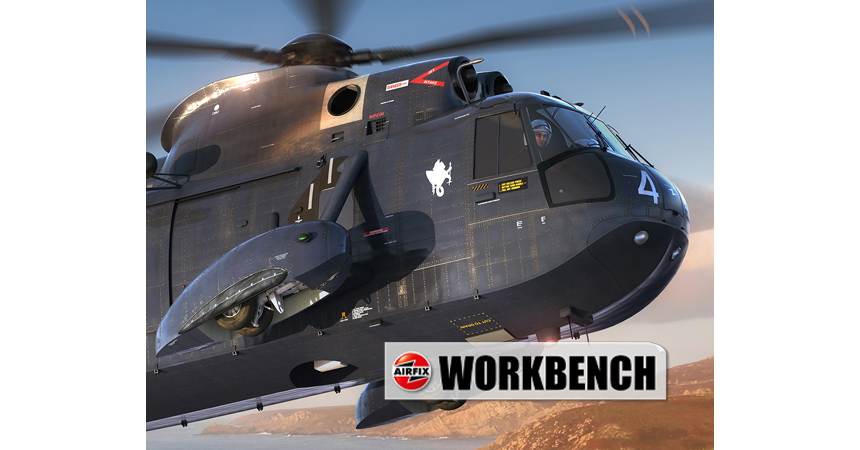
Designed to incorporate impressive levels of detail, the new 1/48th scale Westland Sea King kit is a faithful representation of this magnificent aircraft and in this larger scale, will make for an impressive display piece. This image features a computer rendered representation of the new model's CAD files and was taken from the presentation slides used by Chris and Luke at the launch event on Tuesday.
In Britain, a robust existing licence agreement between Sikorski and Westland had already seen large numbers of S-51 Dragonfly, S-55 Whirlwind and S-58 Wessex helicopters manufactured for the UK military and this agreement was extended to include the S-61 Sea King. The benefit of waiting five years following the aircraft's US Navy introduction was that the Sea King, which had already undergone extensive trials and almost constant in-service evaluation, was now an extremely mature helicopter and they were not only assured of its capabilities, but also the fact that it was capable of taking on many more roles than those it was initially intended to do. Placing an order for sixty aircraft in June 1966, at that time, this represented the largest order ever placed with a British company for helicopters.
As previously mentioned, the licence agreement between Sikorski and Westland allowed the Yeovil based company to make changes to the original design of the aircraft, in order to effectively integrate the Sea King into British military service. Whilst the external appearance of the British built Sea Kings may have resembled those of their cousins across the Atlantic, internally, these were very different machines. Perhaps the most significant difference came with the selection of a new powerplant, with a pair of Rolls Royce Gnome turboshaft engines replacing the General Electric T58-GE-10 turboshafts used on US machines, however, Westlands would also develop the design to incorporate technologies and systems tailored towards British (Royal Navy) requirements, including the latest electronic innovations from leading British aerospace companies.
Once in Royal Navy service, whilst British and American Sea Kings were both initially required to perform the vital anti-submarine warfare role, they would actually be operated in very different ways. US Navy Sea King operations were integrated under the tactical control of the aircraft carrier on which they were based, with these vessels typically being much larger and arguably much better equipped than their British counterparts. In contrast to this, British machines operated very differently and were required to be much more autonomous – Royal Navy Sea King crews often operated alone and were required to coordinate search and attack missions with other aircraft and surface vessels as and when required. The crew arrangement on British machines also differed slightly, in that the observer on board a Royal Navy Sea King would perform the role of sortie controller, as opposed to the aircraft's pilot, as was typical on US Navy aircraft.
Another of the slides used in Tuesday's launch presentation, this render shows how the new model can be built in carrier stowage configuration, a feature which highlights the naval heritage of this magnificent helicopter.
The hugely capable Westland Sea King was selected by the Royal Navy to meet their requirement for an anti-submarine warfare helicopter, replacing the venerable Westland Wessex in this role, but with the Wessex continuing to serve with distinction alongside the Sea King in other roles. The first Westland built Sea King flew from their factory facility at Yeovil on 7th May 1969, with the first Royal Navy machines being delivered to No.700 Naval Air Squadron (Operational Evaluation Unit) at Royal Naval Air Station Yeovilton later that same year. In Royal Navy service, these first Sea Kings were designated Sea King HAS.1.
As the Sea King became established in Royal Naval service, it quickly showed itself to be both operationally capable and highly adaptable, a significant upgrade on previous rotary capabilities. As a result of its incredible versatility, the Sea King was destined for a long and illustrious service career, whilst at the same time earning an enviable reputation for both serviceability and reliability. Capable of operating from ship or shore stations, by both day and night and in all weather conditions, the Sea King quickly became the helicopter against which all others would be judged, a truly magnificent aircraft. From its initial anti-submarine role, the Sea King would also go on to serve in Search & Rescue, anti-surface shipping attack, airborne early warning, communications, surveillance, logistic re-supply, troop transport, medivac and special forces roles, underlining its credentials as one of the most successful aircraft of the 20th century and beyond.
During a 49 year career with the British military, could this magnificent aircraft have been given a more appropriate name, as it most definitely became the King of the Sea in aviation terms.
When briefing the artwork for this new model, researcher Luke was certain that he wanted to depict XV666 in her iconic first operational livery and flying over the coast of southern Britain, just as she would have done during her service years. We have to say, it does look rather stunning.
As you might well imagine, it’s been quite a week for us all here at Airfix. As far as unexpected mid-year Airfix new tooling announcements go, this was quite a biggie and has caught everyone a little off guard, but hopefully in a good way. Obviously, for anyone who would describe themselves as a Workbench regular and certainly those having watched our announcement video posted on Tuesday, you will know that for a project to be this far advanced at this stage, our team have been working on it for many months now and we are glad that we can finally start talking about this impressive new model. So many people have mentioned to us how much they would like to see a Sea King in 1/48th scale over the past few months, that it's been hard not to give the game away and when attending outside events throughout the year, team members regularly ask other colleagues if we gave any body language clues, in the immediate aftermath of fielding the latest round of enthusiast new tooling questioning.
Watching the launch video will not only highlight how an airworthy Sea King proved instrumental in the announcement of our new kit, but how the aircraft has particular significance in the career of designer Chris Joy, a man who is well known to Workbench readers as a result of his extensive Airfix kit designing prowess. Chris was responsible for designing the 1/72nd scale newly tooled Sea King back in 2015 and returning to the subject in this larger, more detail rich scale has been a real pleasure for him, despite presenting him with some significant challenges along the way. We have learned the hard way when producing these Workbench updates about dismissing the upscaling of previously designed kit projects as a simplified design task and when it comes to the mighty Sea King, this was most certainly a sizeable new challenge for Chris and one which could take little from his original Sea King endeavours.
Two more of the slides used during the launch presentation of the new Sea King kit down at Historic Helicopters, firstly showing two LIDAR scan data files of preserved Sea Kings, followed by an interesting comparison of the two Airfix Sea King design projects, eight years apart.
We will be talking to Chis in some detail about his latest Sea King undertaking and highlighting some of the challenges he faced in a forthcoming edition of Workbench, but for now and not wanting to take the spotlight away from the announcement of the new kit itself, let's move on to the subject of artwork and scheme options.
When watching the launch video posted below, it soon becomes clear that our researcher Luke also had a huge part to play in the project to bring this magnificent new kit to the Airfix range and how, even though he wouldn't say so himself, he has become something of a Sea King expert along the way. For an aircraft which enjoyed such a long and successful service career, the Sea King underwent almost constant modification to provide it with ever greater capabilities over the years and he had to become well versed in all these modifications and feature additions, so he could provide concise guidance information to Chris throughout the design phase.
As Luke has also taken on the mantle as our LIDAR scanning guru, he spent as much time scanning the internals of various Sea Kings as he did outside them, with the result being an incredibly detailed kit both inside and out, even replicating variants of the aircraft whilst it was in the process of being upgraded. For both Luke and Chris, the Sea King has been a labour of love and we know they are extremely proud of what they have achieved.
In a first for us here at Airfix and particularly for an aircraft which enjoyed such a long and successful service career, Luke researched four very different British Sea King liveries for inclusion with the initial release from this newly tooled kit, but all sharing one significant feature - they were all worn by the same aircraft at various stages throughout its 52 year career. Westland Sea King XV666 is quite the aviation celebrity and is usually referred to as 'Damien' by virtue of its serial number and the evil connotations this conjures up. Thankfully, superstition never held this particular Sea King back and she remains in service to this day, even though she was amongst the first HAS.1 airframes to enter service with the Royal Navy back in 1970. Luke researched four schemes from across the service life of this incredible aircraft and if modellers select their projects by virtue of an interesting story attached to them, then Luke has made our decision a very easy one when it comes to the new Sea King.
Let's take a look at closer look at each of the four scheme options now:
Sea King XV666 was built as part of the first Royal Navy order for 56 HAS.1 helicopters by Westland Helicopters at Yeovil in 1970, making her first flight on 23rd June that year. Early the following month, she was delivered to the Royal Navy at RNAS Culdrose and initially allocated to No.826 Naval Air Squadron and given the codes E.144. Although assigned to HMS Eagle, one of her earliest taskings was to represent the future of the Fleet Air Arm at that year's Farnborough Airshow, where she arrived resplendent in her distinctive overall navy blue scheme to the delight of the gathered masses, an example of one of the most advanced aircraft of her kind to be found anywhere in the world.
In HAS.1 configuration, the Sea King was a submarine hunter/killer first and foremost, with the capability to perform any number of less offensive, yet still important duties as and when required. The spacious cabin of the Sea King provided plenty of room for equipment installation and allowed crew members to stand up when moving around in this section of the aircraft, with all this additional space surely making this quite a pleasant environment to work from. The Sea King featured an array of advanced features which had been perfected for use on helicopters over the years, including a sophisticated auto hover system, which proved invaluable both when attempting to detect submarines and whilst performing the Search and Rescue role.
Other automated systems fitted to the aircraft made the task of operating this aircraft in the demanding environments it was required to work in, much less onerous for its crew and with its increased operating range, combined with the reassurance of twin-engine serviceability and built in systems redundancy, the Sea King quickly became a favourite with those selected to serve aboard them. Significantly, the Sea King presented the Royal Navy with an exceptional aircraft which possessed the ability to operate over greater distances than ever before, with longer on station capability and the ability to operate in all weather conditions by both day and night. The Sea King had already started to build its impressive reputation.
Full scheme details of 'Damien' in its original 1970s ASW livery, the start of a long and impressive service career.
This scheme was also selected for the box artwork, which will soon be gracing the shelves of model stores everywhere.
In the anti-submarine role, a typical crewing would consist of the pilot, who would captain the aircraft, and co-pilot who would actually fly the aircraft. These would be joined by a sonar operator and anti-submarine control officer, with the latter having the responsibility of taking control of the aircraft when involved in a search and attack scenario. Using a combination of its powerful sonar and navigation equipment, the Sea King could detect an enemy submarine, whilst at the same time coordinate operations with other friendly aircraft and surface vessels in the vicinity and should an attack be authorised, it was more than capable of dealing with the detected threat. The HAS.1 could be equipped with four Mk.44 homing torpedoes, or four Mk.II depth charges, but if the situation demanded, could also deliver a nuclear depth bomb. It provided the Royal Navy with a truly autonomous anti-submarine detect and destroy capability.
In addition to operating from RNAS Culdrose, which at that time was the largest and busiest helicopter base in Europe, XV666 'Damien' operated from the decks of both HMS Tiger and HMS Eagle and would go on to have a long and illustrious career.
With the Sea King proving to be such a robust and reliable aircraft, many individual airframes would go on to enjoy long service careers and as a consequence, would benefit from both the installation of new equipment and indeed undergoing full type upgrade over the years. XV666 had been upgraded to HAS.2 standard in November 1978 and subsequently on to HAS.2A configuration, but by 1986, it was time for upgrade once more, this time to HAS.5 standard.
With the Sea King now having been in service for many years, the Royal Navy had become expert in the effective detection of submarines, but were also only too aware of the limitations of the current system. To this end, No.814 NAS had been conducting trials with the Jezebel passive sonobuoy system, which rather than emitting 'ping' sounds into the water and detecting the echo, just waiting in the water listening for sound waves. Once a sound is detected by the hydrophone, it's relayed to its receiving aircraft, which can then begin to plot the emitting target on its sophisticated data screens.
These trials clearly showed the benefit of utilising a combination of active sonar and passive sonobuoys in a detection scenario, as this allowed for both better area coverage and more accurate target location. Results convinced the Navy to proceed with the next upgrade of the Sea King platform, this time to HAS.5 standard, but rather than simply equipping these aircraft with the Jezebel system, this would be a major upgrade to the overall capabilities of the aircraft. In addition to increasing the Sea King's detection capabilities, the HAS.5 also included upgrades to many of its electronic systems and in particular, the ability to process all this additional information much more efficiently.
The rear cabin was modified to include the launch tubes and storage racks for the Jezebel passive sonobuoy system, however, the most identifiable visual indicator confirming this variant over its predecessors was the much larger dorsal radome which was needed to house the more powerful version of the Sea Search radar equipment. This variant of the Sea King also featured a Magnetic Anomaly Detector system, which was housed in the starboard undercarriage sponson.
Full scheme details of this upgraded, even more capable submarine hunting variant of the Westland Sea King.
Westland Helicopters went on to produce 30 new build Sea Kings of this variant, with an additional 35 existing HAS.2A and HAS.2 variant aircraft being upgraded to the new standard. This upgrade work to existing Sea Kings was actually carried out at the Royal Naval Air Yards at Fleetlands and Culdrose.
As can be seen in the research notes attached to this option, Luke had to base his research information on clear photographic evidence in many cases, which sometimes does leave a few detail questions unanswered. Some details of an individual aircraft, usually around the internal fit of the aircraft, can be extremely difficult, if not impossible to corroborate, but is clearly of interest to a modeller intending to replicate that aircraft in scale. In such situations, Luke had to include his research judgement to provide the modeller with as much information as possible, leaving the final decision on interpretation to them, but having provided the most likely detail information following his exhaustive investigations.
His research notes for this option are as follows:
XV666 was pictured at RNAS Portland circa 1988, prior to conversion to HU.5. It displays a mix of features which hint to her being an HU.5, including the 'SAR step', however, she is missing the external winch unit. We have shown XV666 with this combination of external features as seen on the photograph, but internally, the build matches that of an HAS.5 rather than an HU.5. Use the internal build order for any HAS.5 performing the ASW role.
In 1994, XV666 underwent upgrade once more, this time to HU.5 standard, arguably the variant of Sea King which became most closely associated with the general public and consequently, going on to become one of the most popular British military aircraft types of the post war era.
With the withdrawal of the Royal Navy's Westland Wessex helicopters in the Search and Rescue role, a potential gap in maintaining this vital service was prevented by converting Sea King HAS.5 airframes not selected for conversion to the ASW HAS.6 standard for use in this role. This conversion consisted of removing all anti-submarine detection and attack equipment, as this would be nothing more than unwanted additional weight, with the cabin reverting to more of a troop carrying configuration, whilst at the same time retaining the powerful Sea Search radar.
This work was not carried out by Westlands, but rather by the talented engineers and technicians at the maintenance facilities at RNAS Culdrose and whilst this unusual, yet ultimately extremely famous variant was initially referred to by several different, but slightly linked conversion designations, the Navy eventually allocated the type designation HU.5, although historically, many publications refer to the aircraft as HU.5SAR by virtue of the important role they were required to perform.
Most of the Navy's Search and Rescue Sea Kings were operated by No.771 Naval Air Squadron and in this striking livery, combined with their distinctive 'Ace of Clubs' markings, these aircraft would become some of the most famous aircraft to ever see Fleet Air Arm service.
Although Westland Helicopters would eventually produce over 340 Sea Kings, a relatively small number of these aircraft would go on to become some of the highest profile aircraft to ever serve with Britain’s armed forces. The robust and stable design of the Sea King made it an ideal platform from which to perform the specialist airborne search and rescue role, not only supporting military operations, but also around Britain's extensive coastline and mountainous regions. Designated HU.5 in Royal Navy service and HAR.3 for the Royal Air Force, search and rescue Sea Kings were fitted with highly advanced search and navigation equipment and were capable of operating in this demanding role in all weather and by day or night, utilising the automated systems which had already made the Sea King such a successful aircraft.
'King of the Sea' and 'Angel on our shoulders', the Westland Sea King would become one of the best-loved British aircraft of the post war era, by virtue of its high profile service as a Search and Rescue helicopter.
Specialist crews became expert in this role and were often called upon to operate their aircraft in the worst of conditions, by both day and night, coming to the assistance of people in their hour of greatest need and earning a reputation as 'Angels on our shoulders'. Because the Sea King was seen as an airborne saviour in this role, they were loved by everyone, as news reports of the latest daring rescue gave the entire nation a genuine affection for this magnificent aircraft and the fearless airmen who operated them.
With a crew of four, the Sea King was capable of carrying up to six stretchers, or 18 casualties in its cavernous cabin. Equipped with a powerful hydraulic winch which boasted 75 metres of steel cable, this unit could safely deliver the winchman to most rescue situations, with the winchman themselves being qualified to paramedic standard and able to administer first aid either in situ, or later, having removed the casualty. The winch was powerful enough to lift three people simultaneously, with one being the winchman in almost every case, to enable the safe transfer of winched casualties to the cabin of the aircraft and once inside, further medical assistance could be given, as the aircraft prepared to transfer the casualty to either a waiting ambulance or direct to hospital.
Maintaining a 24 hr Search and Rescue service covering the entire UK mainland and surrounding coastal areas, a total of twelve helicopter rescue units were strategically positioned at bases around the country to maximise their response times to any potential emergency situation. Made up of Royal Navy, Royal Air Force and Coastguard helicopter units, crews were required be airborne at short notice in the event of a rescue scramble and even though they would often be heading towards extremely hazardous situations for themselves, gave little regard to their own safety until any casualties were safely on board their aircraft. Whether it was the crew of a ship adrift in stormy seas, or an injured climber on one of Britain’s mountains, a search and rescue Sea King was usually the most effective way in which to attempt a timely rescue, however, should this not prove possible, the aircraft would invariably remain on station to assist in coordinating the rescue attempt.
When people were in the most perilous of situations, it was usually a Sea King which came to their assistance and as such, everyone came to love this aircraft, even though they clearly hoped they would never be in the position to be need its services. Whenever a SAR Sea King flew over a gathering of people, the crew knew that everyone would be waving at them in a show of appreciation for them and their magnificent aircraft.
Scheme D - Westland Sea King HU.5 XV666, Heli-Operations, Portland, Dorset, England 2022.
When the hangar doors at the Westland Helicopter facility at Yeovil opened to allow newly built Sea King HAS.1 XV666 to emerge into natural light for the first time in June 1970, surely nobody witnessing the occasion would have expected this aircraft to still be flying some 53 years later, but that is exactly what this magnificent helicopter has managed to achieve. One of the first British Sea Kings to enter Fleet Air Arm service, 'Damien', as the aircraft would be referred to, would have a long and distinguished service career, initially in an anti-submarine warfare role, but later and most significantly in a search and rescue/utility helicopter role, a fine example of the incredible versatility and reliability of this incredible aircraft.
She would make her final flight in Royal Navy service on 16th March 2016, when she left her home at RNAS Culdrose to fly across the southern coast of Britain to HMS Sultan at Gosport for storage and something of an uncertain future. Her subsequent decommissioning would result in a period of storage, but not for as long as many people would have expected - this particular Sea King simply didn't want to retire.
With half a century of service to her name (even though she is referred to as Damien), this magnificent aircraft is determined to ensure the Sea King continues to be viewed as one of the most successful Helicopter types ever to take to the skies.
Just twelve months after being forced into retirement, negotiations between the MoD and the HeliOperations company resulted in XV666 being leased to this experienced helicopter operator, to allow them to provide ongoing training support for German Navy Sea King crews, the continuation of a longstanding training arrangement between Britain and Germany. Operating from their base at the former Naval Air Station at Portland in Dorset, HeliOps not only provides training for the Marineflieger, but also offers its specialist services to other organisations connected with helicopter search and rescue operations.
In addition to providing a range of back office and compliance support solutions in this specialist area, HeliOps also offer training and currency support for pilots, winch operators, and other SAR crew members, or those hoping to become one and other than our friends down at Historic Helicopters, are now the last operators of the Westland Sea King in Britain.
The HeliOperations team provided invaluable support to Luke and the Airfix team throughout the research and design phases of this project and we would like to formally thank them for their help once again. We're certain that they are just as excited about this week's unexpected launch announcement as we are and expect a couple of built 'Damiens' to be on display at their facility in the near future.
Inbound to a model store near you, our magnificent new 1/48th scale Westland Sea King kit might have only been announced this week, but is scheduled for a summer release - it's nearly Sea King time!
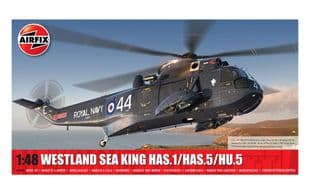
With all four scheme options presenting the same magnificent aircraft at various stages of its impressive working life, this really is a fascinating aviation story to tell and certainly leaves us all with a real appreciation of the Sea King's legacy and that of 'Damien' in particular. The only problem we have now is to decide which of the scheme options to finish our models in, however, we can't procrastinate for long, as our new A11006 Westland Sea King HAS.1/HAS.5/HU.5 kit is scheduled for release this summer.
In a forthcoming edition of Workbench, we will be spending some time with the Sea King's designer Chris, to gain a little more insight into his work in creating this beautiful new kit and in particular, how he and the industry have developed in the eight years between the two Airfix Sea King design projects he produced. We are really looking forward to bringing you that feature, but until then, we hope our Sea King surprise was a pleasant one for you.
We are afraid that's all we have for you in this latest edition, but we will be back next Friday with more project development updates and the very latest Airfix kit exclusives. In the meantime, we are always keen to hear your views on all things Airfix and in particular, any thoughts and opinions you may have regarding our Workbench blog. If you would like to drop us a quick line, could we please ask that you use our workbench@airfix.com email for all correspondence.
To re-visit any of the Airfix blogs we have produced over the past seven years or so, please head to our main Workbench hub, where you will find our entire blog back catalogue and all the Airfix design projects we have already covered.
All our dedicated official social media sites can be accessed by clicking the respective link icons at the foot of this page, or by heading to the Airfix homepage. Other useful Airfix links are:
Facebook, YouTube, Twitter and Instagram official sites
Please join us for more Airfix updates next week and thank you for your continued support.