


Welcome to this latest edition of our Workbench blog and all the news, updates, and modelling exclusives from the fascinating world of Airfix.
As we head into winter this weekend, we find ourselves firmly in modelling season and as such, wanted to commemorate the occasion in some style. In the world of Airfix, if you want to go BIG, you’re definitely talking ‘Superkit’, but for the purposes of this latest update, we’re not talking one Superkit, but two! To help us all cope with the impending trauma of dark nights, we are pleased to announce our latest double blog weekend, with each update featuring examples of our iconic 1/24th scale Superkits.
Serving as something of an Airfix Superkit extravaganza, in this second blog posting of the week, we will be paying a second Workbench visit to the currently available 1/24th scale Junkers Ju-87B kit, a model which is unquestionably one of the most spectacular kits our hobby has to offer. Although we have featured this kit once before, this was many months ago and as we are now in possession of an impressive selection of built model imagery featuring both scheme options included with the kit, we knew you would all be wanting to get eyes on those. Always worthy of a little blog re-visit, we will be replacing the majority of images included in the original post with this latest exclusive selection of pictures and as the kit is now very much on borrowed time regarding its availability, this seems to be more than appropriate.
In the second, separately posted edition, we will be marking the impending release of another rather large addition to the ever-popular Vintage Classics range, with the return of a kit which has to be described as iconic in the world of modelling, our 1/24th scale North American P-51D Mustang. Excited to be welcoming this kit back into the range, we will be including an always welcome look at original Roy Cross box artwork, in addition to the new Vintage Classics representation of it, before moving on to feature both of the appealing scheme options on offer with this kit.
Our mission this week is to help readers offset the trauma of impending dark nights with a double blog posting that will have us all basking in the sunlight of Superkit delights.
Such a sinister looking aeroplane no matter how it was presented, the Stuka was designed to spread panic and confusion, something it did with ruthless effectiveness during the early stages of the war.
As Europe braced itself for war at the beginning of 1939, it was already clear to military planners that air power would be playing a significant role in the conflict to come, with a mastery of the skies being a crucial component of any future military strategy, not to mention the fact that the aeroplane possessed the potential to wreak untold devastation on any target it was sent against. The Great War had shown that no ground action could hope to succeed without friendly air forces having control of the skies above, with the aeroplane itself developing from flimsy, airborne observation platforms into deadly dominators of the sky, all in just a few short years.
The development of air power soon encompassed the need not only to support advancing ground forces, but also to effectively destroy enemy strongpoints and infrastructure with highly accurate strategic bombing attacks, reducing their ability to fight back and spreading panic and confusion amongst their ranks. In the late 1930s, no other aircraft achieved this more effectively than the Junkers Ju-87 Sturzkampfflugzeug or Stuka, a distinctive gull-winged, single engined dive bomber which would not only prove incredibly effective in this role, but one which would become a potent symbol of a new type of terrifying warfare - Blitzkrieg!
Although the Stuka was designed to be an effective and robust strike dive bomber first and foremost, its potential as a fearsome propaganda weapon for the Wehrmacht was not lost on the Germans, who intentionally added airstream driven sirens to the undercarriage spats of these aircraft. Once a Stuka began its near vertical bombing attack dive, the sirens emitted a terrifying wailing sound which was intended to spread fear and confusion amongst the enemy, who knew that when this horrendous sound finally abated, the bombs would start to explode. Not content with this, the bombs themselves could even be equipped with cardboard sirens, continuing the terror of their attacks still further. With the distinctive profile of the Stuka and the fact that its very presence confirmed that war was coming, it's no wonder that the Stuka was considered the very embodiment of German military prowess, by many Western Europeans.
One of the main reasons for the early success of the Stuka was that it was designed from the outset as a precision attack aircraft and incorporated several advanced features to help crews successfully accomplish their dangerous missions. Featuring a relatively thick and incredibly strong wing, one which was designed to withstand the rigors of the violent bombing dive, the Stuka's design incorporated a number of automatic features which helped the pilot concentrate on the task at hand. These included automatic dive brakes, which limited the speed of the dive attack and allowed some stability during this relatively violent manoeuvre, along with an innovative automatic dive recovery system, which prevented the aircraft from crashing due to pilot induced ‘G force’ blackout. Worryingly for those people unfortunate enough to be in its path, once a Stuka crew initiated their attack sequence, it was almost impossible to defend against.
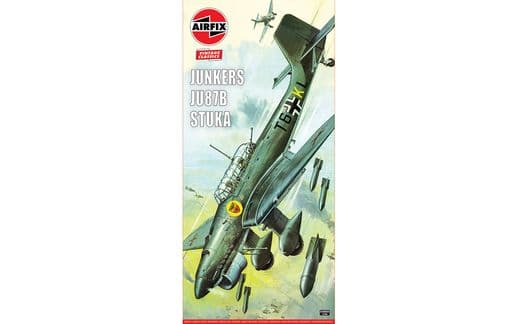
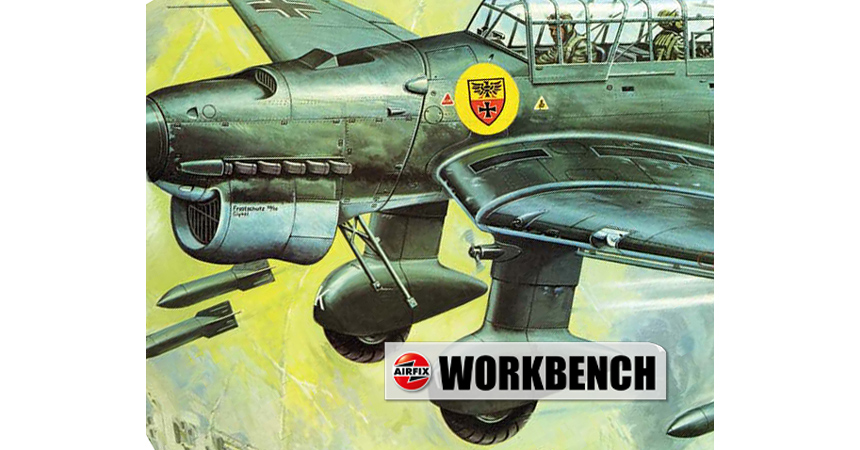
Airfix box artwork has become an enjoyable aspect of the hobby over the years and when Ken McDonough produced this beautiful picture in 1976, it was in support of one of the most impressive model kits the hobby had seen. Here we see the original artwork alongside its Vintage Classics version.
As Europe descended into war again, just 21 years after the end of the war to end all wars, the Stuka would have a prominent role to play in those early months of conflict, writing itself into the pages of military history. With its thick gull wings and fixed main undercarriage spats, the Stuka may not have been the most modern looking aircraft available to the Luftwaffe, however, it had a vital and particularly high-profile combat role to perform. Stuka units relied on a tried and trusted system of direct communication, with specially trained observers embedded with pioneer and mechanized infantry units on the battlefield. In addition to hitting pre-assigned strategic targets, strikes could also be requested in real time by ground advisors.
The Stuka was a precision strike aircraft and unlike the indiscriminate, saturation destruction inflicted by traditional bombers, Stukas were directed at specific, strategic targets, which could include troop concentrations, bunkers and strongpoints, armoured vehicles and anything which may be holding up the advance of ground troops. Their primary role was to keep advancing ground troops moving forward and the enemy in disarray, with the speed of this lightning war being the reason for its unprecedented success - as long as they kept moving forward, the enemy couldn't regroup and plan a cohesive counter offensive.
From a psychological perspective, it could be argued that the reputation the Stuka managed to create proved to be much more than the sum of its actual wartime contribution, despite its success during the early stages of WWII. With its precision strikes and screaming sirens, the Stuka may not have spread widespread destruction itself, but it did come to be regarded as a highly visible bringer of war and how if you were unfortunate enough to find yourself in the vicinity of Stuka operations, you absolutely knew war wouldn't be far behind.
Unfortunately for Stuka crews, despite its fearsome reputation, when they were operating in contested airspace and up against manoeuvrable and capable enemy aircraft, they were hardly capable of effectively defending themselves and unless they were able to count on the protection of strong Luftwaffe fighter forces, a great many aircraft would fall to the guns of Allied fighters. Even though the Stuka would see service throughout the Second World War, the battles of France and Britain would prove disastrous for the Luftwaffe's Stuka units, essentially consigning the aircraft to obsolescence.
A fascinating image which highlights the size difference between Airfix Stukas produced in 1/24th, 1/48th and 1/72nd scales – which one would you prefer on your own workbench?
Due to a combination of the Stuka’s infamous reputation and the undeniable fact that it was one of the most distinctive aircraft to ever take to the skies, the Stuka has long been a favourite subject within the modelling world, with the Airfix range able to boast the inclusion of a Stuka kit since way back in 1957. Since then, Stuka kits have appeared across several different scales in the range, with our original kit offerings in both 1/72nd and 1/48th scales being the subject of major new tooling projects in recent times, further underlining the continued popularity of one of the Second World War’s most famous aircraft and its importance to the Airfix range.
Despite these kits occupying such a significant position within Airfix kit hierarchy, there was one example which just like the real aircraft, earned such a significant reputation that it was revered within the hobby, a kit of such impressive stature than it's considered by many to be the most appealing model kit representation of this famous aircraft ever produced, our 1/24th scale Junkers Ju-87B Stuka. For those fortunate enough to have come into contact with this kit during their previous modelling experiences, they will no doubt be excited at the prospect of renewing this association in the very near future, however, for those yet to make its acquaintance, they really are in for a treat.
As this magnificent kit prepares to take its place in the Vintage Classics range, let's take a closer look at the two very different scheme options we're about to be tempted with, both equally iconic, and both producing stunning display centrepieces.
An aircraft which was the product of a 1933 Sturzbomber Programm in Germany under the constraints of the Treaty of Versailles, the Junkers Ju 87 prototype was initially constructed in Sweden and secretly smuggled back to Germany to undergo the test and evaluation phase of its development. Awarded priority production status, in the wake of the Nazi party coming to power, the Stuka would make its combat introduction as part of the Condor Legion's deployment during the Spanish Civil War, where many lessons were learned regarding the effective operation of dive bombers under combat conditions.
These valuable experiences in Spain allowed Luftwaffe command to cleverly integrate Stuka units into an effective close air support role, using its precision bombing capabilities to surgically destroy strategic targets which may be holding up advancing Wehrmacht units engaged in ground operations, proving itself to be a devastatingly effective weapon. The German propaganda machine was quick to seize upon the fearsome reputation the Stuka earned during the early months of the Second World War, promoting it as an unstoppable bringer of destruction and the spearhead of the Wehrmacht's 'lightning war'. Resistance was futile and the military outcome a foregone conclusion if Stukas were in the air.
Attaching sirens to the undercarriage spats of the Stuka force, if the prospect of coming under dive bombing attack were not terrifying enough, these sirens would emit a blood-curdling wail during the descent from height and only abated once the aircraft had pulled out of its dive and the bombs had started exploding. Disorientating everyone in the vicinity of such an attack, the only thing people wanted to do was run away from this terror, and if troops were not amongst their numbers, any attempt to organise a cohesive counterattack was futile due to the sea of humanity moving in the opposite direction.
In this Battle of Britain era Ju 87B Stuka scheme, Luftwaffe crews found the much vaunted reputation of their main dive bomber effectively in tatters, as the fighters of the Royal Air Force made short work of them over England.
Although usually associated with Blitzkrieg and the astonishing German advances during the early phases of the Second World War, the Stuka proved to be equally effective attacking Allied shipping as it was dislodging stubborn areas of resistance on the battlefield and in fact, would earn a reputation as one of the most successful shipping strike aircraft of the entire war. From operations striking the evacuation beaches of Dunkirk, to the weeks of shipping attacks prior to the start of the Battle of Britain, Stuka units perfected their dive-bombing techniques at sea, taking a significant toll of British shipping in the English Channel in the process.
Sturzkampfgeschwader 2 was formed on 1st May 1939 and would exclusively operate the Junkers Ju 87 Stuka until being disbanded in October 1943. By the nature of the role these aircraft were required to perform, this unit would go on to see plenty of action following the start of the Second World War, serving from the first offensive strikes during the attack against Poland, before moving westwards with actions against the Low Countries and France. The unit's aircraft would continue to be active during operations to disrupt the Dunkirk evacuations and attacking Allied shipping in the English Channel, skills which would be useful following the unit's later deployment to southern Europe and the Mediterranean.
The distinctive lines of the feared Stuka look particularly menacing in 1/24th scale.
This particular aircraft, Stuka WNr.5618, entered Luftwaffe service during the spring of 1940 and would see plenty of action during the Wehrmacht's strike west through Holland, Belgium, Luxembourg and onwards into France, before turning its attention to Britain. In an indication of just how important these aircraft were to Blitzkrieg, on its first day of combat flying, 10th May 1940, this aircraft would take part in no fewer than seven offensive sorties, as it attempted to support the German troops sweeping across Holland and Belgium, only spending enough time on the ground for the Stuka to be refuelled and rearmed.
Having helped to secure the Wehrmacht’s lightning ground victories, it would go on to attack shipping in the English Channel from bases in occupied northern France, with these raids taking it close to the southern coast of Britain, as the Luftwaffe continually goaded the fighters of the Royal Air Force. Unfortunately, the coming Battle of Britain would bring dangerous new challenges for Stuka crews, with not only the Spitfires and Hurricanes of Fighter Command to face, but also two flights over the English Channel to negotiate every sortie and the prospect of spending extended periods over enemy territory, often whilst under fire.
On 16th August 1940, this Stuka was part of a force sent to attack the RAF airfield at Tangmere, one which attracted the attentions of the Hurricanes of No.601 Squadron. Falling victim to the guns of F/L C.R. Davis, the aircraft was brought down on farmland near to the village of South Mundham in West Sussex and completely wrecked, with its two man crew tragically succumbing to the injuries sustained. Although the day of the Stuka was certainly not over, the Battle of Britain proved to be a chastening experience for the Luftwaffe and their Stuka crews.
Placing ourselves in the flying suit of a wartime Stuka crew for a moment, the aircraft’s dramatic attack dive must have been as exhilarating as it was stomach churning and was certainly not for the faint-hearted. Once a target had been identified, the attack dive usually commenced from an altitude of approximately 15,000 feet, with the pilot locating his target through a small bombsight window in the floor of the aircraft. Moving the dive lever to the rear would restrict the movement of the control column, whilst at the same time automatically trimming the Stuka for the attack - similar clever automation would also set the engine speed and propeller pitch for the dive.
The Stuka would then often perform a graceful roll onto its back, before commencing its steep dive attack. A combination of the automatic dive brakes and the drag inducing wheel spats would limit the dive speed to around 350mph, at an angle of attack usually being anywhere between 60 and 90 degrees. Approximately 30 seconds from the start of the dive and with the aircraft's ‘Trumpets of Jericho’ sirens screaming out their terrifying wail, the pilot initiated the automatic dive pull-out system, which also released the aircraft’s bomb load at the correct moment.
The large, centrally mounted bomb would be deployed by the use of a long metal cradle sling, an ingenious device which hurled the bomb away from the arc of the spinning propeller and sent it on its way to the way to the target. A typical attack loadout for a Stuka was either a single 1000kg bomb mounted on the central under-fuselage cradle, or a 500kg bomb on that same station and two much smaller bombs (a total of four) carried on hard points under each wing. The aircraft was also fitted with two fixed forward firing MG 17 machine guns and a single MG 15 (later increased) machine gun in a rearward facing defensive position.
After the automatic dive pull-out system had done its essential work, the pilot would attempt to regain control of the aircraft (and his faculties) by disengaging all the automatic systems and powering the aircraft for a swift getaway. For any Stuka crew, they knew only too well that this was the time their aircraft was at its most vulnerable, so both pilot and gunner quickly had to regain their senses and scan the sky for enemy fighters.
Very different to the other scheme on offer with this kit, I really can’t decide which one I prefer, classic Battle of Britain, or this desert scrub scheme. In truth, both look fantastic!
If remaining fully cognisant after undertaking such a severe manoeuvre were not challenging enough, they also faced the very real danger of being hit by shrapnel from the exploding bombs they had just dropped, or attracting the attentions of ground units determined to exact their revenge for having been subjected to such an ordeal. Although all aircrews who fought during WWII were a special breed of men, Stuka crews really must have been a group apart.
Once Allied fighter pilots had become accustomed to the attack methods adopted by Stuka crews, they knew their best chance to pick them off came in the seconds immediately following their attack run, as the pilot attempted to recover from the dive and regain control. As a consequence, many Stukas would be lost during this vulnerable phase of flight.
Underlining the effectiveness of the Stuka as an attack aircraft, wherever German ground forces were in action, you could be sure that Stuka units would also be in the area. Following their savaging at the hands of the RAF during the Battle of Britain, the Stukas of Sturzkampfgeschwader 1 were sent to assist their Axis allies in the Mediterranean, initially to take part in the siege of Malta and then due to the dire situation in North Africa, moving on to operate from bases in Libya.
The fighting in the deserts of North Africa was savage and constant, with gains made on any particular day often lost the next, resulting in opposing forces contesting the same territory several times over a short period of time. The accuracy of the Stukas precision bombing sorties ensured crews regularly flew combat sorties, sometimes several each day, but always against an Allied Desert Air Force which was inexorably gaining in strength, filling the air with their Curtiss P-40 Tomahawks and Hurricanes.
As many of us will have never seen a Ju-87B in the metal (so to speak), this beautiful large scale kit holds particular fascination for us.
Fortunately for Stuka crews, most sorties would be flown under the protection of the Messerschmitt Bf 109 fighters of JG27, an expert unit which could boast such prolific aces as Eduard Neumann and Hans Joachim Marseille amongst their numbers. Despite their efforts though, the tide of war was already beginning to turn in this theatre of conflict, with allied forces now very much in the ascendancy and it wouldn't be long before former Axis airfields began to fall into the hands of advancing Allied troops.
Once captured, they discovered hundreds of damaged, wrecked and cannibalised Stuka airframes littering the perimeters of these fields, an indication possibly of just how hard working these aircraft and their crews were, and how vital they were to Axis operations, be they offensive, or defensive.
This beautifully presented StG.1 Stuka is adorned with one of many different styles of camouflage applied to the machines which operated across the Mediterranean and North African theatre, although it has to be said that this was arguably the most effective of them all. When viewed from above and with the aircraft flying over scrub desert featuring patches of vegetation, this camouflage proved spectacularly successful, with the aircraft blending perfectly into its surroundings. There are several famous wartime colour images which were published widely after the war, featuring a Messerschmitt Bf 109 wearing a similar scheme to this, flying over desert scrub, where you can barely make it out. On the larger aviation canvas of a Stuka, this scheme will look absolutely stunning.
A Stuka kit of distinction – which scheme will get your vote?
Offering two very different, but equally iconic representations of the Luftwaffe's famous, yet feared Stuka, the return of this fantastic kit has allowed modellers the opportunity to renew their scale infatuation with this aircraft in a BIG way, whilst at the same time, presenting us all with a sizeable modelling conundrum - how on earth do we choose between these two schemes? One of the most impressive kits to grace any Airfix range, this magnificent Stuka is currently still available on the Airfix website, but in relatively small quantities.
Unlikely to be around for much longer, if our impressive 1/24th scale Junkers Ju 87B-2 Stuka kit is the sort of modelling project you could see yourself taking on this winter, please grab one before they go, because it could be quite some time before we see them in our warehouse again.
We are afraid that's all we have for you in this latest edition, but we will be back next Friday with more project development updates and the very latest Airfix kit exclusives. In the meantime, we are always keen to hear your views on all things Airfix and in particular, any thoughts and opinions you may have regarding our Workbench blog. If you would like to drop us a quick line, could we please ask that you use our workbench@airfix.com email for all correspondence.
To re-visit any of the Airfix blogs we have produced over the past seven years or so, please head to our main Workbench hub, where you will find our entire blog back catalogue and all the Airfix design projects we have already covered.
All our dedicated official social media sites can be accessed by clicking the respective link icons at the foot of this page, or by heading to the Airfix homepage. Other useful Airfix links are:
Facebook, YouTube, Twitter and Instagram official sites
Please join us for more Airfix updates next week and thank you for your continued support.