There has been so much Airfix activity over the past few weeks that it can sometimes be difficult to fit everything in to a single edition of Workbench. Our latest blogs have included the exclusive announcement of the new 1/72nd scale Vickers Wellington tooling, along with major updates from two of the already announced 2017 new tooling additions to the model range. For this reason and in view of the fact that we are fast approaching the modelling extravaganza which is the IPMS Scale ModelWorld Show at Telford, we will be devoting this edition of Workbench to providing readers with an update on a number of recent and impending kit releases, along with confirmation of some new model box artwork that has just been added to the Airfix website. We will also bring you an update from our rather unusual Rafwaffe request and how Workbench readers have once again risen to the modelling challenge. Let’s begin by looking at a new kit which marks an important WWII US built aircraft type and one which can genuinely claim to be something of an unsung hero.
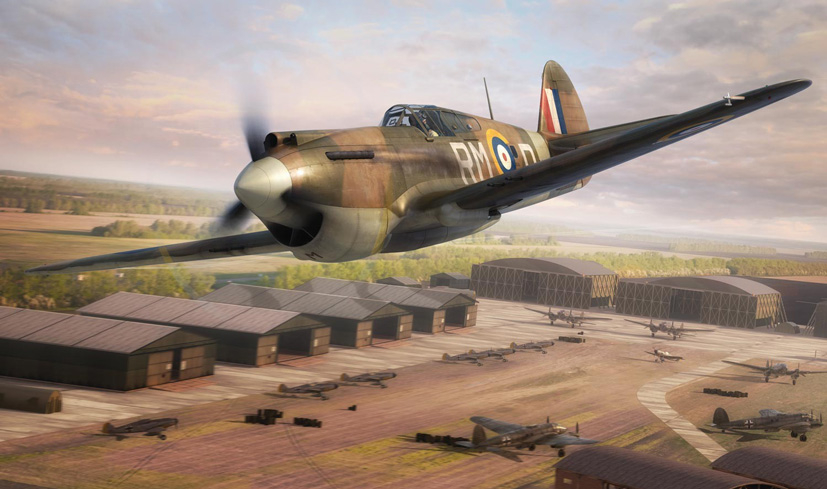
Striking box artwork that features on the new 1/48th scale RAF Tomahawk release
Just as the Great War highlighted the strategic importance of the aeroplane and cohesive air forces during times of conflict, the Second World War would see aircraft development progress at an astonishing rate. As the first Luftwaffe strike aircraft crossed the Polish border in September 1939, the Royal Air Force still had Heyford biplane bombers and Gladiator fighters in service, but in less than six years the first Meteor jet fighters were already indicating the future of aviation and Britain had endured attacks by the fearsome and indiscriminate V2 supersonic ballistic missile. The period in between saw the design and introduction of a great many of the world’s most famous and successful aircraft, many of which went on to become household names and therefore extremely popular subjects for aircraft modellers over the years.
If you were to ask a cross-section of aviation enthusiasts and modellers to name their favourite WWII aircraft or the aeroplane they felt made the most impact during the conflict, it is highly unlikely that anyone would offer the Curtiss P-40 series of fighters as their suggestion. Whilst this is perhaps understandable when considering the more famous (and predictable) alternatives available, this always overlooked fighter is deserving of much more recognition than it receives, as it undoubtedly played a significant role during the early years of WWII. Thanks to two famous fighting units, it also has the distinction of being amongst the most distinctive and instantly recognisable aircraft of the Second World War, fighting on many fronts from the heat of the desert to the barren wastelands of the Aleutian Islands.
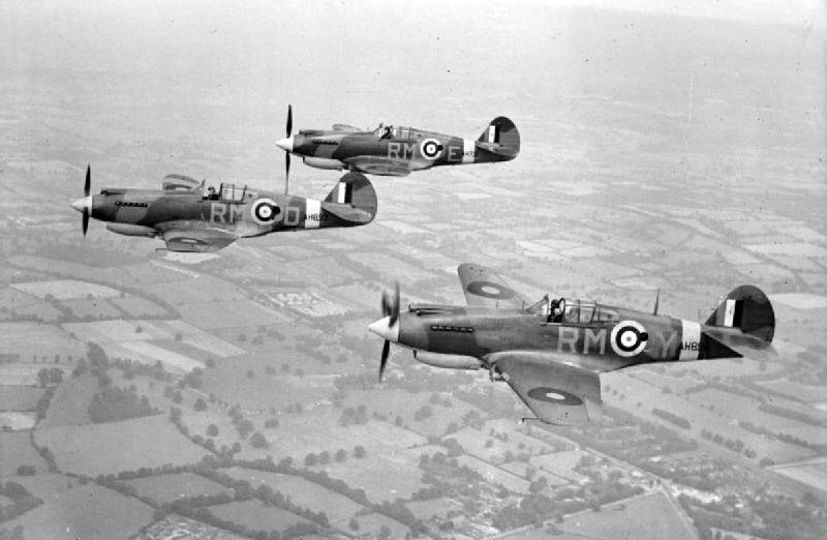
Early RAF Tomahawks flying above the English countryside
Although always overshadowed by the P-47 Thunderbolt and P-51 Mustang, the Curtiss P-40 was produced in greater numbers than any other US fighter (with the obvious exception of both the Thunderbolt and Mustang), but was crucially one of the few modern fighter aircraft in full scale production at the start of WWII. Having seen the gathering clouds of war and the sleek, modern fighters being developed by many of the European air forces, the US Army Air Corps placed the largest order in their history in April 1939 for 524 of the new Curtiss P-40 fighters, but the decision of the US Government to allow foreign air forces to buy the new fighter would arguably be one of the most significant of the entire war. With both France and Britain keen to secure as many of these fighters as possible, it would be in the hands of RAF pilots that the new Curtiss fighter would see its combat introduction.
First announced back in the sixth edition of Workbench, our new 1/48th scale tooling of the Curtiss P-40 has already proved to be a popular addition to the growing range of kits in this impressive scale, with the first release presenting the modeller with decal options for a Pearl Harbor defender and an American Volunteer Group ‘Flying Tiger’. Over the past few days, the second release from this superb new tooling has just been released and this time includes decals to finish the model in one of two distinctive RAF Tomahawk schemes – let’s take a closer look at Curtiss Tomahawk Mk.II A05133.
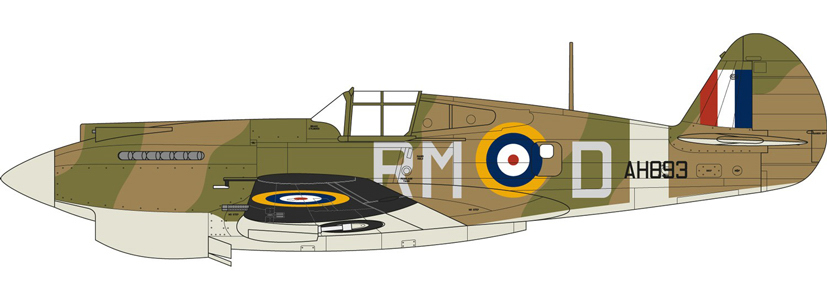
Profile artwork featuring a UK based RAF Tomahawk Mk.IIA
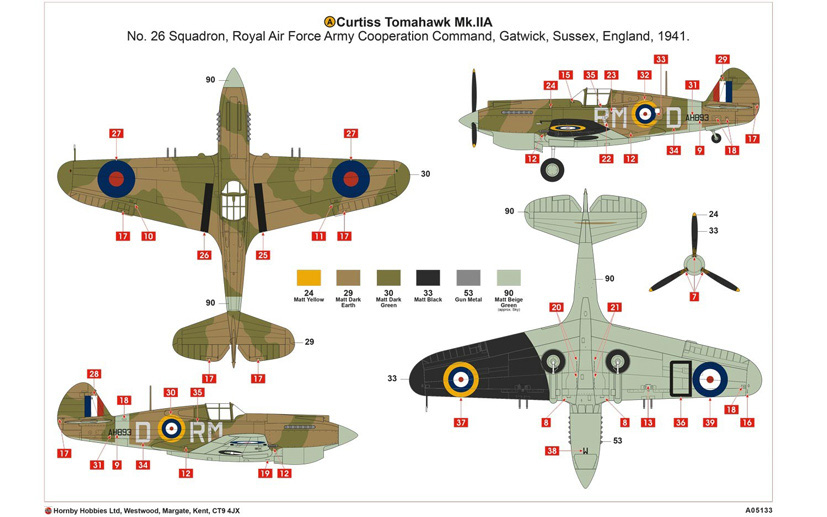
Full scheme details of Curtiss Tomahawk Mk.IIA AH893
Curtiss Tomahawk Mk.IIA, AH893/RM-D, RAF No.26 Squadron, Royal Air Force Army Cooperation Command, Gatwick, Sussex, England, 1941.
The first US built Curtiss P40 fighters arrived in England during September 1940, at a time when the RAF were desperate to bolster their fighter force following the heavy losses they had experienced in France and were continuing to suffer throughout the Battle of Britain. These first machines were actually destined for the French Air Force, but with the French surrender to the invading Germans in June 1940, these aircraft were re-directed to the Royal Air Force and were designated Tomahawk Mk.Is. The aircraft differed little from the standard US P-40 Warhawk, except for improved wing armament and some instrumentation and equipment modifications for RAF use – these included the installation of British radio equipment and are distinguished by the radio mast positioned half-way down the spine of the rear fuselage.
The Tomahawk Mk.II series was basically the export version of the Curtiss P-40B Warhawk and incorporated a number of significant improvements over earlier models, mainly as a direct request from the British Air Ministry. These included higher calibre guns in the wings, the introduction of armour protection for the pilot and self-sealing fuel tanks crucial for aerial combat over Europe. Despite these improvements and following the RAF’s combat experiences in France and during the Battle of Britain, the Tomahawk was not seen as an air superiority fighter capable of taking on the Luftwaffe at medium and higher altitudes and as a consequence, all UK based Tomahawks were used in an Army Cooperation role.
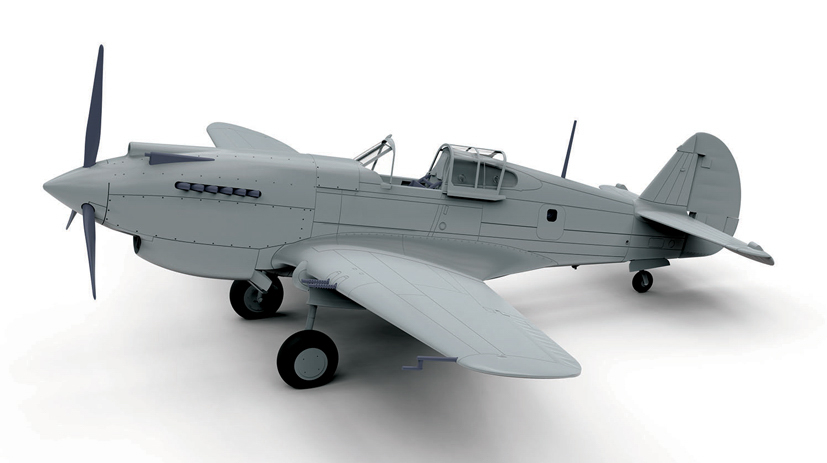
Computer rendered 3D image of the new 1/48th scale RAF Tomahawk
Although proving to be a relatively short lived unit during WWII, the contribution of the RAF’s Army Cooperation Command cannot be underestimated. Established to provide a cohesive link between the RAF and ground based operations by the British Army, aircraft assigned to this unit were required to develop close air support tactics, provide low level tactical reconnaissance and artillery ranging support, whilst also helping to train home based anti-aircraft training facilities. Crucially, they were also charged with developing and establishing tactics that would be used during a future Allied invasion of occupied Europe, where close air support would prove to be of vital importance. By the early Spring of 1942, there were no fewer than ten UK based Tomahawk Squadrons engaged in RAF Army cooperation activities.
The scheme option featured above presents the modeller with an RAF No.26 Squadron Tomahawk Mk.IIA, which flew out of Gatwick engaged in Army Cooperation activities. It features an oblique camera position in the port fuselage side, at the extreme outer edge of the roundel position, which allowed the aircraft to engage in potentially hazardous low-level reconnaissance operations, as well as a distinctive black under-wing section, which helped to identify the aircraft to friendly anti-aircraft units that could be somewhat trigger happy when faced with this unfamiliar shape in the skies above Britain. Wearing the standard RAF ‘Temperate Land’ camouflage scheme, this gives the Tomahawk (Curtiss P-40) an unusual, yet extremely attractive appearance and will surely serve as inspiration for many a model build.
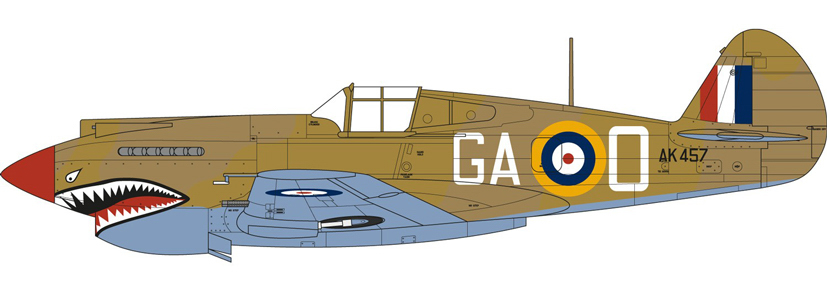
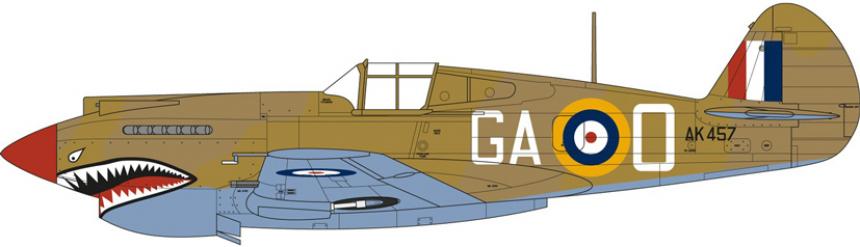
Profile artwork featuring one of the famous RAF Desert Air Force Tomahawks
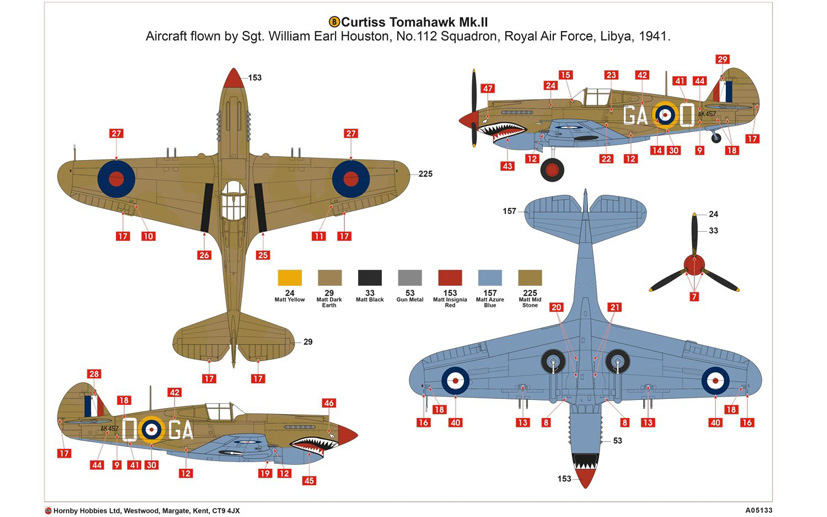
Full scheme details of No.112 Squadron Curtiss Tomahawk Mk.II
Curtiss Tomahawk Mk.II, AK457/GA-O, Aircraft flown by Sgt. William Earl Houston, RAF No.112 Squadron, Desert Air Force, Libya, 1941.
Without doubt, the shark-mouthed RAF Tomahawks of the Desert Air Force were amongst the most iconic aircraft of the entire Second World War and help to underline why the Curtiss P-40 proved to be such an important aircraft to both the US and British & Commonwealth air forces. The first RAF combat units to receive the new Tomahawk were those of the Desert Air Force, who traded their war weary Hurricanes for the new American fighter - these early machines lacked armour protection for the pilot and self-sealing fuel tanks, but this was quickly remedied in subsequent deliveries. The performance of the Tomahawk was generally considered superior to that of the Hurricane and at altitudes below 16,000 ft., better than contemporary Italian fighters and a match for the Bf 109E. Indeed, as greater numbers of Tomahawks became available, the Desert Air Force began to take some control of the air in this theatre and certainly stimulated the Luftwaffe to hastily introduce the latest version of the Bf 109 to combat in North Africa (the ‘F’ model, or Friedrich).
The story behind No.112 Squadron’s adoption of the ‘shark mouth’ markings on their Tomahawks is an interesting one and is usually attributed to engine fitter George Staly. He and pilot Peter Brunton decided to paint the distinctive markings on their aircraft so that Staly could easily spot it when it was returning to the airfield after the completion of its latest sortie and it seems that they could have hardly picked a more appropriate scheme. The deep chin air intake of the Tomahawk readily accepted the artwork and with the stocky side profile the aircraft possessed, it really did look like the gaping mouth of a flying Great White shark – it is almost as if the Tomahawk was built specifically with this scheme in mind. The scheme was an instant success and many other pilots wanted to copy the design, partly to show Squadron unity, but also to give their aircraft a fearsome look during combat. The order was given to allow the widespread adoption of the shark mouth design which was duly applied to the rest of the squadron’s fighters, although there were some fascinating variations on the original scheme carried by several aircraft. RAF No. 112 Squadron of the Desert Air Force soon became known as the ‘Shark Squadron’.
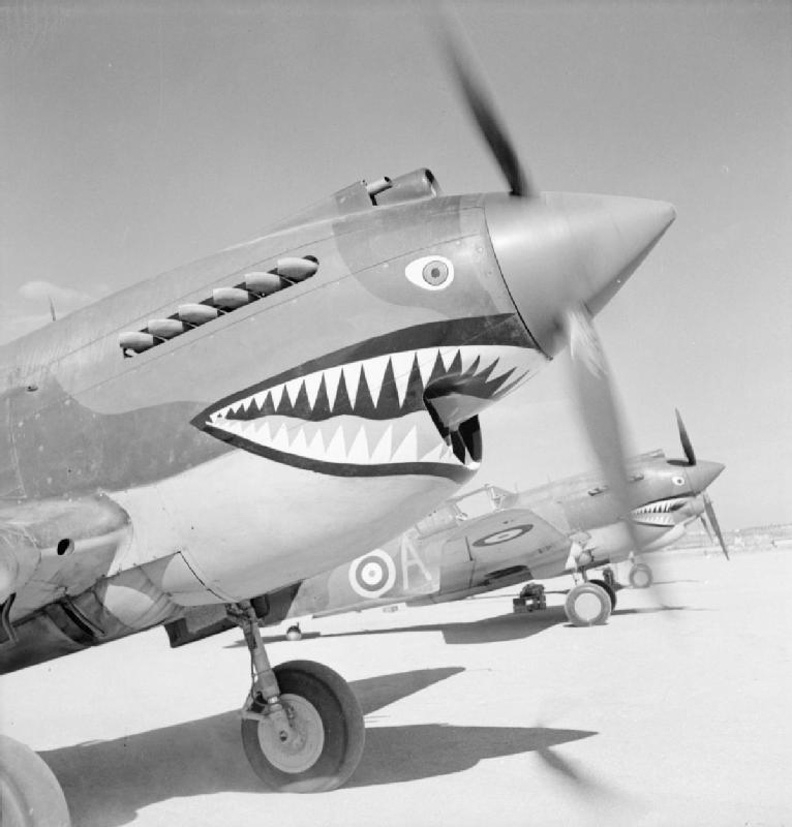
An iconic image featuring the shark mouthed Tomahawks of No.112 Squadron
This interesting story does not end there. Desperate for some positive news from a war which had so far gone quite badly for the British, news of the Desert Air Force’s growing influence and the ‘Flying Sharks’ of No.112 Squadron began to filter back to the UK. It was not long before illustrated newspaper and magazine articles featuring their exploits began to circulate this encouraging news, with the content finding its way all over the Commonwealth. In Burma, American Volunteer Group pilot Charlie Bond (future 9.5 victory ace) was visiting friends on a rare day off from flying, when he noticed the Desert Air Force article in the Illustrated Weekly of India and saw a picture of the shark mouthed Tomahawks of the RAF. The AVG were also flying this early version of the Curtiss P-40 in combat against the Japanese, and he was so taken with the fearsome appearance of the British fighters that he set off into the local town to buy some paint immediately following his visit. The next day, Bond adorned his own P-40 with a similar shark mouth design to the one he had seen in the newspaper, with his aircraft becoming the first of the AVG fighters to carry these markings. Once again, the shape of the aircraft really suited this striking design and many of the other pilots soon applied the markings to their own aircraft and gave rise to one of the most significant aviation stories of the Second World War, that of the famous ‘Flying Tigers’ of the American Volunteer Group.
The Tomahawk proved to be a vital aircraft for the Royal Air Force at a time when they were under severe pressure and desperately trying to stem the advance of Axis air forces on several fronts. They simply needed to stay in the fight until their reserves were sufficient enough for them to go onto the offensive and hope the industrial might of the USA would finally prove decisive. At arguably the most volatile period of WWII for Britain, the Tomahawk played a significant role in North Africa and helped to keep the Axis powers committed on a number of fronts, draining valuable resources in the process. It was to equip no fewer than 25 RAF British and Commonwealth squadrons during WWII and is deserving of much more recognition than it usually receives.
This beautiful Desert Air Force Tomahawk is one of the distinctive shark mouthed aircraft operated by No.112 Squadron in their battles against Luftwaffe and Regia Aeronautica units. Flown by New Zealander Sergeant William Earl Houston from a number of airfields across Egypt, this aircraft would have taken part in some of the most savage aerial combat of the Second World War, which was played out in the baking heat of the sun and over some of the most inhospitable terrain on earth. Like many RAF Tomahawks, this aircraft was to fall to the guns of a Luftwaffe Messerschmitt and it is claimed that AK457 was actually the 32nd victory for celebrated Luftwaffe fighter ace Hans Joachim Marseille (‘The Star of Afrika’) on 11th December 1941.
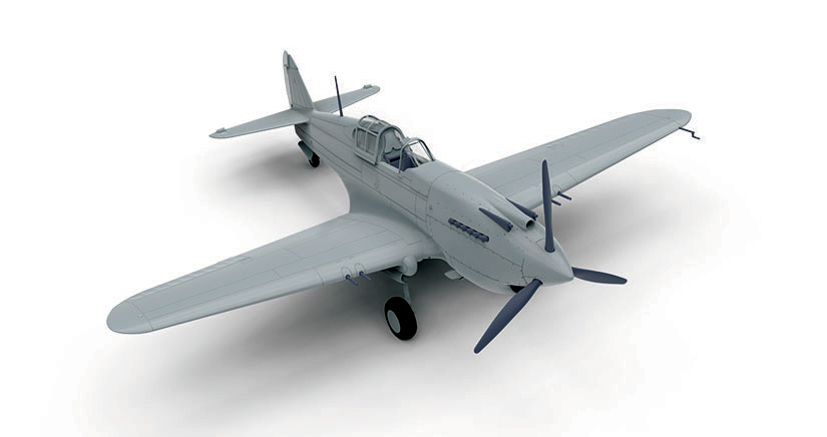
Computer rendered 3D image of the new 1/48th scale RAF Tomahawk
The new 1/48th scale Curtiss P-40 (Warhawk/Tomahawk) tooling is a magnificent addition to this popular range of models, with the larger size associated with this scale certainly lending itself to the unique shape of this important aircraft. It will hopefully bring the P-40 to the attention of many more modellers and will certainly help to raise the profile of this unsung aviation hero of WWII. With both of the scheme options included with the recent release of A05133 allowing distinctive versions of this RAF fighter to be built, it will be a real challenge to decide which one to go with – perhaps this kit is a serious contender for a dual build challenge.
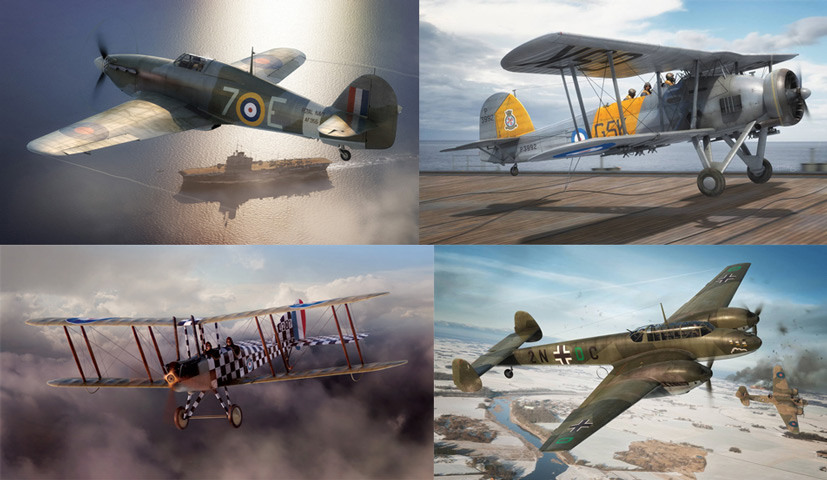
The busy UK Airshow season is always a time when aeroplanes receive plenty of attention and the Airfix release schedule is no exception. With model traders attending many of the summers aviation related events, this is a great time to inspect all of the latest kit releases in the plastic (so to speak) and maybe pick up one or two for the long dark nights to come later in the year. With a number of popular and highly anticipated model arrivals over the past couple of weeks, it could be a good time to head for the New Arrivals section of the Airfix website.
One new model that has been receiving plenty of attention since it was first announced in the 2017 kit range is the beautiful 1/48th scale Hawker Sea Hurricane Mk.IB (A05134). This fully navalised version of the reliable Hawker Hurricane allowed defensive operations to be mounted at sea, but the lack of a folding wing mechanism meant that these important fleet fighters would have to be lashed to the deck when not on flying duties, suffering whatever weather was thrown at them. This stunning new kit also includes decal options to complete your model in a scheme similar to the famous aircraft still operated by the Shuttleworth Collection at Old Warden, currently the only airworthy Sea Hurricane in the world.
Staying with a naval aviation theme, the Fairey Swordfish has long been a favourite with the modeller and despite its rather antiquated appearance, proved to be the Fleet Air Arm's most successful strike aircraft of WWII, responsible for sinking more tonnage of Axis shipping than any other aircraft type. This latest release (A04053A) includes decal options to finish your Swordfish in either the flamboyant pre-war scheme featured on the box artwork, or a much more sinister camouflaged aircraft used during Operation Judgement and the attack on the Italian main battle fleet at Taranto in 1940.
Other recent kit releases include the latest Royal Aircraft Factory BE2c scout (A02104), complete with a striking black and white chequered high visibility training scheme, along with the ever popular and always difficult to keep in stock Messerschmitt Bf 110C/D (A03080A), which includes scheme options for a classic Luftwaffe Destroyer and one of the few Bf 110s to see service with the Regia Aeronautica. For details of all the latest kit releases, please head for the New Arrivals section of the Airfix website.
One of the most popular aspects of any new Airfix kit release is the unveiling of the latest box artwork that will accompany the launch of the model. Now regarded as an integral part of any model release, this beautiful artwork serves to both inspire the modeller by usually featuring one of the scheme options available with the kit and to give the Airfix section of any model shop a unique and impactful appearance. Over the past few weeks, a number of newly created artworks used to support several future kit releases have been added to the Airfix website and they are worth taking a closer look at.
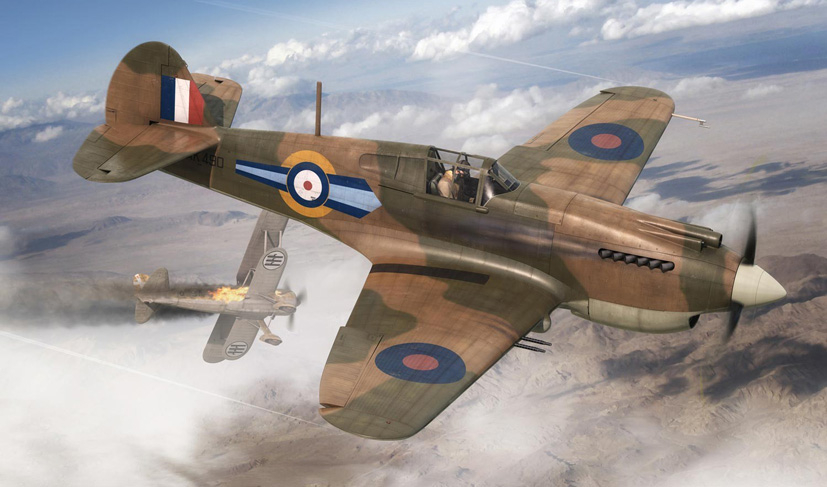
Recently released box artwork featuring the Tomahawk of Peter Wykeham-Barnes
This magnificent image shows the Curtiss Tomahawk Mk.IIB of Squadron Leader Peter Wykeham-Barnes as he watches a flaming Italian CR.42 Falco heading towards the desert floor. Operating from several RAF bases in Egypt during 1940 and 1941, Wykeham-Barnes became one of the most successful pilots of the Desert Air Force, with at least 14 enemy aircraft destroyed and many others either shared or probably destroyed. A01003A is a 1/72nd scale release of the British version of this famous US built fighter, which proved to be so important to the Royal Air Force during the early months of WWII.
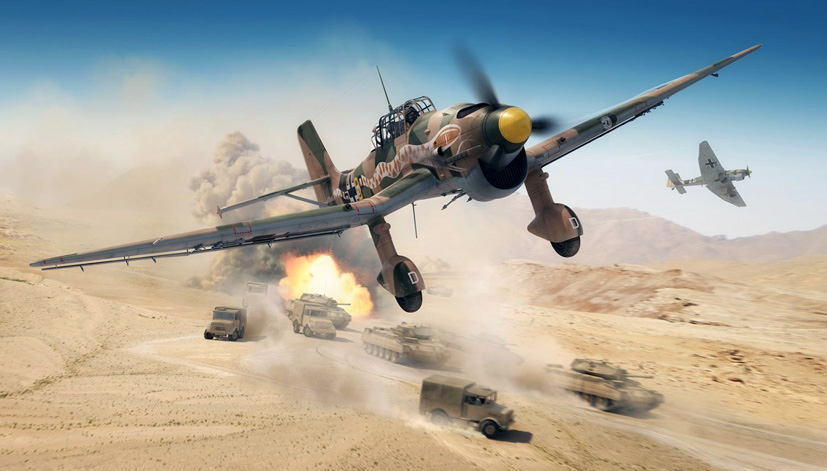
This beautiful Stuka has to be considered one of the most striking of WWII
Staying with the desert air war during WWII, there can be few aircraft more feared or instantly recognisable than the Junkers Ju-87 Stuka, which was perhaps the very embodiment of the ‘Lightning War’ concept. In conditions where the Luftwaffe enjoyed air superiority, the Stuka was a devastatingly accurate airborne artillery piece, able to effectively clear a path for advancing Wehrmacht units, or surgically destroy fortifications and artillery positions. The Battle of Britain proved that the Stuka was vulnerable to attack when not protected by its own fighters, but the aircraft would go on to see extensive service throughout the rest of the war, including the Eastern Front and the deserts of North Africa.
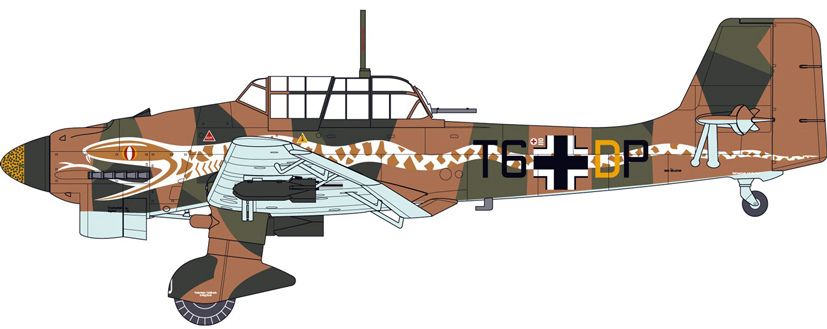
Profile artwork featuring the stunning snake motif applied to this ‘Immelmann’ Stuka
If the Luftwaffe’s Stuka were not distinctive enough, one of the scheme options supplied with the future release of 1/72nd scale A03089 is this 6./StG.2 ‘Immelmann’ machine, which operated from Tmimi in Libya during the summer of 1941. The aircraft is finished in an attractive desert camouflage scheme and features a snake motif which is carried down the length of the fuselage on both sides of the aircraft, which looks absolutely spectacular. The other scheme option is no less fascinating and features a Stuka which flew with the Luftwaffe, before being transferred to the Regia Aeronautica. It was later captured by the British and flown for a time with the national insignia of Britain, Germany and Italy all visible – a unique way to finish your latest Stuka build.
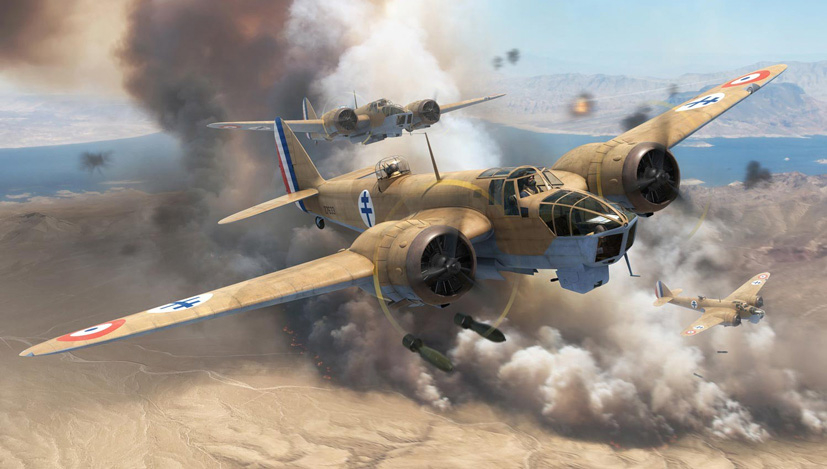
The latest Bristol Blenheim artwork takes inspiration from a Roy Cross classic
Paying more than a little homage to a piece of Roy Cross produced artwork that many Workbench readers will remember from our youth, this magnificent picture shows a trio of Free French Air Force Blenheim Mk.IV bombers attacking Axis targets in North Africa during 1941. There is something quite enigmatic about the desert air war during WWII which may be attributed to the sun, deep blue skies and baking brown sand of the desert floor, which made this a strange environment to fight a war. This theatre of operations was certainly responsible for producing some of the most distinctive and iconic colour schemes seen on aircraft of the Second World War and the fluid nature of desert operations saw airfields changing hands several times over a relatively short period. It was also so far removed from the green and temperate backdrop of the savage Western European battlefields that North Africa somehow seemed to be something of a sideshow to the main events taking place in Europe and on the Eastern Front and generally received much less attention in the years following the end of the war.
This latest release from this recently newly tooled model (A04061) includes scheme options to produce either the unusual Free French Air Force Blenheim featured in the artwork, or an RAF No.107 Squadron bomber, which operated out of Leuchars in the Spring of 1941. All of these recently uploaded artworks can be found in the Coming Soon section of the Airfix website, where you will also be able to pre-order your example of these magnificent models.
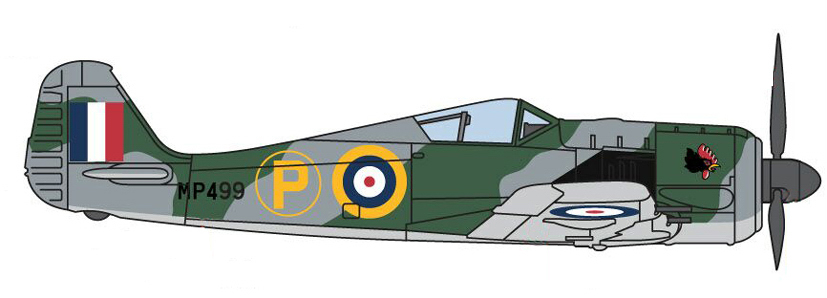
This captured Focke Wulf Fw190 was evaluated by RAF test pilots during WWII
To bring this latest edition of Workbench to a close, we would just like to extend our grateful thanks to everyone who was kind enough to send in pictures in support of our Enemy Aircraft Flight model request over the previous two editions. We have been literally inundated with your images, comments and associated information regarding this fascinating aspect of the European air war and we are very much looking forward to producing this feature in the coming weeks. It is also clear than many of our readers share a similar interest in this unusual RAF unit, as well as the general subject of operating captured enemy aircraft during the Second World War, so we are hoping this will be a popular feature.
We were lucky enough to receive so many e-mails that it will not be possible to individually reply to each one, but to everyone who did contact us, thank you so much and keep an eye out for the forthcoming feature, where one of your models may just put in a guest appearance. Thanks again for all your help.
That’s all we have for you in this latest edition of Workbench. As usual, we are always interested to hear what our readers have to say and are grateful for any modelling features or build pictures you may care to send us. There are several ways you can contact us, including our dedicated e-mail address workbench@airfix.com and of course the Workbench thread over on the Airfix Forum.
If social media is more your style, you could access either the Airfix Facebook page or our Twitter channel, using #airfixworkbench where you will find plenty of modelling news, views and discussion. Whichever medium you decide to use, please do get in touch, as it is always interesting to hear from fellow modelling enthusiasts.
Thanks for reading and see you again in two weeks!
The Airfix Workbench Team
Hornby Hobbies Ltd. All rights reserved.