

Welcome to this latest edition of our Workbench blog and all the news, updates, and modelling exclusives from the fascinating world of Airfix.
As we currently find ourselves on a two week countdown until the end of British summertime, the Airfix team thought we were in need of a little something to help avoid the potential onset of the winter blues this week, and had the ideal remedy in mind, the announcement of a new kit addition to the 2024 range. Last Wednesday saw the unveiling of our latest surprise addition to the current Airfix range, a beautiful new kit which is only the second release from the tooling from which it has been produced, our latest 1/48th scale Avro Anson Mk.I. Unquestionably one of the unsung aviation heroes of the 1930s and 40s, the Anson was one of the most successful aircraft ever designed by Avro, also going on to become one with their longest serving.
This new kit is a stunning scale tribute to the often overlooked legacy of this magnificent aircraft, and we’re hoping that its release will bring the aircraft a little more of the aviation respect it surely deserves, along with a recognition of the important role it played for a modernising Royal Air Force back in the 1930s. Following our usual kit review format, we will begin by taking a look at the history of the Anson and its place in Britain’s aviation heritage, before moving on to look at the three new scheme options included with this kit and the beautiful new box artwork which was inspired by one of them. The artwork also confirms that this second release includes parts to allow two very different looking Ansons to be produced than the one offered with the first release, however, we’ll get on to that a little later.
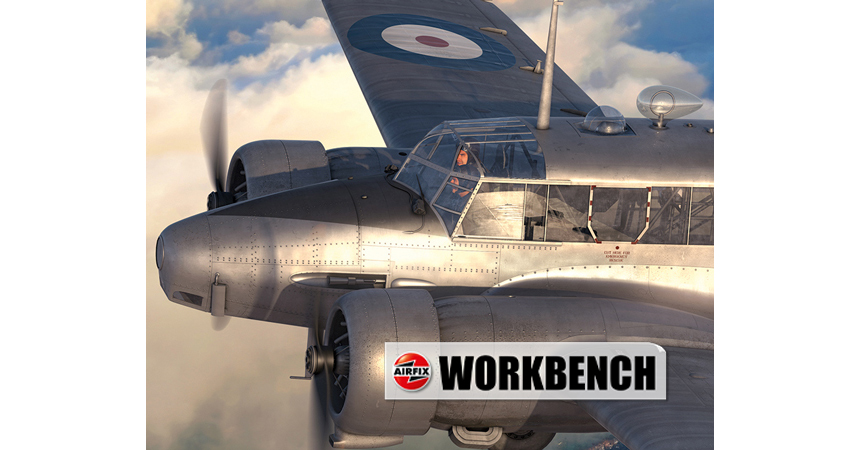
Faithful Annie wearing international colours is the subject of our latest edition of Workbench.
Although the Anson could never be described as being an ‘Ace maker’, it did have a couple of Messerschmitt Bf 109 victories to its name.
When it comes to the subject of how history remembers particular aircraft types, those which were involved in heroic deeds, or which were either the largest, fastest, or best looking of their breed have tended to attract wide public attention over the years and therefore also tend to capture the lion’s share of popular notoriety. For this reason, for every Spitfire, Mosquito and Lancaster receiving all the plaudits, there are several other types which perform the many less glamorous and less celebrated aviation tasks, even though they were just as vital and in some respects, paved the way for their more famous hangar mates to write their names into the annals of aviation history.
One British aircraft type which serves as a perfect illustrator of this phenomenon, the Avro Anson was unquestionably one of the most important aircraft in British aviation history, a groundbreaking new type at the time of its introduction and one which could boast a length of service far greater than some of the more glamorous aircraft produced by its parent company. As proved to be the case with many of the twin engined aircraft types which made their first flights during the advances made during the 1930s, the aircraft which would go on to become the Avro Anson was designed in response to a civilian requirement, but one which reflected the rapidly changing situation in aviation advancement.
Carrying the company designation Avro 652, the new aircraft was a fast and relatively long-range mail-carrying charter aircraft built to satisfy a rather demanding requirement issued by Imperial Airways. Powered by two Armstrong Siddeley Cheetah radial engines, the new aircraft could boast a cruising speed approaching 170mph and an impressive range of 700 miles, whilst at the same time incorporating a host of advanced new design features, making the new aircraft seem to be exactly what the airline was looking for.
Designed by Avro's Roy Chadwick, a man who would later go on to design the Company’s Manchester, Lancaster and oversee the Vulcan project, the new aircraft incorporated a welded steel tube frame fuselage construction, onto which wooden formers and a doped fabric skin could be applied. This method of construction endowed the aircraft with great inherent strength and cavernous cabin space, something which would later prove essential when the aircraft embarked on its military career in the years to come. It would also incorporate a relatively recent innovation - retractable undercarriage.
A first look at the three scheme options available with this second release from our 1/48th scale Avro Anson tooling.
This was operated by a clever gearing system and manual pump handle arrangement in the cockpit, where after around 140 cycles, the main undercarriage legs would move forwards and upwards into a semi-recessed position within each engine nacelle. This system would prove rather fortuitous should an aircraft be forced to make a wheels-up landing, as the semi-recessed position essentially protected the aircraft from sustaining significant damage during the process.
The first flight of the Type 652 took place at Avro's Woodford aerodrome site on 7th January 1935, with the aircraft exhibiting excellent handling characteristics and generally proving to be a resounding success. Delivery of the two completed aircraft to Imperial Airways at Croydon proved to be a little more dramatic, as one of the aircraft actually made its landing with its main undercarriage wheels still retracted, due to pilot error. Thankfully, because of the design of the undercarriage system and the fact that quite a significant section of the wheels remained outside the nacelle after retraction, the mistake was not as bad as it could have been - aside from bent propeller tips and the red faces of the crew, the aircraft would quickly be returned to airworthy condition.
These two aircraft were named Avalon (G-ACRM) and Avatar (G-ACRN) by Imperial Airways and after years of serving with distinction and with war clouds now gathering, both would be impressed into military service, first with the RAF school of Photography and then with the Fleet Air Arm.
From a pilot’s perspective, the view from the aircraft’s generous cockpit and (later) extensive glazed sections was exceptional and must have made the 652 a delight to fly, but as work began on the two aircraft for Imperial Airways, the design held much more in store for the Avro company and an eventual production run which would see this as their most heavily produced aircraft type.
Another look at this CAD screenshot which highlights some of the detail incorporated into the design of this impressive kit.
With construction work already underway on the two aircraft for Imperial, Britain's Air Ministry issued proposals for a new general purpose/reconnaissance aircraft for the Royal Air Force and invited Britain’s aviation companies to submit their designs. After studying these specifications in detail, Chadwick was convinced that his new airliner design was close to meeting requirements and set about building their Type 652A, a military derivative of the existing mail aircraft design.
It wouldn’t be long before this military variant of the Type 652 took on even greater significance for the company, following the Air Ministry's decision to re-designate their requirement as an ‘urgent’ project, requiring the Avro team to devote even greater resource to producing their new aircraft. Powered by two Armstrong Siddeley Cheetah V1 engines, the militarization of the aircraft also brought with it the question of significant additional weight associated with the installation of military equipment, which included defensive armament for the aircraft, in the form of a large manually operated dorsal turret with single Lewis gun and a fixed forward firing Vickers machine gun in the nose, which was operated by the pilot.
The aircraft would also be given the ability to carry a modest bomb load, something which would again go on to increase its operational effectiveness, but also heavy wireless and navigational equipment which would all place further strain on the aircraft’s Cheetah engines.
The box artwork produced to support the release of the first 1/48th scale Anson kit.
Making its maiden flight from Avro's Woodford airfield on 24th March 1935, this militarised variant of the aircraft would later be flown to Gosport and the Coast Defence Development Unit, where it would perform a series of suitability trials with its competition rival, the de Havilland DH89M Dominie, the military derivative of the Dragon Rapide biplane. Emerging victorious from these trials, the Avro 652A triumphantly returned to its home airfield at Woodford to be followed almost immediately by an official Air Ministry order for 174 new aircraft. With its intended use as a maritime patrol and reconnaissance aircraft, it was decided to give Avro’s new fighting twin the name Anson, after George Anson, a former Admiral of the fleet and First Lord of the Admiralty, something which was actually the cause some consternation amongst Royal Air Force officials, with the force going on to be the largest operators of the type.
Production Ansons differed from the prototype aircraft quite significantly, as a result of some flight control concerns which were highlighted during the testing phase, and subsequently required a re-design of the tailplane, horizontal stabilizers and rudder, modifications which did away with the balance horn. The first production aircraft also featured a modified fuselage window arrangement, replacing the original twin window layout with an impressive new fully glazed section which ran along the entire front section of the fuselage, revealing the aircraft’s structural framework and earning the aircraft yet another nickname, that of the 'Flying Greenhouse'.
Entering Royal Air Force service with No.48 Squadron at Manston on 6th March 1936, the Avro Anson represented quite an advance in capability for the force, whilst at the same time presenting them with their first multi-engined monoplane design to see front-line service. It was also the first RAF aircraft to feature a retractable main undercarriage, making this quite an important British aviation type in several ways.
The Anson attracted interest from overseas air arms almost immediately, all of whom could see various potential operational applications this impressive new British aircraft could undertake, with general serviceability and reliability being high on their checklist of appealing features. Keen to cash in on these attractive sales opportunities, some aircraft were diverted from existing RAF orders to be sent overseas, with full production forcing the company to open new manufacturing facilities in the Northwest England.
This next series of images show close-up detailed views of built examples of this second Anson kit, in the various scheme options included.
The RAF Anson Mk.I was equipped with a fixed forward firing .303 machine gun operated by the pilot and a single Lewis gun mounted in the manually traversed dorsal turret. It could also be equipped with a modest bomb load, something which was required by submarine hunting aircraft operated by Coastal Command and whilst there were no reports of an Anson sinking a U-Boat, their presence would keep these feared ocean hunters submerged. The largest 100lb bombs were carried in the wing root area and were dropped through spring loaded doors which allowed the bomb through by weight alone, springing closed once the bomb had gone. This did away with the need to include additional weight associated with a complex hydraulic system.
The Avro Anson Mk.I would be the most numerous variant of the aircraft to eventually be produced, with some 6,688 aircraft being constructed at the main Woodford factory and at a new facility established at Yeadon, near Leeds.
The aircraft would go on to prove itself invaluable to Britain’s war effort during the Second World War, performing a variety of roles throughout the conflict. Hard working and extremely reliable, the Anson would undertake the main role for which it was intended by mounting wide ranging coastal patrols, often spotting for other more offensive aircraft types, but also possessing the ability to launch an attack itself. Similarly, Ansons were operated by air sea rescue units, as these units struggled to establish themselves as a cohesive force, where its general reliability proved to be a real strength.
It was in a training role where the aircraft would truly excel, a role which would see a great many Ansons in Britain’s skies on any given day during the Second World War. Used as a pilot trainer and familiarisation aircraft, the Anson also allowed air gunners, navigators, wireless operators and air observers to gain valuable experience in perfecting their craft, thus supporting a constant stream of trained aircrews destined for service with Bomber Command.
As a pilot training aircraft, it has been said that the Anson, or ‘Faithful Annie’ as it was referred to by crews, was just too forgiving an aeroplane to serve as a truly effective multi-engined trainer. This aircraft was a pilot’s friend, having few vices when it came to catching them out. It was even suggested that an ideal trainer was one which was a little more spirited to fly than the Anson, one which was easy to keep in the air, but challenging to fly well. For those attempting to operate equipment in the spacious cabin area of the aircraft, they would have no doubt been quite grateful that their pilot wasn’t having to fight the aircraft during these long training flights.
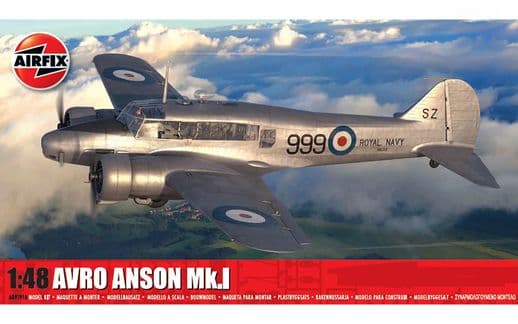
The Royal Navy’s Sydenham Station Flight Avro Anson served as inspiration for the new box artwork produced to support this second release from our 1/48th scale Anson tooling.
Since the initial release of this beautiful new kit back in 2022, the Anson has been receiving some long overdue recognition from the modelling community, however, this wasn’t the first time that a scale representation of this aircraft had been available in an Airfix range. A 1/72nd scale example of the Avro Anson Mk.I was first released back in 1962 and it really was a lovely little kit. For many of us modellers with a few years invested in the hobby, we probably came across this model by default, possibly receiving it as a gift, or even picking it up because it was one of the few kits we hadn’t already made at that time.
Whatever the case, once we started assembling the model, we discovered that it was a little beauty, possessing lots of impressive detail and more than its fair share of charm. With its dorsal turret and impressive overall size, it must have made so many of us want to find out a little more about this unusual warplane, and why we didn’t already know about its heritage and wartime service. Always a popular addition to any Airfix range in which it appeared, the 1/72nd scale Anson kit was released on quite a few separate occasions and always made for an interesting and enjoyable build project.
As the aircraft bore the famous Avro name and has always been regarded as an interesting build project amongst modellers, the announcement that we were working on a new 1/48th scale tooling of the aircraft in 2022 was met with real enthusiasm, but when images of the new kit started to circulate in Workbench, excitement levels really started to rise. The new kit was an absolute beauty, with exceptional levels of detail both inside and out, including impressive design work in accurately replicating the wing covering of the aircraft. As we can see from the new box artwork featured above, this second release from the tooling allows a different variant of the Anson to be built than that initial release.
As with the Bristol Blenheim kit which was launched in 2018, in this larger scale, these twin engined aircraft look truly magnificent and make for a spectacular addition to any display of built model kits. You are about to see that two of the three kit/scheme options included with this new release include new parts to allow a later variant of the Anson to be built, aircraft which featured closed cowl engines and the removal of the aircraft’s dorsal turret.
Let’s take a look at them now.
Scheme A – Avro 652A Anson Mk.I, aircraft number 214 (Formerly NK437), Portuguese Government, 1947.
Following the end of the Second World War and with 11,020 Ansons having been produced, the Royal Air Force were left with a number of surplus airframes for which they had little use for. Fortunately, these aircraft had already shown how useful they had been and for smaller air forces who were looking for a reliable and capable option with which to move into the post war years, they made for a cost effective and accessible option. This particular Anson was one of a batch of 800 aircraft ordered during the Autumn of 1943 and delivered to the RAF early the following year.
After a short service with the Royal Air Force, this Anson was one of a batch of eleven aircraft destined for service with the Portuguese Air Force, and sent to the airfield at Langar in Nottinghamshire for refurbishment by Avro prior to delivery. The Ansons were destined to be general utility aircraft, but were prepared for their new assignment by having their turret removed, having an astrodome fitted and featuring the smooth cowled engine nacelles. The astrodome probably indicates that the aircraft would also be used to train student navigators destined for a career with the Força Aérea Portugiesa, but just as they did during their RAF service, would be more than capable of performing any number of other roles.
Scheme details and a beautifully finished model in these FAP markings.
Delivered at the beginning of April 1946, the aircraft initially operated from the airfield at Portela, just outside Lisbon in the hands of a transport unit and proved to be just as reliable as their new owners had been hoping. Of the aircraft supplied, it was thought that at least two of them were still flying regularly into the 1960s, with some reports claiming that the Portuguese took delivery of a further batch of Ansons, however, this has proved difficult to corroborate.
Towards the end of their service in Portugal, the remaining Ansons were allocated to Esquadra 82, the unit which famously continues to operate the de Havilland Chipmunk in a training role.
Able to take on a multitude of aviation tasks, the capabilities of the Avro Anson attracted attention from the Greek (Hellenic) Air Force in the late 1930s, who were thought to be one of the earliest international admirers of the aircraft. They ordered twelve aircraft in 1938 to fulfil a requirement for a modern advanced trainer/maritime patrol aircraft, although the actual procurement of the aircraft is still something of a mystery. Some reports claim that these aircraft were re-directed from an existing order for the Turkish Air Force once the Second World War had started, whilst others suggest the 12 Ansons were supplied by Britain in an attempt to help support Greek operations in the Mediterranean.
The twelve Ansons were flown to Greece in standard camouflage finish, but wearing civilian markings, however, because the aircraft were in military configuration, it’s unlikely that this could be described as international subterfuge. The fighting capabilities of the Greek Air Force came under serious threat when Italian forces invaded Greece in October 1940, but despite being outnumbered by around 4 to 1 and being equipped with a collection of generally obsolete aircraft, Greek pilots acquitted themselves extremely well, fighting tenaciously in defence of their homeland. Some figures claim Greek pilots scored as many as 64 aerial victories, with a further 24 Italian aircraft sustaining significant damage.
Full scheme details of this most interesting Royal Hellenic Air Force liveried Avro Anson, again also including a model finished in this scheme.
Ultimately, their resilient defence stalled the Italian advance to such an extent that it forced the Germans into supporting their disappointing allies, something they hadn’t originally intended to do. With the British sending troops and supplies to the area, Hitler feared this might threaten his access to oil supplies in the Balkans and moved decisively to prevent such an occurrence. Once the Luftwaffe had been committed to combat over Greece in April 1941, the depleted Hellenic Air Force had little chance, however, five of their Avro Ansons did manage to escape the carnage, flying to Egypt where they would form the nucleus of RHAF units operating as part of the Allied Air Forces.
The aircraft did operate under Royal Air Force command, however, they remained part of the Hellenic Air Force 13th Light Bomber Squadron. From these humble beginnings, the force would grow to three full squadrons, equipped with the most modern aircraft the RAF could spare and would mount wide ranging maritime operations across the region. They would also be engaged in the Allied actions which resulted in the re-taking of El Alamein, where they performed with particular success.
Following the end of the Second World War, the Royal Hellenic Air Force would take a further consignment of Avro Ansons, all of which would operate with the 355th Transport Squadron. Once again underlining the incredible versatility of the aircraft, two of the Ansons were configured to undertake a medical evacuation role, whilst the bulk of the force would provide support which included VIP and staff transportation, the delivery of freight and supplies and even flying night bombing missions during the civil war.
The same attributes which made the Anson such an important aircraft for the Royal Air Force also made it attractive to the Royal Navy, resulting in large numbers of aircraft also going on to see service with the force. Charged with training aircrews across various trades and skills destined to join operational units, the large cabin area of the Anson comfortably supported both students and if required, instructors engaged in airborne training. Although quite a basic design by the mid-war period, the design of the Anson was extremely robust and whilst it might not have been the master of any one aspect of flight, it was incredibly adaptable and extremely reliable.
Hundreds of these aircraft would have been in British and Canadian skies on any given day during the Second World War, with Fleet Air Arm Ansons engaged in providing training support for everything from wireless operators to air gunners and observers, however, if the aircraft were used in a pilot training role, specialist dual control equipped aircraft were required. The spacious cabin afforded trainee aircrews with plenty of room to move around, something which was particularly useful to those engaged in the observer role, as they would often be required to drop marker dyes in the sea both for targeting and positioning purposes. With plenty of stowed equipment available for them to use, this also included an Aldis signal lamp for morse code communications with the shipping below.
As a signal lamp was usually the only way the aircraft could communicate with any naval or merchant ships in its vicinity, the rear window on either side of the aircraft could be opened to allow the observer to signal his message to ships using the lamp, clearly a skill which needed intensive training if it was to be perfected. With its size and weight, the Anson made for a relatively stable platform for such work to be done, something trainees would have no doubt been extremely grateful for.
Lovingly cared for by personnel at RNAS Sydenham, this aircraft was used to transfer staff between Northern Ireland and the Farnborough Airshow – all is revealed in the text!
Following the end of the war, as so many Ansons were produced, there was a surplus of military aircraft of all types, however, the general attributes of the Anson continued to keep the aircraft relevant, despite the type’s advancing years. With its reputation for reliability and general serviceability, many Ansons would take up positions as Station Flight aircraft at military airfields all over the country, where they would be lovingly cared for by station staff and flown regularly by base personnel. Viewed almost as ‘Hack’ aircraft, these Ansons were used as general communications and liaison aircraft, allowing base staff to travel efficiently between airfields, or to transport engineers and technicians should one of the station’s operational aircraft have a problem at another airfield.
This beautifully presented Anson served with the Station Flight at Sydenham in Northern Ireland during the 1950s and would have been used in this general communications and transportation role at that time. The Royal Navy took over this dockside airfield site in the summer of 1943, where it was known as the Royal Naval Aircraft Yard and HMS Gadwall. From the end of April 1946, it would remain in Royal Navy use, but was renamed HMS Gannet III, remaining in operation until the summer of 1959.
The new bow artwork once the current Airfix branding has been applied.
As an illustration of how popular Ansons were in the Station Flight role, in Farnborough Airshow week, many Royal Air Force and Royal Navy stations would send officials to either enjoy, or serve in an official capacity at the show, but with the aircraft landing at nearby Blackbushe airfield, as this was most convenient. Enthusiast photographers would descend on the airfield during Farnborough week to take pictures of the many Ansons and other communications/Station Flight aircraft arriving there, and it was reported that in those days when Farnborough was a huge event, as many as 30 Station Flight Ansons might fly into Blackbushe on any given day.
This particular Royal Navy Anson was photographed at Blackbushe during Farnborough week in 1955, and looking absolutely resplendent in its silver scheme, illustrated the affection in which these aircraft were held by their parent stations. At that time, it’s thought that this was one of the oldest Royal Navy Ansons still in service back then. She will certainly make for an appealing modelling project and will effectively illustrate just how important the Avro Anson was to British aviation during its lengthy service. Compared to the camouflaged RAF Ansons we’re more accustomed to seeing and covered by the initial release of this kit, could this stunning option look any more different?
These new model reviews are never complete without us taking a look at the full box artwork presentation created in support of its release.
Our 1/48th scale Avro Anson Mk.I kit is just the second release from this tooling and the latest addition to the 2024 Airfix range and whilst it’s currently marked as being available for pre-order, we are expecting the kit to be in our warehouse over the next few days.
We are afraid that's all we have for you in this latest edition, but we will be back next Friday with more project development updates and the very latest Airfix kit exclusives. In the meantime, we are always keen to hear your views on all things Airfix and in particular, any thoughts and opinions you may have regarding our Workbench blog. If you would like to drop us a quick line, could we please ask that you use our workbench@airfix.com email for all correspondence.
To re-visit any of the Airfix blogs we have produced over the past seven years or so, please head to our main Workbench hub, where you will find our entire blog back catalogue and all the Airfix design projects we have already covered.
All our dedicated official social media sites can be accessed by clicking the respective link icons at the foot of this page, or by heading to the Airfix homepage. Other useful Airfix links are:
Facebook, YouTube, Twitter and Instagram official sites
Please join us for more Airfix updates next week and thank you for your continued support.