

Welcome to this latest edition of our Workbench blog and all the news, updates and modelling exclusives from the fascinating world of Airfix.
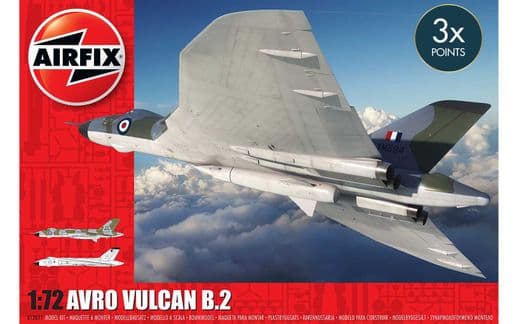
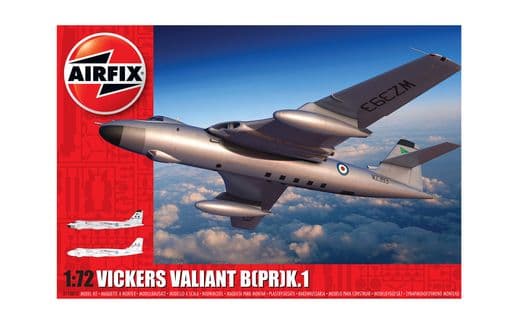
The announcement of our current model range at the beginning of the year brought with it quite a significant development in Airfix history and one which may have slipped the attention of many modelling enthusiasts. For the first time within the same range, all three of our newly tooled/relatively recently tooled 1/72nd scale RAF V-Bomber kits would be available, the all new Avro Vulcan B.2, the Handley Page Victor B.Mk.2(BS) from 2016 and the Vickers Valiant B.(PR) K.1 first released in 2011 will all be available, our own modelling tribute to Britain's V-Force. Marking a particularly important period in British aviation history, this enigmatic trio of highly distinctive jet bombers had the responsibility of delivering Britain's autonomous nuclear deterrent, should the threat of its terrible power fail to prevent conflict during those volatile times. Although relinquishing this responsibility to the Polaris equipped submarines of the Royal Navy from the late 1960s, the legacy these bombers left behind continues to fascinate to this day, even though remaining examples of each can now only be found in museums, or in the hands of groups dedicated to preserving them in ground running condition.
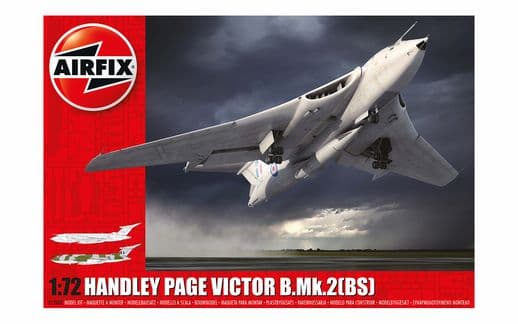
In this latest Workbench update, we will be welcoming our impressive Handley Page Victor B.Mk.2(BS) kit back into the range, by looking at why this unique looking aircraft was as capable as it was distinctive and how it was regarded as the most radical of the three V-bomber designs.
This weekend marks the latest instalment of an event which is without doubt the most important in Britain's modelling calendar, as the great and the good will be heading in their throngs to Telford's International Centre, so they can experience the latest scale ModelWorld phenomenon. Marking the continued renaissance of our beloved hobby, this feast of modelling excellence will be attracting the faithful from across the UK, not to mention those making the pilgrimage from much further afield, all determined to take their place at an event which is without equal anywhere in the world. Airfix will be sending a large team to this year's event and we will be bringing you details of our plans a little later, but for now, we need to welcome a certain Handley Page Victor kit back into the Airfix modelling fold.
One of the most distinctive aircraft to ever see Royal Air Force service, the Handley Page Victor was the last of Britain's three V-bombers to take to the air.
It is difficult to think of a more exciting period for the British aviation industry than during the 1950s, a time when the famous piston engined aircraft of the Second World War were being replaced by a new breed of fast, jet powered aircraft, such as the English Electric Canberra, an aircraft which really was the envy of the aviation world. With the world now firmly in the nuclear age, the Royal Air Force had a requirement for a capable new jet powered bomber to establish a viable nuclear deterrent force and the famous wartime bomber manufacturing companies of Vickers, Handley Page and Avro were all now fully engaged in designing aircraft to fulfil this crucial requirement.
Ministry of Supply specification (B.35/46) was looking for a new medium range jet-powered bomber which was capable of carrying a 10,000 lb ‘Special gravity bomb’ (nuclear free-fall munition) to a target upto 1,700 miles away. It would need to fly at a cruising speed of around 580 mph and at altitudes of between 35,000 and 50,000 feet, in order that the aircraft be able to evade potential enemy fighter attack. This was a crucial design element, as the aircraft would not be equipped with any defensive armament and would therefore have to rely on speed, altitude and stealth to evade enemy fighters. When considering that the aircraft these would be replacing were wartime era Lancasters, Lincolns and Washingtons (B-29), you can appreciate just how technologically advanced these new aircraft would have to be.
Rather controversially at the time, Britain actually decided to proceed with three different aircraft designs from three competing aircraft companies, a decision which was perhaps born out of necessity - with the world now in the grip of a dangerous Cold War and Britain vulnerable to nuclear attack from the East, the introduction of an effective new long-range bomber was now of the utmost national importance. The clock was ticking on this project and the thinking was that if three totally separate aircraft were developed by different manufacturers, each one using different engine types, this would definitely increase the possibility of at least one project providing the impressive new aircraft they were looking for. A more sinical viewpoint might be that this decision provided a much needed boost for the Britain's ailing aviation industry, at a time when the threat of mergers and amalgamations had the potential to create unwanted delays.
The first British V-bomber to fly and subsequently to enter RAF service was the Vickers Valiant. Even though this impressive aircraft was in itself a significant leap forward in bomber design and technology, the prototype aircraft didn't completely satisfy the specification requirements set out by the Air Ministry. This was something of a problem, particularly as the RAF were now desperate for their new jet bomber, however, the Ministry simply altered their existing requirement and Valiant development continued apace. Relatively conventional in its design, the Valiant was seen as the 'safe option' of the three new bombers, with Vickers making some design compromises in order to ensure the aircraft was produced on schedule. Nevertheless, when the Valiant entered RAF service in early 1955, it became Britain’s first high-level strategic nuclear bomber and one of the most advanced aircraft of its type in the world. It was not only significant as the first V-bomber to enter RAF service, but it would also go on to be the first RAF aircraft to drop an operational British nuclear weapon – as it transpired, it would actually be the only one of the V-bomber force aircraft to deliver a nuclear munition.
The second V-bomber to enter Royal Air Force service was perhaps the best known British bomber of the Cold War era and arguably one of the most famous British aircraft types ever produced, the mighty Avro Vulcan. The first bomber aircraft in the world to adopt a delta wing design configuration, the Vulcan would eventually enter service following nine years of development and a year after the Valiant had been introduced, something which clearly illustrates the highly advanced nature of the technology incorporated into this magnificent aircraft's design. For many, perhaps the most striking manifestation of Britain’s early nuclear deterrent capability was the sight of four anti-flash white painted Avro Vulcans blasting off the runway at either Waddington or Scampton on quick reaction alert, displaying to the world that Britain was ready and able to respond to any act of aggression, wielding unimaginable destructive power, if required. This was exactly the military show of strength planners were hoping for when they issued their original 1947 Operational Requirement.
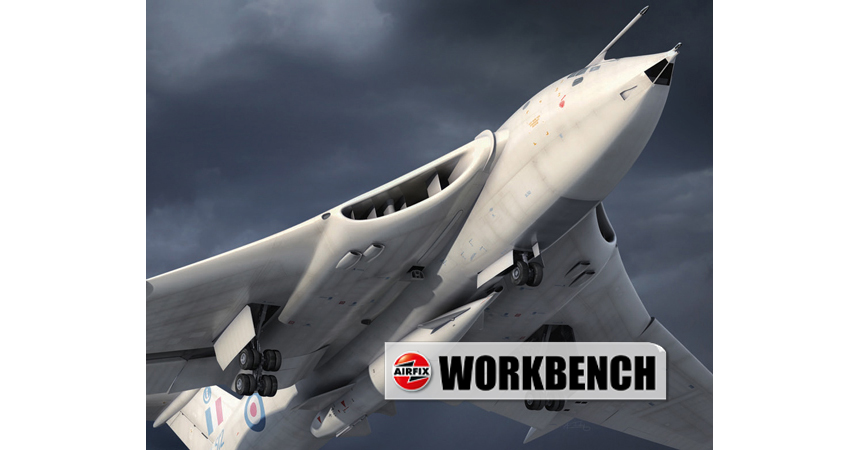
The third and final British V-bomber to enter service was the Handley Page Victor, an aircraft which was viewed as being the most radical and advanced of the three proposed designs and the one which certainly looked the most futuristic. If an aircraft were ever designed to strike fear into the hearts of any potential enemy just by the way it looked, then surely it was the Victor, an aircraft which really did fit the title of the 'Bringer of devastation'. The Victor incorporated a distinctive crescent shaped wing into its design, one which featured three distinct stepped 'kinks' from the wing root out to its tip, reducing in sweep angle at each point, a feature which made the Victor very different to anything which had gone before it. Designed with high speed flight stability as a primary consideration, the Handley Page aircraft also featured a high T-tail unit and deep, pointed nose section, features which made it arguably less attractive than either the Vulcan or Valiant, but certainly made it more distinctive.
One of the many interesting stories linked to the development of the Victor concerns the prototype aircraft WB771, which at that time was still referred to as the Handley Page HP.80. As the now completed aircraft was being readied for its maiden flight at the Handley Page facility at Radlett, a survey by Government officials decreed that the runway at Radlett was not long enough for the safe operation of the new aircraft and at this late hour, plans were drawn up to transport the aircraft to Boscombe Down. This was a huge undertaking and not only would the aircraft now have to be disassembled and prepared for a road journey of some 90 miles, a detailed plan of the proposed route had to be compiled, including the assessment of any sections of the journey down which the convoy might struggle to pass.
Creating a lot more additional work at the eleventh hour, several sections of the proposed route proved to be potential bottlenecks, and required contractors to make some earthwork and structural alterations, something which must have aroused the suspicions of locals. It has to be understood that this new aircraft was still highly classified and this journey to Boscombe Down would have to be made under the very strictest levels of security, despite the distinctly conspicuous nature of the convoy. The dismantled aircraft was loaded onto trucks, covered with tarpaulins and made to look like the hull of a large boat. To add to the subterfuge, the tarpaulins were daubed with the markings GELEYPANDHY/Southampton, to further suggest the load was indeed a boat hull destined for the ocean, with the word Geleypandhy intended to be an anagram of Handley Page. Unfortunately, the signwriter made a letter mistake, but this surely only helped to throw the population off the scent still further.
Having safely negotiated its unexpected road trip, Handley Page HP.80 prototype WB771 was finally re-assembled and prepared for flight at Boscombe Down and on Christmas Eve 1952, this beautiful aircraft gracefully took to the sky for the very first time. Interestingly, the take-off run proved to be surprisingly short for an aircraft of this size and therefore caused many eyebrows to be raised amongst the gathered Handley Page officials, who will not have been pleased at the undignified and now clearly unnecessary road journey their new aircraft had been forced to make from Radlett. To ease their frustrations, the aircraft performed impressively during this first flight and displayed no apparent vices. The aircraft would go on to thrill the British public at the 1953 Farnborough Airshow, where it wore a particularly sinister looking scheme of black fuselage with red cheat line and silver wings and tail - anther triumph for Britain's seemingly unbeatable aviation industry.
In November 1957, following ten years of development and testing, the Handley Page Victor B.1 bomber entered Royal Air Force service with No.232 Operational Conversion Unit at RAF Gaydon. In the spring of the following year, RAF Cottesmore's No.10 Squadron would take the honour of becoming the first operational Victor unit and Britain had her third and final V-bomber.
Wielding unimaginable destructive power, the Handley Page Victor was charged with protecting Britain as part of its nuclear equipped V-bomber force.
For an aircraft which possesses undeniable British aviation pedigree, it will come as no surprise to learn that a 1/72nd scale kit representation of the aircraft has long been high on the most requested new tooling project lists suggested to the Airfix design team by enthusiasts and in 2015, they decided they were going to answer this call in some style. Announced at the Scale ModelWorld show in November 2015, the Airfix stand had a prototype model available for show visitors to admire and they would not have been disappointed. A particularly impressive model, the new Victor took its place in an Airfix range for the first time the following year, with this initial release backed up with a second kit in 2018, one which included new part frames to allow either the K.2 tanker or SR.2 reconnaissance variants of the aircraft to be built.
As we mentioned at the beginning of this update, this latest Victor re-introduction sees the much requested return of the original kit back into the Airfix range and for the very first time in Airfix history, making all three of our 1/72nd scale V-Bomber kits available at the same time. Let's now take a closer look at the two scheme detail options included with the release of this stunning Victor kit.
Even though the original Victor B.1 bombers were extremely successful aircraft, Handley Page felt that they had yet to realize the full potential of the design and therefore began work on deveoping an upgraded ‘Super Victor’ almost straight away. An exercise which clearly highlighted the flexibility of the original design, the resultant Victor B.2 variant featured a number of significant improvements over its predecessors, as designers improved almost every facet of the aircraft's capabilities. New Rolls-Royce Conway turbojet engines replaced the original Armstrong Siddeley Sapphire powerplants, with this decision requiring rather significant re-design of the aircraft's wing area. The intake inlets were increased in size to allow for the greater airflow these more powerful engines required, with these wing modifications resulting in an overall span increase of some 10 feet. A host of internal equipment upgrades made the aircraft even more effective operationally and the inclusion of an auxiliary power unit in the right wing stub even allowed the aircraft to self-start, when operating away from its home airfield.
As the Victor showed itself to be a strong and flexible airframe, other structural modification would follow and the clean, sleek appearance of the first aircraft to enter service would soon disappear beneath a multitude of lumps, bumps and probes, all of which were intended to increase the operational effectiveness of the aircraft. Almost as soon as the B.2 Victors entered service, a significant modification was required to allow the aircraft to carry the ‘Blue Steel’ nuclear stand-off missile, a mighty weapon which was carried in a semi-recessed position under the fuselage of the aircraft, with the missile carried in a distinctive nose down attitude. These all white anti-flash Victors with low visibility markings were arguably the most distinctive and most imposing of Britain’s nuclear deterrent aircraft and a manifestation of the unimaginable destructive power the RAF now possessed.
Royal Air Force Wittering would prove to be a significant airfield in the history of the Handley Page Victor and Britain’s independent nuclear deterrent force. In February 1962, the first Victor B.2 unit (No.139 Squadron) was formed at Wittering, replacing the earlier Vickers Valiants which had to be retired due to the discovery of fatigue cracks in their wing spar components. Wittering based Victors were the first to be equipped with the Blue Steel missile, which was Britain’s air launched nuclear stand-off missile and formed the basis of the nation’s nuclear deterrent force until around 1970, with their destructive potential effectively helping to ensure an uneasy peace during the early Cold War era.
During those dark days of the Cold War, RAF Wittering and their Handley Page Victors would play a vital role in maintaining Britain’s strategic nuclear deterrent force. Prior to January 1969, two squadrons of Victor B.2 bombers equipped with Blue Steel missiles were part of the Quick Reaction Alert force of the RAF. Two nuclear armed aircraft were maintained at a permanent state of operational readiness, their crews able to immediately react to any nuclear threat facing the nation. Parked within 100m of the runway threshold, the aircraft were maintained on the Operational Readiness Platform and if required, could be airborne in just a matter of seconds. This was designed to counter a potential Soviet missile strike and was built around the understanding that from first detection to potential impact, RAF crews would have a maximum of around four minutes to mount their doomsday response. Thankfully for us all, this meticulous mutual destruction planning was never called into action.
Handley Page Victor XL512 would later be converted to operate as a K.2 tanker variant and would go on to provide aerial refuelling support during the famous 'Black Buck' raids of Operation Corporate, the Falklands War of 1982. She would finally meet an ignominious end at the hands of the scrap man's torch in December 1993.
Unfortunately for the RAF and their Victor Squadrons, the pace of aviation advancement was not the preserve of Britain alone and advances in Soviet fighter and Surface to Air Missile technologies would have a significant impact on V-force operations. These advances made the high altitude delivery of nuclear munitions unreliable at best and almost suicidal at worst, a development which required Britain's V-bomber force to immediately switch from high altitude, to low-level strike operations, a role for which none of them had been intended. The white anti-flash scheme was replaced with a tactical upper surface camouflage and for one of the V-force trio, this role dramatic change gave it a distinct advantage over the other two - the greater wing area of the Vulcan definitely favoured its use as a low level strike bomber.
That would not be the only change facing Britain's V-Bomber force and by the end of the 1960s the responsibility for providing Britain’s nuclear deterrent had passed to the Royal Navy and their Polaris ballistic missile equipped submarines. Furthermore, the switch to low altitude operations would go on to claim the service life of the Vickers Valiant, as significant stress fractures were discovered in the wing spars of the aircraft, something which would result in their ignominious withdrawal from service. These low level strike missions were also not particularly suited to the Victor, but the effectiveness of the design dictated that they would definitely be suited to another important role.
Handley Page Victor XL189 first entered Royal Air Force service with No.232 Operational Conversion Unit in early November 1961, but was soon back with Handley Page at Radlett for conversion to B.2R (Retrofit) standard. She returned to service as part of the famous Wittering Wing, where she would provide invaluable support for the crews charged with manning Britain’s Blue Steel equipped Victor nuclear deterrent force, surely one of the most responsible roles RAF personnel have ever been required to fulfil. The scheme option displayed here is particularly interesting, as it confirms that not all Blue Steel equipped RAF Victors were painted in the all over anti-flash white scheme we have all become so familiar with.
Following later conversion to K.2 tanker configuration, Victor XL189 would go on to play a significant role during Operation Corporate, as she provided the final fuel transfer for Vulcan XM607 prior to its bombing attack against the runway at Port Stanley, the famous 'Black Buck 1' raid. Piloted by Squadron Leader Bob Tuxford, XL189 landed back at Wideawake Airfield on Ascension Island following the completion of a marathon 14 hour and 5 minute sortie, without which this historic raid could not have taken place.
This aircraft would end her days as a ground instructional airframe at RAF Waddington and despite the fact that she served so prominently during the Falklands conflict and the famous ‘Black Buck’ raiding Vulcan XM607 was already preserved at the same station, Victor XL189 was unceremoniously scrapped in August 1989.
A box of distinction, unlike the real aircraft, our 1/72nd scale Victor came second in our V-bomber tooling trilogy of kits.
The story of Britain's V-Bomber force marks a truly fascinating period in our aviation history, a time when the boundaries of technology were being traversed on an almost daily basis, in the pursuit of aviation excellence. With all three of these jet bombers proving to be technological marvels in their own right, the story of Britain's V-Bombers can only really be told effectively if you look at all three aircraft types together as a trio and now at least from a scale modelling standpoint, you can do this in Airfix kit form. We are delighted to confirm that our recently re-issued Handley Page Victor B.Mk.2(BS) kit is available once more, both on the Airfix website and through your usual model supplier. Do you need a Victor to complete your scale V-Bomber model display?
This weekend will see the most important event in the modelling calendar taking place at Telford's International Centre, an event which will once again see thousands of modelling enthusiasts making their annual pilgrimage to Shropshire, which is once again destined to be the centre of the modelling universe for two feature packed days. With exhibitors and traders from all over the world in attendance and model displays the like of which you will not see anywhere else in the world, this really is an event not to missed and show organisers will be looking forward to welcoming large crowds on both days of this year's show. What makes this year's event all the more significant is that for the first time in three years, the show will be staged in Full Force, back to the immense scale for which it is famed and the nations modellers will be desperate to be present at the occasion.
This year’s show will see the Airfix team deployed in some force and for those readers who have been regulars at our SMW stand over the years, we will be in our usual position of G 6/7 in Hall 1. Our display will be full of beautiful Airfix kits which have been designed and released over the past couple of years and you can definitely expect to see a 1/24th scale Spitfire Scramble at Telford this year. Our design and development team will be available to answer your questions over the weekend and we are all very much looking forward to meeting as many Workbench readers as possible at the show - please do mention the blog.
For those who are unable to make this year's modelling extravaganza, our social media team will be posting live update from the show, in an attempt to give you a sample of the show and of course, we will be gathering as much content as possible for future use in Workbench. We have a busy few days ahead, but look forward to meeting as many Airfix fans as possible at Scale ModelWorld 2022 - we can't wait!
We are afraid that’s all we have for you this week, however, you can be certain that we will be back again, same time, same place, with plenty more Airfix project updates for your information and enjoyment.
As ever, we are always keen to hear your views on all things Airfix and in particular, our Workbench blog, so if you would like to drop us a line, please use workbench@airfix.com for all correspondence. To re-visit any of the Airfix blogs produced over the past seven years, please head to our main Workbench hub and scroll through the available pages.
All our dedicated official social media sites can be accessed by clicking the respective link icons at the foot of this page, or by heading to the Airfix homepage. Other useful Airfix links are:
Facebook, YouTube, Twitter and Instagram official sites
Please join us for more Airfix updates next week and thank you for your continued support.