

Welcome to this little extra edition of our Workbench blog and all the news, updates and modelling exclusives from the fascinating world of Airfix.
Well, we made it, thanks to support of our awesome photography team and as promised, we have a little extra blog treat for you this week! To celebrate both the first weekend in July and the impending release of our beautiful Westland Navy Lynx Mk.88A/HMA.8/Mk.90B kit, this second blog update features a selection of built model images which clearly illustrate why this kit is held in such high regard and why so many Workbench regulars are looking forward to getting their hands on at least a couple of examples following its release. This extra update also serves as something of a call to action, as we can confirm that the Lynx is already on finals and should be in all good model shops over the next couple of weeks. If you have your eye on one of these beauties, the time to act is now!
To save everyone scouring the Workbench section of the Airfix website, we will include the majority of the feature we recently produced to support the release of this kit, but will only include details of the lead scheme option included with the new kit, the scheme in which this magnificent build has been finished. For details of the other two schemes included, please check the original blog post HERE.
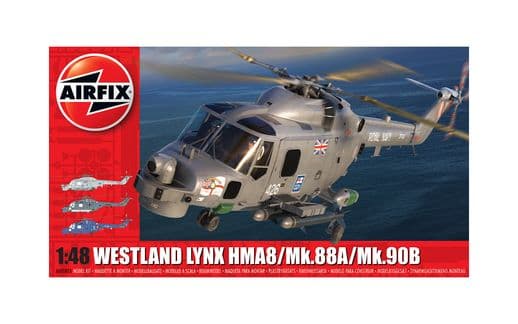
With stunning box artwork like this, how can we possibly ignore adding the re-issued Lynx to our summer build schedules?
For those Workbench readers who are old enough to remember attending Airshows during the 1970s and 80s, they will no doubt still have fond memories of seeing the agile Westland Lynx helicopter thrilling the crowds each summer with its unique displays of rotary agility, culminating with its display 'Pièce de Résistance', a gratify defying back flip. With attributes such as these, is it any wonder that the Lynx was considered a highlight display act on any display programme in which it was scheduled to perform.
Work on the new Westland type WG.13 helicopter began in the mid 1960 and was a project intended to provide a modern replacement for both the Westland Scout (Army) and Westland Wasp (Navy) utility helicopters, potentially even possessing the ability to replace the larger Wessex design. The company also had their eyes on the lucrative export market, with the ubiquitous American UH-1 Iroquois squarely in their sights, so as you can see, right from the very beginning, this was going to have to be a very special aircraft indeed.
As development of the new helicopter progressed, it would go on to form part of a robust agreement between Westland and the French manufacturer Sud Aviation (which later became Aerospatiale), where the French company would take a 30 percent stake in the production work for the new helicopter. Combining the technical, manufacturing and marketing potential of both companies, this deal would also see the French taking the Lynx for their own armed forces, with the British taking both the Gazelle and Puma helicopters in return.
When the Westland Lynx prototype performed its maiden flight on 21st March 1971, it was clear from that early stage that the company had a very special aeroplane on their hands. As these developments flights continued into the following year, the Lynx would go on to set several new speed records for a helicopter, something the Lynx would continue to both pursue and be associated with for the rest of its service life. Indeed, on 11th August 1986, it would go on to set the absolute speed record for a helicopter of 249 mph, a record it would hold throughout its service career and one it still holds for a helicopter of traditional rotorcraft configuration.
For a helicopter which had so many ground breaking features, the Lynx did attract plenty of military orders and would go on to have a long and illustrious service career. The British Army would initially place an order for 100 Lynx helicopters which were designated AH.1 (Army Helicopter Mk.I) - these aircraft were required to perform a variety of essential roles, including that of a devastating anti-tank helicopter. The Royal Navy would also take the Lynx and designated HAS.2, there aircraft would differ markedly from their Army counterparts - in addition to possessing the ability to use different weapons for maritime operations, the Navy Lynx differed visually by replacing the skid landing gear with a tricycle undercarriage, employed an essential deck restraint system, featured a nose mounted Sea Spray radar and incorporated folding rotor blades and an emergency flotation system. This would be essential if the aircraft sustained damage and was forced to make a landing on water.
With the Westland Lynx now in service, the British could boast one of the most advance helicopters in world service and during the summer's hectic Airshow schedule, both the Army and the Navy were more than happy to show the British public just how good it was.
A potent performer, the Westland Lynx provided the Royal Navy with a highly capable rotary platform and one which could genuinely claim to be the eyes of the fleet.
The Westland Aircraft company have been making aeroplanes since 1915, earning a reputation for effectively licence manufacturing other companies aircraft at their Yeovil factory and perhaps less regularly, producing their own designs, such as the famous Lysander Army co-operation aircraft and the Whirlwind twin engined heavy fighter. They would also become prolific in producing Spitfires and Seafires, in the aftermath of Luftwaffe raids targeting the Supermarine factory at Southampton.
The post war period saw the company producing the potent Wyvern naval strike fighter, however, this aircraft would mark a significant change of direction for Westlands, as they turned their back on fixed wing aircraft production to concentrate on helicopters, having secured a significant licence agreement with the American company Sikorsky. Their rotary prowess began with the licence production of the Sikorsky S-51 helicopter, with their design making its first flight in 1948. The British built variant was referred to as the Westland-Sikorsky WS-51 Dragonfly and 72 of these extremely distinctive helicopters would eventually be produced in the UK for the Fleet Air Arm. These aircraft would perform training, communications and search and rescue roles, but with its high fuselage, distinctive heavy glazed cabin area and incredibly long tail boom, this aircraft must have been a difficult one to operate form the confined decks of a British aircraft carrier.
As rotary technology continued to evolve, the Westland Aircraft Company would go on to produce such classic helicopters as the WS-55 Whirlwind, the WS-58 Wessex and the WS-61 Sea King, in addition to the earlier and slightly smaller Sioux, Scout and Wasp designs. Marking a significant deviation from licence building American designed helicopter types, the Westland Lynx was their attempt to produce a multi-purpose helicopter which was intended as a utility aircraft with many military and civilian applications. An ambitious design, the Lynx was always intended to be a ground-breaking aircraft, one incorporating radical new technologies and manufacturing techniques and one which would go on to set many performance records in the world of rotary aviation - it has to be regarded as something of a classic.
As one of the most significant post war helicopter designs, the Lynx has long been a popular kit subject within the Airfix range, with example of both the Naval (Royal Navy and French Navy) and British Army AH-1 first appearing in an Airfix catalogue in 1976. Always a perennial best seller with modellers both in the UK and across wider Europe, the Lynx as a subject would receive a significant tooling upgrade boost with the launch of a spectacular new 1/48th scale kit project in 2012, a stunning new kit which was released in two versions, the AH-7 of the British Army and additional Naval variants Mk.88A/HMA.8 and MK.90B. This builds into a magnificent kit and a fitting scale tribute to the legacy of this record-braking helicopter and a firm favourite with modellers.
For this reason, the announced re-introduction of our 1/48th scale Lynx kit at the beginning of this year was considered to be a serious rival for the new tooling projects announced in the eyes of many, something which has been clearly illustrated by the order numbers already in place for the much-anticipated return of the Lynx. Marking both the home based and international appeal of this magnificent helicopter in naval service, let's now take a look at the three appealing scheme options which will accompany the impending release of this fantastic new model, one which will have many of us delving into the world of scale rotary modelling.
When work started on designing the new Lynx helicopter, Westlands were looking to produce a machine which was basically the next generation of helicopter, one which was not only capable of replacing several existing designs currently in service, but also to set new standards in rotary technology, pointing to the very future of helicopter design. Adopting something of the same methodology as that used by fighter aircraft designers during the Second World War, their design philosophy was based around producing a relatively light airframe powered by extremely powerful engines, making it fast and agile, whilst also equipping the aircraft to carry a variety of weapons to allow several roles to be performed.
The Rolls Royce Gem engines which powered the Lynx were a technological marvel, relatively compact but hugely powerful, they are regarded as the only true British helicopter engine (with the exception of the Napier Gazelle) and allowed the Lynx to be sleek and relatively diminutive in profile, but endowed it with the power to do things previous helicopters simply could not do. A semi-rigid titanium rotor head and state of the art automatic flight control system allowed the Lynx to be an inherently unstable design, able to perform violent evasive manoeuvres and make this an incredibly agile aeroplane, something which was essential for an aircraft which was intended to operate at sea from the deck of a diminutive Royal Navy Frigate.
Entering Royal Naval Service with No.700L Naval Air Squadron in September 1976, the first Navy Lynx helicopters carried the denotation HAS.2 and differed quite markedly from those aircraft intended for Army use. Designed from the outset to operate from some of the smallest ships in the Navy's inventory, The emphasis was on ruggedness and ease of operation, particularly as the deck on which the aircraft would be required to land on was both small and could be moving on heavy seas. The Navy Lynx featured a high-energy absorbing tricycle undercarriage and an under fuselage deck lock mechanism, which protruded on landing and engaged with the grid on the landing deck, holding the aircraft down securely on the deck, no matter how rough the seas. Once locked, the Lynx could traverse through 360 degrees, either to face into wind for take-off, or simply to address its storage hangar, prior to stowage until its services were required once more.
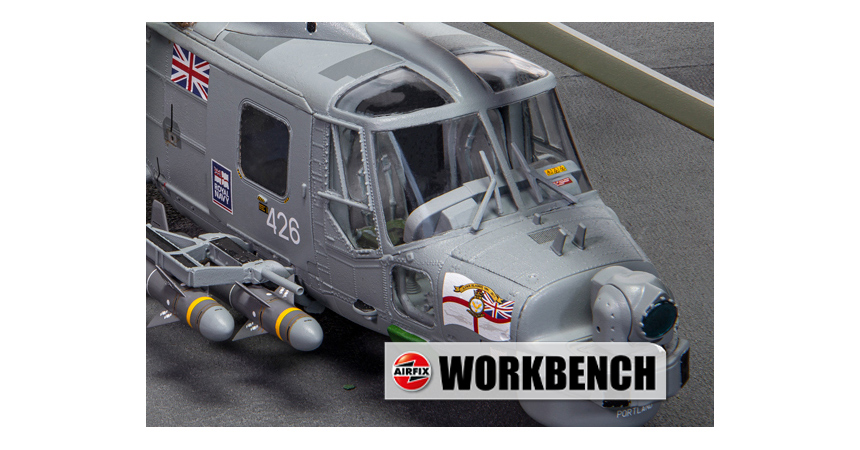
All the images used in this update feature a Lynx kit finished in the lead scheme of three to be included with this impressive kit, Westland Lynx HMA 8 ZF557 of No.815 Naval Air Squadron, serving aboard HMS Portland. Doesn't she look the business!
As these helicopters were intended to increase the operational effectiveness of some of the Navy's smallest ships, it follows that the hangarage space available to store the Lynx was at an absolute premium, so stowage flexibility and ease of preparation were absolute priorities. The tail rotor and main rotor blades could be folded back to reduce the aircraft's profile and this could all be done with a minimum of fuss and prior preparation. In operation, when not protecting the ship from submarine of fast surface craft attack, the Lynx acted as a diminutive eye in the sky, effectively extending the operational effectiveness of its home ship well beyond visual range, targeting other ships before they themselves could be targeted.
Going on to enjoy an impressive 41 years in service with the Royal Navy, perhaps the most significant accolade which can be given to the Lynx is that the Navy trusted it implicitly. Tough, capable and extremely reliable, when they needed their Lynx to do what it was intended to do, it did so to a high standard and with a minimum of fuss - a multi-role helicopter of distinction. During its service career, the Lynx would be used on operations all over the world, from the Falklands War of 1982, to Gulf and Iraqi Wars into the 2000s and would be regularly upgraded to maintain its effectiveness.
A significantly upgraded attack variant of the naval Lynx, the HMA 8 featured more powerful Gem engines, new composite main rotor blades and a modified tail rotor construction. Externally, the most noticeable change was the adoption of a new nose mounted Sea spray Mark 3 360 degree radar unit, even though for cost efficiency measures, the existing Mk.1 unit was retained in its under-nose position. The HMA 8 entered service in 1992 and it is interesting to note that each Lynx which underwent this technology upgrade was a true upgrade in every sense of the word, with only existing airframes being used, as opposed to being newly built aircraft.
A final look at our Westland Navy Lynx kit in diorama pose - such a stunning model.
Westland Lynx ZF557 (construction number 334) was built as an HAS 3 aircraft in 1987, making her first flight on 12th October that same year. She would go on to enjoy an incredibly active service career, spending time with the ETPS before moving on to No.815 NAS, with which it would have a long and illustrious association. During June 1997, she would spend three weeks operating on detachment with the US Navy aboard the missile cruiser USS Cape St. George, showing the Americans just how effective the British Navy Lynx was as a maritime aviation asset. She would also have the distinction of undertaking the last ever Lynx deployment during 2016, when she embarked on HMS Portland for a nine month cruise in Middle Eastern and Atlantic waters.
Following her withdrawal from service, she was sold to a private company who reduced Lynx helicopters for spares, in an attempt to keep existing operators of the type serviced with replacement parts.
That’s it for this little Lynxtastic additional blog post, but we will be back with more project updates for you next week. As always, we are interested to hear your views on all things Airfix and particularly in relation to our Workbench blog, so if you ever feel like dropping us a quick line, please use our workbench@airfix.com contact e-mail address.
All our social media sites can be accessed by clicking the respective link icons at the foot of this page, or by heading to the Airfix homepage. Other useful Airfix links are:
Facebook, YouTube, Twitter and Instagram official sites
Please join us for more Airfix updates next week and thank you for your continued support.