
Welcome to this latest edition of our Workbench blog and all the news, updates, and modelling exclusives from the fascinating world of Airfix.
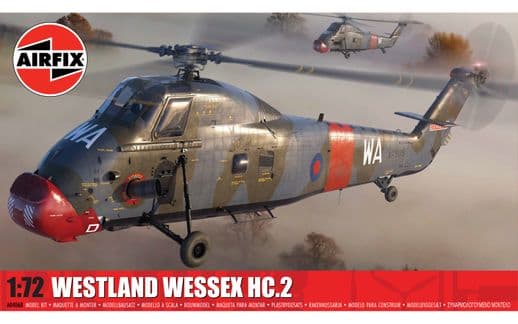
We’re delighted to be in a position to confirm that for the next two editions of Workbench, the focus of our attentions will to be exclusively related to one of the headline new tooling announcements made to the current 2025 range, as we take this opportunity to introduce you to our new Westland Wessex kit in 1/72nd scale. In this first blog, we will be spending some time with the talented product designer who brought us this fabulous kit, and as this was his first helicopter design project, you can be sure we have much to ask him.
Not only will we be bringing you details of how the design phase of the new Wessex kit was successfully negotiated, but we will also be sharing an impressive selection of exclusive CAD screenshots with you, as we guide you through some of the design nuances of this impressive helicopter addition to the Airfix range.
In the follow up edition scheduled for next weekend, we will be looking a little more closely at the history of the Westland Wessex in British military service, paying particular attention to the details behind the three scheme options included with this new kit, which is now scheduled for arrival in our warehouse at the end of this month/beginning of next.
It’s time for lift off with our fortnight of impending Westland Wessex kit new model tooling introductions.
Airfix product designer Ethan Barker now has a helicopter kit on his Airfix design CV.
With the benefit of having ten years of readership statistics to refer to here at Workbench, we know how editions which feature designer new tooling project insights always prove incredibly popular with our audience, and how the work of our specialist product designers continues to be of interest to many in the modelling community. That being the case, we’re delighted to be in a position to bring you the latest instalment in this series, and details behind one of the highlight new tooling additions to the 2025 Airfix range, the Westland Wessex helicopter.
We like nothing more than documenting the talents of our design team members, not only because they usually spend long hours quietly working away on creating the model kits we all love to build, but also because their work is so challenging and specialised, completely fascinating to us mere mortals. In fact, if it wasn’t for these Workbench features, their efforts might be in danger of passing largely unheralded, and that really doesn’t seem acceptable to us. The difficulty we have when putting these articles together is in trying to do justice to the fascinating conversations we have with them, allowing readers to experience their world for a moment, and to see just how challenging this work can be.
The man stepping into the Workbench spotlight this time around is Ethan Barker, a chap who we’ve been fortunate enough to chart the professional development of through his design projects during his time here at Airfix, a man most of us will associate with the Ferret Scout Car kit, an extremely popular addition to the range, and one which was Ethan’s first solo design project! Where do we find such talented people?
Now with many an Airfix design project behind him, it was time for a new challenge – his very first helicopter. This was going to be something very different for him, and something we were desperate to learn more about.
The only appropriate way to start these designer interviews is right at the beginning, so to this end, we asked Ethan when he started looking at the Wessex files (that sounds like something from an espionage thriller!). He told us that he opened his personal project files on 16th October 2023, and how the start of any project will ultimately encompass quite a few phases in each stage of the process. Using a term like ‘design phase’ really doesn’t accurately describe what this stage entails, as there are so many different facets to each phase which all carry equal importance.
Obviously, opening the files and laying down the first design elements of any project is significant for its designer, and will be the start of many hours spent toiling with shapes, curves, undercuts and draft angles, all the usual challenges a designer faces every day and with every project. When they approach the end of any project, marketing renders, 3D printed parts, prototyping, tooling layout guides and tooling finessing will all need to be successfully negotiated, before a single component test frame can be produced, and even then, there will still be much work to do.
With regard to work remaining on the Wessex project, Ethan told us that this particular helicopter design ship had already sailed for him, and how he has long since moved on to other projects. The CAD stage was completed in April 2024 and the work laying out the tooling plan was submitted the following month. Full tooling sign off for the project was granted in January this year, but Ethan did stress that all the time these different stages were being negotiated, how he will always have other projects progressing in the background, and he will still have test assembly responsibilities to negotiate.
Ethan had the benefit of scan data at the outset of this project, and had the opportunity to visit and photograph a pristine preserved example of a Wessex helicopter.
Workbench readers have become accustomed to seeing new tooling projects supported by highly detailed LIDAR scan file images, and Ethan confirmed that he did have access to this information at the start of the Wessex project. He was also quick to point out that scan data files are not the design panacea they may appear to be, and how in most cases, a combination of scan, original drawings, photographs and research material will all be needed in providing a designer with the support he needs in successfully completing any project. Indeed, LIDAR scanning technology isn’t infallible, and a designer quickly learns to understand where certain details may not be replicated correctly in scan, and how he will require additional support in these areas.
For this project, Ethan was handed scans from two different preserved aircraft by his researcher, along with details of which variants of the helicopter his design would need to encompass, plus a host of other guidance notes and research support material. He also had the opportunity to visit a museum and inspect a beautifully preserved example of a Wessex, in fact, he was allowed to essentially crawl all over it. By that stage, he already had a clear idea of what he was hoping to achieve with the project and had considered which details might prove to be the most challenging. That being the case, whilst an inspection visit is not essential in supporting a new design project, it does allow the designer to feel much more confident about the task ahead.
During his visit, Ethan was able to take hundreds of reference photographs, paying particular attention to areas underneath the Wessex where lots of detail was hidden from the prying gaze of the LIDAR scanner, and inside the cabin area, detail which he thought would be crucial to the success of the finished kit. Any aspect of the helicopter’s design which he thought might require additional support during the kit design phase was photographed from multiple angles, and references regarding panel fit and the general lining up of components all attracted Ethan’s interest on the day.
He also went to some lengths in questioning the custodians of the aircraft he was inspecting, to ask if there were any non-standard features on the airframe, or any areas they needed to modify, or re-fabricate prior to the aircraft going on display, as all these details would have to be addressed during the design phase. In summary, detail and the fit/assembly of individual parts on the real aircraft would have to be replicated in scale, so Ethan needed to be sure that he obtained as much reference material as he could during his visit.
Always interesting to see, this image shows the Wessex CAD with scan data overlayed – all in a day’s work for an Airfix designer.
As this was Ethan’s first Helicopter project, we wanted to ask him how different a task this proved to be from projects he had completed previously, and whether he enjoyed the challenge?
Ethan described how the Wessex project was different in so many ways to what he had undertaken previously, but how it was an enjoyable challenge, and how he was excited to see what he could achieve. With things like a tank, or an aircraft, scan data provides much of the reassurance a designer needs in getting all his angles correct, be that the sweep of an aircraft wing, or the angle of a tank’s glacis plate. On a helicopter, it’s all about complex curves and shapes, with so many features, access panels and interior detailing to include, that it can be a little daunting at first.
Ethan had been present when one of his design colleagues worked so successfully on replicating the Sea King in 1/48th scale, and was impressed by the levels of detail he had managed to successfully incorporate into that design. Ethan’s intention at the outset of this project was to try and incorporate similar levels of detail, but in this smaller scale, and even though he knew he would be setting even higher industry standards and raising his workload significantly, the thought, why not.
From the outset, he knew where his many challenges would be. Tying to replicate all this detail in the smaller 1/72nd scale was going to be a challenge in itself, but he knew that the rotor blade detail, rotor head and interior detailing were all going to pose significant challenges from a design perspective, but would ultimately be crucial to the modeller enjoyment of the finished kit. Ethan said how, ‘There was a lot going on in some very small spaces’, and how all his design experience would be needed if he was to create something close to what he was hoping to achieve.
From a designer’s perspective, it’s not just about replicating features of the Wessex accurately, he also has to consider if the breakdown of those parts can be engineered in such a way that they don’t foul during the manufacturing process, and are robust enough to withstand the forces applied during production, and are strong enough to support the weight of the finished model – there really are so many things to be considered.
Ethan told us that the rotor head and blade fold detail proved particularly challenging for him to design, as did the design of the main undercarriage legs, which he actually described as being pretty horrible to work with! Knowing strength would be an issue with these parts, he wanted to design these as individual units for rigidity, but how the angles fought him at every step of the way, but left him with a real sense of achievement when he managed to work out the solution. Ultimately, it’s all about making the kit components accurate, but without them being either too difficult to manufacture/tool, or too complicated/challenging for the modeller to assemble.
Ethan is always good for a design one-liner or two, and he didn’t disappoint this time. He described how “Designing in CAD could be described as being theoretical, but how building the resultant kit is physical, but how you have to embrace both at all times.”
This next bank of images feature cad screenshots of the rotor head design, including the folding feature which posed so many problems for Ethan.
The new Wessex design presents the modeller with plenty of build and display options, including the folded main rotor blades and folding tail.
Taking individual aspects of the design for special ‘challenging’ mention, Ethan told us that the rotor fold mechanism, folding tail design, interior detailing, main undercarriage legs and nose section detailing all provided more than the odd design head scratching moment, with all requiring quite a lot of effort, along with some concept testing and design revisiting. He described how it was sometimes a case of attempting to see just how far you could push the plastic, challenging the current parameters of what the injection moulding industry is capable of, and all in the name of a new model kit tooling.
In summary, Ethan told us that the parts of the Wessex kit’s design he thought would be difficult to work with did turn out to be difficult, and how unsuspected challenges cropped up regularly along the way. Some aspects of the work proved to be more challenging than anticipated, whilst others were relatively easy to overcome, but how in all such instances, the bigger the challenge, the greater the achievement when you overcome it - there’s always a way!
Robust research is always the key to success here, as this will normally highlight where potential problems may lie, but also often show the way to overcome them. From a professional perspective, working closely with the toolmaker to push the boundaries of technology lead to the production of a more accurate kit, and new benchmarks in kit production, which can benefit the hobby as a whole. Every gained experience in overcoming a problem will benefit all future projects, as the hobby continues to advance and improve, as does a designer’s experience.
Ethan was determined that his Wessex design would incorporate impressive levels of detail, adding interest and authenticity to the model.
We next asked Ethan if he had any designing difficulties with the Wessex, and if anything had him diving back into CAD to alter or modify at a later stage?
He told us that the interior detail proved to be incredibly challenging, with one section in particular proving to be a real headache. He brought up a picture of the interior of the Wessex he was allowed to inspect, and showed us the stepped area between the cockpit and main cabin, pointing out an angled section which appeared to be the lower housing for the pilot’s centre console. Having set himself the challenge of replicating as much interior detail as possible, he found this a particularly difficult detail to design, not just the shape and detail of the feature, but how it interacted with other components around it, and how they could all be designed to fit together in kit form, but without creating either manufacturing, or modeller assembly issues.
Ethan described how there were just too many different points of contact when initially designing these parts, and how he needed to produce them as 3D printed components to fine tune his design, addressing any fit issues and improving tolerances between individual parts. Replicating detail for production as a scale model kit is always something of a compromise, a trade off between the finesse of such detail, the number of parts required, the ability to manufacture efficiently, and modeller enjoyment/overcomplication, with the balance being tricky to negotiate and often open to some interpretation.
Is adding detail to larger components possible from a manufacturing perspective, but would splitting into several smaller parts affect the strength and assembly integrity of the overall build? We told you this was difficult stuff to get your head around. Quite a recent development, 3D printing technology can provide the designer with much greater flexibility these days, allowing them to assess and perfect aspects of the CAD file prior to sending them off for tooling production, saving time and often money, as opposed to discovering fit and assembly issues further down the development line.
Ethan drew our attention to just how busy the detail was at the front of the cabin, where the underside of the pilot’s central console angled down, and its association with all the other components. This all needed replicating effectively in design.
Ethan’s personal challenge of attacking the replication of detail as if he was designing a 1/48th scale kit will definitely benefit those building this kit following its release, but does lead to another unusual issue Airfix designers have faced over the years. When it comes to internal detail, some modellers absolutely love it and are of the opinion that if it’s on the real aircraft, they want it on their scale model kit replica. Others might just want a representation of the subject covered itself, with detail they see as being hidden inside the build being something of a waste of effort on the part of the designer.
We suppose the skill is to cater for both groups of modellers if possible, however, in the case of the Wessex kit, Ethan was in pretty safe territory, because the number of optional and posable parts he included made it easy to admire the interior detail once the kit has been assembled, be that in the cockpit, or in the main cabin itself. In any case, having sat in a Wessex and seen all that delightful internal detail, Ethan was determined to incorporate as much of it as possible into his design.
On the subject of moulding, anyone who has made a recent Airfix helicopter kit will know just how large and impressive the main fuselage components can be, and we wanted to find out if designing parts this large create any specific problems from a kit production perspective?
Ethan also described how the nose detail of the Wessex provided him with more than a few challenges during the design phase of the project.
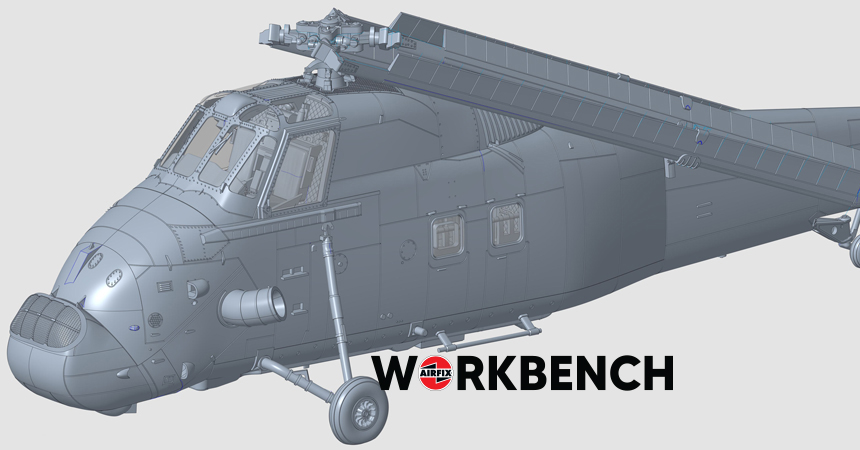
A computer rendered representation of Ethan’s Wessex CAD design files – it’s looking a bit like a Westland Wessex!
Ethan started by saying that every Airfix designer has a set of tolerance parameters they have to adhere to with every project they undertake, including minimum wall thickness when it comes to the plastic components themselves, and ensuring design shapes don’t create moulding difficulties when it comes to producing the kit parts. Both designers and tooling manufacturers know what to look out for regarding these potential pitfalls, and are well versed in ensuring such problems don’t make it through to production. In the rare case that something has been overlooked by one side of the other, the other will step in and raise the issue before development proceeds further.
Despite the fact that these helicopter fuselage halves are large and impressive components for sure, Ethan told us that as they’re essentially a collection of curved design elements, which tend to be much easier for a production tool to cope with, therefore rarely creating a problem for the designer. In the case of the Wessex, the relatively flat underside of the fuselage would have created a tooling foul issue had it been designed as part of the main fuselage sides, however, Ethan overcame this by designing the central section as a separate part, allowing all that fine detail to be incorporated, whilst overcoming any possibility of a potential production issue.
Once the plastic has been injected into the mould under pressure and the component frame produced, after a set time for cooling, the two halves of the tool come apart to reveal the new plastic part frame, and ejector pins push through the inside tool to free the frame from the tool, to be collected beneath. If a design had inadvertently included an inaccurate section of tooling design, the frame may become difficult to eject, or even stuck in the tool, something which must be avoided at all costs in this highly automated process, and therefore a major concern throughout the design phase of any new project.
The inside design halves of the new Wessex CAD files, followed by an interesting look at how these were replicated in tooling.
Ethan kindly sent us a couple of pictures showing the new Wessex fuselage tool halves which not only serve as a fascinating insight into this work, but also clearly illustrate the end result of what the many months a designer spends in CAD software is attempting to produce. Really impressive pieces of engineering, these tools will probably be used hundreds of thousands of times over the years, to produce kit components for the modelling world to enjoy.
With regard to ejecting the part frames from the tooling following the injection process, Ethan tried to describe the difficulties designers and tooling manufacturers face with this important aspect of design by likening it to opening an Airfix kit box. Sometimes, when you open the box of a new kit, it can be a little difficult, as there can be a little resistance when attempting to lift the lid – this is because both are the same shape, with just a very small size difference between the two over their full height.
If the box being opened was shaped like a pyramid, once you break the bond between the two, there is no resistance whatsoever and the lid will lift straight off with no trouble at all.
Essentially, this entire process is a little bit of a trade-off between detail and accuracy, tooling mouldability and ease of assembly. If you manage to successfully circumnavigate all these important factors, you’ll have yourself a new Airfix model kit tooling on your hands.
Ethan’s specialist subject is the CAD design of the new Airfix Westland Wessex scale model kit.
Despite the milled tooling blocks being truly impressive feats of engineering excellence, Ethan told us that for some finer detail, even this process is not capable of replicating it with enough finesse, and in circumstances such as these, how a process called EDM or Electrical Discharge Machining is called upon. Often using copper plates inserted into a tooling to replicate fine surface detailing, rather than using a milling tool to cut steel away, this process uses electrical discharges to melt small sections of metal, causing it to vaporise. This can be used to replicate the finest of detail and can give any project real character, however the copper is clearly much less robust that the steel tools and may need replacing from time to time.
Moving on to the subject of time consuming elements of the design, other than some of the issues already raised, Ethan said the interior quilting details was both challenging and time consuming to replicate. This is such a distinctive feature of the inside of a Wessex that Ethan was always going to replicate this as part of his design, but he soon found out that doing so accurately would involve an extended period working at his computer.
This fascinating series of images illustrate just how fastidious Ethan was in replicating the quilting detail which is such a feature of the cabin section of the helicopter. Beginning with the finished detail, we go on to show how Ethan methodically built up the detail, but had to manually manipulate each individual square when adding it to raised detail.
The flat surfaces weren’t too much of an issue for him at all, and once he’d accurately designed his first single quilt square, he was able to simply pattern this across the rest of the flat surface detail. Where his problems started were on the raised detail sections and some of the weird shapes and ducting detail which was also covered in this quilting. On initially attempting to copy the detail across these raised areas, the squares became misaligned and didn’t look right at all, so Ethan had to individually plot, design and locate each and every quilt square on these raised sections, something which was both time consuming and rather laborious.
Although he’s delighted with the finished detail, he told us that on the cabin roof design component alone, there were 500 individual design actions required to replicate it correctly, but how this was detail he simply wasn’t prepared to compromise on. This same attention to detail was applied to such features as the canvas chairs in the main cabin, the mesh detailing both inside the helicopter and over the external inspection panels, and the surface detailing which will hopefully make this such an enjoyable kit to build and admire.
On to our quickfire questioning round proper now, where one line answers are the order of the day.
Firstly, what proved to be the most challenging design aspects on Wessex?
Ethan started by saying, “Can I only pick one?” He eventually went with the rotor head and tail/rotor fold feature. Such a distinctive element of the kit, but one which had to be designed to be strong enough as individual parts, but also to be of scale thickness. He also needed to make sure they moulded correctly, with the correct amount of surface detailing replicated. This feature alone would take a lot of effort to design to his satisfaction.
Next, which aspect was the most time consuming?
This one was easy, as Ethan referred us back to the interior padding and quilting detailing – it does look great though.
How about the most frustrating part of the design phase?
Again, Ethan had no hesitation in offering two different aspects of the Wessex design here, the main undercarriage legs and the nose detailing. We have already covered the main gear legs which were just very difficult to design full stop, but the nose detailing also caused Ethan a headache or two. He described the nose design as being a real pain, as it was just a collection of unusual and challenging shapes which really needed his full commitment in understanding how they all came together. He then had to replicate these in kit form without overcomplicating the assembly sequence, ensuring all these unusual shapes moulded as intended during production.
Although extremely complicated to design, the main undercarriage legs had to be robust enough to both mould correctly, and support the weight of the finished model.
What about the most rewarding aspect of your time designing the Wessex?
In addition to the levels of details he was able to incorporate into the design of his Wessex, Ethan was pleased with the amount of posable detail the kit incorporates, offering the modeller lots of choice when it comes to building and displaying the model. Whilst achieving all this, he also thinks that the overall assembly process has not been overcomplicated, and how time spent building the Wessex kit will hopefully be a pleasurable experience for all.
What do you think modellers will appreciate most about the new kit?
Again, Ethan suggested the detail and build options incorporated into the new kit, with those who enjoy creating dioramas having plenty to work with when it comes to the new Wessex kit. To say this is a 1/72nd scale design, he’s proud of what he managed to achieve from a detail perspective, and he hopes modellers will see it as a valuable new tooling addition to the range.
And finally, we never like to let one of these opportunities pass without asking our designers if there’s a particular project they would like to take on in the near future, and certainly during their Airfix career, something of a design project free hit, so to speak?
Ethan told us that he’s actually not much of an aviation fan, and having been brought up in the countryside, he’s probably more interested in tractors than he is Typhoons. He loved working on the Land Rover Starter Set, as this was right up his street, as was helping out on the RNLI Shannon Class Lifeboat project.
Ultimately, if he could design something no matter what the subject matter, it would probably be a range of highly detailed construction vehicles, but as he also has a real passion for innovation, he wouldn’t turn his nose up at the opportunity to work on some space or sci-fi kit project.
The new Wessex will certainly make for an interesting build project. This fantastic helicopter enjoyed an impressive 40 service career with the British military.
We think the new Westland Wessex kit is a real credit to Ethan and his design talents, and we’re certain it’s going to be an incredibly popular addition to the range following its relatively imminent release. One of the world’s first truly versatile helicopter designs, the Wessex enjoyed an impressive 40 year service life with Britain’s military, making this surely one of the most significant aircraft of the post war era. We think Ethan has done the legacy of this distinctive helicopter proud with his new kit, and can’t wait to get our hands on one.
We would like to than Ethan for spending so long time discussing the Wessex project with us, when he could clearly have been doing something far more constructive instead. His enthusiasm for the project was truly infectious, and we only hope we’ve managed to bring this through within this article. The pictures he sent us will hopefully illustrate some of the points raised and allow us a further interesting insight into the life of an Airfix Product Designer.
We’ll be hearing more from Ethan and his Airfix design projects in the very near future.
In the next Wessex follow up edition, we’ll be looking a little more closely at the assembly and finish options available with this new kit, along with taking a look at the history of this successful helicopter during its service with both the Royal Navy and the Royal Air Force. Discovering details behind the three scheme details on offer with the new kit, we will also have an impressive selection of built model images to share with you, just in time to help you choose prior to the model arriving in our warehouse.
A final look at a computer rendered representation of the new Westland Wessex CAD files – isn’t she a beauty!
Until then, we hope you enjoy this latest designer interview edition of Workbench.
We're afraid that's all we have for you in this latest edition of the Airfix blog, but we will be back next Friday with more project development updates and the very latest Airfix kit exclusives. In the meantime, we're always keen to hear your views on all things Airfix and in particular, any thoughts and opinions you may have regarding our Workbench blog. If you would like to drop us a quick line, could we please ask that you use our workbench@airfix.com email for all correspondence.
To re-visit any of the Airfix blogs we have produced over the past TEN years or so, please head to our main Workbench hub, where you'll find our entire blog back catalogue and all the Airfix design projects we have already covered.
All our dedicated official social media sites can be accessed by clicking the respective link icons at the foot of this page, or by heading to the Airfix homepage. Other useful Airfix links are:
Facebook, YouTube, Twitter and Instagram official sites
Please join us for more Airfix updates next week and thank you for your continued support.