Welcome to this latest edition of our Workbench blog and all the news, updates, and modelling exclusives from the fascinating world of Airfix.
Our blog title for this week was intentionally selected to possess a little more intrigue than usual, as we want to do something a little different with this latest edition. As far as we know, there’s never actually been an ‘Avro Week’ commemoration event, and certainly never here on the Workbench blog, but as we find ourselves on the cusp of the scale modelling world’s annual ‘gathering’ at Telford’s International Centre, we wanted to take a little break from featuring new tooling projects and secret additions to the current Airfix range. Instead, we wanted to place the blog spotlight on a selection of (relatively) recent model kit releases, all of which are currently in stock and available for modelling project duty right now.
Interestingly, the three kits we have selected chart 20 years of aircraft design development at one of the most famous company’s in British aviation history, a name which became synonymous with powerful bomber types, but can trace its origins back to the early years of the 20th century. We will be seeing how 20 years can seem like a lifetime in the world of aviation, and whilst all three aircraft were groundbreaking in their own right at the time of their maiden flights, how they could hardly be more different from each other, when it came to both their appearance, and their capabilities.
You will probably be able to guess which aircraft types we’re going to be featuring, but you can be absolutely certain that the Airfix range has beautifully crafted scale kit representations of each one, albethey in different scales, to allow our model display cabinets to feature our own appealing tributes to each one of them. When it comes to Avro aircraft types, the current Airfix range certainly helps scale Avro aviators to gain their hobby wings.
As we push the virtual hangar doors back on this latest edition of Workbench, which of this trio of Avro classics will be making its way to the blog taxiway first?
Established in 1910, the first aircraft designs produced by the Avro company could hardly have suggested their future would involve such aviation classics as the Vulcan.
For a name which would become synonymous the world over for its reputation for excellence in aviation design, the Avro company rose from relatively modest beginnings in the basement of a Manchester mill, and only then because the mill was being managed by Alliott Verdon-Roe’s brother at the time. The site was less than ideal for the production of aircraft, as each one would have to be built and assembled in the mill to ensure everything went together as anticipated, before being dismantled and transported by horse and cart to the railway station, for onward transportation to the flying school at Brooklands for flight testing.
Nevertheless, this Brownfield Mill site would be responsible for the production of several important British aircraft designs during those early years, such as the first British aeroplane to take off from water and the world’s first aircraft to feature an enclosed cockpit. During this time, the Avro company also managed to establish an enviable reputation in producing and supplying all manner of components required in the production of aircraft, even becoming known as ‘The Aviator’s Storehouse’.
As their design expertise started to grow, and as the national obsession with aviation started to materialise, the brothers knew that they would need more suitable premises if they were going to grow the company, so in the early spring of 1913, moved their entire factory the 2 miles north to Miles Platting, which was just as well, because the War Office were showing great interest in their most successful design to date, the Avro 500.
The classic Avro 504 would really put Avro on the map, but bring about the need for another factory change, as the huge increase in capacity required more space and more manpower. A new factory in Newton Heath (another area of north Manchester) was quickly secured by the company, allowing the Avro 504 to become one of the most important early British aircraft to see widespread service, with more than 11,000 aircraft eventually produced.
The end of the Great War brought with it a reduction in aircraft orders, so Avro cleverly diversified into the production of motor cars, whilst maintaining their interest in aviation and the maintenance and manufacture of the incredible Avro 504. The Newton Heath factory would be the birthplace of many an Avro aviation classic, including the aircraft which will be featuring in third place as part of our review, an aircraft which started life as an advanced mail-carrying aircraft, but one which was easily converted to meet military requirements, the Avro Anson.
From this point forward, the three aircraft which have attracted our blog attention this time around are going to be featured in descending chronological order, with arguably the most impressive Avro designed aircraft featuring first, and the least well known (certainly from the perspective of normal public perception) being the last to take to the air on this occasion. Interestingly though, by adopting this format, we will also be reversing the actual number of aircraft produced by type, with the first being by far and away the one produced in the lowest numbers, and the last being the most heavily produced.
As already mentioned, this trio of Avro aviation excellence span just 20 years of aviation design, something which will even surprise the most committed of aviation enthusiasts, but only serving to underline why so many of us find this subject to completely fascinating. Onwards and upwards then.
An aviation classic such as this is deserving of classic Airfix box artwork.
When the huge doors of the construction hangar at the Woodford factory airfield were pushed open during the last week of August 1952, the sight must have been truly breathtaking. As Avro Vulcan prototype VX770 was wheeled out onto the hard standing on the airfield resplendent in its white ‘Anti-Flash’ paint finish and wearing RAF insignia, it must have been a proud moment for everyone involved with the project.
Over the course of the next few days, a program of extensive systems testing and runway taxiing trials took place, in preparation for the all-important first flight of the new aircraft. Back then, the aircraft hadn’t been given an official name and was simply referred to as ‘698’, but it was about to make a rather large delta shaped mark on the history of British aviation.
On Saturday 30th August 1952, a beautiful English late summer day, Avro officials and authorised Woodford employees assembled for the historic first flight of the new Avro jet bomber prototype. The flight would be under the command of the highly experienced Avro test pilot Roland ‘Roly’ Falk, a man who had spent the last few years evaluating every aspect of delta flight in support of this project. Falk had previously served as the chief test pilot at the Royal Aircraft Establishment and in that position, had the chance to fly and evaluate many of the captured German aircraft from the Second World War, such as the Messerschmitt Me 262 jet fighter and the incredible Me 163 rocket powered fighter. He was also famous for conducting his Avro test flights wearing a smart pinstriped suit and tie, something which was somehow reassuringly British.
After successfully undertaking a final couple of fast taxi runs, followed by a short delay to clear a flock of birds from the edge of the runway, this stunning new aircraft blasted down Woodford’s runway and into the clear blue Cheshire skies. This was clearly a worrying time for Falk and the Avro designers, as much of the technology used on 698 was totally new and until the aircraft returned to Woodford safely, there would be a great many men in suits biting their nails and wringing their hands nervously. The aircraft was taken to 10,000ft, before completing a series of pre-determined manoeuvres, then repositioning for landing back at Woodford.
Drama ensued following the lowering of the main undercarriage, as something was seen to fall from the underside of the aircraft, with airfield control passing the message on to Falk, who was instructed to perform a wide circuit of the airfield, while the situation was assessed. Both a de Havilland Vampire and Avro 707 research aircraft were sent to fly close to the bomber to assess the situation, and discovered that the fairing panels behind the undercarriage had become detached. As all three of the undercarriage legs had returned green locked down indicator lights and the aircraft was under full control of the pilot, Falk was cleared to land back at Woodford, which he duly did, using the drogue parachute to reduce the landing distance to a minimum.
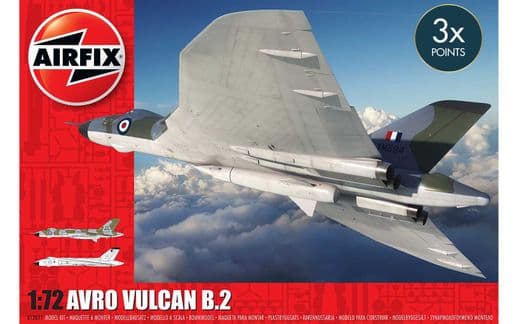
A major new tooling project for Airfix, the newly tooled Vulcan B.2 kit benefited from the production two new pieces of beautiful box artwork.
As the aircraft quickly slowed to a sedate pace, the gathered onlookers burst into a spontaneous round of applause, as the Avro team had achieved a significant aviation milestone, and the project could now progress to the next stage. One of the gathered onlookers later commented that as Britain was still subject to food rationing at the time, the celebrations centred around a nice hot cup of tea and a few biscuits.
At this point, it’s probably appropriate for us to spare a thought for the good people of Cheshire back in 1952, or as it would now be described, the South Manchester area. When they saw (and heard) this mighty delta shape in the skies above them, they must have thought that Armageddon was upon them, and a great many concerned citizens contacted the police to report the terrifying sight in the sky. It now seems strange that even though that first aircraft may well have initially spread fear amongst sections of Britain’s population, the last flying example would become the best loved individual aircraft to ever fly on the British Airshow circuit, even carrying the title ‘The Spirit of Great Britain’ to underline the fact.
It wouldn’t be long before Britain was in the era of the Vulcan and the V-Bomber Force.
By the time the definitive Vulcan B.2 had entered service, the wing area had increased significantly and although still classed as a delta, so had its overall shape. To cope with the increased power output from subsequent engine upgrades and to overcome the stability issues associated with the original wing design, the B.2 wing had a very different planform, and now featured two defined kinks in its leading edge, well forward of the profile of the original. Wing. Rather than detract from the aesthetic appearance of the early Vulcan’s delta, the B.2 actually enhanced the profile of the aircraft, even though the design changes were obviously made purely for reasons of operational effectiveness.
The service introduction of the Vulcan B.2 would also coincide with Britain’s nuclear weapons program maturing somewhat and would see the number of weapons available to the V-bomber force increasing in both number and in the destructive potential they possessed. It would also bring about a change in thinking regarding the delivery of these weapons, as significant advances in Soviet anti-aircraft missile defence technology would now have an impact on the successful dropping of a free-fall gravity munition. A new weapon would be needed if the deterrent threat of the Vulcan and its V-bomber partners was to be maintained.
Avro Vulcan XM594 was the penultimate B.2 variant to be built at Avro’s Chadderton and Woodford factories which was capable of carrying the Blue Steel nuclear stand-off missile, Britain’s most effective deterrent weapon at that time. She was delivered to the Royal Air Force in July 1963 and allocated to No.27 Squadron at Scampton, the Squadron which first introduced the B.2 variant of the Vulcan to RAF service. Pooled into the ‘Blue Steel Wing’, the aircraft would remain at Scampton for the next nine years, serving through the period when the V-Bomber force would be required to change its role from conducting high altitude to low level nuclear operations.
From the mid 1960s, Scampton’s Vulcans gave up their iconic white anti-flash paint scheme for one which featured standard RAF camouflage on all upper surfaces, reflecting the tactical change from high to low altitude operations. Significant advances in Soviet SAM missile capability meant that Vulcan crews could no longer be expected to safely conduct their original high altitude Blue Steel delivery missions and were forced to ‘head for the deck’. Unfortunately, this altitude switch significantly reduced the tactical effectiveness of the missile, and the nuclear writing was already on the wall for Britain’s V-force. Vulcan B.2 XM594 would still be at Scampton when all eight aircraft of No.27 Squadron were converted for a nuclear laydown bombload and assigned to fly deep penetration raids into Eastern Europe, supporting Allied ground forces in the event of conflict.
By the end of 1971, the Vulcan’s of No.27 Squadron had relinquished their nuclear delivery role altogether and by the following year, XM594 had made the short hop to the nearby Waddington Wing, where she joined No.101 Squadron. During her 20 year RAF career, this Vulcan would see service with Nos. 27, 101 and 44 Squadrons. Her final operational sortie was as part of the last Vulcan scramble on 17th December 1982, where no less than 7 Vulcans took part in this impressive demonstration, as the Vulcan prepared to bow out of RAF service. On the same day, four of the seven Vulcans involved in the scramble demo also flew in formation over former RAF Vulcan stations, as this unique aircraft made its farewell flight - XM594 acted as a reserve aircraft for this tribute.
One of the most impressive aircraft to ever see service with the Royal Air Force, Airfix fans have a beautiful scale representation of the Avro Vulcan to grace their display cabinets.
The last flight of Avro Vulcan B.2 XM594 took place on a rather cold and wintery 7th February day in 1983, when she was flown from her home base at RAF Waddington to the Newark Air Museum site at Winthorpe, the start of a new chapter in her life. Not only would she be one of the largest aircraft to have ever landed at this former RAF Winthorpe site, but on this historic occasion, the aircraft was captained by decorated Falklands War pilot Squadron Leader Neil McDougal. On landing, he was more than happy to recount some of his Vulcan flying exploits to enthralled NAM volunteers who had gathered for his arrival. Significantly, at that time, XM594 was the only Vulcan disposed of by the RAF to be flown into an unlicenced airfield.
This magnificent aircraft is now kept in fine condition by the museum volunteers and is a hugely impressive exhibit and until relatively recently was maintained in an ‘electrically live’ condition. At regular occasions during the year, volunteers would conduct an electrical systems check, where the lights, airbrakes and bomb bay doors would all be operated. Unfortunately, a tightening in regulations meant that these checks can no longer be performed on the Newark Air Museum site, though this magnificent museum is definitely still well worth a visit. Indeed, most UK aviation enthusiast visitors will probably tell you that enjoying the sight of this magnificent mighty delta bomber is worth paying the modest museum entrance fee alone, even before you consider all the other aviation delights on show at Newark.
Thanks to the continued efforts of museum volunteers, work on their beloved Vulcan is an ongoing process and she is constantly being cleaned, inspected and restored so this Cold War warrior can be enjoyed by the thousands of visitors who will surely flock to her in the years to come. If you are lucky enough to visit the museum when staffing and weather conditions allow, you may actually be allowed to climb aboard the Vulcan for a very reasonable fee. Clambering into the cockpit area and also sitting at the navigators table, you really do get some appreciation of the operating environment RAF Vulcan crews had to endure - for such a mighty aeroplane, there really isn’t much available moving space inside. It seems highly probable that most Vulcan crews would probably have been rather slim chaps!
Thanks to our good friends at the Newark Air Museum, this is the magnificent aircraft we were fortunate enough to be allowed to scan at the very start of this project, making this lead scheme a popular choice amongst members of the Airfix team.
Lancaster Centurion R5868 PO-S ‘S for Sugar’ is one of the most famous individual examples of this magnificent aircraft.
For an aircraft which is regarded as one of the most successful and impactful of the Second World War, it’s always something of an interesting aviation dichotomy to consider that the overwhelming success of the Avro Lancaster was actually born from the relative failure of the Avro aircraft design which immediately preceded it.
The Avro Manchester was designed in response to Air Ministry Specification P13/36, which required the production of a highly capable medium bomber to replace existing twin engined types currently in service with the RAF, such as the Whitley, Hampden and Wellington. Avro’s innovative design submission retained the twin engine configuration of existing medium bombers, but made use of the innovative Rolls Royce Vulture engine, a new powerplant which promised impressive power output from what was essentially two Rolls Royce Peregrine engines bolted together.
The two 12 cylinder V-shaped Peregrines were mounted one on top of the other (the bottom unit inverted) to produce the 24 cylinder ‘X’ shaped engine block of the Vulture, and whilst designed to produce great power, this innovative design proved to be somewhat underdeveloped, failing to live up to performance expectations. A lack of power and general unreliability of the powerplant seriously undermined the performance of the new Manchester.
Historically, it’s generally accepted that the disappointing Vulture engines were the main reason behind the perceived failure of the Manchester. Ground crews were sick of constantly having to nurse the aircraft into the air and many aircrews assigned to fly the bomber began to fear that their aircraft was incapable of bringing them home after their latest mission. The impact of this phycological barrier can’t be overestimated, because during the flames of war, trust in your equipment is of critical importance to crews and can have a devastating impact on morale and fighting effectiveness. From bitter experience, when flying on a single engine, the Avro Manchester would lose altitude at an alarming rate, whilst at the same time placing great strain on its currently still functioning, but notoriously problematic Vulture engine.
Apart from the engines, the Manchester had the usual issues associated with the introduction of a new aircraft during wartime conditions, however Avro technicians had an excellent reputation for introducing upgrades and improvements to service aircraft, and the Manchester actually did possess some significant advantages over earlier bomber designs. By positioning the aircraft’s fuel storage exclusively within the wing structure, this allowed the designers to incorporate a large unobstructed bomb bay in the aircraft, allowing it to carry an impressive variety of offensive stores.
This also created a relatively spacious fuselage for crews to work in and when combined with the excellent general handling characteristics of the aircraft, it did show great promise. Unfortunately, no matter how hard Bomber Command looked for the many undoubted qualities possessed by the Avro Manchester, aviation history, and those troublesome Rolls Royce Vulture engines have conspired to ensure that Avro’s advanced twin engined bomber was regarded as a disappointment as a service aeroplane.
The magnificent Lancaster was a four-engined development of the earlier twin-engined Manchester.
Only 202 Avro Manchester bombers were eventually produced, even though some of cancelled airframes already under construction at the time of cancellation would eventually go on to become the aircraft which replaced it, and something of an aviation classic.
Aware of the problems with the Vulture engines, Avro’s chief designer, Roy Chadwick and his team, were already working on the design of an improved version of the Manchester, one which was initially designated the Avro Type 683 Manchester III. Replacing the two troublesome Vulture engines with the less powerful, but much more reliable Rolls Royce Merlin powerplant, the wing of the new aircraft was lengthened to accommodate the two extra engine stations engines, whilst still utilising a Manchester fuselage from the existing production line.
When the prototype aircraft made its maiden flight from Manchester Ringway on 9th January 1941, it showed many similarities to the earlier twin engined design, including the distinctive three tail arrangement of the Manchester Mk.l and same impressive modular construction method. The four engined Manchester III proved to be a revelation, and having overcome the major power issue which had plagued its predecessor, highlighted the many impressive design features originally incorporated into Britain’s latest bomber type by the Avro team.
Existing Avro Manchester production was switched in favour of the new design, which as we all now know, would go on to be named the Lancaster, an aviation classic which was pressed into RAF and Bomber Command service from early 1942. It went on to earn an enviable reputation as Britain’s principle heavy bomber of the Second World War, operated by many British, Commonwealth and European squadrons serving in the Royal Air Force. Despite possessing many of the design characteristics of its twin engined predecessor, it seems that from an aviation perspective, history had decreed that whilst one is remembered as a war winner, the other’s existence is hardly acknowledged at all, and when it comes to the subject of RAF bombers, the names Lancaster and Manchester rarely appear in the same sentence.
It is difficult to comprehend how the young men of Bomber Command had the resolve to climb into their machines night after night, heading out over enemy territory, in the sure and certain knowledge they were putting themselves in harm’s way yet again. Placing great faith in their mighty bombers, any number of unquantifiable perils could be playing a part in the coming few hours, from mechanical failure, pilot error, the weather, collision, accurate navigation, and of course enemy action, not to mention the fact that their aircraft was full of fuel, bombs and ammunition.
In the years which followed, many would go on to describe the nerves they suffered from prior to setting out on any sortie, and the despair of losing friends and comrades who could have been sharing a joke over breakfast that morning, but were never seen again. Each crew became a cohesive unit of seven men, often coming together themselves, with one crew member often recommending someone he knew, but someone who would be perfect for the group, someone who might be an asset in ensuring their mutual survival.
Although few ever spoke about it, the odds were very much stacked against them, with the average survival of a Lancaster being around 22 operational sorties, but reduced dramatically for aircraft flying to targets deep into Germany, something which could happen two or three times in a week. Despite sobering statistics such as these, incredibly, at least 35 Lancasters would go on to reach, and in some cases exceed, the incredible achievement of completing one hundred operational sorties, aircraft which became celebrated as the famous ‘Lancaster Centurions’. Each one of these aircraft would usually have been flown by many different airmen during their operational service, some who ultimately may not have been as lucky as the aircraft in which they once served.
One of the most famous Lancaster Centurions was Avro Lancaster B.Mk.l R5868 PO-S ‘S for Sugar’, an aircraft which is now the oldest surviving Lancaster, and one which is on display at the Royal Air Force Museum London. Built by Metropolitan-Vickers at their Mosley Road, Manchester factory, R5868 was originally part of an order for 100 Avro Manchester bombers which was placed in 1939, however for the reasons we saw earlier, only 43 would actually be competed as Manchesters, with the balance (including R5868) being produced as Lancaster Mk.ls.
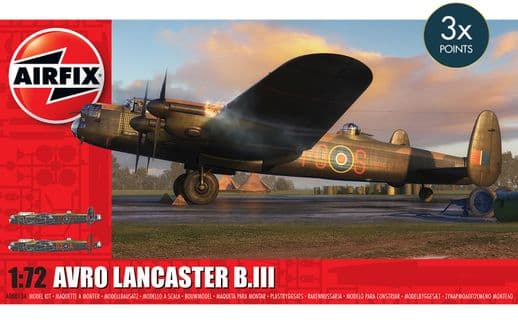
A classic wartime study of a Lancaster centurion – is it any wonder why the aircraft which contested the Second World War have always proved so popular with the modelling community.
Full scheme details for this most famous of Lancaster bombers.
Following assembly and flight testing at Woodford aerodrome in Cheshire, the bomber was delivered to RAF No.83 Squadron at Scampton towards the end of June 1942, taking part in its first operational sortie early the following month. Originally, the bomber carried the fuselage codes OL-Q ‘Q for Queenie’ and would go on to be rather a prolific aircraft with her parent squadron, completing 68 operations with the unit.
On her 46th operational sortie, an attack against targets close to Berlin, the bomber was lucky to make it back in one piece – damaged by flak, the Lancaster was ‘coned’ by several German searchlights for what seemed like an eternity for the crew, also attracting the unwanted attentions of Luftwaffe nightfighters during this time. Thankfully, although sustaining damage, ‘Queenie’ made it back home to Scampton, thanks to the actions of her entire crew.
As No.83 Squadron were due to convert to the latest Lancaster Mk.III in September 1943, R5868 was transferred to No.467 (Royal Australian Air Force) Squadron at Bottesford in Leicestershire, where she was given the codes PO-S ‘S for Sugar’ as the replacement for an aircraft which had recently been lost on operations. In November, the squadron moved to Waddington and Sugar’s operations tally continued to increase – as she approached the incredible mark of 100 ‘ops’, she started to attract the attention of the local press.
At that time, the aircraft was reported to have been sporting a pin-up ‘nude’ as her morale-boosting nose artwork, however, the RAF top brass were less than impressed about the situation, particularly as the Lancaster was attracting so much media attention. The decision to remove the unsavoury artwork was made, to be replaced by Herman Goering’s pre Battle of Britain pledge to the German people that ‘No enemy plane will fly over the Reich territory’, with a yellow arrow pointing to the aircraft’s increasing operations tally. This is now the incredibly famous artwork with which this historic aircraft is associated.
A rare time for celebration. Personnel from No 467 Squadron RAAF toast the incredible achievement of the RAF’s first Lancaster Centurion.
Highlighting the many dangers faced by Bomber Command’s courageous crews on a nightly basis, ‘S for Sugar’ came close to failing to achieve her Centurion Operational landmark. Whilst engaged in yet another raid against Berlin (her 96th operational sortie), R5868 collided with another Lancaster over the target area at 20,000 ft, sending her into a steep dive. The crew managed to bring the aircraft back under control and nurse her back to England, however, she did require extensive repairs once back at Waddington, including the replacement of her entire port outer wing section.
Thankfully, both Lancasters involved in this potentially catastrophic incident managed to survive their unplanned coming together relatively unscathed, with all crew members surviving to recount the tale.
Avro Lancaster R5868 ‘S for Sugar’ completed her 100th operational sortie during early May 1944, and on her return to RAF Waddington following that landmark mission, found almost the entire station, along with British Pathe News, were there to greet them. During the previous night, the crew had been forced to fend off several concerted attacks by Luftwaffe Junkers Ju88 nightfighters, enemy aircraft which appeared determined not to allow this hard-working Lancaster to have her moment of operational glory
Once the aircraft landed back at her home station and the press and propaganda machines started to do their thing, the life or death struggle her crew had been forced to endure just a few hours earlier was quickly forgotten about and Bomber Command had their latest Centurion.
Avro Lancaster B.I R5868 ‘S for Sugar’ would eventually end the war with an impressive 137 operational sorties to her name, with her final ops being repatriation flights for Allied prisoners of war being transported back home during May 1945. It really is fitting that this magnificent aircraft now serves as a treasured centrepiece display aircraft at the RAF Museum London, paying tribute to the international contribution made by the crews of Bomber Command during the Second World War.
Unquestionably, she is one of the most important components of the nation’s rich aviation heritage, and reason alone to make our latest visit to this exceptional museum.
Built in greater numbers than either the Lancaster or Vulcan, the Avro Anson has to be regarded as a British aviation classic.
Few Workbench readers would argue when we describe the first two Avro aircraft types already covered in this review as ‘classics’, however, we wonder how many would also agree that this next aeroplane is fully deserving of receiving that same description treatment. When it comes to aircraft which served during the Second World War, types such as the Spitfire, Lancaster and Mosquito are widely celebrated as examples of Britain’s prowess in the field of aircraft design and production, but how many people do you think would include the Avro Anson in such aviation company?
Produced in much greater quantities than either the Lancaster or the Vulcan, and one of the most important aircraft of the Second World War when it comes to the training of large numbers of crews destined for service with Bomber and Coastal Commands, the Avro Anson was very much the groundbreaking new type at the time of its introduction, and one which would ultimately boast a length of service far greater than some of the more glamorous aircraft types produced by its parent company.
As proved to be the case with many of the twin engined aircraft types which made their first flights during the incredible advances made during the mid 1930s, the aircraft which would go on to become the Avro Anson was designed in response to a civilian requirement, but one which reflected the rapidly changing world of aviation advancement at that time.
Carrying the company designation Avro 652, the new aircraft was a fast and relatively long-range mail-carrying charter aircraft built to satisfy a rather demanding requirement issued by Imperial Airways. Powered by two Armstrong Siddeley Cheetah radial engines, the new aircraft could boast a cruising speed approaching 170mph and an impressive range of 700 miles, whilst at the same time incorporating a host of advanced new design features, making the new aircraft seem to be exactly what the airline was looking for.
Designed by Avro's Roy Chadwick, a man who would later go on to design the Company’s Manchester, Lancaster and oversee the Vulcan project (all within a 20 year period), the new aircraft incorporated a welded steel tube frame fuselage construction, onto which wooden formers and a doped fabric skin could be applied. This method of construction endowed the aircraft with great inherent strength and cavernous cabin space, something which would later prove essential when the aircraft embarked on its military career in the years to come. It would also incorporate a relatively recent innovation - retractable undercarriage.
This was operated by a clever gearing system and manual pump handle arrangement in the cockpit, where after around 140 cycles, the main undercarriage legs would move forwards and upwards into a semi-recessed position within each engine nacelle. This system would prove rather fortuitous should an aircraft be forced to make a wheels-up landing, as the semi-recessed position essentially protected the aircraft from sustaining significant damage during the process.
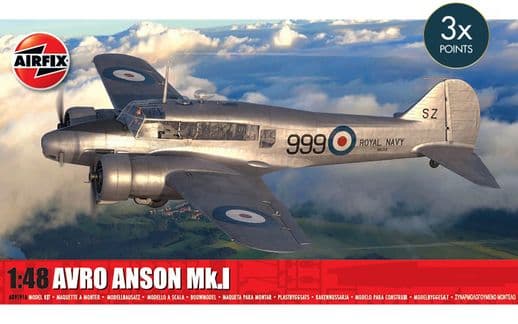
The second release from our new 1/48th scale Avro Anson tooling includes three scheme options which highlight the international popularity of this heavily produced aircraft type.
The first flight of the Type 652 took place at Avro's Woodford aerodrome site on 7th January 1935, with the aircraft exhibiting excellent handling characteristics and generally proving to be a resounding success. Delivery of the two completed aircraft to Imperial Airways at Croydon proved to be a little more dramatic, as one of the aircraft actually made its landing with its main undercarriage wheels still retracted, due to pilot error. Thankfully, because of the design of the undercarriage system and the fact that quite a significant section of the wheels remained outside the nacelle after retraction, the mistake was not as bad as it could have been - aside from bent propeller tips and the red faces of the crew, the aircraft would quickly be returned to airworthy condition.
These two aircraft were named Avalon (G-ACRM) and Avatar (G-ACRN) by Imperial Airways and after years of serving with distinction and with war clouds now gathering, both would be impressed into military service, first with the RAF school of Photography and then with the Fleet Air Arm.
From a pilot’s perspective, the view from the aircraft’s generous cockpit and (later) extensive glazed sections was exceptional and must have made the 652 a delight to fly, but as work began on the two aircraft for Imperial Airways, the design held much more in store for the Avro company and an eventual production run which would see this as their most heavily produced aircraft type.
With construction work already underway on the two aircraft for Imperial, Britain's Air Ministry issued proposals for a new general purpose/reconnaissance aircraft for the Royal Air Force and invited Britain’s aviation companies to submit their designs. After studying these specifications in detail, Chadwick was convinced that his new airliner design was close to meeting requirements and set about building their Type 652A, a military derivative of the existing mail aircraft design.
It wouldn’t be long before this military variant of the Type 652 took on even greater significance for the company, following the Air Ministry's decision to re-designate their requirement as an ‘urgent’ project, requiring the Avro team to devote even greater resource to producing their new aircraft. Powered by two Armstrong Siddeley Cheetah V1 engines, the militarization of the aircraft also brought with it the question of significant additional weight associated with the installation of military equipment, which included defensive armament for the aircraft, in the form of a large manually operated dorsal turret with single Lewis gun and a fixed forward firing Vickers machine gun in the nose, which was operated by the pilot.
The aircraft would also be given the ability to carry a modest bomb load, something which would again go on to increase its operational effectiveness, but also heavy wireless and navigational equipment which would all place further strain on the aircraft’s Cheetah engines.
Entering Royal Air Force service with No.48 Squadron at Manston on 6th March 1936, the Avro Anson represented quite an advance in capability for the force, whilst at the same time presenting them with their first multi-engined monoplane design to see front-line service. It was also the first RAF aircraft to feature a retractable main undercarriage, making this quite an important British aviation type in several ways.
The same attributes which made the Anson such an important aircraft for the Royal Air Force also made it attractive to the Royal Navy, resulting in large numbers of aircraft also going on to see service with the force. Charged with training aircrews across various trades and skills destined to join operational units, the large cabin area of the Anson comfortably supported both students and if required, instructors engaged in airborne training. Although quite a basic design by the mid-war period, the design of the Anson was extremely robust and whilst it might not have been the master of any one aspect of flight, it was incredibly adaptable and extremely reliable.
Hundreds of these aircraft would have been in British and Canadian skies on any given day during the Second World War, with Fleet Air Arm Ansons engaged in providing training support for everything from wireless operators to air gunners and observers, however, if the aircraft were used in a pilot training role, specialist dual control equipped aircraft were required. The spacious cabin afforded trainee aircrews with plenty of room to move around, something which was particularly useful to those engaged in the observer role, as they would often be required to drop marker dyes in the sea both for targeting and positioning purposes. With plenty of stowed equipment available for them to use, this also included an Aldis signal lamp for morse code communications with the shipping below.
As a signal lamp was usually the only way the aircraft could communicate with any naval or merchant ships in its vicinity, the rear window on either side of the aircraft could be opened to allow the observer to signal his message to ships using the lamp, clearly a skill which needed intensive training if it was to be perfected. With its size and weight, the Anson made for a relatively stable platform for such work to be done, something trainees would have no doubt been extremely grateful for.
Avro Ansons were heavily employed in the training of multi-engined aircraft crews during the Second World War, and for many years after the end of hostilities.
Lovingly cared for by personnel at RNAS Sydenham, this aircraft was used to transfer staff between Northern Ireland and the Farnborough Airshow – all is revealed in the text!
Following the end of the war, as so many Ansons were produced, there was a surplus of military aircraft of all types, however, the general attributes of the Anson continued to keep the aircraft relevant, despite the type’s advancing years. With its reputation for reliability and general serviceability, many Ansons would take up positions as Station Flight aircraft at military airfields all over the country, where they would be lovingly cared for by station staff and flown regularly by base personnel. Viewed almost as ‘Hack’ aircraft, these Ansons were used as general communications and liaison aircraft, allowing base staff to travel efficiently between airfields, or to transport engineers and technicians should one of the station’s operational aircraft have a problem at another airfield.
This beautifully presented Anson served with the Station Flight at Sydenham in Northern Ireland during the 1950s and would have been used in this general communications and transportation role at that time. The Royal Navy took over this dockside airfield site in the summer of 1943, where it was known as the Royal Naval Aircraft Yard and HMS Gadwall. From the end of April 1946, it would remain in Royal Navy use, but was renamed HMS Gannet III, remaining in operation until the summer of 1959.
As an illustration of how popular Ansons were in the Station Flight role, in Farnborough Airshow week, many Royal Air Force and Royal Navy stations would send officials to either enjoy, or serve in an official capacity at the show, but with the aircraft landing at nearby Blackbushe airfield, as this was most convenient. Enthusiast photographers would descend on the airfield during Farnborough week to take pictures of the many Ansons and other communications/Station Flight aircraft arriving there, and it was reported that in those days when Farnborough was a huge event, as many as 30 Station Flight Ansons might fly into Blackbushe on any given day.
This particular Royal Navy Anson was photographed at Blackbushe during Farnborough week in 1955, and looking absolutely resplendent in its silver scheme, illustrated the affection in which these aircraft were held by their parent stations. At that time, it’s thought that this was one of the oldest Royal Navy Ansons still in service back then. She will certainly make for an appealing modelling project and will effectively illustrate just how important the Avro Anson was to British aviation during its lengthy service. Compared to the camouflaged RAF Ansons we’re more accustomed to seeing and covered by the initial release of this kit, could this stunning option look any more different from a standard RAF operated Anson?
Full box artwork presentation for this second release from the new 1/48th scale Avro Anson tooling.
Three important British aircraft types produced by the same aircraft manufacturing company over a 20 year period, a period which was probably the most tumultuous in our nation’s history. Which would you select as the most significant or the trio? Would you go for the mighty Vulcan which was only produced in a minuscule percentage of the numbers Avro Ansons were manufactured in, or would the role played by the Lancaster get your vote?
We could probably make a strong case for all three Avro aircraft as being the most significant of this particular gathering, but also a strong case for having all three as model representations in our model display cabinets. With the first flight of the Lancaster taking place less than 6 years after that of the Anson, and the Vulcan taking to the skies some 11 years after the Lancaster, the most interesting aspect is how all three of these radically different aircraft could leap from the same drawing boards in the space of just 20 years – is it any wonder that the modelling world continues to be fascinated by such aviation history.
Currently, all three of these models are in stock and available, so if you happen to have one member of this illustrious aviation trio missing from your own Avro aircraft heritage display collection, I think you’ll agree that this is a modelling story well worth telling in scale form.
We're afraid that's all we have for you in this latest edition of the Airfix blog, but we will be back next Friday with more project development updates and the very latest Airfix kit exclusives. In the meantime, we're always keen to hear your views on all things Airfix and in particular, any thoughts and opinions you may have regarding our Workbench blog. If you would like to drop us a quick line, could we please ask that you use our workbench@airfix.com email for all correspondence.
To re-visit any of the Airfix blogs we have produced over the past TEN years or so, please head to our main Workbench hub, where you'll find our entire blog back catalogue and all the Airfix design projects we have already covered.
All our dedicated official social media sites can be accessed by clicking the respective link icons at the foot of this page, or by heading to the Airfix homepage. Other useful Airfix links are:
Facebook, YouTube, Twitter and Instagram official sites
Please join us for more Airfix updates next week and thank you for your continued support.