

Welcome to this latest edition of our Workbench blog and all the news, updates and modelling exclusives from the fascinating world of Airfix.
Can you believe that we have reached that time of the year already, the final Workbench blog post of 2023 and what a year it's been. In what's turned out to be another feature packed year for new Airfix kit updates, we've not only had a multitude of appealing new additions to the range, but we've also seen several surprise additions to the range, including new tooling project announcements. As you would expect, each and every one of these have been covered within various Workbench updates, however, rather than simply look at the past year of successful releases in review style, we wanted to do something just that little bit different, by way of a little pre-Christmas treat for you.
Despite our very best efforts, mainly due to the sheer number of updates we have to bring Workbench readers throughout the year, sometimes the built model images of the kit subject we are covering in a particular edition may not be available by the time we need to publish and therefore miss their small window of Workbench opportunity. For this final edition of the year, we thought it would be a good idea if we revisited some of those releases, but instead of using imagery already published, only use the built sample exclusives which have as yet been unseen. So, for this final update of the year, we have everything from Land Rovers to BIG Harriers, but all images you will not have seen previously.
Before we make a start, could I please take this opportunity on behalf of the entire Airfix team, to thank each and every one of you for your magnificent support again this year. We continue to be absolutely humbled by the loyalty of Workbench readers and how you help to make each and every edition posted a success by checking in and accessing the latest updates - thank you so much. May we wish you all a very Merry Christmas and a happy, modelling filled New Year!
We will be taking a break next Friday, however, Workbench will be back on Friday 5th January for a new year of Airfix update delights.
Nothing helps tell a Workbench project update story like a built model images and we have an unrivalled selection to bring you in this festive special edition.
One of the major benefits of posting our Workbench updates every Friday, is that we are given the opportunity to cover the vast majority of the latest developments taking place in the world Airfix, always managing to include exclusive information for our readers, be that unveiling new box artwork, or showing built models finished in the decal options to be included in new kit releases. Unfortunately, despite everybody’s best efforts and usually because something has gone a little awry somewhere, there are occasions when images we had hoped to include in an update are not available in time, meaning they usually miss out on their Workbench moment of glory, but not this year.
In order to allow these pictures to be shown, particularly as they often serve as modelling inspiration for many Workbench readers, we have decided to use this final edition of the year to play built model catch up and include a relatively large selection of exclusive build images for your enjoyment. We will begin with our new Land Rover Mk.I starter set and in order to claim a hat-trick of consecutive blog posts on the same subject, will later be including some RAF Buccaneer images, Gulf War Sky Pirates, but this time in 1/72nd scale. This will intentionally be a rather sizeable catch-up edition, so please grab a brew and a couple of mince pies, and settle down for a special edition of Workbench.
A55012 - Land Rover Series 1 Pick-Up Starter Set
Angular and purposeful, you probably wouldn't expect a rugged and hard-working utility vehicle to attract the admiration of the motoring world, however, that is exactly what the Land Rover series effectively managed to do. Entering production back in 1948, the Land Rover was an attempt by the Rover Company to re-enter the motoring market during the financial austerity of the post Second World War period, producing an affordable agricultural and light industrial vehicle with a multitude of applications, on similar lines to the Jeep of WWII, but subtly different.
The Land Rover was designed with little in the way of driver comfort in mind, but was intended to operate effectively in the most demanding of situations, quickly earning a reputation for practicality and reliability. The pick-up version featured an enclosed cab and open rear compartment, which could be used to transport anything from farm machinery to livestock and animal feed over all kinds of terrain. If you had a tough motoring job that needed doing, Land Rover had just the vehicle for you.
From those humble beginnings, Land Rover went on to create something of an automotive phenomenon, although it has to be said that the vehicles which proudly wear that name to this day are very different to the Series 1 vehicles which first rolled off the production lines. For those originals, luxuries and the latest levels of driver/passenger comfort were way down the list of priorities, they were all about functionality and reliability. Some have even described the first Land Rovers as possessing the sophistication of a petrol powered lawnmower, but then usually qualify the statement by including how it may have been basic, but was also wonderfully capable.
The concept behind the Land Rover was that this was essentially a farmer's friend, a vehicle which would help him go about his business efficiently with an absolute lack of fuss - when he needed it, the Land Rover would always be ready for action. Built around a strong and highly effective ladder type chassis, the aluminium body was light and robust, meaning that the vehicle could be powered by a relatively low power output engine, but one which with the use of a high and low range four wheel drive system, allowed the vehicle to handle almost any terrain.
On open roads, the speedometer may have indicated 70 mph and above, however, the Land Rover was not built for speed and anything over 50 mph was an achievement and a rather noisy experience - there certainly wouldn't have been any need for a radio! Unusually, the fuel tank and petrol cap was positioned under the driver's seat on the early models, allowing the driver to have a visual indication of the fuel levels, should the gauge be playing up (which it was prone to doing) and as for the fuel itself, this engine would run on virtually any octane grade of petrol.
The longer wheelbase and larger load carrying area of the station wagon 107 series gave the vehicle incredible versatility and opened up its usage potential to many trades and business applications. In its role as the farmer's friend, the additional space the station wagon offered made it useful when carrying anything from fencing equipment and light machinery, to decent amounts of animal feed for outlying livestock at times of poor weather. Most farmers would also tell you that after a sweep out, it also made for the perfect mode of transport for travelling to and from the local pub with a group of fellow farmers, even though the nominated driver on such an occasion had definitely drawn the short straw.
The rugged adaptability of the Land Rover also extended to the doors, which were hinged to open fully back 180 degrees onto the wing panels for accessibility, with the top section being fully removable, should it prove to be one of those rare warm summers here in the UK, a form of natural air conditioning.
In many respects, the Land Rover was designed to fend for itself, with its owners wanting nothing more than to fill it with fuel and get on with their busy day and in this regard, the Land Rover was exceptional. Described as the finest off-road capable vehicle of its generation, these vehicles may not have been kept in pristine condition, but they were loved for their rugged simplicity nonetheless, and relied upon for their functionality. Even if your Land Rover had a prang and sustained a few dents and scratches, a quick lick of paint would have it looking as good as new - well, at least in acceptable farmyard condition.
Establishing a worldwide reputation which endures to this day, many manufacturers have attempted to follow where these vehicles pioneered, but in the world of rugged, functional vehicles, Land Rover reigned supreme.
A50191 - 617 Sqn. Dambusters 80th Anniversary Gift Set
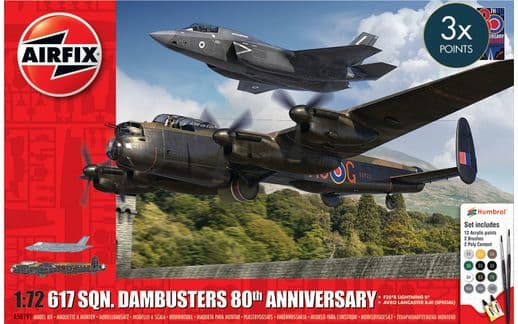
We had to break our own rule here I'm afraid, and include one new piece of Airfix box artwork. In this 80th Anniversary year of the Dambusters range, could there possibly be a more appropriate piece of artwork for us to enjoy?
It will not have escaped many people's attention that this year marked the 80th Anniversary of the Dambusters raid, arguably the most famous bombing raid in the history of warfare and one which propelled the then new RAF No.617 Squadron to unrivalled prominence. Clearly, the modelling world would have expected Airfix to suitably commemorate the occasion in kit form, and as we all know, when it comes to Airfix modelling over the years, two models in the same kit is always better than one, so please meet our 617 Squadron Dambusters 80th Anniversary Gift Set.
A scale representation of the enduring aviation heritage of this most famous of Royal Air Force squadrons, this twin kit set includes Wing Commander Guy Gibson's Avro Lancaster B.III (Special) ED932 AJ-G in which he led the Dambusters raid on 16th/17th May 1943, and one of the latest aircraft to enter RAF service, one which again represents No.617 Squadron, the incredibly capable Lockheed Martin F-35B Lightning II.
It's interesting to note that even though the Lancasters which took part in the Dambusters raid would become some of the most famous aircraft in the history of aviation, only 23 Type 464 (Provisioning) Lancasters were ever produced and indeed for some, the raid would be their only operational sortie. Without doubt, the most famous of all the Dambusters Lancasters, ED932, was not only the mount of raid leader Wing Commander Guy Gibson and his crew, but it was also the subject of only a handful of official photographs which were subsequently published showing an Upkeep equipped Type 464 Lancaster.
The aircraft was delivered to RAF Scampton on 30th April 1943 and immediately allocated to Gibson, where it would wear the rather appropriate fuselage codes AJ-G. Due to the responsibilities of command, Gibson didn't fly his Lancaster on training sorties for as many hours as most of the squadron's other pilots, however, it did go on to drop the unit's first inert Upkeep mine on 11th May, with the Wing Commander at the controls. Unlike the other aircraft of the squadron, it is thought that because of its celebrated assigned pilot, ED932 may have received some preferential treatment during her time at Scampton. Rather than joining the rest of the Lancasters at dispersal areas some distance away from the main building complex, this Lancaster would regularly be parked on the grass outside Gibson's office, clearly one of the perks of his command position.
The rest, as they say, is history for this incredible aircraft, however, as the world continues to mark the heroic exploits of the men of 617 Squadron on that night in 1943, it's probably fair to say that each and every one of them left an indelible impression of the world of aviation history.
As for the F-35, this aircraft is still writing its aviation story, but in the colours of No.617 Squadron Royal Air Force, will be doing so in the full glare of public interest. The Lockheed Martin F-35 Lightning II has been produced in three distinctly different variants, each one intended for a different branch of the US military and each one possessing unique features and capabilities. The F-35B variant Britain elected to take, is arguably the most versatile combat aircraft in the world today and one which possesses many of the operational qualities the much loved Harrier did, only in a 5th generation, long-range stealth strike fighter package.
Lockheed Martin F-35B Lightning II ZM153 is chronologically the nineteenth F-35B built for the UK, making its first flight in August 2020 and arriving at RAF Marham as part of the fourth batch of aircraft delivered on 30th November 2020. The aircraft took off from MCAS Beaufort in South Carolina with two other F-35Bs bound for the UK, making the flight across the Atlantic Ocean with the support of RAF Voyager airborne refuelling aircraft. When the aircraft arrived at RAF Marham, they joined a further fifteen aircraft which had all made this trip before them, with a further three aircraft retained at Edwards Air Force Base, used by RAF No.17 Squadron in a Test and Evaluation role. It's thought that by the end of this year, Britain will have received 48 F-35B jets, with at least 24 of these (two full squadrons) being available for active deployment aboard HMS Queen Elizabeth should they be required.
The initial operational capability for Britain’s F-35B Lightning force was declared on 10th January 2019 for land based operation and subsequently for carrier based operations in late 2020. The first deployment for RAF F-35B Lightnings occurred in May 2019, when 'Exercise Lightning Dawn' saw six aircraft deployed to RAF Akrotiri in Cyprus and during this deployment, two aircraft performed the first combat operation for the type, a Combat Air Patrol over Syria as part of 'Operation Shader'.
Another aircraft type joining the Vintage Classics range in 2023, the distinctive looking Brewster Buffalo is usually castigated as one of the least capable fighters of the Second World War and one which is therefore overlooked, however, this is more than a little unfair and we are certainly glad to now have it in the range. A new monoplane fighter designed for the US Navy, the Buffalo featured a fully enclosed cockpit, hydraulically operated retractable undercarriage and heavy armament, and after the prototype aircraft was later subjected to wind tunnel testing, underwent further modifications to gave it an impressive 10% increase in both speed and aerodynamic efficiency.
Joining the Vintage Classic range in the summer, this attractive little kit was released with two very different scheme options to choose from:
In order to bolster the number of aircraft available to British forces at a time when they could barely make good the losses they currently sustaining, the British Purchasing Commission was established to procure as many US built aircraft as it could during the early stages of the war, one of which was the Brewster Buffalo. Aware of the aircraft ordered by Belgium, the British placed a large order for 170 of the fighters to be designated Buffalo Mk.I in British service, but referred to as the B-339E (England) by Brewster. These aircraft were certainly a welcome addition to the RAF's inventory, however, on their arrival in the UK and after subsequent testing, they were found to be not exactly what the RAF had been hoping for.
The scheme option covered here was carried by an RAF No.67 Squadron Buffalo Mk.I during operations in the defence of Burma, a unit which would be one of the few to spend almost its entire war fighting in the skies over Burma. Formed in Singapore during early 1941, the squadron fully equipped with Brewster Buffalo Mk.I fighters by the end of May, but by the following October had been transferred to Burma, leaving their aircraft to be operated by the pilots and ground crews of No.488 Sqn. RNZAF.
Once they had arrived in Burma, the squadron inherited the Buffalos of No.60 Squadron and would be heavily involved in actions against attacking Japanese forces during the invasion of Burma. Performing valiantly against an overwhelmingly superior and determined adversary, losses began to mount, eventually resulting in a withdrawal to India - highlighting the desperation of this situation, only ten serviceable Buffalos were able to make the transit to India. Buffalo Mk.I W8243 was one of the aircraft involved during the massive Japanese raid against Burma on 23rd December 1941 and is thought to have scored at least one victory against enemy aircraft on that day. Thought to be quite a lucky ship, she was one of the few aircraft to make the withdrawal to India, where she would continue to fly until struck off charge late in 1943.
Brewster F2A-2 Buffalo, Third Section Leader, US Navy Fighter Squadron VF-2, USS Lexington, 1941.
As far as Brewster Buffalo development is concerned, it's widely accepted that the most capable variant of the fighter was the F2A-2, an impressive balance of power, weight and firepower, although the pilots of the Finnish Air Force might have something to say about that. An upgraded variant of the first Buffalos to enter US Navy service, the F2A-2 benefitted from a more powerful Wright R-1820-40 engine, featured a modified electrically operated propeller to utilise all that extra power and included a host of additional safety equipment to make its operation over water potentially more survivable for pilots.
At that time, these little fighters were well liked by the Naval and Marine Corps pilots who were flying them, with this upgraded variant boasting a quoted top speed of an impressive 340mph. The 43 aircraft produced and delivered were direct replacements for the cancelled F2A-1 aircraft from the original US Navy order, with those aircraft actually being the ones subsequently supplied to the Finnish Air Force - at the time, it was decided that the Navy required a more capable version of their first monoplane fighter and would wait for this new variant. It's interesting to note that eight of the originally supplied F2A-1 aircraft would also later undergo upgrade works to bring them to F2A-2 standard.
An attractive pairing, the Brewster Buffalo really does make for an appealing little build project.
The second US Navy unit to be equipped with the Buffalo fighter was VF-2, receiving 18 F2A-2 machines in November 1940 and immediately beginning their work up for a deployment aboard the carrier USS Lexington and a proposed future training cruise to Pearl Harbor. With America not involved in the war at that time, military aviators were busy training for what lay ahead and those posted to fly the Buffalo were generally rather complimentary of the fighter, even giving it the endearing nickname of the 'Peanut Special'. The more potent FA2-2 variant was particularly well liked and one future ace pilot described at the time how landing a Buffalo on the deck of a moving carrier deck was about as much fun a man could have during peacetime.
The final production variant of the Buffalo was the F2A-3 model, an aircraft which was intended as a long range naval reconnaissance fighter, however, the additional weight placed on the aircraft seriously hampered its performance and when combined with continuing problems with undercarriage strength and the strained relationship with the Brewster Corporation, the need to find a more suitable naval fighter saw the Buffalo quickly relegated to secondary duties. Thankfully, all the time the Buffalo was trying to adapt to its role, Grumman had been perfecting their original XF4F-1 design, eventually releasing the excellent F4F Wildcat, an aircraft which would form the backbone of US Navy fighter defences during the early engagements with Japanese forces in WWII.
For an aircraft which had the distinction of being the first monoplane fighter in the history of the US Navy, it's interesting to note that they would not be the largest customer for the Brewster Buffalo, with the majority of the 509 aircraft produced being sent to overseas operators. No US Navy pilots would attain 'Ace' status whilst flying the Buffalo, with that particular distinction going to at least four Commonwealth pilots and impressively, no fewer than 36 Finnish Air Force pilots.
A18001V Hawker Siddeley Harrier GR.1
When it comes to aircraft types and indeed Airfix kits which need no introduction whatsoever, the Hawker Siddeley Harrier is most definitely at the front of this particular formation, an aircraft which captivated the world by quite literally defying gravity. Again taking its place in the Vintage Classics range in a BIG way, our spectacular 1/24th scale kit may have been released last year, however, this was also one of the previous Workbench features which didn't benefit from the inclusion of built model images when they become available, so we felt it was only right to include it here.
With our 1/24th scale range of kits enjoying an almost mythical status within the modelling community, when we were first informed about the existence of this huge kit back in the mid 1970s, we could hardly believe our eyes - surely not, such a large aeroplane for this scale! Those with memories going back that far, or those who have come into contact with the kit since will have noted with interest that this impressive kit took its place in the Vintage Classics range in 2022, featuring two scheme options to tempt us, one Royal Air Force, with the other being a US Marine Corps aircraft. As our built kit has been finished as RAF GR.1 XV788, we will only be featuring that option in this review.
The first example of a production Harrier was delivered to the RAF on 1st April 1969, a date with symbolic significance for them, as it marked the 51st anniversary of the establishment of the force, however it would be Harrier XV746 which became the first aircraft delivered to a front-line squadron, as she arrived with No.1 Squadron at RAF Wittering around three weeks later. The history books record that the Harrier officially entered RAF service on 1st April 1969 with the establishment of the Harrier Operational Conversion Unit (No.233 OCU) also at Wittering, a unit which would be tasked with the honour of introducing this incredible new aircraft into RAF squadron service.
When only modelling BIG subjects will do, our 1/24th scale Harrier more than fits the bill!
The Harrier's service arrival would be marked in a high profile manner, as the jet was entered into the 1969 Transatlantic Air Race, an event which was taking place to commemorate the 50th anniversary of the first non-stop airborne crossing of the Atlantic by aviators Alcock and Brown in their modified Vickers Vimy aircraft. Taking off from an old railway coal yard near St. Pancras Station in central London, an area which the RAF had christened RAF St. Pancras for the occasion and even had a station sign to cheekily prove the point, Harrier XV741 made it to New York in a time of 6 hours, 11 minutes and 57.15 seconds, thus taking the record. In the eyes of the British and American public, this amazing new aircraft was cutting edge technology and rather than ask the question Should we have it, their leaders should have been asking, How many can we get hold of?
The particular Harrier scheme presented here marks the 38th production Harrier GR.1 aircraft delivered to the RAF, making its first flight on 7th April 1970 and delivered to RAF Wittering the following month. She would later be one of 41 GR.1 airframes upgraded to GR.1A standard, following the installation of the more powerful Pegasus 10 (Pegasus Mk.102) engine. She would later undergo an even more comprehensive upgrade, as the GR.3 would see a further engine change, in addition to receiving enhanced electronics capabilities. This upgrade also introduced the distinctive long 'Dolphin nose', which was required to house new laser rangefinder equipment, which gave the Harrier even greater offensive capability. She was one of 61 earlier Harrier variants to undergo the upgrade to GR.3 standard, out of a total of 101 aircraft eventually produced.
In late 1975, XV788 was one of six RAF No.1 Squadron Harriers sent to Belize in the Caribbean, in a high profile attempt to deter Guatemalan forces from encroaching on this British protectorate. Operating from semi-permanent shelters, the aircraft formed No.1417 Flight and provided an aviation show of force in the hope of preventing an escalation of hostilities in the region. Unfortunately, not all the Harriers would return home to the UK following their detachment, with XV788 meeting her end whilst in the Caribbean - during a routine patrol, the aircraft suffered engine failure following a bird strike and crashed into the sea. It is thought that a pelican flew into the engine intake causing a catastrophic engine failure and whilst the pilot was able to eject safely, the aircraft was damaged beyond economical repair.
A02105 Folland Gnat T.1 - Small, but perfectly formed
Any modeller will tell you that sometimes, just sitting down to build a small kit can be quite the pleasurable experience, an opportunity to get away from it all for a while and clear your head immersed in the hobby we love. On occasions such as this, kits like our 1/72nd scale Folland Gnat T.1 in its iconic RAF pilot training livery can be just what the doctor ordered, a little assembly me time in a mad old world, possibly only requiring a couple of enjoyable hours spent at the workbench.
A beautiful little aeroplane and the first mount of the famous Red Arrows, the Gnat makes for an enjoyable and cost effective modelling distraction whatever the situation and whilst it won't require too much space in our display cabinets following completion, will never be short of admiring glances.
For student pilots making their first flight in the Folland Gnat, the experience must have been unforgettable and a little daunting at the same time. Having safely negotiated basic flight training in the steady and reliable Jet Provost, the Gnat must have seemed like something entirely different, real flying in a real performance aeroplane, just what they had joined the air force to do. Likened by many as something of a pocket rocket, the Gnat was a delight to fly, fast and manoeuvrable and the ideal aircraft for future fast jet pilots to gain their first taste of real speed. With power to spare, the relatively small Gnat was able to climb like a rocket, and once a student asked his mount to go, it didn't need telling twice - it must have been exhilarating!
The rather cramped cockpit must have felt somewhat reassuring for the student pilot, almost as if they had strapped the aircraft on in preparation for their latest flight, however, the diminutive stature of the Gnat also posed some distinct drawbacks in operation. Although it must have been thrilling for the student, in the rear seat, the instructor was having a very different experience, having to perform his role in an extremely cramped environment, with very poor forward visibility, which would have been a significant drawback during critical phases of flight.
It was also quickly found that taller and slightly bigger pilots found it difficult to fit in the Gnat and even worse than this, if they were forced to eject for any reason, there was the real chance that they could sustain severe injuries due to the angle of ejection and cockpit fixtures. Although this did see some taller pilots transferring to other aircraft in order to continue their training, pilots who were well over 6ft tall did fly the Gnat without too many problems.
From an engineering perspective, although the Gnat was an extremely pleasing aeroplane to look at, it must have been a nightmare to work on. Everything was crammed into such a small airframe and with space at such a premium, a high degree of dexterity and even the ability to contort your body must have been prerequisites for the ground trades at RAF Valley. Despite this, the Gnat proved to be a successful training aeroplane, serving for 16 years with No.4 FTS at RAF Valley and the mount of both the Yellowjacks and Red Arrows aerobatic display teams during their high profile service life.
The box artwork which graces this release could hardly be more evocative and features two No.4 Flying Training School Gnat T.1s in the skies high above Anglesey in what must have been a memorable playground for student pilots of the day, an image which really captures the imagination of the rest of us who dreamt of becoming a pilot. Wearing what has to be considered the definitive livery for RAF training aircraft, it shows Gnat T.1 XS100 in company with a second aircraft being put through their paces on their latest training sortie, effectively portraying the Hot Ship reputation the Gnat enjoyed.
Constructed in 1964, Gnat T.1 XS100 spent time in storage at a number of sites around the UK following its withdrawal from RAF service but was ultimately dismantled and destined for something of an unusual future. After many years of outdoor storage, the rear fuselage from the instructor’s cockpit position backwards is still thought to be stored at North Weald, an airfield which has become famous with its recent links to airworthy examples of the Gnat. The nose and front seat of XS100 have been tastefully restored and is now located inside the offices of an interior design studio in London.
A06022A Blackburn Buccaneer S.2B GULF WAR
We did say we would be going for three consecutive weeks of Workbench blog postings featuring Royal Air Force Blackburn Buccaneers and we've only gone and done it! Although we have been talking about the larger 1/48th scale kit incarnation of the mighty Buccaneer in our two previous updates, this summer also saw the third release of our popular 1/72nd scale tooling of this famous aircraft, one which commemorates the RAF Buccaneer in the twilight of its operational career and specifically, the exploits of the Gulf War Sky Pirates.
As the Gulf region erupted into conflict in 1990, the ageing Buccaneers of the Royal Air Force were initially told their services would not be required, however, that situation changed pretty quickly. With the RAF's Buccaneers possessing the ability to illuminate targets for laser guided munitions, the race was on to prepare these aircraft for deployment and for the first time in their service careers, for combat. Proudly taking their naval heritage with them, the Sky Pirates would create an enduring legacy of both artwork applied to RAF aircraft and more importantly, operational effectiveness in a warzone.
Having again been told that his Buccaneers would not be required in the Gulf only hours earlier, the Station Commander at RAF Lossiemouth would find himself in an aviation race against time, after receiving a phone call at around 10.30 in the evening from Strike Command HQ. The conversation apparently went something like, "Hello, How quickly can you get your aircraft to the Gulf? - You have 72 hours".
As you can imagine, a period of feverish activity ensued at Lossiemouth, with deployed aircraft and personnel immediately being recalled and work started on preparing the first six Buccaneers for deployment to the Gulf warzone. This work would include the installation of modified IFF equipment, new secure radio sets, new chaff and flare dispensers and a highly visual alteration, the addition of a 'Desert Pink/Sand' ARTF (Alkali Removable Temporary Finish) scheme, to give the aircraft some form of camouflage protection whilst in theatre. From a human perspective, all personnel destined for Gulf deployment were also required to undergo a series of inoculations, just to add to the pressure and their discomfort.
The first pair of 'Pave Spike' equipped Buccaneers left Lossiemouth for the Gulf at around 04.00 on the morning of 26th January 1991, arriving in Bahrain nine hours later, following a direct flight and multiple in-flight refuelling couplings. It was said by base personnel at the time that when the aircraft took off from Scotland, the Desert Pink/Sand paint was still wet! These first two Buccaneers would soon be joined by ten others, with the RAF now having their all-important AN/AVQ-23E Pave Spike laser designation targeting system in theatre.
This technology allowed RAF strike aircraft to accurately target Iraqi hardened aircraft shelters, strategic targets of importance and individual enemy aircraft and even though the venerable old Buccaneers were the last RAF aircraft type to deploy during the Gulf War, these Cold War era strike jets would make a telling contribution to the success of coalition forces in the twilight of their service careers. Operating in pairs, and with four Tornado GR.1s flying with them, one Buccaneer would provide the target marking capability for the formation, with the second aircraft acting as a reserve, in case of any technical difficulties with the lead aircraft. This combination allowed the RAF to accurately deliver their munitions on strategically selected targets and virtually eliminate the potential of any coordinated Iraqi military counter attack, by removing their ability to resupply.
Sisters in Arms, two of the famous Sky Pirates are covered with the introduction of this fantastic third 1/72nd scale Blackburn Buccaneer tooling release.
The RAF's Buccaneer force in the Gulf during 1991 proclaimed themselves to be ‘The Sky Pirates’ in reference to the proud naval heritage of their distinctive aircraft and decorated their classic jets in a suitably swashbuckling manner. Also proudly marking their association with Scotland, the aircraft carried the names of some famous malt whiskeys on the side of the fuselage, along with a variety of ladies names across the fleet. Some of the aircraft also carried striking, if a little risqué, nose artwork, which certainly made these Gulf War Buccaneers highly individual and confirmation that the latest RAF aircraft still needed the help of this wily old warhorse.
Blackburn Buccaneer XW533 was constructed as an S.2B variant for the Royal Air Force by Hawker Siddeley Aviation at Brough and delivered to the RAF on 26th February 1971. She was taken on strength as XW533 and transferred to No.237 OCU at Honington. During her 20 year service career, she is known to have spent much of her time with the Operational Conversion Unit, but also in the colours of Nos. 15 and 208 Squadrons and most significantly, was one of the aircraft sent to support coalition air operations during the Gulf War of 1991.
Whilst on Gulf deployment, the aircraft carried the Sky Pirates and Jolly Roger markings on the port side of the forward fuselage, with distinctive ‘Miss Jolly Roger’ nose artwork and the names ‘Fiona’ and ‘Glenfaclas’ on the starboard side, making her quite the distinctive airframe. During their Gulf War deployment, the RAF's Buccaneers posted an exemplary service record, flying 218 missions and actually dropping 48 laser guided munitions themselves.
On their return to the UK, these aircraft were allowed to retain their Gulf War markings for a time, something which was obviously of great interest to enthusiasts at the time, however, this was a mark of respect for an aircraft which was in the swansong of its service career and scheduled for imminent withdrawal. Records show that this aircraft was broken up and sold for scrap at Lossiemouth in 1992.
With six Buccaneers in theatre by 27th January 1991, a further six Buccaneers had arrived at Muharraq by 8th February, allowing many more tandem laser designator operations to be mounted, with the precise nature of their strikes having a dramatic impact on the outcome of the war. Once coalition forces were confident that air superiority had been fully achieved, the Buccaneers were finally allowed to join in with the bombing operations, self-designating their own targets and dropping their own laser guided bombs. Around 48 laser guided bombs were delivered by Buccaneers in this manner.
With the war over, the Sky Pirates headed back to RAF Lossiemouth on 17th March, flying the 4,000 miles non-stop using in-flight refuelling and home to something of an uncertain future. Proud of their achievements, an aircraft which had been designed to fly low and fast had made its mark operating at altitudes above 20,000 ft, but provided vital support for aircraft which were very much their junior. From the sun of the desert, the aircraft arrived back in Scotland on a typically inclement day, with the conditions further compromising their recently applied 'Desert Pink' paint scheme, which must have looked ridiculously out of place on a grey day at RAF Lossiemouth.
Making her first flight on 29th May 1968, Buccaneer XV863 was delivered to the Royal Navy two months later, where she embarked on what would turn out to be an extremely active thirty year service career. Upgraded to S.2D standard at Brough in early 1973, she continued with her Fleet Air Arm career until late 1978, when she transferred to Royal Air Force ownership and subsequent later conversion to S.2B standard. She would be taken on charge with No.16 Squadron at RAF Laarbruch, but would also go on to spend time with No.237 OCU, No.208 Squadron and then back with the Operational Conversion Unit.
A beast of an aeroplane, the Blackburn Buccaneer was built tough and ready to answer the call to war, even when it came at the end of its service career.
XV863 would also be one of the aircraft to famously serve during the Gulf War, where she carried the nose art 'Debbie/Sea Witch' and the whiskey name Tamnavulin, all on the starboard side of her fuselage. On this same side, displayed under the windscreen framing, she also carried six Paveway LGB symbols, signifying her operational use during the Gulf War in delivering precision guided munitions. On her return from the Gulf, she re-joined No.237 OCU, but was finally withdrawn from service less than two years later.
During the spring of 1994, the aircraft received a smart new application of her famous 'Desert Pink' camouflage and was given a position of prominence as the Gate Guardian at RAF Lossiemouth, a posting she would perform for many years, but slowly suffering the effects of being left out in all weathers. Later removed from display due to her deteriorating condition, she would be purchased by a private collector and moved to a new display location at Weston Airport, near Dublin, where she would initially benefit from some much needed cosmetic attention, but was to ultimately end up in an even poorer state than she was when she arrived.
With her continued display appearing to go against the wishes of airport authorities and with the owner ether running out of funds or losing interest in the project, XV863 was moved to a secluded area of the airfield and simply left to fend for herself. Only last year, this Buccaneer was unceremoniously scrapped, with nothing of note saved for posterity, a sad end for one of the famous buccaneering former Sky Pirates.
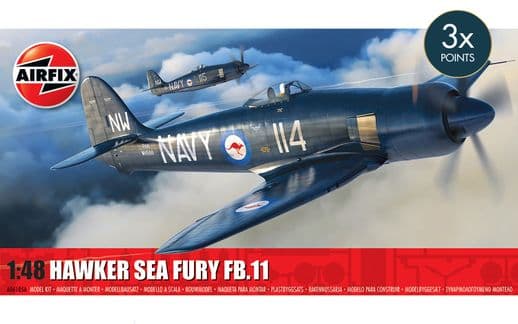
A06105A Hawker Sea Fury FB.11 - Is this the perfect aeroplane?
We end this festive built model review by passing control of proceedings over to the Senior Service and their Fleet Air Arm, with our scale kit homage to two of the magnificent aircraft types which served aboard aircraft carriers during the post war years. Both kits were released this year in 1/48th scale, and it would probably be fair to say that both are spectacular examples of British naval air power.
The first is the Hawker Sea Fury, an aircraft which whilst representing the very pinnacle of piston engine powered aviation technology was also one of the most attractive designs to ever take to the skies. This beautiful aeroplane needs no introduction, but before we move straight into the three scheme options available with this kit, we have to explain that we are including it because even though we were given a single image of each option at the time of producing the update, they hadn't been edited to our usual standard, which they now have.
In all honesty though, we never need too much of an excuse to feature the Hawker Sea Fury.
On 1st June 1947, No.1831 Royal Navy Volunteer Reserve Air Squadron reformed as a reserve fighter unit at RNAS Stretton, one of four such squadrons formed for the RNVR Air Branch that year. It was initially equipped with only seven aircraft, a collection of Rolls Royce Griffon powered Supermarine Seafires and a solitary North American Harvard trainer. Flight operations would take place at Stretton on most weekends, with pilots and observers required to undertake 14 days of continuous training each year and 12 weekends spent on squadron duty. They were expected to achieve a minimum of 75 and a maximum of 125 flying hours, with 2 weeks of continuous annual training and assessment in air warfare and weapons systems, usually at naval air stations away from their home base.
Full scheme details of this No.1831 Royal Navy Volunteer Reserve Air Squadron RNAS Stretton based Sea Fury FB.II, weekend flyers operating one of the world's most potent piston engined fighters.
After completing their annual training camp at RNAS St. Merryn, Cornwall in July 1951, the unit returned to RNAS Stretton knowing they were about to trade their ageing Seafires for Hawker Sea Fury FB.IIs, with a single T.20 trainer having already arrived at the airfield late the previous year, to allow type familiarisation. The Sea Fury was quite a brute of an aeroplane and needed to be tamed by these weekend fliers, however, its wide track undercarriage made it much more suitable for both land and carrier based operations. Nine beautifully presented Sea Fury FB.IIs duly arrived at Stretton during the summer of 1951 and the unit had their ultimate piston fighters.
The first annual training camp following the conversion to Sea Furys was to Malta and the opportunity for squadron pilots to operate their new aircraft in a much more aggressive manner. Operating mainly from the island airfield at Hal Far, they would practice the art of delivering a rocket attack against both stationary and moving targets, in addition to undertaking main armament live firing sorties, using drogue targets both in the sea and pulled by other aircraft. This must have been an exciting time for all involved, particularly as their camp performance was rated as being at least as good as an average front line Fleet Air Arm unit - a proud achievement for 1831 personnel.
Capable and good-looking, what more could you possibly want from a naval aeroplane.
During August 1953, No.1831 RNVR Air Squadron took part in 'Exercise Momentum', which was a major assessment of the air defence capabilities of the Royal Air Force at that time. This involved a hectic period of flying operations for the unit's Sea Furys, as they flew simulated airspace incursions along the south and eastern coasts of the UK, serving as targets for RAF interceptors attempting to chase them down.
Despite the professional nature of their ongoing training programme, the unit's time flying the Sea Fury was not without incident and indeed tragedy, with four reserve pilots losing their lives whilst on flight operations, underlining the dangers these weekend fliers faced in maintaining this valuable additional fighting force.
As No. 1831 RNVR continued to be a top performing unit, they were selected to be the first unit of their kind to re-equip with a jet powered fighter type and in the early summer of 1955, became the first RNVR unit to operate the Supermarine Attacker FB.2 jet fighter, with an additional de Havilland Sea Vampire T.22 two seater arriving for training purposes. During their time operating the Attacker, it is not known if any unit pilot actually landed an Attacker of the deck of a Royal Navy carrier.
Following a savage round of defence cuts in early 1957, the RNVR Air Branch was scheduled for disbandment and by 10th March that same year, the entire organisation and all of its squadrons ceased to exist.
Hawker Sea Fury FB.11 G-FURY, UK Airshow scene, 1981.
As one of the most potent piston engined fighters to ever take to the skies, the Hawker Sea Fury was not only an aircraft many service pilots wanted to fly, but once it had been withdrawn from service, would also become highly sought after by those who were in a position to both fly and afford one privately. A beautiful aeroplane to look at from any angle, whether in the sky or on the ground, the Sea Fury would become a popular addition to the world historic aviation scene and if you were lucky enough to see one fly at an Airshow, all those boring jets just seemed to be completely insignificant, because this was a real aeroplane.
When it comes to Sea Furys which have graced the UK Airshow scene, there is one particular aircraft which happened to be the most striking presentation of a Sea Fury ever seen in UK skies, an aircraft which may have only spent a short time on the Airshow circuit, but is most definitely a case of once seen, never forgotten. Pilot and passionate vintage aircraft collector Spencer Flack managed to amass an impressive collection of aircraft over the years, including this Sea Fury FB.II, a Spitfire Mk.XIV and a Hawker Hunter, all of which were finished in his 'house colours' of red, white and blue. The striking scheme he chose was most certainly an attention grabber and if his impressive collection of aircraft ever needed more publicity, this scheme certainly provided it. Although striking, the scheme was not universally loved, and could actually be described as being somewhat divisive, but as far as Mr Flack was concerned, if you owned a Spitfire or Sea Fury, you could paint yours any colour you like!
Before we move on to the details behind this beautiful Sea Fury, this might be a good time to remind readers that our previously released 1/48th scale Spitfire FR Mk.XIV kit includes decals for Spencer Flack's G-FIRE, so we can now include two of the 'Flack Airline' fighters to our 1/48th scale model collections!
There's no doubt that when it came to Airshow performers, Spencer Flack certainly knew how to get his aeroplanes noticed! Can you imagine a more appealing sight in any display aircraft line-up?
Mr Flack purchased this Spitfire in January 1979 and moved to his base in Hertfordshire, where it benefitted from a concerted period of restoration, returning her to flying condition. After the completion of this costly work, Spitfire NH904, now sporting the new civilian registration G-FIRE, made its first post restoration flight from Elstree Airfield on 14th March 1981 in the capable hands of former Red Arrows leader and warbird pilot extraordinaire Ray Hanna.
Later repainted in a striking red, white and blue livery, G-FIRE would go on to become a firm favourite on the UK Airshow circuit during the 1980s, not only due to its stunning appearance, but also due to the fact that Mr Flack fitted flashing light strobes in the cannon fairings and during a head on pass, it actually appeared as if the Spitfire was firing on the crowds. For those lucky enough to have seen this aircraft up close and in the metal, it will always be remembered as arguably the most attractively presented Spitfire of the post war era – nobody could ever argue that G-FIRE didn’t stand out!
Not content with just owning this beautiful Spitfire, Spencer Flack went on to own several other aircraft, including a P-51D Mustang, and both a Hawker Sea Fury and Hawker Hunter which were painted in similar markings to the Spitfire. It was not uncommon to see the Spitfire either arriving at a show venue, or displaying with one of the other red painted aircraft.
What a cracking scheme! We wonder how many Workbench readers had the opportunity to see this magnificent aircraft, during its brief appearance on the UK Airshow scene?
Hawker Sea Fury FB.II G-FURY was constructed by Hawker Aircraft Ltd at their Kingston-on-Thames factory in 1948 and delivered to the Royal Navy as WJ244, but would end her service career in storage at RNAS Lossiemouth. Following her disposal from military service, she would spend the next few years in the hands of various civilian owners and at different sites around the UK, but would not take to the air again until after she had been secured by Warbird enthusiast Spencer Flack in 1978. Making her first post restoration flight in June 1980, the aircraft would be finished in this striking red, white and blue scheme and was the pride of Mr Flack's growing fleet of impressive Warbirds.
Looking absolutely resplendent in this scheme, the aircraft attended several Airshows during the summer of 1981, always drawing huge crowds of admirers wherever she turned up. There are even photographs existing of the Sea Fury arriving at events in formation with Mr Flack's Spitfire and Hunter, with each one presented in these beautiful markings. The Sea Fury even displayed with wing tip mounted smoke generator pods, as if a display from this beauty ever needed to be made more spectacular.
Unfortunately, despite becoming one of the enduring aviation enigmas of the UK Airshow circuit, G-FURY's time performing for Airshow crowds proved to be all too brief, as she was destroyed following a forced landing in fields close to RAF Waddington on 2nd August 1981. For those who were lucky enough to see her, G-FURY will never be forgotten, one of the most distinctive and attractive aircraft to have ever graced the UK Airshow scene.
When it comes to rivalling G-FURY in the looks department, we think we might just have come up with a viable alternative and this one was worn by a serving Sea Fury. For an aircraft as capable as the Sea Fury, Hawker's final piston engined fighter would not be without its international suitors, with Commonwealth nations being at the head of this aviation pack. In 1947, the Australian Government approved the purchase of two light fleet carriers from the Royal Navy, with the additional procurement of Sea Fury and Firefly aircraft to equip them.
The Fleet Air Arm of the Royal Australian Navy was subsequently formed in 1948 and their first aircraft would serve aboard the new HMAS Sydney (the former HMS Terrible) and HMAS Melbourne (the former HMS Majestic), in addition to equipping the shore based station at Nowra (HMAS Albatross).
The first batch of eleven Sea Furys was delivered in May 1949, forming No.805 NAS, the Royal Australian Navy's first front line naval fighter bomber unit. In total, the Fleet Air Arm of the Royal Australian Navy would purchase 101 Sea Furys and 108 Fireflys from Britain, with quite a number of these aircraft going on to serve with distinction during the Korean War. RAN Sea Fury fighter bombers remained in front line carrier service until 1956, when they were replaced by jet powered de Havilland Sea Venoms, however, the Sea Furys operating out of Nowra would remain in service until the early 1960s, earning a reputation as some of the best looking military aircraft in the world at that time, with the scheme going on to feature on several machines performing on the world Airshow scene over the years.
No. 724 Squadron was re-commissioned into the Royal Australian Navy at Naval Air Station Nowra on 1st June 1955, with the unit having the responsibility of providing fixed wing conversion and currency training for front line Fleet Air Arm squadrons. In this role, the unit would be equipped with several different types of aircraft, including the potent Hawker Sea Fury, but also operating a combination of piston and jet powered aircraft types.
An aviation thing of beauty, the Hawker Sea Fury has to be considered one of the most attractive aircraft to have ever taken to the skies.
Amongst their other duties, from 1958 onwards, the unit also provided target towing services for live firing training exercises, something which would continue until October 1962, when the unit's Sea Furys were finally retired.
Hawker Sea Fury WH5885 was constructed as an FB.II variant in 1951 and taken on charge by the Royal Australian Navy on 7th March the following year. She would be transported to Australia aboard the carrier HMAS Sydney and went on to serve with No.724 Squadron at Nowra Naval Air Station, in a training and conversion role. Struck off charge in September 1963, she would be snapped up by a civilian owner who repainted her in a smart red and white scheme and modified her to take on target tug duties, wearing the civilian registration VH-BOU.
Changing owners once more in 1970, she was subsequently sold to a dealer/collector in America, where she would go on to enjoy a long and successful career on the US aviation scene, competing regularly in the Unlimited Class of the National Championship Air Races, always wearing a two tone grey Australian Navy scheme.
In 1977, the aircraft was purchased by British Warbird collector Paul Morgan, who arranged to have the fighter shipped to the UK and onwards to its new home at Sywell aerodrome. She was repainted into a stunning blue Royal Australian Navy No.805 Squadron scheme and wearing the civilian registration G-EEMV, would spend the next few years thrilling UK Airshow audiences with its displays of grace and brute power. Tragically, the aircraft was written off following a landing accident at Sywell on the 12th May 2001, with the aircraft nosing over on soft ground.
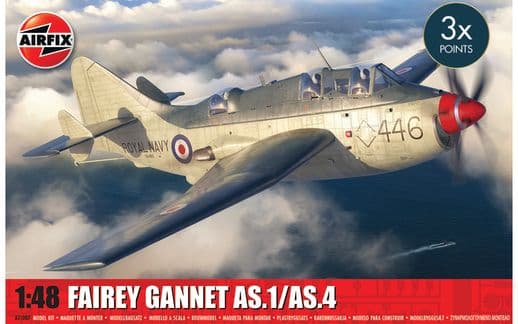
A11007 Fairey Gannet AS.1/AS.4
A totally captivating aeroplane, the Fairey Gannet is full of interest and character and will add much to our model display cabinets.
From the many comments we have seen from modellers over the past few weeks on various forums and social media platforms, we suspect that many modellers probably consider the new 1/48th scale Fairey Gannet to be the Airfix release of the year, a beautiful kit which builds into one of the most interesting models ever to grace our display cabinets. Obviously, we have followed the development of this stunning new kit closely within Workbench and whilst we have showcased box artwork and scheme details previously, this was not with the benefit of built model images for reference, something we are about to put right now.
As our final built model update for this unusual edition of Workbench, we bring you arguably the most visually impactful model subject to join the Airfix range of kits for many a year, the incomparable and totally fascinating Fairey Gannet.
A really impressive naval aircraft type which possessed a number of distinctive features, perhaps the most significant was its use of the innovative Armstrong Siddeley Double Mamba powerplant. This arrangement utilised two gas turbine engines mounted side by side in the nose of the Gannet, sharing a common gearbox, but both operating independently, with each engine driving its own coaxially mounted, contra-rotating propeller.
In addition to this, the engines could run on kerosene and even diesel fuels, which were safer to handle and less refined than traditional aviation fuels. This arrangement provided Gannet crews with more than enough power for effective carrier operations, whilst also providing the reassurance of two engines when engaged in undertaking long ocean patrols in the protection of the fleet. Once in flight, the pilot could shut down one of the engines to conserve fuel and whilst this would reduce the Gannet's maximum speed, it would extend its loiter capabilities considerably.
Usually, a pilot would alternate engine use during a long patrol, running each engine for around an hour before swopping over and feathering the prop, minimising the potential for engine damage and keeping engine usage roughly equal. Providing all the benefits of twin engined operation, the fact that both propellors lay on the centreline of the Gannet, there were no control drawbacks from shutting down one engine in flight. The engine mounted on the port side of the Gannet drove the forward propeller.
Fairey Gannet XA460 was constructed as an AS.4 variant in 1956 and delivered to the Aircraft Receipt and Dispatch Unit at Anthorn on 3rd October the same year, allocated its serial and immediately place into storage. She would later be transferred between the Aircraft Handling Units at Abbotsinch and Culdrose, before finally being allocated to No.849 Headquarters Training Flight at Culdrose in early 1959.
This beautiful aircraft is now under the care of the Ulster Aviation Society.
It appears that during quite an active service career, this particular Gannet was blighted by more than its fair share of unfortunate incidents and technical malfunctions, however in general, the Gannet was regarded as an extremely reliable aircraft and even though XA460 was to suffer a seized engine whilst in flight, the second Armstrong Siddeley Mamba brought her and her crew safely back.
Later selected for conversion to ECM.6 standard, she was allocated to No.831 Squadron at Watton, before arriving at RNAS Lee-on-Solent for reverse conversion back to AS.4. Before being withdrawn from service, the aircraft would once again be allocated to No.849 Headquarters Training Flight, this time at Brawdy, where she wore the code 768/BY.
Following the end of her service career, XA460 was transferred to the Flintshire College of Technology at Hawarden, where she was to serve as a training airframe for their aeronautical engineering department. Later serving as a college gate guardian, she quickly began to show significant signs of deterioration and a decision was therefore made to donate her to an ATC Squadron in Yorkshire. From there, she soon ended up in the care of Doncaster's AeroVenture Museum, where she would remain for the next eight years, before then being donated to the Ulster Aviation Society.
Moving to her new home at Maze Long Kesh in late 2011, Gannet XA460 has since been the subject of a deep restoration project and whilst progress has been slow but steady over the years, she is now looking in much better condition. With the group having a number of exceptional high-profile restoration projects already to their name, it's hoped that she will soon be returned to her former glory, a stunning example of this most interesting aircraft type.
Fairey Gannet AS.4 XA418, No.815 Naval Air Squadron, HMS Ark Royal, 1958.
Another unique feature of the Gannet's design was its intricate bi-folding wing system, an innovation which was designed to allow this relatively large aircraft to operate safely from and to be stored aboard one of the Royal Navy's diminutive aircraft carriers. When a pilot engaged the wing unfold, this ingenious system not only prepared the wings for flight configuration, but also automatically engaged all flight control systems, hydraulic connections and fuel ducting to the main system, without any ground crew intervention in the majority of cases.
In operation, the Gannet endeared itself to both air and ground crews by virtue of its rugged effectiveness and how in one incredible incident, an aircraft managed to safely return to base after losing both outer sections of its wings, after a particularly violent manoeuvre caused them to both be wrenched from the wing. By all accounts, if you were going to serve operating aircraft at sea, you had a better chance of surviving the experience if your mount was a Fairey Gannet.
During the summer of 1950, a Fairey Gannet would become the first turboprop powered aircraft in the world to land on the deck of an aircraft carrier and production deliveries of the most heavily produced AS.1 variant of the aircraft would begin in 1954. No.826 NAS would take the honour of being the first operational Fairey Gannet Squadron in the Royal Navy and around 348 Gannets would eventually be produced.
Ark Royal protector, the endurance of the Fairey Gannet usually meant that the aircraft was the first to take off and the last to land on any operational flying day.
Fairey Gannet XA418 was produced as an AS.4 variant during the early summer of 1956 and delivered to the Fleet Air Arm in July of the same year. It's interesting to note that production of the Gannet was split between two final assembly lines at Northolt and Ringway (Manchester Airport), with both sites receiving components produced in sub assembly plants at Hayes, Hamble and Stockport. Aircraft assembled at Ringway would undergo all their testing and certification flying at the airfield, however, those produced at Northolt made their first flight from Northolt to White Waltham, where their main test and certification flying would take place.
In the livery presented by this scheme, Gannet XA418 served aboard HMS Ark Royal, where she was the subject of a beautifully clear colour photograph, showing the aircraft being prepared for flight operations. In this configuration, the aircraft performed the role for which it was originally intended, defending the fleet against enemy submarine attack, a specialist role in which crews trained constantly. Able to detect submarines using the latest highly effective technologies, once detected, the Gannet could attack submarines either on the surface or whilst still submerged with ruthless effectiveness, using any combination of bombs, depth charges, rockets and air-launched acoustic torpedoes to claim their next victim.
Following the end of her service career, Gannet XA418 was flown to Shorts of Belfast for storage, only to be sold to a local scrap merchant around 22 months later.
Fairey Gannet AS.1 XA335, No.847 Naval Air Squadron, RAF Nicosia, Cyprus, 1957.
During the mid 1950s, British forces based on the Island of Cyprus were embroiled in the conflict between Greek and Cypriot paramilitary groups trying to force an end to British rule on the Island. With the violence worsening, a decision was taken to prevent further arms and explosives reaching the island by boat, with regular patrols by both sea and air hoping to put an end to these disruptive supply runs. Despite having a strong naval presence in the region and access to the RAF Shackletons from Malta, further action needed to be taken - it was felt that having access to aircraft actually based on the Island would make these patrols much more effective.
In support of this decision, No.812 Naval Air Squadron at Eglinton was split to create No.847 NAS and was allocated three Fairey Gannet AS.1 aircraft. Taking up residence at Royal Air Force Station Nicosia on 6th April 1956, these aircraft immediately began flying observation patrols around the island, looking for signs of suspicious activities, or vessels which may be being used for terrorist purposes. Operating in conjunction with Royal Navy fast patrol craft, any signs of activity were reported back and a Navy boat immediately dispatched.
These patrols must have proved effective, because a general reduction in violent incidents saw 847 heading back to their home base at Eglinton at the end of November 1959, only to be disbanded on their arrival. During a hectic period of flying activity whilst operating from its temporary base on the Island of Cyprus, No.847 NAS amassed an impressive 1,700 operational sorties, in a glorious, yet relatively unsung chapter in the history of the Fairey Gannet.
Gannet XA335 was constructed as an AS.1 variant at the beginning of 1955 and delivered to the Fleet Air Arm at the end of June the same year. She would be one of the aircraft sent to fly anti-arms patrols from RAF Nicosia during the second half of the 1950s, where she was also the subject of a rare and unusual colour photograph, showing her as a particularly colourful example of this distinctive aircraft. Resplendent in her wing and fuselage identification markings and sporting a red spinner, she really was a beauty and presumably served as a highly visible deterrent to illicit arms smuggling activities.
Despite being a real Fleet Air Arm looker of an aircraft, XA335 was unceremoniously scrapped at Abbotsinch at the end of February 1962.
This colourful Gannet worked tirelessly in patrolling the coast of Cyprus during the islands troubled period during the 1950s, in an attempt to deter the smuggling of arms and explosives by paramilitary groups fighting on the Island.
In the main, pilots who served flying the Gannet were extremely complimentary about the aircraft and whist probably initially describing it as a large and ungainly beast, would usually end by extolling its many admirable qualities, safety and reliability being amongst the most important. With some even describing it as being so ugly it was actually beautiful, they would go on to describe all the things that made this a special aeroplane and the men who operated it a special breed of airmen.
With the cockpit being set so high from the deck of the carrier, pilots describe how climbing up there was not for the faint-hearted, but once there, how you felt like the king of the ship. This exceptional view made deck landing approach in a Gannet quite a pleasurable experience and with the abundance of available power from the Double Mamba engine arrangement, if the pilot should be waved off for whatever reason, the Gannet simply climbed away and joined the pattern again, with a minimum of fuss.
With the exceptional range afforded by the single engine cruising capability of the aircraft, a carrier's Gannets were typically the first aircraft to take off at the start of any flight operations and the last to recover and if flying late and in dusk conditions, there would be light for the main strike aircraft landing on, but this will have all but disappeared for the poor Gannet pilot.
Pilots who operated the Gannet at Airshows around the UK described how they always knew how to make an entrance. The noise projected by a Double Mamba arrangement at full power ensured that everyone in the vicinity of the aircraft would immediately look to see where all that racket was coming from. Wherever possible and at the end of a Gannet display, the pilot would activate the wing fold system whilst the aircraft was heading back to its parking spot, but whilst facing the crowd. As the hydraulic system was not sequenced, one wing would normally raise before the other and with the distinctive double fold, it looked for all the world as if the aircraft was saluting the crowd.
The Fairey Gannet was undoubtedly an aircraft bristling with character.
That actually turned into a beast of an edition, however, we will all be having a little extra time to ourselves over the coming few days, so if needs be, you could always digest this built model catch-up edition in a series of manageable sittings. They do say that when it comes to modelling inspiration, pictures are everything, however, we also believe that the schemes featured above all have such compelling and engaging stories behind them that any one of them would make for an enjoyable build project, our little piece of history in scale model kit form.
Before we sign off for the year, this seems like a perfect opportunity to thank our colleagues in the photography/creative content team for all the hard work they do in supporting all the Hornby brands, in such a high profile, visual manner. Blogs and websites just wouldn't be the same without your input, so please accept this sincere Thank You from the Airfix team.
We're afraid that's it for another year, so from all of us here at Airfix, may we to wish everyone a very Merry Christmas and see you in the New Year.
We are afraid that's all we have for you in this latest edition, but we will be back on Friday 5th January with more project development updates and the very latest Airfix kit exclusives. In the meantime, we are always keen to hear your views on all things Airfix and in particular, any thoughts and opinions you may have regarding our Workbench blog. If you would like to drop us a quick line, could we please ask that you use our workbench@airfix.com email for all correspondence.
To re-visit any of the Airfix blogs we have produced over the past seven years or so, please head to our main Workbench hub, where you will find our entire blog back catalogue and all the Airfix design projects we have already covered.
All our dedicated official social media sites can be accessed by clicking the respective link icons at the foot of this page, or by heading to the Airfix homepage. Other useful Airfix links are:
Facebook, YouTube, Twitter and Instagram official sites
Please join us for more Airfix updates next week and thank you for your continued support.