
Welcome to this latest edition of Aerodrome and our regular look at the fascinating world of aeroplanes and the historic aviation scene in the UK.
During the dark days of the Battle of Britain, the Royal Air Force airfield at Biggin Hill was at the heart of the nation's attempts to resist the terrifying onslaught of the Luftwaffe, the aviation prelude to what would surely be invasion. One of eight main sector station airfields within No.11 Group Fighter Command and with its position covering raids against nearby London, aircraft operating from Biggin Hill would play a pivotal role in this aerial struggle and as a consequence quickly became a location familiar to millions of people, both in Britain and across the wider world. A base from where the youth of a nation showed their brave defiance in the face of overwhelming enemy aggression, Biggin Hill would become inextricably linked with the fighters of the RAF, particularly the Spitfire. Perhaps this is why it's so fascinating to learn that Biggin Hill continues to be a haven for Spitfires and other historic wartime era aircraft, almost 83 years after the airfield helped to clear Britain's skies of enemy aircraft incursion.
In the latest edition of Aerodrome, we report on two recent visits to a fascinating location on the eastern perimeter of what is now London Biggin Hill Airport, were a very special group of people are dedicated to maintaining, restoring and operating an ever increasing collection of wartime aircraft, including one of the finest concentrations of airworthy, or soon to be so, Spitfires in the world. If you have ever dreamed of flying in an example of the most famous fighting aeroplane to have ever taken to the skies, this is also something these people can help you with, they might even arrange for you to be chased by a Messerschmitt, if you were interested in that sort of thing!
Eighty three years after squadrons of Spitfires rose from this famous RAF station to challenge the Luftwaffe during the Battle of Britain, Biggin Hill can still boast an impressive collection of airworthy Spitfires at this location, almost approaching squadron strength.
Situated within the beautiful Kent countryside and just a few miles inside the southern section of the M25 Motorway, London Biggin Hill Airport may now represent a gateway to London for thousands of business professionals, or a convenient airport for football teams in the vicinity to fly to their latest fixture, however, to many people, this airfield has a very different past, one which came to prominence during the defence of Britain during the early months of the Second World War. Although Biggin Hill came to be regarded as one of the RAF's premier fighter stations and arguably the one which most members of the general public would become familiar with, the airfield had relatively humble beginnings, with its high position on the North Downs making it an ideal location from where to listen and to communicate from.
The airfield at Biggin Hill can trace its origins back to 1916 and a local RFC officer who was charged with establishing a base from where to conduct wireless communications experiments. Aware of the location and feeling it would be ideally suited for the task, his report led the RFC to requisition land in the area, a decision which was presumably influenced both by its proximity to London and by the fact that it was rather conveniently positioned next to a large, unobstructed field, one which would make for an excellent emergency landing ground for aircraft, as and when required.
The following year, the RFC transferred their headquarters to Biggin Hill, at the same time as establishing the site as part of their plans for the defence of London, with the airfield now having the added responsibility of operating aircraft against raiding German Zeppelins and Gotha bombers. The first official fighter squadron to be based there was No.141 Squadron with their Bristol F2B Fighters, in a dedicated night defence role.
Following the end of the war, Biggin Hill was again used as a location from where experimental works were carried out, such as research into aircraft instrumentation, assessing the effectiveness of ground to air anti-aircraft defences and the perfecting of night flying techniques. The site would be closed between 1929 and 1932 for site upgrade, but on reopening, was a very different place and a much more complete, modern aerodrome complex.
Spitfires are still maintained in airworthy condition at Biggin Hill to this day, continuing a proud aviation legacy which began over eighty years ago.
During the Second World War, Biggin Hill would secure its reputation as one of the RAF's most important fighter stations, with its close proximity to London meaning it was never too far away from the action. It's location also determined that it was regularly visited by the Luftwaffe and whilst it did manage to remain operational throughout the Battle of Britain, it was touch and go at times and the airfield did suffer significant damage and loss of life during this period. By the end of the battle, Biggin Hill based squadrons had been credited with at least 340 Luftwaffe aircraft destroyed, but for the tragic loss of 54 of their own number.
Following the end of the Battle of Britain, Biggin Hill based squadrons would go on the offensive, with ever more capable fighter aircraft continuing to take a heavy toll of Luftwaffe aircraft. On 15th May 1943, Biggin Hill Sector based aircraft became the first to be credited with the remarkable figure of 1000 enemy aircraft destroyed in aerial combat, a figure which would increase to over 1400 by war's end.
With the war now over, RAF Biggin Hill entered a period of quite significant change, albeit with its historic aviation reputation assured for generations to come. In the immediate aftermath of war, the airfield played home to aircraft of Transport Command, as people and supplies were shuttled between Britain and Europe, but as an uneasy peace settled across Europe, the airfield would be transferred to the care of Reserve Command for a while. It would later revert back to a Fighter Command station with the arrival of Nos 600 and 615 Squadrons Royal Auxiliary Air Force, initially flying Spitfires, then entering the jet age with Meteors and Hunters.
In 1957, Biggin Hill would become the home of the Historic Aircraft Flight, a unit dedicated to the preservation of an airworthy collection of wartime era aircraft, all of which were required to perform ceremonial flight duties and to head the popular Battle of Britain Day flypasts over London. This unit remains in operation to this day, but we now know it as the Battle of Britain Memorial Flight operating from their long-time home at RAF Coningsby. Just the year following this historic development, the airfield had been relegated to non-operational status, however, the RAF did retain facilities on the North Camp site, where the Officer and Aircrew Selection Centre would put thousands of hopeful candidates through their paces, as they embarked on what they hoped would be a long career in the force. This is where I gained my first experience of Biggin Hill, when I attended the centre in the early 1980s and could hardly believe my luck when a Spitfire blasted into the sky from this famous airfield as I was on my way to my latest series of assessments.
Adding aviation balance, the Biggin Hill Heritage Hangar also has one of the rarest historic aircraft in the world under their care, a Messerschmitt Bf 109E fighter which is thought to have been flown by famous German ace pilot Hans Joachim Marseille during the Battle of Britain.
By 1992, the RAF had left Biggin Hill altogether and facilities began to suffer from neglect. Today however, the airfield appears to be in rude health, an active base from where business aviation and maintenance of these aircraft is thriving and how it is used regularly by locally based football clubs when heading off to fulfil a distant fixture, or overseas training camp.
Significantly though, this famous old RAF fighter station also regularly reverberates to the sound of Rolls Royce Merlin engines, as the Biggin Hill Heritage Hangar uses the airfield as a base from where to conduct its high-profile operations and by way of adding a little historical balance, even have a genuine Daimler Benz powered Messerschmitt Bf 109e within their collection. It seems somehow fitting that this airfield which has such historic links with the wartime operation of single engined fighter aircraft is still doing so to this day and how Spitfires still rise majestically into the air from 'Biggin on the bump'.
Aviation heritage at its best - behind these hangar doors lies a unique collection of historic aeroplanes, many in airworthy condition, but with others soon to join them.
With its enduring heritage as one of the most famous Royal Air Force fighter stations, Biggin Hill has been a popular destination for enthusiasts over the years, whether this was to visit the collection of captured enemy aircraft the airfield held in the years following the end of WWII, visiting the on-site museum, or attending one of the many Airshows held here, most of which proved so popular that they effectively closed down the immediate area, due to the sheer number of people trying to access the airfield. During the Airshow years, celebrated Spitfire pilot Ray Hanna would usually be given the honour of closing each day's flying displays and for those of us who were fortunate enough to experience one, the memory of seeing this master of his craft displaying this iconic aircraft at arguably its most famous operating airfield is a memory we will hold dear until our last moments. Even then, this was such an aviation spectacle that Mr Hanna and his Spitfire will surely be waiting for us in heaven, just to confirm that we have assented and not gone in the wrong direction to the other place!
A major feature of some of the later shows at the airfield was a restored Spitfire which was based at Biggin Hill, a machine which proudly carried the name 'The Spirit of Kent' on its fuselage and was known by all in these parts as 'The Kent Spitfire'. This aircraft and its links to the airfield must have helped form the nucleus of an even more ambitious Spitfire related idea, one which would see the establishment of the Biggin Hill Heritage Hangar in 2011. Initially, the intention was to restore a single Spitfire to airworthy condition at the facility, however, Spitfires can have quite an effect on people and things have taken a turn for the slightly more ambitious since then.
In their current facility at the airfield, they have now assembled a team of professional engineers who possess expert knowledge of skills from a bygone era, Spitfire experts in the field of restoration, maintenance and the servicing. This gathering of acquired knowledge has made their business proposition unique in the world of aviation and given them international exposure, basically a modern day Spitfire factory in full operation. From their still quite impressive beginnings, the recent first post restoration flight of Spitfire LF Mk.IX TE517 marked the 15th Spitfire the Biggin Hill Heritage Hangar team have returned to airworthy condition, something which must be a source of real pride for everyone involved with each and every project. Any visit to this impressive facility also confirms the fact that there appears to be no shortage of future projects awaiting their attention, with this already impressive restoration figure certain to rise further in the years to come.
The pride of Kent, Spitfire TA805 marked the beginning of an aviation phenomenon which has seen not only a great many Spitfires passing through this famous old RAF station, but also other piston powered historic aircraft too.
Spitfires of all types and in all states of repair. The Biggin Hill Heritage Hangar really does resemble something of a modern day Spitfire factory.
All restoration projects have to start somewhere and with no end of projects awaiting their attention, the team at Biggin Hill are going to be kept busy for many years to come - they might even need a bigger hangar soon! Surely this work is just like building a full size Airfix kit, isn't it?
Spitfire international. Not all of the Spitfires found at Biggin Hill are presented in traditional Royal Air Force markings.
A paradise for modellers, there are detail opportunities galore for those who enjoy modelling and with an unequalled level of knowledge and expertise now gathered at Biggin Hill, if you have questions, these guys will know the answers - What they don't know about Spitfires, really isn't worth knowing.
It's all in the detail. This is the restored wheel well of Marseille's historic Messerschmitt Bf 109E.
As one of the many unique opportunities the Biggin Hill Heritage Hangar team now offer their customers, on specially arranged dates, people can apply to join one of their fascinating hangar tours and if you are expecting to see a couple of Spitfires during your visit, prepare to be amazed - you're going to see so much more than that! You will definitely see your two Spitfires, but there will be several others to admire in various states, from those fully restored and awaiting their next flight, to those currently under restoration, or stored awaiting future attention. You will also see several other aircraft types, large numbers of aero engines and a collection of other machines and artifacts to make this a truly unique experience.
Perhaps the most significant benefit of any visit to the Biggin Hill Heritage Hangar is the possibility of seeing a Spitfire flying from this truly historic location and even more than this, offering the chance for you to be in one! This is now one of the world's foremost locations for Spitfire experience flights, with the Heritage Hangar's collection of FOUR airworthy two seat Spitfires being the highest concentration of such aircraft to be found anywhere in the world. Indeed, it was one of these 'Spitfires made for two' which was the reason for our two visits over the past couple of years, as we were looking to produce a Corgi die-cast model of T9 Spitfire TE308, an aircraft which is undoubtedly the most distinctively presented airworthy Spitfire flying in Britain today.
With two seat Spitfires now becoming a major feature of the UK historic aviation scene, in addition to also now being such popular Airshow performers in their own right, we thought it was about time that we had a scale die-cast model example within the Corgi range and the good people at the Biggin Hill Heritage Hangar were only too happy to help with our quest. They were kind enough to allow us to conduct a LIDAR scan of TE308, the first time either Corgi or Airfix had ever scanned a Spitfire in support of a new model tooling project, something which for us, makes this recently released project quite unique in its own right. Interestingly, when our product designers later overlayed the Vickers Supermarine drawings we have in our research files on top of the scan data, the two matched perfectly.
From a project perspective, if you need to scan a two seat Spitfire, where else would you go than to the home of the largest fleet of airworthy two seat Spitfires in the country?
Intended as pilot training aircraft, a two seat Spitfire is the only way a member of the general public could ever hope to fly in one of these iconic aeroplanes, unless of course they became a pilot and got very lucky. If you are going to take a flight in a historic aircraft, surely it just has to be a Spitfire!
When the first Spitfires began arriving at RAF airfields from early August 1938, squadron pilots must have marvelled at the sight of this sleek new fighter, if being secretly a little trepidatious about making their first flight in one. Their usual mounts were the latest biplane fighters of the day, aircraft such as the Gloster Gauntlet, which whilst itself was a fast and manoeuvrable interceptor, could hardly have been more different to a Spitfire. In contrast to their open cockpit, fixed undercarriage and bi-wing design, the Spitfire brought with its sleek monoplane design, a fully enclosed cockpit, retractable undercarriage, eight wing mounted machine guns and perhaps of greatest significance, a maximum speed increase of over 130 mph. In aviation terms, this really did represent a quantum leap in aviation performance and sooner or later, these young pilots would have to try and tame this beast of an aeroplane.
For an aircraft which clearly represented the future of the Royal Air Force and one which was such a huge advancement in aviation technology, it can be surprising to learn that the RAF gave little thought to the production of a two seat training variant of their new fighter. As the first aircraft began arriving with front-line squadrons, they appeared to have great faith in the abilities of their young pilots in their ability to make the transition from biplane to world-leading monoplane fighter. Reading the accounts of pilots who were serving during this tumultuous period, many described how they were petrified of the Spitfire and how some even felt as if the aeroplane was telling them that it wanted to kill them during their first experience of it.
They had negotiated one of the finest and most robust flight training programmes in the world at that time, however, they were going to have to bring all their training and experience to bear, plus copious amounts of courage and resolve if they were going to get over this particular technological hurdle and quickly, as the war clouds were gathering ominously in Europe. So, the young men or the RAF were going to have to read their pilot's notes, pay attention during ground study classes and listen to the instructions given by those already converted to Spitfires who were showing them around the cockpit instrumentation layout, because their first flight in a Spitfire was just around the corner and it would also be a solo affair.
Thankfully, once most pilots had experienced time in a Spitfire and coped with how everything had to be done more quickly and decisively than on the types they had flown previously, especially during take-off and landing, they found that the new fighter was a delight to fly. Of course it had its vices and potential problem areas, but if you had your wits about you and were professional in your preparation, the Spitfire was your friend and not your foe.
The subject of two seat training variants of the Spitfire didn't officially rear its head until after the end of the Second World War and with stories circulating about 'unofficial conversions' carried out on several Spitfires supplied to the Soviet Union under Lend-Lease and with a rather famous two seat 'hack' having been operated by RAF No.261 Squadron in the Middle East. The Vickers Supermarine Company revived their interest in producing a two seat dual control variant of the Spitfire as a private project and in 1946, selected a Spitfire Mk.VIII airframe (MT818) as their donor aircraft. In fact, one of the most interesting facts regarding the two seat Spitfire variant is that there is no such thing as a new build Spitfire T.9 trainer - every single example in existence was originally manufactured as a single seat fighter variant prior to modification.
The start of an aviation phenomenon. Spitfire T8 MT818 was the airframe Vickers Supermarine selected as their two seat Spitfire trainer prototype and this historic aircraft is now part of the Biggin Hill Heritage Hangar collection. Genuine two seat Spitfire royalty.
In early 1947, two seat Spitfire MT818 was sent to Boscombe Down to undergo handling trials and whilst it performed extremely well, the lack of interest shown by the Ministry of Defence effectively ended any hope of large scale production of the aircraft - at that time, the Royal Air Force only had eyes for jet power. The aircraft would be retained by Vickers Armstrong and used for promotional and demonstration purposes, even being allowed to enter several high profile air races around the country. She would eventually be sold to new owners in the US, but in a fascinating turn of aviation fate, now resides as part of the Biggin Hill Heritage Hangar collection, the historic two seat Spitfire which started the flight opportunity phenomenon we all know about today.
Something of a post war phenomenon, the two seat Spitfire did attract several military operators over the years, including the Irish Air Corps, however, it has been during the warbird restoration era and more specifically over the past two decades, that the popularity of ‘Spitfires made for two’ has really become established. As arguably the most famous aircraft of all time, the ability to boast that you had flown in a Spitfire used to be the preserve of talented and extremely fortunate pilots, however, as they now had the opportunity to carry a passenger, the chance to fly in a Spitfire was now open to anyone and there has been no end of people desperate to claim their Spitfire flying experience.
Today, offering Spitfire experience flights has become an extremely lucrative business, to a point where only a few years ago, almost every Spitfire under restoration was being converted to T.9 or two seat Spitfire standard. These aircraft are now much loved in their own right, regularly appearing at Airshows, in addition to operating in all but the poorest weather conditions, taking its latest lucky passenger on their Spitfire experience flight of a lifetime. These Spitfires made for two are maintaining and even enhancing the legacy of this magnificent aeroplane, bringing R.J Mitchell’s classic fighter to the attention of a new generation of Spitfire aficionados.
One of the most distinctively presented historic aircraft in the world, and you can take an experience flight in her. Just one of the aviation delights awaiting visitors to the Biggin Hill Heritage Hangar.
Supermarine Spitfire TE307 was originally constructed as a Mk.IXe fighter variant in 1945, but due the end of the war in Europe, was immediately placed in storage, where she would remain for the next five years. She was then selected as a conversion airframe to T.9 trainer standard, initially earmarked for service with the Egyptian Air Force, but when that sale fell through, would embark on a service career flying with the Irish Air Corps. Following retirement and service disposal, she would go on to be used during the filming of the famous movie 'The Battle of Britain', before moving into private ownership and periods spent with different owners in France, Canada and the US over the next few decades. She would later be purchased by Warbird Experiences at Biggin Hill and returned to British skies at that time wearing the standard RAF wartime day fighter scheme the Spitfire is so synonymous with, however, she was about to take on a very different aviation persona.
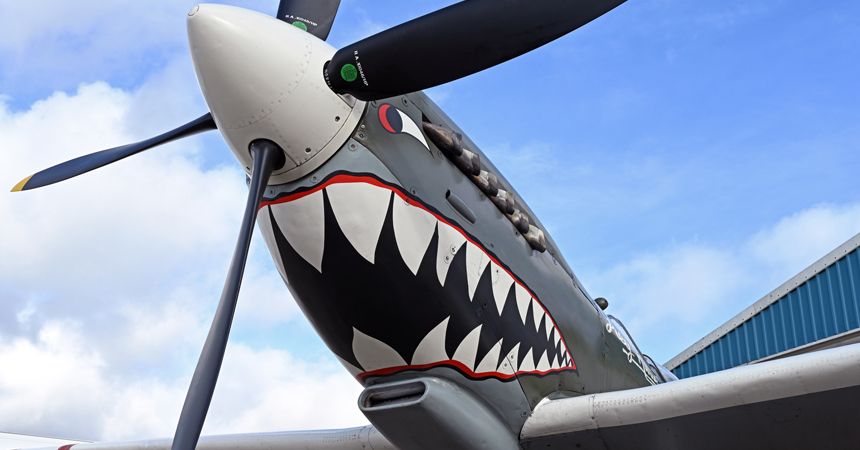
In a development which saw this aircraft become one of the most distinctive airworthy Spitfires in the world today, T.9 TE307 was given a smart new scheme in honour of the fighters flown by the men of No.457 Squadron Royal Australian Air Force during WWII. With each of their aircraft benefitting from the application of sinister looking shark mouths under the engine cowling, the unit was known as the 'Grey Nurse' Squadron and Spitfire TE307 now carries the registration A58-606 and the codes ZP-W in honour of Squadron Leader Bruce Watson, who flew with this unit.
If you would like to fly in one of the most distinctive Spitfires in the world today, you need to get in touch with our friends at the Biggin Hill Heritage Hangar and join the long queue of people hoping to have the opportunity to enjoy this unique aviation experience. With four two seat Spitfires at their disposal and with several flights scheduled on each fair weather day (aircraft serviceability and pilot availability allowing), even though there might be a long waiting list for such an opportunity, they do their level best to keep this list at a reasonable level.
Two seat Spitfire flights are now big business and if you are going to enjoy this fantastic aviation experience, shouldn't the aircraft's smile match your own?
Any visit to the Biggin Hill Heritage Hangar is one to look forward to, offering a unique experience which cannot be enjoyed anywhere else in the world. On a day where someone is enjoying an experience flight, you might even have the chance to see a Spitfire firing up its Merlin engine and taking to the skies, in quite possibly the most historically appropriate location for such an iconic sight to be witnessed. With so many projects on the go at any one time, no one visit will ever be enough, as existing projects will have advanced further and new restorations may have been started, not to mention the possibility of historic aircraft undergoing maintenance and servicing within the two hangars. This really is a fantastic place to visit.
They always say that every Spitfire needs to be chased by something (okay, that might just be my saying) and during our visits to the Biggin Hill Heritage Hangar, we were lucky enough to see two magnificent Messerschmitts and parts from a famous third, however, we will be saving details of these for a further edition of Aerodrome and an unusual Luftwaffe link to this famous former RAF fighter station.
A final image round up of our visits to the Biggin Hill Heritage Hangar. Not all the two seat aircraft we saw were Spitfires - This rare Curtiss TP-40N seems rather pleased to have moved to Biggin Hill, judging by its enthusiastic smile.
Beware the Messerschmitt in the hangar - actually, the Hispano Buchon HA-1112 if we are being pedantic. Recently acquired 'White 9' will be available to intercept you whilst you're enjoying your Spitfire experience flight, just to spice things up a little.
The Grey Nurse Spitfire T.9 TE308 is waiting - will you be her next passenger?
We would like to thank our friends at the Biggin Hill Heritage Hangar for not only allowing us to pay two hugely enjoyable visits their facility, but also for being so generous with their time and expertise on both occasions. For allowing us access to their magnificent aircraft collection, well, that was just a dream come true for us and just one of those days when you consider yourself extremely fortunate to work for Hornby Hobbies.
For anyone interested in taking a Spitfire experience flight, a flight in a P-51D Mustang or to enjoy one of the many other aviation delights on offer at the Biggin Hill Heritage Hangar, please do drop them a line, as they will be only too happy to make your aviation dream come true.
Vickers Wellington Mk.X MF628 under restoration at Cosford in 2017.
We end this latest edition of Aerodrome with some exciting news coming from the Royal Air Force Museum Midlands - their rare Vickers Wellington has just relocated!
The museum's Vickers Wellington Mk.X MF628 is one of only two complete examples of this important British bomber to be found anywhere in the world, with this particular aircraft being built by Vickers Armstrong at their Squires Gate, Blackpool factory during 1944. Delivered to No.18 Maintenance Unit at RAF Tinwald Downs for storage just 3 days before D-Day, this Wellington would not see operational wartime service, but would be used as a crew trainer and navigational instruction aircraft following conversion to T.MK.X standard. Use in this role required the removal of the front turret, replacing it with a painted over fairing and the installation of specialist navigational training equipment.
Rather poignantly in this 80th anniversary year, the aircraft would later be used as a camera ship during the filming of the classic ‘Dambusters’ movie, a film many of us will no doubt be watching again over the coming weeks. Acquired by the RAF Museum, their technicians re-installed the front Frazer-Nash turret, in an attempt to return the aircraft to something like its original Mk.X variant configuration and after many years on display at Hendon, it was decided the Wellington should benefit from full long-term restoration. This process would require the aircraft's disassembly and transportation by road to their Cosford site. The massive fuselage of the aircraft arrived in Shropshire at the beginning of July 2010, with the wings, engines and propellers following on around ten days later. Corrosion found in the intricate geodetic construction of the wings and fuselage ensured this would be a complex and time-consuming project, but we are delighted to confirm the triumphant culmination of this challenging work.
Now on public display at the RAFM Midlands Cosford site, the Wellington will be the centrepiece of a new Bomber Command exhibition, which is due to open next month and as you would expect, your roving Aerodrome editor will most definitely be reporting on that historic aviation development!
I’m afraid that’s all we have for you in this latest edition of Aerodrome, but please keep checking back throughout the year as we endeavour to bring you a series of topical aviation related reviews and features from around the country. As always, if you would like to comment on anything blog related or to suggest a subject you would like to see covered in a future edition, please do drop us a line at aerodrome@airfix.com, where we would be only too pleased to hear your views.
Should you wish to continue the aviation discussions between editions, you will always find something of interest over on the Airfix Aerodrome Forum and if social media is more your thing, please use the respective official social media icon links at the foot of the main Airfix and Corgi website homepages to access our official sites.
The next edition of Aerodrome is scheduled to be published on Friday 26th May, when we will have more aviation features to bring you.
Thank you so much for your continued support of our Aerodrome blog.
Michael

