In this 60th edition of Aerodrome we will be taking a trip to one of the UK’s premier aviation museums to conduct a photographic review with a difference. Rather than producing a traditional review of the exhibits on display in the various hangars, we will be focusing on one aircraft in particular and how this rare and enigmatic aeroplane has once more been thrust into the aviation spotlight. In an exciting development for the UK aviation enthusiast, one of the most significant WWII aircraft currently in Britain has recently relocated to the Midlands from the RAF Museum at Hendon and is about to captivate a new audience with its historic story and stunning good looks. Hendon’s loss is certainly Cosford’s gain and enthusiasts in central and northern areas of the country now have much greater access to Messerschmitt Bf 109G-2 ‘Black 6’, which is undoubtedly about to become one of the museums star attractions. This latest edition of Aerodrome welcomes Black 6 to her new home and marks the public display debut of this unique aircraft at the RAF Museum Cosford. We will also look at some of the fascinating history behind this aircraft and how it became one of the most important historic aircraft in the world and a unique addition to the UK Airshow circuit.
Many aviation enthusiasts will already be looking forward to the Centenary commemorations of the Royal Air Force in 2018 and the many events around the country that will be taking place in support of this anniversary. The RAF Museum at Hendon will be an important focal point for many of these events and preparations for their Centenary Programme are already well under way, with some significant redevelopment taking place to accommodate their plans. With several new projects planned to mark the centenary commemorations, there will undoubtedly be some changes at Hendon over the coming months as this work is completed, but by 2018 there will be some significant additions to their displays. Central to their Centenary Programme will be the ability to tell the story of the Royal Air Force, from the savage aerial duels of the Great War, to the role played by today’s RAF. They also intend that the museum becomes much more of a tactile experience for visitors, making full use of technology in telling the story of the world’s oldest independent air force.

Desert Eagle ‘Black 6’ is now on display at RAF Cosford
Although many of the 2018 RAF Centenary commemoration plans will be centred around the museum at Hendon, the redevelopment work necessary to facilitate this has yielded some unexpected benefits for aviation enthusiasts away from the London area and specifically in the Midlands. With a number of aircraft needing to be moved to allow the renovation work to take place, the RAF Museum site at Cosford in Shropshire will see the arrival of no less than six former Hendon residents before the Christmas holidays, with two already re-assembled and on display to the public. Arriving by road at the end of October, Messerschmitt Bf 109G-2 ‘Black 6’ and De Havilland Tiger Moth II T6296 have already been re-assembled and are settling in to their new home, whilst they are soon to be joined by four more former Hendon classics – Boulton Paul Defiant Mk.I, Junkers Ju88R-1, Gloster Gladiator Mk.I and Westland Lysander III, although the Lysander will be spending some time in Cosford’s conservation centre before taking its place in the display hangars. Of particular interest to many people in this part of the world, the Defiant Mk.I could be described as coming back home, as it was built at Boulton Paul’s Pendeford factory in nearby Wolverhampton and helps to tell the story of the significant aviation heritage of the Midlands area.
For many people though, the arrival of Messerschmitt Bf 109G-2 ‘Black 6’ will be viewed as the most significant Cosford development and will surely see many people visiting the museum specifically to see this beautiful and enigmatic former WWII Luftwaffe fighter. This will be the first time this magnificent aircraft has been on public display so far north (other than a couple of Airshow appearances during its short, but extremely memorable time on the UK display circuit) and is an unmissable opportunity for many more people to see this rare and extremely historic aeroplane. Let’s take a closer look at why this diminutive Luftwaffe fighter became such an aviation enigma and earned a special place in the affections of the UK aviation enthusiast.

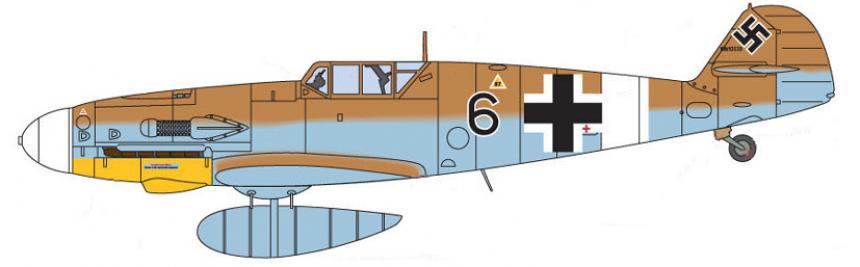
The G-2 version of the Messerschmitt was new to the skies of North Africa
Although the Messerschmitt Bf 109 was the feared adversary of the RAF during WWII, there is something undeniably fascinating about these aircraft to the British enthusiast. Maybe it is the fact that they were the direct contemporary of our own Supermarine Spitfire, or simply the fact that most of these aircraft did not survive the war but whatever the reason, Axis aircraft and the Bf 109 specifically always seem to hold a strange fascination for the British aviation enthusiast. With this in mind, news that a genuine combat veteran Messerschmitt was close to being restored to flying condition in Britain began to cause quite a stir in the late 1980s and brought Bf 109G-2 (Trop) ‘Black 6’ to the attention of the aviation world. If the restoration team were successful, this would be the first time that a genuine Daimler Benz powered Bf 109 had flown since the end of the Second World War, arguably making this the most important historic aircraft in the world, but certainly one of the most interesting. Making its first post restoration flight on 17th March 1991, this magnificent aircraft soon embarked on a short, but extremely memorable period on the UK Airshow circuit and anyone who was lucky enough to see ‘Black 6’ fly will consider themselves extremely fortunate.
The fascinating story of this very special Messerschmitt probably begins at the abandoned Luftwaffe airfield at Gambut Main, Libya in November 1942. With the Allies rapidly advancing towards the airfield, all serviceable aircraft were flown to a safer location, whilst ground crews collected what equipment they could and destroyed the rest, before heading off to meet up with the departed aircraft. When Commonwealth troops arrived, all they found was a deserted enemy airfield and a collection of damaged aircraft scattered across a wide area. Damaged in combat earlier the same month, Messerschmitt Bf 109G-2 (Trop) W.Nr 10369 aroused the interest of Gambut’s new tenants as it was the latest version of the Luftwaffe’s main fighter in North Africa – unfortunately, it was described as being shot up and had probably been strafed by fighters of the Desert Air Force. The 109 had a missing canopy, a bullet hole through one of the propellers and a number of instruments and components removed, obviously to keep other aircraft serviceable. When inspected by famous Australian ace Squadron Leader Bobby Gibbes, unit commander of No.3 Squadron RAAF, he estimated that the fighter was almost brand new, having spent no more than about ten hours in the air.

Jewel in the desert - this Messerschmitt spent more time flying with the RAF than the Luftwaffe
As one of the latest ‘G’ series Bf 109s to fall in to Allied hands, ‘Black 6’ was quite a prize and Sqn. Ldr. Gibbes claimed it as his own. Using parts from other abandoned Messerschmitts at Gambut, he managed to repair the aircraft to a point that it was airworthy and he applied the codes CV-V to the side of the fuselage, which were his personal markings. His intentions were to claim the aircraft as a war prize and have it shipped back to Australia, where he would fly it after the war. Indeed, it has been said that Gibbes became so infatuated with the aircraft that he would sleep underneath it, to prevent anyone from taking it, or trophy hunters removing parts of the aircraft. He did manage to fly the 109 on a number of occasions, but usually whilst flanked by a number of RAAF Tomahawk fighters, to prevent him from falling victim to friendly fire. Impressed by the handling of the diminutive Luftwaffe fighter, he described it as having ‘terrific performance’ and was far superior to the Tomahawks used extensively by the Desert Air Force.
Unfortunately for Gibbes, the captured Messerschmitt soon came to the attention of military officials and his plan to claim ‘Black 6’ was scuppered. He was ordered to fly the aircraft to RAF Heliopolis in Cairo, where test pilots could evaluate every aspect of the latest Luftwaffe fighter, looking for its strengths and possible weaknesses. Again flanked by several Tomahawks, Black 6 arrived at Cairo in early December 1942 and whilst this must have been a painful flight for Gibbes, he did allow himself a little fun on the way. Spotting a flight of Dakotas over the desert, Gibbes flew the captured Messereschmitt in close formation with the unsuspecting transport aircraft and reported ‘interesting results’ – one can only imagine.
By the end of December, ‘Black 6’ was ready to begin flight test operations, looking at all aspects of its performance and assessing it against British and Commonwealth aircraft in theatre. As the latest version of Germany’s most widely used fighter, this information proved crucial, but also highlighted the superiority of the aircraft over its Allied contemporaries. Needing to conduct further testing against some of the latest aircraft being evaluated by the air ministry back in the UK, ‘Black 6’ was dismantled and crated for shipping to Britain sometime during the spring of 1943. Produced by the famous Messerschmitt factory, this capable fighter arrived in Britain towards the end of 1943 and would be used to develop aircraft and tactics to more effectively destroy large numbers of its type in the aerial duels to come.

The tropical sand filter is a feature of many North African operated Bf 109s
The next stage in the fascinating history of this aircraft came in late December 1943, when it arrived at RAF Collyweston, home of No.1426 (Enemy Aircraft) Flight, which was colloquially referred to as the ‘Rafwaffe’. On opening the packing crate, it was discovered that the 109 had suffered some transit damage due to it being poorly secured in Cairo, but when reassembled with parts from other captured Messerschmitts and a new propeller from Farnborough, she was ready to begin air testing. Black 6 went on to have an extremely busy 1944, flying flight comparison trials against many new and existing Allied fighter types and giving demonstration flights to RAF stations around the country, which proved to be in high demand. Following the end of WWII, this once in demand aircraft was no longer required by the RAF and was allocated to No.47 Maintenance Unit at RAF Sealand for storage, although she would regularly appear on public view at the annual Battle of Britain display at Horse Guards Parade Grounds.

The sleek Bf 109 was the most produced fighter series of all time
Over the course of next twenty years, it would be fair to say that Messerschmitt Bf 109G-2 ‘Black 6’ was not particularly viewed with any great affection. Still owned by the RAF and earmarked for museum display, the aircraft spent much of the time in a storage crate, slowly deteriorating through lack of maintenance. She would be assembled and displayed from time to time, often wearing some poorly researched pseudo Luftwaffe colour scheme, which was applied without too much care. In the early 1960s, the aircraft was transported to RAF Wattisham, where a team of volunteers intended to restore her to flying condition, but the task proved too great and was quickly abandoned. Not knowing the combat history of the aircraft, the team could not ascertain the structural integrity of the fighter and with spiralling cost combined with the man hours required for the project, the decision was made to abort the attempt before it had even got started. Again, the next few years saw Black 6 languishing in a hangar, making the odd appearance at Airshows and service charity events.
The most fortuitous development in the history of this Messerschmitt occurred when the aircraft came to the attention of Flt. Lt. Russ Snadden. His search for a suitable restoration project had led him to a hangar at RAF Wattisham and what remained of ‘Black 6’, but despite his determined efforts to secure the aircraft, he was consistently blocked by RAF red tape. Not a man to give up easily, Flt. Lt. Snadden continued to plead with anyone who could help him in his quest, until on 30th September 1972, a pair of Hercules transport aircraft landed at RAF Lynham, containing the crated wings and fuselage of ‘Black 6’ - an exciting new chapter in the history of this unique aeroplane was about to begin. What followed was an extensive and meticulous 19 year restoration project led by Russ Snadden and a small volunteer team of engineers and technicians, determined to bring this magnificent Axis fighter back to flying condition. The trials and tribulations of the project are described by Russ Snadden himself in his book ‘Black 6 – The extraordinary restoration of a Messerschmitt Bf 109’ and I simply could not do justice to the drive and determination of this team here - I will leave you to find a copy and marvel at this achievement.

Black 6 was to become the darling of the UK Airshow scene
On 26th October 1990, ‘Black 6’ was placed on the British civil register as G-USTV and the historic aviation world waited for news of further developments with excitement. Following a 19 year restoration that stands testament to the dedication and professionalism of a small group of committed volunteers, Messerschmitt Bf 109G-2 Trop ‘Black 6’ took to the air for a 32 minute post restoration test flight from RAF Benson, in the hands of Group Captain Reg Hallam and into the aviation history books. This was the first time a Bf 109 had been airborne since the end of WWII and the aircraft was the only genuine airworthy example of the aircraft in the world. Wearing her now familiar authentic desert ‘Black 6’ livery, the aircraft was flown to her new home at Duxford in July 1991 and following the receipt of a CAA flight certification permit, she was ready to make her UK display debut. This triumphant occasion occurred on 15th September 1991 at the Duxford Airshow, where in the capable hands of Squadron Leader Dave Southwood ‘Black 6’ announced her arrival on the Airshow scene and gave spectators a glimpse of the blistering performance of this thoroughbred fighter aircraft.
Anyone who was lucky enough to see ‘Black 6’ fly during her short display career will know exactly what I mean when describing how special it was. The first time I saw and heard this beautiful Messerschmitt blast into the display circuit at Duxford, I was hooked for life. Whether it was the sound of the Daimler Benz engine, the unusual colours of this desert eagle, the black crosses of what we were taught was an enemy aircraft, or the fact that this was Britain’s most feared wartime flying adversary, this became much more than a guilty pleasure. For many aviation enthusiasts all over Europe, Black 6 became a source of fascination and the undoubted highlight of any air display she performed at – a genuine Warbird of some repute.

Black 6 was powered by a genuine Daimler Benz DB 605A engine
Keeping the aircraft flying must have been both demanding and frustrating in equal measure. As one of the rarest aircraft in the world and the only genuine airworthy example of its type, Black 6 was in high demand with Airshow organisers all over Europe, but as you can imagine, parts and expertise must have been in short supply. In a display career that spanned just over six years, she was only able to fly for around half of this time, spending 96 hours in the air. This was more than enough time to captivate Britain’s aviation enthusiasts and leave an enduring legacy that remains with many to this day. Unfortunately, all good things must come to an end and it was decided that following the end of the 1997 display season, the aircraft would cease flying and take its place in the RAF Museum at Hendon. Her final public display at Duxford on 12th October 1997 would see tragedy strike, although thankfully the pilot would emerge unhurt from the incident. As if rebelling against the decision to ground her, the aircraft suffered a landing accident at the end of the display, overshooting the runway and M11 Motorway (which passes close to the 24 end of the runway) to end up on its back in a recently ploughed field on the other side of the airfield. Suffering significant damage and with the pilot needing to be cut from the upturned aircraft, Black 6 was once again facing an uncertain future.


Black 6 pictured in Hendon’s Milestones of Flight building
With the affection in which this aircraft was held, enthusiasts waited with bated breath for news that Black 6 would once again be restored, hopefully to flying condition. In the summer of 1998, it was announced that the fighter would be restored to static display condition, before being transported to the RAF Museum Hendon and a new career as a museum exhibit. It was decided that the work would be carried out at IWM Duxford by the same team that originally restored the aircraft and whilst the work took a little longer than originally anticipated, it was completed to the same high standard. Transported to the RAF Museum in March 2002, Black 6 finally took her place in the Milestones of Flight building at Hendon in the middle of June 2003, looking resplendent in her distinctive North African Luftwaffe colour scheme.

In 2012, the fighter was moved to the much darker surroundings of the Bomber Hall
I don’t know if other enthusiasts had a similar experience to my own, but I was strangely reluctant to go and see the aircraft at Hendon, preferring to keep my precious memories of her chasing Spitfires at Duxford and not standing lifeless in a museum. Thankfully, I was persuaded to visit Hendon in 2010 and reacquaint myself with an aircraft that had made such an impression on me during her short display career – it was like a meeting of old friends and whilst I admit to feeling a little sad that it had ended like this, it was so good to see her again! Having shed my Messerschmitt museum aversion, I made further visits to see Black 6 both in her original location and when she was moved to the Bomber Hall at Hendon in 2012, which proved to be much less convenient for taking photographs. Just as I was planning my next visit for the coming winter months, I began to hear tantalising rumours that I may not have to travel quite as far to receive my latest ‘Black 6’ fix, as this magnificent aircraft could be heading for a period on display further north – the rumours were true!

This famous aircraft is now set to captivate a new audience at RAF Cosford

Black 6 is positioned where she can keep an eye on her famous British adversary
On hearing the news that this most enigmatic of historic aircraft was making the journey north to Cosford, some immediate investigative work was required to find out the exact situation. Thanks to the extremely helpful people at the RAF Museum Cosford, it was indeed confirmed that ‘Black 6’ had arrived at its new home and had only recently been placed on public display. This was almost a clear the diary moment and following a couple of further e-mails, a visit was duly arranged - arriving early on a Saturday morning, it was a case of heading straight for the War in the Air hangar and its famous new resident. What a treat – Black 6 was looking magnificent and if I dare say so myself, looking all the more attractive due to the fact that she was this far north. Positioned next to the museums Focke Wulf Fw 190, its aviation partner in crime during the Second World War, the Messerschmitt is facing an RAF Spitfire and Hurricane and almost appears to be rubbing their noses in the fact that she is the star attraction in this particular hangar.


Black 6 is already proving a popular addition to the collection at Cosford
I would like to sincerely thank the staff at the RAF Museum Cosford for helping to arrange my visit and making it such an enjoyable day. I suspect that many more people will be making the trip to see ‘Black 6’ over the coming months and they are in for a treat when discovering the many other aviation delights on display at Cosford. With so much to see, you need at least a full day to see everything, especially if like me, you spend a little too long loitering around a certain Messerschmitt. With further former Hendon exhibits due to go on display over the next few weeks, I suspect I will be paying at least a couple of further visits to Cosford before the start of the 2017 Airshow season.
I would like to thank all the Aerodrome readers who have already supported this future blog feature and sent in your favourite aviation image of 2016 – you really are a talented bunch. With time running out to send us your pictures, please could I ask you to let us have them at your earliest opportunity, so we can begin compiling this special edition of Aerodrome and showcase the photographic talents of our aviation loving readers. Please could I ask you to send your aviation Best Shot of 2016 to aerodrome@airfix.com or aerodrome@corgi.co.uk so we can end the year on something of an aviation high and showcase some fantastic aviation images to inspire us for the coming Airshow season!

Just one final opportunity to feature Bf 109G-2 (Trop) ‘Black 6’
I am afraid that is all we have for you this week. As usual, if you would like to join in with all the latest social media discussions regarding Aerodrome and aviation matters in general, please head for either the Airfix Aerodrome Forum or our Corgi Aerodrome Forum and have your say. If you have any specific comments, questions or suggestions for future editions of Aerodrome, please do feel free to let us know by using either the Airfix Facebook or Corgi Facebook pages, our Airfix Twitter or Corgi Twitter accounts, using #aerodrome. If e-mail is more your style, then please use our usual addresses above.
We are always looking to appeal to aviation enthusiasts all around the world and continue to increase readership of our Aerodrome blog. We would be most grateful if you would mention us to anyone who may be interested in joining our numbers and direct them to either the Airfix or Corgi websites, where they will be able to find all our previous blogs and receive notification of the latest editions - http://www.airfix.com/uk-en/news/aerodrome or http://www.corgi.co.uk/news/aerodrome. You can also pick up Aerodrome on both the Corgi and Airfix Facebook pages.
Thank you very much for taking the time to read our latest blog and I look forward to bringing you more aviation related content in two weeks time.
Michael
© Hornby Hobbies Ltd. All rights reserved

