
Welcome to this latest edition of Aerodrome and our regular look at the fascinating world of aeroplanes and the historic aviation scene around the UK.
This year has been a significant one when it comes to commemorating important anniversaries from the Second World War years, particularly when marking the turbulent events of 1940, and both the end of war in Europe and the Pacific five years later. As each five year commemorative cycle passes, there are less and less people remaining with us who lived through those times, and some might even argue that there is a diminishing national appetite to remember such things, however, the counter-argument to that must surely be that it’s our duty to do so, a solemn task to never forget, and to celebrate those who gave everything for freedom.
Making their own unique tribute, IWM Duxford’s main event of the year saw their Battle of Britain Airshow commemorate the 85th Anniversary of the battle on the first weekend in September, with an impressive collection of aircraft all gathered for the enjoyment of those fortunate enough to have been attendance. In this latest edition of Aerodrome, we will be looking at what proved to be one of the highlight events of this year’s busy Airshow calendar, but by taking a slightly alternative look at the impressive flying programme. The focus of our review attentions this time will be a rare overseas aviation visitor, and a couple of Spitfires built for two, aircraft which are now becoming Airshow stars in their own right. We might throw in a couple of Battle of Britain formation flypast images in there too, just for good measure.
The historic former Battle of Britain airfield at Duxford is our review port of call in this latest edition of Airfix and Corgi Aerodrome.
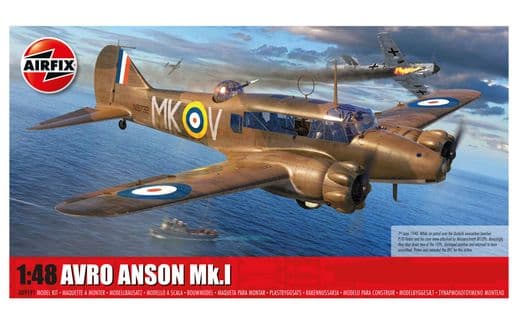
Nothing to see here, only an RAF Avro Anson dispatching a pair of Messerschmitt fighters over the English Channel.
Although images of the single engined fighters of the glorious ‘Few’ immediately spring to mind when we overhear any conversation referring to the Battle of Britain, and usually just Spitfires and Hurricanes at that, a great many British aircraft were actually involved in the fighting during this period, including several types which are usually largely overlooked. Perhaps the greatest popular understanding injustice relates to the aircraft and airmen of Bomber Command, who were fully committed to reducing the Luftwaffe’s ability to fight attacking factories and communications infrastructure in an attempt to disrupt Germany’s ability to re-supply forward areas in northern France.
Coastal command aircraft patrolled our vast coastline on the lookout for German naval incursion, and in the event of actual German invasion, even venerable old Tiger Moth trainers would have been used to attack enemy troops on the landing beaches, so comprehensive was Britain’s plan for defence. Thankfully, by the time the Kanalkampf had become full scale raids against British mainland targets, Britain was producing twice as many fighter aircraft as Germany, and the country’s Chain Home early warning network had the enemy fixed in its gaze.
One aircraft type which would have been a regular in the skies above Britain and the English Channel during the summer of 1940 was the Avro Anson, not an aircraft which usually receives much enthusiast attention these days, but one which did have an incredibly important role to play throughout the entire Second World War. For this year’s Duxford Battle of Britain Airshow, the organisers ensured that the Anson would be receiving much more attention than it usually would, because they had arranged to have the only airworthy Mk.I example of the aircraft fly into the show from its home airfield in the Czech Republic. As we will see a little later, things didn’t go exactly to plan, but she did arrive and we did enjoy this unusual show highlight.
You will have noticed that we began this section by featuring a beautiful piece of Airfix box artwork, and that’s because it draws inspiration from an incident which took place over the English Channel during the Dunkirk evacuations of 1940, one involving an RAF Avro Anson and a pair of Messerschmitt Bf 109E fighters.
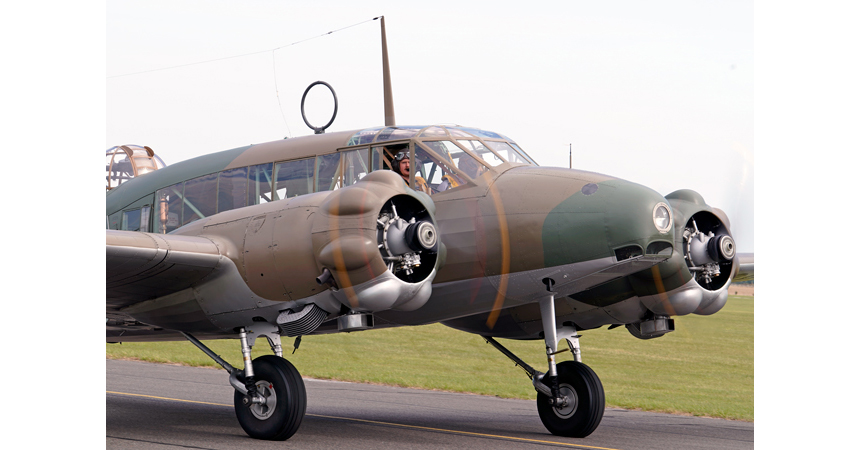
An extremely popular arrival. I only managed to grab this quick shot once the Anson had landed at Duxford, before we were invited to vacate the Flightline Walk.
The Anson salutes the crowd prior to making its UK Airshow debut at Duxford.
One of the outdated aircraft types sent to face the all-conquering modern Luftwaffe, the Avro Anson may have been a cutting edge design when it originally entered RAF service, however, there is nothing like war to stimulate a surge in the pace of technical innovation and this innovation had now largely overtaken the Anson. Although it could defend itself, the Anson was slow, relatively poorly armed and was not blessed with great range, however, it was by no means a sitting duck if challenged, and in the hands of a competent pilot and his crew, could even prove a match for the Luftwaffe's premier fighter aircraft of the day.
At around 08.30 hrs on 1st June 1940, Pilot Officer Philip 'Pete' Peters took off from Detling airfield as the lead aircraft of three RAF No.500 'County of Kent' RAuxAF Avro Ansons, setting a course for France. The flight was sent to provide air cover for the evacuation of the British Expeditionary Force who were stranded on the beaches at Dunkirk and as this miracle of the Second World War unfolded beneath them, another minor miracle was taking place in the skies above.
At approximately 10.40 hrs, the formation came under attack from several Luftwaffe Messerschmitt Bf 109 fighters near Ostend and immediately descended to extremely low altitude in an attempt to evade the onslaught. P/O Peters could see that the other two Ansons appeared to have taken the brunt of the first attack, and he therefore ordered them both back to Detling, whilst at the same time ordering his own crew to use the two additional 0.303 in machine guns the aircraft was carrying. The Ansons of No.500 Sqn were modified to carry two additional machine guns which could fire out of the side cabin windows on either side of the aircraft's fuselage, installed in specially fabricated mountings which were produced by an engineering company in nearby Maidstone, a company which refused to take payment for their work.
Whilst increasing the already considerable weight of the Anson still further, this modification allowed both the wireless operator and the navigator to fire at any enemy aircraft attacking their Anson, although it has to be said that this light armament would only be effective at relatively short range.
The most impressive aspect of this engagement was how P/O Peters managed to skilfully manoeuvre his aircraft to allow all four of its guns to be brought to bear as the Messerschmitts attacked, with the enemy aircraft struggling to target the slow moving Anson, constantly overshooting their target and therefore also coming within the firing line of the fixed forward firing Vickers machine gun in the nose of the aircraft. Incredibly, during this engagement, the crew of Anson N9732 managed to shoot down two of the attacking Messerschmitts, with a further two sustaining combat damage and having to limp back to their base. Incredibly, all three of the Ansons managed to make it back to Detling.
The engagement lasted around ten minutes in total and in a further display of courage and airmanship, once the enemy fighters had been shot down or driven off, Peters and the crew of N9732 continued with their assigned patrol, before returning to RAF Detling, where they landed at 12.37. On inspecting their aircraft back at base, they could only find four bullet holes in their Anson, yet another indication of the skill displayed by Pilot Officer Philip Peters during that dramatic sortie.
For this exceptional feat of airmanship, P/O Peters was awarded the Distinguished Flying Cross, whilst two other members of his crew were recognised with Distinguished Flying Medals.
Despite this particular Anson having two victories against the Luftwaffe’s premier fighter aircraft to its name, the 'Faithful Annie' would earn its reputation as a coastal patrol, reconnaissance, general communications and training aircraft, with thousands of these aircraft working tirelessly in supporting the training of observers, navigators, air gunner, signallers and pilots for roles right across the Royal Air Force during the wartime years.
A rare example of a wartime British multi-engined aircraft type, Avro Anson Mk.I MH120 was built by A.V. Roe for the Royal Air Force at their Leeds Yeadon plant in 1943, but was subsequently allocated to the Royal Australian Air Force in support of the Empire Air Training Scheme and sent to Australia. She would serve with No.1 Air Observer School at Evans Head on the New South Wales coast, and later the Advanced Flying and Refresher Unit at Deniliquin, doing what these aircraft were so proficient at doing, training future bomber crews.
Following a long service career which took it well past the end of WWII, she became an air taxi in 1953, went air racing in 1971 and was even to be the star of film and TV productions, only to end up as a museum exhibit at the Wangaratta Air World Museum. After spending 12 years there, the aircraft was purchased by a private owner and taken to his facility in New Zealand, where he embarked on a lengthy and meticulous restoration project, one which not only intended to see this magnificent aircraft taking its place on the country’s Airshow circuit, but to return the aircraft to as close to wartime configuration as possible and allowable.
A physical manifestation of the drive, determination and vision of its owner, the aircraft became a stunning airworthy representation of this important WWII aircraft type, a stalwart of the New Zealand Airshow scene and the winner of many an aviation restoration award, following her return to flight. She is painted to represent Anson Mk.I K6183, resplendent in Coastal Command colours, and doesn’t she look stunning.
Bringing her story right up to date, the aircraft was sold to RAF Station Czechoslovakia in 2024, and shipped to Belgium, where she was reassembled. She is now based at the Aviation Museum Hangar at Podhorany Airfield, and it’s hoped that she will become the star attraction at many a European Airshow in the years to come, a stunning example of the most heavily produced Avro monoplane type in history.
The Anson’s debut appearance at IWM Duxford’s Battle of Britain Airshow may well have been a sizeable coup for the show organisers, but did look a little touch and go on Saturday. The aircraft was scheduled to travel to Duxford on the Friday prior to the show, or early on the Saturday morning, however, poor weather on the continent prevented that from happening. In fact, many on the airfield were checking flight software on their phones during Saturday, with many claiming the aircraft had managed to take off, but was forced to turn back due to weather.
As the crowds returned for the second day of the show, many had already given up hope of seeing the Anson, but as we all know, ‘Faithful Annie’ is made of the right stuff, and her crew were determined to make their UK Airshow debut. In early afternoon sunshine, the aircraft appeared in the overhead to the relief of many, landing at this famous old Battle of Britain station, to take her place on the flightline. It does have to be said that the conditions were definitely still challenging though.
Like many others, this had me scampering towards the flightline walk, and what would surely be just a couple of minutes to grab the pictures I was hoping for. Unfortunately for me, it seemed as if everyone had the same idea, and by the time I managed to get close to the aircraft, show officials were already clearing people from the taxiway (using a big rope) and I’d missed my chance. Oh well, at least I got to see her on her debut.
With Spitfires and Hurricanes galore at Duxford that weekend, it was nice to see a less fashionable British aircraft type enjoyed some of the Airshow limelight at this year’s show.
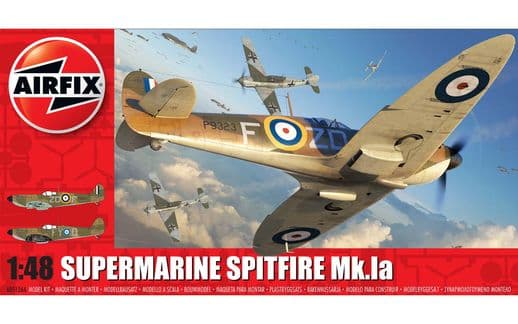
Formerly the Dragon Spitfire, this two-seater was presented as the Battle of Britain Mk.1a of ace pilot Brian Lane for this anniversary Airshow.
As arguably the most famous military aeroplane in the history of flight, if you ever wanted to take an experience flight in a Warbird, surely that flight would have to be in a Spitfire. Thankfully, there are now quite a few examples of two seat variants of the aircraft at locations around the country, and for those with a wish to do so, have operators who would be only too happy to help you realise your aviation dream. To make everything all the more impactful, you will be making your flight in the sure and certain knowledge that the aircraft your are flying in started out as a single seat variant of this historic fighter.
To move this on a stage further, if you were fortunate enough to have a Spitfire experience flights booked, surely you would want to make that flight from a former RAF airfield steeped in Battle of Britain history, somewhere like Duxford, or Biggin Hill – can you think of anything more memorable! We’ll quit whilst we’re ahead now, and not chance our arm by suggesting that you’d also be needing a model memento of the occasions, because that wouldn’t be quite the ticket.
The recent Battle of Britain Airshow saw large numbers of Spitfires gathering at Duxford for the occasion, with a pair of delightful two seat examples from the Aircraft Restoration Company being allocated to the task for the weekend, and they were both absolute beauties.
Looking a little dishevelled, this ARCo Spitfire was a sight for sore eyes.
Many people will no doubt still refer to Spitfire PT462 as the ‘Dragon Spitfire’, as she was owned and operated by a proud Welshman for around 19 years here in the UK, from around 1998 onwards, and will probably have caught up with it at some unusual places over the years. I myself was lying on the top of Ventnor Down on the Isle of Wight on holiday some years ago, looking at the clouds on a beautiful summers day, whilst my kids played in the field. I turned to my wife and said, “This is idyllic – the only thing that could better this would be if a Spitfire flew past’, and within two minutes, one flew right over us. That was the ‘Dragon Spitfire’ on one of its regular visits to Sandown Airport.
The aircraft had received regular maintenance and support from ARCo over the years, so when the owner was looking to sell his Spitfire on, it seemed fitting that it should be to the people who had already spend to much time on her wellbeing, and she joined them in 2017.
As you can see from the images included here, the ARCo team have done something pretty special with this two seat Spitfire for Battle of Britain Anniversary year and not only was she one of the most attractively presented Spitfire over the weekend, but she had also been painted to represent the RAF No.19 Squadron mount of Brian ‘Sandy’ Lane, during the late summer of 1940. With heavy exhaust staining making this particular Spitfire look the most likely to have just returned from a long patrol over the Channel, she really did look stunning, and she definitely helps to illustrate how two seat Spitfires are now much loved historic aircraft in their own right – well done ARCo.
And Johnnie Walker makes two
ARCo’s other two seat Spitfire was also on duty at the Duxford Show this year.
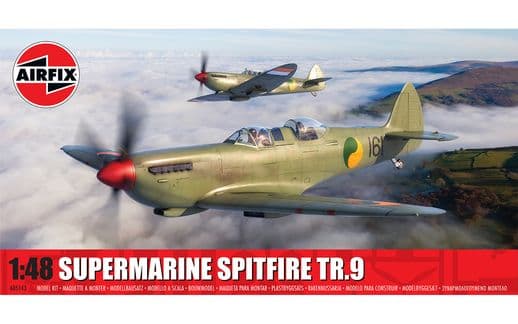
Not content with having one beautiful two seat Spitfire for us to admire at the Battle of Britain Airshow this year, the good people at ARCo also arranged for their second Tr.9 to be on the flightline, another aircraft which is resplendent in the scheme of a Spitfire fighter which was the mount of another ace pilot.
For millions of British people, the Supermarine Spitfire is much more than just an aeroplane. A fighter aircraft which was as deadly as it was beautiful to look at, the Spitfire stands as a symbol of the nation’s defiance in the face of tyranny, one which prevailed against seemingly insurmountable odds during the Battle of Britain, effectively removing the threat of invasion. Even though the prototype Spitfire flew 89 years ago this March, the aircraft could probably claim to be even more famous now than it was back then, with airworthy examples of this magnificent aircraft gathering ever more admirers with each passing year.
For those wishing to fly in a Spitfire, this dream held by so many people is now an achievable reality for those able to afford it, and for those who can, they have the very real possibility of being able to say, “I’ve flown a Spitfire!’ In order to do so, you need to speak to specialists like Duxford based Aerial Collective, and if you’re going to fly in a Spitfire, why not do so from the airfield which took delivery of the first service Spitfire back in the summer of 1938. This beautiful Spitfire is one of their aircraft and is currently presented in the colours of Spitfire Mk.IX ML365, the personal aircraft of ace pilot Group Captain Peter Russell ‘Johnnie’ Walker CBE, DFC and DSO. Anyone fancy the flight of a lifetime?
Again, this aircraft started life a single seat Mk.IX fighter, but would later be one of six Spitfires acquired by the Irish Air Corps to train pilots for service on their Supermarine Seafire fleet. She was sent to the Vickers-Armstrong Factory at Eastleigh, where she was converted to her current Tr.IX trainer configuration.
During her time with the Irish Air Corps, PV202 flew with the identity IAC161, markings she wore until she was sold on in the 1960s, after being deemed surplus to requirements. She next passed through the hands of various private owners, but would not fly again until early 1990, when she took off from Dunsfold resplendent in one of her former wartime No. 412sqn RCAF schemes.
Spitfire PV202 was purchased by Historic Flying Limited (HFL) in 2001, now part of the Aircraft Restoration Company (ARCo), following an incident which had befallen the aircraft the previous year. Following restoration, the Spitfire flew again in March 2005, resplendent in her authentic Irish Air Corps markings once again. On that historic occasion, she was piloted by ARCo’s aviation celebrity head John Romain, with famed veteran Spitfire test pilot Alex Henshaw in the rear seat.
Although two seat Spitfires might not be for everyone, they do continue to preserve the legacy and heritage of this incredible aeroplane, and let’s face it, they’re the only variant of Spitfire that the vast majority of us are ever likely to get the chance to fly in. Having said that, the pictures of the two ARCo machines pictured above show just how attractive these aircraft actually are, and how they have now managed to write their own chapter in the annals of the British historic aviation movement.
As with every show held at this historic venue, there was so much going on at Duxford to inspire several blog reviews, and that being the case, you can be certain that we will be back to look at some more of the Battle of Britain Airshow highlights prior to attending our first show next year. For now though, all that remains is for us to thank the organisers for putting on such an enjoyable event, and for us to pass on our thanks to both the RAF Station Czechoslovakia and Aircraft Restoration Company teams for allowing us to experience their magnificent aeroplanes.
A final selection of images taken at this year’s Battle of Britain 85th Anniversary Airshow.
The Saturday formation flypast included the incredible sight of no fewer than seven Hawker Hurricanes within its number.
Only six Hurricanes made it on Sunday.
Spitfire Power. Mk.XIV MV293 is an absolute beast of a machine.
Returning to the circuit. If Spitfires go out, they have to come back.
Mission accomplished. RAF Station Czechoslovakia’s magnificent Avro Anson lands back at Duxford after completing its UK Airshow debut display performance.
I’m afraid that’s all we have for you in this latest edition of Aerodrome, however, we’ll be back again in four weeks’ time with more news and pictures from the fascinating world of aviation. Thank you for your continued support and as always, if you would like to comment on anything blog related or suggest a subject you would like to see covered in a future edition of Aerodrome, please do drop us a line at aerodrome@airfix.com, where we would be delighted to hear from you.
Should you wish to continue the aviation discussions between editions, you will always find something of interest over on the Airfix Aerodrome Forum and if social media is more your thing, please use the respective official social media icon links at the foot of the main Airfix and Corgi website homepages to access our official sites.
The next edition of Aerodrome is scheduled to be published on Friday 5th December, and we look forward to sharing more aviation inspired content with you then.
I hope to see you all back here in four weeks.
Michael