As one of the premier historic aviation venues in Europe, Duxford airfield offers something unique for the aviation enthusiast, with its array of historic buildings, impressive collection of important preserved aircraft and the opportunity to see restored classic aeroplanes operating from this enigmatic airfield. Perhaps more than this, Duxford airfield serves to educate today’s youngsters about aviation, technical innovation and the history of armed conflict during the 20th century. Much more than a museum, Duxford lives the history it is preserving and helps to bring the exhibits to life, allowing visitors something of a unique experience that will usually see them return many times in the future. In this latest edition of Aerodrome, we are going to take a look at the recently re-opened American Air Museum and how it has been transformed into a must-visit attraction for anyone with even the slightest interest in history.
Although a number of brave volunteer American pilots had already elected to come to England and fight against Nazi aggression as part of the RAF’s three Eagle Squadrons, it was not until 1942 that US airmen began arriving in the UK in large numbers. The newly formed US Eighth Air Force would prove significant in attacking numerous German targets over the coming months and helping to wrestle air superiority from the Luftwaffe in the skies above occupied Europe. Requiring massive organisational and infrastructure support, USAAF units took over numerous former RAF bases, with their flamboyant personnel becoming rather cosmopolitan neighbours to many a sleepy English village. The US airmen made their mark both in the air and with the local communities that accommodated them.

A Battle of Britain Spitfire at Fowlmere airfield being readied for action
Duxford airfield enjoys a rich aviation history, which makes it an ideal location for the Imperial War Museum aviation collection and the commemoration of its links to the Mighty Eighth Air Force. As the first RAF station to receive the Supermarine Spitfire fighter in 1938, Duxford went on to play a significant role during the Battle of Britain, as it eventually played host to Douglas Bader and his ‘Big Wing’ – up to sixty Spitfires and Hurricanes would be ready at Duxford and its satellite airfield Fowlmere, to take off and attack the Luftwaffe en mass, which proved extremely effective in the final weeks of the battle.
Duxford’s association with the USAAF began in 1943, when the RAF assigned the airfield for American use – re-designated ‘Station 357’, Duxford was just one of a hundred such bases operated by the US Air Force across the UK. Assigned to USAAF 8th Air Force Fighter Command, Duxford played host to the famous black and white check-nosed Thunderbolts and Mustangs of the 78th Fighter Group, which went on to become some of the most iconic US fighter aircraft of WWII and served to illustrate the skill and bravery of the American fighter pilots operating over enemy occupied Europe.

Iconic image of a 78th Fighter Group Mustang at Duxford at the end of WWII
Considering the wartime history of Duxford and the inextricable link between this Cambridgeshire airfield and the airmen of the US Eighth Air Force, it is hardly surprising that the site was selected as a potential venue for a permanent commemoration to the contribution of American servicemen based in Europe, both during and after the Second World War. During the mid 1980s, serious discussions began to take place regarding an American Air Museum, with fund raising activities both at home and in the US planned. Celebrated architect Sir Norman Foster was commissioned to design the new building, whilst fund-raising events started to take place across the US – these proved to be particularly successful, not least as the figurehead for this fundraising was General Jimmy Doolittle. With tens of thousands of individual donations and a large Heritage Lottery Fund grant, the first earthworks for the new museum were started in 1995, with US 78th Fighter Group veteran Major James E Stokes in attendance.

USAAF fighters on display at the American Air Museum
The design brief for the new museum was to provide a permanent home for some of the Imperial War Museum’s significant US aircraft, including the mighty Boeing B-52 Stratofortress, B-17 Flying Fortress, B-24 Liberator and B-29 Superfortress, along with a number of other significant American aircraft. Spanning conflicts from the Great War to the Gulf War, the heart of the museum would commemorate the significant contribution of USAAF personnel during WWII and the Cold War period and in particular, their links to the United Kingdom. At its peak strength in 1944, the USAAF employed 450,000 American people in Britain, most of whom were engaged in the invaluable support trades which were essential in keeping their aircraft and airmen flying. As well as marking this significant contribution, the museum would also serve as a striking memorial to the thousands of USAAF personnel who paid the ultimate price during their service.

The distinctive profile of the American Air Museum at Duxford
Clearly, the specifications of the new building would be dictated by the significant size of the aviation exhibits, but Norman Foster would need to use all his skill and experience to satisfy the brief, whilst producing something dramatic. The trustees wanted a landmark building that would provide a neutral backdrop for the aircraft collection, whilst providing climatic control for the exhibits and to be as cost effective as possible to operate. What he produced was nothing short of spectacular – a unique, sweeping arc which was partly dug into the ground and taking inspiration from the RAF Blister Hangars, which were designed to be difficult to see from the air. The massive curved roof was capable of supporting a number of exhibits suspended from anchor points, although these would clearly need to be amongst the smaller aircraft in the collection, with the bombers and aircraft such as the Lockheed SR-71 reconnaissance aircraft being displayed on the floor of the building.
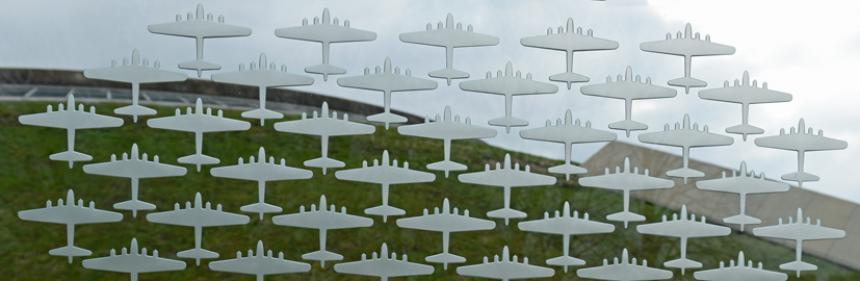
Perhaps the most significant feature of the award winning American Air Museum design is the distinctive ‘Glazed Wall’, which dominates the rear of the building and serves a number of important functions. Clearly, this amount of glass will allow a significant amount of light into the museum, which both improves visitor experience and helps to reduce potential lighting costs for the operators, but in addition to this it also serves an equally important purpose. It actually brings the activities of this historic and active airfield inside the museum and adds an important dynamic to anyone viewing the enclosed exhibits. From the outside, the glass wall reflects the fact that a great many historic aircraft still take to the skies at Duxford airfield and the wall acts as a visual and audible confirmation of that fact, with the sights and sounds bouncing back off it. This highly visible feature of the building benefits visitors to Duxford from outside on the airfield and whilst enjoying the delights of the American Air Museum.

An imposing sight at Duxford – the glass wall at the rear of the museum
Despite the impressive scale of the glass wall at the rear of the museum, the entire structure was designed to be de-assembled if and when required, to allow the aviation exhibits within to be moved, re-arranged, or updated, even though this would be a significant undertaking. It clearly highlights the fact that the museum space has been constructed without any internal supporting columns to obstruct the view of the aircraft, with a number being suspended in dramatic fashion from the ceiling of the structure. It also benefits from an elevated viewing position at the front of the building, which certainly adds to the experience of a visit to this impressive museum. First opened to the public in 1997, Duxford’s American Air Museum helps to tell the story of the USAAF and their significant association with Britain and this historic airfield in particular. Over the past eighteen years, it has attracted millions of visitors and allowed them to be educated on USAAF operations in Britain and to pay their respects to USAAF personnel and their endeavours.

This McDonnell Douglas F-15A Eagle is a new addition to the museum
In late 2014 it was announced that the American Air Museum would undergo a major transformation, which would require it to be closed for the duration of these significant works. Many enthusiasts thought that this would simply be a change round of the aircraft exhibit positioning, but as we will find out a little later, the trustees of the museum had much bigger plans than that. As Duxford is an extremely popular destination for enthusiasts, educational visits and even film production units, the work to be carried out would be very much in the public eye, even though the AAM itself would remain closed – this was an interesting development and made for some unique photo opportunities. With a number of high profile events taking place at Duxford each year, including some of the best attended Airshows in the UK, large numbers of visitors were able to see much of the work as it was actually progressing. I remember seeing the glass front of the museum being completely dismantled at the 2015 Flying Legends Airshow, leaving the interior space exposed to the elements – more interesting than this, the Boeing B-29 Superfortress which was usually resident in the American Air Museum was actually positioned outside the rear of the museum, basking in the summer sunshine. Indeed, regular visitors to the museum would have been able to catch some of the usual AAM residents temporarily housed in different hangars around the airfield and if you were extremely lucky, actually sitting outside on the airfield, when the weather permitted. This would certainly have offered some unique photo opportunities, particularly if it was one of the aircraft that had been taken down from the ceiling of the museum and would usually not be seen sitting on their undercarriage.

Duxford’s Boeing B-29A Superfortress 44-61748 ‘It’s Hawg Wild’

‘It’s Hawg Wild’ enjoying the sunshine at Flying Legends 2015
Before we go on, could I please ask that if any Aerodrome readers were lucky enough to take pictures of the American Air Museum aircraft whilst they were positioned outside on the airfield during the renovations, that you let us have a selection of your images, which we intend to use in a future edition of our blog which will be dedicated to this unusual opportunity. We will certainly credit all photographs that we use to their owners and it would be great for as many readers as possible to be part of this feature, which will mark a situation that is unlikely to be repeated again for a great many years. I would be grateful if you could send your images to aerodrome@hornby.com where we will hope to include as many as possible in our future article.
The past twelve months saw some significant activity taking place in the American Air Museum and as the transformation approached completion, enthusiasts were very much looking forward to experiencing the changes. Before the museum was re-opened to the public, Aerodrome was invited to attend the press day, which took place just a few days before the public opening on Saturday 19th March and gave us an opportunity to experience all the changes, whilst speaking to some of the people involved in making it happen. I am pleased to report that the changes run much deeper than simply moving some aircraft exhibits around and the new American Air Museum is something very special indeed – although still an essential focal point for the museum, the aircraft are not the only highlights on offer.

The North American B-25J Mitchell is a popular exhibit at the AAM

This poignant display features a Lockheed U2 spy plane and SA-2 missile
The newly transformed American Air Museum attempts to tell the story of two nations united through war, loss, love and duty, from the horrors of the First World War to the present day challenges being faced at home and overseas. Although it still contains the finest collection of American aircraft on display outside North America, it also includes a series of compelling personal stories that bring to life the human aspect of Anglo-American collaboration through conflicts both nations have been forced to endure. Adding some poignant human narrative to the military hardware on display, visitors will be fascinated to hear some of the stories that have been preserved in print, film and by an impressive array of displayed artefacts, which really do give some balance to the conflicts and incidents we have all read about in the history books. With fascinating contributions from eighty-five people whose lives have either shaped, or been shaped by their personal experiences of conflict, the transformed museum is a unique record of the special relationship forged between Britain and America.
Some of the significant personalities who were interviewed by museum staff in establishing these fascinating personal stories were flown in for this launch event and quickly became much more interesting than the aircraft that many of us had initially come to see. One such gentleman was Jack ReVelle, who had an incredible Cold War story to tell and one which must really class him as a hero. With the mighty Boeing B-52 Stratofortress as a backdrop, Mr ReVelle’s Cold War experience revolves around two nuclear accidents, known as ‘Broken Arrows’, where he was required to attend the crash scene of a US bomber and make safe nuclear devices which possessed unthinkable destructive power. Significantly, both of these incidents occurred on the North American mainland.

Hero of the Goldboro ‘Broken Arrow’ incident, Jack ReVelle
In January 1961, at the height of the Cold War, Jack ReVelle was serving as Commander of Detachment 4 of the 2702nd Explosive Ordnance Disposal Squadron, based at Wright-Patterson Air Force Base in Ohio, when he received an official call that must have filled him with dread. Whilst flying a routine Strategic Air Command training exercise over the East Coast of the United States, a Boeing B-52 Stratofortress had developed some significant mechanical problems and was attempting to return to its base at Seymour Johnson Air Force Base. The aircraft was carrying live nuclear weapons and this situation could not be more serious. Whilst still 10,000ft above the North Carolina countryside, the B-52 began to disintegrate and the crew attempted to abandon their stricken aircraft – violent vibrations caused the tail unit to sheer off the aircraft, which also dislodged the two Mk.39 thermonuclear bombs from their internal storage racks. Each bomb weighed 6,700 lb and possessed destructive power 250 times that of the weapon that destroyed Hiroshima at the end of WWII – they were both falling towards the Eastern Coast of America.
The bombs eventually landed in a tobacco field in Wayne County, about twenty miles southwest of Greenville, North Carolina and Jack ReVelle and his team were immediately dispatched to the location, under the highest possible levels of security. It is difficult to imagine what must have been going through the minds of the disposal team as they were heading towards the crash site and although they will have been highly trained in dealing with such a nuclear incident, the unimaginable price of failure was hardly worth contemplating. Had one of these bombs detonated, it would have resulted in a blast crater the width of eight football fields, destroying every structure within a four-mile radius. There would have been a 100 percent kill zone for eight and a half miles in every direction and a lethal cloud of radiation would have contaminated the entire region. Even more terrible than this prospect, a detonation may have led US military officials to think that this was the work of Soviet agents, or a pre-emptive nuclear strike against them and led to the unimaginable prospect of nuclear war.

The mighty Boeing B-52 Superfortress around which the American Air Museum is centred
When Jack and his team arrived at the impact site, he quickly saw that the parachute had deployed on one of the bombs, which had caught in a tree and resulted in the bomb standing upright with just the tip of the weapon resting on the ground. The bomb was intact and the arm/safe switch was still in the safe position, meaning that the arming process had not initiated – this bomb was made safe and taken away from the site. Unfortunately, this was not the case with the second bomb. For some reason, the parachute had not deployed on this bomb and it hit the ground at 700mph, burying itself deep into the boggy ground. ReVelle and his crew began digging down to recover the bomb, unsure as to whether it would detonate at any moment.
After five days of careful excavations, one of the team managed to locate the arm/safe mechanism of the buried bomb. Jack Revelle recounts in a recent book he published on the incident, that he will never forget the shout from his sergeant informing him that he had found the all important switch, but that it was in the ‘ARMED’ position. ReVelle and his team successfully managed to disarm the weapon and remove the radioactive materials it contained, but later analysis revealed just how lucky they were. The weapon had gone through six of seven stages towards detonation and by rights, the bomb should have detonated when it hit the ground at high speed. Had either detonation occurred, this region of East Coast America would have been a very different place and the world could possibly have been hurled towards nuclear Armageddon.
To add another terrifying angle to this incredible story, it was also later reported that one of the pilots of the stricken B-52 bomber was parachuting safely down to earth, when he saw one of the thermonuclear bombs his aircraft was carrying hurtling past him, heading for North Carolina. What on earth must he have been thinking about the poor people below, sure that he had been involved in a catastrophic nuclear incident in his home country? I certainly remember as a young man being absolutely petrified at the prospect of nuclear conflict and actually struggling to sleep on numerous occasions, worrying about the sanity of our world leaders and the safety of my loved ones. Thinking back, the Cold War period was a truly terrifying period in our relatively recent history.
I certainly felt privileged to see Jack ReVelle standing in front of his picture, talking to the gathered media at this specially arranged event and reading about his incredible story adds a real poignancy to the mighty Boeing B-52 Stratofortress that towers above this particular section of the new display. Jack’s story is just one of the fascinating new additions to the American Air Museum, which is now so much more than a collection of historic aeroplanes. It has a new life all of its own and allows visitors to experience a series of diverse human stories from a century of war and peace, life and death, in a way that engages and enthrals in equal measure. The magnificent backdrop of this impressive building and the historic aeroplanes it protects adds to the overall experience of the museum, which really does offer something unique to anyone who is lucky enough to visit. The Imperial War Museum staff are to be applauded for the incredible work they have done here and I am certain that anyone intending to visit the transformed American Air Museum will thoroughly enjoy their experience.

Fairchild A-10A Thunderbolt II is the heaviest suspended aircraft in the AAM

The SPAD XIII replica is the lightest suspended aircraft at the American Air Museum
I would like to sincerely thank Ian Crawford for arranging my visit and ensuring that everything went without a hitch – cheers Ian.
I am sure that many Aerodrome readers will be regular visitors to Duxford and will probably be planning to visit the American Air Museum in the near future – you certainly won’t be disappointed. As mentioned earlier, if you managed to get any pictures of the American Air Museum aircraft whilst they were out on the airfield during the renovations, please do send them in to us for a Duxford AAM special we are planning for later in the year – please use our direct e-mail address at aerodrome@hornby.com when sending your pictures.

Marking Duxford’s link with the USAAF 78th Fighter Group, North American P-51D Mustang ‘Etta Jeanne II’
As usual, if you would like to discuss our latest blog, you can head for either the Airfix Aerodrome Forum or our Corgi Aerodrome Forum and join the chat. If you have any specific comments, questions or suggestions for future editions of Aerodrome, please do feel free to let us know by using either the Airfix Facebook or Corgi Facebook pages, our Airfix Twitter or Corgi Twitter accounts, using #aerodrome.
Please spread the Aerodrome word! If you have any friends or acquaintances who you feel would enjoy reading our aviation related blog, please let them know that they can find us at either http://www.airfix.com/uk-en/news/aerodrome or http://www.corgi.co.uk/news/aerodrome. You can also pick up Aerodrome on both the Corgi and Airfix Facebook pages.
Thank you very much for reading our latest blog and I look forward to posting the next edition of Aerodrome in two weeks’ time.
Michael
© Hornby Hobbies Ltd. All rights reserved

