
Welcome to this latest edition of Aerodrome and our regular look at the fascinating world of aeroplanes and the historic aviation scene in the UK.
Most Aerodrome readers will be only too aware of the prominent position the Hawker Hurricane holds within the pages of Britain's aviation history books, but equally how its achievements and legacy have always been in the shadow of its more illustrious fighting companion, the Supermarine Spitfire. To many, this really does appear to be a little unfair, as the Hurricane helped to transform a modernising Royal Air Force during the late 1930s and accounted for more enemy aircraft destroyed during the Battle of Britain than all of Britain's other defences combined, including the much vaunted Spitfire.
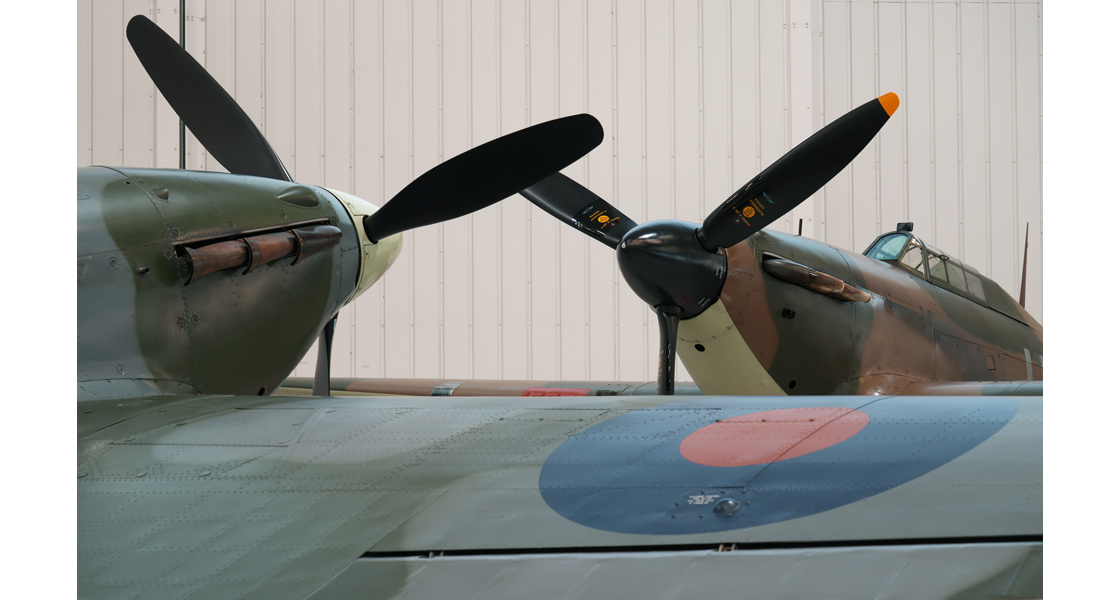
It is perhaps for this reason that it was interesting to hear that the Imperial War Museum's Duxford site intended to embark on another year of Airshows and events by arranging a special spotlight exhibition which attempted to redress this imbalance somewhat, using their Hurricane: Unsung Hero event to tell the story of this important aircraft in a unique manner. Gathering an impressive selection of airworthy Hurricanes in the Conservation Hall section of their huge Airspace building for the first few weeks of the year, they allowed visitors to get close to this British aviation icon and to discover why the Hurricane is deserving of much greater recognition than it usually receives. They also allow visitors the opportunity to see how Hawker Aircraft Limited made the technological leap from accomplished biplane fighter to ground-breaking RAF monoplane interceptor in a little over six years.
In this latest edition of Aerodrome, we will be paying our own blog visit to Duxford's Hurricane: Unsung Hero exhibition and in addition to including a selection of images taken during the visit, will also be taking a closer look at the development of this important aircraft and its position within the history of British aviation. If you have yet to pay your own visit to the exhibition, this review will also serve as something of a call to action, as there are now only two weekend remaining before it closes on 19th February. Without further ado, please join us as we spend a little time in the company of the 'other' aviation hero of the Battle of Britain.
Although the Hurricane represented a significant advance in aviation technology, it retained many of the traditional manufacturing techniques Hawker Aircraft Limited had become so famous for.
When it comes to the subject of aviation, perhaps Britain's historic aviation movement and aviation enthusiasts everywhere should be grateful for how the Spitfire continues to serve as an incredibly effective tool in preserving the legacy of Britain's wartime aviation prowess and indeed can always be relied upon to attract thousands of people to one of the country's many Airshow events. Indeed, if you were to ask anyone, enthusiast or member of the general public, to name a famous British aircraft of the Second World War, in both cases, the most likely response will be Spitfire. Unfortunately, if you were to ask the same people which fighter aircraft won the Battle of Britain, you would probably receive the same answer, which is exactly the image problem the poor Hawker Hurricane has been forced to endure over the past eighty years or so.
Despite the fact that the Hawker Hurricane possesses several important British aviation accolades in its own right, it remained very much in the shadow of the Spitfire during its service life and even though it accounted for more aircraft destroyed during the Battle than all of Britain's other defences combined, the Spitfire is still lorded as the saviour of the Battle of Britain to this day, with the poor Hurricane hardly getting a mention and could even be described as being largely forgotten. Thankfully, Duxford's events team were determined to do something about that situation this year and as we review their impressive Hurricane: Unsung Hero exhibition in this latest Aerodrome blog, we hope to play our own small part in helping to explain why the Hawker Hurricane was much more than simply a Spitfire understudy.
During the inter-war years, Hawker Aircraft Limited's chief designer Sydney Camm and his team managed to earn an enviable reputation for producing some of the most effective biplane combat aircraft the world had ever seen, many of which would go on to see service with the Royal Air Force. Indeed, at times during the 1930s, Hawker designed aircraft made up over 80% of the types in service with the RAF, a statistic which is actually quite difficult to comprehend. With aircraft types such as the Hart, Hind and Demon all going on to have successful RAF careers, it really seemed as if Hawkers could do no wrong and with the introduction of their Fury, the RAF had their most advanced single engined biplane fighter to date.
Hawker's tried and trusted aircraft construction methods can be clearly seen on this recovered Hind which is awaiting restoration.
Although the magnificent Hawker Fury fighter was unquestionably the most capable aircraft of its type in the world at that time and was the pride of the Royal Air Force, Camm knew that the days of the biplane were numbered and for aviation development to advance further, new thinking and new technology would be required. He began work on a new breed of fighter aircraft, using his Hawker Fury as a blueprint, but intending to incorporate all the latest technological innovations into its design, including the use of a powerful new Rolls Royce engine. The new fighter aircraft was initially referred to as the ‘Fury Monoplane’ and was very much a combination of existing traditional manufacturing techniques, whilst at the same time incorporating ground-breaking new technologies. At the time this new aircraft was taking shape, Fighter Command was equipped with just thirteen squadrons of Hawker Fury, Hawker Demon and Bristol Bulldog biplane fighters, all of which had similar characteristics, namely fixed-pitch wooden propellers, fixed undercarriage, open cockpits and limited development potential, even though the Air Ministry were still to be convinced on the latter.
Although Hawker's new monoplane fighter addressed all of these issues and introduced several highly advanced features into its design, all of which would become commonplace in world fighter design in the years to come, there appeared to be a certain amount of intransigence to these ideas at the Air Ministry. They were happy with their capable and highly manoeuvrable biplane fighters and didn't see a need to upgrade their fighter force in the near future. Thankfully, Camm and his Hawker team were convinced they were on the right track and pressed on regardless and as far as Britain was concerned, thank goodness they did.
An aviation thing of beauty, the Hawker Fury was the pride of the Royal Air Force when it entered service in 1931 and was the predecessor of the Hurricane.
On 6th November 1935, the prototype Hawker Monoplane fighter (K5083) took off from Hawker's airfield facility at Brooklands, in the hands of their chief test pilot Group Captain PWS Bulman and into the annals of British aviation history. Although the new aircraft was very different in profile to any other British fighter design which had gone before it, the pilot reported that in operation, it had a very familiar feel about it. In fact, it would probably be accurate to describe the new fighter as an exercise in aviation evolution, as opposed to being revolutionary, due to the fact that it adopted the best manufacturing practices of the day, whilst at the same time incorporating some innovative new features.
It could even be described as a much a larger, upgraded Hawker Fury, with the top wing removed and provision for more guns to be added! This was still quite radical thinking, as the general opinion of the day was that nothing could compete with the manoeuvrability of a biplane in a dogfight and furthermore, it would be the country with the most effective bomber force that would surely win any future conflict.
The Hawker monoplane proved to be fast and manoeuvrable and other than the usual issues associated with the first flight of a new aircraft type, showed great promise. From the outset, Sydney Camm wanted to produce an aeroplane which was pilot friendly and incorporated some design innovations specifically to achieve this aim. The new enclosed cockpit was placed high on the fuselage of the aircraft to afford the pilot an excellent field of view, with the fighter also featuring a retractable undercarriage, an innovation which greatly reduced drag and further increased the performance of the aircraft. The aircraft's undercarriage retracted inwards, in order that it could utilise the thickest section of the wing structure, whilst at the same time giving the undercarriage a wide track for excellent ground handling, a feature which would be greatly appreciated by pilots following its service introduction.
The fighter's relatively thick wing allowed it to carry a pair of machine guns on each side, complete with large ammunition boxes, but was flexible enough to actually accommodate double this armament should it be required, with a later specification change stipulating the use of eight machine guns. Finally, the use of the latest Rolls Royce aero engine powered the aircraft to an impressive 315mph, which represented a significant speed increase over existing RAF fighters. It would be accurate to describe the new Hawker monoplane fighter as exceeding all expectations.
Forming the backbone of a modernising Royal Air Force, the Hawker Hurricane would see service during the Battle of France, before preparing to face the Luftwaffe over home skies.
After making a host of improvements to the prototype aircraft and the completion of evaluation trials by the Aircraft & Armament Experimental Establishment at Martlesham Heath, the name ‘Hurricane’ was officially approved for the new Hawker monoplane interceptor. This was quickly followed by a large Air Ministry order for 600 aircraft, a figure which was unprecedented as a peacetime aeroplane order and another first for the new Hurricane fighter. With the dire political situation in Europe at that time, time was very much of the essence and these new fighters were desperately needed in squadron service. Despite some initial problems with the delivery of engines from Rolls Royce and some re-design work needed to accommodate the latest incarnation of the Merlin powerplant, the traditional manufacturing techniques the Hurricane employed allowed it to enter Royal Air Force service in December 1937, with No.111 Squadron at Northolt taking the distinction of being the RAF's first Hurricane unit.
The first aircraft to enter RAF service were quite similar to the prototype Hurricane in many respects and still retained the twin bladed wooden ‘Watts’ propeller, a unit which was quickly found to be unsuitable, placing undue stress on the aircraft's valuable Merlin engine. It also affected the take-off performance of the aircraft, resulting in the early Hurricane requiring an unacceptably long take off run. Whilst these issues were all being ironed out, the sizeable task of converting pilots to the new fighter was taking place as a service priority. Although many of the pilots were used to flying much slower biplane fighters, conversion to the monoplane Hurricane proved to be significantly less traumatic than many pilots had feared. Much of the technology incorporated within the Hurricane was similar to the aircraft they had been used to flying and many of the improvements on the Hurricane were planned with the squadron pilot very much in mind. As a consequence, converting pilots found the Hurricane to be extremely forgiving and reassuringly stable – indeed, many pilots actually described their first flight in a Hurricane as being like flying a much faster version of the Hawker Hart biplane.
Hawker's fighting lineage, the gleaming Hawker Fury biplane inspired the design of the Hurricane, even though the two are viewed as occupying different eras of aviation.
Improvements and modifications to those early Hurricanes came thick and fast, clearly highlighting the flexibility of the aircraft's basic design. The troublesome twin bladed Watts propeller was quickly replaced, first with a De Havilland variable pitch unit and subsequently with a hydraulically operated constant-speed Rotol unit, both of which significantly improved the performance of the aircraft. The original wings of the Hurricane were actually fabric covered, a feature which really did illustrate the lineage of the aircraft, however, these were quickly exchanged for metal covered wings, allowing the fighter to handle greater stress loads and yielding a further performance increase. The flexibility of the Hurricane design meant that the new metal wings, which would obviously be fitted as standard on new aircraft, could also be easily replaced on existing aircraft during servicing or repair. In fact, it was discovered that an experienced team could complete this wing exchange in around three hours.
It's interesting to note that whilst most aircraft had been upgraded to metal wing standard by the time of the Battle of Britain, a small number of Hurricanes still retained their fabric wings, with several even going into combat with one fabric and one metal covered wing.
Aviation brothers in arms, the Spitfire and Hurricane would take on the might of the Luftwaffe during the savage aerial dogfights of the Battle of Britain.
As Britain prepared to face the might of the Luftwaffe in 1940, there were a number of important factors which made the Hurricane the right aircraft in Britain's hour of need. Although the Spitfire was unquestionably the better aircraft in many respects, the hard working Hurricane squadrons of the RAF would actually carry a heavy burden during the battle and make a telling contribution towards eventual victory. The large number of Hurricanes in service at that time certainly helped to buy Britain valuable time at a particularly precarious stage of the war and it could even be argued that they also allowed the Spitfire the time it needed to undergo almost constant development, which enabled it to remain one of the world's premier fighting aeroplanes for the duration of the war.
With the design of the Hurricane being evolutionary rather than revolutionary, it allowed the RAF to field large numbers of a modern monoplane fighter type at the most crucial period in its history and by the time the RAF had to face the might of the Luftwaffe in home skies, they had 32 Hurricane squadrons as opposed to just 19 of Spitfires. Crucially, the traditional manufacturing techniques employed during the design of the Hurricane meant that it could absorb heavy combat damage and still make it home, only to be quickly patched up and available for flight operations the following day. Hawker's Fury monoplane may not have been quite as advanced as its famous hangar mate, but when it was needed most, it was where it was needed most, in the air fighting.
With more Hurricane fighters in service than any other type during the Battle of Britain, the Hurricane would be responsible for destroying more Luftwaffe aircraft than all of Britain's other defences combined.
As German forces massed on the northern coast of France, the Royal Air Force was quickly attempting to make good the losses incurred during the Battle of France. With their force unquestionably weakened by the losses in France, officials were determined to maximise the effectiveness of their available forces and to learn from the combat experiences of Hurricane pilots who had fought on the other side of the Channel. The RAF quickly ensured that the poorly performing twin bladed Watts propeller fitted to early Hurricanes were replaced by more efficient units, which provided both a performance boost and increased general aircraft serviceability.
As a result of combat experiences in France, many pilots also adapted the way they intended to attack enemy aircraft and altered the harmonisation of their guns accordingly. Rather than fire their guns at the previously prescribed 600 yards behind the target, guns were calibrated for an attack at just 200 yards, where a well-placed burst from all eight guns would have a devastating effect on the target aircraft. It was determined that they were much more likely to bring down an enemy aircraft if successfully executing an attack this manner. Such a move did make Hurricane pilots more susceptible to taking return fire from the aircraft they were attacking and whilst this would certainly have called upon both their resolve and courage, thankfully the pilots of Fighter Command were not lacking in either department.
As Fighter Command prepared to face the might of the Luftwaffe, the Hawker Hurricane would form the backbone of Britain’s air defence and whilst there is usually some discussion regarding the actual squadron strength available to Fighter Command at that time, it is generally accepted that there were up to 32 squadrons of Hurricanes available, with 19 squadrons of Spitfires, 6 squadrons of Blenheims and 2 of Defiants. Facing them was the most feared air force the world had ever known, with experienced, battle hardened pilots and huge numbers of serviceable aircraft at their disposal. At the beginning of the battle, aircraft numbers available to the Luftwaffe outnumbered Fighter Command by almost 4:1 and on paper, the outcome of this mighty aerial clash appeared to be a foregone conclusion. Thankfully for Britain, the battle would not be fought on paper and the pilots of Fighter Command were confident of their abilities and those of their aircraft. As the most numerous fighter available to the RAF, the Hurricane would play a leading role in the struggles to come and prove to be one half of an incredibly effective fighting aviation duo.
A stable gun platform, the Hurricane was crucial to Britain’s survival during the early years of the Second World War and whilst it may not be as glamorous as the more famous Spitfire, it was nevertheless an exceptional fighting aeroplane.
As the Battle of Britain unfolded, the Spitfire may have secured its almost mythical status amongst both the British public and indeed with its Luftwaffe adversaries, however, it was the Hurricane which would carry the heaviest combat burden. For every two Luftwaffe aircraft shot down by a Spitfire, Hurricane's would account for three. In fact, during the Battle of Britain, more German aircraft were shot down by Hurricanes than by all of Britain’s other defences combined, including Spitfires. These statistics, whilst certainly open to some deeper scrutiny, have stood the test of time and clearly highlight just how effective a fighting aeroplane the Hurricane actually was and how it really does deserve much more recognition than it has historically received.
In truth, we really don't have to look all that far to find reasons which might explain this injustice. Over the years, the beautiful profile of the Spitfire would become a symbol for Britain's defiance and fighting determination during WWII, something which almost transcended the world of aviation. Even going back to the aerial struggles of the Battle of Britain, Luftwaffe pilots returning to their bases having sustained combat damage, or having seen fellow pilots shot down over England, would always claim to have been bounced by squadrons of Spitfires, even if there were actually no Spitfires in the area at the time of the engagement. It appeared that even the Luftwaffe were somewhat anti-Hurricane.
Perhaps the most significant indication of how the Hurricane would be regarded historically occurred in the September of 1945. As a flypast to commemorate the fifth anniversary of the Battle of Britain took place over central London, not a single Hurricane would take its place in this mighty celebratory formation.
A fascinating exhibition, Duxford started the year with their tribute to an aircraft which is deserving of much greater recognition than it usually deserves.
Although those in the know will always acknowledge the important position the Hurricane occupies in the history of British aviation, the Imperial War Museum at Duxford were determined that they were going to do their level best to position the Hurricane’s legacy more accurately to a wider audience during their latest early season spotlight exhibition. Working with the owners of airworthy examples of the fighter based at Duxford and further afield, they managed to arrange for an impressive selection of aircraft to be gathered together to help tell this story, highlighting the development of the aircraft and allowing the public close access to an aircraft which is so much more than just a Spitfire's sidekick.
The display also included examples of several Hawker biplane designs from which the Hurricane can trace its lineage, with examples of a Hawker Hind, which is awaiting restoration, a Nimrod II naval fighter and the beautiful Hawker Fury Mk.I all in attendance. The Fury was restored by Duxford based Historic Aircraft Collection and at that time of its first post restoration flight, was the only airworthy example of the type to be found anywhere in the world. Hopefully, it won't be too long before we see the Fury in the air once again, as this really is one of the most enigmatic historic aircraft in Britain today, a true aviation classic.
With aircraft arranged specifically to allow visitors to see the similarities between the Fury biplane fighter and its monoplane derivative which would become the Hurricane, the display also included Hurricanes in several different presentations, including a unique two seat Hurricane which allows those fortunate enough to be in a position to do so to experience a flight in this aviation classic. Of course, the display would not be complete without the inclusion of a Spitfire, to enable the aesthetic differences between the two types to be clearly viewed, but as this solitary example was outnumbered by the aviation chaperones it helped to put in its shadow, it just stayed quietly in the corner, contemplating the part it played in this aviation injustice.
A really enjoyable way in which to start a new year of aviation indulgence, perhaps the most appealing aspect of this excellent spotlight exhibition is the fact that it's available to visitors as part of their standard entry, making a visit to Duxford even more memorable than it usually is. Although the museum is delighted with the number of visitors who have already enjoyed their Hurricane: Unsung Hero spotlight exhibition, they want as many people as possible to come and see for themselves why the Hurricane is worthy of their admiration, however, anyone planning to do so will have to make their plans without delay. As this blog goes live, there are now just two weekend remaining before the display closes on 19th February, so it really is time to ring that bell and SCRAMBLE down to Duxford!
A final selection of images. This was the first time such an impressive selection of airworthy Hurricanes had been gathered together in recent years.
The only airworthy two seat Hurricane in the world, BE505 was built in Canada and as can be seen in this image, was able to carry no fewer than twelve wing mounted Browning machine guns.
Another view of two seat Hurricane BE505, this time with Battle of Britain veteran V7497 in the background, with the Hawker Fury Mk.I looking on with interest.
The iconic profile of a Mk I Hurricane, V7497 was originally produced during August 1940 and flown operationally during the height of the Battle of Britain.
An extremely enjoyable way in which to kick off a new year of aviation related events and opportunities, I am certain that this won't be my last visit to this historic airfield in 2023. I will definitely be hoping to photograph plenty more Hurricanes.
I’m afraid that’s all we have for you in this latest edition of Aerodrome, but we will be back in four weeks' time with more aviation delights for your delectation. Until then, if you would like to comment on anything aviation related or indeed to suggest a subject for a future edition of our blog, then please do drop us a line at aerodrome@airfix.com, where we would be only too pleased to hear from you.
Should you wish to continue the aviation discussions between editions, you will always find something of interest over on the Airfix Aerodrome Forum and if social media is more your thing, please use the respective official social media icon links at the foot of the main Airfix and Corgi website homepages to access our official sites.
The next edition of Aerodrome is scheduled to be published on Friday 3rd March, when we will have more aviation features to bring you.
Thank you so much for your continued support of our Aerodrome blog.
Michael