Over the course of the next few months, the people of Britain will be remembering the sacrifices made by a special group of airmen who were simply known as ‘The Few’. During the summer of 1940, the young men of the Royal Air Force and the Luftwaffe met head on in a clash of air power never seen on this scale before. In the skies above southern England, pilots were embroiled in the most savage aerial combat and despite the large numbers of aircraft taking part, this was a very personal way to go to war with most actions being witnessed by just a handful of combatants. It must have been absolutely petrifying for the airmen on both sides and much less glamorous than popular history would have us believe – the Battle of Britain would prove to be decisive in determining the outcome of WWII.
As the first skirmishes of the Battle of Britain took place, both Britain and Germany were under no illusions as to what was at stake – the very survival of the British way of life and perhaps more importantly, the ability to prolong the war until Allied forces could be bolstered by the industrial might of America. As Britain’s home defences prepared for the onslaught, German forces were gathering at French coastal ports in anticipation of a seaborne assault on the British Isles. Before this could commence, the Luftwaffe needed to gain control of the skies above the proposed landing beaches and they set about their task. They needed to destroy the RAF in the air and on the ground, but they knew that Britain would be fighting for her life and the Royal Air Force would be a determined adversary. They would also be fighting over enemy territory, with little hope of anything other than captivity if they had any problems with their machines, or were shot down – there will have been apprehension on both sides of the English Channel.
As the air forces of Britain and Germany clashed in large numbers, the carnage of this battle would be played out in the skies high above the English countryside, with RAF pilots having to shoot down their Luftwaffe adversaries at a rate of at least three to one if they were to repel this aerial onslaught. Few people on the ground could imagine the sheer pressure that would be placed on their young shoulders, but time and again, they would set aside their fears and climb into the cockpit of their aircraft and head for the carnage in the skies. I purposely used the terms RAF and Luftwaffe when describing the duelling air forces, as pilots from many nations took part in the Battle of Britain and it is important that we recognise this fact. For this latest edition of Aerodrome we will be looking at the exploits of just one RAF fighter pilot and how he became the only Fighter Command recipient of Britain’s highest award for valour, in the face of the enemy.
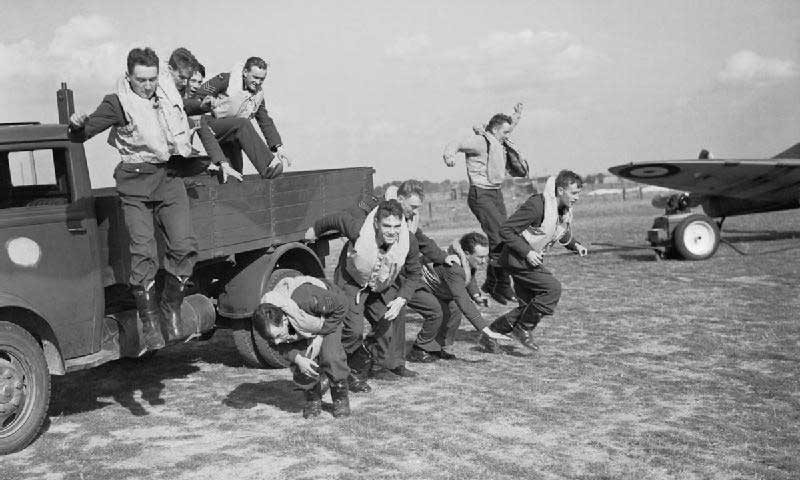
A regular occurrence during the Battle of Britain – Squadron Scramble!
In many ways, Eric James Brindley Nicolson was typical of the RAF fighter pilot in the summer of 1940. Aged just 23 years old, he began his flying career by learning to fly with the de Havilland School of Flying at White Waltham in 1936, where he would have flown the ubiquitous Tiger Moth trainer. He successfully completed the course and passed out in November of the same year, before moving on to the next stage of flying training at No.10 Flying Training School where he flew Hawker Hart and Hawker Audax biplanes. After successfully completing his gunnery training course at RAF Sutton Bridge, Nicolson was finally posted to No 72 squadron at Church Fenton in August 1937 where he would fly the Gloster Gladiator biplane, which was the RAF’s current front line fighter of the day.
In May 1940, Nicolson was posted to No.249 squadron, which was re-forming at Church Fenton, where he was promoted to Flight Commander. The squadron was initially equipped with Supermarine Spitfires, but rather unusually they were soon replaced with Hawker Hurricanes. Becoming operational on 3rd July, the squadron moved south to Boscombe Down in August, as relief squadrons were needed to take part in the continuing Battle of Britain.
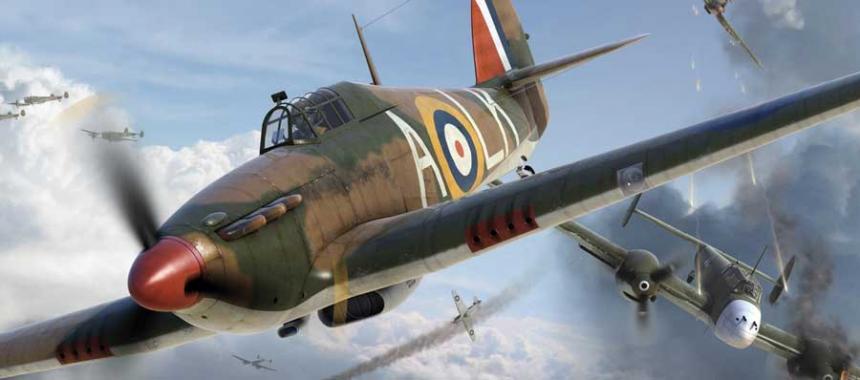
On Friday 16th August 1940, Flight Lieutenant Nicolson was scrambled from RAF Boscombe Down, in Wiltshire and took off in his Hawker Hurricane Mk.I P3576, coded GN-A, as part of ‘Red Section’. The Hurricanes were sent to intercept a flight of Messerschmitt Bf 110 Destroyers, which were approaching the Southampton dock area and forming part of a large force of attacking Luftwaffe aircraft. Flying at 17,000 feet (Angels one-seven in RAF speak), Nicolson spotted a Bf 110 below him and immediately dived in to attack. As he was lining up his gunsight on the enemy aircraft, he felt his aircraft shudder violently, with bullets ripping into the cockpit – he banked his Hurricane violently, in an attempt to get out of the line of fire and managed to catch a glimpse of his attacker. A Messerschmitt Bf 109 had been patrolling above the Hurricanes and had crucially not been spotted by the British pilots – as they pressed home their attack on the Bf 110s, they were unaware that they themselves were being hunted.
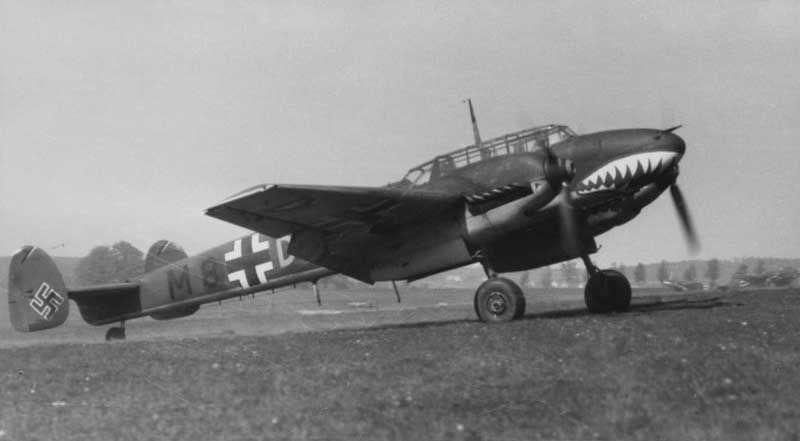
The Messerschmitt Bf 110 heavy fighter ‘Destroyer’
It is difficult for us to imagine the pressure and genuine fear, which must have afflicted the pilots involved in aerial combat during the Second World War. One minute, the sky would have been full of aeroplanes and even the most accomplished pilot would have been firmly in the territory of luck – there will have been a very real possibility of collision with either a friendly, or an enemy aircraft, in this deadly melee. There would also be the fear of being struck by a stray bullet from any of the guns that would be spraying fire in every direction and could again be from either a friendly, or enemy weapon. If you had the opportunity to select a target, the situation could quickly turn into a personal duel of one pilot against another – whatever the outcome of this, you could then find yourself in clear airspace, the only aircraft as far as the eye could see. Whatever the situation, if you were to lose your concentration for just a few seconds, you were in danger of becoming another pilots latest victory and could quite possibly be in the final seconds of your life. Accepting all these factors, the bravery of these young men, who put themselves in this position time and time again, is not just admirable, it is absolutely astonishing.
Back in the skies above Southampton and Flight Lieutenant Nicolson was now fighting for his life. Four shells from the attacking Messerschmitt had struck his Hurricane, which was now badly damaged. One shell had shattered the Perspex of his canopy and a shard of Perspex was sticking in his left eyelid and with blood pouring into his eye, he was temporarily blinded. A second shell grazed his left leg and hit him in the foot, with a third hitting vital instruments in the cockpit. The fourth shell caused the most significant damage to Nicolson’s aircraft – it struck the gravity fuel tank of the Hurricane, which was positioned in front of the pilot, just behind the instrument panel. Nicolson’s Hurricane began to burn.
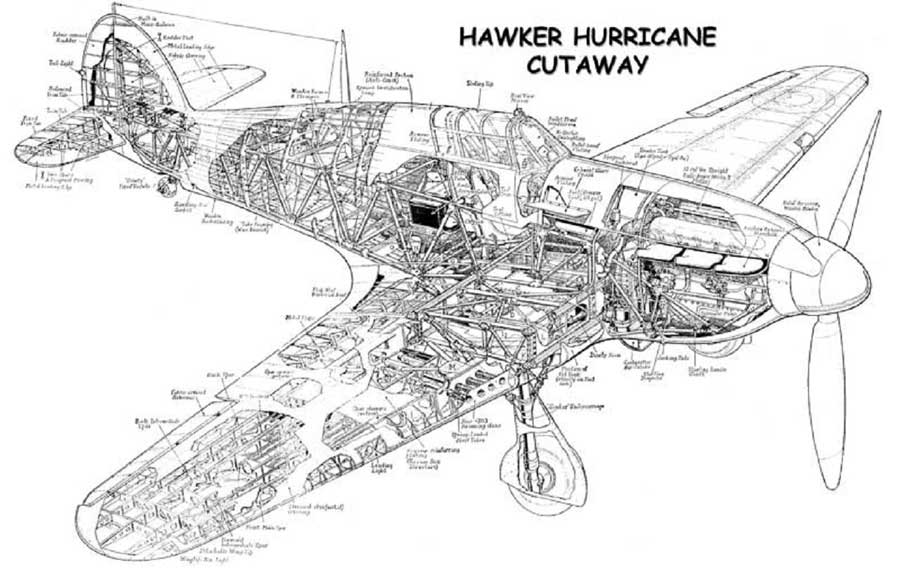
Hawker Hurricane cutaway drawing
For most pilots taking part in the Battle of Britain, the fear of being trapped in a burning aeroplane was the fate that terrified them more than anything else. With a fuel tank positioned just in front of the pilot, a cockpit fire was a very real possibility, with the effects of slipstream forcing the flames straight back towards the pilot.
Nicolson’s Hurricane was now on fire and he needed to get out immediately – he pulled the pin on his Sutton harness to release the belts that were holding him in the seat and wriggled up to abandon the aircraft. Just as he was about to jump out of his burning Hurricane, he saw a Messerschmitt Bf 110 pass just in front of his fighter and rather than make good his escape, a sense of real anger and defiance came over him and he climbed back into his burning aircraft. With flames licking around his hands and face, he took control of his Hurricane and fired his guns at the Messerschmitt that filled his gunsight, which dived towards the ground in an attempt to evade the attack. Nicolson continued to fire his guns, until the cockpit inferno became too intense to carry on. Engulfed in flames, he finally jumped free of his fighter and tumbled earthwards, with the rush of air helping to extinguish the flames – unfortunately for Nicolson, they had already done their work. Despite the intense pain from his fused hands, he had to try and pull the parachute rip chord or he would simply plunge to his death – after a number of attempts, he finally managed it and the harnesses under his arms pulled tight as the parachute inflated above him. Still in agony from his wounds, Flight Lieutenant Nicolson floated serenely towards the ground, just seconds after the horrors of the ferocious combat he was involved in, which was continuing in the skies above his head.
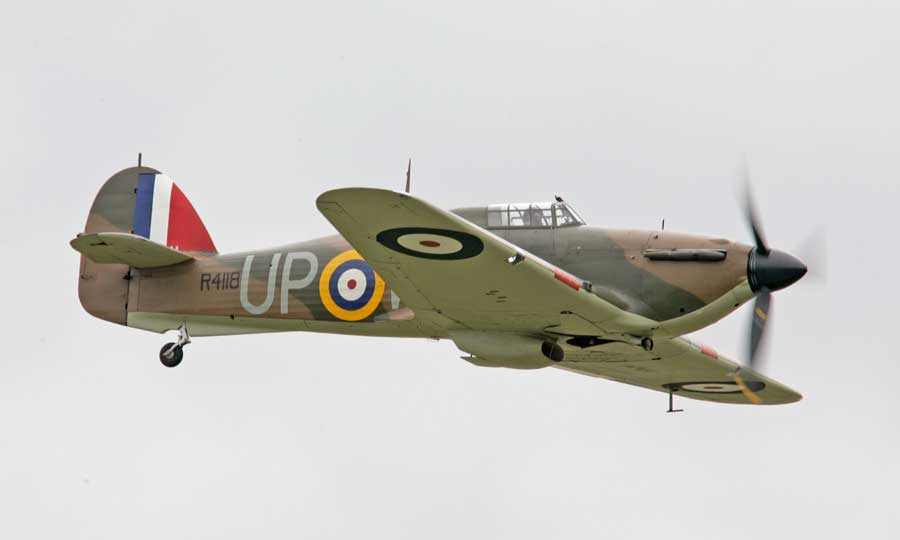
An early Battle of Britain era Hawker Hurricane Mk.I
As if Nicolson had not endured enough already, he was still in mortal danger. It is reported that a German fighter was circling the stricken pilot as he descended to earth on his parachute, possibly considering firing on him to prevent him returning to the battle at a later date. Fearing a potential attack, Nicolson feigned death until the Messerschmitt flew away. The circling Messerschmitt was viewed by members of the local Home Guard and may explain why the following incident occurred. Possibly mistaking the actions of the Messerschmitt pilot as checking the safe landing of a comrade pilot, one of the home defence volunteers fired a shotgun at the descending Nicolson, whilst he was just 50 feet above the village of Millbrook. As if he had not suffered enough, he now had pellet wounds to his buttocks, but once on the ground he was able to confirm his identity to the home guard unit – unfortunately, his hands were so badly burned that he was unable to release his own parachute harness. The small crowd that had gathered around him helped remove the parachute and rushed Nicolson to the Royal Southampton Hospital, where he received immediate treatment for his significant wounds.
The fact that the action in which Flight Lieutenant Nicolson had been involved was witnessed by a number of people on the ground as well as his own squadron mates was to be significant. So many of the combat situations taking place during the Battle of Britain did so in the privacy of the skies high above the country. There will undoubtedly have been many acts of selfless bravery taking place up there, most of which will have gone completely unnoticed by the general public, with many young men taking these valiant actions to their graves. Witnesses on the ground actually saw Nicolson press home his attack, despite the flames engulfing his Hurricane and also saw the Messerschmitt crash into the sea, near Southampton docks. Whilst he was receiving treatment for his wounds, military officials were discussing a suitable award for this display of extreme valour.
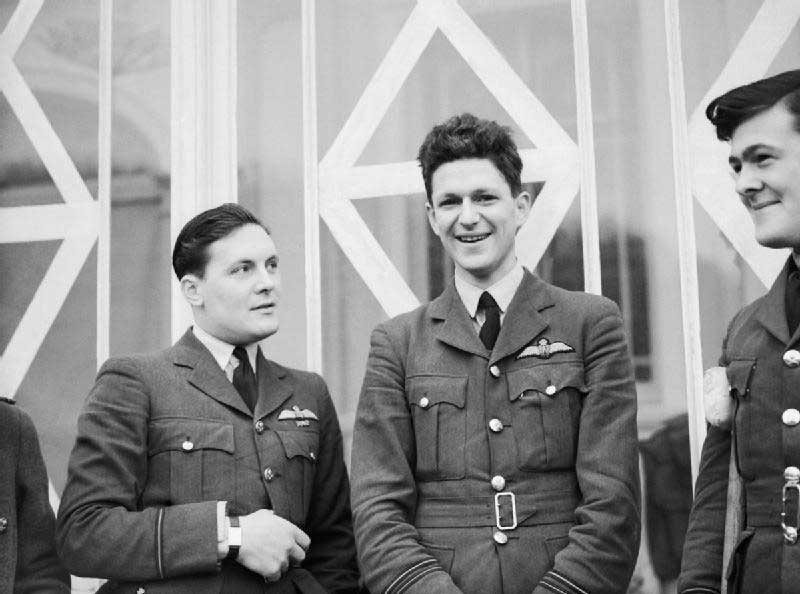
Eric James Brindley Nicolson
When later recounting the incident, following his recuperation, Nicolson said, “When I saw the Messerschmitt in front of me, I remember shouting out, I’ll teach you some manners, you Hun. I am glad that I got him, though perhaps pilots who have had more experience of air fighting would have done the wise thing and bailed out immediately the aircraft caught fire. I did not think of anything at the time, but to shoot him down.”
As details of the incident began to circulate, Nicolson’s Station Commander at Boscombe Down recommended his pilot for the Distinguished Flying Cross. This request was to spark discussions at a much higher level, as the King himself was viewing the situation with interest. At this time, Britain was involved in a fight for survival and the pilots of Fighter Command were the front line of our defence – the Battle of Britain was in full swing. The King was aware that much depended on the resolve of RAF fighter pilots at this critical time and possibly wanted to mark the nation's admiration and also to bolster this much needed resolve to fight. He knew that of the four Victoria Crosses (Britain’s highest military decoration for valour in the face of the enemy) already awarded to British airmen, none had gone to Fighter Command and it may have been the case that pressure was brought to bear. Officially, Air Vice Marshal Keith Park, Air Officer Commanding No.11 Group, said of the incident, “For this act of gallantry and magnificent display of fighting spirit, I recommend this officer for the immediate award of the Victoria Cross.” So, from Distinguished Flying Cross, the award was upgraded to a Victoria Cross.
Whilst Flight Lieutenant Nicolson was still recuperating from the wounds he received on 16th August, he learned that he was to receive the Victoria Cross for his gallantry. On 25th November, he was received at Buckingham Palace, where he was presented with the Victoria Cross – significantly, his was to be the only VC awarded to a Fighter Command pilot during WWII.
There have been a number of comments and opinions regarding the Nicolson VC over the years, as some question whether it was deserved above the actions of other Fighter Command pilots. Having researched this incident again recently, I am of the opinion that it was indeed deserved, but probably had an even bigger meaning. At the time of the award, Britain really did have her back against the wall and maintaining the morale of the pilots of Fighter Command was of national importance. Flight Lieutenant Nicolson was not an ‘ace’ pilot, but the recognition of his unquestionable valour really was recognition of the skill, bravery and devotion to duty displayed by thousands of Fighter Command pilots, who defended Britain during the Second World War. The Nicolson Victoria Cross award was surely recognition for the sacrifices made by all the pilots of Fighter Command, during the Battle of Britain.
Nicolson himself was typically modest about his VC award. He knew better than most the sacrifices being made by his comrade pilots in Fighter Command and possibly felt a little embarrassed about this official recognition, feeling that there were equally deserving pilots. Indeed, he was so modest about his Victoria Cross that he had to be reminded that it was a disciplinary offence to be improperly dressed, as he was slow to attach his VC medal ribbon onto his uniform.
Nicolson eventually returned to active duty and was later promoted to Wing Commander. Tragically, he did not survive the war - flying as an observer aboard an RAF Liberator on 2nd May 1945, the aircraft caught fire and lost two engines. The bomber crashed in the Bay of Bengal and Nicolson’s body was never found.
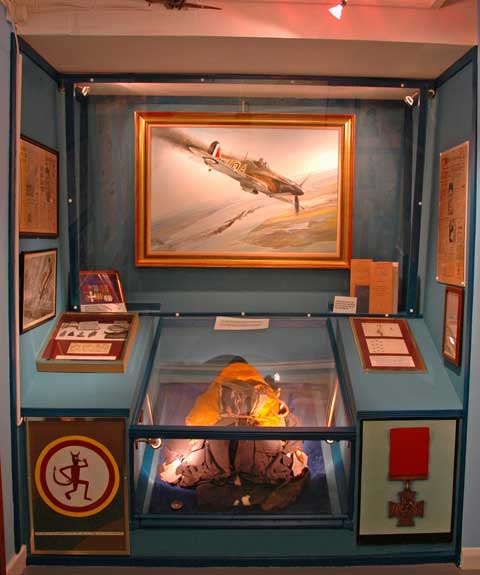
The Nicolson display at the Tangmere museum
As the only Fighter Command winner of the Victoria Cross, there has always been plenty of enthusiast interest in this famous RAF pilot. His Victoria Cross is displayed with his other medals, at the RAF Museum, Hendon. There is also a superb Nicolson exhibition at the Tangmere Military Aviation Museum, in West Sussex – the museum holds the flight tunic, ‘Mae West’ and damaged shoe, which were all worn by Nicolson, during his VC action. The Nicolson family, who had been holding the artefacts since the end of the war, presented the items to the museum, so that they could be viewed by the nation and preserve the memory of James Brindley Nicolson and the brave Battle of Britain pilots of Fighter Command.
This year’s 75th anniversary of the Battle of Britain will see a number of high profile events organised specifically to commemorate the air battles of the summer of 1940. Whilst you might think that Spitfires and Hurricanes will be the focus of our attention this year, they do have some significant competition in the form of the RAF’s current front line fighter – the Eurofighter Typhoon FGR.4. In an extremely welcome, but unexpected development, the Royal Air Force decided to mark this 75th anniversary year by giving one of their Eurofighter Typhoon fighters a Battle of Britain makeover and instantly guaranteed that this aircraft would be one of the most photographed aircraft of the year.
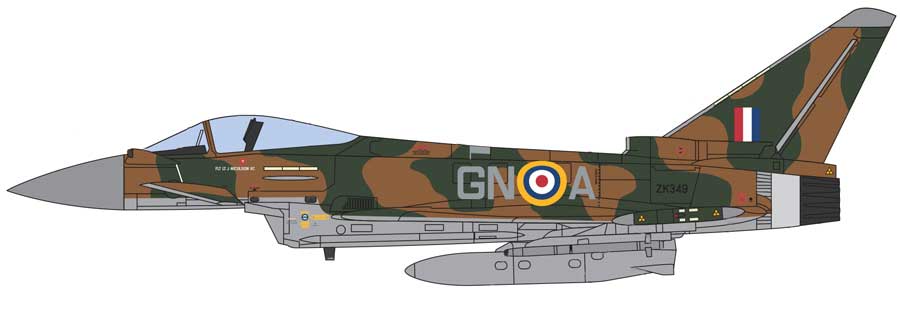
Artwork profile of the stunning Battle of Britain Typhoon
Not only does Typhoon ZK349 look resplendent in her Battle of Britain camouflage, she has also been painted specifically to commemorate the only Fighter Command Victoria Cross recipient of WWII – Flight Lieutenant James Brindley Nicolson. Wearing the same GN-A codes as those on Nicolson’s No.249 squadron Hawker Hurricane Mk.I (P3576), the aircraft will be a high profile way for the current Royal Air Force to pay tribute to the bravery and sacrifice of their predecessors in the summer of 1940.
Flight Lieutenant Ben Westoby-Brooks, who is based at RAF Coningsby, flying with No.29(R) squadron, will fly the camouflaged Typhoon at a number of events this year and also on a daily basis, as this is an operational aircraft. Ben was posted to Coningsby in 2008 to fly the Eurofighter Typhoon fighter and was to become the 100th pilot to go solo in the aircraft at the Operational Conversion Unit. He has since remained at Coningsby, spending over 4 years on 3(F) Squadron for his first tour. Ben has now flown Typhoon for over 7 years, amassing over 1000 Typhoon flying hours. His service includes Front Line operations over Libya in 2011 on Operation ELLAMY plus numerous overseas detachments to the Falklands and exercises in Holland, Italy, Germany, Austria, Cyprus, UAE, Oman and India. Ben returned to 29(R) Squadron as a Qualified Pilot Instructor in 2013 to train both student pilots and instructors whilst also contributing to RAF Coningsby’s primary task of operating the country’s Quick Reaction Alert, where he is scrambled to challenge any incursions into UK airspace.
Commenting on his high profile role for the summer, Flight Lieutenant Westoby-Brooks said, “It is a great privilege to fly this extraordinary aircraft in recognition of the sacrifices made by our predecessors, 75 years ago. Their task of securing the skies was critical in the summer of 1940 and it’s an honour to pay tribute to those few brave airmen who gave their all when the stakes were so high”.
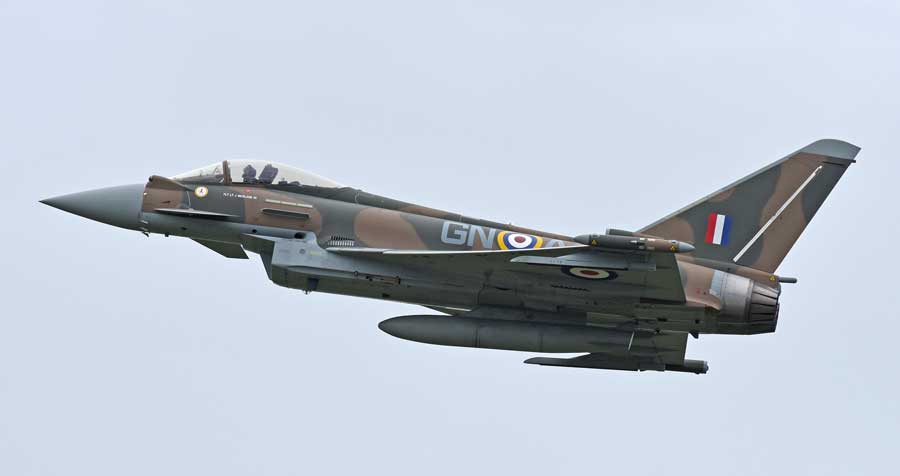
75th Anniversary Typhoon performing at Duxford Airshow in May
As well as being a much sought after aircraft in any Airshow static display this summer, the Battle of Britain Typhoon will also perform a ‘Synchro Pair’ routine, in conjunction with a BBMF Spitfire, as a high profile tribute to the Fighter Command pilots of 1940. One thing is absolutely certain – this beautiful aircraft will be one of the most photographed aircraft of the year and will surely lead to the RAF being pressured to paint some of their other Typhoons in schemes other than air superiority grey.

If you are looking to build either an RAF Eurofighter Typhoon, or a Hawker Hurricane, the plastic modeller is well catered for. Looking first at the Typhoon, the popularity of this current front-line RAF fighter is not in question, which has resulted in it being one of the best selling models in the current Airfix range. There are two models listed in the Airfix catalogue - one of them (A04036) is sold out on the Airfix website, but you may still be able to purchase from your usual Airfix stockist. The large starter set A50098 is available and comes complete with cement, paint and brush and is an ideal model for the younger modeller, or for the casual kit builder.
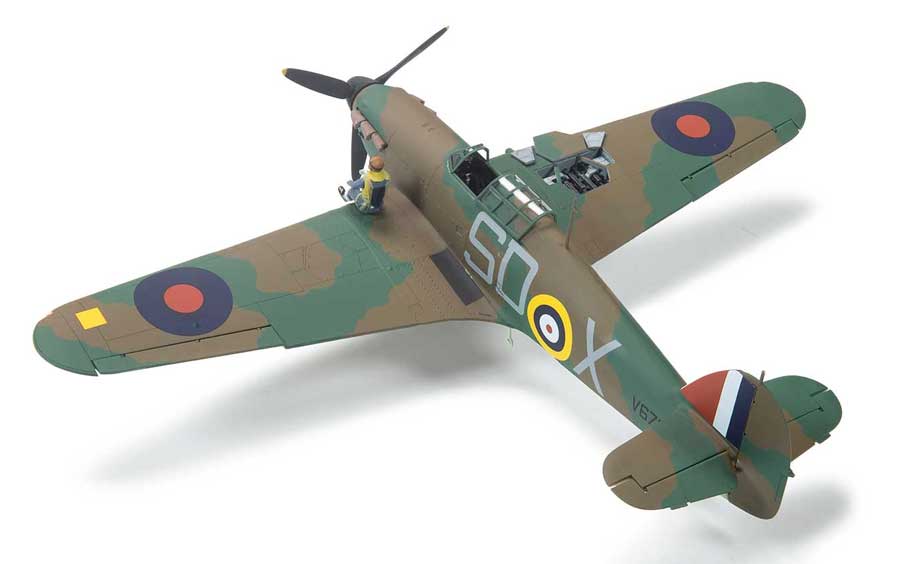
The new Airfix Hurricane Mk.I in 1/48th scale
The Airfix Hawker Hurricane is a different kettle of fish altogether, with examples available in 1/72nd, 1/48th and 1/24th scales – for the purposes of this feature, I am just going to look at one of the latest Hurricane models available, which has already proved to be an incredibly popular kit.
A05127 is a magnificent New Tooling example of the Hawker Hurricane Mk.I and is presented in the larger 1/48th scale. It is a superb example of the current quality of Airfix model tooling and incorporates all the modern production technologies available to the Airfix designers and allows the modeller to produce a really accurate representation of this most famous RAF fighter.
The kit allows the modeller to finish their model as either a No.501 Squadron machine, from RAF Kenley, or a No.605 Squadron Hurricane, from RAF Croydon. Again, as with the Typhoon F.2 kit we discussed earlier, this Hurricane has proved to be a spectacular success and is not currently available on the Airfix website. You can register your interest to be informed when new supplies arrive, or you could always raid your local model store to see if they still have any kits available on their shelves. Either way, you will be getting your hands on an excellent Hurricane kit, which looks even better when combined with the new 1/48th scale RAF ground crew set.
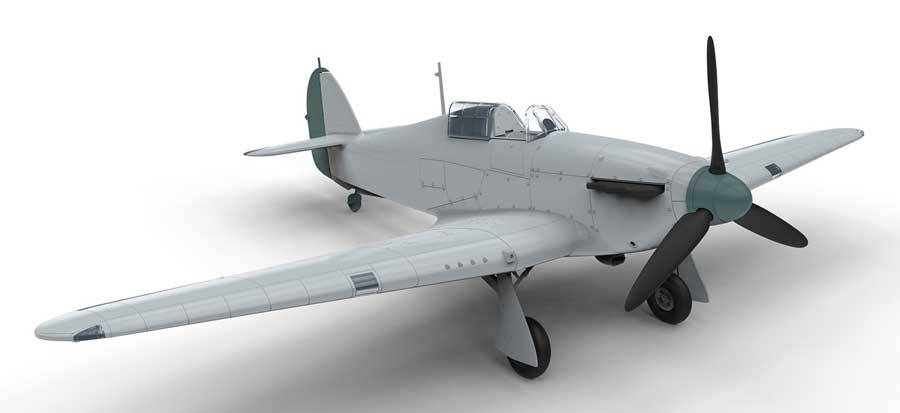
Computer rendered image of the new Airfix Hurricane
This weekend's Royal International Air Tattoo will see the announcement of a very special addition to the Corgi Aviation Archive range, which will be a magnificent way for the die-cast collector to mark the 75th anniversary of the Battle of Britain. Presented in 1/72nd scale, Eurofighter Typhoon AA36407 will be a totally unique addition to the Aviation Archive range and is the first time that the RAF’s current front line fighter has been decorated in such a radical scheme – it looks absolutely spectacular!
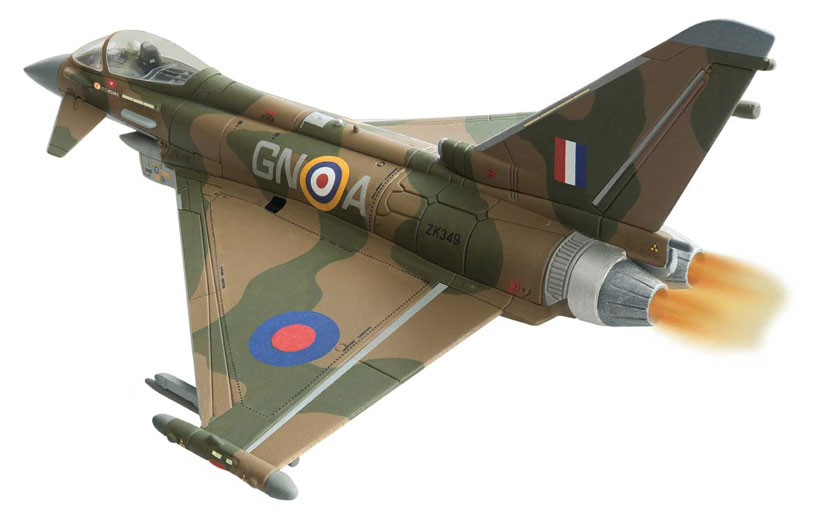
It is clear that this will be a highly sought after release - this model is already in production and is scheduled for release in December 2015. AA36407 will be priced at £54.99 and as we know that this will be an extremely popular model, collectors are advised to pre-order their example early to avoid disappointment – pre-order the Eurofighter from the Corgi website, or call Corgi Direct on 01843 233 519 with a credit or debit card. Alternatively, contact your local Corgi stockist.
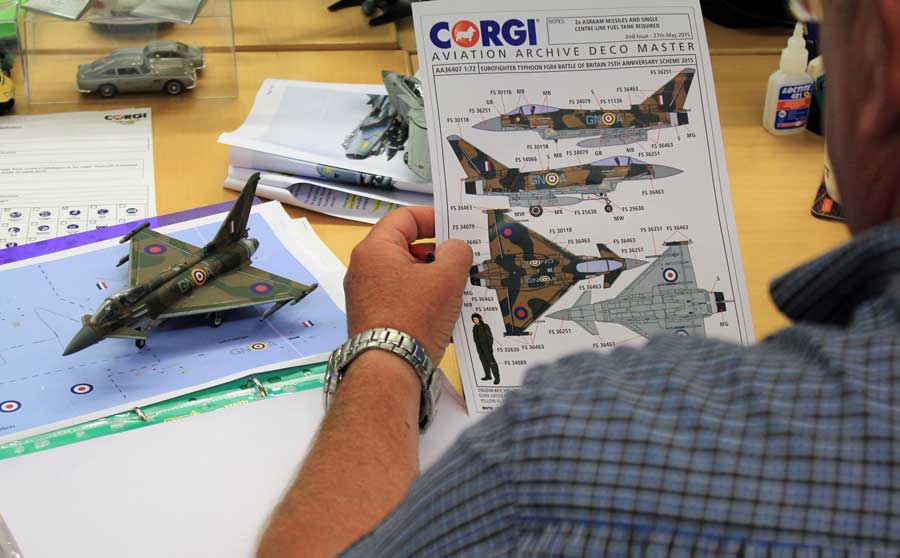
Today also sees the launch of a new Corgi development blog called ‘Die-cast Diaries’ which will keep collectors informed on all things Corgi – the first edition will include more details and exclusive images of the Battle of Britain anniversary Typhoon, so head over to the Die-cast Diaries section for more details.
Right, that’s it for me – I’m off to pack for a marathon session at the Royal International Air Tattoo. Thank you very much for reading our latest edition of Aerodrome, which we hope you found interesting. Don’t forget to order your camouflaged Corgi Typhoon, as these will move almost as quickly as the real thing!
You can discuss this week's blog on the Airfix Aerodrome Forum or Corgi Aerodrome Forum, and if you have any comments, questions or suggestions for future editions, please feel free to let us know on Airfix Facebook or Corgi Facebook, or on Airfix Twitter or Corgi Twitter using #aerodrome.
Happy collecting!
Michael
© Hornby Hobbies Ltd. All rights reserved.
Archive images licensed under Public Domain via Wikimedia Commons.

