
Welcome to this latest edition of Aerodrome and our regular look at the fascinating world of aeroplanes and the historic aviation scene around the UK.
After almost seven months without any classic aviation action to thrill the nation’s Airshow enthusiasts, we can now finally proclaim the 2025 Airshow season off and running, and in some style. Once again taking the honour of opening yet another Airshow season, the Shuttleworth Collection invited the great and the good to their delightful Old Warden airfield for a celebration of classic aeroplane action, and they were determined to kick things off in style. As you would expect, your roving Aerodrome reporter was there to enjoy the action, and to document proceedings for publication in this latest edition of our blog.
From a timing perspective, this blog post is actually due to go live on the same day as an Airfix Workbench special edition marking the 90th anniversary of the first Flight of the Messerschmitt Bf 109, both of which are scheduled to be posted at the same time that I should be enjoying a stroll along the beach near Bamburgh Castle, meaning that this edition is going to be something of an overview, rather than a full review. That will duly follow in a forthcoming edition, however, for this particular posting, we still have a trio of aviation delights for your viewing delectation.
You can look forward to hearing about a unique airworthy Great War bomber, the Airshow debut of a stunning new desert Spitfire, and a Transatlantic visitor marking its ‘Navy to Victory’ tour in this latest edition of Aerodrome, with a selection of supporting imagery, of course.
The only WWI era bomber still in airworthy condition, the magnificent Airco DH.9 is unquestionably one of the jewels in the crown of Britain’s impressive historic aviation scene.
After a long, enforced winter Airshow hiatus, there’s nothing quite like normal service being resumed, and getting that first event of the new season well and truly under our belts. This year, that honour once again fell to the Shuttleworth Collection and their delightful theatre of historic aviation which is Old Warden Airfield, as they once again played host to the first full Airshow of the 2025 season. Neighbouring IWM Duxford did play host to an event the previous day, however, that was more of a flying day, and not an Airshow in the traditional sense of the word, so Shuttleworth took the honours for yet another year.
For aviation enthusiasts and those with an interest in classic machines in working condition, the Shuttleworth Collection is famous the world over, with their airfield home at Old Warden in rural Bedfordshire surely being one of the most idyllic locations from where to see old aeroplanes flying. Home to an unmatched collection of historic aeroplanes, they are maintained by a small team of professional engineers, supported by a small army of volunteers, with their ultimate aim being to ensure that every aircraft in the collection should be preserved in airworthy condition and displayed regularly for Collection visitors, and in the name of aviation heritage.
With the Collection’s aircraft usually residing within the protection of the six historic hangars at the airfield, the regular schedule of Airshows and events at Old Warden give these aviation classics the opportunity to spread their wings to the delight of the crowds in attendance and should one aircraft be unavailable to fulfil its display slot, a replacement aircraft is simply pulled from its hangar and prepared for flight. With a collection which can boast several of the world’s only remaining airworthy examples of particular aircraft types, as well as the oldest surviving airworthy aircraft to be found anywhere in the world (in the shape of the 1909 Blériot XI), Old Warden airfield has to be regarded as one of the most significant locations in the historic aviation world and as enthusiasts, we are extremely lucky to be able to visit it regularly.
Although the Collection’s aircraft could put on a world class Airshow in their own right, one of the most appealing features of an Airshow held at Old Warden is how the organising team always attempt to invite visiting aircraft to perform at their shows. Not only do they try to secure some of the most appealing historic aircraft available in the UK and from further afield, but they also know that any aircraft displaying at Old Warden is a spectacle most enthusiasts will happily travel great distances to see – this really is a very special place.
As mentioned in our introduction, this is actually a holiday edition of Aerodrome, as I should be in Northumberland enjoying a few days break by the time this blog is posted, meaning this will be a slightly abridged version of our blog. Anything left out will make it into our next edition, as there will be another Airshow to attend at Old Warden on the last day of this month.
Although this year’s show was played out under beautiful blue Bedfordshire skies, display pilots did have to contend with quite a strong and challenging wind, one which appeared to change direction several times during the day, but mainly coming from a direction which was trying to push displaying aircraft towards the crowd line during their displays, something which would clearly have been a concern for them. Although all displaying aircraft would have been affected by the conditions to some extent, some of the older aircraft on show would have been particularly susceptible to the wind, including one Great War era aircraft which was making the short trip across from Duxford.
When it comes to displaying Great War era vintage aeroplanes, nobody does it quite like the Shuttleworth Collection, and for their opening show of the year, they had arranged for one of the rarest aircraft in the world to be performing for the aviation pilgrims in attendance. One of the first British aircraft designed specifically as a strategic bomber, the Airco DH.9 was a development of the highly regarded Airco DH.4 already in RFC service in 1917, and was intended to wreak havoc on and behind German lines on the Western Front.
Able to carry either two 230lb or four 112lb bombs carried under the aircraft’s wings and in an internal bomb bay, the DH.9 also boasted significant defensive armament, with a forward firing Vickers machine gun operated by the pilot and either one, or two Lewis guns mounted on a scarf ring and fired by the observer. Although the aircraft was promoted as a significant improvement over its predecessor, the DH.9 was plagued by persistent engine reliability issues and even though numerous different engine combinations were tried during its service career, the aircraft is still remembered as something of an operational disappointment.
Despite this, as the DH.9 occupies such a significant position in the history of the Royal Flying Corps/Royal Air Force, and really is an elegant looking aeroplane when viewed from any angle. The opportunity to see the world’s only flying example in the air above one of the world’s most historic aviation venues is one which aviation enthusiasts will always find hard to resist, and we were not disappointed.
This magnificent link to the early days of military aviation was discovered lying abandoned in India along with two other DH.9 airframes in the late 1990s, and negotiations attempting to secure the three aircraft took place with the Indian Government almost immediately, with back-up support from the Imperial War Museum. An agreement was duly made, however, these discussions were long and frustrating, taking a full three years to come to fruition.
With all three airframes safely recovered back to the UK, a concerted period of inspection and subsequent restoration took place, which would result in work to restore two aircraft from the components secured, with the work to be carried out by the specialists at Retrotec Ltd, the restoration arm of the Historic Aircraft Collection. One of the restored aircraft was intended to be completed to static display condition for the Imperial War Museum, with the intention of subsequently placing it on public display.
The second aircraft offered something altogether more ambitious for aviation enthusiasts, as it was to form the basis of a project to see one of these Great War bombers returning to the skies again, unquestionably one of the most exciting historic aviation projects the world had seen to that date. As we all now know, both projects were successful, and both aircraft now reside at IWM Duxford in Cambridgeshire, unquestionably the most significant venue for restored Airco DH.9 aircraft in the world.
A trio of Airco DH.9 images, including one showing the aircraft being flown in relatively close proximity to the Shuttleworth Collection’s Bristol F2B Fighter.
The first of the two projects to be unveiled was D5649, a beautiful restoration which is currently on display in the huge AirSpace hangar, close the museum entrance, and displayed in close proximity to other classic British bombers, such as the Avro Lancaster and Avro Vulcan. As the first British bomber aircraft, this makes for a unique display which represents the incredible development of Britain’s bomber aircraft.
The second aircraft, E-8894 (G-CDLI), continued with its restoration well into 2018 and throughout a year which marked both the centenaries of the establishment of the Royal Air Force, and the end of the First World War – could the triumphant first flight of this unique aircraft take place in this significant anniversary year? As it turned out, despite the fact that the DH.9 was seen out on the airfield at Duxford, only engine testing took place in 2018, and it would be the following year before a first post restoration flight could take place.
Since then, this unique link to the air war above the trenches towards the end of WWII has graced several Airshow events, even though she is still quite a rare sight in the air and rarer still away from her home airfield at Duxford. The only airworthy Great War bomber in existence, this priceless aviation artefact is entrusted to famous Warbird pilot Clive Denney on show days, who considers flying this aircraft as one of the high points of his illustrious career.
In an interview about flying the DH.9, he describes how it’s a relatively vice-free aeroplane to fly, but how the controls can be a little heavy, especially in strong winds. His major concern though is how the aircraft relies on a 107 year old, extremely rare engine to keep it in the air, and how if this were to stop, it wouldn’t remain in the air for long. During any display, his primary concern is to have a suitable field to land the aircraft, should its Armstrong Siddeley Puma engine decide to have an off day!
In addition to displaying this magnificent aircraft in beautiful blue skies, Clive also flew several passes with the Shuttleworth Collection’s Bristol F.2B Fighter in close proximity, which was a real treat for those viewing the spectacle.
This magnificent aircraft is an early example of the Mk.IX Spitfire, one which started down the production line as a Mk.V.
If you want to ensure a health gathering of aircraft enthusiasts at your first Airshow event of the year, simply add a beautifully presented Spitfire making its first display appearance at your venue, and you’ve cracked it! That’s exactly what the team behind this year’s Season Premier Airshow did, and even the sun came out to take a look at this particular Supermarine sensation – it really is a beauty.
Looking absolutely resplendent in its desert camouflage and azure blue undersides, Supermarine Spitfire Mk.IX LZ842 was the star of the display aircraft static display parked in front of the main crowd line, and really did look at home under the perfect conditions enjoyed at this year’s show. As far as I’m aware, this show marked its UK air display debut, but was certainly the first time its owner pilot and his new Spitfire had ever performed at Old Warden, and those in attendance could hardly wait.
An unusual aircraft which marks the introduction of this ‘stop-gap’ variant of the Spitfire, this aircraft was constructed at the famous Castle Bromwich factory in April 1943, and is particularly noteworthy as she was one of the first 100 Spitfire Mk.IX fighters constructed, aircraft which actually started down the production lines as Mk.Vc airframes, but were adapted to take the new Rolls Royce Merlin 61 two stage, two speed supercharged engine.
Following delivery to the RAF, she was prepared for service in North Africa and given a smart new paint scheme to help acclimatise her for sunnier conditions, however, the subsequent surrender of Axis forces in North Africa brought about a change of overseas destination, and allocation to RAF No.93 Squadron at Hal Far on the Island of Malta. Seeing plenty of combat flying whilst in theatre, the aircraft would see a further changes of ownership when transferred to No.232 Squadron and then on to No.253 Squadron, both flying operations in the Italian campaign, ranging from standing patrols to bomber escort missions.
This next series of images show this magnificent addition to the UK Airshow scene looking resplendent in the sunshine at Old Warden, taxiing out for her display, prior to captivating everyone fortunate enough to see her stunning display.
The fighter was later handed over into the care of No.327 (Free French Air Force) at Borgo airfield in September 1944 and later onwards to France itself, as the Allies successfully liberated the country. Damaged following a landing accident at Mourmelon, the aircraft was dismantled and sent for repair at No.3 Repair Unit at Lokeren, in Belgium, but on completion of the works, was sent back to the UK for storage.
This well-travelled fighter would subsequently be one of 135 Spitfires passed on to the South African Air Force, packed for the sea journey in early April 1948, and arriving in Cape Town around three weeks later. Some of these aircraft were supplied free of charge, and 53 were actually flown down to their new owners – obviously, LZ842 was not one of these.
Not much is known of the aircraft’s service in South Africa, with the trail growing cold until she was discovered in a scrap yard many years later, was secured by the SAAF Museum and transferred to their storage facilities. What remained of the fighter were sold to a UK buyer in 1989, but were later part of a deal which saw her heading to Australia, but that was not the end of this particular aircraft’s travelling. She was acquired by famous Spitfire enthusiast and restoration specialist Peter Monk in 2003, and was eventually the subject of an ambitious restoration project, the magnificent fruits of which we see here.
Making her first post restoration flight in 2022, she is the only airworthy Spitfire powered by a Rolls Royce Merlin 63, and is thought to be the second earliest Mk.IX Spitfire in airworthy condition. The owner specified that his Spitfire should be restored to as close to her original configuration as possible, which included the addition of a water drinking tank for the pilot, something reserved for Spitfires flying in hotter climates.
Looking stunning in these Mediterranean Theatre markings, this beautiful aircraft has already made an impact on the UK’s aviation enthusiast community and on a blue sky day, could there be a better looking Spitfire for us to admire?
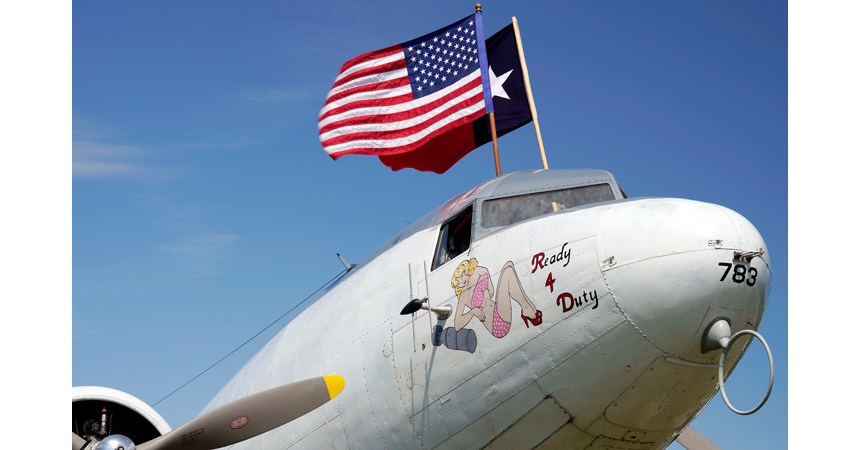
By far and away the largest aircraft on display at this year’s show, and the one which had made the longest journey to get there, Douglas R4D-6s ‘Ready 4 Duty’ is a beautifully presented US Navy variant of the famous Douglas C-47 Skytrain, with this example being one of the aircraft in the care of the Dallas/Fort Worth Wing of the Commemorative Air Force.
You may recall that a number of C-47s made the trip across the Atlantic last year in order to commemorate the 80th Anniversary of D-Day, with the aircraft landing at Old Warden as part of their D-Day Squadron 2024 Legacy Tour, a review of which you can access HERE. ‘Ready 4 Duty’ was one of the aircraft scheduled to take part in this undertaking, however, she suffered engine problems whilst still on the US side of the Atlantic and despite the best efforts of her support team, the problems could not be resolved in time and they were reluctantly forced to admit defeat.
Undeterred, this year has seen the aircraft make the Transatlantic crossing alone, embarking on what her owners have called their ‘Navy to Victory’ tour, with ‘Ready 4 Duty’ only arriving in the UK in the days prior to this year’s show, and we’re delighted to have her.
Built in 1944, ‘Ready 4 Duty’ (BuNo.50783) is an R4D-6S variant of the famous Douglas C-47, one of 35 C-47B-10-DK aircraft converted on the Oklahoma City production lines to US Navy specifications. She was accepted into US Navy service during October 1944 and was assigned to VR-3 at Kansas Naval Air Station that same month. Full details of her service introduction appear to be incomplete, because official records don’t show her being flown operationally until January 1945, although this may be as a result of her being fitted out with specialist anti-submarine equipment, as is denoted by the ‘S’ in her variant description.
Douglas R4D-6S ‘Ready 4 Duty’ arriving at Old Warden to take her place as the star of their static aircraft display at this year’s Season Premier Airshow.
The modification work included the installation of external ordnance racks, which allowed the aircraft to carry depth charges, giving her an offensive capability, in addition to being able to detect enemy submarines. She would later be assigned to the US Navy Atlantic Special Service Squadron, where she conducted airborne search radar and sonar trials, in addition to training specialist operators in their operational use. It’s service area covered a vast area of ocean from Texas to Dakar in the south and Greenland to Iceland in the north, and during operational patrols in February 1945, she was one of a number of aircraft which managed to pounce on a surfaced German U-Boat, sinking it off the coast of Brazil.
The bulk of the ASW equipment was removed in 1956, however, the aircraft’s 'S' designation was retained. The interior of the aircraft was re-worked to a transport configuration, with commercial airliner seats and cabin liner all being installed. She was assigned to ‘Headquarters, Combined Naval Forces, Germany’ in Berlin, however this, and all of her subsequent assignments proved to be relatively short-lived, moving from Berlin to Birmingham, Houston, and finally Los Alamos, as more modern types were now replacing former Second World War aircraft in military service.
The aircraft wasn’t retired until 1979, with an impressive 35 years’ service to her name, however, that wasn’t to be the end of her flying days. She was acquired by the Confederate Air Force in 1980, and in 1985, became the first CAF warbird to cross the North Atlantic to embark on a European tour. Now 40 years later, she’s back again to thrill European audiences at the sight of this rare and extremely attractive warbird, with her ‘Navy to Victory’ tour, and a guarantee of securing a new army of classic aviation followers.
This stunning aeroplane was the centre of attention at Old Warden, right up until she prepared to head back to her temporary home at IWM Duxford.
The aircraft flew in from Duxford for this opening Airshow event of the year, and flew out again at the end of the show, with many on the airfield not leaving until they had seen her taking off. A large and extremely welcome addition to the aircraft attractions on show at this year’s Shuttleworth Season Premier Airshow, you can keep a track on all her intended activities and Airshow appearances by regularly checking in on her official Facebook page.
We’re afraid that’s it for another edition of Aerodrome, however, we’ll be back again in four weeks’ time with more news and pictures from the fascinating world of aviation. Thank you for your continued support and as always, if you would like to comment on anything blog related or suggest a subject you would like to see covered in a future edition of Aerodrome, please do drop us a line at aerodrome@airfix.com, where we would be delighted to hear from you.
Should you wish to continue the aviation discussions between editions, you will always find something of interest over on the Airfix Aerodrome Forum and if social media is more your thing, please use the respective official social media icon links at the foot of the main Airfix and Corgi website homepages to access our official sites.
The next edition of Aerodrome is scheduled to be published on Friday 20th June, when we will be bringing you more news from the fascinating world of aviation.
I hope to see you all back here then.
Michael