With an impressive number of aviation museums and a vibrant calendar of Airshow events, UK based aviation enthusiasts really do have to consider themselves extremely fortunate. Most people would not have to travel too far to indulge their passion for all things aviation, whether your preference is for civilian, or military aviation. Yet despite this embarrassment of aviation riches, the odd occasion still arises when even the UK enthusiast is found pinching himself and asking if he can really believe his own eyes!
In the latest edition of Aerodrome, we are going to look back at a monumental aviation event that took place during the late summer of 2014, which despite its undoubted historical significance took all but the most committed aviation enthusiast by surprise. For an all too brief six week period, two historic aeroplanes captivated the British public and made aviation enthusiasts all over the world extremely envious. It also proved beyond any doubt that our aviation heritage is still as relevant today, as when the brave men of Bomber Command were fighting for our very survival. As anyone who was fortunate enough to witness this spectacle will testify, the summer of 2014 was a Lancaster summer and Britain could hardly believe her good fortune. In this photographic review edition, Aerodrome 39 will mark the memorable visit of the Canadian Warplane Heritage Museum Avro Lancaster Mk.X to the UK and her triumphant debut on the UK Airshow circuit.
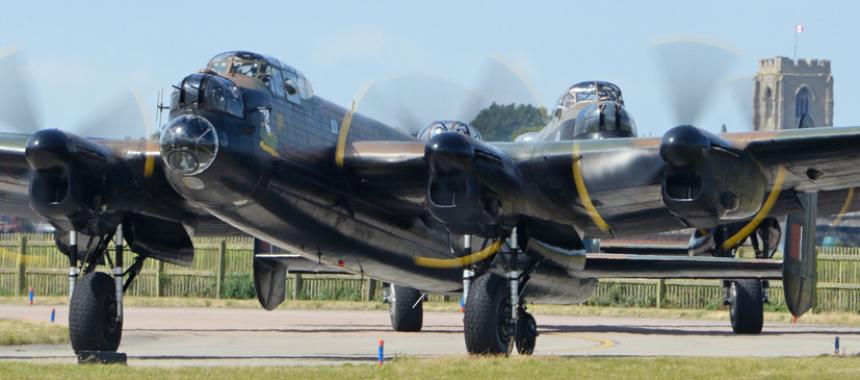
 BBMF Lancaster PA474 on finals at RAF Coningsby
In early 2014, news began to circulate amongst aviation enthusiasts that the Canadian Warplane Heritage Museum were planning to fly their extremely rare Avro Lancaster over to the UK, for a series of high profile events during the late summer. Our very own Battle of Britain Memorial Flight, based at RAF Coningsby were to play host to their illustrious Canadian visitor, with its potential arrival offering the tantalising prospect of seeing two airworthy Lancasters being flown in the same airspace for the first time in fifty years! Although this news could hardly have been more exciting for the UK aviation enthusiast, I am sure that many would have secretly questioned whether this plan would actually come to fruition and hardly dared to believe that they could witness the sight of two Lancasters flying together. Surely this would prove too much for a sixty-nine year old aircraft, which was more accustomed to performing at Airshows and giving experience flights! It would be asked to follow the same dangerous North Atlantic crossing route that Canadian built Lancasters had done since 1943, but those were days of necessity and this was now a very old and extremely valuable Warbird.
Despite a multitude of significant challenges and many fearing the aircraft was not capable of such an adventure, in Hamilton Ontario, an Avro Lancaster Mk.X was being readied for its historic journey, with nothing being left to chance. With a pioneering spirit and a steely determination, the team at the CWHM prepared their beloved aircraft for the flight and made absolutely no excuse for their steadfast optimism – this visit was going to happen and that was that. The Lancaster received replacement tyres and propellers and upgraded radio and navigational equipment – her four Packard Merlin engines were tested and tested again, in preparation for what would be just short of a 4,000 mile journey to the UK. As all this work was going on, Britain watched and hoped!

A welcome sight in the UK – Canadian Lancaster Mk.X ‘VERA’
Although the Avro Lancaster is synonymous with the Royal Air Force and Bomber Command’s effort to subdue Germany during WWII, Canada is also inextricably linked with Britain’s most successful bomber of WWII. As Britain was desperate for as many aircraft as it could get, a deal was signed to allow Victory Aircraft Limited, in Malton Ontario to produce Lancasters, many of which would go on to fly on operations back in the UK. A total of 430 Lancaster Mk.X bombers were produced by Victory, in two production batches between 1943 and 1945. Of equal significance were the large numbers of Canadian air and ground crews who served with Bomber Command during the Second World War, making a significant contribution to the Allied war effort and eventual victory.
The Canadian Warplane Heritage Museum’s Lancaster Mk.X FM213 is one of just two airworthy Lancasters remaining in the world today. She was one of the last aircraft to be constructed from the final production batch in July 1945 and although destined for the ‘Tiger Force’, before the surrender of Japan, she consequently never saw action during WWII. Converted to Mk.10MR standard, the aircraft served the Royal Canadian Air Force in the Maritime Reconnaissance role, until suffering a serious accident in 1952. Interestingly, the aircraft was repaired using the wing centre section of a Lancaster that had flown on combat operations over Germany during WWII. FM213 went back to flying maritime patrol and rescue operations with the RCAF until she was retired in late 1963.
For the next few years, FM213 was displayed on plinths in a flight configuration, at an outdoor location at Goderich, Ontario, before being dismantled and stored at Dunnville, again in the open air. Surely destined for the scrap man’s axe, the Lancaster was saved following the intervention of The Royal Canadian Legion at Goderich and was acquired by The Canadian Warplane Heritage Museum in 1978. Following a painstaking ten year restoration programme, Avro Lancaster Mk.X FM213 triumphantly returned to the air once more on 24th September 1988 and has been kept in airworthy condition since this date.

Avro Lancaster FM213 first flew over 69 years ago
The aircraft is dedicated to the memory of RCAF pilot Andrew Mynarski and is now usually referred to as the Mynarski Memorial Lancaster. She is painted in the colours of the aircraft in which P/O Mynarski was posthumously awarded the Victoria Cross – on 13th June 1944, Mynarski was on board Lancaster KB726 (VR-A), from No.419 (Moose) Squadron RCAF during a raid over occupied Europe. Caught in searchlight beams, the aircraft was attacked by a Ju88 nightfighter and severely damaged – with two engines knocked out and the fuselage ablaze, the order was given to abandon the aircraft. Just as Mynarski was about to jump clear, through the flames, he could see his friend Pat Brophy trapped in the rear turret and immediately went to his aid. Frantically trying to free his friend, Mynarski suffered terrible burns and despite his best efforts was unable to free the jammed turret. His friend implored him to get out and after fighting through the flames once more, Mynarski jumped from the burning Lancaster. Following a heavy landing and with his flight suit still burning, Mynarski later died from his injuries, but miraculously, Brophy survived the crash of the stricken Lancaster and was able to tell this story of selfless heroism.
 The magnificent sight of the Canadian Lancaster at Coningsby
On 5th August 2014, following some last minute engine difficulties the previous day, the CWH Lancaster taxied out at Hamilton International Airport and prepared for take off. Ahead lay 3,900 miles of some of the most inhospitable territory on earth, not to mention the vast expanses of ocean that had to be crossed – like modern day aviation pioneers, the crew of Lancaster FM213 gently encouraged their fuel heavy aircraft into the air and began their epic voyage. The aircraft would follow the North Atlantic crossing route, with scheduled stops planned in Goose Bay (Labrador), Narsarsuaq (Greenland) and Keflavik (Iceland), where the aircraft could take on more refuel and check all systems. It would also give the crew the chance to grab some much needed sleep, before the next leg of their epic journey. One of the most interesting aspects of this flight was the fact that enthusiasts all over the world could chart the real-time progress of the bomber on their computers, using FlightRadar 24. I was one of the many people who did just that and as each leg of the journey was completed, I definitely breathed a huge sigh of relief – I was also filled with admiration for the crew, because when you studied the route map, it looked an awfully long way to fly in a 69 year old WWII bomber!
Like most of the UK, I was glued to FlightRadar on 8th August 2014, watching the final leg of the Canadian Lancaster’s arrival over Britain – I am sure I remember the programme crashing at one point, with the sheer number of people trying to watch the progress of the Lancaster. It was quite an emotional moment when I saw that CGVRA had passed over the Scottish coastline and was over the UK – they had done it! Against all the odds, the Canadian Lancaster had made it to Britain and aviation enthusiasts had a rare, if not unique opportunity to see two airworthy Lancasters in the air at the same time. The only thing now was to try and make sure you had an opportunity to witness this spectacle.
Unfortunately for the crew of the Canadian Lancaster, the weather over the UK was horrendous and a meticulously planned aviation welcoming formation and a triumphant flypast over Lincoln Cathedral had to be cancelled at the last moment. Despite the foul weather, thousands of people lined the roads around RAF Coningsby, determined to be present when this illustrious visitor arrived at the air base. With much media attention and live feeds on many television channels, everyone waited for the Lancaster to arrive, whilst trying to stay dry at the same time. Suddenly, from out of the angry Lincolnshire skies came the telltale rumble of four Merlin engines, closely followed by the unmistakable shape of an Avro Lancaster – as we would soon learn to call her, VERA (after her fuselage codes VR-A) had arrived at last!
 Preparation for the first formation practice flight in the UK
In the weeks that followed, Britain seemed to go Lancaster mad and anywhere where the aircraft was due to display, you were certain to see huge crowds and lots of Canadian flags. Indeed Coningsby itself became ‘Little Canada’ for six weeks in 2014, as the entire community embraced the arrival of their special guests. Following a scheduled maintenance inspection, the Canadian Lancaster and her crew would be required to complete a training programme with the Battle of Britain Memorial Flight, to allow the aircraft to fly together at a number of Airshow events around the country. Without successfully obtaining a display authorisation, the opportunity of seeing two Lancasters flying together in UK skies for the first time in fifty years would be cruelly snatched away and after all this effort that could surely not happen.
I was desperate for my chance to see VERA and I watched the situation with interest. Poor weather and high winds saw a number of planned sorties cancelled, but I had a window of opportunity – I planned to travel to Coningsby on 13th August in the hope of seeing two Lancasters fly! Arriving early, I took up my position and prepared for a long wait. Although the weather was much improved from the past few days, there was still a very strong wind blowing and I started to have some doubts about my chances – at least I would not be on my own, as hundreds of other enthusiasts had also made the trip to Coningsby. The high winds could not keep the resident RAF Typhoons on the ground and we were kept entertained by the home based Squadrons, as they went about their daily business. For once, however, the Typhoons were not the centre of attention and we all waited patiently for signs of movement from the far side of the airfield. We were not to be disappointed and at around 1pm, the sound of multiple Merlin engines could be heard above the wind and we all checked our cameras, hopeful of some serious Lancaster action.

A sight that UK aviation enthusiasts never thought they would see
What happened over the following few hours was probably the most memorable aviation experience I have enjoyed in my entire life and is a day that will stay with me until my last breath. Never in my wildest dreams had I thought that I would have the opportunity of seeing the only two flying Lancasters in the world in the air at the same time, but as both aircraft held at the end of the runway at RAF Coningsby, this was exactly what was just about to happen. Seeing the two aircraft take off one after the other was special enough, but as if to reward my years of aviation infatuation, this was going to be a very special day.

Two Avro Lancasters line up on the runway at Coningsby

The unbelievable sight of two Lancasters flying together in UK skies
As the crew of BBMF Lancaster PA474 were on home territory and well versed in displaying to UK Airshow audiences all over the country, they were the lead aircraft, with the Canadian Lancaster attempting to stay in formation on their tail. I had thought that with two aircraft as valuable as these, the formation flying would be relatively far apart, but I was in for a pleasant surprise – showing exceptional levels of airmanship the pilots kept these mighty bombers in close formation and despite a strong wind that was gusting to a point where this flight must have been in jeopardy, the Canadian Lancaster appeared more assured with every pass. In those moments, we had the shot that we had all been hoping for – two Lancasters in the skies above Britain … the first time this had been seen in over fifty years. As the bombers tried to perfect their formation flying, we were treated to numerous passes, before they lowered their undercarriage and came in to land. It had been everything that we had wished for and more – for once, an aviation enthusiasts gamble and an extremely early morning start had paid off.

Sitting back on my chair, I was absolutely elated at what I had just witnessed and was in no hurry to start my journey home. Whilst looking at my pictures on the screen of my camera and keeping an eye out for any Typhoons on landing approach, the chap stood at the side of me suddenly shouted ‘They’re going up again!’ Sure enough, after a short debrief of the first flight and refuelling the aircraft, both Lancasters headed for the runway and a further practice flight. Determined to make up for lost time and desperate to display the aircraft to as many people as possible during VERA’s stay, the Lancasters went up again and were visibly more proficient in formation, despite the continuing windy conditions. Indeed the pair made a third flight later in the evening, as the wind had now dropped. For this third flight, some of the fighters of the Battle of Britain Memorial Flight joined the Lancasters for the first time, as the formation flying took on a new, more challenging dynamic for the hard working pilots. As the glorious orange light of a summers evening faded and the Lancasters landed for a third time, this really had proved to be a most memorable day. As I packed up my gear and walked back to the car, I remember thinking to myself that this is what people must feel like when they have won the lottery!
 Without doubt, 2014 will be remembered as a ‘Lancaster Summer’
In the six weeks following the arrival of the Canadian Lancaster at RAF Coningsby, thousands of Airshow enthusiasts packed the venues at which the two Lancasters were due to perform. With a full marketing and merchandise team behind them, the Canadian Lancaster was without doubt the star of the 2014 Airshow season and for many people, the only time they will ever see two Lancasters flying together in their lifetimes. Serving as a poignant commemoration to the men of Bomber Command who made such sacrifices during the Second World War, the magnificent sight of the Canadian and BBMF Lancasters flying together stirred the emotions of anyone lucky enough to witness it and the end of every display was greeted with thunderous applause. Unfortunately, even though every aviation enthusiast in Britain would have hoped otherwise, VERA’s stay in the UK was to be all too short and following a further maintenance inspection and the loan of a Merlin engine, the crew of Canadian Lancaster FM213 began their equally intrepid journey home to Hamilton, Ontario on 23rd September. They were welcomed home as heroes, having completed a monumental journey of around 7,500 miles and allowing Britain to experience this unique aviation experience. The crew described how they had been humbled by the warmth and genuine affection afforded them during their stay in Britain and how they had been moved by the overwhelming support they received. Most poignantly, they recounted how so many people shook them by the hand and simply said “Thank you for bringing her over”.
 The sight of two Lancasters flying together will live long in the memory
For those of us who were lucky enough to see the two Lancasters fly together during the summer of 2014, we will never forget this experience and the fact that it is unlikely that we will ever see such a spectacle again, makes it all the more memorable. I will always be able to say that I was there when two Avro Lancasters flew together in the skies above Britain for the first time in fifty years – and the second and third times!
 AA32624 is the latest Corgi 1/72nd scale Lancaster to be announced
Although there are a huge number of magnificent aircraft models in the Corgi Aviation Archive range, it is arguably the 1/72nd scale Avro Lancaster that is held most dear by the die-cast collector. Despite the fact that there have been quite a number of previous releases, the Corgi 1/72nd scale Avro Lancaster continues to be one of the most popular Aviation Archive models to this day and the latest release announcement is certainly no exception. As 2016 marks the 75th Anniversary of the first flight of the Lancaster, it is fitting that AA32624 commemorates a Lancaster that was known as ‘The Mother of them All’.
The aircrew of Bomber Command made a significant contribution to the war effort in WWII and were to pay a heavy price for their devotion to duty. Arguably the aircraft that best illustrates their contribution and the men who sadly paid the ultimate price is Avro Lancaster ED888 PM-M2 ‘Mike Squared’. This magnificent aircraft completed an astonishing 140 bombing missions over enemy territory, the most flown by any Lancaster during WWII. Known colloquially as ‘The Mother of Them All’, this particular Lancaster managed to survive the war, dropping tons of bombs on her various targets and shooting down two Luftwaffe fighters in the process. Avro Lancaster ED888 was the most prolific of the ‘Ton-up’ Lancasters and is a fitting way to mark the 75th anniversary of the first flight of Avro’s most famous bomber. It also serves to pay tribute to the brave aircrew of Bomber Command, many of whom were not fortunate enough to see the end of hostilities.
Avro Lancaster AA32624 is already assured of being one of the quickest selling models from the latest Corgi catalogue line up, but collectors can reserve their example by heading to the Corgi website and pre-ordering their Lancaster now. Scheduled for a May release, we are not going to have to wait much longer for this fantastic model to arrive!
 Recently back in stock at Airfix is the 1/72nd scale Dambuster Lancaster
For aviation modellers interested in the Avro Lancaster, Airfix have produced a magnificent selection of kits to allow this famous bomber to take pride of place in your display cabinets. Only recently coming back into stock, A09007 is a beautifully detailed kit which builds into one of the 19 specially modified Lancasters that took part in the famous ‘Dambusters’ raid against the Mohne, Eder, Sorpe and Ennepe dams in May 1943. Led by Wing Commander Guy Gibson and equipped with the ingenious ‘bouncing bomb’ developed by Barnes Wallis, the raid successfully managed to breach both the Mohne and Eder dams, causing catastrophic damage to the towns and industrial areas below.
This magnificent kit allows the modeller to build a highly accurate 1/72nd scale replica of an ‘Operation Chastise’ Lancaster and is supplied with decal options to finish your model as either ‘T for Tommy’, or ‘E for Easy’, that were both part of the second wave of Lancasters during the attack. Only recently coming back into stock, A09007 ‘Dambusters’ Lancaster is available on the Airfix website and at all good model stores now.
If the historic Battle of Britain Memorial Flight is more your thing, then Airfix have an instant model collection for you. A50158 BBMF Collection Gift Set includes a 1/72nd scale Lancaster kit (in Thumper Mk.III livery) and a Spitfire Mk.II, along with a Spitfire PR.XIX – as a gift set, this box also includes twelve paints, two brushes and two poly cement tubes. Always an extremely popular set, this instant model collection features three of the most famous historic aircraft in Britain, with the magnificent Avro Lancaster being the centre of attention.
That’s it for yet another edition of Aerodrome. I am sure that many of our readers will have similar memories of the Canadian Lancaster visit and it would be great if you shared those with us. Please send your pictures and stories to us using our direct e-mail contact address at aerodrome@hornby.com and you may find yourself featured in a future edition of Aerodrome.
As usual, if you would like to discuss our latest blog, you can head for either the Airfix Aerodrome Forum or our Corgi Aerodrome Forum and join the chat. If you have any specific comments, questions or suggestions for future editions of Aerodrome, please do feel free to let us know by using either the Airfix Facebook or Corgi Facebook pages, our Airfix Twitter or Corgi Twitter accounts, using #aerodrome.
Please spread the Aerodrome word! If you have any aviation friends or acquaintances who you feel would enjoy reading our aviation related blog, please let them know that they can find us at either http://www.airfix.com/uk-en/news/aerodrome or http://www.corgi.co.uk/news/aerodrome. You can also pick up Aerodrome on both the Corgi and Airfix Facebook pages.
Thank you very much for reading our latest blog and I look forward to posting the next edition of Aerodrome in the very near future.
Michael
© Hornby Hobbies Ltd. All rights reserved

