

Welcome to this first edition of our Workbench blog for 2026, and all the news, updates, and modelling exclusives from the fascinating world of Airfix.
The start to any new year is an extremely busy time for the Airfix team, and the wider modelling community, as we prepare to unleash our latest collection of model kits on an expectant modelling world, something we did once again last Wednesday. As we know everyone will still probably be analysing the finer points of the range to see which of the new kits will be finding their way into their own personal modelling logbooks this year, we wanted to let you crack on with this for another week or so, but still throw the blog spotlight on one of the new kit additions made earlier this week.
The Airfix Club has long been a feature of our proud modelling tradition and in recent years, has experienced something of a triumphant rejuvenation, with membership bringing real and tangible benefits for modellers of all ages, abilities and subject preferences. One of those benefits is an exclusive Club kit, an offering which has become something of a cherished tradition within the hobby and one we’re proud to continue with this year’s package.
In this latest edition of Workbench, we will be taking this opportunity to introduce our readers to the latest Airfix Club kit, one which is intended to mark a significant anniversary occasion for one of Europe’s most compelling air forces, and two aircraft types which span 65 years of Swedish Air Force service.
Please join us as we get airborne with the Airfix Club kit for 2026 and our scale tribute to the centenary celebrations of the Svenska Flygvapnet.
We always like to get creative when selecting our exclusive kit offering for Club members each year.
In its most recent incarnation, the Airfix Club prides itself on offering a package which will be of interest to committed and casual modellers alike, allowing them to get just that little bit closer to the wonderful world of Airfix, enjoying a range of benefits which help them to not only get a little bit more out of their hobby, but also to feel part of a wider Airfix modelling community, and a hobby which really has been enjoying something of a real renaissance over recent years. Committed to providing our members with benefits and features they will genuinely view as benefits, Club membership has been growing steadily over recent years, something which allows us to be both optimistic for the future of our club, and to continue looking at ways of improving our membership package.
A major component of any Club membership in any given year is access to the Club kit, a special Limited Edition offering which is only available to Club members and one which is always intended to be both appealing and topical, be that in relation to an impending anniversary commemoration in scale modelling form, or by virtue of the subject's relatively recent tooling entry into the Airfix range. This choice of subject can often be on the slightly unusual side, meaning that not only is the kit exclusive to club members, but it may also be a little esoteric as a standalone offering, something which means that whilst it may not have been considered as a main range offering, it still possesses real interest as a modelling subject.
Since the Club was re-launched in 2020/21, Club members have been presented with such kit offerings as a surrendering Japanese Nakajima Kate, a first and last BAe Hawk T.1, some snooping Gloster Meteors, a D-Day British aircraft pair and two livery options for the same Messerschmitt Me 410 Hornisse in both Luftwaffe and RAFwaffe service. Our latest kit will undoubtedly appeal to a wide modelling audience, and is intended to allow us all to join in this year’s centenary celebrations of the Swedish Air Force, featuring two highly distinctive kits, one of which has not been a part of any Airfix range for many a year.
The Swedish Air Force
Military aviation in Sweden can trace its origins back to 1912, when their Army and Navy independently started experimenting with aeroplanes in mainly reconnaissance and artillery spotting roles, but embracing the incredible potential these craft held. The Swedish Air Force (Svenska Flygvapnet) was established as an independent force on 1st July 1926, the beginning of a significant period of expansion in its capabilities, but mainly by equipping themselves with existing aircraft types procured from their European neighbours, such as Britain, France, Germany and Italy.
The inter war years would see this capability strengthening continuing apace, but would also see the emergence of aviation companies in Sweden itself, using foreign guidance and support to help establish modern facilities, giving them the ability to design and produce their own aircraft types. As Europe erupted into conflict, Sweden was forced to defend its neutrality using an unusual collection of aircraft types secured from many of the waring nations, and by the outbreak of hostilities, could boast a force totalling some 180 aircraft of all types and capabilities. Clearly, this situation left them vulnerable in a capability sense, and if they were unable to make good losses by securing new aircraft from other nations, or couldn’t guarantee a supply of spare parts, defence of their airspace might be compromised.
The only airworthy example of the Saab B-17, pictured during a rare visit to Duxford.
In order to take control of their own destiny, great resource was directed towards the creation of an indigenous Swedish aviation industry, one which resulted in the introduction of their first front-line military aircraft design in 1942. With significant support from the Douglas Aircraft Company of America, SAAB (Svenska Aeroplan AktieBolaget) produced their extremely Douglas-like SAAB 17, the B-17 in its dive main bomber configuration, and the S-17 when configured for reconnaissance and spotting duties.
A large, radial engine powered aircraft, the B-17 may have looked a little ungainly, but actually proved to be an agile and incredibly capable performer, one which held the promise of much more to come from this new aviation manufacturer. The search was now on to introduce Sweden’s first indigenous fighter aircraft, with the FFVS J22 entering service towards the end of 1943, a diminutive fighter which had more than a passing resemblance to a Focke Wulf Fw190.
As the Swedish aircraft manufacturing industry started to find their feet, they soon developed something of a flair for producing unusual and innovative aircraft designs, with the SAAB 21 highlighting this in some style. The J 21 was a twin boom fighter/fast attack aircraft which featured a pusher piston engine and a twin boom design, however, even though this was one of the most interesting looking fighter aircraft to grace European skies, the type wouldn’t enter service until December 1945.
The Svenska Flygvapnet enters the jet age
The end of the Second World War brought new challenges for Sweden in protecting its sovereign airspace, as aviation was propelled into the jet age and relations between the West and the Soviet Union cooled considerably. This resulted in them once again having to rely on jet aircraft purchased from Britain, with de Havilland Vampires and Venoms both seeing service with the Svenska Flygvapnet in some numbers, prior to their home-based industries catching up with the technology.
The Swedish Air Force entered the jet age by securing types produced by other nations, such as this British de Havilland Vampire T.II, or SK 28C-3 in Svenska Flygvapnet parlance.
The first indigenously designed jet powered fighter was the Saab Tunnan, a distinctive looking aircraft which was powered by the British de Havilland Ghost engine and with this rotund little fighter being referred to as the ‘Flying Barrel'. This was followed by the cultured and highly capable Saab 32 Lansen, an aircraft which served in large numbers as a fighter, ground attack and reconnaissance aircraft, with some specially modified aircraft remaining in service for an impressive 44 years – not bad for an early Cold War jet.
We mentioned earlier that Sweden’s aviation industry gained a reputation for designing and producing unusual, innovative and highly capable aircraft, a tradition which was continued in some style with their next fighter-interceptor, the magnificent Saab 35 Draken. A futuristic design, the ‘Dragon’ was truly groundbreaking at the time of its introduction, and equipped the Swedish Air Force with an interceptor that was the equal of any aircraft of its type anywhere in the world, and more capable than most. This proved to be just the aircraft they needed to protect their airspace against hostile Eastern Bloc airspace incursions.
In actual fact, the above statement is slightly misleading, because Sweden’s neutrality put them in the unique position of being between both the Western allies and the Eastern Bloc nations, slap bang in the middle of two clashing ideologies during the most volatile period in world history. It’s a good job they were able to call upon the services of some of the most capable aircraft ever to see service.
The Saab Tunnan was an unusual looking early jet fighter, but one which started a tradition for aviation excellence with the design and production of jet aircraft in Sweden.
The next indigenous jet type to enter service was a true classic, unquestionably one of the best looking aircraft of the 20th century, and one which could boast performance to match its irresistible aesthetic appeal, the mighty Saab Viggen. The name Viggen translates to ‘Thunderbolt’, or ‘Lightning Bolt’, and if ever a name suited the performance of a jet aircraft, then this was it. A multi-mission capable aircraft, the Viggen was designed to operate from extremely short runways, resulting in the production of the most powerful single engined fighter jet in the world, at the time of its introduction.
The Viggen was required to operate from dispersed, forested locations, using the nation’s roads as its runways, something the Viggen could do with consummate ease, ensuring that Sweden had no problems when it came to hiding their forces from potential enemies during times of conflict. These well concealed locations were fully autonomous bases, with everything these aircraft needed to operate effectively in times of war.
The Viggen was an extremely rugged aircraft, not only capable of operating from dispersed locations with little in the way of facilities, but could also be easily maintained by its pilot, should that be required. The aircraft was truly multi-capable, with variants taking on fighter interceptor, ground attack, marine attack, reconnaissance and training duties during its long service career, and always doing it in style – the Viggen really was something special in jet aviation terms.
The final operational Viggen flight in Flygvapnet service took place on 25th November 2005, as this mighty Thunderbolt finally gave way to a lighter, more modern and much more economical replacement.
Such an imposing aeroplane, the Viggen was a triumph for the Swedish aviation industry and it’s a travesty that it didn’t capture hundreds of export orders.
The current Swedish Air Force may not be one of the largest air forces in the world, but is a highly capable and extremely adaptable force when it comes to operational effectiveness. The most important aircraft in its current inventory is the Saab JAS 39 Gripen, a diminutive, cost effective multi-role aircraft which once again underlines Sweden’s impressive capabilities in the field of aviation design and manufacture. Described as the best non-stealth jet fighter currently in service, Gripen forms the backbone of the current Swedish Air Force, and is unquestionably the most important aircraft in their inventory.
Whilst they are hard at work developing its replacement, currently a sixth generation concept fighter, it remains to be seen if Sweden will continue to go it alone in an aviation sense, or whether the eyewatering costs associated with such projects might force them to look towards the west again for their main interceptor aircraft in future. Going off their track record with Gripen, they might just produce an aircraft which captures export success, thus making their new stealth jet a commercially viable project – never bet against the determination and capabilities of the Swedish people.
One of the most admired operations in the historic aviation world, the Swedish Air Force Historic Flight operate airworthy examples of the classic jet aircraft designed and built by Saab during the 20th century, and as they include both a Draken and a Viggen amongst their thrilling inventory, are headline acts with enthusiasts wherever they perform. With this year marking the centenary of the Swedish Air Force, a great many British enthusiasts will be hoping to see Saab’s classic jets at Airshows this coming summer, but they will certainly be front and centre at this year’s Centenary Airshow at Malmen Air Base in August. If you’re into classic Swedish jets, this will definitely be the show of the year.
As we have already seen, when it comes to Club kit selection, the Airfix team always like to come up with something just that little bit different when it comes to subject matter, and with this year’s significant Swedish Air Force Centenary celebrations looming, we couldn’t think of a more fitting subject. Taking two rather colourful examples of Swedish air power over the years, not only have we managed to span 65 years of Svenska Flygvapnet aviation, but we have also marked the development of the force from taking aircraft designed and manufactured in other countries in the years prior to the start of the Second World War, to one of those incredible jets produced by the Swedish Aeroplane Corporation (Saab).
Let’s take a closer look at the two aircraft and their schemes now.
de Havilland SK 11a (DH82a) Tiger Moth, 5-15, Svenska Flygvapnet (Swedish Air Force), Sweden, 1935.
One of the most famous aircraft designs in the history of flight, the de Havilland Tiger Moth was a development of several successful earlier designs, but would become the standard training aeroplane for the RAF, many overseas air arms and civilian flight training schools the world over. Taking to the skies for the first time in October 1931, whilst the aircraft’s designers were clearly confident in the capabilities of their new aeroplane, they couldn’t have envisaged that their DH.82 Tiger Moth would go on to become one of the most important aircraft of the 20th century and astonishingly, would still be performing that same flying training role over 90 years later.
Impressing military officials right from the start, flight tests resulted in an immediate order from the Royal Air Force, who now viewed de Havilland’s biplane as an ideal primary trainer for pilots starting out on their flying careers. That relatively modest original order was followed up by several subsequent orders and as the world descended into conflict, the RAF could call upon the support of around 500 Tiger Moths on strength, with many additional aircraft previously owned by flying clubs all over the country being requisitioned and pressed into military service. With its growing reputation, the aircraft also secured many overseas orders, ensuring that the de Havilland production lines at Hatfield were fully committed to the production of this superb aircraft.
An early admirer of the Tiger Moth, the Swedish Air Force were of a similar opinion to Royal Air Force officials in that this robust little trainer would be the ideal training aircraft for their expanding air force, an ‘off the shelf’ solution to an existing problem. They initially purchased 13 Tiger Moths direct from de Havillands, but also negotiated a deal to secure a manufacturing licence to produce a further 33 aircraft in Sweden. These Tiger Moths were produced by AB Svenska Järnvägsverkstädernas Aeroplanavdning, which was essentially the aviation division of the Swedish Railway Workshops, and would later become one of the constituent companies amalgamated to create SAAB. These aircraft were delivered to the air force between 1935 and 1937.
Full scheme details for this beautifully presented Swedish Air Force de Havilland Tiger Moth.
The Tiger Moths operated by the Flygvapnet were distinguished by two different variant types, the SK.11, which was powered by the 110hp de Havilland Gipsy III engine, whilst the later SK.11a was fitted with the slightly more powerful, and arguably slightly more refined de Havilland Gipsy Major engine. The SK.11 trainers were mainly used by the F5 Wing Flygskolen at Ljungbyhed, which was the main elementary flying training school of the Swedish Air Force, and they would remain in service long after the end of the Second World War, with some still flying in civilian hands to this day.
The liveries worn by Swedish Air Force Tiger Moths really were some of the most attractive to adorn any of these famous biplane trainers. The initial aircraft obtained direct from de Havillands were delivered in an all-over silver finish, and other than applying national insignia and squadron markings, this scheme was retained in Swedish service. By 1935, all aircraft received this striking high visibility yellow and red scheme, not just for reasons of visibility whilst in the air, but also for safety. Should an aircraft need to put down somewhere on the snow covered countryside of the nation, it was felt that these colours would be the most visible to rescue teams rushing to locate the downed aircraft and come to the aid of the stricken crew.
A further scheme change was initiated later in the aircraft’s service life, which saw Swedish Air Force Tiger Moths painted with black fuselage and tangerine wings and stabilisers, with this combination surely making Flygvapnet Tiger Moth trainers the most colourful and aesthetically pleasing to ever see service.
Due to the operating conditions in Sweden, their Tiger Moth trainers were regularly required to alternate wheels with skis on their main undercarriage, something these rugged little aeroplanes did with consummate ease. Judging by the time these aircraft spent in service, they were viewed as an extremely cost effective purchase by the Swedish military.
Saab 37 Viggen, Scania Wing (Skånska flygflottiljen), 1. Div/F10, Ängelholm, Sweden, 2000.
If you were to ask a group of aviation enthusiasts to suggest a Cold War era fighter jet which they think was the most spectacular, a majority would surely offer the Saab Viggen as their selection, a Swedish sensation of an aeroplane which patrolled European skies for almost 35 years, particularly if they had ever seen one in person. Everything about the Viggen was spectacular, from its futuristic appearance to its stellar performance, it’s just a beast of an aeroplane, and whilst these were commonplace in Swedish skies, when an example appeared at an Airshow outside its home country, it would always be the star of the show.
An advanced design intended as a high performance replacement for the Saab Lansen and Draken is a number of roles, the Viggen was a large aeroplane with some big aviation requirements to fulfil. Required to operate from short airfields, this awesome aeroplane had to blast into the air with a take-off run of between 400 and 500 meters, fully laden with fuel and weapons, before landing on the same short airstrip, using an innovative thrust reverse system to bring the aircraft to a speedy halt. In fact, this awesome aeroplane could even travel in reverse.
The aircraft’s impressive STOL capabilities were made possible by the adoption of its Volvo flygmotor RM8A/B three-zone afterburning turbofan, which pumped out enough power to enable the Viggen to do all the spectacular things it could. During tactical demonstrations, it wasn’t uncommon to see a Viggen land on a short airfield, come to a stop in short order, turn 180 degrees, before taking off again in the opposite direction. When operating from a dispersed location, once the aircraft had landed on a public road, it could reverse itself into its operating clearing, usually beneath the effective camouflage afforded by a forest canopy, hidden from prying eyes.
One of the stories which helped to forge the enthusiast reputation of the Viggen centred around a rather specific claim to fame. Although the majority of the aircraft’s aerial interception work was non-confrontational, it was claimed that the Viggen was the only fighter jet known to have achieved a missile 'lock' on a speedy US Lockheed SR-71 Blackbird spy plane. Indeed, as the Swedish Air Force were fully aware that these reconnaissance flights were taking place over their airspace, they developed tactics specifically intended to intercept these aircraft, and it’s claimed that Viggen pilots managed to surprise Blackbird crews on several occasions over the years.
Full scheme details for a kit which is destined to grace many a model display cabinet in this Centenary year of the Swedish Air Force.
Whilst these stories continue to be popular in enthusiast circles, they would surely have been highly classified and strictly controlled occurrences back in the day, so their actual validity has to be brought into some question, but when the reputation of a stunning aeroplane is at stake, why would we ever let the truth get in the way of such a great story?
When it comes to spectacular schemes sported by spectacular aircraft, surely none can come close to the markings carried by Saab Viggen 37027/F10-57 in 2000. With 1. Division of F 10 Skånska flygflottiljen preparing to retire their beloved Viggens, they were in no mood to let this sad occasion pass without marking it in spectacular fashion, with this aircraft emerging from their paint shop wearing this incredible scheme. With the unit’s colour being red, there was only ever going to be one presentation for this aircraft, but it was further enhanced by the addition of the ghost logo the unit had adopted, making this one of the most striking aircraft to have ever flown in European skies.
Marking the transition from Viggen to JAS 39 Gripen, the aircraft took part in an official photoshoot to commemorate this changing of the aviation guard, and as you might well imagine, became one of the most popular aircraft in Sweden at that time. In addition to carrying the two different versions of the unit’s badge on either side of its nose, it also carried its motto ‘The Show Must Go On’ down both sides of its fuselage, something which proved to be rather prophetic, as it turned out.
The Koenigsegg supercar brand now carries this unit’s ghost emblem on its cars, as the vehicles are now manufactured at the former base of these Viggen fighters, and they wanted to preserve that same unit’s proud Swedish heritage.
Following its retirement, this stunning aeroplane was initially displayed at the Flygvapenmuseum at Linköping, before passing to the care of the Technical Museum at Malmö. She is now one of the prized aircraft exhibits at the Stenbäcks Flygmuseum at Skurup, in the south of Sweden, a much smaller aviation museum, allowing visitors to get really close to the aircraft. They certainly have a smart looking Viggen amongst their exhibit collection.
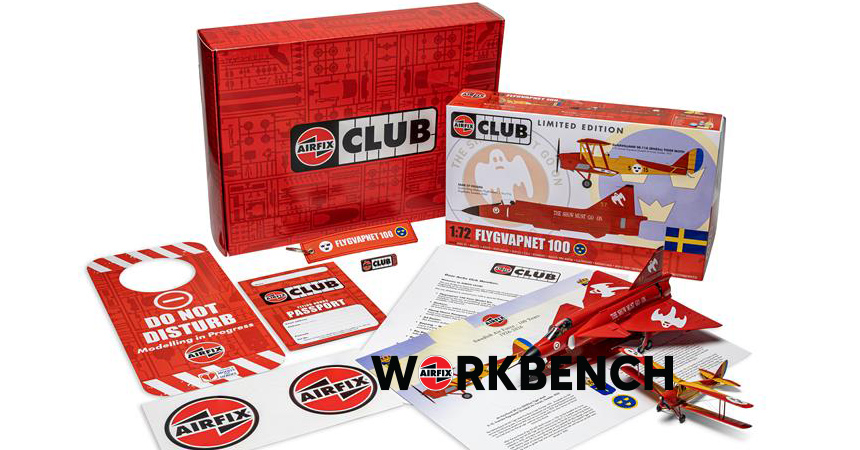
Our scale tribute to this year’s Swedish Air Force centenary, we’re delighted to unveil our Airfix Club kit for 2026.
Although this year’s kit might come as a surprise to many Club members, when understanding the significance of this year’s centenary commemorations for the Swedish Air Force, it makes perfect sense, and there is certainly no denying that these are two extremely strikingly presented models. In many cases, once this completed Viggen takes its place amongst our collections of built models, it will probably be the first example in there, but there’s nothing like making an entrance, and this will be quite the entrance.
New and renewing UK based Airfix Club members will receive this attractive new kit once their ‘Red Box’ package arrives in the post, and hopefully many of us will have this model pairing built and on display by the time of the actual centenary commemorations this coming August – as this Viggen proudly proclaims, the show must go on.
Just to shed a little light on the Club package options displayed down the right hand margin of the blog, the top option is the full UK Club membership for new and returning members, whilst the second ‘Kit Only’ option is the one that needs to be selected by Rest of the World members once they have secured their digital membership for the year.
The Airfix Club area on the Airfix website will help explain the situation much more effectively than I have just attempted to do, so please use the link above to be taken straight there.
We're afraid that's all we have for you in this latest edition of the Airfix blog, but we will be back next Friday with more project development updates and the very latest Airfix kit exclusives. In the meantime, we're always keen to hear your views on all things Airfix and in particular, any thoughts and opinions you may have regarding our Workbench blog. If you would like to drop us a quick line, could we please ask that you use our workbench@airfix.com email for all correspondence.
To re-visit any of the Airfix blogs we have produced over the past TEN years or so, please head to our main Workbench hub, where you'll find our entire blog back catalogue and all the Airfix design projects we have already covered.
All our dedicated official social media sites can be accessed by clicking the respective link icons at the foot of this page, or by heading to the Airfix homepage. Other useful Airfix links are:
Facebook, YouTube, Twitter and Instagram official sites
Please join us for more Airfix updates next week and thank you for your continued support.