Welcome to this latest edition of Workbench and all the news, updates and exclusive announcements from the fascinating world of Airfix modelling. Amongst the many highlights included in this 98th edition of the Airfix blog, we bring you box artwork and scheme details from the latest release of an aircraft kit which has spent more time in various Airfix model ranges than any other type and represents the very pinnacle of British biplane aviation technology. We also bring you a nostalgic look back at some classic military fighting vehicle box artwork which will no doubt have played a significant role in the modelling education of many a Workbench reader and how both are about to be re-introduced to the range as part of our Vintage Classics series, before moving on to enjoy a magnificent reader supplied feature looking at how an old RAF Tengah photograph proved to be the inspiration behind a magnificent Airfix diorama build. Bringing you our latest selection of exclusive imagery, let’s begin by looking at an aircraft type whose unequalled Airfix modelling heritage may surprise one or two readers.
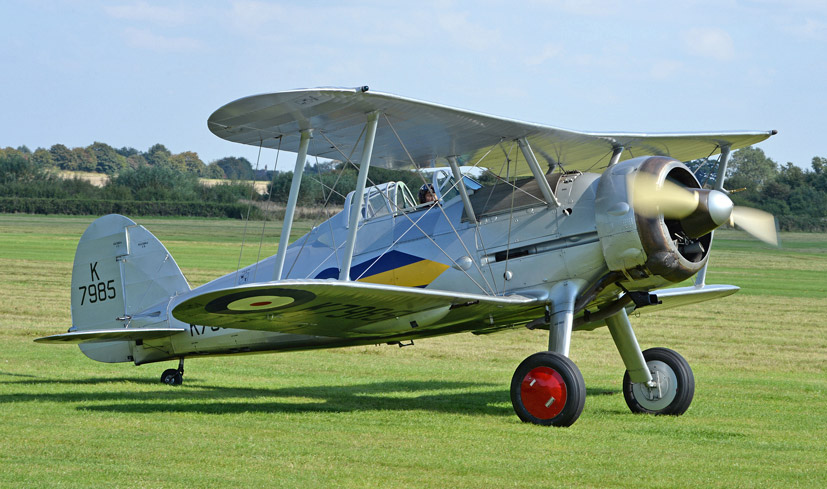
One of the most beautiful British aeroplanes ever to take to the skies, the Gloster Gladiator represented the pinnacle of biplane fighter design, with many examples standing ready to repel German air incursion in Europe, during the period known as the Phoney War
As the last in a long line of distinguished RAF biplane fighter designs, the attractive Gloster Gladiator marked the end of an era in aviation history, heralding not only the arrival of the world’s most accomplished biplane, but also the beginning of the dominance of fast, monoplane designs, the only type of aircraft capable of bettering this fighting thoroughbred. Eclipsing every RAF fighter design which had come before it, the fast and manoeuvrable Gladiator was a true pilots aeroplane, only to be flown by the best of the best and immediately capturing the imagination of a world fascinated by the glamour of aviation. As the first aircraft began to arrive with RAF squadrons at the beginning of 1937, this exceptional aeroplane presented them with innovative design features which had never previously been seen on a British fighter – the Gladiator was the first RAF fighter to feature a fully enclosed cockpit and many of the cumbersome struts and wires associated with previous biplane designs had been replaced with more modern construction methods. Rugged and reliable, the new Gladiator also proved to be a highly proficient aerobatic performer and RAF pilots loved it. A perfectly balanced fighting machine with aerial grace and good looks in abundance, it’s no wonder that any pilot worth his salt was desperate to get behind the controls of the RAF’s latest fighter. At a time when many in Europe preferred to look back, rather than towards the impending conflict which would surely come, the Gladiator effectively represented the end of the flamboyant period of 1930s aviation, when the general public would gaze in awe at the skill and daring of the dashing British fighter pilot, tearing about the skies in his beautiful silver aeroplane. Unfortunately for the Gloster Gladiator, its significant place in aviation history was somewhat overshadowed by the advent of the Second World War and a further significant technological leap for aviation design, but not before this biplane was thrust into combat.
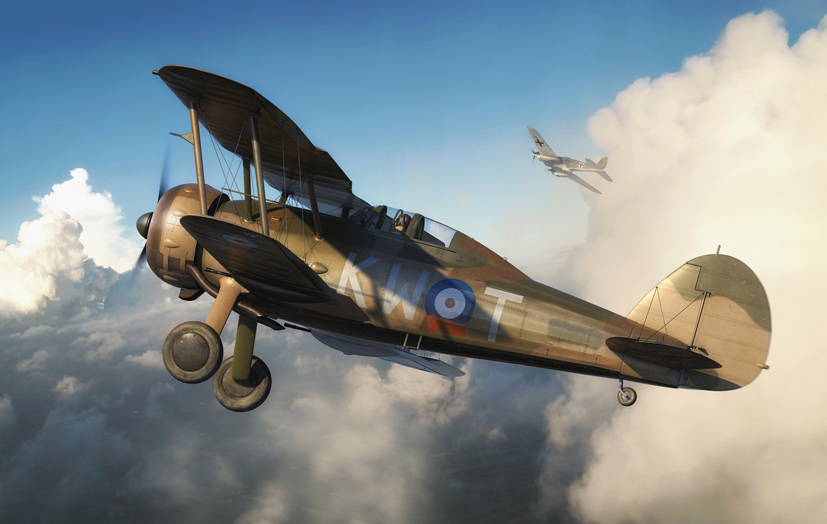
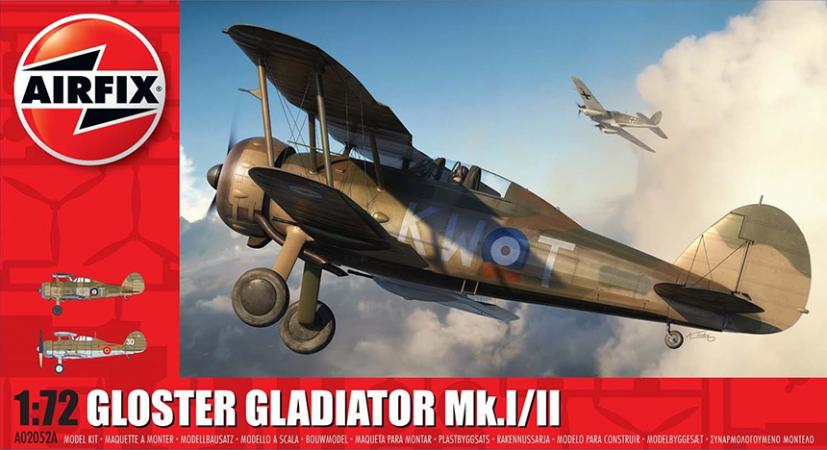
The latest box artwork in support of an Airfix 1/72nd scale Gladiator release features this magnificent image of an RAF No.615 Squadron fighter patrolling the skies of Northern France, looking for enemy air incursion
The Gladiator proved to be such an important British aircraft that under the RAF’s inter war expansion scheme, it was ordered in greater numbers than any of its fighting predecessors and as more RAF fighter units began to equip with the new aircraft, overseas orders soon began to follow. Nations as diverse as China and Belgium were keen to purchase the Gladiator, in an attempt to bolster their own defences with an effective and reliable fighter, as the prospect of war was looking increasingly inevitable. Out of a total production run of 747 aircraft, 216 Gladiators would be exported to 13 countries around the world and it was to be under foreign skies that the Gladiator would see most of its WWII combat experiences.
From an Airfix perspective, it will come as no surprise that an aircraft possessing the aviation pedigree of the Gloster Gladiator has long been of interest to the modeller and therefore found its way into the range many years ago. What may come as something of a surprise is that the Gladiator even surpasses the Spitfire in the annuls of Airfix history, as this is the aircraft kit which has been available the longest in various ranges over the years. First released in 1956, the initial Airfix Gladiator tooling was produced in the same blue plastic as the famous Spitfire BTK, which had thrilled the hobby world when it burst onto the scene just a year previously. Since then, the Gladiator has benefitted from additional parts and various release iterations over the years, culminating in the release of a newly tooled 1/72nd scale kit in 2013, bringing this beautiful aircraft right up to date from the perspective of kit accuracy and production quality. Always a popular subject, we think we are right in stating that the Gloster Gladiator is the kit (in all its various release incarnations) which had been available for the longest period in the history of Airfix, making this quite an important subject in the history of the hobby. With the latest release from the new Gladiator tooling offering two late 1930s schemes for modellers to consider finishing their scale example of this aviation classic in, it seems as if the Gladiator’s unrivalled modelling heritage is set to continue for some time to come, especially as this new kit is expected to arrive over the next few weeks. Let’s take a look at these two new schemes now.
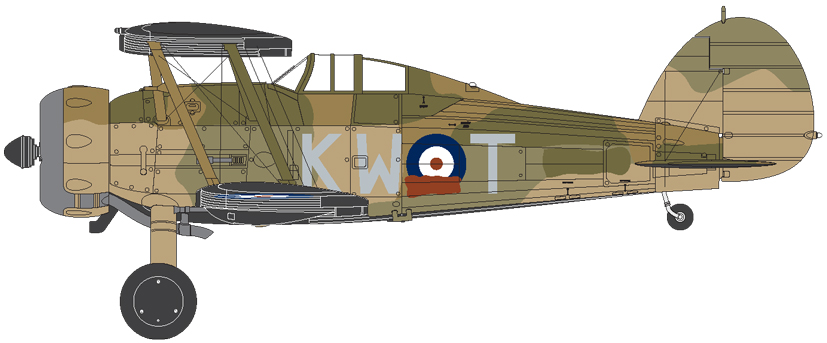
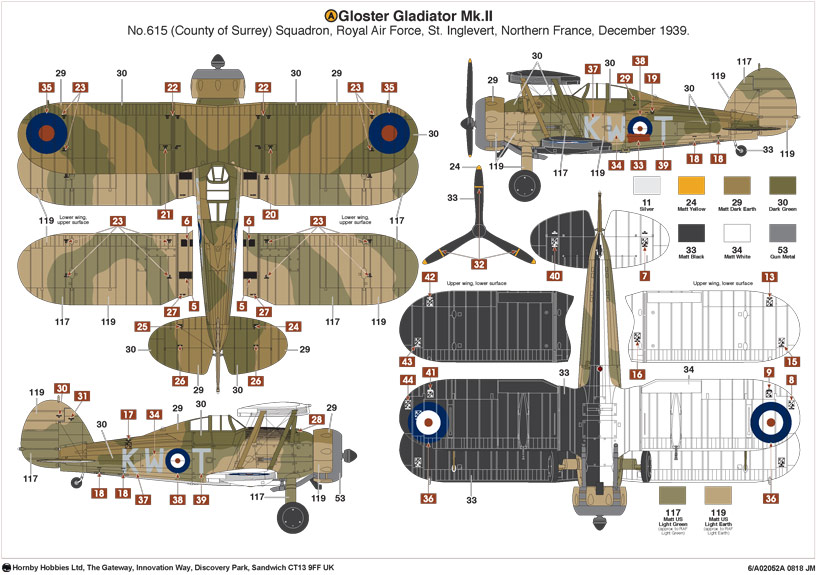
Full scheme and decal placement details for an RAF No.615 Squadron Gladiator Mk.II, operating from Northern France with the Air Component of the BEF at the end of 1939
The inter-war transition of RAF No.615 Squadron from an Army Co-operation to a fighter role, underlines the state of a rapidly expanding Royal Air Force at that time. Trading their biplane Hector and Audax bombers for Gloster Gauntlet fighters on 7th November 1938, less than six months later, they were to receive the Gloster Gladiator, an aircraft considered to be the pinnacle of biplane fighter design. Interestingly, their Gladiators arrived almost ten months after No.19 Squadron at Duxford had received their first Spitfires.
With Britain and France declaring war against Germany following the invasion of Poland, the British Expeditionary Force began to deploy across the English Channel from September 1939, primarily serving to highlight the Allies determination to stand up against German aggression, but also desperately hoping that the move would prevent Europe from descending into all-out conflict. By May 1940, the force had grown to some 400,000 troops, backed up by the Air Component Royal Air Force (consisting of around 500 aircraft) and the Advanced Air Striking Force, equipped mainly with Battle light bombers. RAF No.615 Squadron and their Gloster Gladiator fighters were sent to France in November 1939, where the aircraft would fly standing patrols, familiarising themselves with their new surroundings and posting an aerial show of strength for German spies passing information back to Berlin. The Squadron were in the process of re-equipping with Hawker Hurricanes when the German offensive began and their existing Gladiators would be heavily involved in the deadly air combat which ensued. In the confusion of Blitzkrieg however, the Squadron’s pilots prepared for the days operations not knowing if they would be landing back at the same airfield, such was the speed of the German attack – they also happened to be facing arguably the most feared fighter opposition in the world, the ruthlessly effective Messerschmitt Bf 109E.
BEF air operations against the Luftwaffe proved to be a chastening experience for the Royal Air Force and whilst pilots and their aircraft fought valiantly, they were no match for a well organised and determined enemy. In the 10 days which followed the 10th May attack on France, the Gladiator pilots of No.615 Squadron were flying multiple sorties each day, with some airmen reporting flying six or seven missions against more modern aircraft types. Although operational records from this period have proved difficult to corroborate, it appears that on 15th May, the squadron still had 12 serviceable Gladiators, which were joined over the next few days by replacement Hurricanes and their pilots. Despite their very best efforts, the futility of the situation resulted in an order being issued for all serviceable aircraft to be flown back to Britain on 20th May, as the Battle of France appeared lost and Britain would surely be next in line for attack. The rest of 615 Squadron’s personnel made their way to Boulogne, where most made it back to the UK aboard the steamer 'Biarritz'. Once back in the UK, the squadron finally relinquished their remaining Gladiators and converted entirely to the Hurricane.
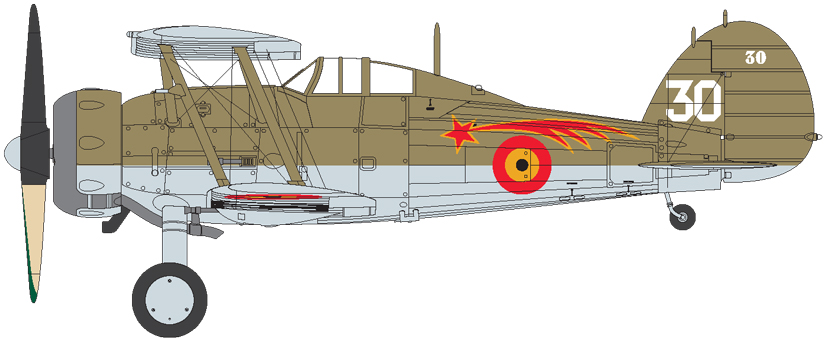
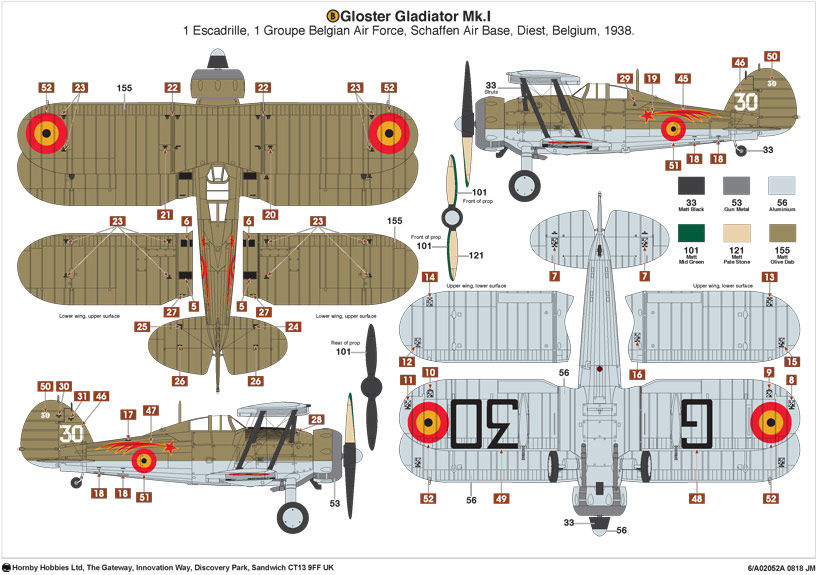
This extremely attractive scheme option marks one of the 22 Gloster Gladiator Mk.I fighters purchased by the Belgian government in advance of the Second World War, each one operated by their elite ‘La Cométe’ Squadron
The Belgian government were early admirers of the Gloster Gladiator and placed an order for 22 fighters (Gladiator Mk.I) on 27th September 1936. The order was comprised of 15 machines to be built by Gloster in the UK and a further 7 to be assembled in Belgium by Sabca – although initial deliveries began in June 1937, disagreements regarding the Belgian assembled machines delayed the signing of the overall contract for almost a year. In Belgian service, the Gloster Gladiator would carry the registrations G-17 to G-38 and would immediately become the most capable fighting aircraft in the country – all aircraft were operated by 1/1/2 Escadrille ‘La Cométe’ flying out of Schaffen airbase. As Belgium’s premier fighter aircraft at that time, the general public could not get enough of them and they were the highlight of any event where they were scheduled to appear. Flying formation and solo aerobatics in the years prior to the start of WWII, the aircraft provided reassurance that Belgium’s neutrality would be respected, in the event of European conflict. This period was not without incident however and a number of aircraft would be lost in accidents before WWII began. The subject of the attractive scheme option detailed above was lost on 11th February 1938, along with another La Cométe Gladiator – both aircraft crashed at Rognée (Namur) during a heavy snowstorm. They were not alone, as no fewer than 6 of the squadron’s remaining Gladiators were lost between March 1939 and March 1940, after suffering various flying incidents.
The German attack of 10th May 1940 proved disastrous for the Belgian Air Force and particularly the Gladiators of La Cométe. With war looking inevitable, Belgium’s neutrality would not protect it from German attack and at 3am on 10th May 1940, the alarm sounded at Schaffen-Diest airfield. Aircraft at the site were arranged neatly on the open airfield, wingtip to wingtip and as their engines fired into life, confusion reigned as to whether this was just another drill or not. Minutes later, Luftwaffe Dornier Do.17 bombers appeared over the airfield at treetop height and began their attack, strafing everything in sight. Taking a heavy toll of the aircraft parked on the airfield, they appeared to concentrate on the more modern Hurricane fighters, leaving the Gladiators relatively unscathed – of the 14 serviceable Gladiators on the day, 12 would make it to the relief airfield at Beauvechain, but were only accompanied by 2 of the Hurricanes. By the time Belgium surrendered to the Germans on 28th May, most of the remaining Gladiators had been destroyed whilst on the ground at Beauvechain.
The Gloster Gladiator not only holds an important place in the history of the Royal Air Force, but also several overseas operators who were attracted by the capabilities of this ultimate biplane fighter. From an Airfix perspective, the Gladiator also occupies quite a significant position in the history of our construction kits, with this latest Mk.I/II release destined to continue its legacy when it arrives in model stores everywhere from next month. Featuring two Gladiator schemes from Continental Europe prior to the outbreak of WWII, A02052A will surely prove to be a popular modelling subject on many a workbench in the weeks to come.
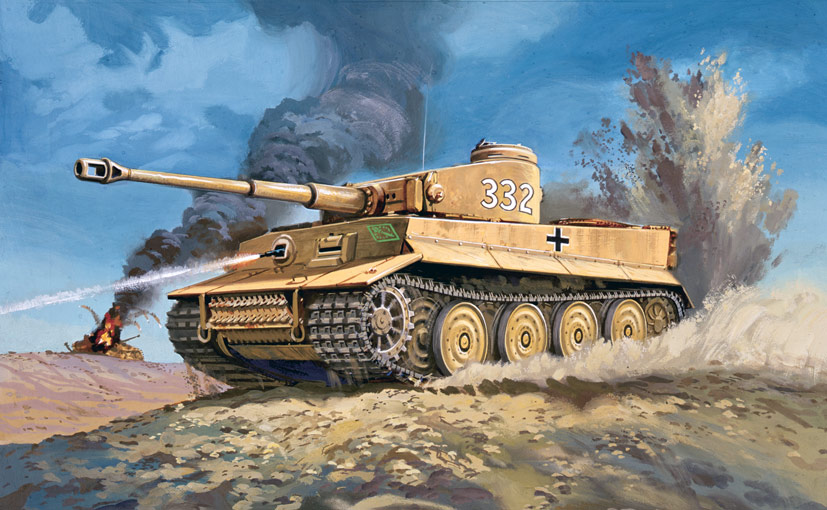
As far as classic Airfix artwork goes, this famous painting featuring a mighty German Tiger tank will have been responsible for introducing many Workbench readers to the delights of Airfix armoured fighting vehicles
For many Workbench readers, one thing we all have in common is our love of the beautiful artwork which was synonymous with Airfix and our initiation into this fantastic hobby. Many of us will remember the excitement of leafing through the latest Airfix catalogue, trying to decide how many of the delights within we could cajole our loved ones into buying us for Christmas and birthdays – there were just so many to choose from. In most cases, it was the evocative artwork which drew our attention and demanded that certain models had to be included on our ‘wants’ list, whether that be an aircraft, tank or warship, at that stage of our modelling infatuation, it didn’t really matter. As far as memorable Airfix artwork is concerned, the military vehicles range can boast some truly iconic examples and as two absolute classics are about to join our Vintage Classics range for the very first time, what more excuse could we need to enjoy this modelling nostalgia in Workbench?
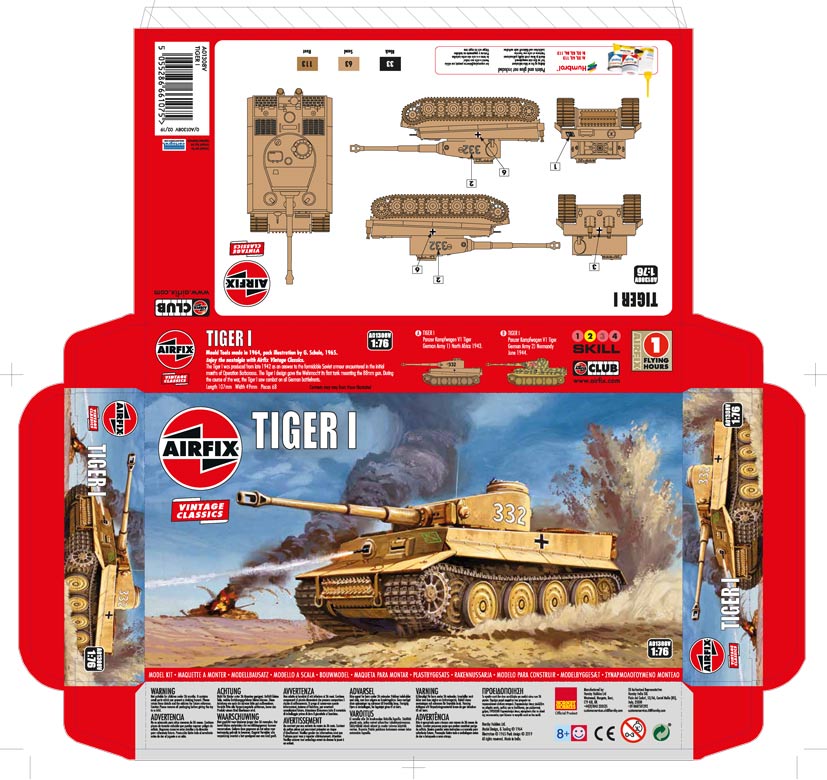
Taking its place in the Vintage Classics range for the first time, this is how the latest incarnation of the iconic Tiger artwork will look when it appears in model shops from this coming July
In tank parlance, the word ‘Tiger’ has come to represent the epitome of military vehicle development and one of the most feared battlefield weapons in the history of warfare – for this reason, the Panzerkamfwagen VI Tiger I heavy tank has always been a popular subject for the world’s modellers. Developed as a result of Wehrmacht experiences on the Eastern Front, the Tiger was only used in relatively small numbers, due to the complexity of its manufacture and a reluctance to compromise on the quality of materials used or technology incorporated, but despite this, its fearsome reputation and sinister appearance ensured it is still regarded as the most famous tank of the Second World War. Although the rather square looking Tiger may not have shared the cultured appearance of the later Panther, this was a war machine pure and simple and one which proved to be devastatingly effective on the battlefield. Heavily armoured and equipped with the powerful 88mm gun, the sighting optics on the Tiger were so effective that enemy tanks could be destroyed at great distances, well before they were within range to return fire, making the Tiger almost impervious to attack itself. By the time of the D-Day landings, the reputation of the Tiger was already assured, but even though they managed to inflict heavy losses on Allied armoured units, their small numbers were soon swamped by an overwhelming tide of Allied armoured numerical superiority. Unable to control the battlefield, damaged and unserviceable Tigers were simply abandoned to be captured by advancing Allied troops, who were no doubt delighted that these fearsome tanks could no longer be used against them.
The famous artwork featured above will have no doubt captivated millions of modellers in to building this iconic kit, one which first appeared in the Airfix range in 1964. Initially utilising a much less impressive artwork representation of the Tiger, it would not be until 1973 that the beautiful artwork above graced the card and acetate release version of this kit, at a time when gunfire and explosions were still seen as being an integral part of product artwork, which as many readers will attest, went on to become some of the most familiar pieces of art in the world. Indeed, many modellers throughout the 70s and 80s will probably admit to cutting out and keeping the box artwork from all the kits they built, as they were as much a part of the modelling experience as constructing the kit itself.
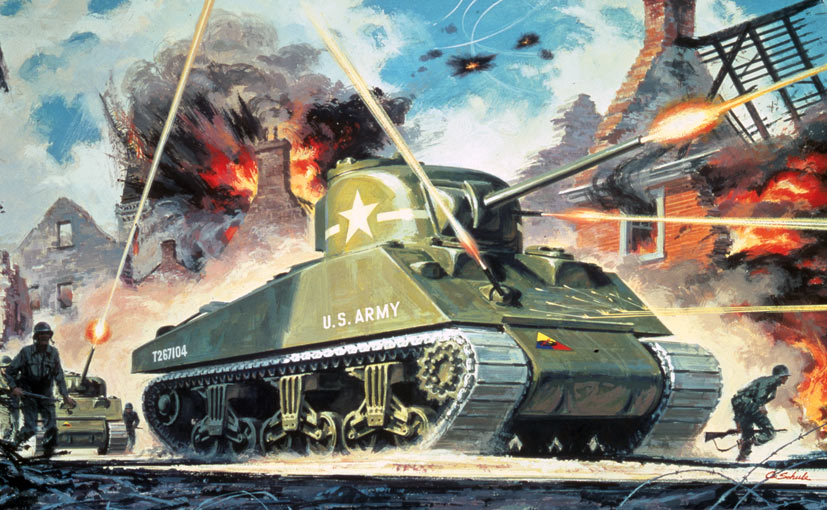
Featuring explosions and machine gun bullets striking the armour of the tank, is it any wonder why youngsters fount the lure of Airfix kits so irresistible? This artwork actually preceded the Tiger I artwork by ten years
As iconic as the Airfix Tiger I artwork undoubtedly is, it was preceded by another classic fighting vehicle kit release in the shape of the M4 Sherman, a kit which was originally released back in 1961. The initial artwork utilised was a stylised representation of the tank, however the famous artwork shown above first appeared just two years later, paving the way for some of the iconic Airfix artwork which was to follow – it was a clear marketing decision that these pictures help to sell model kits.
One of the most famous military vehicles of the Second World War, the M4 Sherman was an American built medium tank used by many of the Western Allies and produced in massive quantities. With the prototype M4 only being available in September 1941, it is incredible to think that these tanks would flood the battlefields of Western Europe, North Africa and the Pacific in the months to come, with almost 50,000 examples being built by the end of July 1945. The Sherman was first used in combat by the British Army at the Second Battle of El Alamein, where it would face German armour for the very first time. One interesting feature of the Sherman’s design was that each tank manufactured in the US would have to be shipped around the world and therefore included four lifting rings, one at each corner of the tank. This also had an impact on the tanks weight, as dockside cranes around the world would have to be strong enough to lift them. Large numbers of Sherman Tanks would be used during the invasion of Normandy and in the months following the breakout from the D-Day beachheads, including a small number of tanks specially modified to be amphibious.
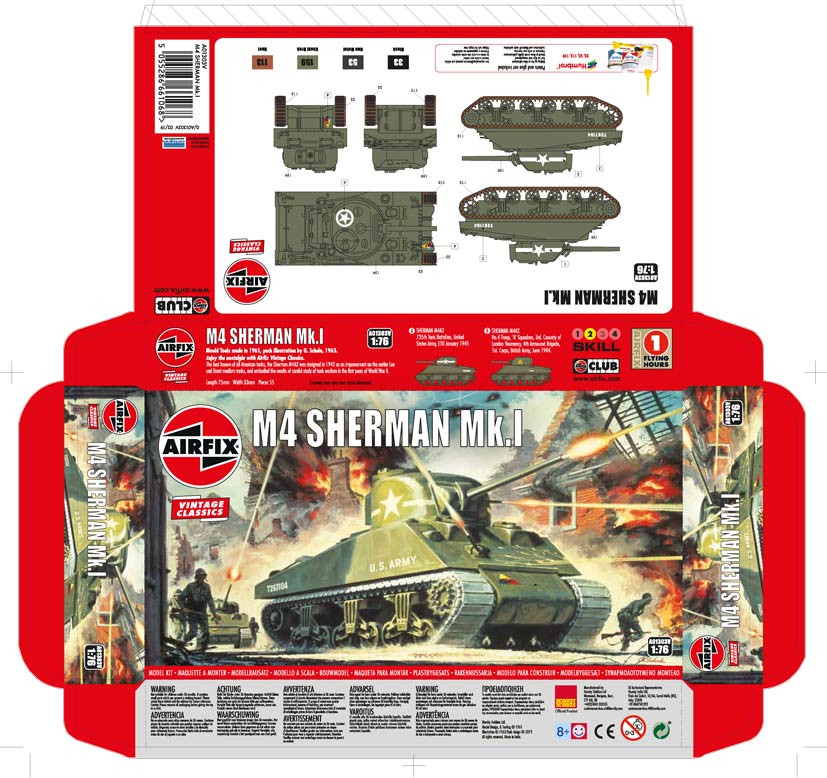
Once again, this classic Sherman artwork is about to attract a new modelling audience, when it takes its place in the Vintage Classics range
Although no match for the mighty Tiger, the M4 Sherman is nevertheless one of the world’s most famous fighting vehicles and one which could be accurately described as quantity over quality. Occupying a historic place in Airfix modelling history, both of these famous kits will take their place in the Vintage Classics range this coming July, with this iconic artwork once more appearing on model shop shelves to the delight of those who remember these kits from their modelling youth and hopefully helping to attract some new blood to the hobby at the same time.
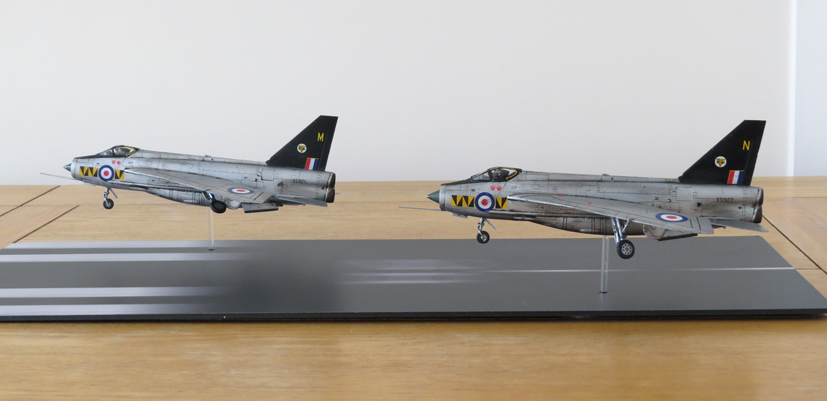
As one of the most exciting aircraft to see RAF service, the English Electric Lightning provided inspiration for many a modelling project, however, Tony Clay had something a little different in mind for his latest diorama build
With the modelling hobby enjoying something of a participation renaissance at the moment, there is no shortage of inspiration or skills guidance available on-line for anyone requiring a little help and with contributors appearing to be only too happy to help, many modellers are applying some real creativity to their build projects. The internet is also proving to be a fertile hunting ground for the Workbench production team as well and a recent submission to an Airfix tribute forum had us requesting further information and a request to include details in a future edition of our blog. From this initial tentative request, we were fortunate enough to make the acquaintance of Tony Clay, a modelling hobbyist who has developed a real flair for incorporating diorama displays in many of his latest model builds, projects which have been specifically produced to replicate a particular incident or photograph.
Like many Workbench readers, Tony described how he was an avid modeller for many years during his youth, but work and family commitments did their best to distract him from finding the time to continue with the hobby, leading to a break which would last for many years. As life became a little more stable, Tony returned to modelling in 2009, with his initial stimulus being ‘What if’ modelling, where he could take a kit and either finish it in markings which it was never intended to wear, or even modifying the kit to produce something of a hybrid aircraft or vehicle. Tony still enjoys producing models around this unusual theme, however, his real passion is RAF No.74 Squadron and the aircraft they have operated over the years. The real driving force behind Tony’s modelling proved to be the production models featuring aircraft which represented 74 Squadron and how this was probably initiated by the iconic sight of the squadron’s sliver Lightning F.6 fighters of the 60s and 70s. The kit of choice for this initial obsession was the Airfix 1/48th scale Lightning, but this stimulated a hectic period of modelling activity, where Tony built as many No.74 Squadron aircraft kits as he could, not only in this scale, but also in 1/72nd scale. The size of this collection soon began to come to the attention of the 74(F) Tiger Squadron Association and he was asked to present a display of his models at a Squadron reunion event, which proved to be a significant development – from this display event, Tony was asked to become the webmaster for the association, which he was more than happy to do.
Back on the home front, the size of Tony’s model collection was fast becoming a problem and he desperately needed to find a new home for it. His new association with No.74 Tiger Squadron Association provided the answer to the problem and every model would go on display at the Norwich Aviation Academy, which was rather a fitting venue – Norwich Airport is on the site of the old RAF Horsham St. Faith airfield, a former home of No.74 Squadron and the venue for the annual Squadron reunion dinner. They inherited a striking modelling tribute to the history of their squadron and an instant attraction at this airfield site, which has ambitious plans for the future.
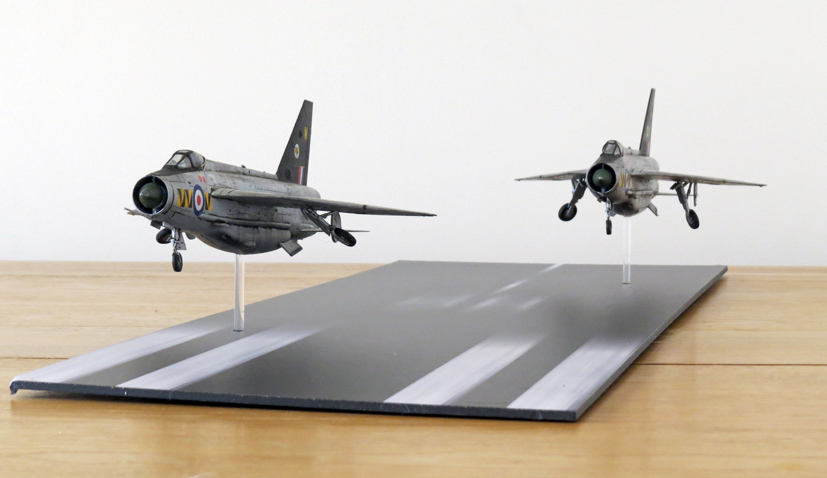
This selection of images from Tony’s Tengah Lightning scramble diorama show the models from various angles and allows us all to see the work he has done in replicating the aircraft’s unique main undercarriage retraction procedure
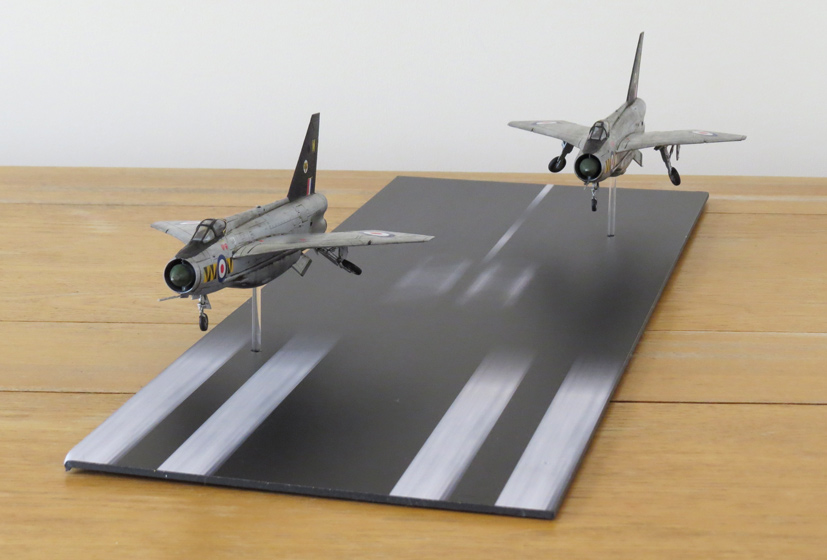
The diorama base helps to convey the impression of speed, something the Lightning is always associated with
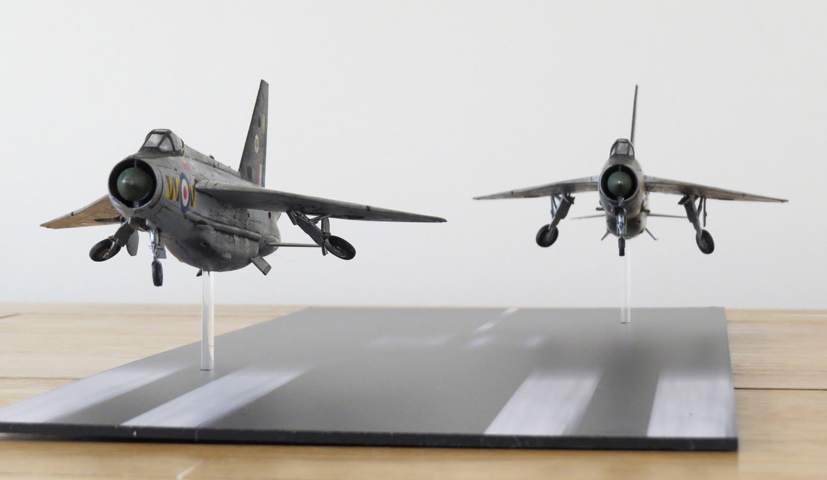
At this slightly lower angle, you can clearly see the different retraction angles of the two aircraft’s main gear units
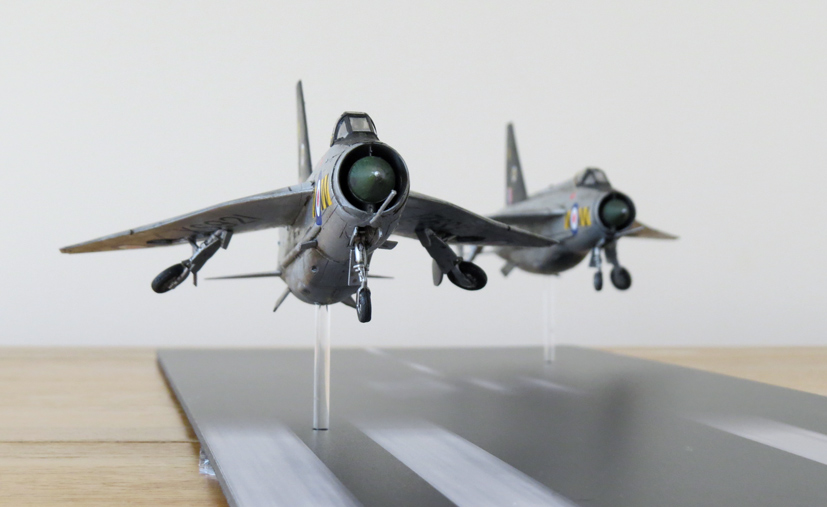
With such a dramatic picture, is it any wonder how the Lightning continues to be such a popular modelling subject years after the aircraft was withdrawn from service
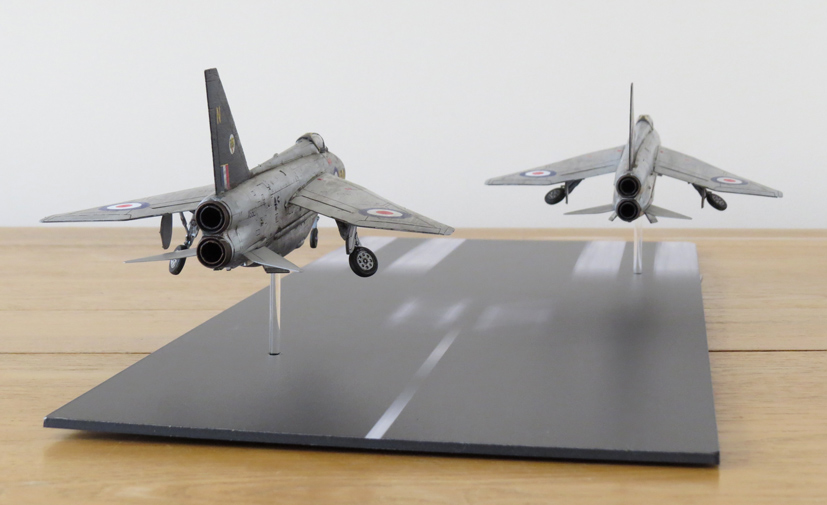
Blasting off on their latest sortie, Tengah’s Lightning legacy has been beautifully represented by Tony’s fantastic diorama build
As is often the case with modellers, Tony described how he is never happy with his modelling performance and is always looking to improve. With all the extra space at home following the relocation of his 74 Squadron model collection, he was looking for a new direction for his modelling and aviation diorama creation proved to be the ideal medium for his next challenge. The ability to use his modelling skills to re-create a specific moment in time really excited Tony and proved to be an interesting new stimulus to a hobby which had brought him so much pleasure over the years. One of his first projects was a continuation of his passion for No.74 Squadron subject matter and came about after finding a Lightning F.6 picture on the associations website. Featuring a pair of English Electric Lightning F.6 fighters blasting off from the runway at RAF Tengah, Tony decided to re-create this scene, for no other reason than he had a pair of 1/72nd scale Airfix Lightnings in his kit stash, the result of a competition win at work. Needing to give the project an impression of speed, the build would centre around an appropriate diorama base produced and supplied by Coastal Kits of Blackpool, which would make the Lightnings appear as if they were travelling at speed.
In order to replicate the picture effectively, Tony would have to build two almost identical Lightning kits and gain an understanding of the aircraft’s undercarriage retraction operation, before attaching both model builds to his new diorama base. The Lightning had a distinctive undercarriage retraction sequence, which saw the main wheels raise first, leaving the nose-wheel to retract last – in addition to this, the two aircraft were at different stages of this process, which dictated that Tony would have to replicate this difference on both of the Lightning kits. Already an accomplished modeller, the main build would not pose too many problems, however, the representation of the undercarriage retracting sequence would be something of a challenge. In addition to this, the main wheels of the Lightning also rotate as they are retracting, a feature which any Lightning devotee would spot immediately, should he omit this feature from the build. With so many points of detail to be represented, this part of the build would need all of Tony’s modelling experience and by his own admission, a little trial and error in attempting to effectively replicate the retraction sequence was needed. With both aircraft having wheels at different angles, the process involved trimming the legs of the kit parts and reducing the length of the hydraulic arms, allowing them to be fixed at the correct angle. Wedged into place to allow Tony to check the accuracy of the build, once he was happy, superglue was used to provide an instant bond for the units at the correct angle, with further support added a little later to give this important feature of the build a little more rigidity. Once he was happy with each Lightning build, the models were attached to the diorama base with slightly different lengths of clear plastic rods – mission accomplished!
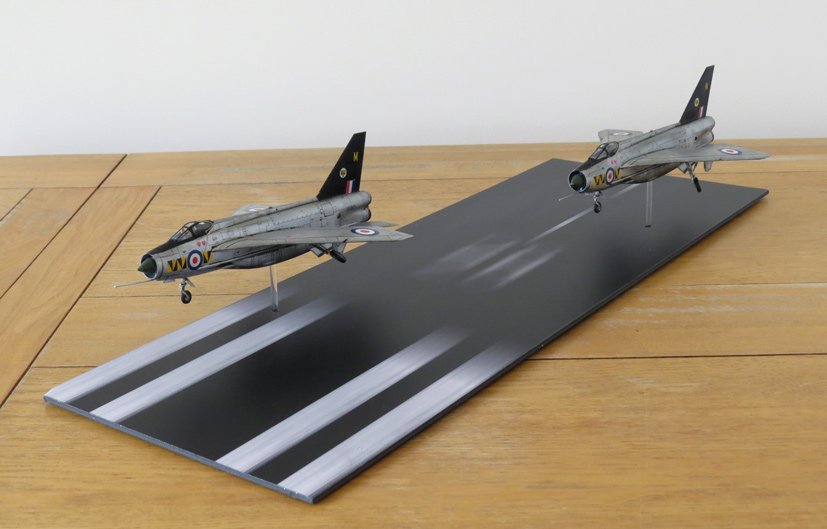
A final look at Tony’s Lightnings. He has set the bar extremely high for future projects, although we suspect he will continue to drive himself towards even greater modelling achievements
Tony’s ‘Tengah Lightning Scramble’ diorama is a real triumph and not only helps to convey an impression of the speed and power of this iconic aeroplane, but adds interest to a model build, which now possesses more character than a more traditional kit construction project. We are extremely grateful to Tony for sending us these magnificent pictures and spending the time discussing his love of modelling. Quite a prolific modeller, Tony has also sent us details of several other diorama projects he has worked on over recent months, which we intend to feature in future editions of our blog. Undoubtedly, modelling is only limited by our imaginations and it is absolutely fascinating to see how different people bring their own hobby to life – long may this continue.
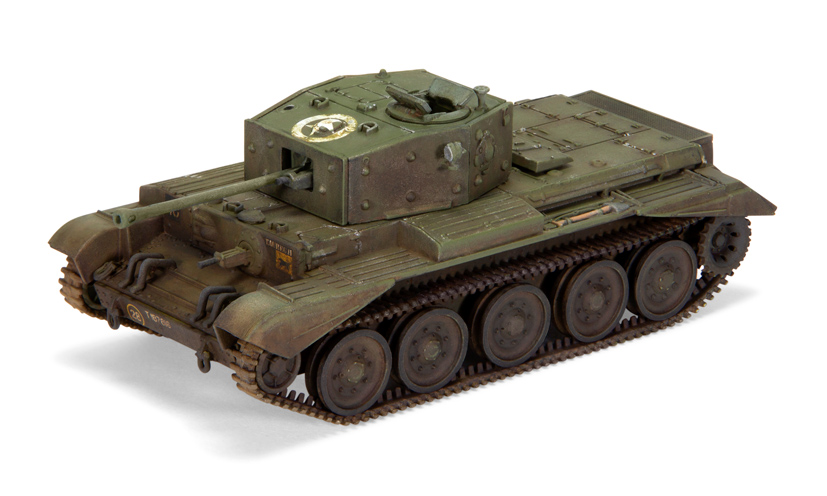
Providing modellers with the plastic canvas with which to create their latest masterpiece, there can be few who would argue against modelling being classed as an impressive form of art
We end this latest edition of Workbench by delving back into the world of tanks and featuring the modelling (and photographic) talents of Michael Collins, a member of our photography and retouching team. An avid modeller himself, Michael informed us that his latest build project featured one of our Cromwell tanks and whilst we are always keen to show his modelling prowess in the blog, he described how this time, he had tried something a little different with the finished model. As well as constructing and finishing an accurate representation of the tank itself, Michael took a series of photographs of the completed build, including one where he dropped the model onto a suitable background. If you look closely at the hedgerow image, Michael has even represented the tanks track marks on the ground and even included churned up earth falling from the tracks at the rear of the tank, to provide a little more drama to the scene. This was produced during a lunch break and whilst he told us that he could introduce a more realistic representation of motion to the image, he had to get back to his day job and there are always plenty of interesting Hornby projects awaiting his skilful attention.
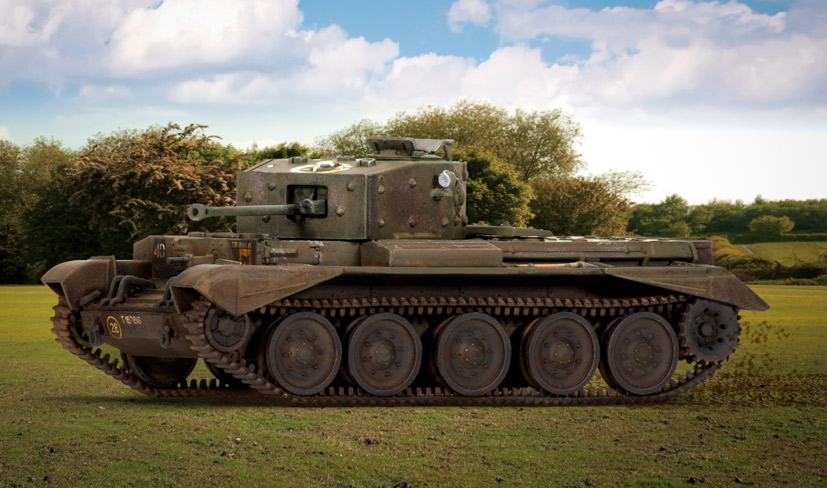
Combining his modelling skills with an in-depth knowledge of Photoshop, Michael has managed to give his Cromwell Tank build real character with this composite image
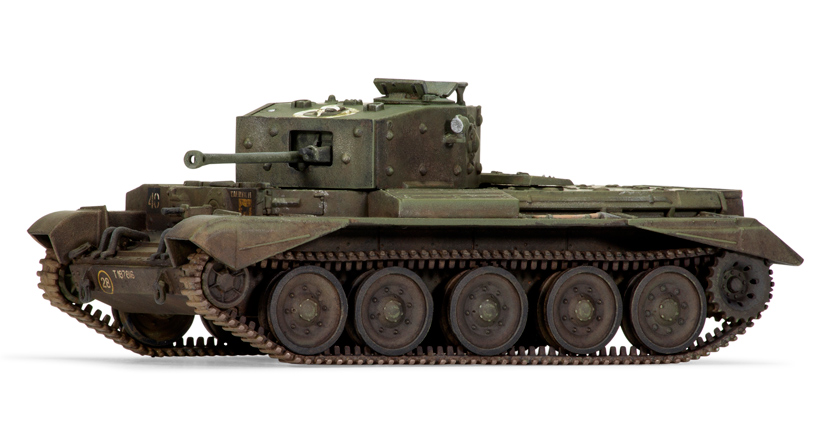
The same Cromwell image without the background – which one do you prefer?
A late war British tank design, the Cromwell came at the end of a line of successful cruiser tanks built for speed and mobility. The Cromwell had an unusually long development period for a wartime tank and even though the project began in 1942, the first machines did not enter combat until the D-Day landings, some two years later. Although the Cromwell was no match for the firepower of the German Tigers and Panthers, it was designed to support rapidly advancing infantry units, allowing them to make strategic gains through the speed of their advance. An extremely fast tank, the Cromwell could reach speeds of 40mph, although this would not have been a pleasant experience for its five man crew, so it was usually limited to speeds no greater than 32mph. Powered by the excellent 600 hp 27 litre Rolls Royce Meteor engine, this was actually a development of the famous Merlin engine which powered the Spitfires and Hurricanes of the Battle of Britain and gave the Cromwell exceptional performance. What it may have lacked in firepower and armour protection, it more than made up for in speed and mobility, going on to become a popular and capable Allied tank in the final months of WWII. Although not available in the same numbers as the ubiquitous American built Sherman, around 4,000 of these tanks were built, with the type seeing heavy usage during the battles following the D-Day landings.
Again illustrating how modelling, imagination and photography can all go hand in hand, Michael’s British Cromwell build shows what splendid things can be achieved with a little Airfix tank kit and some modelling talent.
That’s all we have for you in this latest edition of Workbench, however, we will be back as usual in two weeks’ time with a further selection of Airfix modelling delights for your enjoyment. In the meantime, if you have any suggestions for subjects you would like to see covered in a future edition of the blog, or ways in which we could enhance your enjoyment of Workbench, please do not hesitate in contacting us. We can be reached via our usual e-mail address workbench@airfix.com or by contributing to our Workbench thread over on the Airfix Forum. If social media is more your style, you could access either our Airfix Facebook page or Twitter channel, (using #airfixworkbench), where you will find plenty of modelling news, views and discussion taking place. Whichever medium is your preference, please do get in touch, as it is always interesting to hear from fellow modelling enthusiasts and the projects you have on the go at the moment.
As always, the Airfix website is the place to go for all the latest model release information, with our New Arrivals and Coming Soon sections both quickly accessed by clicking either of the links above. As updating the website is an ongoing process, a quick search through each section of the Airfix web pages will often reveal new information and updated images in many of the product sections and this is always an enjoyable way in which to spend a few spare minutes.
The next edition of Workbench is due to be published on Friday 10th May, when we will have more news and modelling features from the fascinating world of Airfix.
On behalf of the entire Workbench team, thank you for your continued support our Airfix blog.
The Airfix Workbench Team
© Hornby Hobbies Ltd. All rights reserved.