Welcome to the latest edition of our weekly Workbench blog, and all the news, updates, and modelling exclusives from the fascinating world of Airfix.
In a week which has been nothing short of momentous in the history of human space exploration, there really could only be one subject for this week’s edition of Workbench, and that would be for us to continue reaching for the stars. As the crew of Artemis II set new records in space exploration history, the return to earth of the Orion capsule (Integrity) on 10th April will also serve as the precursor to another significant NASA anniversary to be celebrated just two days later, the 45th anniversary of the first Space Shuttle mission launch.
In this latest edition of Workbench, we will be ‘going for launch’ on our own blog tribute to the NASA program which came between Artemis and Apollo, marking the world’s return to the fascinating subject of human space exploration, and the incredible technology behind it. Of course, as we are Airfix, we will be including several model kit representations which have helped us to commemorate the incredible machines which have taken mankind into space, but in impressive scale form, kits which are thankfully in plentiful supply in this momentous year for NASA and their current space program.
Without doubt, one of the most impressive machines ever created by man is the subject of this latest edition of Workbench.
For anyone who lived through the early years of NASA’s space program, particularly the Apollo 11 mission which saw men setting foot on the surface of the moon for the first time, this will probably rank as one of the most significant moments in their lives, a day which both enthralled the world and brought humanity together, a truly cultural moment for many millions of people. As they, and the rest of the world, watched in total amazement, and probably no little disbelief, the crew of the Apollo 11 moon lander set foot on the surface of the moon, with astronaut Neil Armstrong delivering his historic quote, “One small step for man, one giant leap for mankind”. Those words may well have brought the world together, but they were also significant in positioning America as the lead player in this incredible space race, something the administration at the time were desperate to secure.
Although the cultural and historical significance of that first lunar roam cannot be overestimated, 53 years (and counting) without a human being walking on the surface of the moon has resulted in space exploration playing very little part in the lives of huge numbers of people, and even though every NASA project always managed to thrill during launch and recovery procedures, and the technologies developed have managed to find their way into our everyday lives in an impactful way, did this captivate as overwhelmingly as the Apollo program did?
As for Apollo, ultimately six mighty Saturn V rockets powered astronauts to the moon, with Apollo 11 being the first, and Apollo 17 being the last. Only twelve American men have ever set foot on the surface of the moon, with Neil Armstrong being the famous first, but would you know who the last was? Surely occupying just as significant position in human history, that man was Eugene Cernan, the last man to have his feet on the surface of the moon.
Due for release later this year, our ‘One Small Step for Man’ Gift Set includes a Lunar Lander, display base and figure collection.
As he was about to climb the ladder into the Lunar Lander for the final time, he delivered a speech equally as memorable as the words uttered by his predecessor in the summer of 1969. ‘As I take man’s last step on the surface and head back home, I’d like to say what I believe history will record. America’s challenge of today has forged man’s destiny of tomorrow, and as we leave the Moon at Taurus, we leave as we came and, God willing, as we shall return, with peace and hope for all mankind. Godspeed the crew of Apollo 17’.
Astronaut Eugene Cernan is also one of only three men to have travelled to the Moon twice, and one of only two men to flown in two different Apollo Lunar Modules in space while not docked to the Apollo Command and Service Module, both times near the Moon. Although he’s no longer with us, those words spoken in December 1972 ultimately proved to carry even greater gravitas than he possibly intended back then, as we are currently at 53 years and counting since a man has stood on the surface of the Moon. That being said, there is currently light at the end of the telescope, as NASA’s Artemis Programme intends to continue man’s Lunar exploration heritage.
Back then though, as the incredible achievements of the Apollo Space Program and having men on the moon between July 1969 and December 1972 were arguably not such significant events in many people’s lives any more, the eyewatering costs associated with space exploration and the ongoing Vietnam War started to place a shadow over its future, particularly as the proposed successor of Apollo had a very different mission profile.
The next Space Launch Vehicle would have to operate on much tighter budgets, and with the moon not now being its ultimate goal, would it obtain the public support for continued investment? More in line with US Military requirements for satellite delivery and retrieval (both theirs and potentially those of their enemies), the Space Transportation System under development was more like a re-usable rocket truck, taking equipment into low earth orbit. Although this held much less public appeal than placing men on the moon, such missions would arguably be of greater benefit to mankind, but would it did actually manage to get off the ground financially, what would this new launch system look like?
Whilst the Apollo program was still breaking records and placing men on the moon, its successor was being sought, with various concepts having been explored since the late 1960s. With the focus now being on low earth orbit equipment delivery, the new project was positioned as something of a ‘Space Truck’, but after the excitement of the moon landings, why should the American public have a continued appetite for funding such an expensive program?
NASA became as effective in marketing as they were technological leaders at that time, and as their engineers looked at ways of creating a cost-effective delivery method of transporting meaningful payloads into earth orbit, the money people took their case to the Government about the benefits of space stations, satellite servicing and the sustained human habitation of space. They were successful, and as the many weird and wonderful delivery and re-entry craft were gradually assessed and discounted (this was still incredibly difficult science), the shape of Apollo’s successor slowly began to take shape.
It’s fascinating to learn that the budget proposal for Space Shuttle was finally agreed during the penultimate Apollo mission in April 1972, and was actually transmitted live to astronauts John W. Young and Charles M. Duke Jr. during their walk on the surface of the moon. Commander Young was clearly excited at the news and nine years later, would be the Commander of STS-1, the very first Space Shuttle mission.
John W Young was an extraordinary man. After a successful career as a Naval aviator and test pilot, he joined the NASA Space Program for astronaut training in September 1962 and would go on to fly on Gemini 3, Gemini 10, Apollo 10 and Apollo 16, as well as being Commander of the first Space Shuttle mission STS-1. He would also take his place on no fewer than FIVE backup space flight crews, Gemini 6, and Apollo missions 7,13 and 17, in addition to being the Spacecraft Commander of STS-9.
John Young was most definitely made of the Right Stuff!
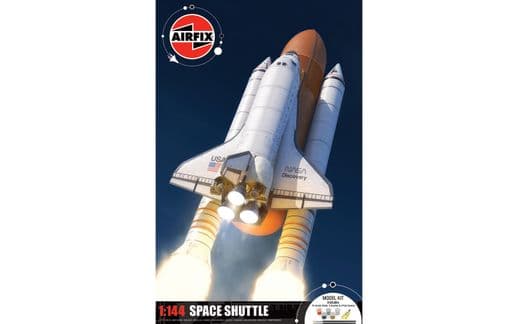
Utilising re-usable technologies, the Space Shuttle was intended from the outset as a low earth orbit delivery system.
Effectively taking the space delivery method baton from the Apollo Program to continue NASA’s space exploration endeavours, the Space Shuttle may well have been conceived at a time of international unrest, and space exploration being of a lower national priority, however, it once again represented the very pinnacle of engineering and technological excellence, becoming a spacecraft for the ages.
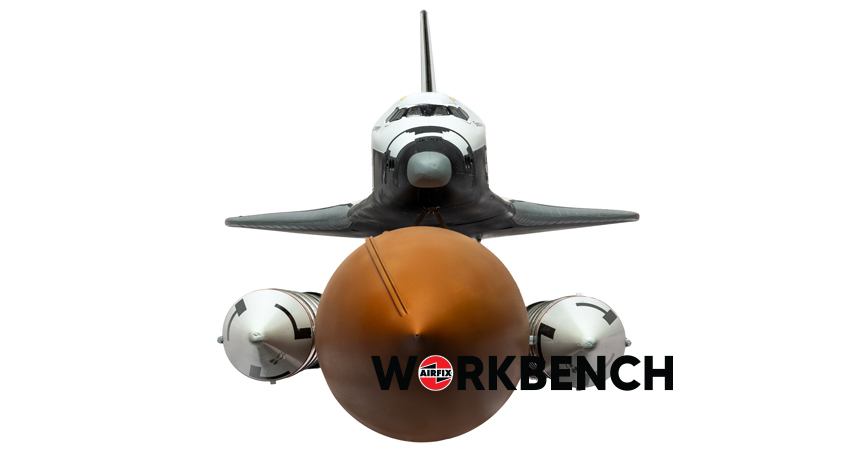
Designed specifically to incorporate reusable components, but to be even more capable than the missions which preceded it, in launch configuration, the Space Shuttle consisted of four main elements – the Shuttle orbiter craft itself, the main external tank and two additional solid rocket boosters. The rocket boosters provided 83% of the thrust power required for launch, with the Shuttle’s three Rocketdyne RS-25 (SSME – Space Shuttle Main Engines) providing the remaining 1,125,000 lbs of thrust.
The most complex machine ever conceived to take humans into space, and to bring them back safely again, beneath the sleek, aircraft-like exterior of the Space Shuttle lay an incredible network of wiring, pipework and equipment all intended to get these amazing craft into space and safely back to earth again, but significantly, for them to be used again on subsequent launch missions. A new generation of engineers and technicians brought their expertise to bear on this program, each one a ‘difference maker’ and each one determined to play their part in ensuring the safe delivery and recovery of the latest Space Shuttle crew.
For many space enthusiasts, the Space Shuttle will be the most recognisable space launch vehicle in their lives.
As for the crews themselves, they would train exhaustively in every aspect of their upcoming mission, from mundane, yet essential tasks, to safety and emergency simulations which were so important, the conducting of science experiments and experiencing everything in conditions of simulated weightlessness. Absolutely nothing was left to chance, and only the finest, fittest and brightest minds were engaged in this work.
Once in space, the Shuttle’s large cargo hold allowed respective crews to engage in any number of important tasks, from cutting edge science, to launching space probes, and repairing satellites. Significantly, Shuttle crews also helped with the construction of the largest man-made structure in space and the platform for future space exploration, the International Space Station.
With their work completed, the Shuttle would begin its re-entry descent from around 400,000ft some 4,300 nautical miles from the landing airfield, eventually touching down at a glide speed of 226 mph. Once assessed, there was every chance that the Shuttle could be used again on a future mission, and indeed several times during its service life.
Following the success of NASA’s Apollo program, their next phase in space exploration was to develop a partially reusable, low earth orbital space transportation system, one which would allow many more astronauts to travel into space by further extending the boundaries of engineering excellence. For this spacecraft combination to work as intended, one million individual components would have to work in unison and impressively, over a 30 year period, five of these Space Shuttles would manage to successfully achieve earth orbit, with ‘Discovery’ becoming their most active craft. This incredible spacecraft completed 39 flight mission and spent an impressive 365 days in space.
The 12th April this year marks the 45th Anniversary of the first mission for the Space Shuttle.
During the 30 year history of the Space Shuttle program, a total of eight were built including prototypes, but with just five of them being space-worthy. Those Shuttles flew 135 missions and allowed 852 people to experience space travel, opening up this experience to more human beings than ever before. For the first time, NASA had a true Spaceship, and science fiction had become science fact.
Once again man’s desire for space exploration had set another spectacular technological benchmark, providing new research data for further conquest of the stars, and the ultimate aim for humans to have a semi-permanent presence in space, venturing ever deeper, and exploring new planets. The Space Shuttle would also further our understanding of space equipment delivery methods, and crucially, what could and could not be achieved by a spacecraft powered by non-nuclear engine technology.
Space Transportation System mission 1 took place on 12th April 1981 from the Kennedy Space Centre, with NASA’s most experienced astronaut John Young as Commander. His pilot for that mission, Robert Crippen, was making just his first spaceflight, and after orbiting the earth 37 times over the next 54.5 hours, Space Shuttle Columbia touched down on Runway 23 at Edwards Air Force Base to mark the start of NASA’s Space Shuttle era.
Happy 45th birthday Space Shuttle.
With the past few days being so monumental for NASA and their latest space mission, we couldn’t end this Space Shuttle birthday edition of Workbench without at least making mention of SLS Artemis, the craft which will surely produce a new generation of space enthusiasts, and return the subject of manned space exploration to the front pages of every newspaper and technology magazine publication.
The long awaited second launch of Artemis took place on 1st April, and saw a crew of four astronauts embarking on a ten day lunar flyby mission designed to test every aspect of the launch system’s onboard systems and technology, the precursor to sending humans back to the surface of the moon.
With the launch procedure itself captivating millions of people who were glued to their high definition television sets to see a NASA lift off in all its incredible glory, SLS Artemis is the most powerful rocket ever built by NASA, and has already started breaking records. At the time of writing, the Orion Spacecraft is still making its way back to earth, however, whilst going radio silent for 40 minutes whilst it passed by the far side of the moon, it carried its crew to the furthest point away from earth that human beings have ever travelled. The crew are true pioneers, something rather fitting in a year where the American nation will be celebrating its 250th birthday.
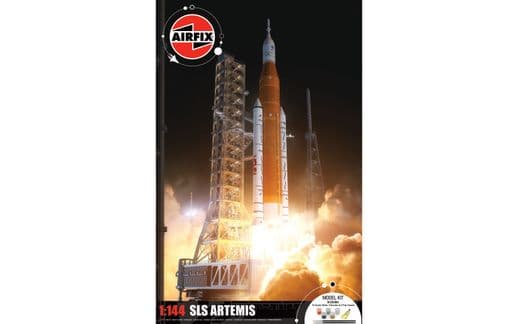
Bringing NASA’s space exploration endeavours right up to date, and representing an exciting new model kit tooling addition to the current Airfix range, SLS Artemis is a new generation of super heavy lift launch vehicles designed to be ‘evolvable’, changing over time, and adaptable enough to be used to carry numerous different payloads into space.
SLS Artemis inspired a recent new design project for one of our talented designers, creating his own little piece of scale space history.
This incredible coming together of technologies will allow a new generation of the earth’s population to witness the development and impressive achievements of a contemporary NASA space program, as the Space Launch System is their latest and most powerful rocket launch system to date, one intended to take mankind back to the surface of the moon and beyond.
The latest generation of super heavy lift launch vehicles, to the uninitiated, SLS and the Orion spacecraft capsule almost appears to be a combination of both Apollo and Space Shuttle technologies, however, this incredible program does represent the absolute pinnacle of engineering technology as we know it today, and the means by which man will venture deeper into space than ever before. Blasting off from launch pad 39B at Kennedy Space Centre in Florida for an unmanned maiden launch on 16th November 2022, the Artemis generation began in successful manner, with the new spacecraft harnessing 8.8 million pounds of thrust from its outer solid rocket boosters and main Aerojet Rocketdyne RS-25 engines.
The first manned launch has just taken place, with the Orion capsule having completed a spectacular and historic lunar flyby, the precursor to man’s long awaited return to the surface of the moon and deeper space exploration to follow. It’s intended that Artemis technology will drive NASA’s space program for decades to come, with this impressive space delivery system evolving to adapt to different mission demands, and the size of payload to be delivered into space. Indeed, as the weight of those payloads increase, so will the capability of the rockets needed to power them, as the Artemis Generation will create rockets which become ever more capable, claiming ever more achievements in the process.
The latest kit addition to our space range, SLS Artemis represents the future of NASA’s space exploration endeavours and a new chapter in the history of space flight.
From a space exploration perspective, we find ourselves at the beginning of an exciting new chapter for humankind, many of whom will never have seen a live space launch in their lives. Certain to captivate audiences old and new, SLS Artemis will take mankind’s desire to explore to new heights, with the drawdown in associated technologies going on to benefit everyone over the coming years.
As we have now witnessed this exciting ‘Next Beginning’ for NASA’s space program, what achievements will Artemis missions be claiming in the years to come, and how many of us are as excited at witnessing this prospect as those people who heard Neil Armstrong’s famous words were back in July 1969?
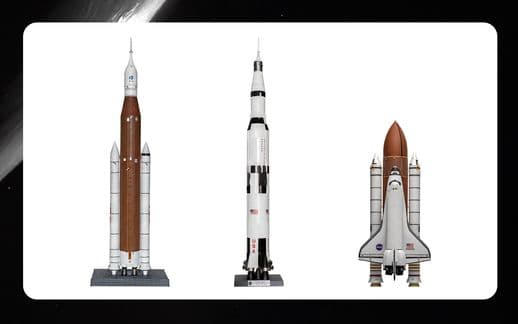
As the subject of space exploration continues to enthral and inspire, there’s nothing quite like having a physical scale representation of these most incredible craft as a model display centrepiece, and we’re proud to have the last three of NASA’s main manned launch vehicle systems in the current Airfix range.
The new Space Section on our website not only has details of all the models available in this range, but also an interview with the designer of our SLS Artemis kit, and details or our record breaking project to actually send one of these kits into near space.
It really does look as if 2026 is going to be a significant year for space exploration and the return of space being an inspiration for many millions of people the world over.
We're afraid that's all we have for you in this latest edition of the Airfix blog, but we will be back next Friday with more project development updates and the very latest Airfix kit exclusives. In the meantime, we're always keen to hear your views on all things Airfix and in particular, any thoughts and opinions you may have regarding our Workbench blog. If you would like to drop us a quick line, could we please ask that you use our workbench@airfix.com email for all correspondence.
To re-visit any of the Airfix blogs we have produced over the past TEN years or so, please head to our main Workbench hub, where you'll find our entire blog back catalogue and all the Airfix design projects we have already covered.
All our dedicated official social media sites can be accessed by clicking the respective link icons at the foot of this page, or by heading to the Airfix homepage. Other useful Airfix links are:
Facebook, YouTube, Twitter and Instagram official sites
Please join us for more Airfix updates next week and thank you for your continued support.