

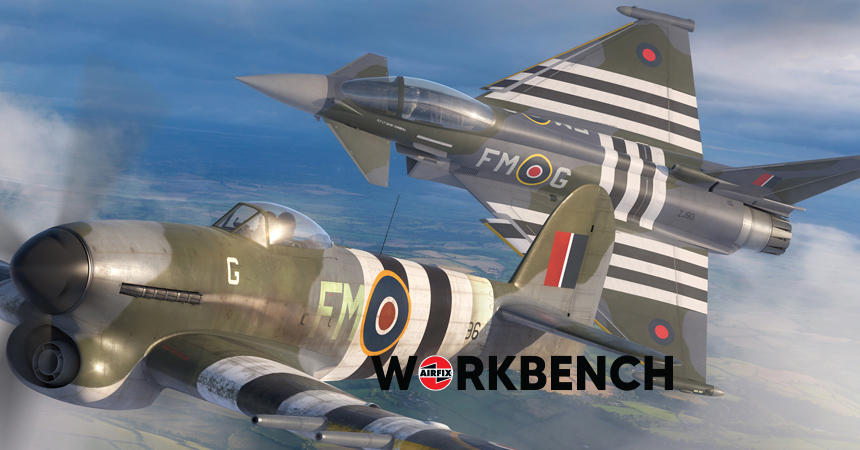
Welcome to the latest edition of our weekly Workbench blog, and all the news, updates, and modelling exclusives from the fascinating world of Airfix.
With this weekend marking the first Bank Holiday of British summertime for 2026, we knew that people might have a little more time on their hands for reading an Airfix blog post, so wanted to put something special together in this latest edition of Workbench. That being the case, we thought our subject should not only feature one of the most capable aircraft in current Royal Air Force service, but also our scale kit tributes to three of the most popular examples of this aircraft, wearing schemes which have thrilled millions of people at numerous Airshows and commemorative events over the past ten years or so.
Announced with the launch of our current kit range back in January, spectacular box artwork alerted modellers to the fact that we were releasing a trio of twin pack kit models featuring RAF Typhoon Display Team aircraft in strikingly different commemorative liveries, along with the aircraft from which they took inspiration, two from the Second World War, and one a much missed training aircraft display livery from 2008, one created to commemorate the 90th anniversary of the Royal Air Force.
As all three kits feature some of the most popular individual aircraft to have ever represented the Royal Air Force, we knew these special kit pairings would prove incredibly popular across the hobby, so are therefore delighted to have this Bank Holiday opportunity to formally introduce them to you – we might even make you forget about chocolate eggs and fuel shortages for a minute or two.
Please join us as we put the modelling world on Typhoon notice, and introduce you to Moggy, Blackjack and Gina.
Where it all began, RAF Display Typhoon ZK349 ‘GINA’ was finished in this beautiful 1940s style Battle of Britain Hawker Hurricane Mk.I scheme.
As the current defender of Britain’s airspace, and one of the most capable multi-role combat aircraft in world service today, the Eurofighter Typhoon FGR.4 has become a regular sight in European skies over the past twenty years or so, with around 800 aircraft now in service with nine nations, and Turkey about to become the tenth in the very near future. This magnificent aircraft now forms the backbone of the Royal Air Force, and as the aircraft assigned the task of keeping our sovereign airspace safe, and the aircraft deployed overseas whenever an aviation show of strength is required, the Typhoon is probably the aircraft which is now most recognisable to the vast majority of the nation’s current population.
An aircraft which has now been in operational RAF service for almost 20 years, the Eurofighter Typhoon was born from an international design collaboration which aimed to produce an agile air defence fighter (European Combat Fighter Project) for service with several European air forces. Such a collaboration held the prospect of keeping costs to more manageable levels for all those involved, as they were being shared across the partner nations, although each would ultimately have their own requirements, something which would put a strain on both costs and working relationships.
At the time this new aircraft entered the development phase, Britain’s sovereign airspace was being protected by such aircraft as the McDonnell Douglas F-4 Phantom and BAe Tornado F.3, the air defence variant of the RAF’s highly capable Tornado strike jet and whilst both were classic aircraft in their own right, neither could really describe themselves as being agile performers. With the USAF able to boast such manoeuvrable aircraft as the General Dynamics F-16 Falcon and world leading McDonnell Douglas F-15 Eagle, the new Eurofighter consortium was looking to develop their own agile fighter, one which was much better suited to the modern and constantly changing air combat arena.
The multinational consortium consisted of the aviation industries of Britain, Germany, Italy and Spain and as the project progressed, it was clear that the new Eurofighter was going to be an extremely advanced aeroplane indeed. Designed to be aerodynamically unstable at all speeds, the aircraft was controlled by a powerful suite of computers, which combined to endow the fighter with exceptional agility.
A popular addition to the Airfix kit range, this beautiful RAF Typhoon FGR.4 is a recent addition to our Starter Set range of kits.
Making extensive use of composite materials, the aircraft was to be powered by a pair of Eurojet EJ200 engines which propelled the fighter to a maximum speed of Mach 2.35 and the ability to supercruise without the use of afterburner. These engines were just as advanced as the aircraft itself and were designed in 15 fully interchangeable modules, with everything monitored in real-time to ensure the early indication of any potential problems with the unit. This was all designed to keep the aircraft serviceable and ready for action.
Equipped with an impressive array of targeting and defensive technologies, the Typhoon can also carry a seemingly endless selection of ever more capable weapons, as it has developed from its original air superiority fighter designation, into an exceptional multi-role platform, one which is truly at the forefront of military aviation technology. Now at the midpoint of its service life, the Typhoon is expected to remain in service until 2040 and beyond.
The Typhoon era began in earnest on 27th March 1994, when the first prototype aircraft made its maiden flight from the EADS facility at Manching in Bavaria, to be followed six days later by the first flight of Britain’s first development Typhoon (ZH588) from the Bae facility at Warton in Lancashire. The name ‘Typhoon’ was officially adopted for the new fighter in September 1998, the same year that the first production contracts were signed, committing nations to purchasing an aircraft they had already been working on for five years at that point.
The first operational RAF Typhoon Squadron was No.3 Squadron, which was established at Coningsby on 31st March 2006 and by the summer of 2007, the unit were sharing national QRA (Quick Reaction Alert) responsibilities with the RAF’s existing Tornado F.3 force, initially on a rolling month on - month off basis, but working up to taking this important duty over entirely.
Have you ever wanted to see what a Eurofighter Typhoon looks like wearing a 1944 era D-Day air support aircraft scheme?
Today’s in service Eurofighter Typhoon is a mature multi-role combat aeroplane, with much of its ongoing development taking place during its first 20 years of service and in the full gaze of the aviation world. With Germany having indicated that their Typhoons will remain in service until at least 2060, we possible have 2/3rds of the aircraft’s service life still to come, and when you consider that the iconic Supermarine Spitfire that everyone knows and loves only spent 16 years in Royal Air Force service, with the Typhoon already surpassing this figure, it remains to be seen if the nation will hold our current airspace dominator in the same affection in years to come?
Although the main role of the RAF’s premier air superiority interceptor is a deadly serious one, it’s always incredibly important for the force to forge strong and positive relationships with the general public, particularly those living close to operational air bases, in view of the important fact that the public purse funds the force. That being the case, although the age of the Eurofighter Typhoon was already upon the Royal Air Force, the aircraft had yet to be introduced to the public.
That first introduction took place at the largest, most prestigious Airshow event in the country during the summer of 2003, the Royal International Air Tattoo at Fairford. Two Typhoons were sent to take part in the show, one on the flying program and one for the static display, however, these were development aircraft and the crowds were going to have to wait to experience the full force of a full fat Typhoon display.
For most Airshow goers here in the UK, that would happen during the summer of 2005, and several show appearances by this spectacular new aircraft at events across the country. Thousands of spectators thrilled at the agility of a T1 Typhoon blasting across Shropshire skies at the annual Cosford Airshow, and just a week later, two Typhoons attended the Kemble Air Day, an event which saw the RAF’s new Typhoon operating from a non-military/development airfield for the very first time.
Combat ready, the vast majority of RAF Typhoons are presented in this sinister, but photographically uninspiring scheme.
The aircraft’s performance at that year’s RIAT show was memorable for all the wrong reasons, as a practice display on the Friday almost ended in disaster, when a Typhoon appeared to lose power when coming out of a loop and only avoided striking the runway by around 30 feet. Recovery from this incident did draw our attention to the incredible power generated by the aircraft’s two Eurojet EJ200 engines, powerplants which have now also gone on to forge the Typhoon’s reputation as the consummate Airshow performer.
By way of highlighting the important roles Royal Air Force Typhoons are tasked with fulfilling, the vast majority of the aircraft allocated to Airshow display duties during those early years were all presented in the standard air superiority grey scheme, which whilst perfect for protecting the skies, were somewhat uninspiring from a display spectacle perspective. Clearly, presenting their new interceptor in striking display schemes wasn’t even on the agenda of Royal Air Force officials at the time, however, a development which took place at RAF Coningsby during May 2015 captured the attention of the nation and proved to be something of a second coming for the RAF Typhoon.
In a high profile tribute to mark the 75th anniversary of the Battle of Britain, Eurofighter Typhoon FGR.4 ZK349 emerged from the paint shop at Coningsby wearing a stunning camouflage scheme based on the VC winning RAF No.249 Squadron Hawker Hurricane fighter flown by James Nicholson on 16th August 1940, including that aircraft’s GN-A fuselage codes. The aircraft looked magnificent and immediately became the most popular aircraft in RAF service at that time – from this point forward, standard grey Typhoons just didn’t cut it in the eyes of the aviation enthusiast.
Our trio of RAF Typhoon Display Team special scheme releases are already showing themselves to be some of the most popular releases of the year.
With the enthusiast world now smitten with display Typhoons presented in a very different scheme to the standard grey scheme usually associated with the RAF’s most prolific multi-role jet, the die had now been cast as far as they were concerned and nothing else would now do. The RAF Battle of Britain 75th Anniversary Typhoon quickly took on a personality all of her own, and by virtue of a play of the fuselage codes applied to the aircraft, she would be known to most people as GINA and if this mane was uttered in aviation circles, everyone knew exactly which aircraft you were talking about.
GINA proved to be an RAF public relations masterstroke, and if the RAF’s enduring connection with the British public had started to wane over recent years, their Battle of Britain Eurofighter Typhoon fully restored the situation, whilst also gathering a new generation of followers – we absolutely loved GINA.
Over the next decade or so, the RAF’s Display Typhoon would continue to wear distinctive and appealing markings, unquestionably becoming the most popular individual airframe in current Royal Air Force inventory during their tenure, and raising excitement levels amongst the nation’s aviation enthusiasts to fever pitch in the months prior to the start of the Airshow season – would the RAF be unveiling a new Typhoon scheme?
This beautiful new kit will make a striking addition to many a model display over the coming few months.
Historically, starting with GINA in 2015, the RAF presented three of their display Typhoons in special schemes, each one becoming incredibly popular with the Airshow-going public and each one a public relations masterstroke for the Royal Air Force. All three aircraft would be referred to by the colloquial name bestowed on them by enthusiasts, and all three would be highlight acts at any display they were scheduled to perform. If for any reason the display aircraft was unserviceable and we had to make do with the reserve (all grey) jet, depression immediately set in, and we would invariably have to arrange a visit to Coningsby, for a much needed Typhoon fix.
By way of our own 1:72nd scale model kit tribute, the Airfix 2026 range includes a trio of linked Display Typhoon double kit sets, featuring all three of the distinctively presented Eurofighter Typhoons to grace UK Airshows and commemorative events over the past decade, along with the aircraft which provided the inspiration for the scheme selected, two from the Second World War, and one a classic RAF training aircraft which served with distinction for 30 years from the beginning of the 1990s.
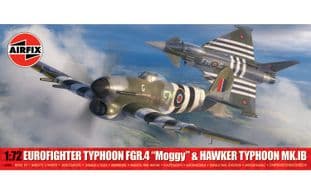
Whilst we will be including all three of these kits we already know will be amongst the most popular releases of the year within this feature, the main purpose of this update is to concentrate on the first of these kits to arrive, introducing you to Moggy, and the RAF aircraft from the summer of 1944 which provided the inspiration for her spectacular anniversary scheme.
On a rainy April morning at RAF Coningsby in 2024, the gaze of the aviation enthusiast world was firmly fixed on one of the hardened aircraft shelters at RAF Coningsby, known to many of us as ‘Fighter Town UK’. The Royal Air Force Typhoon Display Team prepared to unveil a new scheme on one of their Typhoon jets, one which was intended to mark this year’s 80th Anniversary of the historic D-Day landings.
As the doors slowly opened in suitably dramatic fashion, they parted to reveal Typhoon FGR4 ZJ913 resplendent in her stunning new livery, one which took inspiration from an RAF No.257 Squadron Hawker Typhoon flown by Squadron Leader Denzil Jenkins in support of the D-Day landings during the summer of 1944. Flying many missions in the weeks leading up to D-Day, Jenkins also led a raid against enemy radar sites across the northern French coast immediately prior to invasion, effectively blinding the Germans and keeping the approaching Allied armada secret for a few vital minutes longer.
The new scheme looked spectacular, as the RAF knew this aircraft was taking over from the relatively long serving, and much loved ‘Blackjack’, which interestingly was the nest serial number consecutively in RAF Typhoon allocation – ZJ914.
Even at this early stage, the aircraft had already attracted a nickname for this uniquely presented Typhoon, as she was introduced as ‘Moggy’ by those who will be operating her throughout the 2024 Airshow season, where she was flown by this year’s display pilot Flight Lieutenant David ‘Turbo’ Turnbull. ‘Turbo’ thrilled crowds at events both here in the UK and overseas, as he displayed the incredible power and agility of the RAF Eurofighter Typhoon to millions of people, demanding that every camera in their vicinity was locked onto the RAF’s dynamic duo of ‘Turbo and Moggy’.
Full scheme details and a finished kit in this most attractive commemorative scheme.
Wearing this striking scheme which was similar to the one Allied aircraft engaged in D-Day air operations eighty years earlier wore, Turbo and Moggy worked tirelessly during the 2024 Airshow season, performing at commemorative events in both the UK and France, in addition to completing a successful Canadian tour. They ably demonstrated the legendary agility of the Eurofighter Typhoon, and effectively highlighted the professionalism and capabilities of the modern Royal Air Force in some style.
Unfortunately, after just one glorious summer, Moggy’s RAF Typhoon Display Team reign was over, and we knew she wouldn’t be serving in this high profile role for as long as her predecessor ‘Blackjack’ did. As an airframe expired aircraft, Moggy was flown to RAF Lossiemouth, where whilst retaining her iconic D-Day scheme, she was destined to embark on a new career as a ground instructional airframe, helping to train the next generation of engineers and technicians charged with keeping the RAF’s aircraft fleet in good order.
Despite relinquishing her high profile display role, ‘Moggy’ will definitely be remembered as one of the most popular individual Royal Air Force aircraft of the post war era.
The real aircraft photographed on a particularly sunny day at RAF Coningsby in 2024.
Double Typhoon trouble.
BAe Systems Eurofighter Typhoon ZJ913 was one of the earliest Tranche 1 aircraft assigned to the Royal Air Force, making its first flight on 21st December 2004, and subsequently being delivered to RAF Coningsby on 1st April the following year. During a long and active service career, this aircraft spent time with, and wore the colours of Squadron numbers II(AC), 3, IX(F), 17(R) and 29(R), being with the latter during her tenure as the RAF’s Typhoon Display Team aircraft.
At the end of the 2024 season, with her airframe life almost expired, she did manage to avoid being reduced to produce, but did fly up to Lossiemouth to begin a new career as a ground instructional airframe. The MoD did announce that many of the air defence configured tranche 1 Typhoons still in service would be withdrawn by the end of 2026, with the majority heading for BAe Warton to be harvested for parts, helping to keep remaining Typhoons in service.
With the 2025 Display Typhoon reverting to a plain grey jet, will the RAF delight Airshow enthusiasts with a new special scheme in 2026, perhaps one which draws inspiration form an aircraft which took part in the Falklands conflict, which will be marking its 44th anniversary this year? Only time would tell.
By way of providing a more effective visual representation of the historic associations between the three different RAF Display Team Typhoons which served over the past decade, and the aircraft which provided the inspiration for them, the Airfix team felt it would be a good idea to release a series of dual kit releases, each one including one of the three specially presented Typhoons, along with the historic aircraft from which its anniversary scheme drew inspiration. With advanced order numbers already confirming these will be amongst the most popular kit releases of the year, it appears that modellers are in no mood to forget just how popular these spectacular display Typhoons were, and seem determined to create their own display tributes which are certain to be real attention grabbers.
For a year which would be marking the 80th anniversary of D-Day, RAF officials wanted their Display Typhoon to mark the significant contribution air power and Allied aircrews made to the success of ‘Operation Overlord’, both before, during and after the amphibious landings in Normandy. With the Hawker Typhoon being a low altitude battering ram of an aeroplane, and with its pilots flying some of the most hazardous missions of the entire war, they couldn’t think of a more appropriate subject aircraft, and ‘Project Moggy’ started to take shape. Clearly, whichever aircraft they selected, the distinctive D-Day identification markings were going to have a significant role to play, even if they were going to be applied with a little more care to a Eurofighter Typhoon than they would have been to its Hawker predecessor during the first few days of June 1944.
The Hawker Typhoon was originally intended to be the 'Super Hurricane' designer Sydney Camm had intended to take over from his famous Battle of Britain fighter, however, issues with elements of its design and the troublesome Napier Sabre engine prevented it from being the next generation of interceptor fighter. Thankfully, despite its initial problems, the Typhoon had enough people in positions of influence who believed in its potential, effectively enabling the aircraft to go on to fulfil its potential, not as a dedicated fighter, but as a rugged fighter bomber and attack aircraft, operating extremely efficiently at lower altitudes.
Earning a fearsome reputation throughout the spring and summer of 1944, the RAF's Typhoon squadrons were positioned at bases around southern England and on days which allowed flight operations, the Germans knew that the sky would soon be full of these heavily armed fighter bombers, with Typhoons raining a constant stream of bombs, rocket projectiles and machine gun fire on their positions, and anything they might find useful to the war effort.
Any military vehicle caught in the open was at risk of destruction if it attracted the attention of Typhoon units operating in the area, and there were even reports of some German tank crews abandoning their vehicles and running for cover during the battles across Normandy, if they spotted Typhoons in the clear skies above - clearly they were fearful of becoming the latest victims of the RAF's savage Typhoon squadrons.
Research conducted after the war indicated that actual success rates for Typhoon using rocket attacks weren't actually all that impressive, however, the psychological impact the Hawker Typhoon possessed appeared to be much more effective on German ground units than actual combat successes. Nevertheless, RAF Typhoon operations kept German forces pinned down in the weeks which followed D-Day and prevented any concerted and coordinated large scale German response to the invasion from being mounted, allowing the beachheads to be consolidated and supply lines to become established.
The aircraft which provided the scheme inspiration for ‘Moggy’, Pilot Officer Denzil P. Jenkins’ Hawker Typhoon Mk.IB MN396 FM-G.
The identification markings which were such a distinctive feature of the Allied aircraft which took part in air operations in support of D-Day.
Considered one of the most important aircraft of the D-Day period and indeed the final eighteen months of the war in Europe, the fearsome Hawker Typhoon was used to great effect during this time, either attacking strategic targets in the weeks prior to invasion, such as German radar sites, or providing invaluable close air support to ground units breaking out from the landing beachheads.
Fast, agile and heavily armed, forward air controllers were embedded with ground units throughout the Normandy region, with RAF Typhoons ready to respond to any request for aerial support. Aircraft not already engaged in strike missions would be holding at 10,000 ft in their 'Cab Ranks' off the coast of Northern France, just waiting to be called into action.
These support missions were incredibly hazardous for Typhoon pilots, not so much due to the effectiveness of Luftwaffe fighter opposition, but more from the murderous anti-aircraft fire hurled in their direction from seemingly every German operated gun in the Normandy region, not to mention the many ground hazards they faced when flying at these low altitudes. Research initiated after the end of the war highlighted that in the weeks following the D-Day landings, more than 500 Hawker Typhoons had been lost whilst on combat operations, but how less than 10 percent of this number could be attributed to enemy fighter activity.
Flying at high speed and extremely low altitudes, Typhoon pilots held the opinion that no pilot had experienced real combat flying until they had spent time on a Typhoon squadron, and they were probably right.
Knowing the important role Typhoon units had to play in the coming battles, many squadrons were sent to operate from new bases situated as close to the south coast of England as possible, with the airfield at Needs Oar Point being one such station. Situated on the edge of the New Forest near St Leonards Grange and overlooking the Isle of Wight, this airfield was about as far south as it was possible to get on the UK mainland, but was to become a centre of Typhoon operations in the weeks leading up to D-Day.
Previously just a flat area of farmland, the airfield was constructed in 1943 and featured temporary steel plank runway construction, with airfield personnel living out of basic canvas accommodation. Officially, this was an intentional exercise in acclimatising pilots and ground trades for their expected relocation to forward operating airfields on the continent, following the successful invasion of Normandy, but really just saw men camping out next to their aircraft.
The airfield was extremely active in support of the Normandy invasion, with its close proximity to France meaning that the Typhoon aircraft based there were regularly called upon to provide close air support for troops fighting to break out of the beachheads and to suppress any hope of a German counter offensive.
An attractive kit pairing. All three of these new Typhoon double kit sets will make for interesting display additions to many a model collection in the weeks and months to come.
The aircraft which provided the scheme inspiration for ‘Moggy’ was the Hawker Typhoon flown by Pilot Officer (at the time) Denzil Plummer Jenkins, a particularly determined ground attack specialist pilot who flew many missions in support of D-Day.
On qualifying as a pilot, Jenkins was initially assigned the task of training new pilots for the force. He must have been rather effective in this role, because his almost constant requests for an operational posting were just as regularly turned down. Finally, he was granted a posting to Gibraltar, the majority of his flying would be ferrying fighters around the Mediterranean Theatre to get them close to where they were required, before returning to Gibraltar to collect and lead a new ferry formation of aircraft.
On later joining No.257(Burma) Squadron, he would fly the mighty Hawker Typhoon in the ground attack role, ignoring murderous German anti-aircraft fire to press home attacks against communications, transport, logistics, railway tunnels, bridges and fortified installation targets across Northern France. One of the most important tasks Jenkins undertook was to lead a series of strikes against German radar stations on the morning of D-Day itself, effectively blinding German defenders to the massive Allied armada which was already approaching them.
Making a significant contribution to the success of the Normandy landings, as the Allies started to push out from their beachheads, Jenkins and No.257 Squadron moved to forward operating airfield B.3 at St. Croix, the start of a period where pilots would have to get used to operating from recently captured airfields across France, Belgium and the Netherlands.
Although the markings applied to Denzil Jenkins’ Hawker Typhoon were purely functional and intended to improve the survivability of aircraft operating in busy and contested airspace, it does have to be said that this 1944 Hawker Typhoon scheme looks particularly appealing when worn by a Typhoon jet some 80 years later.
Was ‘Blackjack’ the most popular individual RAF aircraft of the post WWII era?
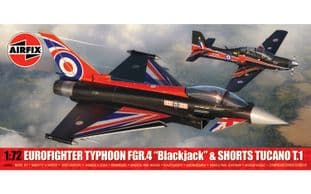
Although not being fully reviewed as part of this introduction feature, as we have mentioned the other two kits which make up this appealing series, we should at least show you the impressive box artwork created to support their release. Taking the display Typhoons in reverse chronological order as far as their introduction is concerned, the next aircraft in this series is ZJ914 ‘Blackjack’, the aircraft which immediately preceded ‘Moggy’ on the UK display circuit, but the one which actually followed it off the production lines at Warton, according to the consecutive serial numbers of the two aircraft.
‘Blackjack’ was the longest serving of the specially presented RAF Typhoon Display Team jets, as she served through three complete seasons from 2021 until the end of 2023. In actual fact, Flt Lt David ‘Turbo’ Turnbull, who flew ‘Moggy’ so successfully throughout the 2024 season would fly the majority of his display work-up practice flights in ‘Blackjack’ prior to it being flown to Warton at the end of its RAF career.
The scheme which most closely represents the one worn by ‘Blackjack’ and thought to have been the inspiration for it were the beautiful markings worn by the RAF’s display Tucano during the 2008 season, created to commemorate that year’s 90th Anniversary of the establishment of the Royal Air Force. We’ll have more details regarding this kit pairing in a forthcoming edition of Workbench.
The start of an appealing RAF Typhoon commemorative scheme tradition, Eurofighter Typhoon ZK349 wore these markings during the 2015 display season, to mark the 75th anniversary of the Battle of Britain.
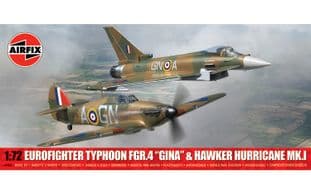
The final Display Typhoon double kit set takes us back to the beginning of this story, and the unexpected, but hugely popular unveiling of Eurofighter Typhoon ZK349 wearing her Battle of Britain Hawker Hurricane linked markings. ‘GINA’ was unveiled at a media event at RAF Coningsby during the late spring of 2015, where the RAF made this unique tribute to that year’s 75th anniversary of the Battle of Britain.
The scheme was based on the Hawker Hurricane Mk.I fighter flown by Flt Lt James Brindley Nicholson during actions over Southampton on 16th August 1940, actions which saw him awarded the Victoria Cross, Fighter Command’s only VC award of the Second World War.
All three of these special schemes prove that the Eurofighter Typhoon looks great when allowed to wear the markings of earlier RAF types, and even though not particularly suitable for use in operational circumstances, transform a relatively anonymous example of the RAF’s current aviation inventory into a high profile and much loved focal point for Royal Air Force public relations.
Let’s hope this is a trend we see continued in the years to come.
This trio of linked RAF Typhoon special scheme double kit packs are amongst the highlight releases of the current Airfix range, and are scheduled for staggered releases throughout the coming Airshow season.
We're afraid that's all we have for you in this latest edition of the Airfix blog, but we will be back next Friday with more project development updates and the very latest Airfix kit exclusives. In the meantime, we're always keen to hear your views on all things Airfix and in particular, any thoughts and opinions you may have regarding our Workbench blog. If you would like to drop us a quick line, could we please ask that you use our workbench@airfix.com email for all correspondence.
To re-visit any of the Airfix blogs we have produced over the past TEN years or so, please head to our main Workbench hub, where you'll find our entire blog back catalogue and all the Airfix design projects we have already covered.
All our dedicated official social media sites can be accessed by clicking the respective link icons at the foot of this page, or by heading to the Airfix homepage. Other useful Airfix links are:
Facebook, YouTube, Twitter and Instagram official sites
Please join us for more Airfix updates next week and thank you for your continued support.