

Welcome to this latest edition of our Workbench blog and all the news, updates and modelling exclusives from the fascinating world of Airfix.
As we find ourselves in the first full week of British Summer Time, the Workbench team felt that this was an occasion worthy of celebration and as such, really did call for our latest double blog post weekend, which is exactly what we have just posted for your consideration. To mark the impending release of two rather special and particularly poignant dual kit Gift Set model offerings, we wanted to feature both of them in this latest update, however, as both are surely destined to be incredibly popular additions to our 2023 range, we wanted both to feature in their own separate blog updates, just for those people who access the information via a generic web search, or via our main Workbench blog hub.
This first update will cover the larger of the two Gift Set offerings, a set which commemorates one of the RAF's most famous squadrons by featuring the aircraft it operated from its inception, right through to the aircraft it's pilots and ground support teams operate to this day. With this year also commemorating the 80th Anniversary of the squadron's involvement in one of the most audacious 'special' bombing raids of WWII, we are expecting our new 617 Sqn. Dambusters 80th Anniversary double kit Gift Set to be a popular modelling project for many over the coming months. As part of our review introduction, we will be looking at not one, but two spectacular pieces of box artwork, in addition to looking a little more closely at the details behind the scheme options included for each model.
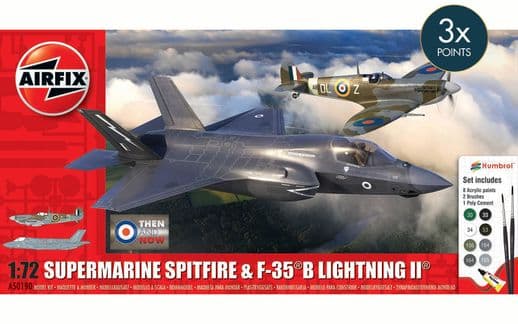
Our other blog for the week will feature the second of our new Gift Set kit offerings, one which again features the impending new Lockheed Martin F-35B Lightning II kit, but this time paired with one of its famous Royal Air Force forebears and arguably the most famous fighting aeroplane of all time, the Supermarine Spitfire. As already mentioned, this will be posed as a separate blog, but can be accessed by scrolling to the foot of the Airfix homepage, or heading to our main Workbench blog hub, where all previous editions can be searched and accessed.
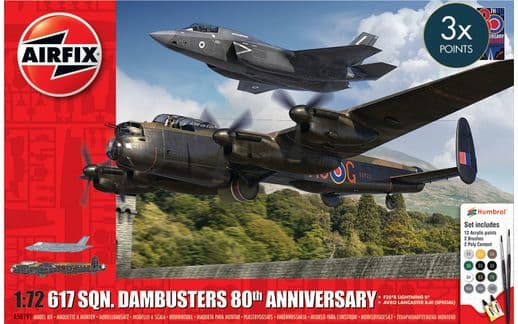
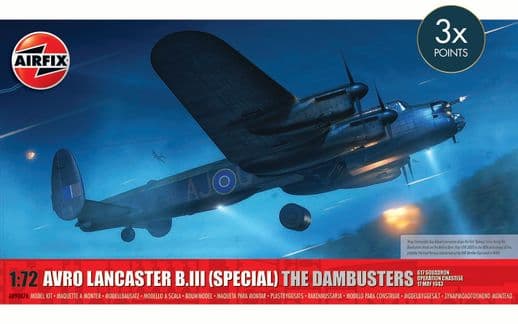
As befits a release of this stature, not one, but two spectacular pieces of box artwork were produced for our new 617 Sqn. Dambusters 80th Anniversary Gift Set.
When it comes to Airfix modelling heritage, there's one range of kits which occupy a special place in the hearts of a great many modellers, especially those who have been around for quite a while, our Dogfight Doubles. At a time when Airfix and the impressive range of model kits they produced held a really significant position in our lives, getting our hands on as many different kits as we possibly could was just about as stressful as life got for us back then and as such, a range of kits which offered two models in the same box was obviously of great interest to us. Add to this some clever Airfix marketing and supporting 'duelling' box artwork which was captivating to say the least and it isn't hard to understand why Dogfight Doubles became a perennial favourite with modellers for many years. To this day, the sight of any of the instantly recognisable box artwork which graced these double kit releases still brings back happy memories for us and probably those same feelings of excitement we felt back in our youth, an effective illustration of just how important Airfix was to us back then.
Although these enigmatic kits are still a feature of contemporary Airfix ranges, it's still the real classics which have us all marvelling at just how popular these kits actually were, dogfighting duos such as the IL-2 Sturmovik & Focke Wulf FW190, Spitfire Mk.IX & Messerschmitt Bf 110 and Beaufighter & Bf 109G all had us visiting our local model shops, or cajoling family members about suitable gifts for Christmas and Birthdays. For many, the ultimate offering in this enigmatic twin kit series was the Mosquito & Messerschmitt Me262 Dogfight Double, a kit pairing that even if you had already built it several times previously and had examples within your built model display, receiving yet another as a gift was still regarded as something of a treat, such was the reputation of this spectacular kit.
Although our latest 1/72nd scale 617 Sqn. Dambusters 80th Anniversary Gift Set release isn't a traditional Dogfight Doubles release in the truest sense, the fact that it contains two hugely appealing kits in the same box makes it connected if only by association, however, with both kits being either an all new tooling project release, or relatively recently introduced classic kit offering, this is double kit modelling at its very best. At its heart, this release is our scale tribute to aircraft which have represented the RAF's No.617 Squadron since its inception in 1943, right up to current operations, with both aircraft types being cutting-edge and hugely influential machines during their particular service periods.
Undoubtedly, the aircraft which is most closely associated with No.617 Squadron is the Avro Lancaster B.III (Special), a unique collection of Lancasters which underwent modification to carry the Barnes Wallis designed 'Upkeep' mine, intended to allow the attack against the great dams of the Ruhr Valley to take place. Attempting to uphold the historic traditions of this most famous squadron, the aircraft which currently equips RAF No.617 Squadron is the hugely capable Lockheed Martin F-35B Lightning II, one of the most advanced aircraft ever to take to the skies and one which represents the future of both the Royal Air Force and the Fleet Air Arm and both of these significant aircraft are represented in this fantastic new kit.
What could possibly be better than finding a spectacular scale kit representation of a famous aircraft when opening the box of your latest Airfix model purchase, finding two kits in there of course! This image shows built sample models from our new 617 Sqn. Dambusters 80th Anniversary Gift Set release.
Even before war broke out in September 1939, Bomber Command had already produced a robust list of potential strategic targets in Germany they intended to hit should the situation in Europe come to war, a list which included the great dams of the Ruhr Valley. A series of mighty dams which supplied the region with the water and electricity it needed to fuel Germany's vital industries, surely if they could be destroyed, it would be catastrophic for the region and for Germany, whilst at the same time providing a significant propaganda victory for the Allies. As their night bombing campaign later got underway, the Ruhr region was subjected to heavy saturation bombing, however, results were disappointing to say the least and if attacking the dams was to be seriously considered, it was clearly going to take the use of a very special new weapon if they were to stand any chance of success.
As Bomber Command continued with their campaign, celebrated British inventor and engineer Barnes Wallis was working on an ingenious method of designing an air launched bomb which could skip across the surface of a body of water and when delivered correctly, might well be the ideal way in which to target the supporting wall of a dam. Perhaps now, Bomber Command had the very weapon they had been looking for, but how could they deliver such a weapon and how could they design a new aircraft around it at this crucial stage of the war?
In the hope that Wallis would be successful with his design work and at the same time, in devising a modification to standard Lancaster bombers to allow delivery of his new bouncing bomb, the RAF instructed the highly regarded Wing Commander Guy Gibson to form a crack new squadron to be made up of some of the most proficient Lancaster crews in Bomber Command. The group would include men from Britain, Canada, Australia, New Zealand and America within their number and they would all gather at RAF Scampton to train exhaustively in low flying, by both day and night, whilst at the same time testing the navigational skills of each and every crew. Flying a collection of standard Lancasters at first, crews couldn't help wondering what was all this effort was leading to and what their intended target would be? All would be revealed soon enough.
Charged with forming a new ‘Specialist’ Squadron at RAF Scampton in March 1943, Wing Commander Guy Gibson gave his assessment of the challenge which lay before him by stating ‘This Squadron will either make history or it will be completely wiped out’. Taking experienced volunteer crews from within 5 Group Bomber Command, Squadron X (or 617 Squadron as it would later be numbered) was formed under the utmost secrecy, which for the men who joined would mean censorship screening of all letters and monitored telephone conversations. Initially, the Squadron received ten Lancaster bombers for training purposes, taking aircraft from existing operational units as these had been tried and tested on operations. It was felt that new aircraft were usually prone to suffering from numerous annoying little problems and the tight training schedule meant that there was absolutely no time to waste on rectifying such issues.
The training would be extremely intense and would be both physically and mentally demanding for the airmen involved. The crews would be required to fly their Lancasters at low level by both day and night and over some of the most demanding terrain in the UK, including the steeply protected approaches to three specific reservoir sites around the country – Eyebrook in Leicestershire, Abberton near Colchester and Derwent Dam in Derbyshire. These locations were selected to prepare the crews for their impending 'Special Mission', although at this time neither they, nor Wing Commander Gibson were aware of their intended target.
More new Airfix box artwork delights, this is the stunning image used on the box front of this new anniversary release, a kit which will surely be a popular tribute build during this 80th anniversary year of the RAF's 'Dambusters' squadron.
On 8th April 1943, the first of 20 modified type 464 ‘Provisioning’ Avro Lancaster B.IIIs arrived at RAF Scampton, most including two under-fuselage spotlights and all featuring a heavily modified bomb bay, with robust mounting arms and drive mechanism to allow the ingenious ‘Upkeep bomb’ to be delivered effectively. Although often referred to as ‘Bouncing Bombs’ Upkeep resembled more of a large oil drum than anything else, but weighing in at just over 4 tonnes, this powerful mine was developed with one specific aim in mind, the destruction of a dam. Just a few days before the raid was due to take place, 56 of the Upkeep mines were also delivered to Scampton, which must have caused significant interest amongst the crews training hard using the ten standard Lancasters.
On 12th May, less than five days before the raid was scheduled to take place, some No.617 Squadron crews began training with their new Lancasters, equipped with their unusual bombs, with Gibson and his crew being amongst the first. Performing practice releases at the test site at Reculver on the north Kent coast, crews were amazed to see these large rotating mines actually skipping along the surface of the sea and heading inland towards the beach, leading many of them to immediately assume that their intended target would be the massive German battleship Tirpitz.
With a relatively short training period ahead of them and using new weapons and specific delivery methods, not everything went entirely to plan during the practice release sorties and several Lancasters were damaged by the huge plume of water which resulted from the mine hitting the sea and engulfing the rear of the aircraft. If the Lancaster was flying too slowly or if the aircraft was too low to the water at the point of release, this splash plume could cause significant damage, resulting in the aircraft needing maintenance time in the hangar. Indeed, one Lancaster was so badly affected by a splash plume that it was still receiving attention on the night of the raid itself, meaning the attack force was now down to just 19 aircraft.
On the day prior to the attack, Gibson was finally briefed on the mission and his intended targets – primary targets were A - the Mohne Dam, B – the Eder Dam and C – the Sorpe Dam, with three additional dams listed as secondary targets, information he then shared with a small number of his trusted officers. He was also informed of the impact a successful attack would have on both the Allied war effort and the morale of the German people. Barnes Wallis had calculated that the successful delivery of just a single mine would be sufficient to cause a breach as long as the dams were full and whilst he was more concerned with the science behind this audacious attack, military planners knew how devastating the potential outcome could be.
Striking at the very heart of the mighty German industrial manufacturing base in the Ruhr Valley, their aim was to disrupt war production by breaching three of the huge dams in the area, depriving factories of water and power generation, whilst also wreaking devastation on an unprecedented scale, with the torrent of water potentially flooding the entire region. Devastation on this scale would both seriously affect Germany’s ability to keep its armed forces supplied with weapons and ammunition, whilst also rendering large areas of farmland unworkable. The resultant repairs would draw valuable resource away from front line operations and force the continued deployment of Luftwaffe units in the area, again preventing them from being used elsewhere.
The two kits which make up our new 1/72nd scale 617 Sqn. Dambusters 80th Anniversary Gift Set are:
It's interesting to note that even though the Lancasters which took part in the Dambusters raid would become some of the most famous aircraft in the history of aviation, only 23 Type 464 (Provisioning) Lancasters were ever produced and indeed for some, the raid would be their only operational sortie. Without doubt, the most famous of all the Dambusters Lancasters, ED932 was not only the mount of raid leader Wing Commander Guy Gibson and his crew, but it was also the subject of only a handful of official photographs which were subsequently published showing an Upkeep equipped Type 464 Lancaster.
The aircraft was delivered to RAF Scampton on 30th April 1943 and immediately allocated to Gibson, where it would wear the rather appropriate fuselage codes AJ-G. Due to the responsibilities of command, Gibson didn't fly his Lancaster on training sorties for as many hours as most of the squadron's other pilots, however, it did go on to drop the unit's first inert Upkeep mine on 11th May, with the Wing Commander at the controls. Unlike the other aircraft of the squadron, it is thought that because of its celebrated assigned pilot, ED932 may have received some preferential treatment during her time at Scampton. Rather than joining the rest of the Lancasters at dispersal areas some distance away from the main building complex, this Lancaster would regularly be parked on the grass outside Gibson's office, clearly one of the perks of his command position.
On the night of the Dambusters raid, this aircraft would lead the first section of the main attack wave with Gibson at the controls. The second wave with the Sorpe Dam as their primary target, actually left Scampton first, due to the fact that these aircraft would be flying a more northerly course to try and confuse German night defences. By 21.39, the main attack wave were ready to set course for the Ruhr, taking off in sections of three aircraft, with Gibson leading the first section. Their target was the Möhne Dam and Gibson himself would perform the first attack run of Operation Chastise. Whilst his attack didn't result in a breach, he would remain in the area and fly alongside each aircraft undertaking its attack run, attempting to draw enemy defensive fire in the hope of giving the attacking Lancaster crew a better chance of achieving a dam breach.
One of the most famous aircraft in RAF history, ED932 led the Dambusters raid and would be the first to release an Upkeep mine in anger. For his heroic actions on the night of 16th/17th May 1943, Wing Commander Guy Gibson would be awarded the Victoria Cross.
Once a breach of the dam had been achieved, Gibson then led the remaining Upkeep equipped Lancasters on to their secondary target, the Eder Dam, where he once again tried to help his comrades by remaining on station until the final mine had been released. For his incredible bravery, leadership and devotion to duty, Gibson would later be the recipient of the nation's highest award for valour in the face of the enemy.
An interesting footnote relating to all the Type 464 (Provisioning) Lancasters concerns the aircraft's serial numbers and how they are often shown with a /G added to the end of them. This was an instruction to base security teams that this aircraft carries secret equipment and must therefore be under armed guard at all times when on the ground. This system was in widespread use throughout WWII, but was not noted as being an official part of the Type 464 Lancaster serial number allocation process and indeed, it appears that this secretive prefix was removed prior to the raid itself.
Avro Lancaster ED932 would remain with No.617 Squadron after the raid and was eventually handed over to the care of the unit's new commander. She would be one of six former Dambusters Lancasters to be converted back to standard configuration, with the return of its ventral turret, but this time featuring bulged bomb bay doors. She would conduct further operational sorties, most noticeably when dropping a 12,000lb 'Blockbuster' bomb on the Antheor Viaduct. Interestingly, she would later be converted back to Type 464 configuration and used during 'Operation Guzzle', sorties mounted to dispose of the remaining Upkeep mines in the Atlantic Ocean.
It was reported that by the time of the 'Guzzle' missions, the aircraft was in quite a poor state and would spend the next few months languishing on the ground at Scampton, where she was eventually scrapped in July 1947.
The Lockheed F-35 Lightning project began in 1990s and was a program intended to produce a capable new combat aircraft which was not just a modern replacement for the F-16 Fighting Falcon, but actually a replacement for several US aircraft types in service at that time. Crucially, it was intended to use the same basic design to provide a new aircraft for the US Air Force, the US Navy and the US Marine Corps, quite a tall order for the design team. In addition to this, development included the involvement of partner nations, as it was intended that the new aircraft was always going to be available as an export option.
Making use of all the very latest cutting edge technologies, and with a punishing design brief to satisfy, the project was beset with delays and cost overruns from the outset and with the media regularly commenting only on the negative aspects of the project, it really did seem as if more people wanted the project cancelled than wanted to see it in service and patrolling the world's skies. Thankfully, with the F-35 now in widespread service, all those issues seem to be in the past and this impressive multi-role aircraft is finally showing the world what it can do.
The F-35 comes with quite a reputation and from a design perspective, employs a bewildering combination of technologies, the use of which have only been possible over recent years. Significantly superior to anything potential adversaries could develop and introduce over the next 20 years or so, this really is a technological marvel, an aircraft designed to outlast all of its potential combat competitors. Described as being three times more effective in recognising and neutralising enemy air defences than any other aircraft, it is also second only to the F-22 Raptor in its air superiority capabilities and is claimed to be the most affordable, lethal and supportable aircraft ever produced.
The Lockheed Martin F-35 Lightning II has been produced in three distinctly different variants, each one intended for a different branch of the US military and each one possessing unique features and capabilities. The F-35B variant Britain elected to take is arguably the most versatile combat aircraft in the world today and one which possesses many of the operational qualities the much loved Harrier did, only in a 5th generation, long-range stealth strike fighter package.
As the most capable aircraft to ever enter Royal Air Force service, it's somehow fitting that the F-35B's introduction to the Airfix range is in the iconic markings of No.617 Squadron 'The Dambusters'.
Arguably the most exciting and technologically advanced variant of this amazing aircraft, the F-35B is STOVL (Short Take Off and Vertical Landing) capable and employs innovative variable thrust technology which makes this the most versatile combat aircraft in the world today. This variant can take off in extremely short distances and land vertically, attributes which make it suitable for use off aircraft carriers and similar to the Harrier, capable of operating from short field locations and those which are described as dispersed and rudimentary at best. This is the variant operated by the Royal Air Force, the Fleet Air Arm of the Royal Navy, the US Marine Corps and the Italian Air Force.
Lockheed Martin F-35B Lightning II ZM153 is chronologically the nineteenth F-35B built for the UK, making its first flight in August 2020 and arriving at RAF Marham as part of the fourth batch of aircraft delivered on 30th November 2020. The aircraft took off from MCAS Beaufort in South Carolina with two other F-35Bs bound for the UK, making the flight across the Atlantic Ocean with the support of RAF Voyager airborne refuelling aircraft. When the aircraft arrived at RAF Marham, they joined a further fifteen aircraft which had all made this trip before them, with a further three aircraft retained at Edwards Air Force Base, used by RAF No.17 Squadron in a Test and Evaluation role. It's thought that by the end of this year, Britain will have received 48 F-35B jets, with at least 24 of these (two full squadrons) being available for active deployment aboard HMS Queen Elizabeth should they be required.
The initial operational capability for Britain’s F-35B Lightning force was declared on 10th January 2019 for land based operation and subsequently for carrier based operations in late 2020. The first deployment for RAF F-35B Lightnings occurred in May 2019, when 'Exercise Lightning Dawn' saw six aircraft deployed to RAF Akrotiri in Cyprus and during this deployment, two aircraft performed the first combat operation for the type, a Combat Air Patrol over Syria as part of 'Operation Shader'.
Current Royal Air Force Squadrons operating the Lockheed Martin F-35B Lightning II are No.17 Squadron at Edwards Air Force Base in a Test and Evaluation role, No.207 Squadron at Marham as the Lightning Operational Conversion Unit and No.617 Squadron 'The Dambusters' also at Marham, currently the UK's only operational front line F-35B unit. Later this year, No.809 Naval Air Squadron will become the second operational UK F-35B Lightning II unit, a clear illustration of how this magnificent aircraft is as effective operating from a land based airfield as it is from the decks of one of Britain's new super carriers.
Full product box artwork in both orientations, highlighting why this could be the perfect way in which to mark the 80th Anniversary of the Dambusters raid and with it, 80 years of this famous Royal Air Force squadron.
From May to December 2021, eight F-35B aircraft from RAF No.617 Squadron, a number which included ZM153, embarked on HMS Queen Elizabeth for the carrier's first operational deployment. They were joined by ten F-35Bs of the US Marine Corps' VMFA-211 Marine Fighter Attack Squadron 'Wake Island Avengers' and 180 US personnel, in a deployment which highlighted the joint operability of this advanced new aircraft in tandem with fellow NATO allies. The successful seven month deployment across the Indo-Pacific region as part of 'Operation Fortis' was a significant development in the ongoing integration of the F-35B and during that time, this was the largest fifth generation Carrier Air Wing to be found anywhere in the world.
Unfortunately, during this deployment, the UK lost its first F-35B, as a Lightning suffered a catastrophic loss of power during its take-off run, forcing the pilot to eject just seconds before the aircraft hit the water, thankfully emerging unscathed from the incident. An investigation later found that failure to remove an intake rain cover was the cause of the loss of power, something which turned out to be a rather expensive mistake. In a complex joint services operation, the submerged aircraft was later recovered and it has been confirmed that a replacement aircraft will be procured.
Clearly, 2023 is going to be a significant year for No.617 Squadron of the Royal Air Force, as this coming May will mark the 80th Anniversary of the famous Dambusters Raid against the great dams of the Ruhr Valley and their aircraft will be in great demand to perform commemorative flypast and requests for Airshow attendance throughout the year. The association between the F-35B and arguably the RAF's most famous squadron is one which current squadron members are extremely proud of and if there was ever an occasion with which to effectively underline both the capabilities and continuing integration of the F-35B Lightning II into Britain's armed forces, then the Dambusters 80th Anniversary could hardly be more appropriate.
An enigmatic scale aviation kit paring which is very much of the moment, our new 617 Sqn. Dambusters 80th Anniversary Gift Set will certainly make for a fine scale modelling tribute to this significant anniversary, and with this new kit is scheduled for imminent release, could be an appealing build project for us all over the next couple of months.
We are afraid that's all we have for you in this latest edition, but we will be back next Friday with more project development updates and the very latest Airfix kit exclusives. In the meantime, we are always keen to hear your views on all things Airfix and in particular, any thoughts and opinions you may have regarding our Workbench blog. If you would like to drop us a quick line, could we please ask that you use our workbench@airfix.com email for all correspondence.
To re-visit any of the Airfix blogs we have produced over the past seven years or so, please head to our main Workbench hub, where you will find our entire blog back catalogue and all the Airfix design projects we have already covered.
All our dedicated official social media sites can be accessed by clicking the respective link icons at the foot of this page, or by heading to the Airfix homepage. Other useful Airfix links are:
Facebook, YouTube, Twitter and Instagram official sites
Please join us for more Airfix updates next week and thank you for your continued support.