
Welcome to this latest edition of our Workbench blog and all the news, updates and modelling exclusives from the fascinating world of Airfix.
At the risk of repeating ourselves in a blog writing sense, as we find ourselves in the first full week of British Summer Time, the Workbench team felt that this was an occasion worthy of celebration and as such, really did call for the posting of our latest double blog weekend. To mark the impending release of two rather special and particularly poignant dual kit Gift Set model offerings, we wanted to feature both in this latest update, however, as both are surely destined to be incredibly popular additions to our 2023 range, wanted both to feature in their own separate blog updates, just for those folks who access the information by generic web search, or via our main Workbench blog hub.
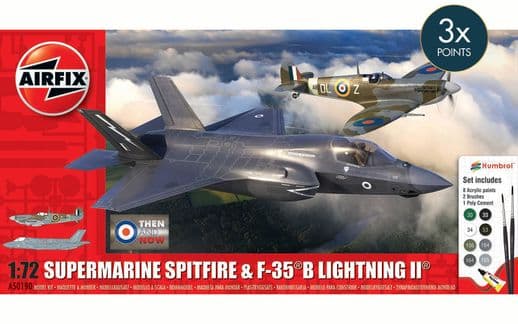
This second update of the weekend will cover the other of the two new Gift Set offerings up for review, one which features two of the most famous single engined aircraft types to have ever seen Royal Air Force service, both representing air power from different eras, one from the Second World War, with the other the most advanced aircraft currently in RAF service. What makes this particular kit all the more noteworthy is the fact that both kits have been designed as part of our new Starter Set range of kits, meaning this new dual kit release is as much for the novice and first time modeller as it is for the seasoned veteran, but in both cases, with beautifully accurate representations of a Spitfire and F-35B Lightning II the result of this modelling experience. As with the other review for this weekend, we will be looking at the box artwork produced in support of this release, in addition to looking a little more closely at the details behind the scheme options available for both of the models included.
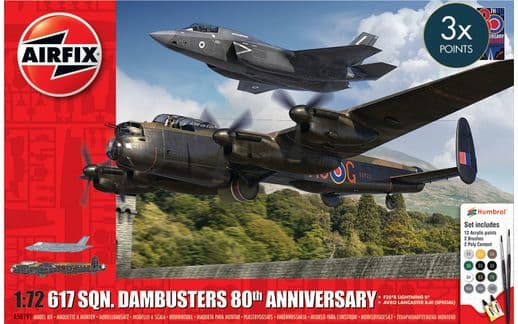
The other blog update posted this weekend, which you may or may not have already viewed, features our new 617 Sqn. Dambusters 80th Anniversary double kit Gift Set and can be accessed via the link above, or by heading to our main Workbench blog hub, where you will find this, and all previous editions of our blog within its many searchable pages.
With both of these dual kit Gift Set releases about to land with model retailers everywhere, I suppose we had better get on with things.
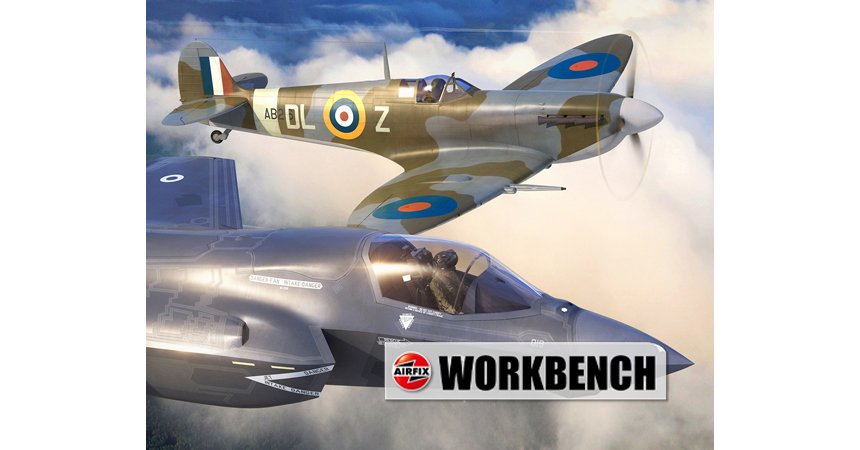
Double Trouble, this latest twin kit Gift Set release marks two aircraft which represent the pinnacle of Royal Air Force air power, but eighty years apart - the iconic Spitfire and technologically astonishing F-35B Lightning II.
In the other update blog posted this weekend, we discussed the modelling heritage Airfix can boast in releasing kits which include not one, but two model kits in each box and how these Dogfight Doubles kits enjoy something of a mythical modelling status with those who remember them in their heyday. Even though these hugely popular kits are still a feature of contemporary Airfix ranges, it's the real classics which continue to have us all marvelling at just how appealing these kits are, iconic dogfighting duos such as the IL-2 Sturmovik & Focke Wulf FW190, Spitfire Mk.IX & Messerschmitt Bf 110 and Beaufighter & Bf 109G which all had us visiting our local model shops in our droves, or cajoling family members about suitable gifts for Christmas and Birthdays. For many, the ultimate offering in this enigmatic twin kit series was the Mosquito & Messerschmitt Me262 Dogfight Double, a kit pairing that even if you had already built it several times in the past and had examples within your built model display, receiving yet another example as a gift was still regarded as something of a treat, such was the reputation this fantastic kit enjoyed.
Although our latest 1/72nd scale Supermarine Spitfire & F-35B Lightning II Gift Set release couldn't be described as a Dogfight Doubles kit in the traditional sense, the fact that it contains two hugely appealing model kits in the same box makes it somehow connected, even if only by association, however, with both kits being either a completely new tooling project release, or in the case of the Spitfire, still a very relatively recent kit introduction, this is definitely double Airfix kit modelling at its very best. At its heart, this release is our scale tribute to two extremely famous aircraft in Royal Air Force service, one which is undoubtedly the most famous British fighting aeroplane of all time, with the other being the latest addition to Royal Air Force inventory and one which will hope to emulate the service achievements of its famous forebear.
As a pairing, placing the F-35B with the Spitfire certainly creates a point for debate, as aviation has come a long way since the early stages of the Second World War and despite the fact that the Spitfire was cutting-edge back then, cutting-edge in an aviation sense is a very different thing now. If it isn't already, the F-35B is destined to become the highest profile aircraft in British service for many years to come, something which will certainly bring it into 'Spitfire Territory' and as such, will probably make it the aircraft type most members of the general public will become familiar with, whether they would describe themselves as aviation enthusiasts or just followers of current national affairs.
Nevertheless, if we look a little deeper into this aviation comparison, even though the F-35B might hope to emulate the Spitfire in the popularity stakes, the two aircraft are quite different and have/had distinctly different roles to perform. Certainly during its early years of service, the Spitfire was a relatively short range interceptor, designed to clear home skies of encroaching enemy aircraft, ideally before they could do any damage to targets below. Undeniably, this exceptional aircraft would prove capable of taking on other roles during its service life, however, its main intended task was that of interceptor.
In our home skies, mess with us at your peril. Our latest Gift Set release brings the most famous British fighting aeroplane together with the current darling of the Royal Air Force in kit form, both designed to take their place as one of our new generation of Starter Set kits. Simplified construction but every inch Airfix classics!
In contrast to this, the Lockheed Martin F-35B Lightning II has been developed as a stealthy multi-mission capable platform, but one which is equipped to not only dominate the aerial battlefield, but also to direct the operation of friendly forces in a coordinated attempt to neutralise the enemy threat, before it can actually become a threat. Perhaps more than any other combat aircraft in the history of aviation, the F-35 is equipped with technologies which are specifically designed to confuse and disorientate a potential adversary, whilst at the same time communicating in real time with a wide range of friendly forces, in a manner which will give them an unprecedented control of the strategic situation, maximising their impact and ensuring the most devastating response once given authorisation to do so. Using stealth technologies to get close to an enemy target, before unleashing its weaponry and clearing the way for more conventional aircraft to launch their attacks, whilst all the time using new technologies to obtain an unrivalled situational awareness of its surroundings. The F-35 really is an impressive bit of kit and in its 'B' STOVL variant form, is just about the most flexible combat capable aircraft in the world today.
If we concede that both the Spitfire and F-35B were designed to dominate the skies, then they are indeed perfectly aligned and what this new double kit Gift Set release will allow modellers to appreciate is how aviation technology has advanced over the past eighty years or so and the relative size difference between these two iconic combat aircraft from different eras. Significantly for the 2023 Airfix range, as new Starter Set tooling designs, this build comparison can now be enjoyed by arguably the widest modelling audience in Airfix history, with everyone from the first time modeller right up to the time served expert all able to effectively negotiate the construction process.
Bringing their combined industry experience to bear and utilising all the very latest advancements in design and manufacturing technology, the Airfix design team expertly created this new generation of Airfix Starter Set kits, designs which incorporate all the impressive features our scale model kits are famous for, but in a much simplified construction format, with less parts for the modeller to contend with and simple, intuitive assembly guidance for them to follow. All these steps were taken to support the first time and novice modeller in spending an enjoyable couple of hours modelling a scale representation of an ever growing range of model kits, a range which currently includes classic and contemporary aircraft and cars, with a couple of classic military vehicles thrown in for good measure.
What all these kits have in common is that they will allow a beautiful scale representation of the subject to be built easily and relatively quickly, with the modeller having enjoyed what may actually have been their very first modelling experience. This new Then & Now Gift Set release will allow 1/72nd scale representations of both a Spitfire and F-35B Lightning II to be modelled, but which schemes will the kits be offered in?
As Robert Wardlow Oxspring's father was a decorated airman during the Great War, it seemed fitting that the gathering clouds of war in the late 1930s encouraged him to follow in his footsteps and having safely negotiated his RAF basic training, was posted to No.66 Squadron at Duxford in December 1938. He was still serving with the unit at the start of the Battle of Britain and with his well-honed flying abilities, would score some notable successes during this aerial struggle, claiming at least eight Luftwaffe aircraft destroyed and a further six either damaged or shared destroyed. He would himself be shot down by Messerschmitt Bf 109 fighters over Tonbridge Wells on 25th October 1940 and whilst his fighter was destroyed, he managed to safely bale out, if sustaining slight injuries in the process.
Following a period of recouperation and time serving in an instructional role, Oxspring returned to operational flying as Commander of No.91 (Nigeria) Squadron at Hawkinge, where his personal Spitfire AB216 was one of the most distinctive of the unit's aircraft. The Squadron benefitted from the significant fund raising efforts made by the people of Nigeria and several of the Squadron's Spitfires proudly took the name of the nation into combat with them. The aircraft flown by Squadron Leader Robert Wardlow Oxspring carried the Nigeria name, in addition to that of Oyo Province, presumably one of the regions which proved particularly generous in contributing towards buying Royal Air Force Spitfires.
Going on to serve successfully with several squadrons throughout the rest of WWII, Oxspring would survive the war with an impressive 21 aerial victories to his name, 4 V1 Doodlebug victories and many other combat sorites which produced damaged and 'probables' claims.
Classic presentation of a classic aeroplane, the incomparable Supermarine Spitfire in RAF No.91 Squadron presentation livery.
Supermarine Spitfire Vc AB216 made its first flight on 23rd December 1941 and was later delivered to No.91 Squadron, where she would wear the codes DL-Z, becoming the personal aircraft of Squadron Leader Robert Wardlow Oxspring. It would also be the subject of several official publicity photographs at the time, with six of the Squadron's aircraft suitably spruced up and placed in a neat line for the benefit of the camera, with each aircraft's pilot stood in front of his mount, as if about to be subjected to inspection. These pictures clearly show the markings Nigeria - Oyo Province carried on the front port fuselage of Oxspring's aircraft, just ahead of the windscreen.
Interestingly, although this Spitfire remained with No.91 Squadron until June 1943, it would later be used in rather unusual trials to assess whether Spitfires could be used to tow Hotspur gliders laden with men and supplies destined for forward operating airfields in the wake of D-Day. The aircraft was fitted with a tail hook and used as part of the Hasty-Hitch program and whilst there are reports of Spitfires successfully towing gliders over short distances, it's not known if any photographic evidence of this unusual practice survives.
Spitfire AB216 would suffer an inflight engine fire in early 1945 and was forced to make an emergency belly landing in a field near Sleap in Shropshire and whilst the pilot managed to walk away from the incident unscathed, the Spitfire was struck off charge.
The Lockheed F-35 Lightning project began in 1990s and was a program intended to produce a capable new combat aircraft which was not just a modern replacement for the F-16 Fighting Falcon, but actually a replacement for several US aircraft types in service at that time. Crucially, it was intended to use the same basic design to provide a new aircraft for the US Air Force, the US Navy and the US Marine Corps, quite a tall order for the design team. In addition to this, development included the involvement of partner nations, as it was intended that the new aircraft was always going to be available as an export option.
Making use of all the very latest cutting edge technologies, and with a punishing design brief to satisfy, the project was beset with delays and cost overruns from the outset and with the media regularly commenting only on the negative aspects of the project, it really did seem as if more people wanted the project cancelled than those who wanted to see it in service and patrolling world skies. Thankfully, with the F-35 now in widespread service, all those issues seem to be in the past and this impressive multi-role aircraft is finally showing the world what it can do.
The F-35 comes with quite a reputation and from a design perspective, employs a bewildering combination of technologies, the use of which have only been possible over recent years. Significantly superior to anything potential adversaries could develop and introduce over the next 20 years or so, this really is a technological marvel, an aircraft designed to outlast all of its potential combat competitors. Described as being three times more effective in recognising and neutralising enemy air defences than any other aircraft, it is also second only to the F-22 Raptor in its air superiority capabilities and is claimed to be the most affordable, lethal and supportable aircraft ever produced.
The Lockheed Martin F-35 Lightning II has been produced in three distinctly different variants, each one intended for a different branch of the US military and each one possessing unique features and capabilities. The F-35B variant Britain elected to take is arguably the most versatile combat aircraft in the world today and one which possesses many of the operational qualities the much loved Harrier did, only in a 5th generation, long-range stealth strike fighter package.
As the most capable aircraft to ever enter Royal Air Force service, it's somehow fitting that the F-35B's introduction to the Airfix range is in the iconic markings of No.617 Squadron 'The Dambusters'.
Arguably the most exciting and technologically advanced variant of this amazing aircraft, the F-35B is STOVL (Short Take Off and Vertical Landing) capable and employs innovative variable thrust technology which makes this the most versatile combat aircraft in the world today. This variant can take off in extremely short distances and land vertically, attributes which make it suitable for use off aircraft carriers and similar to the Harrier, capable of operating from short field locations and those which are described as dispersed and rudimentary at best. This is the variant operated by the Royal Air Force, the Fleet Air Arm of the Royal Navy, the US Marine Corps and the Italian Air Force.
Lockheed Martin F-35B Lightning II ZM153 is chronologically the nineteenth F-35B built for the UK, making its first flight in August 2020 and arriving at RAF Marham as part of the fourth batch of aircraft delivered on 30th November 2020. The aircraft took off from MCAS Beaufort in South Carolina with two other F-35Bs bound for the UK, making the flight across the Atlantic Ocean with the support of RAF Voyager airborne refuelling aircraft. When the aircraft arrived at RAF Marham, they joined a further fifteen aircraft which had all made this trip before them, with a further three aircraft retained at Edwards Air Force Base, used by RAF No.17 Squadron in a Test and Evaluation role. It's thought that by the end of this year, Britain will have received 48 F-35B jets, with at least 24 of these (two full squadrons) being available for active deployment aboard HMS Queen Elizabeth should they be required.
The initial operational capability for Britain’s F-35B Lightning force was declared on 10th January 2019 for land based operation and subsequently for carrier based operations in late 2020. The first deployment for RAF F-35B Lightnings occurred in May 2019, when 'Exercise Lightning Dawn' saw six aircraft deployed to RAF Akrotiri in Cyprus and during this deployment, two aircraft performed the first combat operation for the type, a Combat Air Patrol over Syria as part of 'Operation Shader'.
Current Royal Air Force Squadrons operating the Lockheed Martin F-35B Lightning II are No.17 Squadron at Edwards Air Force Base in a Test and Evaluation role, No.207 Squadron at Marham as the Lightning Operational Conversion Unit and No.617 Squadron 'The Dambusters' also at Marham, currently the UK's only operational front line F-35B unit. Later this year, No.809 Naval Air Squadron will become the second operational UK F-35B Lightning II unit, a clear illustration of how this magnificent aircraft is as effective operating from a land based airfield as it is from the decks of one of Britain's new super carriers.
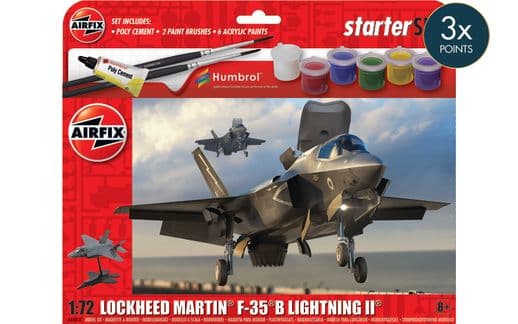
Full product box artwork in both orientations, with both kits benefitting from shadow stands, this Gift Set offering will make for an attractive RAF aircraft through the ages model display.
From May to December 2021, eight F-35B aircraft from RAF No.617 Squadron, a number which included ZM153, embarked on HMS Queen Elizabeth for the carrier's first operational deployment. They were joined by ten F-35Bs of the US Marine Corps' VMFA-211 Marine Fighter Attack Squadron 'Wake Island Avengers' and 180 US personnel, in a deployment which highlighted the joint operability of this advanced new aircraft in tandem with fellow NATO allies. The successful seven month deployment across the Indo-Pacific region as part of 'Operation Fortis' was a significant development in the ongoing integration of the F-35B and during that time, this was the largest fifth generation Carrier Air Wing to be found anywhere in the world.
Unfortunately, during this deployment, the UK lost its first F-35B, as a Lightning suffered a catastrophic loss of power during its take-off run, forcing the pilot to eject just seconds before the aircraft hit the water, thankfully emerging unscathed from the incident. An investigation later found that failure to remove an intake rain cover was the cause of that loss of power, something which turned out to be a rather expensive mistake. In a complex joint services operation, the submerged aircraft was later recovered and it has been confirmed that a replacement aircraft will be procured.
Clearly, 2023 is going to be a significant year for No.617 Squadron of the Royal Air Force, as this coming May will mark the 80th Anniversary of the famous Dambusters Raid against the great dams of the Ruhr Valley and their aircraft will be in great demand to perform commemorative flypast and requests for Airshow attendance throughout the year. The association between the F-35B and arguably the RAF's most famous squadron is one which current squadron members are extremely proud of and if there was ever an occasion with which to effectively underline both the capabilities and continuing integration of the F-35B Lightning II into Britain's armed forces, then the Dambusters 80th Anniversary could hardly be more appropriate.
An enigmatic scale aviation kit paring which is very much of the moment, our new 1/72nd scale Supermarine Spitfire & F-35B Lightning II Gift Set will allow two of the finest single engined aircraft to ever see Royal Air Force service to be modelled, a scale representation of 80 years of aviation technological advancement in kit form. With this new kit scheduled for imminent release, this could definitely make for an appealing build project for us all over the next couple of months.
We are afraid that's all we have for you in this latest edition, but we will be back next Friday with more project development updates and the very latest Airfix kit exclusives. In the meantime, we are always keen to hear your views on all things Airfix and in particular, any thoughts and opinions you may have regarding our Workbench blog. If you would like to drop us a quick line, could we please ask that you use our workbench@airfix.com email for all correspondence.
To re-visit any of the Airfix blogs we have produced over the past seven years or so, please head to our main Workbench hub, where you will find our entire blog back catalogue and all the Airfix design projects we have already covered.
All our dedicated official social media sites can be accessed by clicking the respective link icons at the foot of this page, or by heading to the Airfix homepage. Other useful Airfix links are:
Facebook, YouTube, Twitter and Instagram official sites
Please join us for more Airfix updates next week and thank you for your continued support.