
Welcome to this latest edition of our Workbench blog and all the news, updates, and modelling exclusives from the fascinating world of Airfix.
As the Airfix team return from our attendance at the Royal International Air Tattoo, and four long and intense days of working and talking all things modelling and aeroplanes, we wanted to take this Workbench opportunity to make those who couldn’t make this year’s show aware of our exclusive show announcement, and a further unexpected kit addition to the 2025 range. If you’re attending the world’s greatest military Airshow and intend to unveil a new kit at such a prestigious event, you’d better make sure it’s a BIG one, and in this regard, we pulled out all the stops.
When it comes to aircraft types which can claim to have earned the status of aviation icon, nothing comes close to rivalling the reputation of the Supermarine Spitfire, so if you need a new kit announcement which possesses real hobby gravitas, look no further than the Spitfire in our largest 1/24th scale, a Super Kit in every sense. A project which has seen us collaborating with some influential partners, this latest large scale kit announcement is so much more than just a re-issue of an existing kit, it’s one which boasts some unique and appealing additions, but one which also attempts to draw attention to an unusual and very human story from the final year of the war in Europe.
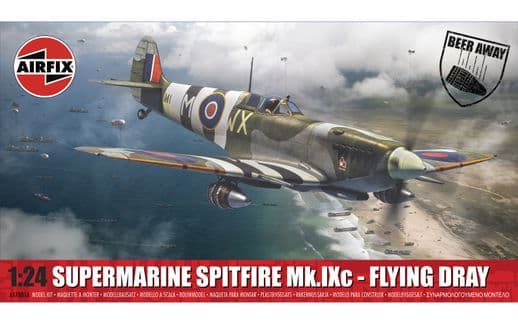
A kit build project which has an interesting story to tell, with a selection of new parts to help it do so, this release is more of an ‘experience’ than just a simple assembly process, with our ‘Beer’s Away’, or ‘Flying Dray’ Spitfire really hitting the spot, in more ways than one. We will be bringing you pictures from the RIAT unveiling event, a series of built model images for your inspection, and full details of the THREE new scheme options included with this new kit, as we take this opportunity to introduce you to our new ‘Beers Away’ Spitfire Mk.IXc kit.
It's definitely not last orders from us, as our latest Spitfire release brings barrels of refreshment in several enjoyable ways.
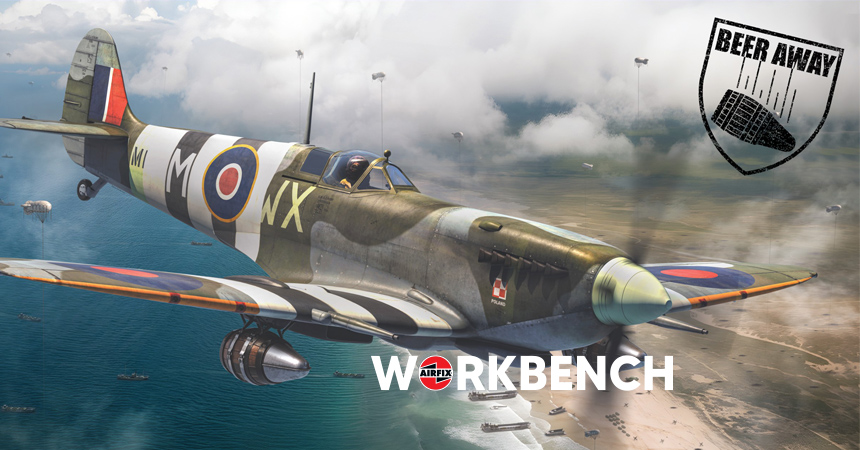
The latest secret release was unveiled at RIAT last week, and presents our 1/24th scale Spitfire Mk.IXc in ‘Beer Bomber’ configuration.
With the incredible success of our latest 1/24th scale Spitfire kit release over the past couple of years, and the original Mk.IX kit being followed up with the less numerous, but no less fascinating Mk.VIII variant, modelling enthusiasts have recently been calling for the re-issue of the first kit once again, as it’s now becoming increasingly difficult to get hold of them. Our Head of Brand was keen to heed these calls, but didn’t want to do so with just a straight re-issue, so working closely with our researcher Clint, they both started to formulate a plan which would see an appealing new twist on the Spitfire Mk.IX theme joining the Airfix ranks.
As Clint started to look a little more deeply into a subject which many aviation enthusiasts will be fully aware off, he quickly started to discover just how little definitive information regarding aircraft, squadrons, individual pilots and the delivery of beer barrels under the wings of RAF Spitfires there actually is out there, but was determined to sort popular myth, from wartime fact.
At the same time, our Head of Brand Dale Luckhurst was busy speaking with businesses both inside the hobby, and some who were completely unrelated, in an attempt to add even more appeal to this intended secret release project, one which would be a refreshing change, when it comes to embarking on an interesting large scale aviation build project. Before he’d finished, he had a fine collection of full size and 1/24th scale beer barrels under his desk at work, and a much better understanding of a fascinating side-story which was taking place during the savage fighting in the days which followed the Allied D-Day landings.
Accuracy and authenticity are two extremely important attributes any Airfix project must possess, but when this is combined with an interesting and thoroughly engaging story to be commemorated in scale, you find yourself presented with a model build project possessing real character, something which would have wide appeal across the entire modelling community.
The only place to be on Friday at RIAT 2025 was the Airfix stand, as our latest surprise release was announced to the modelling world.
This brings us nicely to an appointment on the Airfix stand at this year’s Royal International Air Tattoo, where at 10am on Friday 18th July, the events team unveiled a surprise addition to the 2025 Airfix range, our Limited Edition 1/24th Scale Supermarine Spitfire Mk.IXc – Flying Dray. Airfix fans now have the return of the original Spitfire Mk.IX kit to look forward to, but a return which is different in so many ways, featuring a host of new schemes and part options, and a wartime story which is what modelling, and the preservation of history is all about.
As enthusiasts will know only too well, the Spitfire Mk.IX variant was arguably the most important mark of this famous aircraft in its entire production run and because of that, it’s somewhat surprising to learn that it actually possesses the lineage of that of a stop-gap development. The arrival of the Luftwaffe’s new Focke Wulf 190 fighter over the Western Front in August 1941 saw RAF Spitfire Mk.Vs operating over the Channel falling victim to the ‘Butcher Bird’ in ever increasing numbers and something had to be done.
A major Spitfire variant upgrade program was in progress, however, the Mk.VIII was still some way off, when it came to new aircraft being delivered to RAF squadrons, as manufacturing plants had yet to install their tooling jigs for production of the new aircraft. Thankfully though, there was a temporary solution. One of the major features of the new Spitfire variant would be its use of a powerful new version of the Rolls Royce Merlin engine, and it was proposed that fitting this new engine to an existing Spitfire Mk.V airframe might present the fighter a welcome performance boost.
Such an icon of aviation, this particular Spitfire was equipped to carry a rather unusual, yet refreshing payload, a little taste of home for personnel operating away from their home bases.
The first 100 of these new fighters, which were designated Spitfire Mk.IX, actually started as existing Mk.Vc airframes on the production line, adapted to take the new Merlin 61 two stage, two speed supercharged engine. This combination of technologies resulted in the production of a thoroughbred fighting aeroplane, one which was more than capable of meeting the challenge posed by the Focke Wulf Fw190 and the latest variant of the Messerschmitt Bf 109, the Friedrich. In fact, this new Spitfire would prove so successful that it would become the second most heavily produced variant in the entire production run and if including the aircraft powered by the licence built Packard Merlin 266 (Spitfire Mk.XVI) even eclipsed the Mk.V in production numbers.
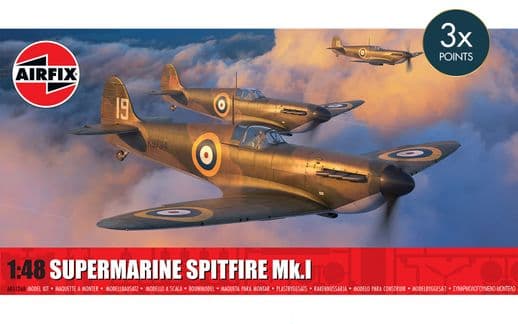
With further powerplant refinements taking place throughout the production life of this impressive variant, the first Mk.IX Spitfires started to join RAF Squadrons from July 1942, with this famous mark of Spitfire going on to see service past D-Day and into the post war era. The last major Merlin engine powered variant of the Spitfire, this ‘emergency stop-gap fighter’ would actually prove to be something of an aviation classic, and one which was still in widespread service during the period which encompassed the Allied amphibious invasion of Europe.
The complete package – there are a host of appealing extras with this third release from our 1/24th scale Spitfire Mk.IX/Mk.VIII tooling.
The aircraft would also be used in a fighter bomber role, with the additional power provided by the Rolls Royce Merlin 61/63 engine allowing underwing and under fuselage stores to be carried. That being said, not all of these external stores were offensive in their nature, as some were very specifically aimed at providing a few home comforts for troops and RAF personnel now operating in France, with these aircraft literally performing the task of airborne pubs – these Spitfires carried beer, not bombs.
Perhaps because it was a story which showed human spirit and endeavour, as opposed to the savage fighting, which was raging across northern Europe at the time, tales of beer carrying Spitfires captured the imagination of the public in the years which followed the end of the Second World War. In addition to this, the handful of pictures which feature aircraft fuel tanks being filled with beer, or Spitfires featuring ‘Modification XXX’ and carrying wooden beer kegs on their underwing weapons pylons only served to fuel our interest in this story, but as our researcher Clint Mitchell soon found out, some of the information out there was less than robust, and not as definitive as the details he would usually base his research on.
In support of this ambitious new Airfix project, Clint had to take information which had been published previously, and attempt to reconstruct events from over eighty years ago using official, proven sources and squadron records, in order to shed some light on the story of the beer bombing Spitfires. Speaking with Clint on the evening following the unveiling of the new 1/24th scale Spitfire, I was fortunate enough to be allowed to discuss his research into this project with him, and I have to say I was fascinated. The effort he put in literally unearthed new and trustworthy information into this rather mysterious subject, and we the modelling fraternity are the hobby beneficiaries.
Let’s take a look at how Clint’s research has benefitted this impressive new addition to the current Airfix range, and the surprise Modification XXX Spitfire announced at this year’s Royal International Air Tattoo.
Accurate and appealing, this Spitfire Flying Dray kit will grace many a workstation over the coming months.
In returning our largest scale Spitfire Mk.IX model kit to the range, the team didn’t want to just re-issue the original kit release from back in 2022, with the same scheme options included, they wanted to make this a desirable new release in its own right. In addition to this, researcher Clint also didn’t just want to make this about the beer carrying Spitfires, but rather to document the impressive service life of the Mk.IX, from early introduction, to post war. Although the kit would be majoring on the new research information unearthed by Clint and the new parts included with this kit, he definitely didn’t want to add to the subject confusion which has circulated over the years, and just stick to the facts.
This is the information carried on the new kit’s product page on the Airfix website, describing details of the project and what’s included with this impending 1/24th scale release.
Beer Away!
Celebrate one of WWII’s most legendary morale-boosting missions with the exclusive Beer Away Pin Badge — a tribute to the Spitfire pilots who delivered more than just firepower.
Get this exclusive Beer Away pin badge when you pre-order A17001A - Supermarine Spitfire Mk.IXc – Flying Dray.
This finely detailed enamel pin features a beer barrel with a P-51 Mustang drop-tank rear section as a makeshift noise cone, having been jettisoned.
This isn't just a badge. It’s a salute to wartime ingenuity, British humour, and the unbeatable spirit that kept the Allies going — one pint at a time.
In the summer of 1944, after the D-Day landings, British troops pressing into Normandy faced fierce resistance—and a dry pint glass. Supplies were tight, and morale was vital. So, in one of the war’s most unexpected missions, Spitfire pilots took to the skies not just with ammunition—but with beer.
Ingenious airmen modified drop tanks and strapped barrels beneath their wings, delivering much-needed refreshment to parched troops across the Channel. Some called it “Operation Cheers.” These weren’t official missions. They were flights of morale. Spitfires—symbols of British grit—became airborne drays for a brief, glorious period.
Featuring new parts, new schemes and a couple of appealing ‘extras’, this is a major addition to our 1/24th scale kit lineup.
It wasn’t about luxury. It was about home. A cold beer in a hot war zone was more than a drink—it was a reminder of what they were fighting for. So, raise a glass to the RAF pilots who delivered courage, camaraderie, and casks—one flight at a time.
Because even heroes need a pint!
This bundle includes:
• Resin Parts ( 2 x Beer barrels, including lids, 2 x Nose cones, 2 x Bomb rack and 1 x Slipper tank).
• 1:24 Scale - A17001A Supermarine Spitfire Mk.IXc - Flying Dray - Model Kit
• Free Special Edition Pint Glass - dedicated to ML208
As part of this special release, we've partnered with CAMRA.
'CAMRA campaigns for pubs, pints and people, which includes celebrating our beer heritage and how that fits into the history of Great Britain. The story of the Spitfires and their ‘Flying Dray’ service to the front lines of D-Day is a brilliant example of that.
Airfix’s Flying Dray Spitfire kit sounds like the perfect way for beer lovers to remember this unique piece of history' – CAMRA
The scheme which proved to be the inspiration behind this release took our researcher quite some time to corroborate, but after many hours of searching and just a little luck along the way in finding information which bound everything together, he was able to offer these details for one of the beer flight Spitfires. During his research into this subject, Clint found himself studying a blog post entitled ‘Zythophile’, which literally means ‘A person who loves beer’, written by Martin Cornell. At the foot of the piece and way down in the comments section of the blog, Clint noticed an interesting comment by a gentleman named Marek Drewicz. This comment post would eventually prove to be the breakthrough for the entire project.
Clint managed to track down and purchase a copy of Mr Drewicz’s grandfather’s war diary, quickly reading through it to see if it contained more information about these infamous Spitfire beer delivery flights. He then began to cross reference dates and locations with period and contemporary research sources.
It soon became clear that the book, which had been published in 1993, was formed of a collection of various written diary entries the Polish pilot had smuggled out of Poland, covering his arrival in England, and onwards throughout his wartime Royal Air Force flying career. Many of the dates, locations, and event descriptions didn’t exactly correlate with each other, or indeed tally up with records now held in national archives, however, this was a valuable starting point.
In illustration of this, the pilot stated that his ‘beer delivery’ flight took place on 12th June 1944, however, No. 302 Squadron was still based at RAF Chailey in England on that date. He also mentioned that it was his Squadron Leader, Wacław Król who asked him to fly back to England to pick up the beer barrels, however whilst Wacław Król had previously been in command of No.302 Squadron, he had in actual fact been posted to No. 11 Group Headquarters on the 5th June 1944, prior to D-Day.
It became clear to Clint that whilst the details in this book were a fascinating record of a Polish pilot serving through this tumultuous period in history, the passage of time had taken a toll on the accurate recording of events and timelines, which is perfectly understandable. Having said that, all the information was there, it was just a question of placing some details in the correct order, something he set about doing using available records and proven sources.
In his recollections, the Polish pilot mentioned the airfield where he was based at that time as being Airfield B.10, the Allied designation for advanced landing ground Plumetot Airfield, which was situated close to Gold Beach on the Normandy beachhead. The airfield at Plumetot had been neglected by the Germans and was in quite a state, but by the 10th June 1944, it had been hastily reconstructed by engineering units, and made available for use by Allied aircraft operating in forward positions.
Full scheme details for this meticulously researched beer keg carrying Royal Air Force Spitfire Mk.IXc.
From a timeline perspective, this did correlate with the beer carrying story, because it was the first landing ground that No.302 Squadron was posted to operate from in Northern France, after previously being stationed at RAF Ford in England. Conditions at the airfield would have been a little primitive for pilots and their ground support, but they were closer to the action and in position to support Allied ground operations more effectively, as they attempted to thwart any German counter attacks. In addition, this was undoubtedly the airfield where Tadeusz Szumowski’s beer flight would have occurred, flying back to his previous base at RAF Ford, near Chichester, to collect the beer barrels, to serve as a little light relief for those now operating from this forward French airfield.
Records show that No.302 Squadron were only based at B.10 Plumetot for a very short period from 3rd August to 30th August 1944, when they returned to England to operate from RAF Fairwood Common. This gives us a brief window of opportunity for Tadeusz Szumowski to have undertaken his beer flight.
Interestingly, whilst the squadron were operating from the airfield close to Gold Beach, it was situated so close to contested lines that it was regularly targeted by German snipers operating around the perimeter of the airfield. Explosions were also a regular occurrence at the airfield, as bomb disposal teams were hard at work dealing with the many German mines which had been left around the site.
Clint’s next task was to inspect No.302 Squadron’s Operational Record Book, which listed all flights and the allocation of aircraft to individual pilots on any given date. These records showed that during August 1944, throughout the time the squadron were based at Plumetot, pilot Tadeusz Szumowski’s usual aircraft was a Spitfire Mk.IX carrying the serial number ML208, however, as is usually the case, only the serial number was recorded and not the aircraft’s individual fuselage code. Clint was therefore left with WX-?, and that simply wasn’t good enough for this project.
Thanks to assistance from a Polish researcher friend, Clint managed to obtain the email address of a prolific and respected author on the subject of Polish Fighter Squadrons of WWII, Mr Wojtek Matusiak, who he asked for assistance with this project. He subsequently sent a request, and kept his fingers crossed for a positive reply. A few days went by without any response, and he presumed that the request had perhaps fallen on deaf ears.
A trio of built model images, showing a kit finished in the lead scheme of this latest 1/24th scale kit announcement. Is it possible for a Spitfire kit be any more interesting?
Undeterred, he decided to continue the search using his own book collection and the extensive Airfix research archives, in an attempt to narrow things down further. He was of the opinion that no photographs of ML208 had survived, however, knowing that squadrons would typically have 12 aircraft allocated to them, this did allow him to check the available photographic evidence to see which serial numbers were assigned to which aircraft/fuselage codes in the squadron. Hopefully, he could then narrow down the possibilities with regard to ML208, by which time more information might have turned up.
Whilst he appreciates that this is a rather approximate and not a very reliable method of research, he was left with little alternative at this stage and simply wanted to see what, if anything, he could establish.
It was at this point that he was fortunate to receive a very welcome reply from Wojtek Matusiak. He informed me that from a primary source in his possession, the individual aircraft code for ML208 was ‘WX-M’, which, amazingly happened to be one of the code options Clint had highlighted for ML208 from his own research. The next stage was to study all available photographs of No.302 Squadron Spitfire Mk.IXs taken during the same period in 1944, in addition to any images of Spitfires close to the same production block of ML208 from the Castle Bromwich Factory.
All this research work allowed Clint to put together an accurate estimation of how Supermarine Spitfire Mk.IXc ML208/WX-M would have looked when Tadeusz Szumowski undertook the beer delivery/collection flight he mentioned in his diary. Ultimately, this was success for the project, allowing Airfix to offer a different take on this scheme for one of the famous beer delivery Spitfires, one which at least had a fighting chance of being based on fact and not supposition.
More beer flight project work required
Clint was slowly managing to piece together the identity of the Spitfire polish pilot F/L Tadeusz Szumowski used on his beer run flight.
The next issue facing Clint and the Airfix development team were the ‘Modification XXX’ beer barrels themselves. Clearly, we were going to need to supply parts which were not included in our original release of the 1/24th scale Spitfire Mk.IXc, so research details would have to be produced for the Beer Barrels, a 30 gallon external ‘Slipper’ fuel tank, and the bomb carrier equipment itself. From a company perspective, the design and tooling costs required to create these injection moulded parts may turn out to be prohibitively costly, but thankfully, we have an excellent working relationship with the model kit and aftermarket product company Eduard, who were more than happy to help us.
As they already produce scale resin accessories for the hobby, we knew it would be far more cost efficient if we worked with Eduard on this project, adding the parts they produce to the existing kit parts to create this interesting third release from our 1/24th scale Spitfire Mk.IX tooling. Historically, Eduard had already produced similar resin accessories in support of their own ‘Beer Spitfire’ release in 1/72nd scale, so it was initially suggested that they upscale their CAD files to the larger 1:24th scale.
The Airfix team were of the opinion that in this largest of aircraft scales for Airfix, that we needed to design really fine examples of these new items, so with the reference material we had at hand, decided to design the parts in house as a new project, custom designed components for a significant new Airfix kit project.
As you might expect, this created a further research challenge for Clint to overcome, not only to create files to accurately replicate the barrels carried by RAF Spitfires, but also some unusual extras which feature on the pictures taken during the summer of 1944.
This new kit comes complete with a host of extras, including newly designed beer barrels, mounting rails, aerodynamic cones and belly slipper tank.
In his memoirs, Tadeusz Szumowski describes how they attempted to think of a way to make the underslung barrels a little more aerodynamic during the transit flights, but with little information available about these units, the research gauntlet was thrown down once more. The Polish airman wrote how ground crews explored the idea of fitting metal propeller nose cones over the barrels to provide a more aerodynamic profile.
Once again, Clint’s research experience told him that there was something not quite right with this description, as surely an aircraft spinner would be too large, too expensive and not readily available to the average RAF station, let alone for these beer transportation flights. That being said, period photographs of the beer barrel/bomb rack assembly do show some featuring extremely distinctive cone shaped object fitted to the barrels to give them a more aerodynamic profile.
Further investigation highlighted that these were identical in shape to a USAAF drop tank fitted to North American P-51 Mustangs, items which would have been readily available to ground crews at stations around southern England at that time. For the ground trades at RAF Ford, they may even have had stores of these tanks at their airfield, as USAAF fighter units had been stationed at the airfield during previous months. Clint was certain that the aerodynamic cones fitted to the wooden barrels carried by these ‘Joy Juice’ Spitfires featured USAAF 75 gallon drop tanks which had been cut down at the exact point to allow them to fit around the circumference of the beer barrels themselves.
These resin component additions really do add interest to this third kit release from our 1/24th scale Spitfire Mk.IX/Mk.VIII tooling, and also help to more effectively tell the story of the beer carrying Spitfires which many find so fascinating. As he worked to support this project, Clint would discover that whilst much has been written about the subject, there was still much for an Airfix researcher to learn.
As we have seen so many times during the production of ten years of Workbench scheme detail reviews, every aircraft scheme option has an interesting story to tell, one which is worthy of further discovery, and stories which are deserving of replication as scale modelling projects. This particular aircraft is an example of the first Spitfire Mk.IX fighters to enter Royal Air Force service, but also underlining the invaluable contribution made by overseas airmen in Royal Air Force operations during the Second World War.
Built at the Supermarine factory at Eastleigh during the summer of 1942, she was powered by a Rolls Royce Merlin 61 engine and made her first flight on 15th September the same year. She was allocated to No.611 (West Lancashire) Squadron, who would be one of the first to take this latest RAF fighter into combat operations with the Luftwaffe. On the 20th December 1942, this aircraft was used by Czech pilot F/Lt. František Vancl to undertake a fighter support mission in support of a bombing raid against the Luftwaffe air depot at Romilly-sur-Seine in France, with 13 Spitfires from the squadron assigned to escort USAAF B-17 Flying Fortresses.
From a research perspective, this aircraft was the subject of a beautifully clear photograph which provides us with great references relating to this early variant of Spitfire Mk.IX, where the aircraft is being pushed by a number of No.611 Squadron pilots, who clearly look rather pleased to be flying this latest variant of Spitfire.
Full scheme details for what was one of the first true Spitfire Mk.IX aircraft to enter Royal Air Force service.
Following the occupation of Czechoslovakia, František Vancl made his way to Poland, then on to France, where he joined the Foreign Legion and was subsequently posted to Algeria. Following the outbreak of war, he trained to become a fighter pilot, flying the French Morane Saulnier MS.406, but after the fall of France, applied to join the Royal Air Force. A talented airman, it was highly likely that he scored more than enough victories to attain ace status, however, as many of his victories could not be corroborated by other pilots, they remained as probables, or damaged claims.
His length of operational service indicates that he was more than just a proficient pilot, and by November of 1943, he was commanding the Czech RAF unit No.312 Squadron, after being awarded the Distinguished Flying Cross.
Spitfire BS451 would go on to have a long and successful service career, and after her time with No.611 Squadron, would go on to serve with the Polish units Nos. 315, 303 and 308 squadrons at RAF Northolt. During her time with the famous No.303 Squadron, she would become the mount of ‘ace’ pilot Sqn Ldr Jan ‘Kon’ (Horse) Falkowski, with his aircraft carrying the fuselage codes RF-M.
After an active period of operational flying, the aircraft was overhauled and transferred to No.229 Squadron in 1944, and she would still be with this unit when the war ended. She would subsequently be sold to the South African Air Force, where she would end her flying career.
A scheme option which represents the opposite end of the Mk.IX Spitfire’s operational RAF career, Spitfire MJ349 was built at the Castle Bromwich aircraft factory during 1943, and was destined to spend her operational career overseas. She was prepared for transport to Casablanca and service with the Mediterranean Allied Air Forces at the beginning of 1944, but would subsequently also see service with the USAAF.
Rejoining the Royal Air Force before the end of the war, she first joined No.601 Squadron and then No.73 Squadron as they relocated to the Island of Malta in July 1945, where they operated from airfields which suffered heavily at the hands of Axis forces during the Second World War. With the end of hostilities, flying these beautiful aeroplanes from this idyllic Mediterranean Island location can’t have been a bad posting, and would have been a relief for those pilots who had wartime flying operations in their logbooks. Having said that, flying high performance fighters is never without its risks, something pilot Douglas Readdy would no doubt confirm.
Full scheme details for this post war Spitfire which spent its entire operational career flying in Mediterranean skies. If you’re looking for a different Spitfire build, this might well be the scheme for you.
On the morning of 19th September 1946, three Spitfires from RAF No.73 Squadron left their home airfield at Ta’kali to undertake the latest training flight in these post war times. After following their assigned flight plan, pilot F/Sgt. Douglas Readdy had a problem when landing back at his home airfield, with Spitfire Mk.IXc MJ349 overshooting the runway, and ending up on her nose outside the airfield perimeter fence.
Records show that this aircraft was struck off charge at the end of April 1947, however, this information doesn’t tell us if the fighter was repaired following her runway excursion, or simply recovered and used as a spares aircraft to keep other aircraft in the squadron airworthy. If you, or someone you know were based at Ta’kali during the early post war years, perhaps you could contact us and shed some light on this unknown seven month period in this aircraft’s history.
The unusual markings on this Spitfire make this a worthy scheme option for modellers looking for a different looking representation of this classic British fighter, with this example spending its entire service career in sunny Mediterranean skies, and featuring its unusual fuselage flash markings.
let’s raise a glass to the latest Airfix 1/24th scale Supermarine Spitfire kit release.
A really interesting large scale addition to the current Airfix range, this beautiful new Spitfire not only includes additional parts to enable an unusual variant of the Spitfire to be built, but also marks the early and late Royal Air Force service of the ubiquitous Supermarine Spitfire Mk.IX. This limited edition release is currently available as an appealing bundle deal with the additional parts, an etched pint glass featuring the code ML208 and a limited edition pin badge.
We would like to thank Airfix researcher Clint Mitchell for his diligent work in allowing this appealing new kit to grace the modelling world, and for his help in putting this latest edition of Workbench together.
We are afraid that's all we have for you in this latest edition, but we will be back next Friday with more project development updates and the very latest Airfix kit exclusives. In the meantime, we are always keen to hear your views on all things Airfix and in particular, any thoughts and opinions you may have regarding our Workbench blog. If you would like to drop us a quick line, could we please ask that you use our workbench@airfix.com email for all correspondence.
To re-visit any of the Airfix blogs we have produced over the past seven years or so, please head to our main Workbench hub, where you will find our entire blog back catalogue and all the Airfix design projects we have already covered.
All our dedicated official social media sites can be accessed by clicking the respective link icons at the foot of this page, or by heading to the Airfix homepage. Other useful Airfix links are:
Facebook, YouTube, Twitter and Instagram official sites
Please join us for more Airfix updates next week and thank you for your continued support.