

Welcome to this latest edition of our Workbench blog and all the news, updates and modelling exclusives from the fascinating world of Airfix.
We have yet another double Workbench blog posting for our readers to enjoy this weekend and in Airfix modelling terms, our subjects are something of the old and the new. Our featured kit for this first update is our latest delve into the nostalgia of the Vintage Classics range and the latest impending addition to this ever popular range, a kit which for many Workbench readers will bring back plenty of fond modelling memories. Going back to the final months of the Second World War and America's entry into the jet age, using original box artwork and scheme option details as our visual aids, we will see how the introduction of Lockheed's P-80 (F-80) Shooting Star owed much to the British and their jet propulsion technology.
Our second blog of the week brings us right up to date in terms of new Airfix tooling projects, with a major project exclusive which marks the final update from a highly anticipated new kit which is fast approaching its initial release date. Showcasing a stunning selection of built model images, we know that many of you will be keen to get your first look at a completed 1/48th scale Avro Anson Mk.I kit and we can promise that you won't be disappointed. A model kit which is surely destined for future Airfix classic status, the Anson, in all its fully finished glory, will be our second blog update of the week.
Before you all head off to our main Blog hub to check out the Anson, please stay with us for a while to look at America's entry into the jet age and an aircraft which was the forerunner of today's awesomely capable F-35 Lightning II and the first product of the famous 'Skunk works'.
America's entry into the world of jet powered interceptors, Lockheed XP-80 prototype 'Lulu-Belle' was powered by a British Halford H.1 (de Havilland Goblin) engine.
When you consider how the US has earned an unrivalled reputation for producing many of the world's most capable post war jet aircraft, it can be surprising to learn that during the early years of jet technology, they were very much in the shadow of both Germany and Britain. This does have to be put in some historical context however, because America were making a vital contribution to eventual Allied victory by producing some of the finest conventional aircraft types of the war, and lots of them. Whilst the Germans were desperately attempting to introduce their jet and rocket powered aircraft in a vain attempt to arrest the inexorable slide towards defeat, America was flooding the skies with several effective bomber types, all of which were protected by arguably the most effective fighter aircraft of the conflict, the magnificent North American Mustang. Although America lagged behind in terms of jet technology, it really is a good job they weren’t distracted by this when it came to the overall wartime picture.
Nevertheless, the aviation history books note that work on jet propulsion had started in both Britain and Germany in the early 1930s, with this work continuing throughout the Second World War, to a point where the Germans took a discernible lead during the early 1940s, possibly for exactly the same reason suggested above. When American pilots began to encounter the Messerschmitt Me262 in the skies over Europe in the summer of 1944, the awesome capability of this new jet fighter caused alarm amongst senior military officials, who were worried about the potential impact large numbers of these aircraft could have on their daylight bombing operations. How many of these jets did Germany have and what else did they have waiting in the wings?
Aware that Britain were also in advanced stages of introducing their own jet fighter into Royal Air Force service, it now became an absolute priority for the Americans to develop and introduce their own jet powered fighter, one which was capable of taking on and at least matching the Luftwaffe's Messerschmitt Me262.
Back in the US, military officials turned to the Lockheed Company and their Chief Research Engineer Clarence 'Kelly' Johnson to deliver this program, challenging him to design and produce a new jet fighter based around the British Halford H.1 engine, however, there were three major drawbacks in accepting this challenge. Firstly, because the situation in Europe was so pressing, Johnson and his team would have to deliver their prototype jet fighter in only 180 days and secondly, the work had to be completed under the most stringent levels of security, in a secure location away from existing facilities. Thirdly and perhaps of most significance, the all-important jet engine which would power the new aircraft was still in Britain at that time, so a significant proportion of the initial design and development work would have to be done without the engine in hand.
In order to feel confident enough to take on this challenge, Johnson arranged to hand pick a team of 130 of his most capable technicians and engineers, who would be allowed to operate autonomously from other manufacturing commitments at Lockheed. Initially, due to a lack of available 'secure' facilities at Lockheed, work began in a rented circus tent on land at the factory and as a reflection of the status of this priority project, only five of the 130 people working on the project actually knew they were working on a jet powered aircraft.
This picture beautifully illustrates the clean lines and sleek appearance of the first product of Lockheed's famous Skunk Works and America's first jet interceptor to go into full production. This P-80A was later upgraded to F-80C standard.
Another indication of the highly secretive nature of the project relates to the now famous 'Skunk Works' name which has become associated with the secret aviation projects undertaken by Lockheed over the years came about. A colloquial reference to the top secret facility used to develop America's first production jet fighter, the origins of the name were connected to one of the team's engineers and his affection for the 'Li'l Abner' comic strip series which was popular at the time. The comic story included a secret (and not altogether legal) brewing establishment which was hidden deep in a forest to keep its operation away from prying eyes, and this was referred to by all in the know a the 'Skonk Works'. This name seemed rather apt for the secret new Lockheed facility, but with officials apparently wary of using a name associated with such a famous publication and the potential for litigation, they subtly changed it to 'Skunk Works', a name which actually works much better!
The new jet fighter would be powered by a British Halford H.1 engine (which would later be renamed the de Havilland Goblin), one of only two such units in the world at that time. When the British technician sent to America with the engine arrived at the Lockheed factory, the top secret nature of the project created something of an embarrassing international situation, to say how much the British were helping the program. With no official at the factory prepared to vouch for the Brit, he was detained by the Police, presumably as a potential spy, despite the crucial delivery he was accompanying.
Clearly, they managed to diplomatically negotiate their way out of this situation, however, a little later when the new Lockheed jet had been mated with the Halford jet engine and it was ready to begin running trials, this same British technician voiced his serious concerns about the design and how he was certain that the inlet ducts of the aircraft were manufactured in material too thin for the forces they would be subjected to. His advice was ignored and during the very first engine run, the same walls disintegrated and were ingested into the engine, completely destroying.
This was a massive setback for the project and resulted in an immediate request for the second engine to be shipped from Britain, but there was a problem - this engine was at that time installed in the prototype de Havilland Vampire fighter. Incredibly, de Havilland were instructed to remove the engine from their Vampire jet and send it to the US, a development which would seriously delay the introduction of this aircraft and effectively allow the Gloster Meteor to take the historic accolade of becoming the RAF's first jet fighter, but that is a subject for another blog on another day.
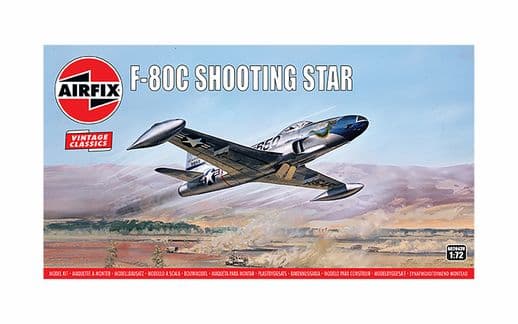
More famous Roy Cross artwork which will be familiar to many thousands of modellers and marked the 1973 introduction of the Lockheed F-80C Shooting Star into the Airfix model kit range.
In what turned out to be a significant achievement in the world of aviation, Clarence 'Kelly' Johnson and his Skunk Works team managed to produce their sleek new fighter in just 143 days, 37 days ahead of their punishing initial schedule, however, this was no rush job and the aircraft had a distinct 'cutting edge' feel to it.
With its relatively straight wings and cultured, sleek fuselage, the F-80 (or YP-80A at the time) was a beautiful aeroplane to look at and once further development aircraft became available, the fighter not only allowed America to become a serious player in the fledgling jet age, but it also began to set records for both speed and endurance. These achievements were not gained without significant cost however, and the early test and development program was plagued by a number of fatal accidents, which were mainly attributed to pilot unfamiliarity with this new technology, the new General Electric jet engines and an ever changing fuel transfer pump system.
With the aircraft now cleared for USAAF service, it was initially planned that 4,000 of the new fighter would see squadron service, providing an awesomely powerful deterrent force which would deter any potential aggressor from waging further conflict. These plans would change following the end of the Second World war, with this initial requirement being dramatically reduced to less than half that number.
The P-80/F-80 is however, one of the most important of the world's early jet fighters and as such, definitely attracted the attention of the Airfix design engineers, with this popular model kit first entering the range back in 1973. Thankfully, with its impending introduction into the Vintage Classics range, the beautiful shape of the Lockheed F-80 Shooting Star will once again be gracing modelling workbenches all over the world and allow Airfix modellers old and new to enjoy building a 1/72nd scale representation of this historic jet fighter. Let's take a closer look at the two slightly later developments of Lockheed's Shooting Star which can be modelled with this kit.
Although the P-80 Shooting Star officially entered USAAF service in late 1944, these were actually twelve pre-production aircraft designated YP-80A and were only really used for test flying, evaluation and familiarisation purposes. Four of these jets were dismantled and sent by ship to Europe before the end of WWII, arriving in England on 30th December 1944, at the height of the savage fighting of the Battle of the Bulge. Two of the fighters would operate in Britain, with the remaining two being sent onwards to an operational unit in Italy. The two aircraft in England travelled around USAAF bases allowing personnel to see America's first jet fighter in the metal (so to speak) and watch demonstration flights, however, these were curtailed following the crash of one of the jets during a demonstration at the huge Burtonwood base in Lancashire.
In Italy, the two jets were assigned to the 1st Fighter Group at Lesina airfield and their arrival at the base appears to have been rather symbolic. At that time, the Luftwaffe had started flying reconnaissance flights over Italy using Arado jets, aircraft which were so fast and flew at such high altitudes that their operation was effectively impervious to Allied fighter interception. The Americans purposely left the new jets in open revetments on the airfield, because they wanted news of their entry into the jet age to reach the German High Command as quickly as possible, maintaining the pressure on their increasingly desperate situation.
Although a jet versus jet combat engagement didn't actually take place during the Second World War, both the British Gloster Meteor and the American P-80 Shooting Star were later flown in evaluation trials with captured Messerschmitt Me262 jets and although all three aircraft were relatively evenly matched, it was generally accepted that in a combat situation, the German jet was superior to both of the Allied jets.
In 1948, the US Air Force redesignated their fighter force from P - pursuit to F - fighter, giving their first jet interceptor the new designation F-80 Shooting Star. Out of a total of 1715 aircraft built, 798 of them would be constructed as F-80C variants.
The aircraft which is presented in this first scheme occupies quite a unique position in the history of aviation, as it was one of the aircraft which took part in an engagement which resulted in the first jet versus jet aerial combat victory on 8th November 1950. That accolade was attributed to a different aircraft in the flight, one flown by First Lieutenant Russel J Brown, however, the colourful 'Saggin Dragon' did take part in this same historic engagement.
Full scheme details of the colourful 'Saggin Dragon', which was a 16th Fighter Interceptor Squadron, 51st Fighter Interceptor Wing machine.
When later debriefing the incident, Brown described how he and the rest of the 16th Fighter Interceptor Squadron had just completed a strafing attack against anti-aircraft positions near the Yalu River, when they were warned of enemy aircraft activity in the area. Once re-formed, they could make out the beautiful silver shape of enemy jets glinting in the sunlight ahead of them, aircraft which strangely appeared to be performing aerobatics over the Yalu River. As the two formations closed, a dogfight broke out and one of the jets passed close to the nose of Brown's Shooting Star, allowing him to fire his guns and shoot it down - this was the first jet versus jet aerial combat victory in history. Although the American's were delighted to take this aviation 'first', the Soviets claimed that none of their aircraft were lost on that day and indeed that one of their own pilots was claiming that he himself had shot down an American jet. What this engagement did confirm however, was that the Soviets were not only supplying MiG-15 jet fighters to both China and North Korea, but how their pilots were now actively engaged in the fighting.
This aircraft would be lost on 7th March 1951 whilst taking off from Taegu Airbase (K2) at the start of another combat sortie, crashing almost as soon as it had left the runway, with the aircraft being classified as beyond repair - thankfully, the pilot managed to escape the incident with his life.
Although the Shooting Star was developed as a high altitude interceptor, the F-80C variant was used extensively in a fighter bomber role during the Korean War and equipped ten USAAF fighter/fighter bomber squadrons and one reconnaissance unit during the conflict. In the ground attack role, the F-80 could be equipped with a variety of offensive weapons, including unguided rockets, bombs and napalm, in addition to their six nose mounted 0.50 inch machine guns, which would all be brought to bear against ground targets which included tanks, supply lines, artillery, troop concentrations and any number of strategic targets.
The 36th Fighter Bomber Squadron, the 'Fighting Fiends' were one of the first units to respond to the crisis on the Korean Peninsula, with their pilots going on to make a telling contribution during the conflict. Destroying hundreds of North Korean ground targets, the squadron also claimed at least six aerial combat victories against enemy aircraft, despite the fact that in most cases, their own fighters would be weighed down with offensive ordnance required for their ground strikes. The 'Fiends' would also set the record for the number of combat sorties its pilots undertook on a single day during the conflict, with 121 being flown, as they kept up the pressure on enemy forces.
Full scheme details of this fascinating 36th FBS machine, a unit which would operate three different aircraft types in the fighter bomber role during the Korean War.
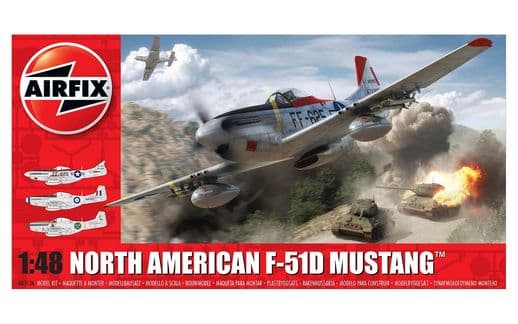
One of the most interesting facts connected to the squadron's service during the Korean War is that the unit would actually use three different aircraft types during their time in Korea, each one in the fighter bomber role. They began the conflict equipped with the Lockheed F-80C Shooting Star, but unusually, would later trade these for piston powered F-51 Mustangs, as these older aircraft were deemed more suitable for use in ground attack operations in Korea. Finally, the 'Fighting Fiends' would end the war flying the North American F-86 Sabre jet, arguably the most accomplished of the world's early generation jet fighter types. During their time serving during the Korean conflict, the 36th Fighter Bomber Squadron would operate from no fewer than twelve different airfields, which even included a period flying out of Pyongyang Air Base.
This particular F-80C would end its operational career flying with the 144th Fighter Bomber Squadron of the Alaska Air National Guard, operating out of Kulis Air National Guard Base.
In the annals of aviation history, the Lockheed F-80 Shooting Star will go down as the first American jet fighter to go into full production and the first jet interceptor in the world to claim a jet versus jet air combat victory, both of which are significant enough accolades to bring this early jet to the attention of the modelling world. A particularly handsome aircraft, the Shooting Star also holds a prominent position in the history of the Airfix brand and its impending inclusion in our Vintage Classics range will be viewed as a welcome addition by many a Workbench reader. We expect the Lockheed F-80C Shooting Star kit to be in our warehouse and shipping by the end of the month.
Two different renditions of the Lockheed F-80C Shooting Star kit in Vintage Classics packaging presentation, featuring the timeless and beautifully nostalgic artwork of Mr Roy Cross, digitally restored for a new Airfix audience.
That’s all we have for this particular blog update, but please don't forget that we also have a second, Avro Anson new tooling update related blog available for you this weekend - please head for the Workbench hub to find this, and all previous blog posts. We will be back as usual next Friday with more Airfix project updates to tell you about. As ever, we are always interested to hear your views on all things Airfix and particularly in relation to our Workbench blog, so if you ever feel like dropping us a quick line, please do so using our workbench@airfix.com contact e-mail address.
All our social media sites can be accessed by clicking the respective link icons at the foot of this page, or by heading to the Airfix homepage. Other useful Airfix links are:
Facebook, YouTube, Twitter and Instagram official sites
Please join us for more Airfix updates next week and thank you for your continued support.