

Welcome to this latest edition of our Workbench blog and all the news, updates and modelling exclusives from the fascinating world of Airfix.
Our latest edition of Workbench returns to the world of classic Airfix kits and an impending addition to this ever expanding range which will be familiar to many thousands of modellers the world over. In the days when the most affordable Airfix kits were presented in either the original header card and polythene bag style, or later full card backing with clear acetate panel containing kit parts and decals, the distinctive artwork of the Auster T.7 Antarctic kit could always be relied upon to grab our attention and will have no doubt been built by a great many Workbench readers. Although the Auster series of aircraft are often seen as being something of unsung aviation heroes, this artwork somehow managed to command our attention as modellers and even though it exchanged guns and bombs for skis and floats, became a much loved member of the Airfix kit family for many modellers.
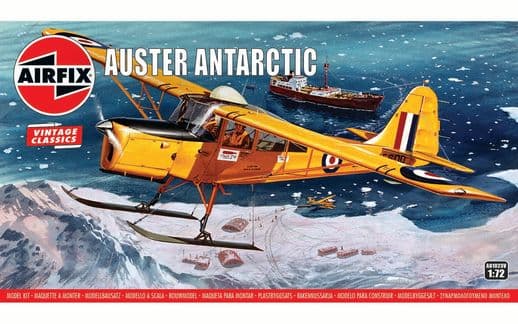
As we prepare to welcome this distinctive kit into the ranks of the Vintage Classics series, we will be attempting to show why the Auster series of light observation aircraft are deserving of much greater recognition than they usually receive and how this Airfix kit classic had to undergo some interesting modern design additions before it could be considered for 2023 range inclusion. In addition to covering the details behind the distinctive presentation of this kit, we will also be showing the original Roy Cross box artwork in all its historic glory, something we know many of our readers enjoy seeing.
Although most of us are already in summer mode, it’s time to wrap up warm just one final time for a little Antarctic flying activity in the company of our Vintage Classic Auster T.7 kit.
Building a reputation for producing excellent airborne observation platforms, the Auster company would produce several highly capable types over the years, including this historic machine which inspired the Airfix kit which is the subject of our latest update blog.
It would probably be accurate to say that aircraft which performed the roles of observation, communication and liaison during their military careers don't tend to attract too much attention from the wider aviation enthusiast community as a rule, despite the fact that many such aircraft were extremely proficient in fulfilling the roles for which they were designed. Not viewed with the same affection as the famous fighters and bombers which contested the Second World War and immediate post war years, the contribution of these light, extremely reliable high-wing monoplanes was unquestionably just as valuable in their own way, even though they were endowed with a very different collection of aviation attributes to their more glamorous fighting counterparts.
The name Auster would become synonymous with the production of rugged and reliable British high-wing, light air observation aircraft, however, its origins actually lay in a licencing agreement between a Leicestershire businessman and the Taylorcraft Aviation Corporation of America. The agreement granted the new British company the ability to produce a variant of their Taylorcraft Model B aircraft, but one which was modified to meet the more exacting standards required to satisfy Britain's Civil Aviation Authority. Designated the Taylorcraft 'Plus C' model, the aircraft made its first flight in May 1939, however, the outbreak of the Second World War would have a significant impact on the ongoing operational fortunes of the new Taylorcraft Aeroplane (England) Limited.
Becoming one of the Ministry of Aircraft Production's authorised repair facilities, the company began by repairing and rebuilding de Havilland Tiger Moth trainers, later expanding to take on similar work with damaged Hawker Hurricane fighters and later still, with their powerful and technically challenging Typhoon strike fighter. The ever increasing volume of work brought about the need for additional premises and be the end of the war, the company was also using ten requisitioned sites around the country, including those at Thurmaston, Syston and Rearsby. It's recognised that during WWII, the company repaired or rebuilt around 1,300 aircraft, returning them to airworthy condition, where they could continue making their contributions to the war effort.
In addition to undertaking their contracted repair commitments, the Company were also hard at work developing their own 'Model C' design for military service, a project which would eventually result in an order for 100 of their Taylorcraft-Auster Mk.I aircraft being placed in 1942. The aircraft was to serve in the role of Air Observation Post, offering its pilots a bird's eye view of the battlefield and working in tandem with artillery units, providing targeting and range-finding information at the spearhead of any offensive engagement.
If it's a famous aircraft, then you can be sure it will have found its way into the Airfix range over the years.
The aircraft would also be called into action in performing general reconnaissance flying, communications and light transport duties, along with a multitude of other airborne taskings as and when required, but always with close ties to Army Cooperation and their rather specific needs. Continually modifying this original military design, three further aircraft would be produced for service with Air Observation squadrons, with around 1600 aircraft of all variants eventually being produced for wartime military service.
As the war progressed towards its increasingly inevitable conclusion, the company started to think about their potential future peace time sale opportunities, feeling that an economical light aircraft for private and flying club use would be a good option. To this end, they further developed their final wartime design, the Taylorcraft-Auster V, into a successful three seat touring aeroplane known as the Taylorcraft-Auster J/1 Autocrat, however, following a company name change in 1946, their original US links were finally severed, with the new name being Auster Aircraft Limited. The Autocrat would go on to become one of the first successful post war British light aircraft designs, however, it would not mark the end of the company's military aviation association.
The Auster AOP.6 (Auster Model K) was a British military Air Observation Post aircraft developed as the successor to the several earlier designs the company had in British military service towards the end of WWII. Intended as the successor to the Taylorcraft Auster V, the new aircraft featured a strengthened fuselage construction, was powered by a more capable de Havilland Gipsy Major 7 engine and had longer main landing gear struts, needed because of the use of a larger propeller to maximise the performance of the new engine. Initial production deliveries for the Royal Air Force would begin in 1949 and around 400 of this standard version would eventually be produced. Alongside this aircraft, the Model Q, or Auster T.7, would be a dual control training variant of the aircraft, a really useful and flexible aeroplane which had a multitude of uses, most notably the two aircraft converted to T.7 Antarctic standard for service during the 1956 Commonwealth Trans-Antarctic Expedition. 84 of these dual control aircraft would eventually be produced, but only two would be modified specifically for Antarctic expedition support duties.
More iconic Aviation box artwork, this one created by Roy Cross in 1967 to benefit an existing kit which was originally tooled almost ten years earlier.
Since its introduction back in 2018, the Vintage Classics range of kits has proved to be a resounding success and has resulted in some of the best loved Airfix kits from the past 70 years or so joining the range once again. Allowing those who remember them to take a nostalgic trip down modelling memory lane, whilst at the same time captivating a new generation of modellers keen to try their hand a modelling a hobby classic, whether it's the sight of the restored original box artwork, or the pleasant memories of building these kits in years past, our Vintage Classics range announcement each year almost rivals new tooling projects for website page view popularity.
Clearly, with such a rich modelling heritage to call upon and having so many appealing kits in the Airfix back catalogue, there will be a great many models enthusiasts would like to welcome back as a Vintage Classis release, however, before that can even be considered, our development team have some serious investigative work to carry out, with the very real possibility that they might uncover a few unexpected challenges along the way. With some of the classic Airfix kit toolings having been produced during the 1960s, 70s and 80s, not only could they have been used several times in various production runs over the years, but would have also endured long periods of inactivity during their lives, placed in storage at various locations around the world.
All this means that from the perspective of the current Airfix team, they can actually face quite a challenge when assessing whether a classic kit tooling is available for Vintage Classics range consideration or not, something which involves quite a bit of detective work and detailed tooling analysis. If they do manage to confirm the location of the tooling moulds up for consideration, are all the parts there and if so, have any sustained damage over the years. In the majority of cases, the main part of the tooling, which is known as a Bolster, is relatively easy to locate, however, many of these kits can also include much smaller mould inserts for components such as the clear parts, inserts which can often be where the problems start. These metal tooling inserts can be as small as a sandwich box and are therefore the most likely parts of a model tooling to either go missing or to suffer damage - if that turns out to be the case, it's now an exercise in time and cost to see if redesigning new parts is feasible and therefore if a particular classic kit will ever be released again.
Proving the point that you can teach an old Airfix kit new tricks, Matt kindly sent us this selection of images illustrating some of the stages he had to negotiate in reverse engineering and designing the new clear parts for the Auster Antarctic, prior to it taking its place in the Vintage Classics range. This first image shows the original parts sprayed in a single colour, prior to being scanned.
The scanned kit parts ready to be imported into Matt's design software.
The design work starts in earnest, ad Matt expertly creates the complex shaping of the new clear canopy part for the Auster.
Mission accomplished, the new clear canopy part in design software form.
In many cases, the cost of repairing or re-tooling lost tooling components can be both financially prohibitive and technically challenging, and if that turns out to be the case, may actually prevent that particular classic kit from taking its place in a future range, however, the Airfix team are a determined and resourceful bunch and if there's any way they can engineer a solution, they will try their level best to do so. In a fascinating twist on the classic kit positioning of the Vintage Classics range, some of the kits actually benefit from the very latest design and manufacturing technologies the industry has to offer before they can join the range, as missing or damaged components are cleverly re-engineered to fit the original tooling, in a modelling design case of old meets new.
Speaking with Design Manager Matthew Whiting earlier this week, he informed us how that exact situation arose with the soon to be re-released Auster T.7 Antarctic kit and how he was forced to source original components and reverse engineer them in design, so a new tooling action could be added to the original classic tooling. Matt described how over the years, previous design engineers at Airfix had attempted to modify the problematic clear canopy components of the Auster T.7 Antarctic, but how they had actually managed to make the situation worse. He knew that if the kit was going to be able to take its place within the Vintage Classics range, he was going to have to do something about this situation, using current technologies to address a long standing issue with the tooling.
His first task was to obtain a kit from the most recent production run, so he could laser scan all the components, which would then allow him to import all this data into the design software the team use. Once this had been done, he could then assess and align each component part in the CAD model space and prepare it for design modification. The challenge he was facing was to basically re-engineer the clear part components, all the time knowing that they would have to perfectly align with the rest of the 'classic' parts from a kit which is now almost 65 years old.
Not only did he manage to do this, he also took the opportunity to correct the shape of the clear components, using new data to include additional detailing around the canopy framework. On the Auster T.7, the canopy component is a structurally integral part of the assembly, as the wings locate into tabs attached to the clear part, so Matt also ensured that the overall fit of these new parts referenced the original parts for much more effective assembly alignment. Once he was happy with his design, it was on to prototyping the new components using our in-house 3D printer, assembling the components to assess shape and fit accuracy, before making a couple of small CAD adjustments as required, ensuring the parts assembled as Matt intended.
A meeting of old and new as the newly designed clear canopy part has the original wing offered up in the design software to check fit alignment.
Test fitting of the 3D printed newly designed parts.
First test shots from the new part design mould in production form.
Test fitting of the new parts with an original kit wing.
This specialist work was made all the more challenging because of a further issue Matt discovered when building the kit. The actual fuselage halves were not completely symmetrical, in part due to the way the original mould tooling was pantographed from a hand made pattern back in 1958. Clearly, this was something Matt was also going to have to consider when designing his new clear parts. Towards the bottom edge of the canopy design, Matt had to ensure that both sides aligned perfectly with both sides of the kit's fuselage halves, even though they were both slightly different . Ordinarily, with a newly designed kit using current software, the designer would have the option of just mirroring one half of the design, however in the case of the Auster T.7, this would have resulted in an unwelcome part fit issue, something Matt simply could not allow. All in a day's work for an experienced Airfix product designer.
This situation shows how even some of our Vintage Classics kits can benefit from the very latest technologies the industry has to offer and how had it not been for the skills of the Airfix design team, a truly historic kit may have been lost to the modelling hobby forever. Matt informed us that all this work was completed in just a couple of rather intense days, but how projects such as this can prove really effective in providing a designer with a little creative break between larger, more substantial tooling design projects.
Within the heritage of the wider Airfix range, this handsome little Auster T.7 Antarctic kit was first tooled in 1958, but was to benefit from the talents of Roy Cross in 1967, as he produced the stunning box artwork many Workbench readers will probably be so familiar with. The images we have used to illustrate this section of the blog were all supplied by Matt and show the various stages of his Auster design reverse engineering project, from the first scanned kit components, to the test shots of the newly designed parts in manufactured test component form, with some CAD screenshots in between.
We would like to thank Matt for this fascinating insight into his efforts in enabling the Auster T.7 Antarctic to take its place in the Vintage Classics range and with it, allow this classic kit to be enjoyed by thousands of modellers once more and some lucky people for the very first time!.
This rather famous little aeroplane was built by the Auster Aircraft Company at their Rearsby facility in early 1951 as a T.7 dual control variant for service with the Royal Air Force and allocated the serial WE600. Collected and flown to No.20 Maintenance Unit at RAF Aston Down wearing a smart all-over silver training scheme, with yellow bands around her wings and fuselage, she would later be displayed at RAF Hendon as part of the Daily Express 50 years of flying exhibition.
Allocated to No.663 Air Observation Post Squadron at Hooton Park on the Wirral Peninsula, she joined the unit's standard Auster AOP6 aircraft in their Territorial Army role, training Royal Artillery personnel in target spotting and range finding exercises at weekends. During this time, it's thought that the aircraft became the personal machine of the senior unit commander and whilst the other aircraft wore their usual Army Cooperation camouflage schemes, WE600 retained her distinctive silver training scheme, even though she was still used regularly across all the unit's training activities.
In 1953, she was transferred to No.1964 AOP Flight RAuxAF at Yeadon, but later the following was sent back to the Auster Company for repairs following a nose-over incident, where the pilot ran into boggy ground when taxiing. Following completion of the repairs, the aircraft was on the move again, this time to No.9 Maintenance Unit at RAF Cosford for storage, a location which would become quite significant in her later history.
During the summer of 1955, WE600 was back at Rearsby once more, this time to undergo conversion for a significant deployment as part of the 1956 Joint Commonwealth Trans-Antarctic Expedition. The expedition was attempting to make the first overland crossing of Antarctica via the South Pole and would eventually be only the third expedition to reach the South Pole and the first in 46 years. Although the expedition was to be an overland endeavour, it was to be supported by aviation throughout, with aircraft such as Auster WE600 providing reconnaissance, supply and emergency support to expedition personnel.
Full box presentation for this most famous of Airfix kits, including scheme details, painting guidance and its positioning within the history of the Airfix kit range.
WE600 would be one of two such aircraft converted in support of the expedition, the other being WE563 of the Royal New Zealand Air Force (NZ1707), with the British Auster assigned to provide reconnaissance support and other duties for the Shackleton Base team. Due to the additional weight carrying capability this role required, the aircraft was stripped of anything deemed unnecessary and fitted with new radio equipment, additional fuel carrying capability in a belly tank and the fitting of a SARAH air-sea rescue beacon.
The aircraft was loaded aboard the Canadian seal catcher ship MV Theron which set sail for the Shackleton Base via the South Atlantic in November 1955. Interestingly, the ship would suffer quite considerable damage when it became stuck in sea ice, however, disaster was averted when its Auster was launched and managed to chart a course for the ship out of the crushing ice field.
Amongst the most role specific modifications made to the two expedition Austers was the ability to easily change the aircraft's main undercarriage, with skis and floats both destined to see heavy use during the attempt. With its impressive reputation as an exceptional air observation post aircraft and with it possessing great short field performance, expedition leaders knew that if they could get their Austers into the air, they would be crucial to the success of their attempt, something which was clearly evident when an aircraft charted the stricken Theron to safety.
Used extensively throughout the duration of this high-profile expedition, WE600 eventually arrived back in British waters aboard the Norwegian Antarctic ship MV Tottan and in March 1958, arrived at No.19 Maintenance Unit at RAF St Athan, where she was allocated the instructional serial 7602M and designated as a future exhibition artifact.
Taking its place in the Vintage Classics range, the release of the Auster Antarctic gives us all the opportunity to spend some quality time with a kit which is a real eye catcher. Perhaps one or two in the stash for posterity?
In 1968, she was repainted in 'trainer yellow' replacing the Antarctic Expedition high visibility orange previously worn and would spend the next few years appearing at events, open days and Air Force review events the length and breadth of the country, spending lengthy periods in the care of the RAF stations at Gaydon, Finningley and St Athan. She eventually arrived into the care of the RAF Museum at Cosford in February 1989, where she would undergo a significant period of renovation and refurbishment, during which time she was returned to her original yellow paint scheme, evidence of which was discovered during the renovation works themselves.
This historic aircraft was on display for many years at Cosford (RAF Museum Midlands), where she was lovingly cared for by museum staff who were only too aware of her fascinating and historic past. Only recently, she left her long-time Cosford home and can now be found as part of the impressive display at the Midland Air Museum, Coventry.
Her sister aircraft from the Joint Commonwealth Trans-Antarctic Expedition of 1956 is also preserved, but on the other side of the world as part of the Air Force Museum of New Zealand's collection at Wigram, Christchurch.
Our Vintage Classic (with ultra-modern design additions) tribute to this historic aircraft is scheduled to be available by the end of the month, so please keep an eye on the Airfix website and more specifically, the Auster Antarctic product page for availability details, as this much-loved Airfix classic is sure to be a popular addition to the range and may not be available for long.
We hope you found this week's blog story of a new design twist on a classic Airfix kit re-introduction of interest.
Would you be interested in experiencing a unique movie memory for a lifetime?
Airfix is proud to support RAF Midlands with a unique experience for all aviation and classic movie enthusiasts! RAF Midlands is showing classic war films, and here’s the best part: you’ll be surrounded by genuine wartime aircraft as you watch!
With films showing in their newly launched Bomber Command Exhibition Hall, this is an opportunity not to be missed - buy your tickets before they are gone!
Tickets are only £7.50 for adults and £5 for children.
The films scheduled to be shown are:
• Battle of Britain (U) - Saturday 27 May at 2pm
• The Dam Busters (U) - Sunday 28 May at 2pm
• The Great Escape (PG) - Monday 29 May at 2pm
• 633 Squadron (PG) - Tuesday 30 May at 2pm
• Reach for the Sky (U) - Wednesday 31 May at 2pm
• Memphis Belle (PG) - Thursday 1 June at 2pm
You can reserve your place by booking at this link: Airfix Classic War Film Season - RAF Museum
We are afraid that's all we have for you in this latest edition, but we will be back next Friday with more project development updates and the very latest Airfix kit exclusives. In the meantime, we are always keen to hear your views on all things Airfix and in particular, any thoughts and opinions you may have regarding our Workbench blog. If you would like to drop us a quick line, could we please ask that you use our workbench@airfix.com email for all correspondence.
To re-visit any of the Airfix blogs we have produced over the past seven years or so, please head to our main Workbench hub, where you will find our entire blog back catalogue and all the Airfix design projects we have already covered.
All our dedicated official social media sites can be accessed by clicking the respective link icons at the foot of this page, or by heading to the Airfix homepage. Other useful Airfix links are:
Facebook, YouTube, Twitter and Instagram official sites
Please join us for more Airfix updates next week and thank you for your continued support.