

Welcome to this latest edition of our Workbench blog and all the news, updates and modelling exclusives from the fascinating world of Airfix.
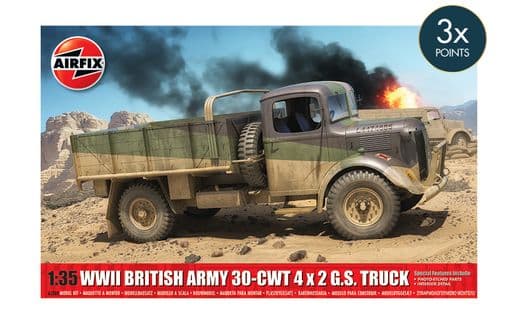
In the latest edition of our Workbench blog, we have a single posting for this Easter weekend, but a double treat for Airfix fans - our latest voyage of discovery into the popular world of 1/35th scale Military Vehicle modelling and our first visit to a 2023 new tooling project addition to our range. Our subject for this week is not a tank, mobile assault gun or anti-tank vehicle, no, it's arguably far more interesting than any of these, one of 17,000 similar vehicles adapted from civilian applications prior to war breaking out, but ultimately proving essential in ensuring the wheels of war could keep moving forwards. This week, we will be focusing on our new scale tribute to the British Army's 30-CWT 4X2 General Service truck and why this utility transport vehicle has as much right to be in your military vehicle model collection as something like a Cromwell or Sherman tank does.
Included in this first project overview, we will be positioning this vehicle from a historical perspective, taking a closer look at the scheme and decal options scheduled to accompany the initial release from this kit and as something of a Bank Holiday stop press exclusive, hope to include a selection of images which feature a sample kit build using the very latest round of test frame components produced from this newly designed tooling. As we write this introduction, this blog feature is very much in the 'hopeful' department, so if you are reading these words, then chances are that we got lucky and this particular blog plan actually came together.
It's time to start your engines and prepare to join one of these long motorised supply columns from WWII, this time hauling a load of the latest Airfix updates.
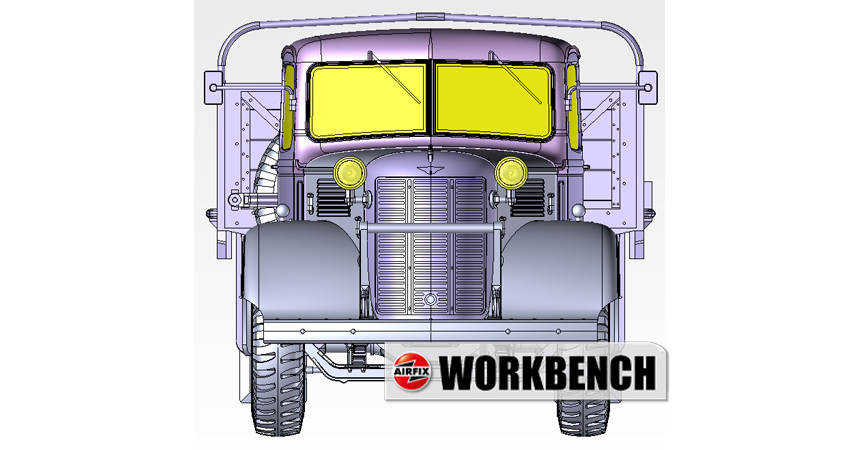
A CAD screenshot introduction to the latest impending addition to our 1/35th scale Military Vehicles range, the British Army 30-CWT 4X2 G.S Truck, a 1.5 ton load-lugger which kept the Army moving during WWII.
Even though huge numbers of horses, donkeys and mules were used in a multitude of military linked roles during the Great War (it's estimated that around six million were used), it soon became clear that in order to keep a modern army supplied efficiently, a huge force of reliable mechanised vehicles would be needed, particularly where the front lines in any combat zone were constantly moving and advances by reconnaissance units had to be quickly consolidated. If not transporting weapons or troops to the front lines, supply vehicles were needed to haul the vast amounts of fuel, ammunition, food and other vital commodities a modern army consumed, with this capability being crucial to the success of any military campaign. As the pace of modern warfare increased exponentially, so military supply lines started to lengthen as a consequence.
To this end, during WWII, vast numbers of supply vehicles were pressed into military service, initially taking existing civilian utility truck designs and re-purposing them for military use. In addition to this, modern warfare would inevitably lead to more casualties, both military and civilian, and on the home front in particular, require the effective transportation of fire, rescue and support professionals to the scene of incidents and attacks. Once again, existing truck designs would have to adapt to this important new role and do so at speed and in some numbers, with the immediate requisitioning of former civilian vehicles a necessity.
In pre Second World War Britain, with the dark clouds of war looming large, the British Government were acutely aware that their existing inventory of fire engines, casualty evacuation vehicles and general service trucks was sadly lacking and immediately set about a significant programme of expansion. Officially ‘encouraging’ many of the motor manufacturing companies to return to the production of trucks in support of this programme, they were in desperate need of as many rugged and reliable commercial vehicles as they could get their hands on, proven existing designs with a reputation for effectiveness. Using the existing chassis and adapted cab arrangement, they easily made the transition to military service and would therefore go on to become hard working general supply trucks, fire appliances with a multitude of uses and ambulances for use both on the home front and increasingly, on battlefields across Europe and the Mediterranean. The mechanical workhorses of commerce were about to provide the same service for war.
Despite the feverish production of transport vehicles right up until the start of WWII and the end of the so called Phoney War, it's generally accepted that Britain was still significantly under-equipped when it came to numbers of military vehicles of all types, a situation which was just about to get much worse. Although the evacuation of almost 340,000 troops from the beaches of Dunkirk during the early summer of 1940 was a source of incredible national pride, the fact that the British Expeditionary Force had to leave the vast majority of their equipment in France was a huge setback to an already dire logistical situation and something had to be done.
A further selection of CAD screenshots which illustrate why this will be an incredibly popular addition to the 2023 Airfix kit range.
At the outbreak of war, it's interesting to note that almost thirty companies in Britain were engaged in the manufacture of commercial vehicles, from household names such as Ford, Bedford and Morris, to lesser known specialist manufacturers, like Scammell. Clearly, in order to address the supply issues facing Britain's military, these companies were going to have to come under the overall control of a central co-ordinating body and the establishment of the Ministry of Supply effectively provided this, immediately all but ending the production of vehicles for civilian applications, whilst at the same time procuring the manufacture of vehicles from overseas manufacturers. It is often quoted that almost 530,000 trucks and tractors were produced by Britain's various manufacturing companies during WWII, a figure which does not include production figures for cars, motorcycles or ambulances.
Before moving on to look at this truck in a little more details, in fascinating contrast, although the Wehrmacht was seen as the most modern, most well equipped army in the world at the start of the Second World War, from a supply infrastructure perspective, it was definitely lagging behind many other nations. It would be true to say that the Panzer Divisions were incredibly well equipped, however, these impressive units only ever made up around 25% of the German Army and for the rest, it was horse power that kept them moving, both from a transport and supply perspective. This stems back to the rapid expansion of the German Army during the 1930s and how at that time, few ordinary people in Germany had access to a motor vehicle or were even able to drive one. Bringing this fact starkly into focus, America could boast a ratio of 1:5 relating to the number of cars to people in the country, however in Germany, that same ratio was 1 car to every 89 people, the lowest in Western Europe.
On the eve of war, the German Army had around 400,000 horses in service, with all the complex associated infrastructure that entailed and by the time of Operation Barbarossa, they had amassed an incredible 750,000 horses for the attack, approximately one horse for every 4 troops. When considering the popular understanding of the strength of the modern Wehrmacht, these are actually quite sobering details.
The latest in a long line of Workbench blog image exclusives, this time a first look at test frames produced from the new 1/35th scale British Army 30-CWT 4X2 G.S Truck, a fabulous build project for any modeller to engage with.
Notice any similarities to a popular previous release in this scale?
A gathering of components. All kit parts including the clear frame - we do have to include the fact that these are test frame components and as such, may still be subject to alteration.
Getting back to the subject of this update and our impending truck addition to the 1/35th scale Military Vehicles range, the British Army's 30-CWT 4X2 General Service series of trucks heralded from a line of successful pre-war commercial designs, where reliability and operability were favoured above driver and passenger comfort. Initially, these 30-CWT trucks were simply diverted from civilian production and as the military required the vehicles to be manufactured to a tight costing, actually removed some of the features of these already spartan vehicles, resulting in an open cab, canvas cab awning and canvas doors (if you were lucky). Not surprisingly, this style of truck finish quickly became known as 'Flu or Pneumonia Wagons' by the poor drivers assigned to operate them, because whilst this design did not detract from the effectiveness of the truck, conditions for the driver could be almost unbearable at times.
Thankfully, their plight was quickly recognised and a new enclosed cab version made from pressed steel was soon introduced and whilst driver equipment in the cabin was still rudimentary at best, at least conditions were a little more bearable when driving in most weather and temperatures. Significantly, these medium sized load luggers shared many components with other vehicles being manufactured by its parent company at that time, making mass-production less onerous and much more cost effective.
By their ubiquitous, yet vital nature, the General Service trucks used by the British Army during WWII are a fascinating subject for the scale modeller to spend some time with, beautifully simplistic by design, yet interesting in both their rugged, reliable nature and how the application of military paint finish and markings completely transformed their appearance. In a numbers game, there would be many more service trucks close to any combat hotspot than the tanks and armoured vehicles most modellers are more familiar with, even though they would usually be bringing up the rear and performing more of a support, if still essential role.
Now for the exclusives we have quite literally been waiting for - thanks to our Development Manager, we have these test build images which really are 'Hot off the Press'. Indeed, this test build is so new, that the glue used might even still be wet! Again, please note that this is a test build using test frame components and therefore, may well be subject to further change - we know you know, but just in case.
And again, from various angles.
In the configuration modelled here, it's clear to see the commonality this truck shared with other vehicles produced by its parent company at that time and whilst this vehicle sports the General Service cargo body, loads carried on the rear bed could simply be left open, or if operating in poor weather, or if the cargo was to be hidden from prying eyes, to be covered with a lashed down tarpaulin. If greater loads were being carried, the crew had the option to mount the tarpaulin on a higher frame, something which gave the truck a very different appearance. Powered by a six cylinder 3462cc overhead valve petrol engine, which produced a reliable 63hp, the truck also featured a 4-speed gearbox, hydraulic brakes and fully sprung suspension which made operation over most types of terrain effective and more than bearable.
A reliable small truck, these vehicles were the mechanical workhorses of the British Army's supply system and were consequently only earning their keep when on the move, lugging another load of supplies and equipment. Production wise, although plenty of these vehicle were manufactured in Britain prior to the outbreak of war, the Ministry of Supply were soon of the opinion that as it was roughly the same cost to produce the larger 3 tonne trucks which had twice the load carrying capacity of these smaller vehicles, it made little sense to keep the smaller trucks in production. Switching production almost entirely to the 3 tonne truck variant, the 30-CWT variant would gradually be used in secondary roles, or made available to other nations engaged in fighting the Axis forces, including relatively large numbers sent to the Soviet Union.
Interestingly, a great many of these vehicles were abandoned in Northern France following the hasty retreat and evacuation of the British Expeditionary Force in the spring/early summer of 1940 and as they would prove extremely adept at doing, the Germans requisitioned this valuable supply of transport vehicles and put them to good use for the remainder of the war, spare parts willing.
A really fascinating new addition to our 1/35th scale Military Vehicles range, let's now take a closer look at the two scheme options which will accompany the initial release of this interesting new kit.
The hostile environment of the deserts of North Africa witnessed some of the most savage fighting of the Second World War, lasting over three years from early June 1940. Initially, this fighting was between British and Italian forces, with the vast expanses of desert and the ebb and flow of combat gains and retreats placing a heavy burden on the machinery of war and of course the men operating the various vehicles. In this punishing environment, the robust qualities of the British Army's ubiquitous 30-CWT General Service supply truck really did prove to be invaluable, a hardworking vehicle which required a minimum of maintenance and was always ready to do its essential transport duties.
One feature of the vehicle which proved to be particularly noteworthy were its tyres, with the rubber compound used endowing these units with incredible durability and the ability to operate in both on and off-road conditions. Most vehicles were also equipped with a bespoke tyre inflation unit, however in operation, these proved to be virtually redundant due to the robust qualities of the tyres.
Another interesting fact regarding the production of these trucks is that each and every one of these vehicles was painted in British Army olive drab when they left the manufacturing plant, but could receive an additional coat of paint if their intended operational deployment required. The most dramatic presentation differences came on vehicles destined for use in the Western Desert and of these, the application of the Caunter or ‘Dazzle’ scheme was without doubt the most distinctive. The brainchild of Brigadier John Alan Lyde Caunter, the scheme was specifically for use on military vehicles of all types fighting in desert conditions, with Caunter having served in a senior role in the region since 1935 and as the Commanding Officer of the 4th Armoured Brigade from January 1940 onwards - clearly he had the necessary experience in theatre.
The Caunter scheme was a disruptive pattern of paintwork intended to break up the profile of the vehicles and was one which had been in development with the War Office since before the start of the war. In a similar manner to how warships were painted during the Great War, with zig-zag lines intended to confuse U-Boat commanders into making range finding miscalculations when selecting their targets, the Caunter scheme was intended to break up the angular profile of military vehicles in the Western Desert, particularly when operating in flat, open conditions. With the added benefit of heat haze assisting with this visual deception, it was thought that this scheme would assist in confusing gunners attempting to fire on the vehicles, buying them valuable time to either launch their own attack, or to seek whatever shelter they could find.
Full scheme details of this beautifully presented Western Desert British Army 30-CWT Truck, wearing its Caunter 'Dazzle' scheme. A Vehicle wearing these very markings was the subject of a painstaking restoration project a few years ago.
Another look at the built model assembled using test frame components.
Several different permutations of the design were considered, with this particular variation being the most distinctive and the one which actually made it onto operational British Army vehicles in the desert. With painting instructions and paint stocks supplied to units training for desert deployment, the Caunter scheme adopted a three colour design and straight lines, which must have been quite the challenge to apply and presumably requiring the use of bespoke paint masks during the task.
Trials of the scheme took place in Egypt in May 1940, with the 7th Armoured Division taking the scheme into combat, and whilst the exact colour combinations used at that time are still the subject of some debate, it does appear that whilst it was initially used extensively, it actually proved to be less successful than anticipated. By the middle of the following year, most vehicles operating in a desert environment would be finished in a single overall khaki/linen colour and the dazzle scheme was an unusual Western Desert thing of the past.
This particularly attractive scheme was applied to an incredibly rare example of a restored 30-CWT truck, which was rescued after spending more than forty years left abandoned and unloved. With the restoration project beginning in 2016, it would take over three years for the truck to be returned to its former glory, when it would become one of only three such restored examples known to exist. Later offered for sale, the personalities behind the restoration project were disappointed that a UK buyer didn't come forward, with the truck now being on display in a Russian museum, however, this is actually rather fitting when considering the second scheme option which will accompany the initial release of this appealing new kit.
Scheme B - British Army 30-CWT 4X2 G.S. Truck, Evaluation Unit, Russia, 1944.
As the Second World War took a dramatic turn with the German invasion of the Soviet Union towards the end of June 1941, it quickly became apparent that the Soviets were going to be in need of huge quantities of materials and military equipment if they were to avoid defeat and in the process, devour significant enemy resources with the continued fighting. The British Empire War Assistance programme and more importantly, America's Lend-Lease Act, allowed for the supply of vital machinery, equipment and commodities to the Soviet Union between October 1941 and March 1946. When considering that in one week alone, Soviet forces lost a staggering 4,000 aircraft during the German attack, it underlines why this agreement and the resources it provided proved to be one of the most crucial battles of the entire war.
With agreements in place, the race was on to ship the equipment to the Soviet Union at the earliest opportunity, however, this would be by sea and would have to be via one of three Arctic shipping routes, heading mainly for the port facilities at Archangel or Murmansk. Unfortunately, all three routes posed different problems and logistical challenges, however, the merchant sailors and the men of the Royal Navy would have to run the gauntlet if the operation was to stand any chance of success. The main issue was that of timing - if safer routes were taken, it would take much longer for the equipment and supplies to reach the front lines in the Soviet Union, however, if the more dangerous, shorter route was taken, there would undoubtedly be casualties and whilst the equipment would be in position sooner, there would be less of it.
Prepared for Russian service, this particular 30-CWT Truck would have had plenty of miles to cover when serving in the markings of its new owners.
Another look at the test build of this new kit, clearly illustrating why this little truck will prove an interesting build diversion for many a modeller, not just those who specialise in Military Vehicle kits.
The main route taken by the supply convoys would be via the Northern (Arctic) route, which was the shorter one and not only required sailings through the bitter condition of this region, but would also run the gauntlet of the Luftwaffe and Kriegsmarine, who were only too aware of what the Allied powers were attempting to do. Every ship which managed to get through could potentially cost the lives of German troops, so you can imagine the ferocity of these attacks when they came. In addition to the supply of Aircraft, Tanks and other vehicles, this arrangement also included the delivery of raw materials, food, machinery, industrial plant, medical supplies and hospital equipment.
As crucial as aircraft and tanks undoubtedly were, the Soviets also needed large numbers of transport and supply vehicles to supplement their own indigenously manufactured machines and by the end of this programme, it was estimated that more than 500,000 trucks and jeeps were supplied, the majority of which were manufactured in America. As part of Britain's commitment, only relatively small numbers of 30-CWT (1.5 ton) 4x2 General Service trucks were supplied via the British Empire War Assistance programme, not because the vehicles were deemed unsuitable, but because by that time, the majority of production in the UK had been switched to the larger 3 ton variant, which were deemed more sensible from a war production perspective.
Nevertheless, the 30-CWT trucks were gratefully received by their new owners and put to good use transporting any manner of supplies across this vast nation. In Soviet service, many of the British manufactured supply trucks were finished in this distinctive black and dark earth camouflage scheme for anything other than winter operations, although finding definitive evidence confirming that this paint was applied in the UK prior to shipping has proved elusive - perhaps one of our knowledgeable readers could shed some light on this fascinating subject for us.
One final look for this week's blog, clearly showing its manufacturing lineage, the new 1/35th scale British Army 30-CWT 4X2 G.S Truck will surely prove to be an incredibly popular addition to the Airfix range.
A really unusual, yet fascinatingly appealing addition to the 2023 Airfix Military Vehicle range, we still have a couple of further project updates to bring you before our new 1/35th scale British Army 30-CWT 4X2 G.S Truck is ready for release, by which time, we hope it will be high on the intended build schedule of many a Workbench reader.
We are afraid that's all we have for you in this latest edition, but we will be back next Friday with more project development updates and the very latest Airfix kit exclusives. In the meantime, we are always keen to hear your views on all things Airfix and in particular, any thoughts and opinions you may have regarding our Workbench blog. If you would like to drop us a quick line, could we please ask that you use our workbench@airfix.com email for all correspondence.
To re-visit any of the Airfix blogs we have produced over the past seven years or so, please head to our main Workbench hub, where you will find our entire blog back catalogue and all the Airfix design projects we have already covered.
All our dedicated official social media sites can be accessed by clicking the respective link icons at the foot of this page, or by heading to the Airfix homepage. Other useful Airfix links are:
Facebook, YouTube, Twitter and Instagram official sites
Airfix Workbench Forum
Please join us for more Airfix updates next week and thank you for your continued support.