
Welcome to this latest edition of our Workbench blog and all the news, updates and modelling exclusives from the fascinating world of Airfix.
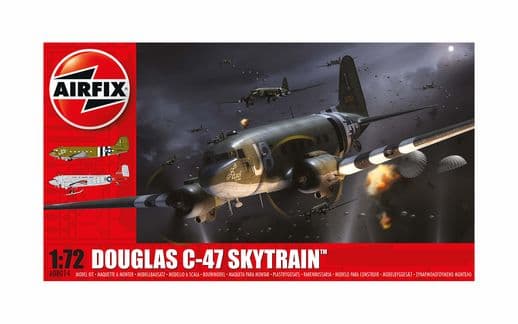
For this second blog of the week, we will be staying with the theme of impending kit reintroductions to the current Airfix range and indeed with the same subject matter of iconic, rugged aeroplanes developed during the 20th century, many of which are still flying to this day. The aircraft which is attracting our attention this time is the Douglas C-47 Skytrain, an aircraft which can trace its origins back to the pioneering days of commercial aviation in the US, but one which proved versatile enough to adapt to the position of war winner during the Second World War. Again featuring stunning box artwork and a look at the two schemes which are included with this impending 1/72nd scale kit release, we will be seeing why this legendary passenger airliner would also go on to have a military career which is unrivalled in the world of aviation.
Before we begin, how would you like to have the opportunity to take a chance of a lifetime flight in a Supermarine Spitfire T.9 and all you have to do to be in with that chance is to build a model kit? If this sounds like something which might be of interest to you, please check the Spitfire Flight page in the community section of our website for all the relevant details - unfortunately for me, your Workbench editor is banned from entering, but I'm not upset about this in the slightest - who wants to fly in a Spitfire anyway?
The Douglas C-47 Skytrain was one of the most successful military aircraft of all time, but could trace its lineage back to arguably the first of the modern passenger transport aircraft in the history of flight.
It's incredible to think that one of the most influential aircraft in revolutionising the world of passenger transport in the 1930s would also go on to become an essential wartime aircraft, one which was described by General Dwight D. Eisenhower, the Supreme Commander of Allied Forces in Europe, as one of the machines which proved vital to Allied success during WWII, but that is exactly what the Douglas C-47 Skytrain (Douglas DC3) managed to do.
At a time when aviation was still very much in its infancy, the Douglas Aircraft Corporation of California unveiled an aeroplane which is still regarded as one of the most significant in the history of aviation and one which would help to establish regular air travel in America. The Douglas Commercial 3 (DC-3) was a sleek, twin engined passenger airliner which was a development of the company’s previous DC-2 airliner. An aircraft which featured a relatively wide fuselage, the DC3 was able to carry a greater number of passengers than had previously been possible and in levels of style and comfort which made air travel both glamorous and relatively affordable. Indeed, the DC-3 proved to be the world’s first profitable airliner for operators and paved the way for widespread air travel across America, accessible for millions of people – the world’s first truly modern airliner.
Initially conceived as a direct competitor for the Boeing 247 already in operation with United Airlines, the DC-3 incorporated a host of innovations in its design and utilised wind tunnel technology to develop the swept back wing leading edge design which gave the aircraft such impressive performance, as well as its distinctive appearance. Possessing both high speed and impressive range, the aircraft was an instant success, however it would be its stability and reliability which endeared the Douglas airliner to passengers and operators alike. The DC-3 made air travel in America both safe and attainable for much of the population, replacing the rather basic and uncomfortable conditions of earlier air travel with spacious, comfortable seating in a relatively quiet and heated cabin area. The age of air travel had truly arrived.
It is also interesting to note that the first flight of the Douglas DC-3 took place on 17th December 1935, a date which was exactly 32 years after the Wright Brothers had made their historic flight at Kill Devil Hills.
As America watched Europe and the Far East descend into conflict at the start of WWII, military officials knew they would have to upgrade their armed forces whatever the next few years were going to bring. They knew that the efficient transportation of troops and supplies would be crucial in the outcome of any future conflict and in the Douglas DC3, they thought they had an aircraft capable of providing this. Indeed, so much importance was placed on this proposed military variant of the DC3 that an army engineering team was directly assigned to the Douglas Factory during the aircraft's development to ensure that modifications made to the standard DC-3 (Douglas Sleeper Transport) configuration prepared it for future military service.
In October 1941, the US Government decided to adopt the British system of identifying different aircraft types by name, the main reason for which was to mask development of new aircraft from the prying eyes of enemy spies and prevent this information from falling into enemy hands for as long as possible. The new Douglas C-47 military transport aircraft was given the rather fitting name ‘Skytrain’, the first US Army aeroplane to be given a name in this manner. The first flight of the C-47 Skytrain took place on 23rd December 1941 and from this date until the end of the war, the Douglas Corporation would eventually build over 9,200 examples of this magnificent aircraft.
When we marvel at the sight of one restored C-47 these days, can you imagine what it must have looked and sounded like with a sky full of aircraft on the eve of D-Day?
This military variant of the DC-3 would differ from airliner configuration in a number of ways, perhaps most noticeably by its inclusion of a large two piece cargo door located at the rear port side of the aircraft's fuselage. It would also have reinforced flooring to cope with the rigors of military service and the main cabin floor was angled upwards slightly, to make this surface parallel to the ground during the loading procedure. The fuselage seating arrangements consisted of fold down metal and canvas benches down both sides of the fuselage and each window featured a rifle grommet, which allowed troops to fire from inside the aircraft, should the situation dictate.
To aid with navigation, the aircraft also featured an astrodome on top of the fuselage, just behind the cockpit area, whilst other differences from the original airliner configuration included a slightly increased wingspan for military variants and a reduced internal fuel capacity, down from 882 gallons to 804 gallons. This reduction could be mitigated by fitting the aircraft with up to eight 100 gallon ferry tanks for long distance flights. A design feature which would prove invaluable during operations in support of D-Day was the fact that most Skytrains would also be fitted with a heavy duty glider attachment point, positioned centrally at the very back of the fuselage and often hidden behind a removeable tail cone. A specialist paratrooper delivery variant of the aircraft was designated the Douglas C-53 Skytrooper, however, the many aircraft which would be operated by British and Commonwealth air forces would be known as Dakotas. If we are talking names, the C-47 would also attract a number of less than flattering nicknames during its military service, names which included the Gooney Bird, Dumbo and even Old Fatso, but these were all names of endearment, as the Skytrain was always held in extremely high regard.
Perhaps the most poignant nickname the aircraft inherited was the ‘Vomit Comet’, a name given to it by paratroopers, presumably due to the severe buffeting experienced in the minutes immediately prior to arriving over the drop zone and in no small part linked to the significant task which lay ahead of them.
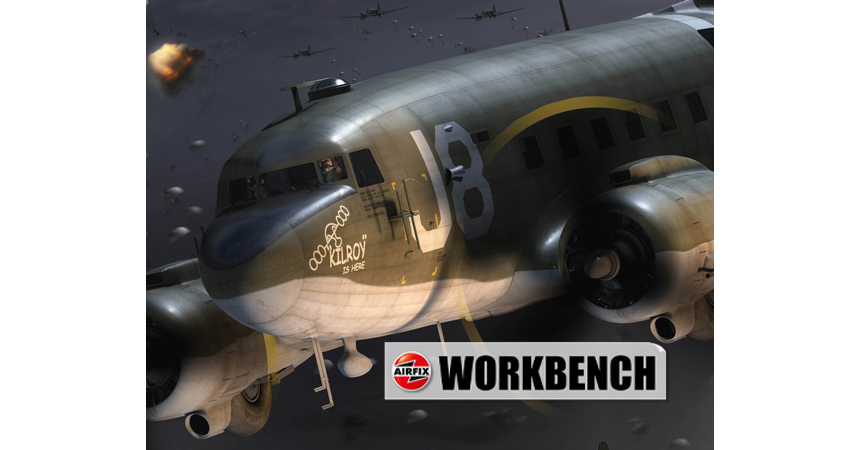
Has Airfix box artwork ever managed to capture the drama of a truly historic event more than this magnificent piece of work? Whilst we are all captivated by stories of the heroics of D-Day, can we even begin to imagine what it was actually like for those who took part in those actions?
During its extensive military service, the Douglas C-47 was required to perform many of the less glamourous, yet absolutely essential duties aircraft are capable of doing, tasks which would ultimately prove crucial to the outcome of the Second World War. The Supreme Commander of Allied Forces in Europe, Dwight D. Eisenhower, famously described the Douglas C-47 Skytrain as one of his ‘Four items of military equipment most vital to Allied success in Europe and Africa’, a list which also included the bulldozer, the Jeep and the two and a half ton truck. Despite the fact that all were incredibly successful products of the mighty American industrial machine, none of them were originally designs intended for military roles, so could therefore be described as wartime unsung heroes.
In aviation terms, the Douglas C-47 Skytrain may not have been as exciting an aircraft as something like a Mustang, or enjoyed the incredible acclaim of the Spitfire, but on reflection, can you think of another aircraft which made such a telling contribution to Allied victory during the Second World War?
In terms of its historic significance, perhaps the most famous use of Douglas C-47 Skytrains occurred on the night of 5th and 6th June 1944, the night the Allies embarked on 'Operation Overlord' and the liberation of Fortress Europe. In order to ensure the defeat of Germany and the eventual end of the Second World War, the Allied powers knew that they would have to launch a full scale assault against continental Europe, an undertaking which was a logistical nightmare for military planners and for the troops taking part, fraught with many terrible dangers. In support of this plan, Allied aircraft began a concerted bombing campaign many months before the actual landings were to take place, targeting aircraft and munitions manufacturing plants, in addition to neutralising strategic targets in the intended landing areas. Whilst this offensive aimed to diminish Germany’s ability resist the Allied onslaught when it came, they had to be careful these attacks did not alert the enemy to the intended invasion location, so the raids were widespread and heavy, placing a huge strain on forces prior to invasion. D-Day planning proved to be as much about deception, as it was about preparation.
The scene inside a restored C-47 after they had just completed a parachute drop over Normandy, to mark the 75th Anniversary of D-Day in 2019.
Finally, after months of meticulous planning, the order to ‘Go’ was given and the invasion was on. At RAF Greenham Common in the late evening of 5th June 1944, paratroopers of the US 101st and 82nd Airborne Divisions climbed aboard hundreds of Douglas C-47 Skytrains, as they prepared to drop behind German lines in advance of the main seaborne invasion force, the airborne spearhead of Operation Overlord. The crucial mission facing C-47 crews was to deliver paratroops in designated drop zones behind the German coastal fortifications, allowing them to disrupt the enemy’s ability to effectively reinforce the landing areas, thus giving Allied forces a greater chance of quickly breaking out from their beachhead landing areas.
Their many objectives included securing important road junctions, bridges and strategic villages, as well as helping to disable as many of the coastal defensive positions as possible and in advance of the main amphibious landings, with the speed of their assault spreading confusion amongst the defending Germans. Plans such as these look good on maps and charts, but always have to be carried out by ordinary men who are required to perform heroic actions.
The reintroduction of our 1/72nds scale Douglas C-47A Skytrain kit allows our scale tribute to this incredibly important aircraft to return to the Airfix range once more and includes two scheme options which could hardly be more opposed. Marking an aircraft which took part in Operation Overlord, the lead scheme is presented in full D-Day identification markings and even benefits from some nose artwork, whilst the alternative scheme features a post war aircraft which plied its trade in Canada's frozen Northern Territories. Let's take a closer look at both options now.
With the long-anticipated invasion of Europe now imminent, some determined new arrivals turned up at Station AAF-462 Upottery airfield, Devon in the last few days of May 1944, the paratroopers of the famous 101st Airborne Division ‘Screaming Eagles’. These men would be putting their lives in the hands of the crews of the home based 439th Troop Carrier Group Douglas C-47 crews, but would have trained exhaustively for the historic mission which now lay ahead of them. All would take part in detailed briefings to give them information regarding flight routes, timings, drop-zones and known enemy anti-aircraft gun locations during this period and on 3rd June, base personnel were given orders to paint black and white stripes around the rear fuselage and wings of all their aircraft.
With so many aircraft in the air at the same time and with this possibility of friendly fire casualties resulting not only from friendly aircraft attack, but also from ground and seaborne anti-aircraft fire, Allied D-Day planners called for ‘invasion stripes’ to be painted on the majority of Allied aircraft, in an effort to clearly identify them to other friendly units. For everyone involved in this momentous day, the situation was now crystal clear – ‘if it ain’t got stripes, shoot it down’. In order to prevent German spies and reconnaissance aircraft from discovering this black and white secret, the plan was a matter of the utmost secrecy and was only divulged in the days immediately prior to invasion, increasing an already hectic workload for airfield personnel. On the invasion airfields which were now playing host to thousands of paratroopers, the importance of the operation meant that nobody was allowed to enter of leave the base and whilst billet conditions for them may have been basic, the food was unusually good, something the men took full advantage of.
Painting identification markings on the aircraft was intentionally a last minute preparation and with every aircraft taking part needing the markings, every available hand was set to the task. In most cases, the markings were hand applied by brush and for larger aircraft, often employing large sweeping brushes and as a consequence, were rarely dead straight. The only thing that mattered was that the aircraft received the crucial markings, so visual aesthetics were given little consideration at the time.
On the 5th of June, just hours prior to the departure of ‘Mission Albany’, the night time parachute combat assault by 101st Airborne Division of the US Army at the start of D-Day, General Eisenhower and Commander General Maxwell Taylor of the 101st Airborne Division visited launch airfields around the country to address the troops who were about to embark on their ‘Great Crusade’. Eisenhower's intention was to rally the troops ahead of their leap into the unknown, but when he saw their determined, blackened faces and the number of weapons and knives each paratrooper was brandishing, he knew that the men of the Screaming Eagles were ready for the coming fight.
Image T - Full scheme details of this RAF Upottery based C-47A which delivered paratroopers into Normandy early on D-Day morning.
Construction of the airfield at RAF Upottery began during the summer of 1943 and with its three hard runways, extensive dispersal areas and attached accommodation for around 2500 personnel, this was always going to be a major undertaking. The airfield was opened for operation in February 1944, with its first residents being the four squadrons of Douglas C-47 Skytrains which made up the 439th Troop Carrier Group of the USAAF. These aircraft began a period of intensive training in preparation for the anticipated invasion of Europe, dropping paratroopers and towing gliders.
In the early hours of D-Day, Upottery's C-47 squadrons carried the men of the 101st Airborne Division to their drop zones in Normandy and the following evening, towed gliders to the same areas bringing much needed reinforcements for Allied troops now fighting to establish their positions.
Upottery airfield would come to the attention of a new generation of people following the publication of the book 'A Band of Brothers' and the hugely successful TV series which followed, as this was the airfield from where the men of 'Easy Company' of the 506th Parachute Infantry Regiment, 101st Airborne Division 'Screaming Eagles' took off from bound for Normandy on the night of 5th/6th June 1944.
The J8 fuselage code carried by this aircraft denoted that this was an aircraft of the 92nd Troop Carrier Squadron, with the tail code 'I' being its individual radio callsign. This particular Skytrain also benefitted from the addition of some rather distinctive nose artwork and the words 'Kilroy is Here', which was a play on the 'Kilroy was Here' graffiti which started to appear around the world, but more specifically, anywhere where American troops were stationed. It is actually thought that this practice originated in the UK as it was something of combination of both British and American cultures at that time.
With over 10,000 Skytrains constructed and the aircraft earning a reputation for being both reliable and extremely capable, a large number of aircraft would go on to see long service careers with air forces all over the world and indeed in US service, the last of their aircraft were only retired as late as 2008. Unfortunately for the aircraft depicted in this second scheme, her service career would only end up being around five years and she would meet with a freezing end in the wild remotes of Northern Canada.
Constructed as a C-47A by Douglas at Long Beach in California, this aircraft was taken on strength with the USAAF as 43-16062 on 14th June 1944, initially assigned to Troop Carrier Command during the Second World War. Following the end of WWII, the aircraft was upgraded to C-47B standard, which was optimised for higher altitude performance, and later still to the D variant, which basically took some of this engine performance away.
This aircraft was later assigned to the Military Air Transport Service, where it found itself flying to and from the remote airfield at Isachsen in the northern Canadian territory of Nunavut. She was assigned to the weather station at Isachsen on Ellef Ringnes Island, which formed part of an arctic weather observation program jointly established by the US and Canada following the end of the Second World War. It was reported that Isachsen endured the worst weather in all of Canada and when you consider the size of this nation and some of the inhospitable areas in its frozen north, is must have been a particularly uncomfortable place to be stationed.
The freezing weather would have an impact on the destiny of this particular aircraft, as she met with an unfortunate accident on 9th October 1949. The previous day, the aircraft had been operated on the station runway, attempting to assess if it would allow a larger USAF C-54 to land on the snow covered runway in the coming few days. At the end of the day, the aircraft was parked out in the open air, ready for a scheduled early morning flight the next day.
This unfortunate Skytrain lay for many years on the frozen ground on the threshold of Isachsen airfield in Northern Canada, the victim of a failed overweight take off attempt in icy conditions.
As the aircraft fired into life the following morning, the pilot cleared his windscreen of ice, but for some reason, elected not to do the same on his wings and control surfaces. To make matters worse, the aircraft was laden with supplies and equipment and was actually overweight, a perfect set of circumstances for an accident to occur. As the ski equipped Skytrain set off down the snow covered runway, it appeared to be glued to the ground and even though it tried to rotate on a couple of occasions, it never cleared the runway by more than a few inches. The undercarriage struck the edge of a creek just past the runway threshold, which caused a wing to strike the ground and send the aircraft careering into the snow. Thankfully, there were no fatalities, however, three people on board did suffer injuries and the aircraft itself was immediately written off.
Serving as a permanent reminder of the perils of operating from this frozen airfield, Skytrain 43-16062 was simply left where she came to rest, preserved by the frozen temperatures and remaining in relatively complete condition for many years to come. It was reported that the wreckage was still in the same position as late as 2007 and on the fateful day it met with its accident, she only had a total of 3,353 flying hours on her airframe.
Marking the post war career of this magnificent aircraft, this MATS scheme could hardly be more different from the wartime scheme option included with this release, but is most definitely something of an attention grabber. With the interesting story of its service in the frozen north of Canada and its unfortunate demise, this might just be the scheme option that captures your modelling imagination.
One to look out for, the artwork adorning the reissue of this fantastic model really is amongst the best of recent years.
As was the case with the de Havilland Beaver, we are expecting the Skytrain to be in our warehouse and available for dispatch within the next couple of weeks.
That’s it for this week, but please don't forget that we also have a second, de Havilland Canada DHC-2 Beaver related blog update for you this weekend - please head for the Workbench hub to find all previous blog posts. We will be back as usual next Friday with more Airfix project updates to tell you about. As ever, we are always interested to hear your views on all things Airfix and particularly in relation to our Workbench blog, so if you ever feel like dropping us a quick line, please do so using our workbench@airfix.com contact e-mail address.
All our social media sites can be accessed by clicking the respective link icons at the foot of this page, or by heading to the Airfix homepage. Other useful Airfix links are:
Facebook, YouTube, Twitter and Instagram official sites
Please join us for more Airfix updates next week and thank you for your continued support.