Welcome to this latest edition of our Workbench blog and all the news, updates, and modelling exclusives from the fascinating world of Airfix.
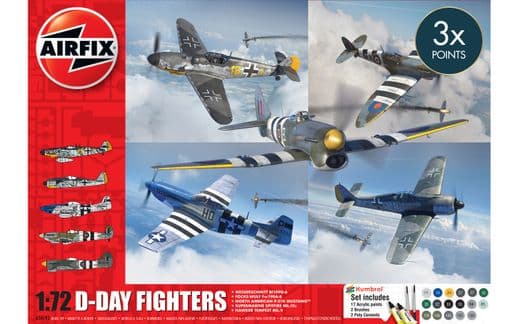
When the annals of Workbench blog history are compiled in the years to come, this week’s edition will definitely stand out as being something just that little bit unusual. Although we will still be featuring another of the new kits announced with the launch of the 2024 range, the one attracting our attention this time is an impending addition to our popular Gift Set range, and unusually, one which comprises of no fewer than FIVE different kits. In what’s sure to serve as a popular modelling tribute to this year’s D-Day 80th Anniversary commemorations, our D-Day Fighters Gift Set includes five of the single engined fighter types which were in service at that time and would have been engaged in combat operations on D-Day itself, be that actually over the invasion beaches themselves, or a little further inland on that most momentous of days. With the kit also featuring a rather impressive stand which allows all your completed models to be displayed in a striking manner, this is arguably the most unusual kit offering within the current 2024 range, however, it does make for an incredibly appealing build project.
As we feature this impressive new kit for the first time here on Workbench, we have no fewer than five new pieces of Box artwork to bring you, in addition to looking at each of the aircraft types included in turn. We will then look at the details behind the individual schemes selected for each kit, just to try and give each one its scale identity and to look at what its role might have been on D-Day itself. Within the modelling world, there’s and old saying that goes something like, ‘There’s nothing like having an Airfix kit box which includes more than one kit’, and in the case of our new 1/72nd scale D-Day Fighters Gift Set, that means a quintet of classic WWII fighters. Talk about an instant collection, we’re almost approaching squadron strength with this new kit.
As we currently find ourselves on the cusp of the coming D-Day 80th anniversary commemorations, could there be a more appropriate subject for this latest edition of Workbench?
This impressive new set has been assembled to commemorate this year’s D-Day 80th Anniversary commemorations, Airfix style.
Although it happened almost eighty years ago, the actions of 6th June 1944 will remain in perpetuity as one of the most momentous days in human history, when the Allied Expeditionary Force embarked on their ‘Great Crusade’, with ‘Operation Overlord’ opening a second front which was intended to eventually bring about the complete destruction of the German war machine. For many people, D-Day immediately conjures up images of a massive naval force and brave Allied troops storming five landing beaches across a 50 mile stretch of Normandy coastline from the Cherbourg Peninsula to Merville, however, this was a combined services operation and whilst the landing beaches were full of troops, the skies were full of aircraft.
Although we tend to think of D-Day as a single day when the Allies gained a foothold in enemy occupied France, planning for this historic day began many months prior to the first troops landing on Normandy beaches and was heavily reliant on air power. Allied air forces embarked on a systematic campaign targeting the Germany’s ability to fight and respond to the coming invasion, be that the destruction of defensive structures within the landing area, or the destruction of the German aviation industry deeper into Germany itself, all the time careful to avoid giving any clues as to the potential location of the proposed assault. If they could keep the Germans guessing, the defenders couldn’t concentrate their forces in the right location, allowing vital time to establish and reinforce their beachheads.
After months where the Allies bombed a multitude of German targets by day and night and fighter sweeps attempted to clear Northern France of any coherent Luftwaffe opposition, D-Day itself would see around 11,590 aircraft allocated to supporting the amphibious operation, performing a multitude of tasks from delivering airborne troops in the early hours of D-Day, to the close air support strike fighters waiting to be called in to support troops fighting on the ground – the tide of war had turned and the Allies were determined to take this opportunity to flood the Normandy region with troops and equipment.
For the purposes of this review and in support of the impending release of our new 1/72nd scale D-Day Fighters Gift Set, we will be looking at the impact single engined fighters had on or around D-Day, and how the four years since the Battle of Britain had brought about much change in how aerial combat was contested in a similar region of Europe’s skies. We will be looking at each of the five aircraft types included in the new kit in turn, before going a step further and discovering the details behind each of the scheme options featured. In order to maintain some structure to the overview, we will begin by looking at the Allied aircraft in this kit collection first, before moving on to look at the famous Luftwaffe fighter aircraft included. When looking at famous fighter aircraft of the Second World War, there really is only one place to start and that’s with the famous Supermarine Spitfire.
The Spitfire Mk.IX variant was arguably the most important mark of Spitfire in the entire production run and because of that, it’s somewhat surprising to learn that it was actually something of a stop-gap development. The arrival of the Luftwaffe’s new Focke Wulf 190 fighter over the Western Front in August 1941 saw RAF Spitfire Mk.Vs operating over the Channel falling victim to the ‘Butcher Bird’ in ever increasing numbers and something had to be done. A major Spitfire upgrade was in progress, but the Mk.VIII was still some way off, as manufacturing facilities prepared their tooling jigs for the production of the new aircraft, but there was a temporary solution available.
One of the major features of the new Spitfire was its use of a powerful new version of the Rolls Royce Merlin engine and it was proposed that fitting this new engine to a Spitfire Mk.V airframe would give the fighter a welcome performance boost.
The first 100 Spitfire Mk.IX fighters were actually Mk.Vc airframes adapted to take the new Merlin 61 two stage, two speed supercharged engine, with this combination producing a thoroughbred fighting aeroplane, one which was more than capable of challenging the FW190 and the latest ‘F’ variant of the Messerschmitt Bf 109. In fact, the new Spitfire was considered so successful that this would become the second most heavily produced variant in the entire production run and if including the aircraft powered by the licence-built Packard Merlin 266 (Spitfire Mk.XVI) even eclipsed the Mk.V in production number terms.
With further powerplant refinement taking place throughout the production life of this variant, the first Mk.IX Spitfires started to join RAF Squadrons from July 1942, with this famous mark of Spitfire going on to see service past D-Day and into the post war era. The last major Merlin engine powered variant of the Spitfire, this ‘emergency stop-gap fighter’ actually became something of an aviation classic.
Illustrating how the Royal Air Force was fortunate enough to be able call upon the service of aircrews from a great many nationalities throughout the Second World War, No.312 Squadron was formed at Duxford towards the end of August 1940 at the height of the Battle of Britain and was made up of mainly Czech personnel. Initially flying the Hawker Hurricane, the squadron remained at Duxford until the end of the next month, when it was sent north to defend the port of Liverpool and surrounding area. It would later be sent to RAF Valley to provide cover for the huge amount of shipping operating in the Irish Sea.
From the summer of 1941 onwards, the squadron started flying offensive fighter sweep operations into northern France, but would also fly protective cover for the disastrous Allied landing operation at Dieppe. They would become part of the 2nd Tactical Air Force operations from the Autumn of 1943 onwards, exchanging their Spitfire Mk.V fighters for new Mk.IX aircraft from January 1944 and from April that year, would engage in fighter bomber operations in support of D-Day. The Squadron’s Spitfires would continue flying close support and fighter bomber operations until July 1944, when they didn’t follow the majority of 2nd TAF fighter bomber units in heading for new advanced bases in France, but instead moved to East Anglia, where they would provide long-range escort for bombers heading into occupied Europe.
Full scheme details for this RAF Appledram based D-Day Spitfire.
Spitfire Mk.IX MJ840 was produced at the massive Castle Bromwich facility during the Autumn of 1943 and joined No.312 Squadron at Ibsley in early 1944. Wearing full D-Day identification markings, MJ840 was flown by Czech ace pilot Flt Lt Ladislav Světlík on D-Day itself, flying two sorties without increasing his victory score further. Over the course of the next few days, the aircraft would be flown by various other pilots from the squadron and on 11th June, pilot Flt Lt Vilém Nosek flew the aircraft on a combat air patrol over the Allied beachheads in Normandy.
During the return flight to RAF Appledram, pilots discovered their home airfield to be shrouded in thick fog, so broke into pairs of aircraft and headed for nearby airfields where they would have better visibility for landing. Tragically, due to the continued poor visibility and being unfamiliar with the terrain over which he was flying, Vilém Nosek’s Spitfire struck high ground at Barnes Farm, near Washington in Sussex and tragically, would lose his life in the ensuing crash. The Spitfire’s of No.312 (Czech) Squadron only used the airfield at Appledram between April and June 1944, the period which covered D-Day operations.
Our research team would like to thank Tom Dolezal of the Free Czechoslovak Air Force Association for his help in providing information relating to this scheme.
A development of the Hawker Typhoon which was initially regarded as something of a disappointment, the Hawker Tempest undoubtedly proved to be the ‘Super Hurricane’ designer Sydney Camm had been striving to produce since he started work on his Battle of Britain fighter replacement. Incorporating several significant improvements over the Typhoon, the new fighter was initially referred to as the Typhoon Mark II, but this was changed to Tempest as the prototype aircraft neared the date of its first flight. Although this was still a relatively large aeroplane for a single engined fighter, its airframe was light and would be pulled along by the massively powerful 24-cylinder Napier Sabre engine, a powerplant which would give the new fighter spectacular performance in the air. Making its first flight on 2nd September 1942, the new Hawker Tempest featured a newly designed laminar flow wing, which was much thinner than the wing used on its predecessor and allowed the new fighter to slip through the air at incredible speeds.
At first glance, the Typhoon and Tempest do share many similarities and differentiating between the two can be a little confusing, however, if you know where to look, it isn’t that difficult to tell the two aircraft apart. Without doubt, the wing is the most obvious distinguishing feature, as not only is this thinner than the one used on the Typhoon, but it is also a completely different shape. With a straighter leading edge and more elliptical trailing edge, the Tempest’s wing was designed for speed, even though it could still be used effectively in a ground attack role. Other Tempest design differences include a slightly longer nose and a tail section which appears to be much larger, with a more generous tail which features a pronounced dorsal fillet. During the prototype aircraft’s maiden flight, it posted an impressive top speed of 477 mph in level flight, to the delight of both the Hawker design team and the watching Air Ministry.
Moving on to the Tempest V variant on which the new Airfix kit is based, this mark was produced in two distinct variants, with each displaying differences which clearly identify the individual production series. The first 100 series 1 aircraft were built by Hawkers at Langley and still used some components left over from Typhoon production. These aircraft featured Hispano Mk.II cannon, the fairings of which protruded beyond the leading edge of the wing, the most visible identifier between these aircraft and subsequent production runs. The Series 1 Tempests also incorporated the tail strengthening ‘fish plates’ which were used on the Typhoon, with this additional reinforcement dictating that these particular aircraft did not have a detachable tail unit. The first 100 Series 1 aircraft were all fitted with larger Typhoon main wheels and built at Hawker’s Langley factory, allocated serial numbers with a JN prefix.
The next 300 Series 2 Tempest fighters were fitted with the new short barrelled Hispano Mk.V cannon, a gun which could be completely housed within the wing of the aircraft, leaving just the gun ports visible in the leading edge of the wing. The reinforcement measures applied to the first 100 (Series 1) machines were now deemed unnecessary, which meant that from this series onwards, the tail assembly of the Tempest could be detached, with additional provision for two underwing 45 gallon drop tanks to be fitted if required. The first 300 of these Series 2 Tempest V fighters were built by the Gloster Aircraft Company and had serial numbers prefixed by the letters EJ. Two further additional orders for Series 2 Tempests would be placed, bringing the total production of Mark V variants of the fighter to 801 aircraft.
When reading about the life and flying career of Roland Beamont, it really is like reading a story from the Boy’s Own Paper, a true British hero and one whose exploits continue to inspire anyone lucky enough to discover them to this day. Graded ‘Exceptional’ during his RAF Officer Training, Beamont passed out as a pilot officer on 21st October 1939 and was almost immediately sent to join the Hurricanes of No.87 Squadron in France as part of the British Expeditionary Force, despite only having 15 hours on the type. Taking part in the frenetic fighting during the Battle of France, Beamont would be credited with his first aerial victory on 13th May, when he shot down a Dornier Do.17 bomber, but whilst he would probably have at least shared in the destruction of several others, this was the only victory officially credited to him.
Following the fall of France, Beamont and the rest of No.87 Squadron returned to England and prepared to face the might of the Luftwaffe once more, this time as they attacked the Royal Air Force, in advance of a planned invasion attempt. During the Battle of Britain, he would be credited with a further five enemy aircraft destroyed, giving him the coveted status of ‘air ace’ and a growing reputation as an influential leader of men. As daylight raids gave way to the night blitz, Beamont would become part of Britain’s fledgling nightfighter force and whilst flying on clear moonlit nights, began to lobby his superiors about mounting raids across the Channel to harass Luftwaffe airfields in northern France, something RAF officials would soon sanction.
At the end of his tour of duty, Beamont turned down the opportunity to be Trafford Leigh-Mallory’s personal aide to take up a position as a production test pilot with the Hawker company, whereby his own admission, did he only then start to gain an understanding of the technical aspects of flight dynamics and an appreciation of the valuable work performed by test pilots. He would spend the majority of his time flying newly built Hurricane fighters, however, he would also become involved with the development of the new Typhoon, an aircraft he would go on to champion, despite some significant official opposition to its continued operational use. Having been so involved in the development flying of the Typhoon, Beamont was keen to return to operational flying and in July 1942, he first joined No.56 Squadron and was later given command of No.609 Squadron, both units operating the mighty Typhoon.
Returning to Hawkers once more in May 1943, he would become influential in imploring the RAF to keep faith with the Typhoon, an aircraft which may have had its problems, but one which Beamont passionately believed to be an excellent aircraft and one which had a big part to play in the coming months of war. Test flying the Typhoon as well as Hawker’s new high-performance fighter the Tempest, he would be heavily involved in the final development of the Tempest V, an aircraft which would once again tempt him back to operational flying.
The Tempest was unquestionably one of the most capable fighter aircraft in service during the D-Day air operations.
Charged with forming the RAF’s first Tempest Wing (No.150 Wing), it is thought that Beamont went on to score the Tempest’s first aerial victory, when he shot down a Messerschmitt Bf 109G two days after D-Day, a victory which was certainly the first for No.150 Wing. Beamont’s Tempest Wing would also be used extensively in a home defence role and particularly in combating the V-1 ‘Doodlebug’ threat which was hurled towards southern England in the aftermath of the D-Day landings. By the end of August 1944, No.150 Wing had accounted for no fewer than 638 flying bombs, with Beamont himself destroying 32 V-1s.
On 12th October 1944, Beamont was shot down by flak during an attack against a troop train near Bocholt in Germany, whilst flying Tempest V EJ710 (JF-L). Captured by the Germans, he would spend the rest of the war as their guest in Stalag III, but on his repatriation back to Britain after the war, would take up a position as a test pilot with the Air Fighting Development Unit. He would leave the air force soon after, first to take up a post with the Gloster Aircraft Company and later as the Chief Test Pilot at English Electric Aviation Ltd. In this role, he would famously work on and fly the futuristic BAC TSR.2, as well as the Lightning, going on to be regarded as one of the nation’s most accomplished airmen. With a string of awards to his name, Beamont would also become famous as the first British pilot to exceed Mach 1 in level flight and the first to achieve Mach 2 in a British aircraft. His glittering career would see him flying an impressive 170 different aircraft types during 8,000 individual sorties - in fact, he probably spent more time in the air than on the ground!
Hawker Tempest V JN751 was built at Hawker’s Langley factory in early 1944 and delivered to No.20 MU at Aston Down on 20th February 1944. She was initially allocated to No.486 (NZ) Squadron, but subsequently passed to No.3 Squadron, where she would become the personal aircraft of Wing Commander Roland Beamont, wearing the distinctive fuselage codes R-B. On 8th June 1944, this aircraft became the first Tempest to shoot down an enemy aircraft, when Beamont brought down a Bf 109G-6 near Rouen, quickly followed by two further victories by other 150 Wing Tempest pilots. This famous aircraft (and its pilot) would go on to shoot down 32 V-1 Doodlebugs over the following few weeks, as the Wing’s priority became home defence against these indiscriminate and terrifying flying bombs.
On September 1st, 1944, JN751 suffered an in-flight engine failure and was forced to make an emergency landing at Langley, thankfully suffering only limited damage during the incident. The repaired aircraft was collected by Beamont on 5th September, who flew it back to his base at RAF Newchurch in Kent, however, this would be the last time he would fly this particular Tempest. Later transferred to No.287 Squadron to perform anti-aircraft co-operation duties, it was lost in an accident on 18th May 1945, tragically claiming the life of its pilot.
One of the greatest fighting aeroplanes in the history of flight, Packard Merlin powered P-51B/C Mustangs only started to arrive in Britain during November 1943, which makes the impact they had on the European air war all the more astonishing. Those first US Mustang fighters were fitted with a birdcage type canopy which was hinged on the port side of the aircraft, with its top section folding open (hinged to the starboard) to allow the pilot access and egress. Although the aircraft possessed stellar performance, the canopy design was less than ideal, being slightly clumsy to use and restricting pilot visibility somewhat – it was also rather snug around the pilot’s head and on a long mission, could prove rather uncomfortable, an aspect of the aircraft’s design which would once again benefit from British intervention.
In service with the RAF as the Mustang III, this hinged canopy was deemed unsuitable for combat operations over Europe and a fairly complex modification was applied to British Mustangs, replacing this canopy with a sliding alternative, which utilised a single, bulged, frameless canopy design which became known as the Malcolm Hood. This excellent modification was later applied to many USAAF Mustangs, with many pilots describing the ‘Malcolm Hood’ equipped P-51Bs and Cs as the definitive fighting variant of the Mustang, despite the fact that it had less guns than later versions – a true pilot’s aeroplane.
Arguably, the finest example of a WWII fighting aeroplane was delivered to combat units with the introduction of the ‘D’ variant of the Mustang, the most heavily produced version of the aircraft and one which addressed a number of perceived shortcomings of the earlier versions. Despite the fact that razorback B and C model Mustangs were excellent fighters, they did have problems with poor general visibility from their birdcage canopy and guns which had a tendency to jam during combat, both of which hampered its performance as a premier fighting aeroplane.
The ‘D’ model addressed both of these issues, redesigning the rear fuselage to allow the adoption of a large, single piece Plexiglas teardrop canopy which offered excellent all-round visibility and a redesigned wing which housed six .50 calibre machine-guns, which were mounted upright and thus greatly minimized the ammunition jamming issue. The improvements also included the addition of a superb gunsight, one which would prove to be one of the most effective to be fitted to any WWII fighter, and part of an upgrade combination which made the already impressive Mustang into a war winner.
Beginning to appear on airfields during the summer of 1944, the P-51D would allow the Mustang to build on earlier operational successes and provide pilots with a fighter which was capable of hunting the Luftwaffe to destruction. Mustang pilots interviewed after the war described how they knew the Mustang was a special aeroplane as soon as they sat in one – ‘it just felt right’. Featuring a two stage, twin speed supercharger, the aircraft was equally at home defending USAAF bombers at altitude, as it was down on the deck looking for targets of opportunity. Famous USAAF ace Bud Anderson said that best of all, “It went like hell”. From a German perspective, it has been said that Hermann Goering reputedly proclaimed that he knew the war was lost when he saw USAAF Mustangs flying low over Berlin – with the Luftwaffe struggling to replace their spiralling losses, the Allies continued to introduce even more capable aircraft.
Already an accomplished pilot prior to enlisting in the US Army Air Corps, George Preddy had no trouble in graduating from flying school, and was subsequently posted to fly the Curtis P-40 fighter against the Japanese in northern Australia. During six months of training and combat flying with the 9th Pursuit Squadron, 49th Pursuit Group, he was credited with damaging two enemy aircraft, before being involved in a serious mid-air collision with another P-40 fighter. After a lengthy period of recouperation, Preddy was posted back to the US, where he converted to the twin engined Lockheed P-38 Lightning, but fearing this might lessen his chances of seeing further combat flying, enlisted the assistance of an influential former squadron mate in attempting to ensure this didn’t happen. His friend pulled a few official strings and managed to arrange for Preddy to be posted to a unit which was to become the 352nd Fighter Group.
George Preddy would become known as an ace pilot flying the North American P-51 Mustang and even though he would score his first three of his European combat victories flying the mighty P-47 Thunderbolt, it was the Mustang which propelled Preddy to aviation recognition. The 352nd Fighter Group converted to the Mustang in April 1944, initially flying the Razorback P-51B, but subsequently converting to the definitive ‘D’ variant of the fighter. All of George Preddy’s aircraft were named ‘Cripes A’ Mighty’, with his first Mustang being Cripes 2nd and his first ‘D’ variant machine being Cripes 3rd.
Just to confuse matters somewhat, his final Mustang reverted back to the original ‘Cripes A’ Mighty’ name carried by his original ETO Thunderbolt, rather than being chronologically named Cripes IV. Using this combination of three different Mustangs, Preddy saw his victory tally increase significantly and he would eventually be credited with 23.83 victories using Mustangs, a figure which made him the top scoring Mustang ace in the European Theatre. This impressive tally included ‘Six in a Day’, which occurred on 6th August 1944, when he dispatched six Messerschmitt Bf 109 fighters in a frenetic combat engagement which only lasted a few minutes, a sortie he completed whilst nursing quite the hangover, having enjoyed a party the night before. Preddy certainly wasn’t a reckless pilot was and had only been at the party because the following day’s operations had been officially cancelled, only to be reinstated in the early hours of the following morning.
‘Cripes A’ Mighty 3rd’ was the mount of USAAF ace pilot Major George Preddy Jr, a man who was undefeated in aerial combat and the top Mustang ace of the Second World War.
Following a subsequent period of rest and recuperation back home in the US, Preddy returned to the ETO in October 1944 as the Commanding Officer of the Bodney based 328th Fighter Squadron. In support of operations during the Battle of the Bulge, the squadron was deployed to a forward operating airfield in Belgium during December 1944 and on Christmas Day, Preddy would lead a flight of 10 Mustangs on a patrol over the region.
Vectored to intercept a gaggle of Luftwaffe fighters, he shot down a further two Messerschmitt Bf 109s, however, the melee of combat scattered his group over a wide area, and he became separated with his wingman. Sent to intercept more enemy fighters over Liege, he spotted an Fw 190 at low altitude and swooped in for another potential victory – at high speed and flying at tree-top height, his aircraft was inadvertently struck by anti-aircraft fire from an Allied unit. Struggling to get out of the stricken Mustang, Preddy managed to slide the canopy of his fighter back just before the aircraft struck the ground and tragically, he didn’t survive the incident.
Described by his commanding officer as ‘a man of intense desire to excel’ and ‘the complete fighter pilot’, George Preddy was one of the most accomplished Allied fighter pilots of the Second World War and whilst clearly a subject of some debate, would probably have gone on to become the most successful Allied fighter pilot of the war had he not been involved in that incident on Christmas Day 1944.
George Preddy was ultimately credited with 26.83 aerial victories and 5 ground victories, with 23.83 of these gained whilst flying the North American Mustang, figures which made him the most prolific Mustang ace of the Second World War. In the years which followed the end of WWII, Preddy’s former squadron mates claimed that his victory tally was significantly greater than the one he was officially credited with, and how there were many incidents where he simply didn’t claim victories, particularly when involved in the shared destruction of an enemy aircraft. For Preddy, the only driving force was to simply be the best fighter pilot he possibly could.
Preddy was actually using a P-51B Mustang on D-Day, but exchanged this for his new ‘D’ model fighter by the middle of June 1944.
Without question, the Messerschmitt Bf 109 series of fighters are amongst the most famous and historically significant single engined combat aircraft to have ever taken to the skies. Perhaps more than any other Axis aircraft type of the war and during the years which followed, the Bf 109 came to represent German aerial prowess and professionalism during the Second World War, famous as the RAF’s main aerial adversary throughout the conflict and a fighter which like the British Spitfire, remained in service right through to the final days of the war. Perhaps even more than this, the Messerschmitt Bf 109 stands as one of the most important military aircraft ever produced, one which was ahead of its time when introduced and one which pointed the way towards the future of world military aviation.
Taking many of its design philosophies from the extremely successful Bf 108 Taifun four seat sports aircraft which preceded it, the Messerschmitt Bf 109 was intended for one thing and one thing only, to dominate the skies. Quite a diminutive aeroplane, everything about the 109 was cutting edge, from the inclusion of automatic leading-edge slats, to the fuselage mounted fully retractable undercarriage, this aircraft was intended to give the Luftwaffe an advantage when war eventually broke out, whilst always intended to be a mass-produced aeroplane.
When the prototype made its first flight in May 1935, the new aeroplane was dramatically different in appearance to the front line fighter types which were in service with most of the world’s major air forces at that time. With fast and manoeuvrable biplane fighters very much the order of the day at that time, Messerschmitt’s sleek, fast and diminutive monoplane was a completely new direction for aviation, possessing exceptional speed and manoeuvrability, designed to outfly anything sent to oppose it.
Just like the Spitfire, which is historically regarded as its main adversary, the basic Messerschmitt design was effective enough to allow the aircraft to be modified and upgraded throughout its service life, with several major versions ensuring the aircraft maintained its position as one of the world’s most effective combat aircraft throughout its impressive period of service.
The ‘G’ or Gustav variant was essentially the same basic airframe as the Friedrich which preceded it, but incorporating several significant improvements, which included a reinforced wing, more powerful armament and the use of the latest development in Daimler Benz engine, the DB 605A. By far and away the most heavily produced variant of all the Bf 109s, the Gustav was designed to allow the aircraft to be used in a multitude of roles as the changing nature of the war dictated, however, if the ‘F’ variant is regarded as the most cultured variant of the fighter, the lumps, bumps and external stores carried by the G variant made this the most workmanlike in appearance.
Contrary to relatively widespread misconception, the Messerschmitt Bf 109 remained an extremely competent fighter aircraft throughout the Second World War and even during the final months of conflict, if a 109 were flown by a talented or experienced pilot, it was more than capable of holding its own against the very latest Allied fighters in aerial combat.
In the weeks prior to the D-Day landings, Luftwaffe pilots based in Northern France knew an Allied invasion was probably going to take place sometime soon and that it would be somewhere along the Pas de Calais coastline, but exactly when and where remained a mystery. Luftwaffe high command elected to keep strong reserves of aircraft behind the potential front lines, a move which left some units woefully short of operational numbers.
In addition to this, the overwhelming superiority of the Allied air forces meant that no German aircraft could ever consider itself to be safe, either whilst in the air or on the ground, so effective had the Allied air forces become at clearing the skies of Northern France of any concerted Luftwaffe opposition. As Allied air attacks across the region intensified, Luftwaffe units continued to have aircraft stripped from their ranks, as they were flown to be held at reserve airfields in anticipation of mounting concerted counterattacks, once the Allies’ invasion plans had become clear. Indeed, due to the poor weather in the days leading up to D-Day, the Luftwaffe were at a reduced state of readiness and didn’t stand a chance of mounting any meaningful opposition against the landing beaches on invasion day.
The Luftwaffe’s response to the Allied landings on D-Day were somewhat disjointed and the overwhelming superiority of the Allied Expeditionary Air Forces meant that they had little chance of securing any significant successes.
Two of the best equipped airfields available to the airmen of Jagdgeschwader 26 in the weeks leading up to D-Day were Guyancourt and Villacoublay near the city of Versailles and quite a way south of the coastal areas where the Allied invasion would surely be taking place. The Villacoublay complex actually comprised of two separate airfields separated by a major motorway, but both being particularly well appointed from an operational perspective. The larger of the two airfields was Villacoublay-Sud, a former test and evaluation facility for the French Air Force, but once in German hands, was to become a major repair and servicing facility for Fw190 fighters, administered by the Junkers company.
On the other side of the motorway, the smaller Villacoublay-Nord was formerly the factory airfield of the Morane company, but under new German ownership would become an assembly airfield for Fieseler aircraft. Both airfields were extremely well proportioned, with excellent infrastructure and dispersals, a grass airstrip which drained well during wet periods and even a hard runway available at both. Two nearby airfields served as relief landing grounds, but as these were both surrounded by wooded areas, the units based at Villacoublay north and south would often use these to hide their fighters during Allied attacks on the main airfields.
Fighting in conjunction with the Focke Wulf Fw190 fighters of JG26, this Bf 109G-6 would have been one of the heavily outnumbered Luftwaffe fighters flying futile missions against the powerful Allied air forces following invasion, with their own high command being in absolute disarray. A great many proficient and expert pilots would be lost during the operational period around D-Day.
As the RAF steadily replaced the attritional losses of the Battle of Britain, they began mounting offensive fighter sweeps and bomber support missions into enemy occupied France and with the arrival of the new Spitfire Mk.V variant, they began to enjoy some significant successes. Whilst this latest variant of Spitfire proved to be a match for anything the Luftwaffe could put in the air at that time, intelligence information started to circulate, suggesting the Germans had developed, and were close to introducing a new fighter, one which possessed impressive performance.
Thankfully, the Luftwaffe were reluctant to commit their new fighter to combat operations until all development issues had been ironed out and pilots had been given the time to convert to an aircraft which was very different to the Bf 109s they had been flying previously. It didn’t take long before Spitfires started failing to return from sweep missions in ever increasing numbers, with one or two lucky to make it back having tangled with an impressive new enemy fighter, the Focke Wulf Fw190.
Unlike the Messerschmitt Bf 109 and its long, slender fuselage, the new Focke Wulf fighter was powered by a huge 14-cylinder BMW 801 radial engine, one which gave the new fighter a very different, almost sinister profile. With much greater power available to its pilots, the Fw 190 proved to be both fast and agile, capable of carrying much greater weight than the Messerschmitt, a feature which would eventually see it used successfully in a variety of operational roles. If the Bf 109 was likened to a greyhound, the Focke Wulf was more of a pit bull on steroids, the ruthless dogfighter the Luftwaffe desperately needed.
The Focke Wulf Fw 190A-8 is one of the five kits which comprise the new 1/72nd scale D-Day Fighters Gift Set.
By the middle of September 1941, the Focke Wulf’s of JG26 were ready for action and they went on the hunt for Spitfires. During many of the early combat skirmishes, it was clear that RAF pilots were confident in the capabilities of their Mk.V Spitfires but were also misguided in thinking that this new German fighter was nothing to be too concerned about. This mindset was usually shattered in a hail of bullets, as the Luftwaffe’s latest fighter proved to be an extremely potent adversary and RAF aircraft began to be lost over France in large numbers. On the 18th September, eight Fw190s from JG26 attacked four squadrons of Spitfires from the Debden Wing over the Belgian coast. Attacking from out of the sun, they managed to shoot down 9 Spitfires and damaged a further five without suffering any loss to their own number. This was not to be an isolated incident and over the next few months, it became clear to the RAF that this new German fighter was superior to the Spitfire Mk.V in almost every respect and posed a serious threat to continued daylight operations over occupied Europe.
From its dramatic introduction in the summer of 1941, the Focke Wulf Fw190 would remain in service for the rest of the war, continually upgraded and improved to ensure it continued to be effective in every role it was required to perform. The A-8 variant would benefit from the use of a more powerful engine, with the pilot gaining better protection and better visibility from a newly developed canopy. The aircraft also benefited from increased firepower and the ability to be fitted with offensive ‘packs’ which were useful when operating in specific roles, particularly when used against the massive daylight bombing raids which were striking deep into Germany.
With almost 6700 aircraft produced, the A-8 was the most heavily produced of all the A variant machines.
Arguably one of the most famous aircraft to take to the skies on D-Day, this Focke Wulf Fw190A-8 was the personal mount of celebrated Luftwaffe ace pilot ‘Pips’ Priller and was recorded as being one of the few Luftwaffe aircraft to attack the Allied landing beaches on D-Day itself. Having argued vociferously with his superiors regarding the decision to move the majority of the fighters under his command to bases deeper into France, with even more held in reserve in Germany in advance of the anticipated Allied invasion, Josef ‘Pips’ Priller was informed about the landings in the early hours of 6th June 1944 by telephone.
His superiors immediately instructed him to arrange for his fighters to be moved closer to the beachhead area, infuriating Priller who regarded this as nothing more than command incompetence. His mood wouldn’t have been lifted when he realised that just he and his wingman Heinz Wodarczyk were available to mount an attack against the Allied landing beaches. Climbing into their Focke Wulf fighters, Priller instructed his wingman to stay as close to him as possible and once in the air, they made for the invasion beaches.
Travelling at low level and high speed in an attempt to avoid Allied fighters, the pair could see plenty of enemy aircraft in the skies above them, and as they approached the port of Le Havre, made for heavy cloud to conceal their presence. When they broke cloud near the British landings a Sword beach, they were met with a sight which must have been both spectacular and terrifying – a mighty naval armada off the coast and thousands of troops moving up the beach. What could two Focke Wulf fighters hope to achieve against such a mighty force?
The two fighters dived for the landing beach at maximum speed, firing their guns at anything in their path, but with every Allied gun in the vicinity now firing back at them, it was surely just a matter of time before they were brought down. Miraculously, both aircraft were able to make for cloud cover again relatively unscathed, having made their defiant, if futile statement for the Luftwaffe. Thanks to accounts of this attack and its subsequent appearance in a famous book and film about D-Day, this is definitely the most famous mission mounted by a Luftwaffe Geschwader on D-Day itself.
Although Priller and Wodarczyk were famous as the first Luftwaffe pilots to attack an Allied landing beach on D-Day, they were by no means the only Luftwaffe airmen to take to the skies on that historic day. The Luftwaffe would claim aerial victories on D-Day and D-Day plus 1, but these had almost no impact on the overall outcome of this historic day. Due to overwhelming Allied air superiority and a combination of poor preparation and the force being in complete disarray, the Luftwaffe were largely anonymous on D-Day itself. To illustrate the futility of their response, whilst the Allies mounted almost 14,000 combat sorties on D-Day, the Luftwaffe could only muster 121.
This scheme serves to commemorate one of the most famous Luftwaffe actions of D-Day, one which illustrated the sheer scale and impressive planning behind Operation Overlord.
Incredibly, as Priller and his comrades awaited reinforcements, the German High Command continued to procrastinate, convinced that the Normandy invasion was simply a diversion, with the main invasion about to land around Calais. When they did finally release their fighter reserves, the operation was disorganised and ill prepared, and all the while, the Allies were securing their beachheads. Many of the fighters heading for France didn’t know which airfields they were supposed to land at and when they did land, they found nothing had been prepared and little in the way of basic operational infrastructure awaited them, or flak units to protect their coming operations.
By the early hours of D-Day plus 1, there were 17 Luftwaffe fighter Gruppen in France and had these all been at full operational strength, that should have seen an impressive force of around 1100 aircraft available to challenge the Allies. As it was, due to the complete disarray the Luftwaffe in France found themselves in, it has been estimated that no more than around 278 aircraft were available for combat operations on D-Day plus 1 and any chance they had of driving the Allies back into the Channel had been lost.
Furthermore, all these airfields were now attracting the attention of the Allied Expeditionary Air Force and as many aircraft would subsequently be destroyed on the ground as they would be in the air.
Josef ‘Pips’ Priller had other concerns on D-Day and the days which followed, as he was looking to secure his 100th aerial victory and a place amongst the elite of the Luftwaffe’s fighter aces. He and three other Luftwaffe airmen in the region were close to reaching this score and the race was on to see who would be first. Priller would not be credited with his 100th victory until 15th June, when he brought down a USAAF B-24 Liberator over the town of Dreux. He would end the war in a staff job position as the Inspector of Day Fighters (West) with 101 aerial victories to his name, of which an impressive 68 were against Spitfires, the highest such mark set by any Luftwaffe pilot in WWII.
One thing Airfix have always been renowned for over the years is how they have allowed modellers to build and display a wide variety of subject matter in kit form and if aircraft are your thing, then you’ve definitely been spoilt for choice. Once you’ve settled on a scale, the world really is your modelling oyster, with all the different sizes, shapes and colours of the world’s most famous aircraft at your fingertips, each one appealing in its own way and each one with an interesting story to tell.
An impressive new kit, our new D-Day Fighters Gift Set is the perfect modelling project with which to mark this year’s 80th Anniversary of D-Day.
What a modelling formation, this set is guaranteed to impress.
With the impending release of our 1/72nd scale D-Day Fighters Gift Set, we are presented with five of the most famous fighter aircraft of the Second World War in a single build project, with the box not only containing a rather impressive stand on which to display your finished models, but also a selection of acrylic paints, brushes and poly cement to set you on your way. Not only does this set make for a fitting tribute to this year’s D-Day 80th Anniversary commemorations, it also makes for an impactful display piece, one which possesses real character and presence.
Our new 1/72nd scale D-Day Fighters Gift Set is now scheduled for imminent release.
We are afraid that's all we have for you in this latest edition, but we will be back next Friday with more project development updates and the very latest Airfix kit exclusives. In the meantime, we are always keen to hear your views on all things Airfix and in particular, any thoughts and opinions you may have regarding our Workbench blog. If you would like to drop us a quick line, could we please ask that you use our workbench@airfix.com email for all correspondence.
To re-visit any of the Airfix blogs we have produced over the past seven years or so, please head to our main Workbench hub, where you will find our entire blog back catalogue and all the Airfix design projects we have already covered.
All our dedicated official social media sites can be accessed by clicking the respective link icons at the foot of this page, or by heading to the Airfix homepage. Other useful Airfix links are:
Facebook, YouTube, Twitter and Instagram official sites
Please join us for more Airfix updates next week and thank you for your continued support.