

Welcome to this latest edition of our Workbench blog and all the news, updates and modelling exclusives from the fascinating world of Airfix.
We are pleased to be bringing readers a double edition of Workbench this weekend, as we prepare to welcome two new kit releases to the 2022 range and if rugged and reliable load-lugging aircraft types are of interest to you, this might just be the double blog update you have been waiting for. The first subject covered is our classic kit tribute to an aircraft which has the reputation of being one of the toughest aeroplanes ever produced and one which was designed to operate in particularly challenging environments, literally having the ability to go where no other aircraft types were capable of going, the incomparable de Havilland Canada DHC-2 Beaver.
The subject of our second, separately posted blog of the week is another aircraft which has a reputation for toughness and durability, a civilian aircraft which made the transition to military war winner with consummate ease, with many examples of the type still flying to this day - we are, of course, talking about the Douglas C-47 Skytrain. As we welcome the re-introduction of this modern Airfix kit classic, we will be taking a closer look at the two scheme options which will be tempting modellers who take on this magnificent 1/72nd scale kit following its impending release, in addition to marvelling at the box artwork which is as iconic as it is mesmerising. We begin though with the DHC Beaver and an aircraft bred to be as tough as they come.
de Havilland Canada were determined to produce an new aircraft which would have widespread appeal in the civilian aviation sector, however, its largest single customer would turn out to be the US Military.
During the dark days of the Second World War, Canadian aircraft manufacturing establishments were instrumental in the incredibly efficient production of more than 16,000 aircraft for British, American and Canadian use, making an invaluable contribution to the Allied war effort. Despite having helped to successfully fulfill these military contracts, the management team at de Havilland Canada felt that military contracts in the immediate aftermath of the war could not be guaranteed and if the company was to have a post war future, venturing into the production of civilian aircraft types would be essential. With this in mind, they hired pioneering Canadian aviator and bush pilot Punch Dickins as their new sales director, with a brief to come up with a design for this important new aircraft.
With his reputation as a fearless bush pilot flying in the vast expanses of the Canadian wilderness, Dickins already had a good idea of what features the new aircraft should possess, but in his new position, embarked on a program of consultation, interviewing a large number of Canadian bush pilots, asking them what they would like to see in a potential new aircraft. The long list of desirable qualities were echoed by many of those consulted, but centred around the fact that the aircraft should be rugged and extremely flexible, able to satisfy the requirements of pilots working in the unforgiving terrain of the Canada's Northern Territories. Crucially, it should have lots of power and possess excellent Short Take Off and Landing performance, allowing the aircraft to operate from even the most rudimentary of landing strips and even unprepared clearings if required. It should also have the ability to be fitted with floats or skis, further enhancing the go anywhere nature of the aircraft.
From the perspective of general operability, the new aircraft should have full sized doors on both sides of the fuselage, enabling it to be loaded from either side, particularly when operating from water and those doors must be wide enough to allow a 55 gallon oil drum to be loaded, either upright or on its side. With the rugged nature of the aircraft demanding an all metal construction, they now had a clear idea of what the perfect Canadian bush aircraft should possess, all they had to do now was design it.
At the time this new STOL aircraft was being proposed, de Havilland Canada was still in British ownership and it was initially intended that a British built engine would power the new aeroplane. As the available engine designs were not overly blessed with an abundance power, the wing area of the new aircraft had to be significantly increased, in order to ensure STOL performance could still be achieved, however, before a first flight could take place, there was a significant powerplant development. The Pratt & Whitney Company of Canada offered to supply de Havilland with war surplus 450 hp Wasp Junior engines, at an extremely competitive price and this was just too good an offer to turn down. From a design perspective, when the extra power provided by the Pratt & Whitney engine was combined with the aircraft's larger wing design, the STOL performance of the aircraft would prove unbeatable!
As de Havilland Canada had a reputation for naming their aircraft after animals, what else would you call a rugged, hard-working aircraft operating in remote locations and often from water than Beaver - in those early days, they could hardly have imagined just how successful their new aircraft would become.
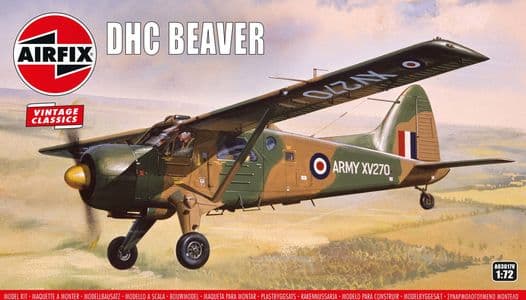
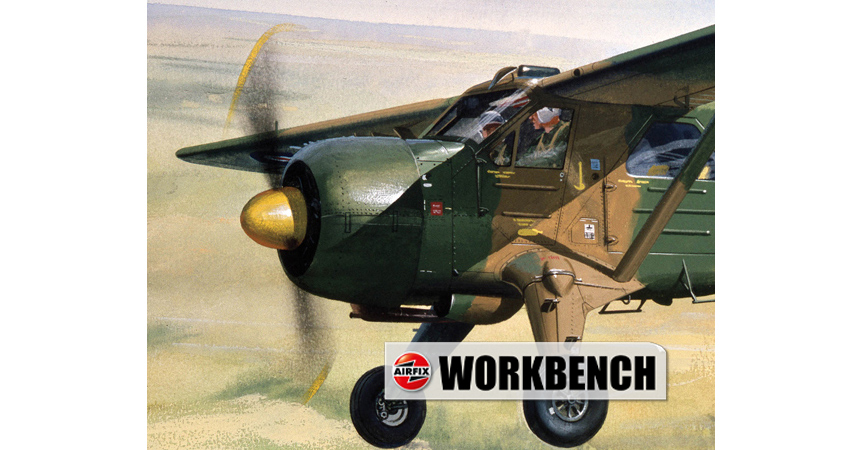
Produced in 1971, this iconic artwork came from the brush of Roy Cross and will be familiar to thousands of Workbench readers. For its introduction into the Vintage Classics range, this original artwork has been restored so it can take its place in an Airfix range once more.
The first flight of the de Havilland Canada DHC-2 Beaver proved to be rather interesting, not because of anything that happened during the flight itself, but more the person who was given the task of performing it. Russell Bannock was a former WWII RCAF fighter pilot and national hero, a man who became one of the leading aces in the European Theatre of Operation. Ending the war as Canada’s second highest scoring ace pilot, he was prolific in destroying V-1 flying bombs over southern England, with no fewer than 19 Doodlebugs falling to his guns, a tally which included four destroyed in less than an hour on one occasion, but was also credited with eleven Luftwaffe fighters destroyed before the end of the war. Perhaps the most interesting fact about this impressive airman was his heritage – actually born Russ Bahnuk in 1919, his family were originally of Polish-Austrian descent and whilst he was flying with the Royal Air Force during WWII, he had two cousins who were flying operationally with the Luftwaffe at the same time!
Right from the outset, the overall performance of the Beaver was incredibly impressive and quickly proved itself to be ideally suited to the unforgiving conditions of the vast expanses of the Canadian North. Allowing operators to get the job done with the minimum of fuss, the aircraft was robust and didn't require any special treatment from the pilot – it just got on with what it was asked to do! Indicative of the rugged nature of the aircraft, the oil reservoir filler for the engine was located in the cockpit, which allowed the pilot to top up his oil levels whilst in flight. Despite being one of the most rugged and capable aircraft in the world at that time, initial sale of the Beaver were rather slow, with perhaps two or three machines being sold each month, but as they went about their business, the many admirable qualities of the aircraft began to circulate and a huge order was just around the corner.
With its own requirement for a new rugged utility aircraft, the US Army were showing great interest in the Beaver, but politically, were facing quite a challenge in convincing the American public that a Canadian design was really their best option. With a need to replace their ageing Cessna liaison aircraft and conflict in Korea looking likely, the robust DHC Beaver was of real interest to them and the competition quickly came down to the Beaver and the Cessna 195 - selecting the best aircraft for the role, the Beaver emerged as the clear winner and the American public would just have to accept the fact. A significant US Army order for 986 aircraft was placed with de Havilland soon after and the attention of the aviation world was immediately drawn to their rugged little Beaver and as you might well imagine, additional orders started flooding in.
In US Army service, the de Havilland Beaver was known colloquially as the 'Generals Jeep' and their order would be the largest single order for the aircraft, also stimulating orders from several other air arms across the world, including the British Army. Production of the aircraft ended in 1967, not because ordering interest in the Beaver had ended, but because the new Company Chairman insisted that he wanted to concentrate all resources towards the development of a new large commercial airliner project. When production ended in 1967, a total of 1692 Beavers had been manufactured, but that proved to be only half the story of this magnificent aircraft.
A true Airfix Vintage Classic, the re-introduction of this fantastic kit will be welcomed by many and will bring the unique attributes of this aviation icon to a new generation of modelling admirers.
With its unrivalled reputation for rugged, no nonsense operation, the Beaver was regarded as the most effective aircraft of its kind in the world and certainly when working the remote routes of Northern Canada. Bush pilots were adamant that the only aircraft capable of replacing a Beaver was another Beaver, something created quite a vibrant industry in the years which followed the end of its production run. With hundreds of former US Army Beavers becoming available following their service withdrawal, several companies started updating, renovating and restoring Beavers for customers all around the world, with the reputation of the aircraft only serving to enhance its appeal. Unfortunately, for an aircraft which originally cost around $30,000 with floats when new, the cost of restoring a Beaver for a new customer might now run to around a million pounds.
With many examples still flying to this day, the de Havilland DHC-2 Beaver is considered something of an aviation classic, a fact underlined in 1987, when the Canadian Engineering Centennial Board named the DHC Beaver as one of the top ten Canadian engineering achievements of the 20th century, an award which was well deserved.
In a move which will be of interest to many hundreds of modellers all over the world, the 1/72nd scale de Havilland DHC-2 Beaver kit is the latest high profile addition to our Vintage Classics range and marks the return of a hugely popular model. With tooling produced in 1971 and artwork created by Roy Cross, this kit will bring back happy memories for many Workbench readers and is surely destined to take its place on many a build schedule over the coming months. Let's take a look at the two scheme and decal options included with this release.
Once the Beaver had entered full production, the many impressive qualities of the aircraft soon attracted the attention of Britain’s military and it wasn't too long before the aircraft entered service with the Army Air Corps. In British service, the aircraft was designated Beaver AL Mk.1 and one of its first assignments was to operate from airfields in the Far East, where the aircraft's rugged nature was very much appreciated. Britain's Beavers were similar in configuration to a standard civilian machine, with just a few relatively minor alterations and were all obviously tail wheel equipped machines, like the ones produced for the US military. They did feature the addition of a pair of bomb racks under each wing, just out-board of the substantial wing strut and although they were capable of carrying a 250 lb bomb load, they were never actually used in a strike role. In fact, they were mainly used to re-supply troops operating in remote areas, or to supply humanitarian aid when safe access by road was difficult.
For pilots, receiving a posting to fly the Army Air Corps Beaver may not have been an enthralling prospect at first, but they soon came to appreciate the hard working, no nonsense capability of this unique aircraft. From a flying perspective, the Beaver's seats were substantial, comfortable and featured the standard four point full harness, but for passengers, a flight was something of a no frills experience. The aircraft could carry five passengers, on rather functional seating, which if required, could quickly be reconfigured to carry either two stretchers with medics, or loaded with cargo and supplies.
Without doubt, the most useful attribute of the DHC Beaver was its magnificent short field capability, something which was aided by the abundance of power generated by the Pratt & Whitney Wasp Junior engine. The twin bladed propeller tips would approach the speed of sound at full power, which gave the Beaver a distinctive and rather loud rasp during take-off, which were often short and with a steep climb out. The dark, dusty camouflage appearance of Army Air Corps Beavers always made them very interesting aeroplanes to look at and with the propeller rasp of a tactical take off, was a difficult aircraft to ignore.
Full scheme details for this British Army Air Corps Beaver AL.1, a scheme which will prove difficult to overlook for many.
British Army Beavers were to see significant service during their time in Ireland, during the period referred to as ‘the troubles’. Based at RAF Aldergrove, in Northern Ireland, there were usually five or six machines based there at any one time and they were employed in conducting joint operations with the Royal Air Force flying reconnaissance and intelligence gathering missions. In November 1979, an Army Beaver was flying a photo reconnaissance sortie over a suspected IRA checkpoint on the South County Armagh/Republic of Ireland border, when it came under machine gun fire. Continuing to fly its assigned mission, the aircraft was hit at least seven times, before flying away and from that point forwards, Army personnel referred to this particular border crossing as ‘Beaver Junction’. Around the area of Aldergrove airfield, the sight of Beavers on operations would have been a common sight for the local population, with some describing take offs in strong winds being particularly interesting - some people were certain that they saw Beavers flying backwards in these conditions.
UK enthusiasts can still see an Army liveried Beaver displaying at Airshow events around the country, with XP820 being owned and operated by the Historic Army Aircraft Flight, the largest aircraft type in their fleet. She is maintained in as close to her delivery flight condition as possible and flies in tribute to all Army pilots, ground crew and engineers who served over the years.
The aircraft depicted in the Vintage Classics kit (XV270) made its first flight on 26th January 1967 and was taken on charge by the Advanced Fixed Wing Flight Army Air Corps at Middle Wallop in early February the same year. She would quickly go on to spend time with the Aeroplane and Armament Experimental Establishment at Boscombe Down, returning to operational flying with the 'Beaver Flight' in Northern Ireland during 1976. Her final service flight took place in November 1989, after which time she was sold to a civilian owner and a commercial flying career in the US. It is thought that the aircraft is still flying to this day, complete with floats and wearing a particularly eye catching livery.
Scheme B - de Havilland Canada DHC-2/U-6A Beaver 53-3727, US Army, 1960s.
By far the single largest operator of the de Havilland DHC-2 Beaver was the US military, who selected the aircraft as their new liaison and aerial evacuation aircraft in 1951. Eventually, almost 1000 aircraft were delivered to the US armed forces, with the majority going to the US Army, but with around 200 Beavers operated by the US Air Force and designated L-20A in US service. Most of these incredibly versatile aircraft would perform a multitude of tasks, from medical evacuation, to laying communications cables, but a seemingly endless list of jobs it was asked to take on included the transportation of troops and supplies, flying mapping and reconnaissance missions, coordinating search and rescue operations and relaying battlefield radio traffic.
US Beavers would see extensive service during the Korean and Vietnam wars, where the rugged qualities of the aircraft and its excellent short field performance earned it a reputation for effectiveness and reliability. Loved by its aircrews and trusted by military officials, the aircraft was soon given the nickname of the 'Generals Jeep', as this became the aircraft transportation of choice for officials flying between strategic locations.
The US military proved to be the largest single customer for the rugged de Havilland Canada DHC-2 Beaver, many of which would go on to see service during the Vietnam War.
With its wide-track undercarriage and magnificent short field performance, the L-20 proved to be the ideal aircraft for close engagement operations during the Vietnam War, where it was often required to move small, specialist teams of troops around the battlefield, often operating into jungle clearings, or the most rudimentary of airfield facilities, acting something like a fixed wing helicopter. If the Beaver was good enough for bush pilots operating in the wilds of northern Canada, then these same qualities would prove incredibly useful on the battlefields of Southeast Asia. The aircraft would also be required to undertake aerial photography duties, drop paratroopers and even drop bombs during its time in Vietnam.
In 1962, the US military redesignated their L-20A Beavers U-6A, even though they continued flying the same long list of existing duties. A rugged performer with the ability to operate in all climatic conditions and in even the most inhospitable of geographic locations, US military Beavers only enhanced the reputation of this magnificent aircraft and would only relinquish its duties following the introduction of more capable rotary aircraft types. At the time of their procurement, the DHC Beaver was the largest aircraft order ever placed for a type not manufactured in the US, a clear indication of how highly they regarded this magnificent aircraft.
An important part of the history of the rugged de Havilland Beaver was its use by the US Military, who very much appreciated the attributes of this magnificent aircraft. This US Navy U-6A was pictured during the 1980s.
The scheme option replicated here is in direct reference to the scheme originally offered with the first release of this kit back in 1971, a float equipped US Army U-6A in its standard olive drab colour scheme. This aircraft was originally built and delivered as an L-20A in July 1954, was re-designated U-6A in 1962 and went on to serve during the Vietnam War in standard wheeled configuration. Not too much is known about either her service or post retirement operations, however, a beautifully clear reference image allows us to accurately place the aircraft in this exact configuration on a specific date in time.
When it comes to the Vintage Classics range, the de Havilland DHC-2 Beaver kit has definitely been one of the models most requested for inclusion in this range and we are delighted that this absolute kit classic will once again be bringing the unique attributes of this magnificent aircraft to a wide modelling audience once more. The latest information we have is that we are expecting the Beaver to arrive in our warehouse in the next couple of weeks, we won't have to wait too long before we can re-engage with this classic kit once more.
Have you dreamed of flying in the iconic Spitfire? It’s the ultimate aviation dream, and we are offering this once-in-a-lifetime experience to one very lucky winner.
There exist few model builders who are strangers to the iconic Spitfire; fewer who can admit they have never dreamed of experiencing a Merlin engine roaring in front of them as they prepare to take to the skies in the legendary warbird. As part of a special new competition, anyone who purchases an Airfix GiftSet or StarterSet, on the Airfix website will be automatically entered into a draw to win a flight in a two seat Spitfire T.9 next Summer.
Entries opened on 1st October 2022 to all who purchase an Airfix GiftSet or StarterSet via the Airfix website.
Strap into the aircraft, experience the Rolls-Royce Merlin start, and then taxy out for pre-flight checks and take-off. This experience will see you flying one of Spitfires.com's TR9's around the local area and over the English Channel. Enroute you'll enjoy the sight of the Spitfire's famous elliptical wing passing over England's green and pleasant land and if you elected to try some aerobatics you'll marvel at the power, manoeuvrability and grace of this aircraft that is over 75 years old. You will also have the opportunity to touch the controls and fly the aircraft yourself.
Deadline: 31st January 2023
For more details, please use this link.
What an unforgettable experience awaits one lucky Airfix modeller.
That’s it for this particular blog, but don't forget that we have a second, Douglas C-47A Skytrain related blog update for you this weekend. We will be back as usual next Friday with more Airfix project updates to tell you about. As ever, we are always interested to hear your views on all things Airfix and particularly in relation to our Workbench blog, so if you ever feel like dropping us a quick line, please do so using our workbench@airfix.com contact e-mail address.
All our social media sites can be accessed by clicking the respective link icons at the foot of this page, or by heading to the Airfix homepage. Other useful Airfix links are:
Facebook, YouTube, Twitter and Instagram official sites
Please join us for more Airfix updates next week and thank you for your continued support.