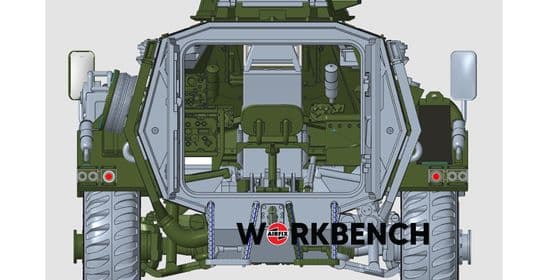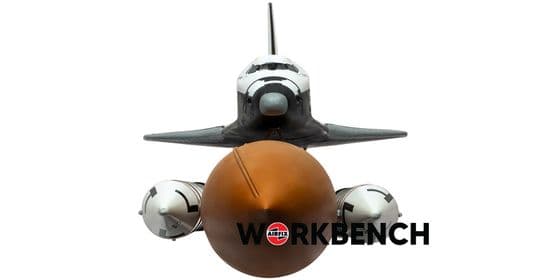
Welcome to this latest edition of Workbench and all the news, updates and exclusive announcements from the fascinating world of Airfix modelling.
This 129th edition of Workbench is already looking like being something of a blog behemoth, simply because there are just so many project updates to bring you. With modelling variety very much the order of the day, you can look forward to our usual collection of exclusive imagery, project updates and supporting information, as another feature packed edition awaits your pursual.
We begin by looking at a pair of Vietnam War classics brought together for an Airfix modelling tribute, before featuring arguably the most eagerly anticipated aviation addition to the Vintage Classics range in the current catalogue. We follow this up with articles looking at a pair of 20th century warships and a Second World War military vehicle which went by a distinctly ecclesiastical name. Relying heavily on our extremely busy photographer David, we are hoping to end with exclusive build images of a recent release which is the third of our 1/48th scale Battle of Britain 80th Anniversary releases, but this will definitely be going right to the wire if we do manage to include them. OK, we have a lot on our modelling agenda, so we had better make a start straight away.
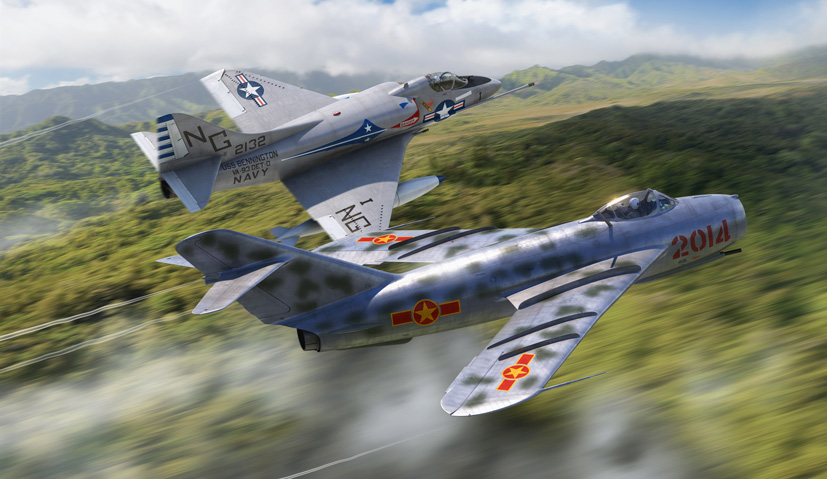
This latest stunning box artwork shows the meeting of two of aviation’s most agile early jets, both extremely advanced in their own right
For those of us who have a great many years invested in the delights of the modelling hobby, the Airfix ‘Dogfight Doubles’ range of kits will probably be remembered with some fondness, particularly when thinking back to the time when the pressures of work and life commitments had not yet entered our heads. Usually coming into our possession as either birthday or Christmas presents, these slightly larger kits included two separate models of aircraft types which could quite conceivably have engaged in combat with each other and included some real classics. With famous pairings such as Spitfires and Messerschmitts (either Bf 109s or Bf 110s), Mosquito and Me 262, Beaufighter and Bf 109G and from an earlier era of aerial combat, the Sopwith Camel and Albatros, these kits combined iconic box artwork with the ability display both finished models in an interesting combat pose. Getting two kits in one box, what was not to like?
A hugely popular kit range over the years, our ‘Dogfight Doubles’ sets are still very much a part of every Airfix model range and regularly benefits from the inclusion of some recent new tooling releases, keeping these magnificent sets as hobby relevant as they have always been. The latest range includes a classic jet pairing from the mid 1960s, aircraft which proved that sometimes the most simple designs were the most effective in a combat situation. Operating in the same hotly contested airspace during the Vietnam Air War, both the North Vietnamese MiG-17F and US Navy Douglas A-4B Skyhawk may not have represented the latest cutting edge aircraft designs, but they were both extremely agile, highly capable and as tough as they come. They make for an ideal Dogfight Doubles pairing.
The Douglas A-4 Skyhawk was a subsonic single engined attack jet intended as a replacement for the piston powered A-1 Skyraider which was developed during WWII but introduced just too late to take part in this conflict. Interestingly, the design philosophy behind the two aircraft could not have been more different, as the Skyraider was an absolute beast of an aeroplane, something of a flying arsenal and one of the largest single piston engined fighter-bombers ever to see service. In comparison, its jet powered replacement was a diminutive jet which was purposely designed to be the smallest and lightest aircraft of its type in the world. Attracting such names as the ‘Tinkertoy Jet’ and ‘Scooter’, the A-4 Skyhawk was so small that it didn’t have to include a folding wing mechanism, even though it was destined to operate from the US Navy’s relatively small former WWII aircraft carriers.
Despite its lack of stature, there was certainly no compromise on the strength and rigidity of the US Navy’s new strike jet, which turned out to be one tough little aeroplane. Designed to be simple to maintain and operate, the Skyhawk was reliable, extremely effective and relatively cheap to produce, whilst at the same time able to carry an impressive weapons loadout, which included the option of carrying nuclear munitions. An attack aircraft which could be flown from virtually any carrier in the US Navy fleet, the Skyhawk was an aggressive little jet and a type which would become one of America’s most important post WWII military aircraft.
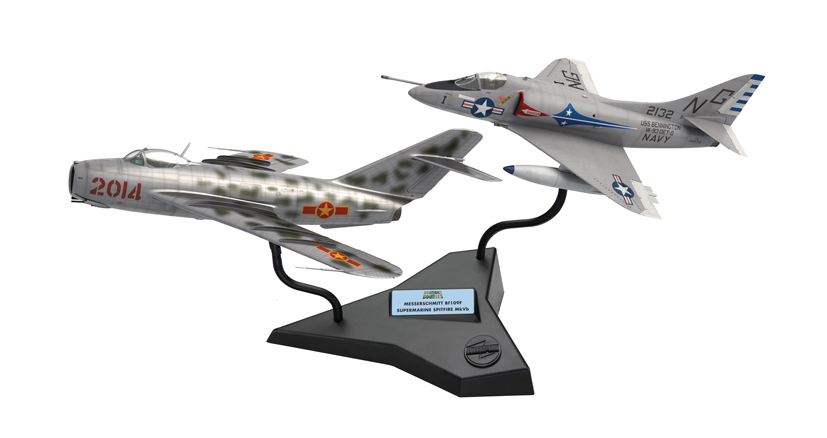
Just to check if you are paying attention, can you spot the deliberate mistake included in this image? Our Dogfight Doubles kits have always been popular with modellers since the first pairing appeared back in the 1960s and whether it is a classic Spitfire v Messerschmitt pairing, or two Vietnam War jets, they always make for an enjoyable build project
An aircraft which preceded the A-4 Skyhawk into world military service, the Mikoyan Gurevich MiG-17F is a classic fighting aeroplane of some repute, one which could be described as a classic combination of the best fighter technology from the Second World War and the latest advancements in transonic flight research. Possessing a devastating array of cannon and machine gun armament, the MiG-17 was designed in the days before effective air to air missiles were available, where agility and firepower were very much the order of the day – it would go on to be described as the Soviet’s last ‘Gunslinger’.
Learning many lessons from the design and service introduction of its predecessor the MiG-15, the Fresco was a fast, high-subsonic fighter aircraft, designed to combat the potential threat of large scale Western bomber incursion into Soviet airspace. Much more than a simple upgrade of its famous predecessor, the MiG-17 represented a further technological leap forward in aviation design and incorporated many improvements over the earlier aircraft, some of which were made as a direct result of feedback from pilots with combat experience. The advanced wing design of the new jet made this the most agile combat jet in the world, an impressive boast the MiG could claim until the introduction of the General Dynamics F-16 Fighting Falcon in 1978.
With both the A-4 Skyhawk and MiG-17 available in large numbers by the time of the Vietnam War, the scene was set for an aviation showdown in the skies of Southeast Asia and a meeting of two of the world’s most agile combat jets.
Scheduled for impending release, our MiG-17F Fresco and Douglas A-4B Skyhawk ‘Dogfight Double’ set comes complete with everything to ger the modeller started, including a tube of poly cement, a selection of paints and paintbrushes. It also includes the following scheme/decal options with which to finish your models.
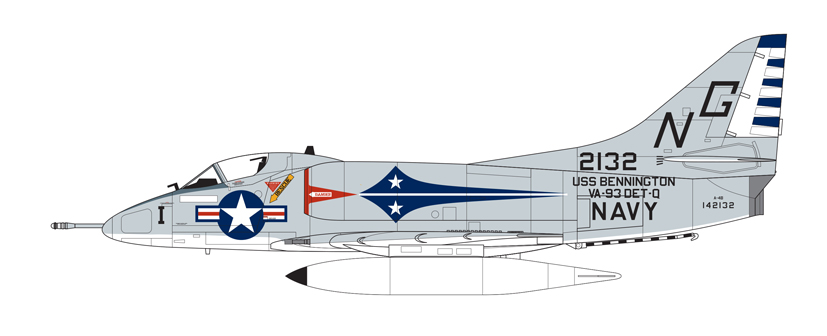
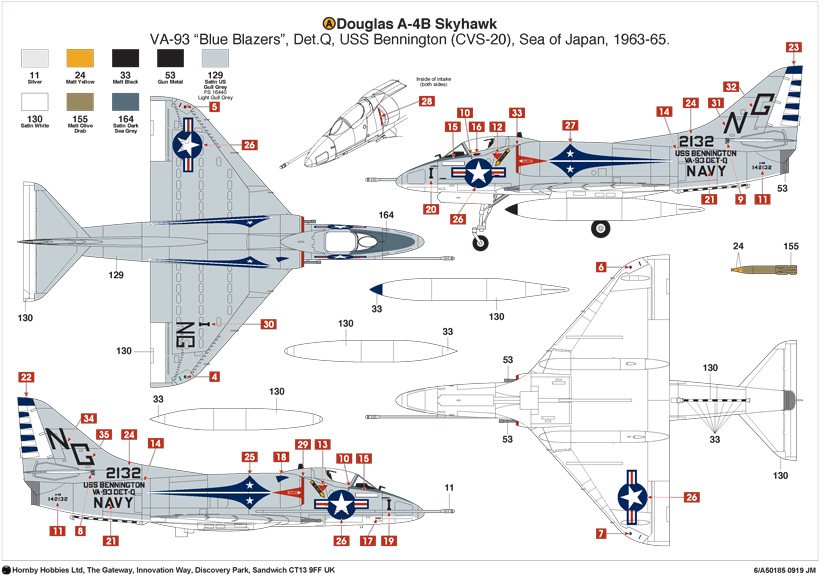
By the time of the Vietnam Conflict, the A-4 Skyhawk had matured into a highly effective strike platform and would be used extensively by the US Navy in Southeast Asia. Able to operate from even the smallest US carriers in theatre, the Skyhawk had a relatively short take off and landing run, yet was capable of carrying an impressive combination of offensive weaponry on its three (in the case of the A-4B) external hard points. The aircraft took part in the first US air strikes of the Vietnam War and from that point, would be used extensively on strike missions against such targets as roads, bridges, power stations and troop concentrations. Importantly, the aircraft would provide vital air support for troops on the ground, flying in at high speed and extremely low altitude to ensure their munitions struck for maximum effect. These missions were extremely risky for the Skyhawk pilots, who were vulnerable to anti-aircraft and small arms fire, with little opportunity to react if their aircraft was hit. Thankfully, the A-4 was a rugged aeroplane and managed to bring its pilot home even after sustaining quite significant damage. During the Vietnam War, the A-4 Skyhawk impressively took part in more combat missions than any other US Navy aircraft.
The primary fixed armament of the A-4B Skyhawk was a pair of Colt Mk.12 cannons, one located in each of the aircraft’s wing roots. These powerful guns would make short work of anything in their path, either in the air or on the ground, however, they only carried a relatively modest ammunition capacity of just 100 rounds each, meaning a Skyhawk pilot could never allow himself to become trigger happy.
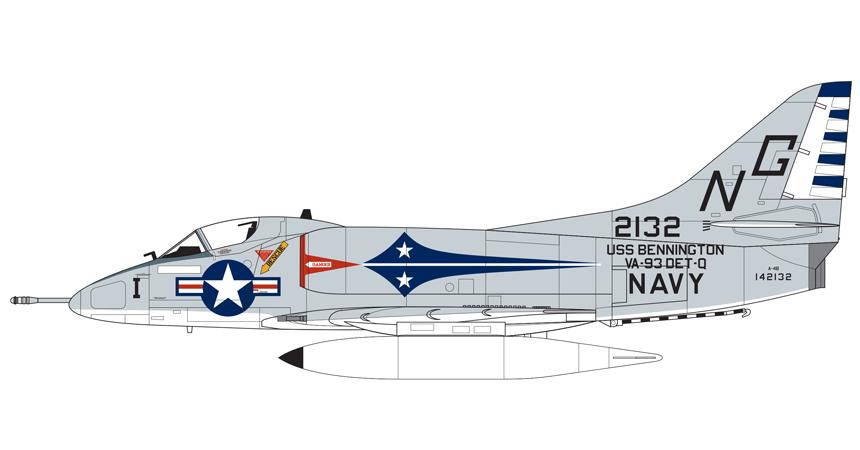
The aircraft pictured above represented US Navy Attack Squadron 93 (VA-93) ‘Blue Blazers’ during a detachment aboard USS Bennington (CVS-20) to the Western Pacific and Vietnam during the mid 1960s. Assigned to Carrier Anti-Submarine Air Group 59 (CVSG-59), the Skyhawks were to provide daylight fighter protection for both submarine hunting aircraft and ships in the group, as they attempted to prevent attacks against their ships, which were most likely going to come from fast North Vietnamese torpedo attack boats. Using their cannon and any external armament carried, the Skyhawks were more than capable of mounting effective attacks at low altitude, using the aircraft’s incredible agility to ensure they were back on target almost as soon as they had finished their previous attack run.
It is interesting to note that during this particular deployment, the Skyhawks of VA-93 retained their usual NG tail codes and did not adopt the NT code applied to the aircraft of Carrier Anti-Submarine Air Group 59. In addition to this, the unit also had to make a change to its existing squadron patch whilst on operations in Southeast Asia, as military officials felt it could be inflammatory to their enemy and cause downed airmen to be mistreated. The original patch featured a skull in front of a nuclear bomb blast, complete with lightning flashes and two sweeping paper aeroplanes, obviously signifying the delivery of a devastating attack sortie by two of the units jets. The much altered, updated version did away with the skull and explosion altogether, whilst retaining the two swooping paper planes, a much more benign, if less interesting design.
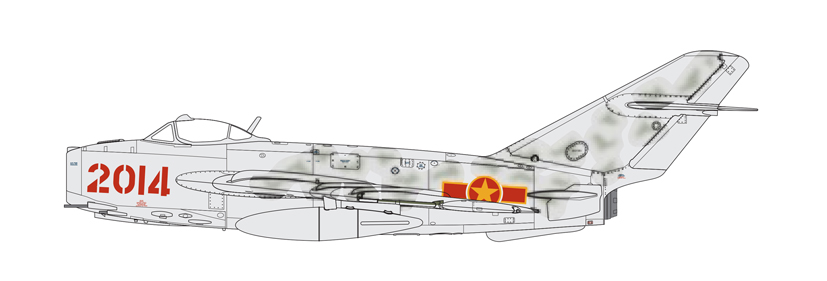
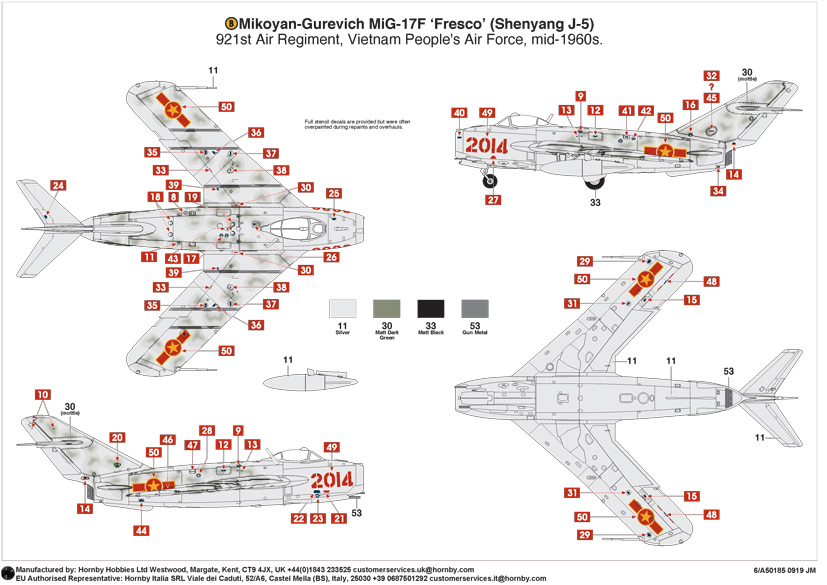
Having the distinction of being the first MiG-17 equipped unit in the Vietnam People’s Air Force, the 921st Fighter Regiment ‘Red Star Squadron’ received its aircraft after their pilots had undergone extensive training in China. Initially, thirty-six former Soviet Air Force machines arrived at their Phuc Yen airfield home base during 1963, with greater numbers of the more capable MiG-17F variant following over the next eighteen months – the majority of these aircraft were Chinese licence manufactured Shenyang J-5 examples. Operational by early 1964, the North Vietnamese MiG-17s would play a significant role in the escalating Vietnam Air War, where they would be forced to fly their almost obsolete jets against the very latest US air power.
Although the US military were aware of the existence of VPAF MiG-17 fighters in the region before they began their concerted bombing strike campaigns, intelligence reports told them that their pilots were still converting to the fighters and it was unlikely that they would be committed to combat during the next few months. In addition to this, their relatively low numbers and the fact that they would be flying in combat against well trained and highly capable US airmen, who were equipped with the very latest aircraft and air-to-air rocket capability, further fuelled their complacency. Initially sending their strike bombers in without fighter protection, the ageing MiG-17s proved to be aggressive and tenacious in attempting to repel the American aerial onslaught and provided something of a rude awakening for US military planners.
Although the MiG-17 and A-4B Skyhawk rarely met each other in close combat dogfights, this did happen on several occasions and it was certainly a meeting of two of the most agile aircraft in the SE Asia combat zone. As far as the pilots of VA-93 were concerned, the threat of MiG-17 anti shipping strikes remained very real throughout their entire deployment, especially when the VPAF started receiving more of the supersonic MiG-21 fighters, releasing the older model for other duties. When flown to its maximum capabilities, in the hands of a competent pilot, the MiG-17 was an extremely dangerous opponent, with its heavy cannon armament capable of destroying any outwitted US airman. Indeed, three VPAF pilots were to achieve ‘Ace’ status whilst flying this classic ‘All Gun’ fighter, despite the fact that it was generally regarded as obsolete when pitted against the latest US air power.
Total loss statistics for both aircraft types during the conflict are difficult to definitively corroborate, however, it is though that 282 Douglas A-4 Skyhawks were lost (195 in combat), compared with 63 MiG-17 losses. What is certain is that when talking about basic, rugged, no frills jet aviation types, both the MiG-17 and A-4 Skyhawk definitely occupy the same historic airspace.
This latest Dogfight Double kit is due for imminent release and should be available through your usual model supplier over the next few weeks.
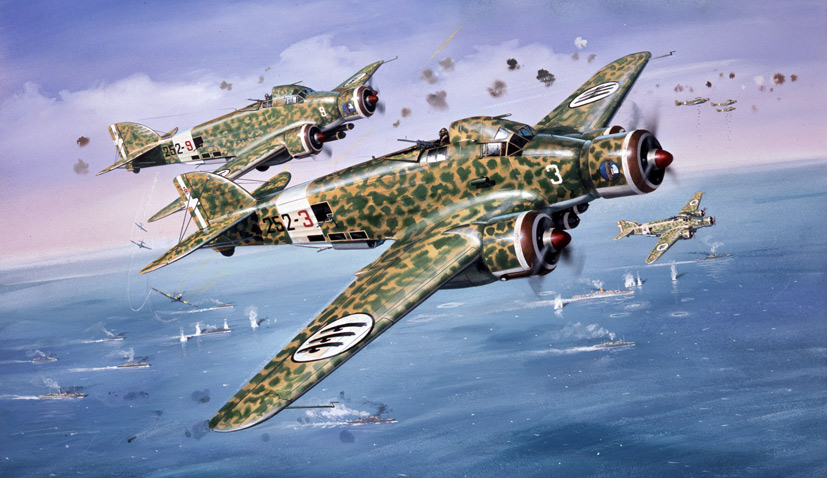
An impending kit release which will absolutely guarantee the continued popularity of the Vintage Classics range, the stunning Savoia-Marchetti SM.79 Sparviero was definitely one of the most distinctive fighting aeroplanes of the Second World War and going off feedback received from modellers over recent months, one a great many of them are looking forward to getting their hands on. An aircraft which began life as an eight seat civilian transport aircraft in the mid 1930s, the three engined SM.79 adopted a clever mixed material construction method which gave the aircraft great strength, which when combined with its outstanding performance, immediately brought it to the attention of the Italian military. As was the case with several other similar civilian aircraft designs of this period, the SM.79 would make a relatively easy transition from civilian to military aircraft, with the strength of the design lending itself readily to the role of medium bomber.
Without doubt one of the most advanced aircraft in the world during the pre-WWII years, the SM.79 would go on to capture an impressive series of world speed records during the second half of the 1930s and at that time, it really did seem as if no air force had a fighter capable of intercepting Italy’s speedy Sparrowhawk. The aircraft would see its combat introduction during the Spanish Civil War, where it again continued to impress Regia Aeronautica officials. Undergoing further development following combat experiences in Spain, the SM.79 would go on to form the backbone of Italy’s bomber force during WWII and see combat operations on every front where Italian troops were deployed.
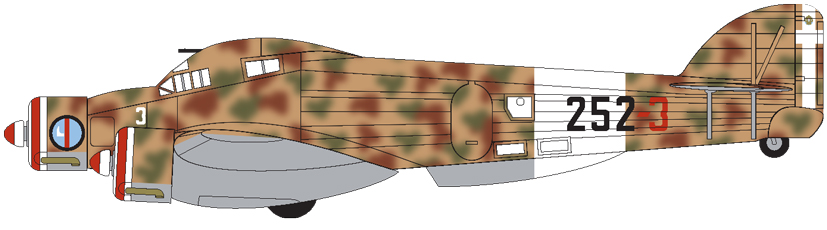
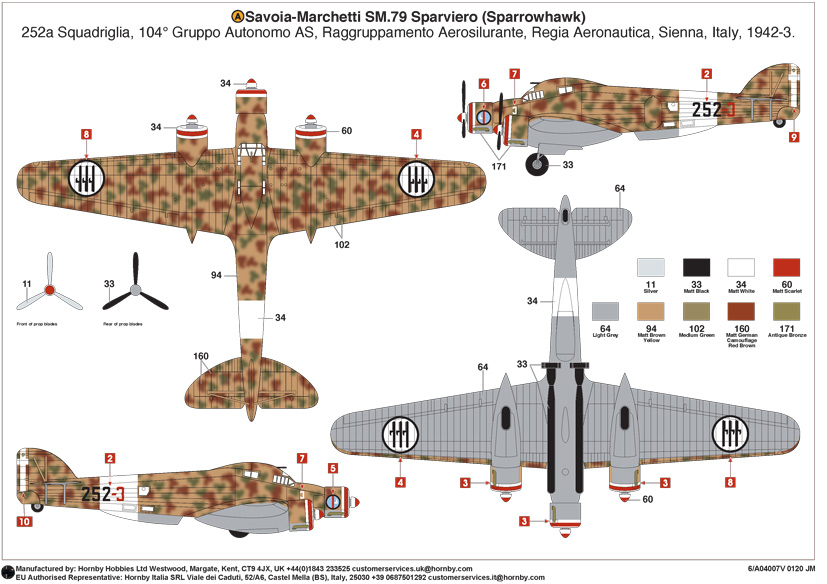
Unfortunately for Italy’s distinctive Sparrowhawk, the pace of aviation advancement as the world careered headlong towards war, dictated that the attributes which made this one of the most capable aircraft in the world during the post war years, made it much less impressive as crews took it to war. In addition to its role as a medium bomber, Italy’s location in the middle of the strategically crucial Mediterranean Theatre dictated that it would also be pressed into service as a maritime strike aircraft, with successful actions against British shipping essential if the Axis powers were going to prevail in the coming struggle. With this in mind, the Regia Aeronautica had been conducting trials with SM.79 Sparrowhawks converted to carry air launched torpedoes for many years and by the time the Mediterranean erupted into conflict, the Italians were ready to deploy their anti-shipping squadrons.
Carrying powerful torpedoes on external mountings under the fuselage of the aircraft, trials showed that carrying a single torpedo made the aircraft much more stable and responsive during the critical launch stage of an attack, even though this did limit the aircraft’s destructive potential. Carrying two torpedoes did introduce some stability issues for the pilot, however, once the first weapon had been released, the aircraft would become more responsive and still have the potential to launch a further attack, assuming they had not sustained damage due to defensive fire. The torpedoes themselves could be launched at distances in excess of 1000 metres from the target, allowing crews more time to evade enemy fire, however, it was discovered that the further away from the target the attack was launched, the probability of scoring a hit was greatly reduced.
In an attempt to increase attack success rates and to allow the Regia Aeronautica to make a telling contribution to the Mediterranean air war, SM.79 crews soon adopted a more aggressive approach, releasing their torpedoes much closer to their intended targets, often in the face of withering defensive fire. Indeed, the Italian torpedo bomber group pilots earned the respect of ally and enemy alike, as they displayed great courage in pressing home their attacks, with little consideration for their own chances of survival. Thanks to the design and construction of this impressive aeroplane, should a Sparrowhawk sustain critical damage during an attack and have to ditch in the sea, the aircraft would sit majestically on the water, allowing the crew ample time to make good their escape and take to their life rafts.
As the war progressed, the Savoia-Marchetti SM.79 became increasingly vulnerable to enemy aircraft attack and despite receiving more powerful engines and increased defensive firepower, the protracted delay in developing the aircraft’s replacement would result in dramatically declining success rates and ever increasing losses. Despite this, the Regia Aeronautica’s tri-motor Sparviero was undoubtedly one of Italy’s finest warplanes of the Second World War and an extremely accomplished anti-shipping torpedo bomber.
From the modeller’s perspective, one of the most interesting features of WWII Italian aircraft is their presentation and looking at this magnificent 252a Squadriglia machine, it is not difficult to see why this latest addition to the Vintage Classics range has been so well received. Combining the distinctive shape of this handsome aeroplane with the attractive three tone upper surface scheme it wears, this will surely encourage many modellers to look for more Regia Aeronautica projects to keep their new Savoia-Marchetti SM.79 Sparviero company. This beautiful new model is scheduled for imminent release and with only a small number of kits remaining unallocated, this really is a final opportunity to make sure you are not one of the ones missing out.
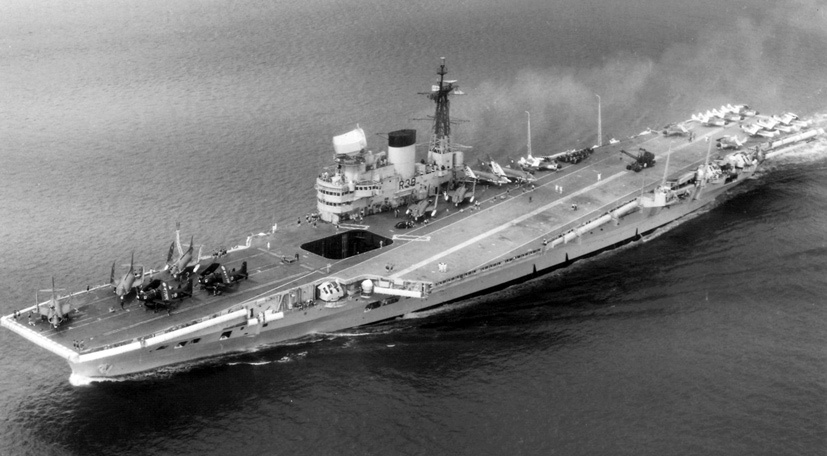
Due to the huge variety of kits produced by Airfix over the years and the way in which each new catalogue presented these models to an already captivated audience, it is unlikely that many modellers were strong enough to resist straying from their usual modelling subject area from time to time. With temptations ranging from Space and Sci-fi to dinosaurs and historical figures, there was always something to have us considering a diversion from our more usual fare of Spitfires and Lancasters. One range which could always be relied upon to captivate a massive modelling audience, our ships allowed active young minds to build scale representations of the sailing ships which were involved in the discovery of new worlds, as well as some of the most powerful warships the world had ever seen. If you enjoyed doing a little research alongside your modelling, these floating wonders became almost irresistible as modelling projects.
The Vintage Classics range is about to welcome the return of two much loved and eagerly anticipated warship kits, one British and one German, but both possessing strong links to the sea battles of the Second World War.
An impressive vessel in every respect, the German Deutschland class ‘Armoured ship’ Admiral Graf Spee was built during the 1930s, around the restrictions imposed by the Treaty of Versailles, following the end of the Great War. Although this prohibited Germany from building warships with a weight greater than 10,000 long tons, the country knew that if they were to prevail in any war to come, they would have to challenge the dominance of Britain’s powerful fleet and have some presence on the world’s oceans. Working loosely around the restrictions, this new ship had a nominal weight which did conform to the weight limitations, however, when she was fully fitted out, she significantly exceeded it.
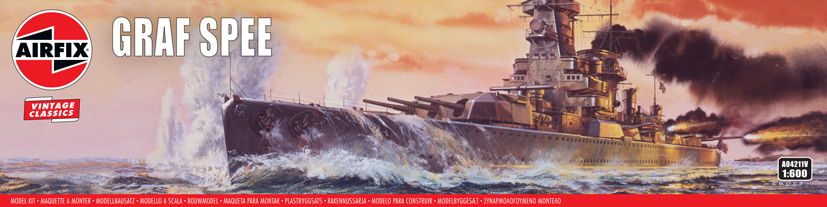
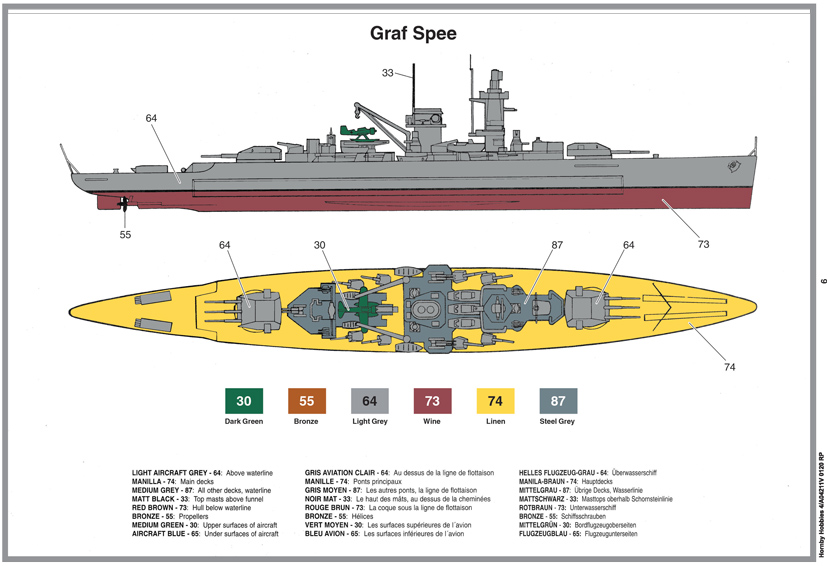
Fast and heavily armed, the Graf Spee was one of the most advanced warships of the day and if any British or French ship were able to catch it, they would struggle to match her main armament of six 11 inch guns. Attending the Coronation Review of King George VI at Spithead in May 1937, the sight of this magnificent ship led the British to christen her as a ‘Pocket Battleship’, a name which is now inextricably linked to these types of ships.
In preparation for war, the Graf Spee sailed for the South Atlantic, where she could raid merchant sea lanes unopposed in the three months which followed the start of the Second World War. Sinking nine merchantmen, the ship was a cause of great concern amongst the British admiralty. Sending three cruisers to deal with the threat, the Battle of the River Plate in December 1939 underlined the destructive potential of this powerful ship, but would ultimately lead to her own demise. Damaging all three of the British ships during a savage engagement, the Graf Spee was herself damaged and had to put in to Montevideo port for repairs, replenishment and to offload her casualties.
Whilst in this neutral port, which only allowed him a 72 hour stay, the ship’s captain Hans Langsdorff was convinced that reports of a powerful British force closing in to finish them off were true and rather than allow his ship to fall into enemy hands, ordered the Graf Spee to be scuttled. Positioned off shore and watched by a huge crowd of local onlookers, the ship was ripped apart by a series of huge explosions, starting fires which would burn for two days. The ship’s crew were to spend the rest of the war interned in Argentina, but Captain Langsdorff, unable to wrestle with the consequences of his actions, took a more radical and distinctly permanent course of action.
The fourth Royal Navy ship to carry the name Victorious, R38 was an Illustrious-class aircraft carrier which was launched in 1939, but would have her commissioning delayed due to the critical situation in the Battle of the Atlantic. Once thrust into action, Victorious would be an extremely busy ship, used in actions to hunt the German Battleship Bismarck, serving on many convoy protection missions and helping to re-supply the beleaguered Island fortress of Malta. Also seeing service with the US Navy during the war, Victorious would travel the world’s oceans in support of the Allied war effort and by the end of hostilities, found herself in the Pacific, where she was positioned for the anticipated final push against the Japanese. If looking at pictures of the ship during her WWII service, it is interesting to note that she featured a traditional straight flightdeck at that time.
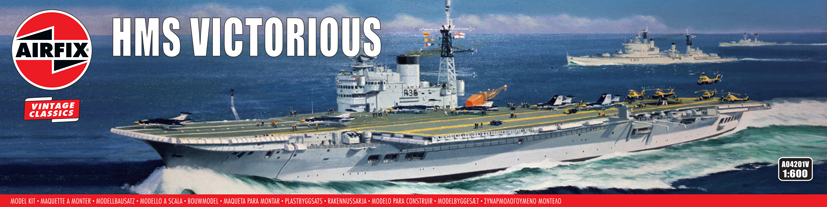
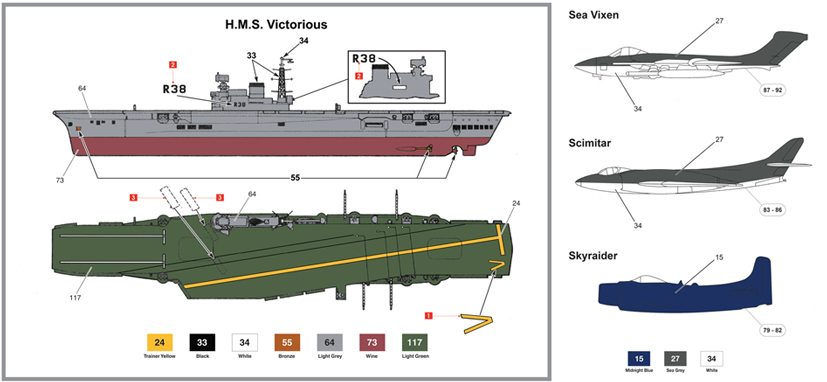
After the war, Victorious spent some time in reserve, before undergoing a significant refit, to bring the warship right up to modern fighting standards. The work included lengthening, widening and deepening her hull, the fitting of new radar and target acquisition technology and the fitting of new boilers. The most visible upgrade was in relation to the ships flightdeck, which was now much more impressive, being longer, wider and now featuring an angled section to aid with the launch and recovery of aircraft.
At this point, it seems appropriate to ask our learned Workbench readers an aviation question – ‘Have Airfix ever produced a model of a Supermarine Scimitar naval strike fighter?’ The answer to this question is Yes, but not in the normal sense of the word. As part of the air wing compliment of this 1:600 scale kit, the model includes scale representations of Sea Vixens, Skyraiders and Scimitars to be positioned by the modeller on the deck of this famous ship.
Due to changing requirements and constantly altering the design of the ship, a later refit was to take an unacceptably long eight years and whilst initially intended that a complete carrier air group would be embarked on the ship, the ever increasing size of aircraft dictated that no more than 28 aircraft (both fixed wing and rotary) were ever deployed on the ship. After a glorious service career, the end for Victorious came with distasteful haste towards the end of the 1960s and a withdrawal which was confirmed at extremely short notice. Scrapped in July 1969, this was a sad end for a ship which had served so valiantly and with such distinction.
Both of these magnificent ships were popular additions to the Airfix model range and their inclusion in the growing Vintage Classics range has been welcomed by many. We are pleased to announce that both are now ‘on the water’ and scheduled for imminent release.
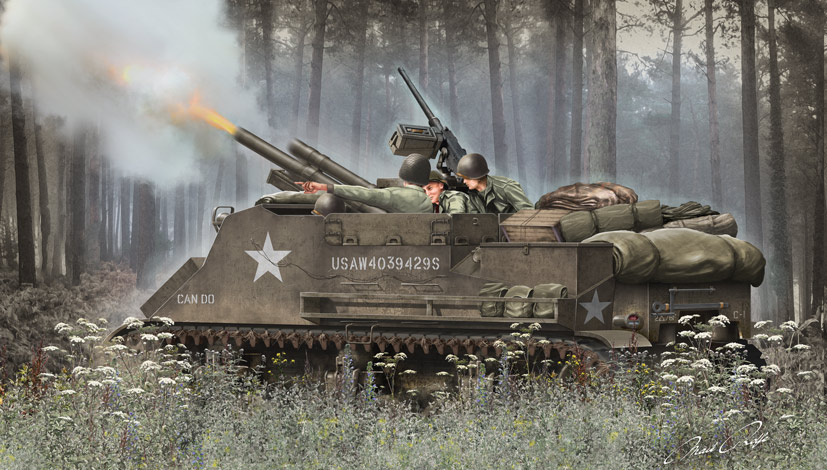
Although it is usually the famous tanks which fought throughout the Second World War which receive much of the enthusiast armour attention, they were not the only vehicles vital to the success of any ground operation. Artillery would pave the way for any infantry advance, in addition to providing suppressing fire against any particularly stubborn pockets of resistance they encountered along the way, but the usual method of towing guns behind tractor units, deploying and constantly re-deploying was less than ideal in a battlefield situation. The answer was to mount a powerful howitzer on a robust, mobile armoured and tracked chassis, which could keep up with advancing units and was able to operate in a mobile and more autonomous manner.
Developed in the US, the M7 Howitzer Motor Carriage mounted a powerful 105mm artillery gun on the chassis of an M3 Medium Tank, allowing this self-contained support unit to possess unrivalled mobility. Removing the turret from the M3, the gun was centrally mounted on an open-topped superstructure, allowing the crew to operate around the recoil of the gun and act quickly in a combat situation. Protected from small arms fire and shrapnel by substantial armour plating, the crew were further protected by the inclusion of an elevated machine gun ring, which afforded the gunner a 360 degree angle of fire. Resembling a church pulpit, this feature of the M7 quickly earned it the nickname ‘Priest’ in British service.
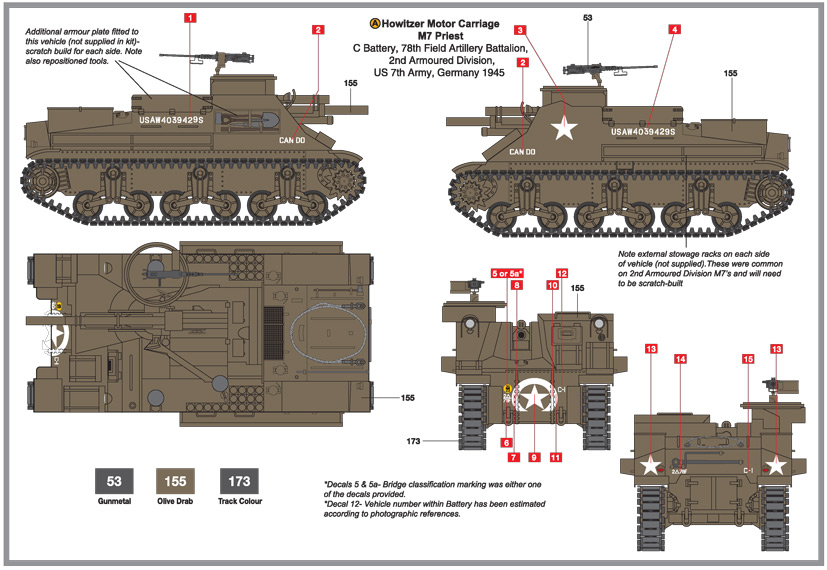
The US 2nd Armoured Division (known colloquially as ‘Hell on Wheels’) had the distinction of being amongst the first US Military units to engage in combat in the European and Mediterranean Theatres during WWII. They would see action from Operation Torch, right through to them being the first American unit to enter Berlin during the final weeks of fighting. During the Normandy invasion, the 2nd landed on Omaha Beach on 9th June, where they dived straight into the action, pounding German targets and attempting to prevent a possible Wehrmacht counterattack.
Providing effective mobile artillery support to ground troops, each US Armoured Division had up to three battalions of M7 HMC’s assigned to it, which reflected the importance in which these vehicles were held when planning any ground operation. Used by all the Allied armoured fighting units in Normandy and the battles to come, the M7 may have been something of an unsung armoured hero of WWII, however, its combat effectiveness could never be called into question.
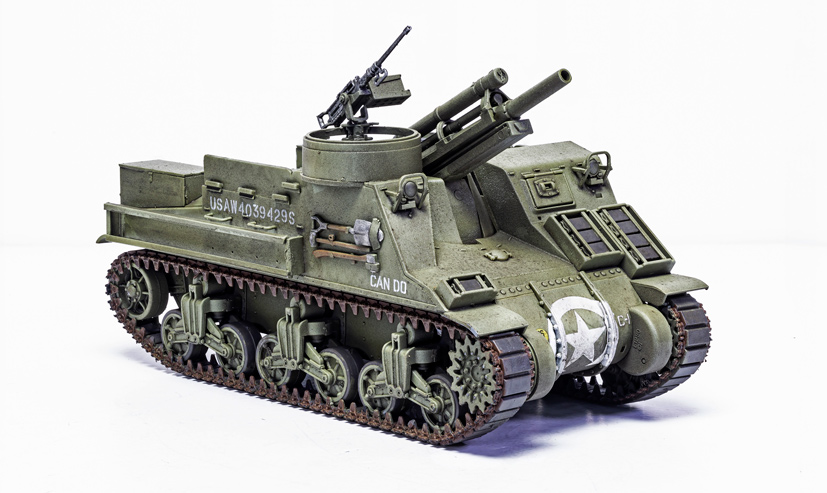
This particular machine was deployed by the US 7th Army during the final push into Germany during 1945 and carries the name ‘CAN DO’ on the side of its hull. This presumably reflects the crews involvement in providing effective artillery support on many previous occasions, as the Allied armies gradually began to push German defenders back towards their homeland right across Europe.

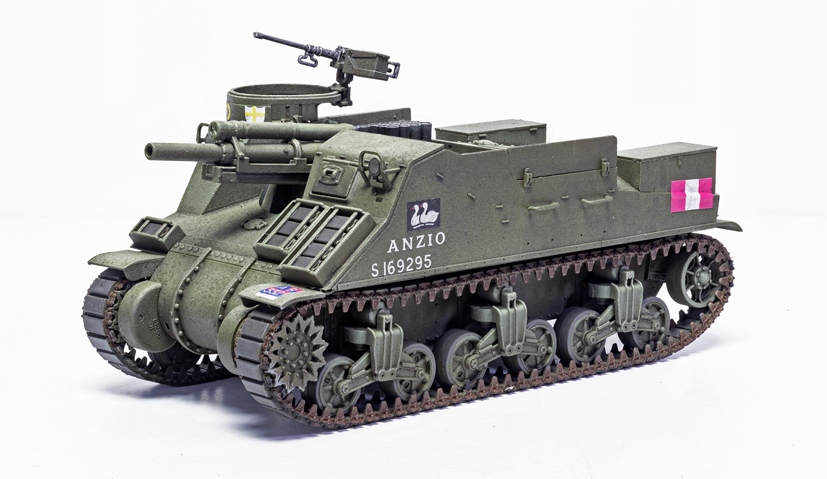
As you would expect, the first examples of the M7 HMC were supplied to the US Army, however, thanks to the crucial Lend-Lease program, quite a number of this early production run would be diverted to British forces, who were in desperately in need of any additional weapons they could get their hands on. During the late summer of 1942, around 90 M7s were sent to the British Army fighting in North Africa, which would see their combat introduction during the Second Battle of El Alamein in October 1942. The mobile howitzers performed admirably during the battle and immediately led the British to place a significant order for a further 5500 machines. As America was now in the war and would be in need of significant numbers of these weapons themselves, it will come as no surprise to learn that this order was never completely fulfilled.
In operation, British crews were well placed to make some observations about the Priest, observations which were fed back to the Americans. These included a recommendation for higher and additional armour protection for the crew and stowed ammunition, in addition to the inclusion of a loading hoist when re-arming the vehicle. Indeed, the ammunition used by the M7 would pose the British some problems throughout its service life, as it still required US ammunition and their was no cross compatibility with British stocks. This would lead to some frustrating supply issues in the field.
The vehicle presented here is one which was the subject of several famous wartime photographs, with its crew using a welcome lull in the fighting to enjoy an ‘Al fresco’ meal by the side of their fighting machine. Christened ‘ANZIO’ by her crew, this Priest was involved in the heavy fighting which took place during the Italian campaign, as the Allies attempted to break the stubborn resistance of the Gustav Line and to finally use this second front as a springboard to launch offensives into Germany itself.
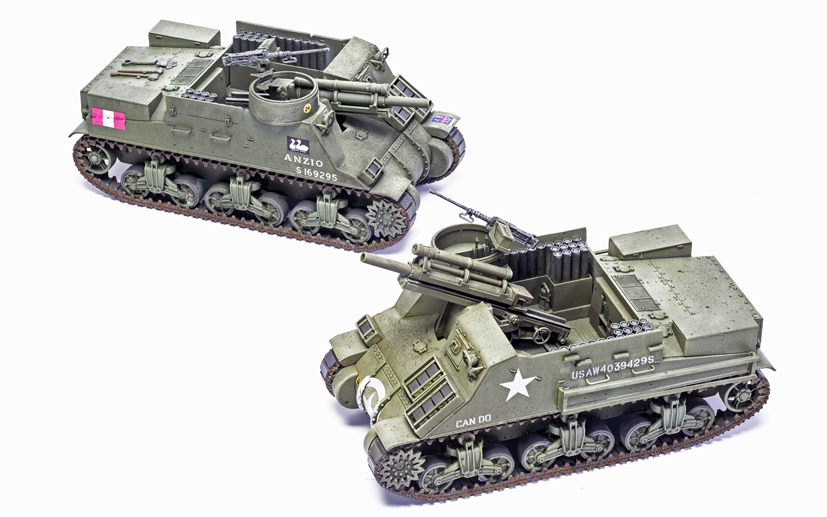
This fantastic image shows built examples of both scheme options which are included with this latest 1/35th scale armour kit
The landings at Anzio were an attempt to sever the Gustav line and hasten the capture of Rome, bringing about a significant change in fortunes for the Allied forces in Italy and effectively split Germany’s defensive forces. Although the amphibious landing undoubtedly placed a strain on D-Day planning and affected the size of the landing force at Anzio, the operation itself was a success and took German commanders in the area by surprise – it has since been reported that some where actually taken prisoner whilst still wearing their pyjamas. Unfortunately, the opportunity to secure a decisive victory was not taken and rather than rushing into Rome whilst the German defenders were still in disarray, the Allies dug in and the Germans quickly got their act together. Launching concerted and effective counterattacks, the war in Italy once again descended into heavy, close quarters fighting.
Equipped with high explosive anti-tank shells, explosive and smoke shells, the M7 Priest proved to be a vital component of the ground war following its combat introduction in October 1942, with many examples going on to see service across the world long after the end of the Second World War.
The latest edition to our growing and incredibly popular range of 1/35th scale armoured fighting vehicle kits, the HMC M7 Priest is scheduled for imminent release and should be available in model shops over the next few weeks.
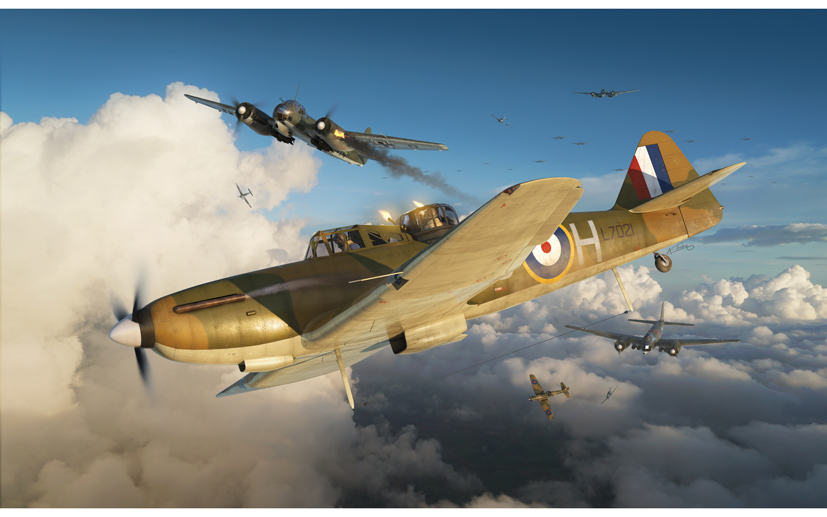
We end this latest colossal edition of Workbench by marking the release of the third and final model in our trio of 1/48th scale releases which were intended to mark this year’s 80th Anniversary of the Battle of Britain commemorations, the stunning Boulton Paul Defiant Mk.I. In addition, we are delighted to do this by showcasing an exclusive selection of built model images featuring the new Defiant, once again courtesy of our modelling superhuman, Paramjit Sembhi. Clearly demonstrating his ability to live without sleep, Paramjit has been at it again, turning round this magnificent build in super quick time and in addition to fulfilling all his usual work tasks. The sight of these beautiful images should also put us all on notice that this highly anticipated model is now here and it will not be around for long.
RAF No.264 Squadron reformed at Sutton Bridge on 30th October 1939, where it became one of the ‘Madras Presidency Squadrons’ as the aircraft they were to be equipped with were purchased with money gifted by the Presidency of Madras’. In December 1939, the squadron was at full strength and moved to Martlesham Heath for training and trials with their new Boulton Paul Defiant Fighters, the first RAF squadron to be equipped with this aircraft. Their time working up to operational status proved somewhat frustrating, as these new aircraft suffered from numerous niggling technical issues, most commonly associated with hydraulics and engine installation.
The first of the squadron’s Defiants were made operational towards the end of March 1940, but even at this early stage, there were misgivings about the aircraft’s ability to survive in combat against the much vaunted Messerschmitt Bf 109 fighter in a daytime role. This uncertainty appeared to continue throughout the following few weeks of training, as crews embarked on an intense period of flight training in both day and night fighting tactics.
Pilot David ‘Bull’ Whitley joined No.264 Squadron straight from successfully negotiating his flight training courses and before the unit moved to Martlesham Heath. He was going to fly the new Defiant turret fighter and would go on to forge a successful working relationship with his assigned air gunner Sgt. Robert Charles Turner, a team which would fly together throughout the savage fighting which followed the German Blitzkrieg offensive in Western Europe.
In May, 264 Sqn. moved to Duxford airfield so they could be nearer to possible combat zones and whilst one aircraft was kept at a state of constant readiness both day and night, the rest of the squadron continued with the intensive training which would soon stand them in good stead. The retreat of the BEF towards Dunkirk saw No.264 Sqn. thrust into combat, where they would be used in conjunction with RAF Spitfire and Hurricane fighters. This was a considered tactic to fool Luftwaffe pilots into thinking they were attacking a standard RAF single engined fighter, with their misjudgement being confirmed by an unexpected hail of bullets heading in their direction.
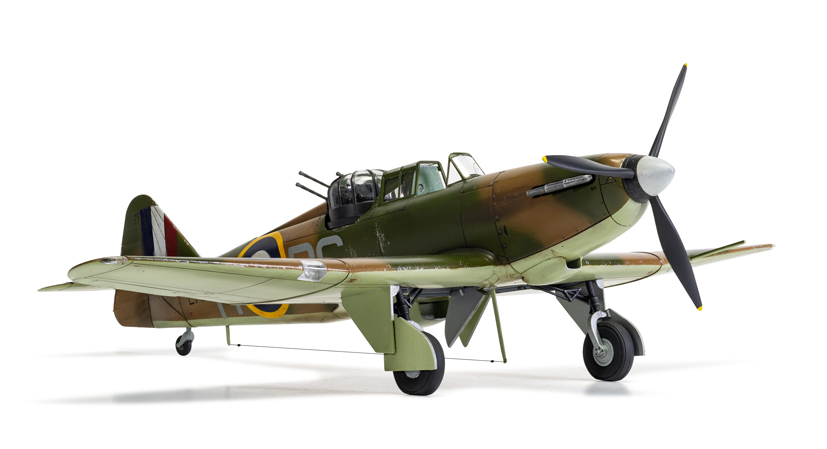
Well, we are delighted to say that our Photographer David M managed it, as he has just supplied us with these magnificent Defiant build images. The latest impressive modelling creation off the conveyor belt of projects our product designer Paramjit Sembhi has been turning out recently, this beautiful build surely highlights how this slightly less fashionable RAF home defence fighter makes for a stunning modelling tribute to this Battle of Britain 80th anniversary year. When combined with the previously released Spitfire and Hurricane, could there possibly be three better looking models to mark the achievements of Churchill's 'Few'?
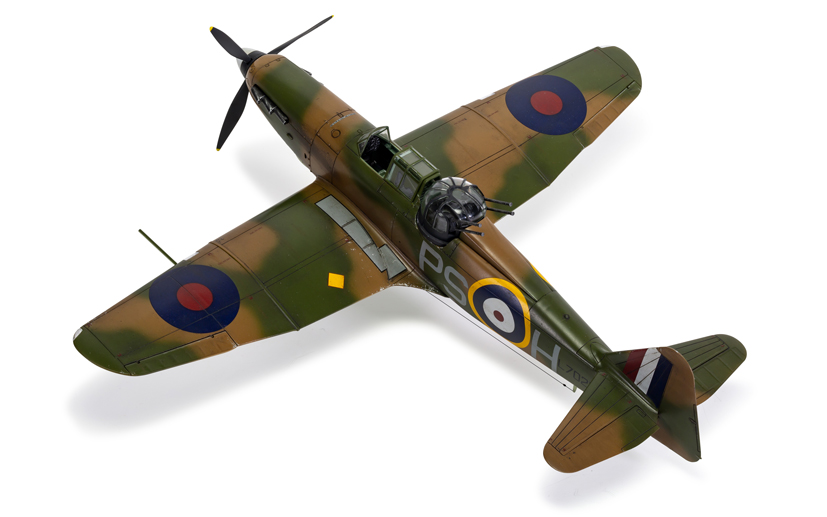
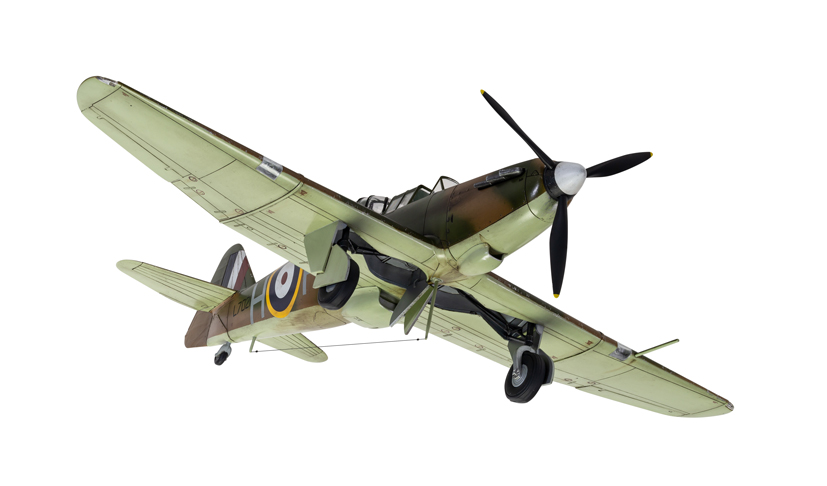
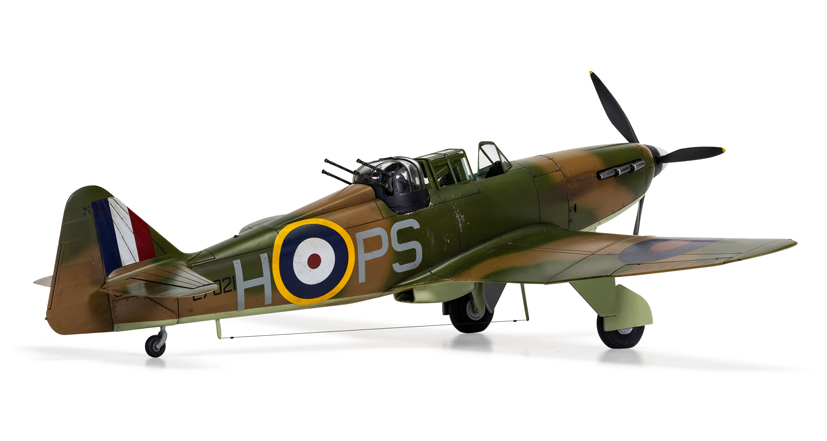
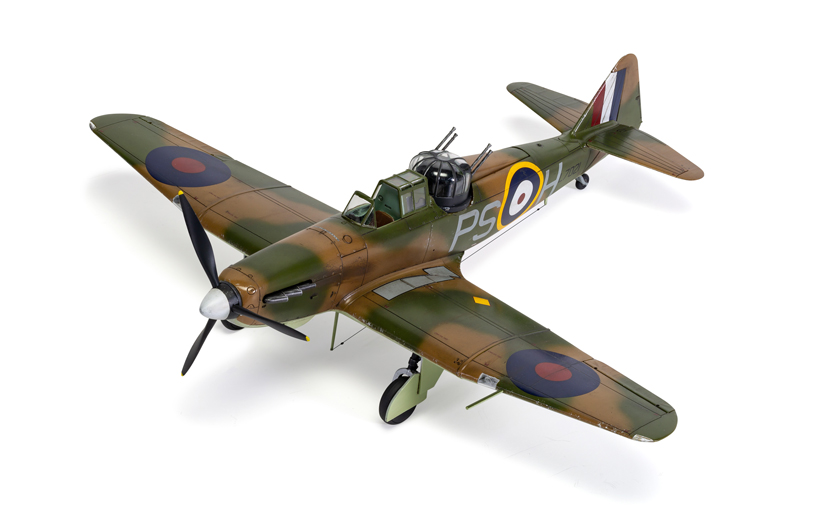
During these early exchanges, the Defiants posted encouraging results, with 24 enemy aircraft being destroyed without loss by 28th May. Without question, the most successful day for No.264 Squadron’s Defiants occurred on 29th May 1940. During combat operations over the Dunkirk beaches, Defiants destroyed 37 Luftwaffe aircraft in two sweeps over the area, figures which included 15 Bf 110 Destroyers, 2 Bf 109 fighters and no fewer than 19 Ju-87 Stukas. This would definitely prove to be the highpoint of RAF Defiant operations, as the Luftwaffe quickly learned the weak points of the British turret fighter and how best to launch their attacks.
From the very next day, Defiants began to fall to the guns of the Luftwaffe and would quickly be withdrawn from the fighting. June and July would be spent in a period of rest and replenishment, but in these early actions, the squadron had claimed 65 enemy aircraft for the loss of 14 Defiants – the fighting partnership of Whitley and Turner had also gained ‘Ace’ status, having claimed 5 enemy aircraft over the beaches of Northern France.
The ‘ace’ crew of Whitley and Turner first flew Defiant L7012 in early August 1940 from their training base at Kirton in Lindsay and later the same month, flew it with the rest of the squadron down to a new home at RAF Hornchurch. On 24th August and at the height of the Battle of Britain, they were scrambled to intercept a large enemy raid approaching the Kent coast and in the ensuing combat over the Manston area, they managed to shoot down a Junkers Ju-88 bomber, but not before it had severely damaged their own aircraft. Despite the damage, Whitley was able to nurse the fighter safely back to Hornchurch.
Four days later, whilst flying a different Defiant (N1574), the two airmen were tragically lost having been shot down over Thanet by a strong force of JG26 Messerschmitt fighters. Their previous aircraft L7012 was also lost during the same actions in what proved to be an extremely bleak day for No.264 Squadron. By 1st September, the squadron had been withdrawn back to Kirton and out of daytime combat operations for good.
This latest 1/48th scale Boulton Paul Defiant is in stock now and selling out fast. With the kit featuring two classic Defiant schemes, we don’t expect this one to be around for long, particularly as it makes for an idea way in which to make our own modelling commemoration of this year’s Battle of Britain 80th Anniversary.
We are afraid that’s it for another edition of Workbench, however, we will be back as usual in two weeks’ time with a further selection of Airfix modelling delights for your enjoyment. If you have any suggestions for subjects you would like to see covered in a future edition, please use this workbench@airfix.com link to contact us.
In between new editions of our blog, the Airfix conversation continues over on our Airfix Forum Worbench thread, with further discussions taking place on both the official Airfix Facebook page and the Airfix Twitter channel - please do get involved in the discussions and let us know what you think about Workbench.
Whenever you decide to visit, the Airfix website is always the place to be for all the latest model availability information, previous editions of our blog, a selection of modelling tips and much more.
The next edition of Workbench is due to be published on Friday 24th July, when we will have more interesting features from the world of modelling.
On behalf of the entire Workbench team, thank you for your continued support our Airfix blog.
The Airfix Workbench Team
© Hornby Hobbies Ltd. All rights reserved.