Welcome to this latest edition of our Workbench blog and all the news, updates, and modelling exclusives from the fascinating world of Airfix.
We are pleased to be taking a slightly different course with this week’s edition of Workbench, firstly by featuring a classic British helicopter type as our lead update, but also by bringing you our latest double blog posting weekend. Having spent the previous few weeks informing readers about the latest kit developments which represent our scale tributes to classic jets, iconic WWII fighters aircraft, tanks and even a high-tech lifeboat, we haven’t had much in the way of rotary action going on of late, but that’s all about to change this week.
If we are about to include our scale tribute to a British helicopter type in the latest Airfix model range, we thought that we might as well make it something of a classic release. The latest impending addition to our 1/72nd scale model kit range is our tribute to a rugged and hard working utility helicopter which earned a reputation for toughness during its 36 year service career, and as far as the Sea King HC.4 Commando is concerned, you most certainly knew that if one of these beasts were in town, it would be full of troops who love nothing more than sorting out a bit of trouble. A fabulous addition to the current range, we will be showcasing new box artwork and looking a little more closely at the two appealing scheme options from a kit which will surely be high on the build schedules of many a Workbench regular.
In our second, separately posted blog for the week, we will be marking the induction of a true Airfix kit classic into the Vintage Classics Hall of Fame, as we take a closer look at the incredible Hawker P.1127, an aircraft which was the forerunner of the Hawker Siddeley/BAe Harrier, one of the best loved British aircraft of all time.
A bumper ‘dual’ edition of Workbench is awaiting your inspection this weekend.
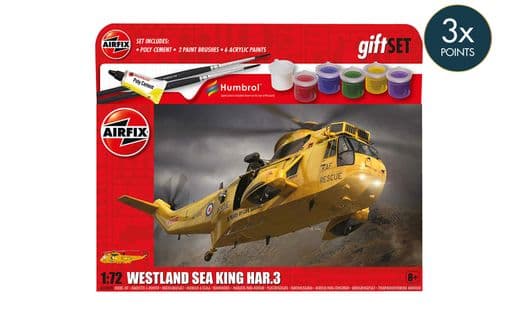
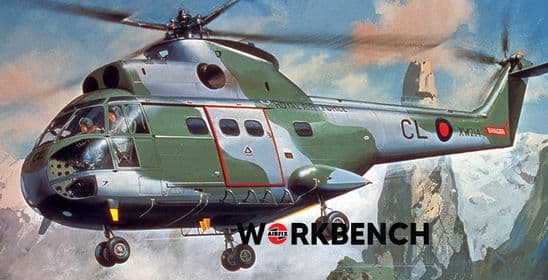
Previously released Sea King box artwork, this time showing the aircraft in RAF HAR.3 configuration. When we needed their help, these rotary ‘Angels on our shoulders’ were always there – no wonder we loved them.
Although many of the world’s most famous aircraft were those which contested the aerial duals of the Second World War, or blasted through the skies during the terrifying cold war period, it has to be conceded that some of the post war era’s most effective aircraft aren’t the fastest or most streamlined designs ever produced. Representing a family of aircraft which rose to prominence in the years which followed the end of WWII, helicopters possess the ability to do things other aircraft types are simply incapable of doing and have therefore proved themselves indispensable in so many applications, both military and civilian. As a result, helicopters are always at the forefront of operations in times of conflict, or spearheading a humanitarian response, be that in an offensive, supply, covert, reconnaissance or medical evacuation capacity. In essence, helicopters are pretty indispensable.
A name which has always been at the very forefront of world helicopter design and development throughout the post war era, America’s Sikorsky Company were awarded an important contract to produce an all-weather, amphibious helicopter for the US Navy in 1957. Its primary mission profile would be that of an anti-submarine warfare aircraft, protecting the US fleet from possible attack, however, the aircraft would prove adaptable enough to take on a multitude of secondary roles, going on to become one of the truly great aircraft of the 20th Century. The aircraft, which was given the designation SH-3 Sea King, was produced with an amphibious hull, giving it the capability to land on water, in addition to its more usual environment on the decks of numerous US Navy warships.
Powered by a twin turboshaft engine arrangement, the Sea King was an impressive machine, capable of carrying significant loads of men, equipment, or general supplies, providing the US Navy with a truly revolutionary new aircraft. On entering service in 1961, the Sea King was the most advanced aircraft of its type in the world and presented the US Navy with one of the most flexible aviation platforms available at that time.
Keen to maximise the commercial success of their impressive new helicopter, Sikorski went on to develop a civilian derivative of the SH-3 Sea King, a helicopter which carried the designation S-61 and an aircraft which was immediately of interest to many of the world's naval air arms. At around this time, the Royal Navy had become concerned about the growing threat posed by the constantly expanding Soviet submarine force and were looking to equip their ships with a powerful helicopter capable of detecting and destroying this underwater menace. Looking for an aircraft to initially work alongside, then ultimately to replace their Wessex fleet, a decision was taken to request Sea Kings from America in the mid 1960s, but Anglicised versions of the original aircraft.
Computer rendered image created from the 1/72nd scale Westland Sea King design files, highlighting the fact that several versions of this famous aircraft can be produced from the tooling.
In Britain, a robust existing licence agreement between Sikorski and Westland had already seen large numbers of S-51 Dragonfly, S-55 Whirlwind and S-58 Wessex helicopters manufactured for the UK military and this agreement was extended to include the S-61 Sea King. The benefit of waiting five years following the aircraft's US Navy introduction was that the Sea King, which had already undergone extensive trials and almost constant in-service evaluation, was now an extremely mature helicopter and they were not only assured of its capabilities, but also the fact that it was capable of taking on many more roles than those it was initially intended to do. Placing an order for sixty aircraft in June 1966, at that time, this represented the largest order ever placed with a British company for helicopters.
As previously mentioned, the licence agreement between Sikorski and Westland allowed the Yeovil based company to make changes to the original design of the aircraft, in order to effectively integrate the Sea King into British military service. Whilst the external appearance of the British built Sea Kings may have resembled those of their cousins across the Atlantic, internally, these were very different machines. Perhaps the most significant difference came with the selection of a new powerplant, with a pair of Rolls Royce Gnome turboshaft engines replacing the General Electric T58-GE-10 turboshafts used on US machines, however, Westlands would also develop the design to incorporate technologies and systems tailored towards British (Royal Navy) requirements, including the latest electronic innovations from leading British aerospace companies.
Once in Royal Navy service, whilst British and American Sea Kings were both initially required to perform the vital anti-submarine warfare role, they would actually be operated in very different ways. US Navy Sea King operations were integrated under the tactical control of the aircraft carrier on which they were based, with these vessels typically being much larger and arguably much better equipped than their British counterparts. In contrast to this, British machines operated very differently and were required to be much more autonomous – Royal Navy Sea King crews often operated alone and were required to coordinate search and attack missions with other aircraft and surface vessels as and when required. The crew arrangement on British machines also differed slightly, in that the observer on board a Royal Navy Sea King would perform the role of sortie controller, as opposed to the aircraft's pilot, as was typical on US Navy aircraft.
Another computer rendered image from the design files, this time showing the rotor folding system which was also a feature of the Sea King HC.4 Commando helicopters.
The hugely capable Westland Sea King was selected by the Royal Navy to meet their requirement for an anti-submarine warfare helicopter, replacing the venerable Westland Wessex in this role, but with the Wessex continuing to serve with distinction alongside the Sea King in other roles. The first Westland built Sea King flew from their factory facility at Yeovil on 7th May 1969, with the first Royal Navy machines being delivered to No.700 Naval Air Squadron (Operational Evaluation Unit) at Royal Naval Air Station Yeovilton later that same year. In Royal Navy service, these first Sea Kings were designated Sea King HAS.1.
As the Sea King became established in Royal Naval service, it quickly showed itself to be both operationally capable and highly adaptable, a significant upgrade on previous rotary capabilities. As a result of its incredible versatility, the Sea King was destined for a long and illustrious service career, whilst at the same time earning an enviable reputation for both serviceability and reliability. Capable of operating from ship or shore stations, by both day and night and in all weather conditions, the Sea King quickly became the helicopter against which all others would be judged, a truly magnificent aircraft. From its initial anti-submarine role, the Sea King would also go on to serve in Search & Rescue, anti-surface shipping attack, airborne early warning, communications, surveillance, logistic re-supply, troop transport, medivac and special forces roles, underlining its credentials as one of the most successful aircraft of the 20th century and beyond.
During a 49-year career with the British military, could this magnificent aircraft have been given a more appropriate name, as it most definitely became the King of the Sea in aviation terms.
Old Airfix artwork is still good Airfix artwork. This image was produced in support of the initial release from this popular tooling back in 2015.
The Sea King may have been conceived as a fleet defender, protecting surface ships from submarine attack, however, it quickly proved itself to be capable and adaptable enough to tackle a variety of different roles, becoming a vital component in any air arm in which it served. One of the most extensively modified variants of the Sea King was the Westland Sea King HC.4 Commando, an incredibly capable amphibious assault and support helicopter used by the Royal Marines, an aircraft specifically required to deliver, supply and extract troops in a variety of tactical situations, whilst retaining the overall usability of the Sea King in a multitude of operational situations.
Strangely for an aircraft dedicated to the support of seaborne troops, the HC.4 was based on a variant of aircraft developed for desert operations in Egypt and Qatar and are distinguishable from other variants by the fact that they did away with the large undercarriage float sponsons which were such a feature of earlier variants of the helicopter, replacing them with fixed main landing gear.
The aircraft also featured a folding main rotor system and a folding tail boom for ease of stowage on a British naval vessel and were capable of carrying 28 fully equipped troops over a range of around 600 miles. Ideally suited to amphibious warfare and the tactical insertion of ground troops, the 'Commando' proved to be an important variant of the Sea King. It was initially proposed as a tactical transport for the Egyptian Air Force for which the amphibious capability of earlier Sea Kings was not required and so the side floats were deleted. With folding rotors and tail, the Commando entered service with the Royal Navy as the Sea King HC.4. It would eventually be provided with radar-warning and infrared jamming devices, and could also deploy M130/M147 flares as countermeasures.
Spot the differences! This computer rendered image features the tooling in HC.4 Commando configuration, but can you spot the major differences between the two variants?
Besides troops, it could also be fitted to carry underslung loads of up to 2.5 tonnes. Increased range and a 28-troop capacity made it ideal as an amphibious transport aircraft, and the HC.4 would see operational service in the Falklands, Balkans, Gulf, Lebanon and Afghanistan conflicts. It was often deployed in order to evacuate wounded personnel and refugees, as well as preparing for and supporting ground advances.
Finished in a sinister olive green scheme and sporting a door-mounted 7.62mm general purpose machine gun, the Royal Navy eventually received 42 newly built HC.4 Commando helicopters, with deliveries beginning in 1979. Taking on the tactical effectiveness the helicopters of the Vietnam War had shown the world’s military, the Navy’s Commandos were incredibly sinister looking machines and from an operational perspective, the first time you knew one of these helicopters was upon you is when they started shedding their load of Royal Marine troops near you, by which time you knew you were in BIG trouble.
Retired in March 2016 after a spectacularly successful 36-year service career, the Commandos of the Royal Navy’s Commando Helicopter Force were replaced by Merlin Mk4/4a helicopters inherited from the Royal Air Force. These mighty helicopters further enhanced the capabilities of the force, which are now considered the most advanced amphibious battlefield helicopters in the world.
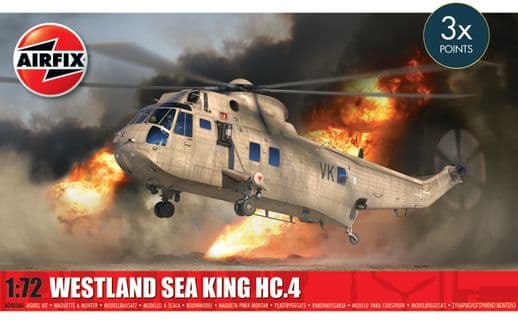
Now on to the real good stuff. An exclusive first look at the new box artwork produced in support of this latest release from our 1/72nd scale Sea King tooling, one which draws inspiration from details behind the service history of the helicopter in the second available scheme option with this kit and its deployment during Gulf War I.
From an Airfix perspective, the Sea King has been a perennial kit favourite since its initial 1/72nd scale introduction back in 1969, initially in its iconic SH-3D US Navy configuration and later in its guise as a Royal Air Force Search and Rescue helicopter. A clear indication of the huge affection these aircraft were held in by the British public, is how they were always seen as angels on our shoulders when we found ourselves in times of need, and from a modelling perspective, how the Sea King kit was always amongst the most popular model releases in any Airfix range in which they appeared. This popularity almost guaranteed that this much loved subject would be destined to become a new tooling subject at some point.
That time came in 2015 when a new Sea King tooling project was announced in one of the earliest editions of Workbench, although by this time, much of the design phase had already been completed and the new kit was heading towards its initial release. That first release presented the kit as an HC.4 Commando variant and we’re delighted to be welcoming this fantastic kit back to the current Airfix range in that same release configuration, for what will only be the fourth release from this tooling.
Let’s take a closer look at the two scheme options included with this latest release:
Over the years, the helicopter has proved itself capable of operating in some of the most unforgiving conditions, allowing military operations to be initiated and supported in areas where other aircraft simply wouldn’t be able to go. As a result, helicopters are usually found at the spearhead of any military operation, the first aircraft in when troops are needed on the ground and the last ones out when troops and equipment are extracted.
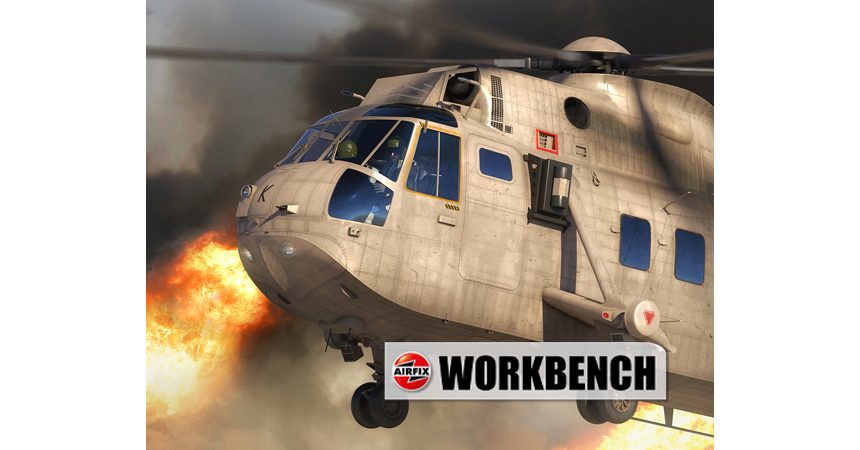
Anyone who has ever been fortunate enough to attend one of the many Airshows held at RNAS Yeovilton over the years will no doubt have fond memories of how Yeovilton liked to bring each of their events to a close, with their popular Commando Helicopter assault finale. A simulated role demonstration where Royal Navy assets react to and quickly neutralise a hostile enemy threat using air and ground assets, these demonstrations are always popular with the crowds because they are dynamic, exciting and have lots of bangs and fire!
The idea behind the role demonstration is to provide spectators with an idea of the work Royal Navy personnel carry out in support of British interests around the globe and specifically, how Commando Helicopter Force deploys its assets in order to place Royal Marine Commandos in the most effective position of influence – these highly trained troops make up one of the most feared fighting forces in the world.
In this exciting set piece scenario, insurgent activity on the ground is reported to military headquarters, who dispatch assets to deal with the situation quickly and effectively. Fast air assets will first survey the situation, often making an initial strike, before guiding attack helicopters to the scene and, whilst they were still in service, Sea King HC.4 Commandos full of Royal Marine troops to quickly neutralise the enemy. At the end of the set piece and with calm restored, the helicopters rise imperiously in a rather sinister fashion, before a final high-speed pass by the fast jet assets creates a wall of flame backdrop for the helicopters – it’s all quite spectacular!
Although these demonstrations are created in the name of Airshow entertainment, they do provide the general public with just a small indication of what it must be like to be on the receiving end of a Commando Helicopter Force operation and why these aircraft were regularly deployed in some of the world’s most volatile hotspots during their 36-year service career, starting with the Falklands Conflict in 1982. Colloquially referred to as the ‘Land Rover of the skies’, ‘Green Giants’ and ‘Junglies’, the latter nickname is the one which tends to resonate with most people, even though it isn’t actually meant in reference to the colour adopted by these Sea Kings. It’s actually thought to have emanated from the important role British Belvedere Commando helicopters played during their time serving in the jungles of Borneo during the 1960s, as they helped re-supply remote British Army outposts along the border with Indonesia.
Because of the layout of these scheme decoration details, we are showing both options side by side and including the same image in both scheme detail sections. The scheme we’re talking about here is the one to the left.
Britain’s Commando Helicopter Force train exhaustively for deployment in some of the world’s most hostile and inhospitable environments, where the helicopter will play a crucial role in delivering them, keeping them resupplied and reinforced and also extracting them at the end of the operation. Should casualties be taken during the deployment, force helicopters will also be there to remove the casualties to field aid stations and onwards to more robust medical facilities if required.
Westland Sea King HC.4 ZD479 was one of the 42 Junglies built new for the Fleet Air Arm at Westlands in Yeovil, making its first flight in March 1984 and joining the Royal Navy later that same month. During a long service career, this helicopter spent time with both Nos 707 and 848 Naval Air Squadrons and benefited from several upgrades over that time, and noted as returning to Westlands for major upgrade works on two separate occasions.
To mark the end of a glorious 36 year service career, five Commando Helicopter Force HC.4 aircraft and a Merlin chase aircraft embarked on a farewell flypast tour of the south and southwest of Britain on 22nd March 2016, where thousands of people turned out along the route to pay their respects to this rotary stalwart.
Sea King HC.4 ZD479 was recorded as being in storage at RNAS Gosport in 2016, but from that point, her story goes a little quiet – can you shed a little light on the post-retirement era of this hardworking helicopter?
As the Royal Navy’s Sea King HC.4 helicopters could always expect to be sent to operate in some particularly hostile environments, the array of equipment the aircraft could call upon was regularly improved and upgraded, making these hard-working aircraft as survivable as they were dependable. Carrying either troops, cargo or underslung loads, the cockpit of the aircraft was compatible with night vision goggles and their defensive protection included a Sky Guardian radar warning receiver, missile approach warning equipment, an infra-red jammer and chaff dispensers.
Other electronic equipment included a secure communications suite, an ‘Elmer’ secure speech radio and state of the art identification friend or foe equipment, all intended to leave crews informed and protected. The entire fleet of Commando Helicopters underwent upgrade towards the end of 2007, intended to improve the aircraft’s performance when operating in the high and humid conditions of Afghanistan. Those improvements included a new set of composite rotor blades and a new five-bladed tail rotor, which improved controllability of the helicopters when operation in mountainous areas. Aircraft undergoing this modification were unofficially referred to as Sea King HC.4+ machines.
During the Gulf War of 1990/91, after an initial period where the services of the Navy’s Commando helicopters were seemingly not required, a force of 20 of these helicopters were rushed to theatre, in support of the Royal Marines, who were part of No.3 Commando Brigade RM. After quite a slow start, crews embarked on an intense period of training and workup, initially working closely with tank and artillery crews, as in the event of a land invasion, they would be required to provide medivac cover for artillery support troops engaged right along the active front line.
After crews witnessed the awesomely impressive Allied night barrage which was the prelude to invasion and the eerie silence which followed, they once again felt as if their services may not be required, because how on earth could any enemy force withstand such a withering onslaught?
Nevertheless, as Allied units pushed deeper into Kuwait, they eventually met with stiffer opposition and casualties started to be taken. This was very much the operating environment of the ‘Junglie’, with crews knowing they would be potentially flying into a firefight, but also, how their troops were in desperate need of their support, so this was a job which just had to be done. During the transit flight, aircraft flew past a great many burning oilfields, set alight by retreating Iraqi troops, with the acrid smoke being so dense that flight visibility was seriously hampered. In fact, the air was so thick with smoke that GPS equipment couldn’t function and crews were effectively flying blind.
The same scheme detail montage image as shown above, with the aircraft attracting our attention this time being on the right-hand side.
This stunning box artwork takes its inspiration from the Gulf War service of this hard working and heavily photographed (at the time) Royal Navy Sea King HC.4.
Once in the forward combat zone and landing far enough from the casualties so as not to cause further injury, or blow over any temporary shelters erected, the wounded could be taken onboard, both Allied and Iraqi. Then, it was back to field aid stations in the rear, or more robust facilities if required, all the time taking small arms fire from troops who were simply aiming towards the noise, to this were the clouds from the burning oil fields.
These kinds of operational taskings were all in a day’s work for the Commando helicopter force of the Royal Navy and during their 36 year period of service, they would see service during the Falklands War, during the first Gulf War, in Lebanon, Sierra Leone, Northern Ireland and Afghanistan, not to mention any number of operational deployments and training exercises along the way.
This particular aircraft was constructed by Westlands during early 1980, making her first flight on 28th May 1980. She was taken on strength with the Fleet Air Arm the following month, assigned the serial number ZA296 and allocated to No.864 NAS aboard HMS Bulwark. During an active career, this aircraft took part in the D-Day 50th Anniversary flypast in 1994, in addition to playing her part in at least two of the popular Commando Helicopter assault role demonstration finale displays at the annual Yeovilton Air Day.
During her service in Afghanistan in June 2008, this aircraft was damaged whilst attempting a night landing in sandstorm conditions, sustaining quite significant damage to all of its rotor blades and the port side main undercarriage. Despite the damage and potential severity of the situation, the pilot managed to nurse his aircraft back to Camp Bastion and safety, even though she would be out of commission for some time.
During her time in the Gulf, ZA296 was also the subject of a famous series of colour photographs which documented the service exploits of this aircraft and the wider UK helicopter force, both operating over the desert and whilst landing on Royal Navy ships. These pictures are so clear that they allow those people wishing to research this particularly aircraft to be absolutely certain about the markings she wore during that deployment and the shade of her temporary ‘Desert Pink’ finish.
During her Gulf deployment, this aircraft was also one of four Royal Navy Commando helicopters which took part in ‘Operation Trebor’, the retaking of the British embassy in Kuwait City.
Following her withdrawal from service, this aircraft was passed to the care of Vector Aerospace at Fleetlands, before being sold to the Navy of Pakistan the following year. As a reduce to produce airframe, she was stripped of all useable parts whilst still in the UK, with the remaining fuselage later being sold to a new owner in Slovakia. It is thought that she is currently at the advanced stages of being returned to static display condition.
Full box artwork presentation for this impending kit addition to the 2024 Airfix range.
If you are looking for a build project which possesses real character and has interesting stories to tell, you could do much worse than focusing your attentions on this fantastic new kit, one which pays scale respect to the service legacy of a relatively small fleet of specialised British Sea King helicopters, aircraft which were never too far away from the action hotspots. Loved by air and ground crews and relied upon by the Royal Marine Commandos they provided transport and servicing for, these aircraft were some of the most popular British aircraft of the post WWII era, serving both the Royal Navy and the British military with distinction for 36 years.
This beautiful new kit is scheduled to arrive in our warehouse towards the end of next month, but is available to pre-order on the Airfix website now.
Please don’t forget to check out our Vintage Classics Hawker P.1127 kit project update, which has been posted separately and accessible via this link.
We are afraid that's all we have for you in this latest edition, but we will be back next Friday with more project development updates and the very latest Airfix kit exclusives. In the meantime, we are always keen to hear your views on all things Airfix and in particular, any thoughts and opinions you may have regarding our Workbench blog. If you would like to drop us a quick line, could we please ask that you use our workbench@airfix.com email for all correspondence.
To re-visit any of the Airfix blogs we have produced over the past seven years or so, please head to our main Workbench hub, where you will find our entire blog back catalogue and all the Airfix design projects we have already covered.
All our dedicated official social media sites can be accessed by clicking the respective link icons at the foot of this page, or by heading to the Airfix homepage. Other useful Airfix links are:
Facebook, YouTube, Twitter and Instagram official sites
Please join us for more Airfix updates next week and thank you for your continued support.