

Welcome to this latest edition of our Workbench blog and all the news, updates, and modelling exclusives from the fascinating world of Airfix.
As we are now steaming inexorably towards the end of another year of new Airfix modelling developments, we find ourselves in the position of bringing you details of the final Vintage Classics addition to the range for the year, but for fans of classic warships, this will undoubtedly be an occasion to relish. Coming from a time when the status of a nation was judged by the naval power it could wield, HMS Iron Duke represented the very pinnacle of warship technology when she was launched from the Royal dockyard at Portsmouth in 1912, a vessel which possessed incredible destructive power and could strike fear into the hearts of countries which had their own naval aspirations.
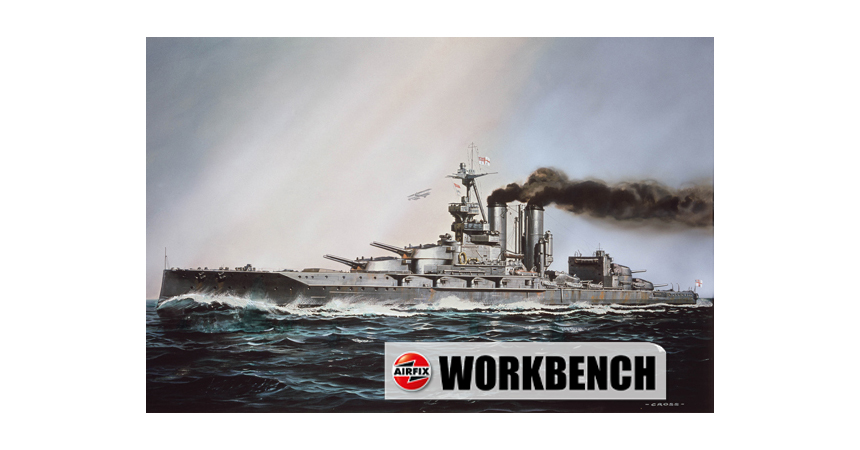
Building into a truly impressive model display, we will be looking into the history of this magnificent warship, before moving on to feature a selection of built model images which highlight what we all have to look forward to, should a little winter warship modelling be on our radar this year. In addition to this, as this kit benefitted from the input of a certain Mr Roy Cross, we will be bringing you an exclusive look at the original artwork produced in support of this impressive kit, before also including how this has been digitally replicated to allow it to take its place in the Vintage Classics range.
As we’re almost in the season of giving, we will also be including an additional feature which highlights one of the fabulous kits which is currently available on the Airfix website, but is just one highlight in a conglomeration of modelling stars. With a selection of built model images to share which weren’t available at the time its main review was posted, we think it entirely appropriate to allow our 1/72nd scale Phantom FG.1/FGR.2 kit to bask in the Workbench spotlight once again, particularly because as we all know only too well, trends are temporary, but modelling class is timeless.
Classic British kit subjects are the focus of our attention in this week’s edition of Workbench.
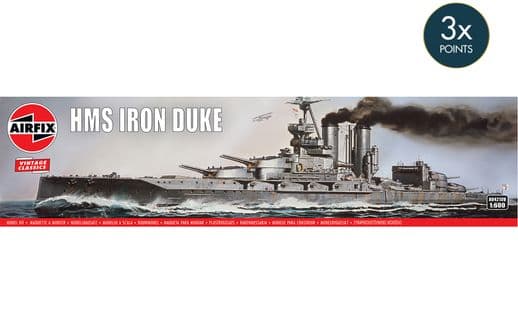
Airfix tribute to Britain’s flagship Super Dreadnought HMS Iron Duke.
As an Island nation, the sea has always been an incredibly important aspect of Britain’s identity and culture, something which has protected and provided for us in equal measure, but also something which has fired our ambitions over centuries. Our front line of defence in our darkest hours, the sea allowed our most adventurous sons to discover new lands and opportunities, establish trade links with the furthest corners of the globe, and extend Britain’s influence far beyond its home shores. As that influence grew, protecting far flung outposts and Britain’s sea lanes became of paramount importance, with the establishment of a powerful, well organised navy becoming part of Britain’s identity, something which instilled a great sense of pride in the nation, but was also feared and admired by those seeking to challenge its standing.
Just as the sea protected Britain from invasion, it also provided the means for the nation to protect itself, and as the warships of the age of sail gave way to the mighty floating behemoths of the Dreadnought era, Britain’s naval power was second to none, with these floating cities of destruction being just as much a statement of intent, as they were of the nation’s manufacturing and technological prowess. In fact, HMS Dreadnought was such a marvel in warship design and production that the ships which preceded her were simply described as being of the pre-Dreadnought era, and those coming immediately after simply referred to as Dreadnoughts.
And then there was their fearsome appearance. Crewed by several hundred, if not thousands of men, these vessels were awe-inspiring in every sense of the word, truly the pinnacle of man’s technological ingenuity and the most impressive fighting machines ever conceived by man. As such, these vessels captured the imagination of the world and clearly made for popular modelling subjects, which brings us rather conveniently onto the subject of this latest update and the final addition to the Vintage Classics kit range for 2024.
In 1910, the Royal Navy moved from the production of their 10 inch gun equipped Dreadnought warships, to the more powerful 13.5 inch gun Orion Class Super Dreadnoughts, as they sought to further enhance their capability during turbulent times. These were followed by the King George V series, which were essentially larger versions of the same basic design, but equally impressive warships.
Profile of a naval leviathan, HMS Iron Duke was the physical embodiment of Britain’s naval prowess.
Full Vintage Classics presentation for this magnificent warship kit.
In 1912, the Navy ordered four new ‘Super Dreadnoughts’, their Iron Duke class warships. These ships were similar in size and main armament to the King George V class ships which preceded them, but benefitted from additional armament specifically intended to deal with the threat posed by U-boats and fast torpedo attack craft, in the shape of ten casement mounted 6 inch guns. The initial displacement of these mighty ships was around 25,000 tons, however, this would increase during their service life as armour upgrades and more new equipment was added.
These warships were equipped with 18 coal fired boilers, which drove four mighty propellers to give the ships a top speed of just over 21 knots and as such, these would be the last of the coal powered British battleships. Of the four ships in this class, Iron Duke and Marlborough were constructed in Royal dockyards and were laid down in January 1912 and impressively launched just nine months later. Their sister ships Benbow and Emperor of India, however, were built in commercial dockyards, where industrial action meant that both these ships were launched a full year after the previous two. All four warships were commissioned into the fleet in 1914 and at the start of the First World War, these were the most advanced ships available to the Royal Navy.
Following the start of the Great War, the Royal Navy’s Home Fleet was reorganised as the Grand Fleet, with HMS Iron Duke serving as the flagship of the fleet, under the command of Admiral John Jellicoe. For quite an extended period, this capable warship was to engage in a lengthy series of sweep operations, gunnery practices and periods in refit, as this important battleship served as more of a deterrent threat than actually being committed to direct actions.
In January 1916, Iron Duke collided with a service vessel which had come adrift during a severe storm at Scapa Flow and whilst she didn’t sustain any damage in the incident herself, the tanker Prudentia subsequently sank. On the night of 25th March, Iron Duke sailed as part of a large battle fleet sent to raid the German Zeppelin base at Tondern, however, as she neared the area of a potential sea battle, both the British and German Navies had disengaged due to more bad weather, with the smaller ships in the formation struggling in the high sea swells.
The following month saw the Grand Fleet turning out in force in an impressive show of strength and posturing, which had the dual effect of serving to distract the Imperial German Navy, whilst allowing the Russian Navy to relay their defensive minefield shield in the Baltic Sea. After returning to Scapa Flow to refuel and replenish, Iron Duke and the rest of the Grand Fleet steamed for the seas off East Anglia, after intelligence reports appeared to suggest the Germans were intending to shell the coastal towns in the area. By the time the fleet arrived on station, the Germans had already made off in the opposite direction, allowing another period masking Russian Navy operations further north to take place.
Both the British and German navies were probing each other’s capabilities within much shorter distances during this period and it only seemed a matter of time before the finest naval minds of both countries would have an opportunity to score a decisive victory over their rivals, but which way would this naval pendulum swing?
Roy Cross box artwork magic in all its original glory – truly magnificent!
Following months of actions in the North Sea where the warships of the world’s two most powerful navies probed and postured in their respective displays of naval capability, Britain’s seaborn blockade of Germany was beginning to have a significant impact. Germany knew that if the blockade wasn’t broken, their military aspirations would be seriously undermined and the only way to avoid this was to strike at the heart of Britain’s Grand Fleet and score a decisive victory.
By the end of May 1916, both the Royal Navy and the Imperial German Navy had resolved to initiate a mighty naval engagement, the largest single clash or naval armour the world had ever seen. Each planned to lure the other into an ambush which gave them an advantage, however, both forces effectively cancelled each other out and as the two headed for combat off the coast of Denmark, the outcome would be down to being in possession of the most accurate intelligence and the skills of individuals warship crews.
The German plan was to lure part of the British Grand fleet into battle by making them think they were a small force themselves, but holding a larger force just south of their position ready to strike when needed. Once they had cut down this smaller, but still significant British force, they would return to the safety of home waters, having secured a symbolic victory. Unfortunately for them, the British had intercepted German naval communications and as a result, their main force was already at sea, steaming towards Jutland Bank.
During the first phase of the battle, poor manoeuvring and inaccurate ranging by the British saw the Germans coming out on top, with British sailors paying the price as a consequence. Both HMS Indefatigable and HMS Queen Mary were lost following devastating explosions after taking hits which ignited their magazines, by which time the full German fleet and their intentions had been discovered. The remaining British fleet had to buy time until Admiral Jellicoe and the main Grand Fleet formation could arrive.
Once Jellicoe and Iron Duke arrived, the tables were well and truly turned, with the mighty British force taking up a strategically advantageous position, where maximum firepower could be brought to bear against their opposition. A daring manoeuvre effectively prevented the German ships from escaping back to home waters, whilst Iron Duke’s guns scored many hits on their adversaries, in a period of firing which was later described as outstanding. With the German force now in disarray, they turned away from the British to make their ships less vulnerable, before inexplicably turning once again into the full fury of the British onslaught.
This next selection of images feature a photographic look at a built example of our HMS Iron Duke kit from bow to stern.
The onset of night and a daring torpedo attack against the British force brought about a respite for the heavily mauled German fleet and as both forces feared torpedo attack under the cover of darkness, they both slipped away to count the cost of the past few hours and live to fight another day. Admiral Jellicoe was subsequently faced recrimination about his decision not to hunt down and finish off the German fleet, even though Naval intelligence had proved inaccurate throughout the engagement and therefore of no use in formulating a supporting plan of action.
The Battle of Jutland resulted in more British ships being lost and more unfortunate sailors paying the ultimate price, however, the Germans had failed to score the decisive victory they needed. With their own forces suffering significant loss and damage during the battle, their own fighting capabilities were much reduced as a consequence. Poor intelligence, flaws in the command and control structure and bad practice in the heat of battle led to the destruction of the British ships, with the overall performance leading to a requirement to fit most major warships with additional protection around areas vulnerable to shell strikes.
Ultimately, the Germans had failed to break the British blocade and the Grand Fleet maintained its position of superiority. In the immediate aftermath of this engagement, the German fleet could muster no more than ten dreadnought or pre-dreadnought warships, whilst the British Grand Fleet could call upon almost three times that number. In the weeks that followed, German Admiral Scheer informed the Kaiser that in his opinion, the German high seas fleet could never defeat Britain at sea and that a period of unrestricted U-boat warfare was the only way for Germany to proceed.
Although the Germans knew this would likely bring America into the war, they were of the opinion that the effectiveness of this offensive would bring Britain to her knees before American involvement could have an impact on the war, a miscalculation which would prove decisive in the outcome of the Great War.
On the British side, Jutland left them with some serious questions to answer and the need for the fleet to undergo significant modernisation, particularly in equipping the Navy to meet the challenge posed by U-boats and torpedo attack craft. The Battle of Jutland would be the last time the world would see massed lines of main battleships facing each other in open battle at sea.
The kit includes decoration details to finish our scale Iron Duke kits in her 1915 fit.
In the aftermath of Jutland, Iron Duke went into dock to receive additional armour to protect her magazines, in the hope this would prevent her from suffering the same fate as Indefatigable and Queen Mary, and whilst she was still undergoing works, Jellicoe was replaced as Commander of the Grand Fleet. In January 1917, she relinquished her role as Flagship of the Fleet, prior to undergoing further works to equip her B and Q turrets with aircraft launch platforms and associated equipment.
After the Great War, the warship operated as the Flagship of the British Mediterranean Fleet, where she would serve as a high profile naval symbol of Britain’s influence in the region, until she was assigned to the Atlantic Fleet to take on the much more sedate role of training ship. In 1930, the London Naval Treaty resolved that the four Iron Duke class warships should either be scrapped or undergo demilitarization and in response to this, Iron Duke herself had much of her armour and most of her armament removed, thus reducing her to an unfit for combat status.
At the outbreak of the Second World War, Iron Duke was positioned in Scapa Flow to perform the dual role of depot ship and anti-aircraft platform, with her remaining large calibre guns removed to be used as shore batteries. Although damaged by Luftwaffe air attack on two separate occasions, the ship was repaired both times and would see out the rest of the war performing this same role. Having been repainted to resemble a major battleship in an attempt to deceive the Germans, her new appearance was thought to have influenced the decision which saw the German Battleship Bismarck making a break for Atlantic waters in May 1941, as intelligence reports suggested a strong British fleet was still moored at Scapa Flow.
Sold for scrap whilst still beached at Scapa Flow, HMS Iron Duke was subsequently refloated and taken to Glasgow, where she met her end at the hands of the scrapper’s torch in late 1948, but with the ship’s bell saved for posterity and later placed in Winchester Cathedral.
Although we rarely see below the waterline when viewing pictures of the world’s most famous warships, the full hull configuration of these kits only serves to make these truly spectacular scale representations.
To say these mighty warships were once the absolute epitome of military prowess and considered to wield the most destructive capabilities of any weapon, their reign proved all too short in many cases, as both the aeroplane and fast torpedo attack craft rendered these floating behemoths incredibly vulnerable. Built at great expense and consuming vast quantities of raw materials and consumables, they were nevertheless some of the most impressive weapons of war ever conceived by man, standing as an enduring source of fascination ever since.
Back in 1966, Airfix proudly released the 4th edition of their product catalogue, and whilst its contents were still somewhat basic in design presentation compared to what we’re all accustomed to these days, it was still packed full of fantastic scale model kit options for us all to covet. As had already become the norm by that stage, aircraft subjects dominated the early pages of the catalogue, however, towards its centre, a growing range of impressive warships and ships from the age of sail was becoming popular with modellers, and it has to be said, represented some of the most impressive model kits produced by Airfix at that time.
With black and white pictures of famous Great War and WWII warships imprinted in our minds from books, magazines and the iconic World at War TV series, these mighty vessels represented some of the most impressive machines ever created by man and as such, the nation’s modellers simply had to have scale kit representations of them to build. With such classic warships as HMS Hood and Bismarck already in the range, 1970 saw the introduction of a new HMS Iron Duke tooling, an impressive new kit which immortalised this super Dreadnought and flagship of the British Grand Fleet at the Battle of Jutland in scale model kit form.
Once again, Roy Cross has been immortalised in a Vintage Classics release and HMS Iron Duke is an absolute cracker!
With these models being described as being ‘Just like the real thing!’, how on earth could we be expected to resist such items, and as these kits built into truly impressive display pieces, warship models became an increasingly popular feature of every Airfix kit range.
Further enhancing the appeal of this fantastic new model kit, a certain Mr Roy Cross was engaged to bring his impressive talents to bear, and create a beautifully evocative piece of artwork showing this beautiful warship under full steam. It’s a well-known phenomenon within the modelling community that the artwork of Roy Cross was responsible for launching the modelling journeys of thousands of people, in addition to stimulating the sale of hundreds of thousands of kits over their lifespan, a proud tradition our Vintage Classics range continues to uphold to this day.
The Vintage Classics A04210V HMS Iron Duke kit is available now.
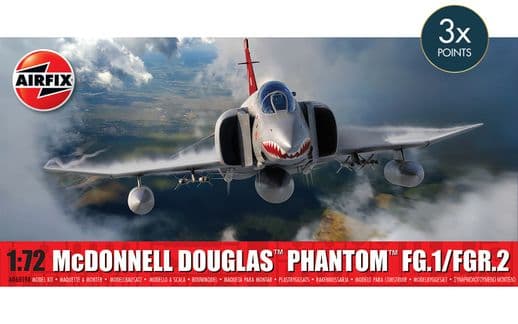
Is there a more iconic sight in aviation that a British Phantom bearing down on you?
With the Airfix range being so vast, the task of selecting our next build project can sometimes be a difficult one and with that being the case, we thought we might provide a bit of inspiration by directing reader’s attention to a classic release from last year. This is no ordinary kit though and happens to be our scale homage to an aircraft which is revered amongst the UK’s aviation enthusiast community, Anglicised variants of the McDonnell Douglas Phantom. As these kits are still currently available AND we now have built sample kit photography available in all three scheme options included with this kit, it really would be remis of us not to give this fantastic kit a little extra time in the Workbench spotlight.
For an aircraft type which has become something of an icon, it can be surprising to learn that Britain’s adoption of the Phantom only came about after a lengthy period of political indecision and the cancellation of some high profile indigenous aviation projects. With the deal going through at a time of great national austerity and political upheaval, it could even be argued that neither the Fleet Air Arm, nor the Royal Air Force actually wanted to take America's highly regarded Phantom for themselves and how many at the time actually regarded this as something of a second-rate procurement.
With its unfortunate association to the failure of the indigenous Hawker Siddeley P.1154 supersonic VSTOL fighter project, and the subsequent cancellation of both TSR.2 and the intended purchase of General Dynamics F-111K strike fighters, Britain’s adoption of the Phantom did get off to something of a turbulent start. Despite the unrest in Britain, McDonnell Douglas were more than confident about the capabilities of their aircraft, which had one rather large ace under its wings – it was already a successful service aircraft.
Having the foresight to send examples of the Phantom around the world in the hope of securing lucrative export orders, the Royal Navy had already started warming to the idea of adopting the American jet, even before the cancellation of the Hawker Siddeley P.1154 project. With the Navy now becoming firm admirers of an aircraft which they were confident would meet their needs, an order for ‘British’ versions of the Phantom was subsequently placed for the Fleet Air Arm, leaving the RAF to continue on with P.1154 and TSR.2 projects.
Built sample models finished in each of the three liveries included with this superb kit release.
The subsequent cancellation of both Hawker Siddeley's P.1154 and TSR.2 would leave the Royal Air Force without their intended replacement for such ageing aircraft as Hunter and Canberra, and as Britain was now already committed to buying modified versions of the Phantom for UK service, it made financial and logistical sense to further increase this order with additional aircraft destined for the RAF. Perceived as a naval aeroplane, to say the RAF were initially less than enamoured at the prospect of having the Phantom pressed upon them is probably something of an understatement, however, this was an exceptional multi-role aeroplane, one which would prove hugely successful in British service.
The Phantoms destined for British service (excluding the 15 F4J(UK) aircraft purchased later) were very different to other Phantoms, something which has made them a fascinating aviation curiosity over the years. Presumably in an attempt to plicate those still upset about the cancellation of several high profile indigenous British aviation projects prior to the purchase of Phantom, the MoD insisted that their aircraft be optimised for UK service, with the most significant difference being the adoption of Rolls Royce Spey engines, as opposed to the original American General Electric J79 turbojets.
This decision resulted in significant structural re-design of British Phantoms, particularly around the engine bays and rear fuselage. British Phantoms also incorporated larger air intakes, auxiliary intake doors to the rear of the aircraft, larger flaps and a folding nose radome in their design. The Navy’s Phantoms would also employ an impressive extendable nose wheel oleo, which allowed it to have a greater angle of attack immediately prior to launch, assisting the aircraft during the deck launch procedure, whilst also providing the Navy’s Phantoms with their iconic aggressive profile.
This kit release was so spectacular that it qualified for the creation of two different variations of its box artwork – which one do you prefer?
All British Phantoms were based around the US Navy’s F-4J variant, however, the FGR.2 jets destined for the Royal Air Force were all multi-role aircraft from the outset, an effective air defence platform which could also perform both strike and reconnaissance roles. As all the RAF's Phantoms would be operated exclusively from land bases, some of the design features incorporated in the earlier Fleet Air Arm Phantoms would not be required on the FGR.2 variant. From the perspective of the aircraft’s external profile, these included a standard nose wheel, the adoption of non-slatted horizontal stabilisers, a fixed nose radome, and the omission of the Navy’s catapult launch hooks.
The aircraft did, however, retain the arrestor hook of the naval machines and the ability to fold their wings, as the deletion of these features would have increased costs significantly, despite the fact that they had little or no impact on performance. Electronic, navigation and radar fit were also altered slightly to support Royal Air Force operations and the FGR.2s were also capable of carrying a SUU-23/A 20mm Vulcan gun pod, usually a single pod carried on the belly centreline station, or an EMI Reconnaissance pod carried on the same pylon.
The Royal Air Force would eventually operate more than double the number of Phantoms procured for the Fleet Air Arm and following the withdrawal of HMS Ark Royal from service, would also take over the operation of remaining former Royal Navy Phantoms. With the aircraft going on to see 24 years of exceptional service wearing the famous British roundel, the Phantom represents a particularly fascinating period in British aviation history, and whilst the nation was forced to go American in securing a capable jet fighter at an important period in world history, the Phantom certainly gained honorary British status, viewed by most people as a very British aeroplane.
Delivery of British Phantom FGR.2s destined for the Royal Air Force began during the summer of 1968, with all aircraft being received by October of the following year. Every one of the RAF's Phantoms initially passed through No.23 Maintenance Unit at RAF Aldergrove, which can boast quite a history with regard to Phantom operations, as at one time or another, every single one of the RAF and Fleet Air Arm Phantoms passed through the Aldergrove site, either for service acceptance preparation, repair, re-paint or upgrade. The first RAF unit to receive the Phantom was No.228 Operational Conversion Unit at Coningsby, which would be responsible for training aircrew in how to operate this beast of an aeroplane, and one which would go on to enjoy a successful service career.
During the height of the Cold War, the Royal Air Force upheld their commitment to the defence of Europe by maintaining a large military presence in Germany, including at its maximum strength, no fewer than six squadrons of Phantoms. Often operating at lower altitudes and in the strike/reconnaissance role, these mighty Phantoms wore a striking camouflage scheme, which many enthusiasts think looks much more aggressive than the lighter colours which would later be used on those aircraft performing an air defence role. Replacing Canberras and Hunters in both the strike/attack and reconnaissance roles, many of these RAF aircraft were stationed close to the borders of the Warsaw Pact nations and were at a heightened state of readiness, in what must be considered one of the most dangerous periods in world history.
The first dedicated Phantom reconnaissance unit in Germany was No.2 Squadron, who were originally stationed at Brüggen, but quickly moved to Laarbruch, where they would stay until returning to the UK in 1976. It's also interesting to note that only around thirty of the RAF's FGR.2 Phantoms had been configured with the full reconnaissance wiring package to allow them to carry the EMI Recce Pod, so it could be argued that not all the RAF's FGR.2s were actually 'R' capable.
Back in the UK, Phantoms were engaged in performing the equally vital role of airspace defender and it quickly became apparent that the aircraft was eminently more suitable for this task than the English Electric Lightning the RAF were also using in this role, as long, standing patrols over the North Sea were well within the capabilities of the Phantom. As RAF Germany began to replace Phantoms with the SEPCAT Jaguar, so their Phantoms returned to the UK to take over the air defence role vacated by the diminishing numbers of Lightnings still in service, but with the Tornado F.3 scheduled to take over this role, the days of the RAF Phantom would also soon be numbered.
By 1991, Britain's Phantom force had been reduced to just four remaining squadrons, all of which were based at RAF Wattisham in Suffolk and all under notice of impending retirement. Nos 92 and 19 Squadrons disbanded first, leaving just 56 and 74 Squadrons to commemorate the glorious history of the Phantom in British service. By the time of a final photocall event at Wattisham in July 1992, most of the remaining Phantoms sported coloured tails, black for No.74 Squadron and red for the 'Firebirds' of No.56 Squadron, with XV470 being particularly well presented. This aircraft sported a sinister looking sharkmouth nose, clearly indicating that this particular RAF Phantom had no intention of going quietly.
Phantom XV470 was delivered to the Royal Air Force in the spring of 1969 and would go on to enjoy a successful 23 year career representing several squadrons during that time. Ending her career with No.56 Squadron at Wattisham, it's thought that she received her distinctive sharkmouth markings somewhere between the beginning of 1991 and the summer of 1992 and following her withdrawal from service, she was flown to RAF Akrotiri, where she would serve as a BDRT airframe.
For the Phantom purists amongst us, there is only one thing we need to say about this particular scheme option - 'It's Black Mike in an earlier guise!' Now one of the best loved preserved former RAF aircraft in the country, 'Black Mike' has become something of an aviation legend and for many enthusiasts, has come to represent the era of the British Phantom in a particularly attractive manner. A long-time resident at the former Northern QRA airfield at Leuchars in Fife, ‘Black Mike’ enjoys such iconic status amongst the UK enthusiast community that the aircraft played a prominent role in the RAF’s centenary commemorations at the 2018 Cosford Airshow, where it was the undoubted star of their impressive static display, even though she made her final flight many years ago.
Phantom FG.1 XV582 saw service exclusively with the RAF, making its first flight in early 1969 and delivered to No.43 Squadron 'The Fighting Cocks' later that same year. Once in Royal Air Force service, this magnificent aircraft appeared determined to make a name for itself, eventually becoming arguably the most famous of all the British Phantoms. Her list of noteworthy achievements included the fact that she was the only FG.1 variant to serve with No.228 Operational Conversion Unit and became the first Phantom to exceed 5000 flying hours.
Phantom FG.1 XV582 was also the aircraft used in the record breaking ‘Land's End to John O’Groats Run’ on 23rd February 1988, when this impressive fighter covered the 590 mile distance in just 46 minutes and 44 seconds, posting an impressive average speed of over 772 mph in the process.
With the impending disbandment of No.43 Squadron looming large, the unit's commanding officer had been giving some thought as to how he could bring the Phantom era of the 'Fighting Cocks' to a fitting end, whilst at the same time generating some positive PR for the wider Royal Air Force. A number of options were considered, however, when it was discovered that no airspeed record currently existed between the two furthest points on the UK mainland, this was the challenge they just had to take on.
With UK airspace restrictions forbidding supersonic flight over mainland areas unless operationally required, the attempt could only make use of short supersonic 'hops' over the Bristol Channel and the Irish Sea, however, the Phantom managed to cover the 590 mile distance between the two points in just 46 minutes and 44 seconds, a record which still stands to this day. Interestingly, Phantom XV582's flight hours clock would tick over the 5000 hours mark whilst engaged on this high-profile record-breaking flight.
No.43 Squadron would be disbanded at RAF Leuchars in July 1989, with all its remaining Phantoms, including XV582, transferring across the airfield to the care of No.111 Squadron from that date, which is where this particular air defence Phantom would take on the aviation persona of 'Black Mike'.
Phantom XV582 made her first flight from the McDonnell Douglas production facility airfield at St Louis on 11th January 1969 and would become one of the twenty FG.1 aircraft which were produced for, but never saw service with the Fleet Air Arm, but were instead delivered direct to the Royal Air Force. She would only serve with three units during her career, Nos.43 and 111 Squadrons, in addition to time with No.228 Operational Conversion Unit, but in each case, always calling RAF Leuchars her home.
All Phantoms originally destined for the UK were primarily procured to serve as fleet defence fighters for the Royal Navy, replacing the highly distinctive but by then outdated De Havilland Sea Vixen in this role. It was decided that the British machines would be powered by the Rolls Royce Spey engine for a number of reasons, not least because they would give a valuable power increase to these aircraft destined to operate from the relatively short decks of Britain’s carrier fleet. Although on the face of it this seems like quite a logical decision, the adoption of these engines required some significant modifications to the rear fuselage of the British Phantoms to be made, which included enlarged engine bays, a re-designed rear fuselage and larger air intakes at the front of the aircraft, all of which gave the British Phantoms a unique appearance.
When taking into consideration the weight and increased drag caused by these modifications, the additional power provided by the Rolls Royce engines did have some beneficial impact on the overall performance of the aircraft, but perhaps not as much as initially envisaged. What the decision did do was to make British Phantoms look very different to the rest of the Phantoms in world service, making them something that little bit special and arguably the most attractive of them all, although I suppose we Brits would say that, wouldn't we!
The initial Royal Navy order was for an impressive 140 Phantoms, all of which were intended to be operated from four aircraft carriers, two upgraded existing vessels, plus a further two new vessels to be constructed specifically for the task. Unfortunately, a continuing period of national austerity dictated that this mighty force would never be realized and with the subsequent government cancellation of the two new aircraft carriers and a further decision not to upgrade all the existing ships, this ambitious Phantom order would ultimately be slashed to just 48 aircraft.
The Royal Navy received their first F-4K Phantoms (British designation FG.1) in April 1968 and immediately began flying trials with their new aircraft, in preparation for embarkation on HMS Ark Royal, the first vessel to be re-fitted to accept this beast of an aeroplane. That first operational embarkation occurred in 1970, when twelve Phantoms of No.892 NAS landed on Ark Royal as part of her air group and began a short, if glorious period of British Phantom operation at sea.
Having taken delivery of their new Phantoms, the next few years must have proved rather depressing for members of No.892 Naval Air Squadron. Having initially thought they would be the first in a mighty naval force of 140 Phantoms, subsequent cuts to the defence budget and almost constant requirement changes for these aircraft, actually led members of the squadron to believe that they might in fact be the last fixed wing aircraft squadron in the Fleet Air Arm. As a consequence, they development adopted the Omega symbol as their emblem, painting it on the tail of their aircraft. As this was the last letter in the Greek alphabet, its use seemed both symbolic and appropriate.
During her final cruise in 1978, HMS Ark Royal visited the massive US Naval base at Oceana, Virginia, the world's largest naval base at that time, and disembarked her Phantoms to the care of the recently reformed VF-171 'Aces' Replacement Air Group Squadron. In US Navy parlance, student aircrew and those working up to operational deployment were assigned to RAG units and the visit of the Royal Navy's Phantoms was certainly viewed as a big deal to all at the station at that time.
Always an opportunity for some inter-service shenanigans, before the Phantoms left to rejoin their home carrier, a couple of them had benefitted from several special additions to their appearances in honour of their visit, including XV590, which came in for particular attention. Courtesy of VF-171's corrosion control department, not only did she sport large VF-171 squadron patches on either side of her fuselage, but the aircraft also had her British roundels modified to resemble inter war US Navy insignia, in addition to having her Royal Navy titles defaced to read 'Colonial Navy' - the cheek of it!
Apparently, the station commander at NAS Oceana was less than pleased with the work of his RAG unit team members, however, the incident was taken in the right spirit by HMS Ark Royal and No.892 NAS, who were probably already planning a revenge attack on the next US aircraft to land on Ark Royal’s decks.
A tantalising trio of British Phantoms. This image shows kits finished in all three options included with this incredibly popular release.
Following her Fleet Air Arm service, Phantom FG.1 XV590 was transferred to the Royal Air Force and as far as we can ascertain, would spend the entirety of her RAF service in the colours of No.43 Squadron, the famous 'Fighting Cocks' Squadron. She was still wearing these colours when photographed disassembled and looking in a very sorry state in a Glasgow scrapyard in 1992.
Our 1/72nd scale British Phantom continues to be one of our most popular kits, so we don’t think many Workbench readers will have an issue with us paying a little re-visit to this appealing existing kit as a little additional feature to this latest update. Don’t forget, if you have the previously released A06019 kit in your stash, you will have decal options to produce XV582 in her striking ‘Black Mike’ scheme, to go with her record breaking ‘Land's End to John O’Groats Run’ scheme from earlier in her career, one which features in this current kit. Now if that doesn’t tempt us all into an interesting dual Phantom build project this winter, we definitely need to be having our modelling pulses checked!
If you have this beauty in your stash, the supplied decal options with this and the current kit above will allow you to build this most famous of British Phantoms in two very different scheme presentations.
We are afraid that's all we have for you in this latest edition, but we will be back next Friday with more project development updates and the very latest Airfix kit exclusives. In the meantime, we are always keen to hear your views on all things Airfix and in particular, any thoughts and opinions you may have regarding our Workbench blog. If you would like to drop us a quick line, could we please ask that you use our workbench@airfix.com email for all correspondence.
To re-visit any of the Airfix blogs we have produced over the past seven years or so, please head to our main Workbench hub, where you will find our entire blog back catalogue and all the Airfix design projects we have already covered.
All our dedicated official social media sites can be accessed by clicking the respective link icons at the foot of this page, or by heading to the Airfix homepage. Other useful Airfix links are:
Facebook, YouTube, Twitter and Instagram official sites
Please join us for more Airfix updates next week and thank you for your continued support.