
Welcome to this latest edition of our Workbench blog and all the news, updates and modelling exclusives from the fascinating world of Airfix.
In the world of aviation and in particular, the subject of the combat aircraft of the Second World War, even if an aircraft type enjoys the unwavering support of its infamous Commander-in-Chief, that doesn't always dictate that the aircraft type in question can live up to its much vaunted reputation, even if it's boastfully referred to as a 'Destroyer'. Even though the Messerschmitt Bf 110 heavy fighter was undoubtedly one of the most interesting aircraft of WWII, it would probably be accurate to say that its operational fortunes ebbed and flowed during the early months of conflict and whilst the Battle of Britain cruelly exposed the fact that the Luftwaffe's Zerstörer couldn't compete with the RAF's single engined fighters, it would later find its fighting niche and remain in production and in service throughout the rest of the war.
As we prepare to welcome just the fourth release from a beautiful new (relatively) tooling of this classic Luftwaffe aircraft, this latest edition of Workbench delves into the history of this most interesting aircraft, one which remains an extremely popular subject throughout the modelling world. We will be showcasing the stunning new box artwork produced to support this kit release, before going on to look at the two scheme and decal options we have to look forward to, in addition to looking a little more closely at why the Messerschmitt Bf 110 heavy fighter has always been considered something of a fascinating aviation enigma.
Box artwork for a previous release of our 1/72nd scale Messerschmitt Bf 110 kit, showing a 'C' variant aircraft which was the mount of Helmut Florenz of Staffel II/Zerstorergeschwader 1 in Northern France between 1940-41, complete with its distinctive ‘Triple Wespe’ nose artwork.
For an aircraft which bears the famous Messerschmitt name, you could be forgiven for thinking that the Bf 110 twin engined heavy fighter might be one of the most famous and instantly recognisable aircraft of the 20th Century, however, for a number of different yet related reasons, this distinctive aircraft has always been viewed as something of a disappointment and has always been in the shadows of its far more famous single engined predecessor. For an aircraft which was heralded as an airborne Destroyer, you might think that the opposite should have been the case.
The Messerschmitt Bf 110 can trace its origins to a time when the aviation world was going through a significant period of transition, with the ultimate biplane fighters in service at that time being forced to give way to a new breed of fast, modern monoplane designs, a conversion which was not without many challenges. At that same time, many air force seniors across the world shared the opinion that a new breed of fast and heavily armed bombers would decide any future conflict, powerful enough to inflict unimaginable destruction on those they attacked, but able to defend themselves against enemy fighter attack. With the single engined fighter seen by many as therefore having a secondary role in the future of major air forces, the concept of a 'Battle Destroyer' began to gain some traction in Germany during the early 1930s, an aircraft which was so powerful that it could blast all other aircraft out of the sky and when not sweeping the skies of enemy opposition, could itself turn its hand to dropping a modest bomb load.
To this end, the German Ministry of Aviation issued specifications for such an aircraft and Germany's major aviation companies all responded, with companies such as Messerschmitt, Focke Wulf, Henschel and Arado all competing for the potential contract. The Messerschmitt design emerged as the clear winner of this competition, however, just as contracts for the production of a series of prototypes were being signed, the RLM (Reichsluftfahrtministerium) decided to change their requirements once again. They had now decided that their modern Luftwaffe should be quipped with different aircraft to fulfil the Battle Destroyer role, a Schnellbomber (fast bomber) and a heavy fighter, or Destroyer. Messerschmitt were easily able to modify their design and as it was the clear front-runner in the original contest, it would go on to become the Luftwaffe's much vaunted Zerstörer, gaining some rather high profile champions along the way.
A powerful proposition, the Messerschmitt Bf 110 heavy fighter would be used extensively during the early stages of WWII and even though it suffered at the hands of the RAF during the Battle of Britain, would continue to be used effectively for the remainder of the war - Image Bundesarchiv.
Great War fighter ace Ernst Udet was a great proponent of the strategic potential of the heavy fighter concept and would go to great lengths explaining his beliefs to anyone of influence who was willing to listen to him. He also worked tirelessly to convince the RLM that they must establish a Kampfzerstörer force as a matter of some urgency, in order to support the aspirations of the German leaders, which were now all too apparent. His views were shared by the Luftwaffe's Commander-in-Chief Hermann Goering and between them, they ensured that the new heavy fighter being developed by Bayerische Fligzeugwerke (soon to become Messerschmitt AG) became something of a priority project for the nation.
The reasoning behind their enthusiasm certainly wasn't without merit, but in the world of aviation, ideas on paper don't always translate to air combat effectiveness. As the new Destroyer was following in the wake of the new 109 single engined fighter, surely an aircraft possessing greater range, heavier firepower and the ability to defend itself from attacks from the rear would be a much more potent fighting machine, particularly as it also offered much greater future development potential. In addition to this, early trials of the new aircraft actually showed that it was marginally faster than Messerschmitt's single engined fighter, seemingly underlining the faith Goering and Udet had placed in it.
As a long range heavy fighter, the Messerschmitt Bf 110 was indeed a fearsome prospect and as far as Hermann Goering was concerned, he couldn't wait to commit his new Zerstörers to combat.
This seems like the ideal point for us to tackle a question which has caused some confusion over the years, one which will hopefully clarify how you should describe your Messerschmitt correctly. The subject of this latest update is the Messerschmitt Bf 110, however, other Messerschmitt types carry the nomenclature (or acronym, I never know which is the correct way to describe this) Me, such as the Me262 jet recently reviewed within Workbench. Indeed, many publications have described the 110 as an Me 110 over the years, so what is the definitive answer?
With its impressive range and heavy firepower, the Messerschmitt Bf 110 had the potential to be one of the great combat aircraft of the Second World War, but did the Germans use it to the best of its capabilities? Image Bundesarchiv.
In simple terms, it’s all down to the date of the development of the particular aircraft type in question - the Bayerische Flugzeugwerke (Bavarian Aircraft Works) and Messerschmitt Flugzeugbau were 'encouraged' to merge by the Bavarian government in 1927, but continued to be known as Bayerische Flugzeugwerke for some years. On 11th July 1938, influential designer Willy Messerschmitt was named Chairman and Managing Director of the BFW company, renaming it Messerschmitt AG from that point, with that date being important in our quest. Before 11th July 1938, any Messerschmitt design which had already been developed and was in production carried the original Bayerische Flugzeugwerke of Bf nomenclature, whilst those which came later, such as the 410 and 262 were referred to as Me for Messerschmitt. As both the Messerschmitt 109 and 110 were developed prior to 11th July 1938, they are both referred to as Bf's.
Simple right, well if only that were the case. Although this is the official explanation, there are so many anomalies, even in official German records, that things can get really confusing. Although we in the know will always frown when people describe the Bf 110 as an Me 110, even official RLM documents sometimes describe these earlier Messerschmitt designs using Me and in some cases, use both options within the same document. If the Germans appeared unsure, what hope to we have? As a pretty accurate rule of thumb though, the 11th July 1938 date rule should be used when correctly differentiating between a Bf and an Me when describing your Messerschmitt type.
As the Messerschmitt Bf 110 moved into its final development and service trials phase, it was beset with a number of problems and delays which caused the Messerschmitt team no end of frustrations. This tumultuous period of aviation advancement went hand in hand with huge strides in aero engine technology, as new engines were developed producing more power than ever before, just the thing a fast new Destroyer aircraft was going to need. Unfortunately, new technologies often bring with them unforeseen delays and whilst the aircraft was ready to begin its test flying program, the problematic Daimler Benz DB 600 powerplants would force an eleventh our engine change. Initially, Messerschmitt were forced to use Junkers Jumo 210B engines, which were not as powerful as the DB600 and hampered the performance of the aircraft.
Other than test and pre-production aircraft, the first major production variant of the Bf 110 to be fitted with the new Daimler Benz powerplants (the DB601) was the 'C' series, which entered service in 1939 and as a priority aircraft type, the production of new aircraft proceeded at an impressive rate - by the end of the year, around 500 Bf 110s were in service and Germany was at war.
The Messerschmitt Bf 110 always cut an impressive figure and must have been a fearsome sight if you came up against one in combat, especially if it was wearing these aggressive looking shark teeth markings. Image Bundesarchiv.
As the Luftwaffe and Blitzkrieg swept through Poland, Norway, the Low Countries and into France, the Messerschmitt Bf 110 Destroyer proved to be particularly successful, with their additional range and firepower proving to be devastatingly effective in the air and during strafing attacks. Not encountering serious enemy fighter opposition, the aircraft were allowed to operate as the operational conditions allowed, relatively unchallenged and able to perform a number of different roles. As the conflict moved on to the massed air attacks against Britain, the confident Destroyer crews were in for a rude awakening, although it could be argued they were walking into a trap set by their own Luftwaffe commanders.
When the aircraft and their crews came up against the fast, agile fighters of the Royal Air Force, the Messerschmitt Bf 110 was quickly found to be lacking in aerial agility and would suffer significant losses over England, however, the aircraft were being deployed in a bomber protection close fighter support role, one for which this aircraft was never actually intended. The combat performance of the aircraft was so poor that these much vaunted Destroyers could not operate on their own without the protection of Bf 109 fighter cover and it seemed as if the faith shown in the type by Goering and Udet had been misplaced.
Nevertheless, the Messerschmitt Bf 110 would find many other roles to which it was better suited and would go on to see service in many different combat theatres and throughout the remainder of the Second World War.
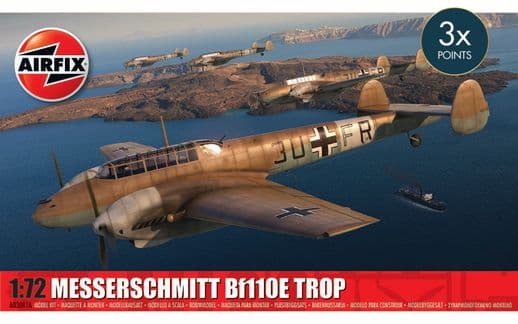
Stunning new artwork produced to support what will only be the fourth standalone kit release from our Messerschmitt Bf 110 tooling, one which should be available imminently.
As one of the most heavily produced twin engined aircraft of the Second World War and for many, one of the most attractive aircraft to see service during the conflict, the Messerschmitt Bf 110 Destroyer has been a staple of the Airfix model kit range since it appeared back in 1959. Back then, the aircraft was modelled as the 'D' variant and it its early bagged and cardboard packaging presentation, was described as being part of the 'Airfix series of famous aircraft types'. Appearing many times in subsequent Airfix ranges from that first appearance, it would become a firm favourite with many thousands of modellers, most notably as part of the classic Dogfight Doubles release of 1966, boxed with the Spitfire IX kit.
For an aircraft of this pedigree and with its lofty position within the Airfix kit hierarchy, the kit was definitely in need of updating and in 2010, a newly tooled representation of this classic aircraft was unleashed on the modelling world, a kit we are featuring here and one which with the release of this new kit, will only be making its fourth appearance as a standalone kit in an Airfix range. Let's take a closer look at the two new scheme options which are included with this impending release.
Messerschmitt Bf 110E 3U+FR, 7./Zerstörergeschwader 26, Derna, Libya, 1942.
One thing that any modeller will tell you is that conducting any research alongside your decision to build a model kit of the Messerschmitt Bf 110 can lead to some head scratching, because this aircraft had such a bewildering array of modifications and additions made to it over its service life. Two of the main benefits of the aircraft's impressive design were its size and structural adaptability and whether it was armament, additional fuel carrying capability, radar and radio equipment installation, or the use of special weapons, it seemed as if anything and everything was considered for Messerschmitt's Destroyer.
Building on the successes of the earlier C and D series aircraft, the Bf 110E brought with it a myriad of internal additions and improvements, and the installation of the latest variant of Daimler Benz engines. As was the case with this aircraft throughout its service life, Bf 110 units had access to a wide variety of field modification kits and at any time during the life of an individual aircraft, they could be fitted with such things as additional armour plating for both crews and vital aircraft components, along with the fitting of additional armoured panels for cockpit windows. All these additions could be made at the same time, or in stages as required, but just to make modelling identification that bit more challenging, could just as easily be removed at any point.
First introduced on the 'D' series machines, the 'Bootsheck' or Boat Tail was a fuselage modification to allow the aircraft to carry a dinghy and additional survival equipment in an extended section of the rear fuselage. This was released by a wire which ran into the rear cockpit and was an addition intended to support the aircraft's operation over large expanses of open water, providing crews with the reassurance that should they be forced to ditch their aircraft, they would have more than just a life preserver, or Schwimmweste to rely on until they could be picked up by a patrol boat.
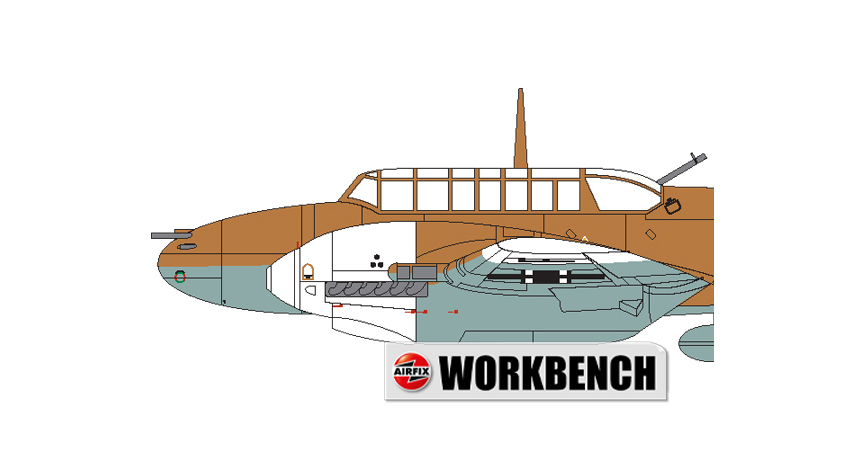
Full scheme details of this most attractive North African based Bf 110, complete with its extended Boat Tail.
Several sources have claimed over the years that the boat tail fuselage extension exclusively featured on the 'D' series aircraft, however, clear evidence exists that many 'E' and even 'F' variants also featured this most distinctive of modifications.
The Luftwaffe had never initially intended to fight over the deserts of North Africa, however, the dire situation facing their Italian Ally forced Hitler's hand and significant resource was diverted in an attempt to avert an Axis military disaster. One of the first units to arrive in the region, Zerstörergeschwader 26 had been heavily involved in all combat operations since the start of the Second World War and were viewed as being experts in the use of this long range fighter. Initially tasked with providing fighter protection for Stuka units engaged in halting Allied ground advances, this type of mission was better suited to the many impressive qualities of the Bf 110, even though they were coming into contact with the Hurricanes and Curtiss P-40s of the Desert Air Force.
The aircraft’s desert deployment would also prove significant for another operational reason, and that was its first use in a role at which it would prove to be incredibly successful, that of nightfighter. On the night of 22nd/23rd May 1941, the Messerschmitt Bf 110 was pressed into the night interception role over the desert and over the course of the next week, ace pilot Oberleutnant Alfred Wehmeyer would score three nocturnal victories against Allied raiders. Messerschmitt’s ‘Destroyer’ might just have found its true fighting niche.
Prior to the start of the Battle of Britain, German forces mounted 'Operation Weserübung', the occupation of Denmark and invasion of Norway. The operation was mounted primarily due to growing fears that combined British and French forces were planning to occupy Norway themselves and with it, pose a significant threat to German military aspirations. As part of a significant Luftwaffe commitment to the attack, their Messerschmitt Bf 110 Destroyer force would be heavily deployed, with the type acquitting itself extremely well, both in providing fighter cover for strike and transport aircraft and also in a ground attack role. In one particularly noteworthy incident, Bf 110s prevented Norwegian forces from retaking an airfield on which Ju 52 transports had just landed and subsequently come under heavy fire, repeatedly strafing enemy forces at low altitudes until Wehrmacht ground forces in the area could battle through to hold the airfield.
Already possessing excellent range, the length of patrol missions led to the Luftwaffe developing technologies to further increase the range of their Destroyers, utilising external fuel tanks of various capacities and even developing a large and unsightly belly mounted 1,050 Litre fuel tank known as a Dackelbauch, or Dachshund's belly - this idea did not last long. Messerschmitt Bf 110 units would remain in Norway for the rest of the war and with the lack of serious enemy fighter opposition, the aircraft would prove itself particularly effective operating over this often inhospitable terrain.
Ace pilot Felix-Maria Brandis was one of the leading pilots of 13.(Z) JG5, with his relatively short time in Norway being rather eventful. Flying the Messerschmitt Bf 110 heavy fighter throughout, he crashed two aircraft in relatively quick succession, one time when becoming lost in a snowstorm and landing in Swedish territory. He and his damaged aircraft were initial interned, but were later returned to German forces.
Like many Luftwaffe staffeln, Brandis' unit was extremely fond of their pet mascots, which in their case was a trio of Dachshunds named Bamse, Herdla and Lockheed. The emblem carried on the nose of their aircraft was a Dachshund with a Soviet Rata fighter in its mouth, although it's not known if this emblem came before the arrival of the staffeln pets, or after, but what is known is that the unit retained this emblem for the entirety of its three year deployment to Norway and were more than happy to be known colloquially as the 'Dackel Staffel'. There are a number of wartime pictures featuring pilot Felix-Maria Brandis, with some showing the victory total displayed on the tail of his aircraft, but there is one constant in all of these pictures - he is always holding one of their beloved Dachshunds.
Full scheme details of an aircraft flown by Luftwaffe ace Felix-Maria Brandis during his time serving in Norway with the 'Dachshund Squadron'.
Brandis would be killed in early 1942 whilst attempting to crash land his damaged aircraft in a snowstorm, highlighting the difficult conditions the units pilots often had to fly in during their time in Norway. Jagdgeschwader 5 reorganised later in 1942 and became known as the Eismeer Geschwader, which roughly translates as the Arctic Sea fighter wing, by nature of the northerly operations they were required to conduct.
Before leaving the subject of the Messerschmitt Bf 110 long range heavy fighter, without doubt, the strangest incident involving one of these aircraft occurred on the night of Saturday 10th May 1941, as Britain's Chain Home radar network picked up an unidentified raider approaching the coast of Northumberland. Crossing the coast near Alnwick, the Royal Observer Corps identified the raid as a single Messerschmitt Bf 110 fighter which continued flying inland in the direction of Glasgow, and was tracked continually until it hit the west coast of Scotland. With a Defiant nightfighter now on its tail and with its fuel reserves running low, the intruder was seen to turn back inland, before crashing at Bonnyton Moor, Eaglesham, near Glasgow at 23.09pm.
The lone pilot was observed parachuting to earth and was promptly detained by a pitchfork toting local farmer, who when inquiring if the airman was German, was surprised by the reply he received in excellent English. His prisoner announced that he was Hauptmann Albert Horn. Taken into custody by the Home Guard, the prisoner was later interviewed by an Observer Corps Major, who almost immediately recognised the airman as none other than Rudolf Hess, senior Nazi Party official and Deputy Fuhrer of Germany. Why had such an important political figure made such a perilous, one-way flight and what were his intentions?
One to keep an eye out for - full branded box presentation for this new Messerschmitt Bf 110E/E (Trop) kit, which includes two very different scheme finish options.
Taking off from the Messerschmitt factory airfield at Augsburg-Haunstetten in Bavaria at 17.45 UK time on 10th May 1941, Nazi Party official Rudolf Hess had a long and dangerous flight ahead of him. Even though his Messerschmitt Bf110 fighter was carrying additional fuel, this was always going to be a one-way flight and to this day, it still remains unclear as to what his intentions were – surely, capture by the British would be the absolute best possible outcome of this risky adventure. During later interrogation, it was reported that Hess planned to land by parachute on the estate of Scottish nobleman, the Duke of Hamilton, a man he had previously met at the 1936 Olympic Games in Berlin and someone thought to be politically influential in trying to muster support for a negotiated peace with Germany.
A fascinating incident which has been the subject of a great many conspiracy theories over the years which followed, Hess’s true intentions have never been definitively ascertained, however, the flight did coincide with Germany’s decision to launch a massive and ultimately disastrous offensive against the Soviet Union, in addition to Hess being somewhat side-lined at that time within the Nazi Party hierarchy.
Hitler was reported to have been enraged on hearing about the actions of his trusted deputy and described him as having lost his mind. Whatever his intentions, this incident did highlight the invaluable contribution of the Royal Observer Corps throughout the Second World War, as once a hostile aircraft had reached the British mainland, radar was no longer of any use and vital tracking information was provided by this impressive network of vigilant volunteers.
One of the most interesting combat aircraft of the Second World War, we are expecting this beautiful new 1/72nd scale Messerschmitt Bf 110E/E-2 (Trop) kit to be in our warehouse and ready for onward dispatch to customers by the time you are reading this latest blog update. Dachshund or Desert, the scheme choice is yours!
Would you be interested in experiencing a unique movie memory for a lifetime?
Airfix is proud to support RAF Midlands with a unique experience for all aviation and classic movie enthusiasts! RAF Midlands is showing classic war films, and here’s the best part: you’ll be surrounded by genuine wartime aircraft as you watch!
With films showing in their newly launched Bomber Command Exhibition Hall, this is an opportunity not to be missed - buy your tickets before they are gone!
Tickets are only £7.50 for adults and £5 for children.
The films scheduled to be shown are:
• Battle of Britain (U) - Saturday 27 May at 2pm
• The Dam Busters (U) - Sunday 28 May at 2pm
• The Great Escape (PG) - Monday 29 May at 2pm
• 633 Squadron (PG) - Tuesday 30 May at 2pm
• Reach for the Sky (U) - Wednesday 31 May at 2pm
• Memphis Belle (PG) - Thursday 1 June at 2pm
You can reserve your place by booking at this link: Airfix Classic War Film Season - RAF Museum
We are afraid that's all we have for you in this latest edition, but we will be back next Friday with more project development updates and the very latest Airfix kit exclusives. In the meantime, we are always keen to hear your views on all things Airfix and in particular, any thoughts and opinions you may have regarding our Workbench blog. If you would like to drop us a quick line, could we please ask that you use our workbench@airfix.com email for all correspondence.
To re-visit any of the Airfix blogs we have produced over the past seven years or so, please head to our main Workbench hub, where you will find our entire blog back catalogue and all the Airfix design projects we have already covered.
All our dedicated official social media sites can be accessed by clicking the respective link icons at the foot of this page, or by heading to the Airfix homepage. Other useful Airfix links are:
Facebook, YouTube, Twitter and Instagram official sites
Please join us for more Airfix updates next week and thank you for your continued support.