
Welcome to this latest edition of our Workbench blog and all the news, updates, and modelling exclusives from the fascinating world of Airfix.
As promised in our previous post, this week’s edition of the Airfix blog will see us returning to the lair of our new Jaguar kit once again, for the second instalment of our designer interview, where this highly anticipated new tooling project once again takes centre stage. In the previous edition, we looked at the early staged of the new kit’s development, including an unusually detailed look at what a designer can expect to find in their hand-over brief at the start of every new tooling project, obviously with a specific Jaguar leaning.
This time, we will be getting a little more creative with our subject matter, or perhaps to be more accurate, our Senior Product Designer Paramjit Sembhi will be. In this follow up feature, we will be looking at some of the many design challenges he faced with Jaguar, how he managed to overcome them, in addition to looking at some elements of the design which ultimately pleased him most. With thanks once again to Paramjit, the feature will not only provide a fascinating insight into this project, but will also be lavishly illustrated throughout, with a host of exclusive imagery which is being shared with Workbench readers before anybody else gets to see them.
Please join us as we venture into the kingdom of the new Airfix Jaguar once again this weekend.
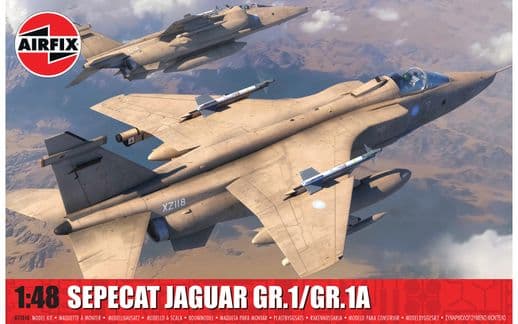
From this angle, has there ever been a better looking RAF aircraft in the post war years?
Although it could be argued that the SEPECAT Jaguar many not have enjoyed the overwhelming media and enthusiast affection such aircraft as the Harrier and Tornado did towards the end of their respective service lives, its only since this magnificent aircraft has left Royal Air Force service that many of us realised just how much we miss our Jaguar. A pioneer of international aviation collaboration, the Jaguar was an exceptionally capable aircraft which overcame the frustrations of international differences to become a jet powered warrior of the skies, one which certainly lived up to the name it was given.
An aircraft which was bred for the Cold War, but excelled in the deserts of the Gulf region, the Jaguar was an aircraft which continued to evolve throughout its service life, but always managed to give a good account of itself wherever its services were required. With aircraft arriving with RAF squadrons from 1973 onwards, the Jaguar would go on to equip eight squadrons, five in Germany and three based at RAF Coltishall in East Anglia, a base which would become synonymous with the Jaguar. The aircraft based there performed a role which essentially saw them becoming a mobile, rapid deployment force, intended to be rushed overseas in times of international crisis. This role would see them training exhaustively for such situations, often from bases in other NATO countries and regularly inside the arctic circle. Two of the Jaguar squadrons would perform strike/ground attack missions, whilst the other would be engaged in tactical reconnaissance.
For many enthusiasts though, our enduring affection for the Jaguar doesn’t come from the fact that it was the product of a groundbreaking Anglo-French aviation collaboration, or by virtue of its excellent service record during its deployment during the Gulf War, but because it was just such an exciting aeroplane to watch at close quarters. Whether you were attending an Airshow event, or clinging to the fence at Coltishall or another operational RAF base, the Jaguar was exciting, dynamic and just so damned good looking, an aircraft which seemed at home near the ground, whether that was flying, or not.
On a personal note, I remember travelling through the Lake District and onwards to Scotland with my dad on several occasions, and how we would always have our eyes peeled on the lookout for low flying Jaguars and Harriers along the M6 Pass, heading toward Tebay. If you did see any, they invariably blasted past at extremely low altitude and even though the passage of time can play tricks on the mind, I’d swear they were usually below the level of the M6 carriageway. I’m sure many readers will have similar experiences, which is probably why we all have an infatuation with aeroplanes, and wouldn’t have it any other way.
We are fortunate enough to still have locations around the UK where we can still pay our respects to the RAF’s Big Cat, particularly at Cosford and especially during their fantastic annual Airshow, where the engineering team usually arrange for a Jaguar to be placed on undercarriage retraction jacks for the duration of the show, much to everyone’s delight. Actually, I wonder if Paramjit had the chance to watch a Jaguar gear retraction as part of his project research - surely, this would have helped him during the design phase.
Let’s ask!
A source of aviation infatuation, Airfix designer Paramjit Sembhi knew he was taking on a popular modelling challenge when he took on the Jaguar.
It really can be difficult when discussing the design of new tooling projects with one of our designers, because there can be a real difference between our layman’s perception of some of the processes we cover in these interviews, as opposed to how these talented individuals actually go about their work. I suppose the real skill here is in trying to describe what they tell us in their answers in terms most of us can understand, because at the end of the day, our designers have a unique set of skills which they use every day, doing things that are so intricate, so clever and so specialised, that we have to concede would be beyond most of us.
That being said, the whole point of these features is to give our modelling community a little insight into what it takes to bring our favourite models to market, so that’s exactly what we’ll be trying to do.
Our first question of this second review instalment was something of an all-encompassing one, which we have purposely split into four parts, but before we got around to that, were initially sidetracked by some preamble discussions regarding the design of the new Jaguar’s cockpit, so if you don’t mind, we’re actually going to start with that.
With modern kits being so detailed and with modellers often choosing to display their built kits with the canopy in the open position showing the cockpit interior, we wanted to ask if this posed any challenges for Paramjit.
As we saw in the previous review, Paramjit was presented with a robust file of information at the outset of this project, containing a plethora of information which enabled him to embark on this project, however, he also confirmed that there will be occasions when a designer will always need more. When it came to cockpit detail design, all the vital scaling and positioning work which forms the bedrock of not just the Jaguar, but any project had been completed, however, in order to replicate the internal detail he was looking at as accurately as possible, he was going to need further references.
This next quartet of images are fascinating and show how Paramjit built up his cockpit design from raw scan data of the area, to starting his design overlay and finally the finished cockpit tub design. The bottom picture shows a computer rendered representation of the cockpit design detail and how it locates with other components in the wider Jaguar assembly.
In addition to having the opportunity to closely inspect several preserved Jaguars, Paramjit told us that he relied heavily on our contacts at Cosford and the RAF’s No.1 School of Technical Training who are based there. These folks are expert in all things Jaguar, so if you have a question that’s Jaguar related, these are the people to ask. Our contact at Cosford was invaluable throughout this project and was always on hand to assist Paramjit with any queries he may have, particularly around cockpit layout. As important as localised scan data, photographs and measurements undoubtedly were, the ability to talk through details with a Jaguar expert was just so helpful to him, and meant that Paramjit could attack this section of the project with real confidence.
Once Paramjit knows what he has to work with from a detail perspective, this is where a designer’s experience comes to the fore, because it’s not only about detail replication, but also about splitting the design into a kit of parts, and knowing how each individual component interacts with those around it. At the end of the day, this design will be subjected to the rigors of the injection moulding process and Paramjit has to be absolutely sure that even the smallest component in his design moulds as intended and will eject from the mould tool correctly once committed to plastic.
Paramjit went on to describe how he found the design interaction between the cockpit components and the forward undercarriage bay to be quite a challenge to overcome, as the two assembly sections are right next to each other and therefore share components. A selection of different parts had to be designed, all with the required levels of details and all needing to be just the right thickness for manufacture – they couldn’t be too thick, or too thin, had to all assemble together to create the desired effect, whilst also locating securely into the respective fuselage halves.
Looking at the selection of images above, we can see a series showing cockpit scan data, the start of Paramjit’s design overlay work and a third image showing the finished cockpit section detail. There are further shots showing the wider cockpit design and how it interacts with other elements of the new kit’s design, particularly the front undercarriage unit and its retraction bay.
So finally, on to that all-encompassing question we mentioned a little earlier. As we’re always fascinated to hear about how you approach projects such as Jaguar, could we please ask (A) which aspect of the new kit’s design did you find most challenging?
Paramjit was unequivocal with his answer this time – main undercarriage. He went on to describe how everything to do with the undercarriage was extremely challenging, not only because he was replicating one of the most distinctive features of the Jaguar, but how at the same time he had to ensure the manufacturing integrity of the parts he was designing. He told us that this was the most difficult undercarriage he had ever attempted to design and really was quite complex.
In an attempt to help us understand some of the issues he was facing, Paramjit sent a selection of images showing not only the individual undercarriage components, but also the boxed bay sections he designed for them to locate into and how all these parts had to assemble correctly into the main fuselage sections. The red coloured detailing shows how individual leg strut components are assembled together and how there are quite a number of elements which all have to come together in order to correctly replicate this detail.
Although it may not initially look so challenging to us as non-designers, Paramjit drew our attention to the fact that these parts are also of differing shapes and thicknesses and how all this had to be incorporated into his design. In addition to this, as we all know, a Jaguar’s robust main undercarriage is one of its most distinctive features and how it was therefore important that this was reflected in the design. The retraction sequence for the units is incredibly impressive, with the huge legs and double tyres twisting through 90 degrees as it is pulled forwards to its position in the fuselage, with the hinges and hydraulic arms all having to be designed to appear as if hinged, even though they are fixed, robust individual pieces.
We have quite a few images to bring you here, starting with this pair of CAD created undercarriage leg components and some of their complexities.
A close up CAD image of a Jaguar main undercarriage leg.
More main undercarriage leg detail and an illustration of how the different shapes and thicknesses were replicated and how the individual components have been designed.
The main undercarriage legs and their anchor points. Although rigid, the inclusion of detail has not been sacrificed.
Undercarriage bay components and their included detail.
Waiting to accept the robust undercarriage leg assembly.
A fascinating CAD image showing the Jaguar’s undercarriage assembly.
When describing his time with the Jaguar’s undercarriage, he said it was really quite difficult and how he even went so far as to design two completely different sets of undercarriage parts. When he received the prototype parts, he already had some reservations about the undercarriage design, and once he had components in hand, he found himself immediately back into CAD to design them differently. He told us that no matter how much time you spend on the design phase, there’s nothing like having physical components in your hand, because it reveals everything, the good and the not so good. Thankfully, this stage is intended to allow a designer to make little changes, and is valued greatly for just that reason.
When working on the undercarriage, Paramjit quite an amount of additional reference material and to this end, he asked us to extend his personal thanks to our friends at the RAF’s No.1 School of Technical Training at Cosford, without whose support he would have found this incredibly challenging aspect of the Jaguar project even more of a struggle. Although Paramjit clearly had some head-scratching moments with the design of the Jaguar’s undercarriage, what our designers all pride themselves on is effectively overcoming challenges, and the Jaguar’s undercarriage looks great. It will have certainly provided him with some new knowledge to apply to future projects we will hopefully be talking about before too long.
Unfortunately for Paramjit, he confirmed that he’s yet to have the joy of experiencing the magic of a Jaguar gear retraction test as yet, but how he very much looks forward to such a treat.
Moving on to the second part of our question (B) – Which aspects of the design phase were the most time consuming?
Paramjit told us that many aspects of the Jaguar’s design were challenging and therefore time consuming, including the cockpit and undercarriage, but also how in most cases, the most time-consuming task relating to every new tooling design project is getting the overall shape right. Unfortunately, when it comes to articulating what has to be done to ensure this is done correctly, it never really makes the translation to the written word effectively enough, meaning the travails of this phase of a new model’s development remains largely in the realm of the Product Designer – it’s just really hard to understand if you’re not a designer.
Any aviation enthusiast will tell you that all aeroplanes are a fusion of complex shapes and sweeping lines, with beautifully shaped outer panels giving the aircraft its distinctive shape, whilst hiding everything going on underneath. Those individual panels are all shaped to seamlessly fit within a collection of other panels, with items such as guns, aerials and probes all requiring shaped panelling to ensure the streamlined appearance of the aircraft.
Paramjit sent us this selection of CAD shape imagery to help us try and understand some of the challenges he faced when committing the SEPECAT Jaguar to model kit design.
The highlight areas show some of the complex shapes and how difficult they were to replicate in design.
The next two images include some arrows included by Paramjit to point us towards some of the features which caused him more than a few challenges.
That being the case, spare a thought, if you will, for an Airfix designer not only having to replicate the shape of that aircraft in 1/48th scale form, but to do so in kit form with possibly hundreds of individual pieces and to have all those pieces fit together perfectly, after passing through a plastic injection moulding machine. There are so many ways where things can go wrong in that scenario that for most of us, we simply wouldn’t know where to start, but thankfully for an Airfix designer, it’s all in a day’s work.
To help us try and understand the shape replication and surfacing process a little more clearly, Paramjit thought that a series of pictures would serve us best, and supplied us with an impressive selection. To help illustrate the shape referencing he was telling us about, he introduced some highlighting into the images, allowing us to see the contours and shapes he was working with on Jaguar. All those sweeping lines were 100% Jaguar and had to be replicated correctly, even though this was a model kit and had to ultimately be assembled from a collection of individual parts.
In order to replicate the required levels of detail on some of the larger components, Paramjit’s tooling needed to make use of tool slides, or side actions, clever engineering solutions to a detailing/moulding problem, where parts require shape and detailing to be added from a different angle. This could be the underside of the main fuselage half, or a particularly deep component, but a benefit which comes at a cost.
An interesting trio of images which illustrate how Paramjit attacked the surfacing detail of his new Jaguar, starting with the scan data, then with increasing levels of design sections overlaid to replace it.
Slide mould technology can allow particularly difficult design elements to be moulded correctly, however, this does introduce additional complexity to the tooling and it’s also devilishly expensive. Whilst it may help a designer over a particularly challenging element of the design, the cost implications have to be factored into the overall project and if not done correctly, run the risk of placing the entire project in some jeopardy. Thankfully, the combined experience of the Airfix team will usually have considered such matters right at the outset of any project, and it’s rare for anything to jump up and catch them in the mid to latter stages.
The correct replication of surface detailing is unquestionably the most time-consuming element of the design process, and from the images Paramjit has supplied, it isn’t difficult to see why. All those shapes, contours and detail requiring correct replication can be the stuff of nightmares and no matter how pleased a designer is with the result, they will invariably be diving back into CAD at some point in the future to make a few little design tweaks. Not exactly a case of trial and error, but a designer’s experience really does come to the fore during this phase, but they are always prepared to learn something new – this is all very tricky stuff.
C – Can we ask which element of Jaguar’s design you are most pleased with, in terms of how it all turned out?
As we expected, Paramjit confirmed that where challenging and time-consuming elements all come into play, these are the areas where you generally tend to find your most rewarding elements of a design project and Jaguar was no different in this regard. He is particularly pleased with the overall shape of the kit and all the surfacing detail all those long hours spent at his computer resulted in replicating. This was all achieved by utilising a combination of scan data, detailed photographs and accurate measurements, however, the importance of the prototype model and test frame stage cannot be overlooked.
No matter how happy you are with the design phase of a project, having a physical sample ‘in hand’ to inspect really does let you see where elements of the design need improving, if any, or if something could just be designed that little bit better. If something hasn’t replicated as anticipated on receipt of the prototype, this has to be investigated, and whether this be a part accuracy, fit, or just an assembly sequence issue, a designer will be back into his CAD files to perfect his design.
Not wanting to leave the front undercarriage design features out of this review, this image also shows how the floor of the cockpit interacts with the roof of the undercarriage bay.
Moving a little further back, whilst problematic for Paramjit, the main undercarriage of the Jaguar is such a distinctive feature of the new kit.
A shape which is about to become rather a familiar one in display cabinets up and down the country.
As ever, a designer will not have Carte blanche when it comes to the number of parts he can include within his design, but other than this, they are left to create and innovate when it comes to the latest design project they are assigned.
Getting back to the question at hand, in addition to the surface detail replication on Jaguar, Paramjit is really pleased with how the cockpit detail has turned out and how posing the canopy in an open position reveals all that beautiful detail and will allow modellers to really go to town. He is also really pleased with how the undercarriage has turned out, possessing great strength and locating securely, just like it did on a real Jaguar. The undercarriage is such a distinctive feature of the Jaguar that he was determined to not only get this right, but improve on the kit offerings which preceded his design, and he’s really pleased with how this has turned out.
Finally, Paramjit confirmed that one of his most pressing concerns at the start of any project is to make the new kit as enjoyable to make as possible and as far as Jaguar is concerned, it’s mission accomplished – it goes together a treat!
D – The final question in this rather detailed series of four is this. If you could point us in the direction of one feature we will all come to appreciate when building the new Jaguar, what would that be?
Without delay, Paramjit replied, “All of the above!” He thinks that the overall appearance of the kit is really pleasing and how it will hopefully be viewed as the long-awaited 1/48th scale version of the Jaguar the hobby has been waiting for. It really is a beautiful replication of a handsome aeroplane, and even though we actually added this bit ourselves, because Paramjit is far too modest to let such words pass from his own lips, we think that everyone taking one of these and building it, will be absolutely delighted with it.
Another CAD screengrab view of that distinctive Jaguar undercarriage, something which caused Paramjit plenty of problems, but is a feature he hopes modellers will enjoy.
Paramjit has just filled a sizeable 1/48th scale Cold War RAF jet hole in our built model collections, and we can’t wait for you all to get your hands on it.
Finally, we wanted to end with a couple of short, sharp, slightly less intense questions, and started by asking Paramjit how long he spent designing Jaguar.
As he keeps copious records and can easily see when design files were opened, he told us that it was between ten and eleven months from taking the project on to passing it on. This covers periods of really intense design work, days where he hardly gets to move away from his computer workstation, to others when he was able to take a bit of a break and visit a preserved Jaguar to check details and gather additional information. It also covers periods where the project had progressed to a point where he really couldn’t do much more and was able to work on other projects alongside it, typically after the tooling plan had been sent to the toolmaker, or in between rounds of test frames being produced and arriving in the Airfix offices.
We’ll end this Jaguar design introduction with a cheeky little parting question. As Paramjit now has some real 1/48th scale kit design heavyweight achievements to his name, which one would he call his favourite?
This was probably a little bit unfair, as it was tantamount to asking a parent to choose which of their kids was their favourite, but to be fair to Paramjit, he did have a crack at it.
He told us that it’s all relative and each project has its own merits and affections, particularly as they came at different stages in his career. He remembers the Blackburn Buccaneer fondly because it was such a beast of an aeroplane to try and replicate in scale form and a great project to be involved with. Covering much of the aircraft’s impressive service career within his design, the part count on this impressive kit actually rivalled that of a 1/24th scale Spitfire and is something he is really proud of.
In a trio of 1/48th scale design classics, how will modellers come to regard the new SEPECAT Jaguar kit, and will it have an impact of where it’s positioned within the affections of its designer?
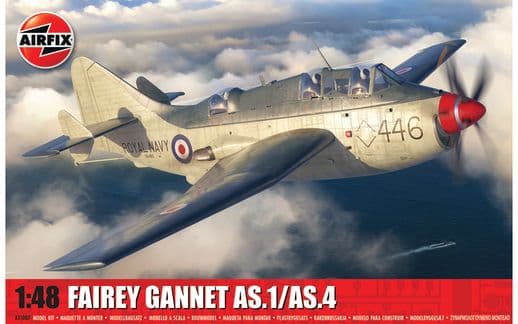
As for the Fairey Gannet, he loves this project because it was just so unexpected when originally announced, and a very different subject for both him and the modelling public to enjoy spending time on. One of the more interesting kits in the Airfix range, the Gannet provides that subject variety Airfix have always been known for, but from the point of view of real display presence, the Gannet will always have a place in his heart.
Moving on to Jaguar, Paramjit is only too aware that this kit has been high on the ‘most requested’ list of modellers for several years now, something which does bring with it a certain amount of responsibility and design trepidation. He told us that, “How people react to a new model following its release, and the comments which circulate after they have built it, definitely have an important part to play in how I remember a project. If everything I worked on turn out as intended, and people enjoy spending time with the kit, then that goes a long way in determining whether I judge the project a success or not, for me and for Airfix.
At the end of the day, we all design these models for the enjoyment of our modelling enthusiasts, and if they’re pleased with it, then we’ve hopefully done something right. So, that being the case, I really can’t commit to the question at this point, and you’ll have to ask me again when we discuss a future new tooling project”.
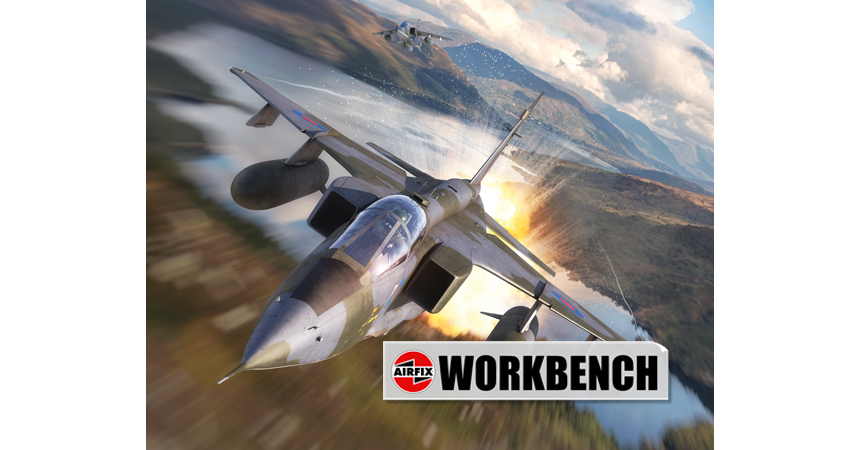
Due to its prominent position within the 2025 range, the new Jaguar demanded the production of two impressive pieces of digital artwork, with one making the front cover of the new 2025 catalogue.
We really can’t wait for that occasion, but once again, would like to thank Paramjit for giving his time so generously in helping us put this latest feature together. I would personally like to thank him for providing almost every single image used to illustrate the two interview articles posted, although I think he was getting a bit cheesed off with me in the end – they all looked so appealing, I just couldn’t stop asking.
Importantly for the Jaguar, Paramjit has provided us with a real winner here and pre-ordering activity has been just as spectacular as we anticipated. With the first kits expected to arrive towards the end of March (this can change, so please keep an eye on the Jaguar product page on the Airfix website), we know these are going to be straight in and straight out again, so if you don’t want to have to wait for your Jaguar kit, you really do need to be reserving your example now.
There are going to be a great many of us who will be looking forward to a little ‘Big Cat’ action in the months to come, as we all pay our scale modelling tributes to one of the RAF’s best-looking post war jets. Prepare for Jaguars at low level across our workstations.
Thanks again Paramjit – see, I told you I wouldn’t let the cat out of the bag, and inadvertently tell people what you’re currently working on!
We are afraid that's all we have for you in this latest edition, but we will be back next Friday with more project development updates and the very latest Airfix kit exclusives. In the meantime, we are always keen to hear your views on all things Airfix and in particular, any thoughts and opinions you may have regarding our Workbench blog. If you would like to drop us a quick line, could we please ask that you use our workbench@airfix.com email for all correspondence.
To re-visit any of the Airfix blogs we have produced over the past seven years or so, please head to our main Workbench hub, where you will find our entire blog back catalogue and all the Airfix design projects we have already covered.
All our dedicated official social media sites can be accessed by clicking the respective link icons at the foot of this page, or by heading to the Airfix homepage. Other useful Airfix links are:
Facebook, YouTube, Twitter and Instagram official sites
Please join us for more Airfix updates next week and thank you for your continued support.