
Welcome to this latest edition of our Workbench blog and all the news, updates, and modelling exclusives from the fascinating world of Airfix.
As we await the impending and much-anticipated arrival of our new 1/48th scale SEPECAT Jaguar GR.1 kit, we’re pleased to report that this magnificent model will be taking top billing in this latest edition of Workbench, placing everyone on alert that just a small quantity of kits from this initial run still remain unallocated. If you want one of these first Jaguars, this is most definitely your final opportunity to secure one.
In celebration of this momentous occasion, we have a visual feast of Jaguar imagery to bring you this week, from original artwork, to the four scheme profiles which accompany this initial release. We also have a selection of built model imagery to bring you, with advanced frame samples being used to complete models in all four of the scheme options on offer, so as you can see, we find ourselves very much in the lair of the RAF’s Big Cat in this latest edition.
We also have a second blog posting for this weekend, however this one is very much a tribute posting and one intended to pay our respects to the passing of the ‘Last of the Few’ earlier this week. With thanks to modelling maestro and Workbench contributor Michael Scott, we are reposting a feature from a couple of years ago where he allowed us to feature his beautiful scale tribute to Battle of Britain pilot John ‘Paddy’ Hemingway DFC, who sadly joined the rest of his Fighter Command comrades this week.
Right then, who’s ready to spend some quality time with our scale tribute to the RAF’s charismatic Big Cat?
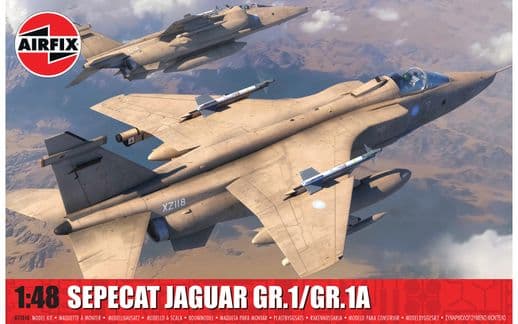
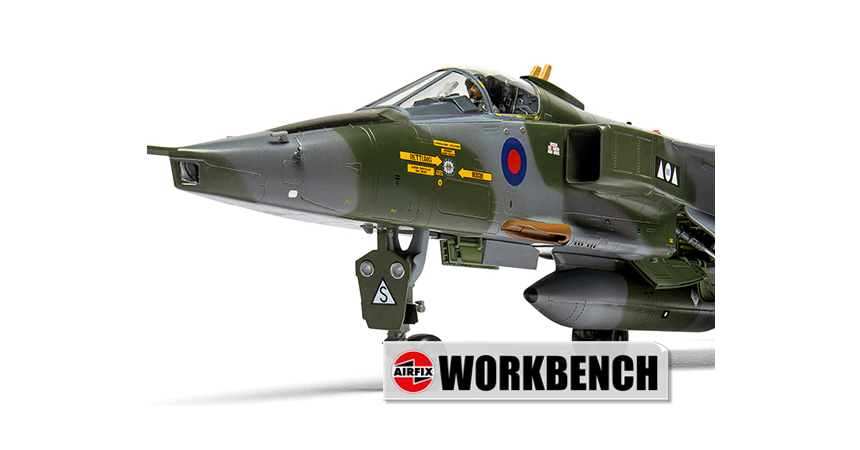
This final pre-release update will benefit from the addition of an impressive series of Jaguar built model images, like this stunning Desert Cat.
Still regarded by many as one of the best looking post war aircraft to see service with the Royal Air Force, the SEPECAT Jaguar is about to enter the ranks of iconic Airfix model kits, with the release of our new 1/48th scale tooling homage to this much-loved aircraft, a development which also gives us the opportunity to look at its fascinating history. Interestingly though, when the RAF decided to retire their Jaguars, they did so without much of the media attention the Harrier received just over three years later, even though the Jaguar was still an incredibly capable strike and reconnaissance asset at the time. Although enthusiasts will always have their affections, we have to trust that the military have their reasons for such decisions, and therefore have to accept them as being correct.
For an aircraft which looks every inch the Cold War strike warrior, it can be surprising to learn that the project which eventually led to the introduction of the SEPECAT Jaguar began as one looking to design a high-performance training aircraft. During the 1960s, Britain’s aviation industry was going through a period of great change, as the Royal Air Force were considering their needs for an uncertain future. There were some exciting projects in development at that time, such as the BAC TSR.2 and the P.1154 and in support, they were in need of an advanced new training aircraft to produce pilots to fly them. Looking for an aircraft to replace the diminutive Folland Gnat and ultimately, the Hawker Hunter, it was clear such a project would be expensive and place further strain on the nation’s finances.
Across the English Channel, the French found themselves with a similar need for a new training aircraft, but one which also possessed a light strike and battlefield support capability, and whilst both projects progressed independently at first, they did appear to be very closely aligned. With several projects later falling victim to cancellation and worries about spiralling costs being the most pressing concern, it appeared that the only way the RAF were going to get their new trainer was if they embraced the cost saving potential of a collaborative project. In a similar arrangement to several recent collaborations which had gone before it, BAC in the UK and Breguet in France came together to form the company SEPECAT.
Such a good looking aircraft, the SEPECAT Jaguar is about to receive the scale recognition it deserves.
This arrangement really did appear to suit both parties with regard to their aircraft requirements, and clearly from an affordability perspective, however, it soon became apparent that the British and French had some differing role profiles for the new aircraft. As development got underway, five different variants were being proposed, with the French looking for single seat strike, trainer and naval variants, whilst the British needed a trainer and light strike variant. Running concurrently with this, Rolls Royce in the UK and Turbomeca in France were jointly developing the Adour engine which would power the new aircraft, something which would create its own problems and result in some protracted delays. This situation wouldn’t be helped when the British insisted the aircraft possess supersonic capability.
Nevertheless, both Britain and France placed sizeable orders for the new aircraft, with both committing to 200 aircraft each, with Britain’s order being weighted in favour of 110 trainer aircraft and 90 light strike variants.
The aircraft would endure a relatively long period in development and even as the first prototype aircraft was unveiled in April 1968, the operational landscape the aircraft was heading into was already beginning to change, and the RAF were about to change their order requirements. In 1970, they decided to abandon the trainer requirement for the new aircraft, other than for trainer variants destined to provide conversion support for the Jaguar in service, and subsequently modified their order requirements to 165 strike jets and just 35 two seat trainers. A separate project would be placed with Hawker Siddeley to develop a new training jet, one which would eventually result in the introduction of the highly successful Hawk.
Entering Royal Air Force service in 1973, the Jaguar GR.1 (Ground Attack/Reconnaissance Mk.I) would prove to be a more sophisticated and technologically advanced aircraft than their French counterparts, and immediately showed itself to be a potent performer. It would become one of the most important British aircraft throughout the Cold War era, with pilots always training for a role at the spearhead of any future military engagement and therefore, serving as a significant deterrent to possible Eastern Bloc aggression. A vital component of RAF Germany’s offensive inventory, they maintained four squadrons of Jaguars for strike and battlefield support operations, with a further squadron performing the tactical reconnaissance role. Further squadrons were based in the UK, and served as a deployment ready mobile force, should their services be required.
Allowed to slip from RAF service without too much fanfare, let’s hope the release of our new 1/48th scale Jaguar kit will bring the aircraft some long overdue recognition.
From a design perspective, the Jaguar’s distinctive undercarriage was specifically developed to allow this capable performer to operate from damaged airfields, roughly prepared grass strips and even larger roads, as the RAF assumed that in times of war, any first strike by the enemy would be directed towards known operational airfields. This ability was regarded as a valuable deterrent asset and was ably demonstrated to the nation’s media on 26th April 1975, when the second production development Jaguar GR.1 XX109 made a parachute assisted landing on the carriageway of the soon to be opened M55 motorway near Blackpool. Pushed under a bridge over the carriageway, the aircraft was fitted with bombs, before taking off again, demonstrating the impressive operability of the Jaguar.
The Jaguar would go on to enjoy an impressive 34 year service career with the Royal Air Force, undergoing regular upgrades to improve and perfect its operational capabilities during that time. It would earn a reputation as a hardworking and reliable strike and reconnaissance platform, something which was illustrated by its performance during the first Gulf War. The twelve Jaguars deployed during Operation Granby flew 612 combat sorties, with one Jaguar flying 47 missions, the most of any aircraft in theatre.
Although starting out as an Anglo-French training aircraft project, the RAF’s Big Cats certainly went on to live up to their name, showing themselves to be aircraft not to be messed with. If the Jaguar showed its offensive claws, you knew you were in big trouble.
A thing of beauty. The new Jaguar GR.1 box artwork in all its Desert Cat glory.
Although it could be argued that the SEPECAT Jaguar many not have benefited the overwhelming media and enthusiast affection such aircraft as the Harrier and Tornado did towards the end of their respective service lives, it’s only since this magnificent aircraft has left Royal Air Force service that many of us realised just how much we miss our Jaguar. A pioneer of international aviation collaboration, the Jaguar was an exceptionally capable aircraft which overcame the frustrations of international differences to become a jet powered warrior of the skies, one which certainly lived up to the name it was given.
An aircraft which was bred for the Cold War, but excelled in the deserts of the Gulf region, the Jaguar was an aircraft which continued to evolve throughout its service life, but always managed to give a good account of itself wherever its services were required. With aircraft arriving with RAF squadrons from 1973 onwards, the Jaguar would go on to equip eight squadrons, five in Germany and three based at RAF Coltishall in East Anglia, a base which would become synonymous with the Jaguar.
The aircraft based there performed a role which essentially saw them becoming a mobile, rapid deployment force, intended to be rushed overseas in times of international crisis. This role would see them training exhaustively for such situations, often from bases in other NATO countries and regularly inside the arctic circle. Two of the Jaguar squadrons would perform strike/ground attack missions, whilst the other would be engaged in tactical reconnaissance.
For many enthusiasts though, our enduring affection for the Jaguar doesn’t come from the fact that it was the product of a groundbreaking Anglo-French aviation collaboration, or by virtue of its excellent service record during its deployment during the Gulf War, but simply because it was just such an exciting aeroplane to watch at close quarters. Whether you were attending an Airshow event, or clinging to the fence at Coltishall or another operational RAF base, the Jaguar was exciting, dynamic and just so damned good looking, an aircraft which seemed at home near the ground, whether that was flying, or not.
No trip to the Lake District, or onwards to Scotland was ever complete without keeping our eyes peeled on the lookout for low flying Jaguars along the M6 Pass, heading towards Tebay. If you were lucky enough to see one or more commonly two, they invariably blasted past at extremely low altitude and even though the passage of time can play tricks on our minds, they really did appear to be below the level of the M6 carriageway itself! Many Workbench readers will probably have shared similar experiences, which is probably why we all have an enduring fascination for aeroplanes, and the Jaguar in particular.
Let’s take a look at the FOUR Jaguar GR.1 and GR.1A scheme options available with this impressive new kit.
The Jaguar aircraft which initially entered service with the Royal Air Force were actually quite significantly more sophisticated and therefore capable than their French Air Force counterparts, and were equipped with some of the most advanced nav-attack technology available at that time. This equipment gave British Jaguars the ability to attack targets with pinpoint accuracy, without emitting a detectable radar signature. Ultimately, this helped to make the Jaguar one of the most important RAF aircraft for at least a decade following its introduction, with the RAF taking 165 single seat variants, and an additional 35 two seaters. They would take a further three trainer variants for use in various test and evaluation situations.
RAF Lossiemouth would have quite a role to play in the service introduction of the Royal Air Force Jaguar, with the first production aircraft XX111 being flown to the airfield on 30th May 1973, to allow ground trades to begin training on this exciting new aircraft. Whilst initial pilot training was carried out at the BAe airfield site at Warton in Lancashire, the Jaguar Operational Conversion Unit had also been established at Lossiemouth and at its height of training activities, around fifty Jaguars would be operated by them.
The first operational RAF Jaguar unit would be No.54 (Fighter) Squadron, initially as a designated unit, but once 54 had transferred their current remaining Phantoms to No.111 Squadron, becoming a Jaguar unit on 2nd July 1974. The Squadron relocated to Coltishall in early August and were declared operational on type on New Year’s Day 1975. They would maintain their association with this aircraft until disbanding on 11th March 2005.
This particular aircraft would go on to have a long career with the Royal Air Force, one which it could be argued, continues to this day. She made her first flight on 26th April 1974 and was subsequently delivered to RAF Lossiemouth at the end of the following month. During her career, she spent time with both Nos.54 and 6 Squadrons, but made her final flight from Coltishall when being delivered to the Defence College of Aeronautical Engineering at Cosford on 12th June 2007.
She is preserved in GR.3A configuration and can usually be seen on Cosford Airshow day as part of the School of Engineering display, possibly even performing undercarriage retraction cycles. In the scheme option presented here, she is the only one of the four on offer showing the original Light Aircraft Grey undersides of the early RAF Jaguars, making this an extremely tempting finish proposition.
The upgrade of Jaguars to GR.1A standard made an already extremely capable aircraft even more operationally effective, with 75 existing aircraft passing through the upgrade program from December 1983 onwards. Although the upgrade did introduce features which were externally identifiable, most of the significant improvements were internal, including the fitting of an impressive new inertial navigation system. The upgrade also included improvements to the aircraft’s offensive and defensive capabilities, with the aircraft now able to carry the high-tech AN/ALQ101 ECM electronic countermeasures pod, a powerful unit designed to counter radar guided weapons being used against the Jaguar during sorties.
At a similar time to this upgrade, but not actually linked, RAF Jaguars benefited from a significant powerplant upgrade from Adour 102 to the much more capable Rolls-Royce Turbomeca Adour Mk.104 unit. This unit provided the Jaguar with a 10% thrust improvement at take-off and an impressive additional 27% at high subsonic cruise, helping to maintain the deterrent capability of this magnificent aircraft at a time when political tensions were rising in Europe.
RAF No.6 Squadron also formed at Lossiemouth as a designate Jaguar unit, whilst still retaining its Phantom FGR.2s at Coningsby. Once these had been relinquished, the designate title was dropped, and the squadron’s Jaguar era began. Moving to Coltishall in November 1974 and becoming operational in the tactical nuclear strike role the following year. No.6 ‘Flying Tin-Openers’ Squadron has the proud distinction of having the longest record of continuous service within any of the world’s air forces, gaining their impressive nickname during air operations against the Afrika Korps during the Second World War.
As one of the most famous RAF stations, the former Battle of Britain airfield at Coltishall would become inextricably linked with the Jaguar and for over thirty years, would be known as the Home of the Jaguar. With the impending arrival of the Eurofighter Typhoon in RAF service and the subsequent withdrawal of the Jaguar, Coltishall was not selected to be a Typhoon airfield and was therefore identified for closure. The final Jaguar movement from the airfield took place on 3rd April 2006 and this once proud home of the Jaguar settled into retirement having played a significant role in the aircraft’s history.
Jaguar XX741 made her first flight on 10th October 1974 and was subsequently delivered to the Royal Air Force around seven weeks later. Another Jaguar with a long and illustrious service career, once this was over, she was sent for long-term storage to RAF Shawbury, until purchased by Everett Aero of Suffolk in November 2005.
She was subsequently purchased by the Bentwaters Cold War Museum on the 16th August 2009, following a generous donation by one of the members of the Bentwaters Aviation Society. She is thought to be one of the finest preserved examples of the Jaguar in Britain today, and thanks to the dedication of a team of former RAF engineers, is now maintained in ground running condition. The aircraft had to have many parts sourced and re-fitted once in the hands of Museum volunteers, but is now a LIVE aircraft, allowing visitors to hear the Jaguar growl once more.
This aircraft spent time with 226 OCU and Nos.6, 54 and 16(R) Squadrons during her service life, including service as the RAF Jaguar display aircraft for 1993. In this scheme configuration, she wears the sinister wrap around camouflage which was such a feature of RAF Jaguars for much of the most significant period of their service lives.
By the late 1980s, some observers were of the opinion that the RAF’s Jaguars were becoming less effective than other comparable aircraft in world service, but nevertheless, the Iraqi invasion of Kuwait in August 1990 would bring about a significant overseas deployment for the RAF’s Big Cats. The UK Government ordered the deployment of an expeditionary force, and Coltishall’s Jaguar Wing was told to prepare aircraft for imminent deployment to the Gulf. Twelve Jaguar GR1A aircraft were prepared for deployment, with the most significant visual preparation being the application of a new desert scheme, a temporary was which consisted of a Desert Sand alkaline-removable temporary finish scheme designed to make the aircraft more suitable for operations in the Gulf region.
Each aircraft was equipped with external fuel tank, AN/ALQ-101 jamming pod and additional self-protection equipment, and would subsequently be the first British aircraft to arrive in theatre. By the time they arrived, crews had unofficially proclaimed themselves and their aircraft to be the ‘Desert Cats’ and after moving to Muharraq International Airport in Bahrain, a period of additional training took place in preparation for the unit’s first operational sortie. That first mission came on 17th January 1991, when a Jaguar four-ship attacked Iraqi Army facilities in Kuwait.
The primary mission role for RAF Jaguars in the Gulf was Battlefield air interdiction, with a range of targets attacked including missile sites, artillery positions, munitions storage areas, airfields, armoured columns and troop concentrations, but all aimed at preventing Iraqi forces from either mounting a credible opposition, or advancing against coalition forces. Once again demonstrating the professionalism and application of British forces during times of war, the Jaguar’s Gulf deployment was impressive and even though the Jaguar force constituted less than one sixth of the RAF fast jets deployed, but went on to fly almost one third of all the offensive strike sorties.
Working under extreme conditions and flying the aircraft very hard, all twelve aircraft were invariably serviceable when called upon, a real testament to the work of Jaguar ground crews. With no aircraft losses to combat damage, only seven sorties were lost to technical issues, with the Desert Cats mounting 158 sorties during their Gulf deployment. This was further broken down to 618 individual aircraft sorties, with aircraft spending 922 hours in the air on operational sorties.
One of the most interesting facts relating to the Jaguar’s Gulf War deployment is how the majority of the aircraft received impressive nose artwork whilst there. Jaguar GR.1 XZ118 was adorned with the slightly risqué nose artwork featured on this scheme option, a character from a much loved British comic magazine at the time, with some being commissioned by the pilots, whilst others miraculously appeared during quieter periods on the airfield.
This particular Jaguar made its first flight on 12th May 1976 and was delivered to the RAF early the following month, where she embarked on a long service career, which included deployment to the Gulf described above. At the opposite end of her career, she was sent to the Defence Aviation Repair Agency at St. Athan at the end of September 2005 for spares recovery, then was sold to Everett Aero at the former RAF Bentwaters.
In an unusual turn of events, this aircraft was later used as the basis of a major art exhibition at the Tate Britain Gallery in London, with the aircraft displayed on its back, with the undersides facing upwards. The aircraft had all its paint removed and had been polished to within an inch of its life, showing of the beautiful lines of the Jaguar in some style. After the exhibition, the aircraft was recorded as being sold to the Slimelight Nightclub in Islington, but by the following year had been scrapped.
At the end of her Gulf War deployment, in addition to her nose artwork, Jaguar XZ118 was noted as displaying an impressive 38 mission symbols on the side of her fuselage.
Perhaps the most significant operator of the Jaguar in British service was RAF Germany, who maintained four squadrons as part of the 2nd Allied Tactical Air Force under SACEUR (Supreme Allied Commander Europe). This particular aircraft XZ101 was the first Jaguar allocated to No.II(AC) Squadron, arriving at RAF Laarbruch in Germany on 26th February 1976. Over the coming two months, she was joined by eleven more single seat and a single two seat Jaguar and after intensive work-up, took over the tactical reconnaissance role for RAF Germany from the McDonnell Douglas Phantom in October that same year.
Operational flying in Germany was intense and demanding for air and ground crews alike, and it wasn’t long before No.II(AC) squadron suffered its first aircraft loss. This happened on 14th December 1976, when a pilot was forced to eject after his aircraft entered an uncontrolled roll – it was later discovered that a faulty maintenance control connection was the cause of the problem, but how the pilot was fortunate to escape unharmed.
A second loss occurred early the following year, as an aircraft crashed into the North Sea having lost contact with other aircraft during a formation join up. Tragically, the pilot wasn’t so fortunate on this occasion. The work of undertaking high speed, low altitude reconnaissance work was extremely demanding for pilots, particularly as they also had to train for the secondary role of strike attack operations. The aircraft were equipped with a specially designed British Aerospace recon pod carried under the jet’s belly, which housed an array of precision photographic equipment and an infrared linescan sensor.
A typical mission would see a Jaguar pilot making just a single pass over his assigned target with cameras firing at breakneck speed. On landing back at Laarbruch, the exposed film magazines were removed from the aircraft by specialist fitters and handed to a waiting motorcyclist, who sped them to the Reconnaissance Information Centre for rapid processing. This was their main method of processing, but for mobile processing and in case of conflict, a specialist air transportable processing lab could be utilised, something which provided the service with a level of autonomy which must have spread fear into the hearts of the Warsaw Pact nations.
As the Tornado entered Royal Air Force service and took over strike operations from the Jaguar, No.II(AC) Squadron would have the distinction of being the final Jaguar unit to serve with RAF Germany, as its specialist services were still in demand, and the reconnaissance pod being developed for the Tornado was suffering protracted delays. Operating their aircraft until mid-December 1988, the end of Jaguar operations in Germany may have brought about the end of a relatively short career for the aircraft based in Germany, however, it did serve during a particularly volatile period in European history.
Whether carrying bombs or cameras, RAF Germany’s Jaguar Force was certainly one to be reckoned with, and you definitely didn’t want to get on the wrong side of these Big Cats.
XZ101 would see service with Nos.16 and 41 Squadrons, in addition to its time with II(AC) Squadron, making its first flight on the 4th February 1976, and being delivered to the RAF at the end of that same month. She would end her days as a Ground Instructional airframe at Boscome Down, used in support of their structural teardown programme. She was scrapped during 2003, such an ignominious end for an aircraft which worked so hard to preserve peace in Europe.
Our new Big Cat kit is about to get its claws into us and climb onto our workstations – the wait is almost over!
An aircraft of this Cold War pedigree deserves to be immortalised in scale model kit form in some style, so we are therefore incredibly excited to be expecting our new 1/48th scale Jaguar GR.1 kit to arrive any time now. In fact, by the time you are reading this latest update, if this first consignment isn’t already in our warehouse, something has gone awry.
We are pleased to say that we know many of you will be looking forward to getting your hands on one, because this first consignment is almost completely allocated, bar a few remaining available via the Airfix website, but we expect those to be snapped up in no time once this news gets out. We will be trying hard to bring in a second run to satisfy the incredible demand for the Jaguar, however, this may not be available for some weeks.
We’re all looking forward to you getting your hands on our new Jaguar and can’t wait to see what you all do with your build tributes to this popular and extremely capable aircraft. We’ll leave it to you to explain the details behind the Gulf War ‘Desert Cat’ nose artwork, should you decide to go for that scheme option – tin hats on, or should that be wheelbarrow required!
We are afraid that's all we have for you in this latest edition, but we will be back next Friday with more project development updates and the very latest Airfix kit exclusives. In the meantime, we are always keen to hear your views on all things Airfix and in particular, any thoughts and opinions you may have regarding our Workbench blog. If you would like to drop us a quick line, could we please ask that you use our workbench@airfix.com email for all correspondence.
To re-visit any of the Airfix blogs we have produced over the past seven years or so, please head to our main Workbench hub, where you will find our entire blog back catalogue and all the Airfix design projects we have already covered.
All our dedicated official social media sites can be accessed by clicking the respective link icons at the foot of this page, or by heading to the Airfix homepage. Other useful Airfix links are:
Facebook, YouTube, Twitter and Instagram official sites
Please join us for more Airfix updates next week and thank you for your continued support.