
Welcome to this first edition of our Workbench blog of 2021 and another year of bringing you all the news, updates and exclusive announcements from the fascinating world of Airfix modelling.
Before we embark on another busy year for Airfix, we would like to apologise for the delay in getting this first blog of the year posted to the website, which for several reasons has taken much longer than expected. Hugely increased web traffic activity, a new range launch and the launch of a new website have resulted in a few additional publication pressures, however, we have maintained our blog production schedule, so you may find yourselves benefiting from a few extra blogs over the next couple of weeks, as we intent to play ‘catch up’ to our usual schedule. This first edition of Workbench is definitely one of the blog highlights of our year and was initially scheduled to be published in the same week as the new 2021 Airfix model kit range was announced on the Airfix website. We don’t see any reason not to still post this range overview edition, as we feature all the new and modified tooling announcements and celebrate the launch of a host of new Airfix models. If you have yet to inspect the 2021 range for yourself, now might be the ideal opportunity and you will also have the added bonus of experiencing our new website for the first time.
Surely, there can be no finer way to start any year that by bringing you news of an impressive collection of new Airfix kits, both exciting new tooling projects being revealed for the very first time and the appealing selection of new liveries applied to popular existing toolings which will always make up the majority of every model range. Add to this a couple of modified tooling releases and the return of some true Airfix classics and you have the perfect recipe for another enjoyable year of Airfix modelling and the continuation of this hobby story which brings so much pleasure to so many people. We are confident that 2021 will be another significant year for Airfix and we hope we can provide some modelling distraction from everything else that may be going on in the world, as we safely negotiate the coming twelve months with our regular exclusive updates.
Right then, let’s dive into the main subject of this first Workbench blog of the new year and our New Airfix kit range review. Deviating somewhat from our usual, slightly more focused look at several of the new model projects currently negotiating their way through the various stages of product development, we will this time be taking a look at some of the highlights of the new 2021 model range, concentrating on the new and modified tooling additions to the range, but also welcoming back some true Airfix classics. Once we return to our usual blog format in a fortnight’s time, we will be bringing you more detailed updates from all the many projects modellers will be charting the progress of throughout the coming year, including development details from our new models.
Significantly though, the New 2021 Airfix range is now live on the ‘All New’ Airfix website and available for immediate inspection, with the individual product pages containing all the relevant information you might need when making your all-important pre-order decisions. Ok then, who would like to hear about some new Airfix models?
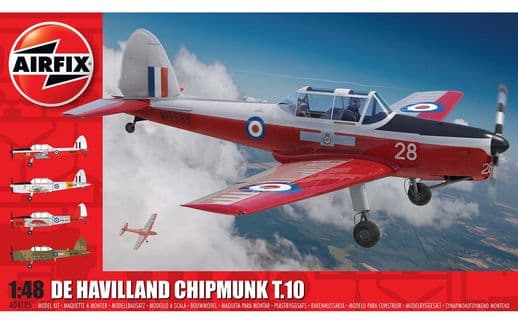
An early Airfix artwork present for Workbench readers … may we introduce our new 1/48th scale de Havilland Chipmunk tooling
With the launch of every new Airfix model range, we know that many tens of thousands of modellers from all over the world will be keen to see if their own personal subject favourites have made it into the latest range and which of the new models will be destined to take their place on modeller’s own workbenches following their eventual release later in the year. Of course, we also know that whilst we always try to please as many people as possible when it comes to the matter of new subject selection, this is never going to be completely possible and whilst a particular new model tooling project may appeal to many, it could also come as a slight disappointment to others - it just goes with the territory.
Having said that, the past few years have definitely marked something of a renaissance for the modelling hobby, with a real surge in popularity coming on the back of the widespread introduction of fast home broadband and a general coming together of like-minded enthusiasts. With modelling regulars joined by people returning to the hobby after a ‘poly cement’ free sabbatical and younger people once again discovering the simple pleasures of the hobby, modelling is now once again very much a high-profile and extremely popular pastime. This resurgence has hugely benefitted the Airfix brand, as new tooling investment has seen the addition of several exciting new tooling project announcements over successive recent range launches, with this latest selection being no exception. Let’s now take a closer look at what we all have to look forward to over the coming twelve months, from a new tooling perspective.
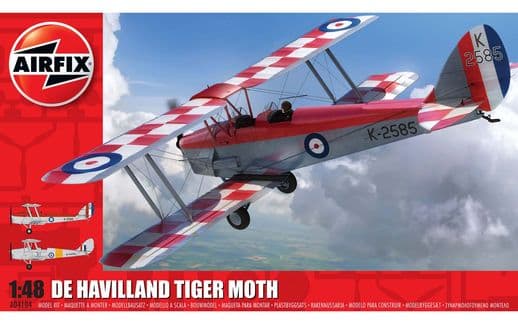
A scale which has gained real traction over the past few years as far as Airfix is concerned, our latest 1/48th scale models allow our designers to not only incorporate all the latest design and manufacturing advancements into their work, but also to really ramp up the levels of fine detail their designs can feature. The newly announced 2021 range includes two new model tooling projects in this scale, both of which add real interest and diversification to this ever expanding range. Taking its place as the ideal follow up to the beautiful de Havilland Tiger Moth announced at the beginning of 2019 and acting as something of this aircraft’s younger and more accomplished relative, the new de Havilland Chipmunk T.10 will come as a pleasant surprise for many and is surely destined to become one of our most popular releases in the years to come.
Having the distinction of being the first aircraft type designed and built by de Havilland Canada, the first Chipmunk took to the skies in May 1946 and almost immediately gained interest from the military. By April 1948, the Royal Canadian Air Force had taken delivery of their first Chipmunk, but they were not the only ones admiring the qualities of this extremely capable aeroplane. The vast majority of the 1,283 de Havilland Chipmunks built would be manufactured under licence in the UK, in factories at Hatfield and Chester, with around 735 of these going on to see service with the Royal Air Force, as the direct replacement for the venerable old Tiger Moth. In RAF service, the British built machines were known as the de Havilland Chipmunk Mk.10 and they would go on to provide basic flight training support for many thousands of future military aviators, in addition to providing air experience opportunities for many more as part of the University Air Squadron organisation.
Once we get the chance to build this stunning new model, we will all be wondering ‘how on earth did we manage without a 1/48th scale Chipmunk in our lives?’ Featured here is a computer rendered image produced during the early development of the new model kit
Despite being a Canadian design, the Chipmunk has become one of the most recognisable Royal Air Force aircraft of the post war era and has enjoyed a military career which began in the early 1950s and continues to this day. The Battle of Britain Memorial Flight still operate two Chipmunks regularly, providing currency training for aircrew assigned to fly the unit’s historic ‘taildraggers’ and also to allow crews to reconnoitre new display venues in advance of their show appearance. In other situations, the aircraft can be used to deliver replacement aircrew or spare parts, whilst the Flight’s Spitfires and Hurricanes are out on display duties during the Airshow season. These two Chipmunks have ensured that the aircraft must now be regarded as one of the longest serving types in Royal Air Force History.
Perhaps the most enduring feature of the flying legacy of this classic training aeroplane is not only the fact that it served as a primary trainer throughout the 60s and 70s, therefore training many thousands of qualified pilots, but that it also provided air experience opportunities for many thousands more. As such, a great many people will have an affinity with the Chipmunk and therefore be interested in building an accurate 1/48th scale model of the aircraft. For those who still have links to the many aircraft which continue flying to this day, the temptation to finish their model in the markings of their own aircraft, or one they have enjoyed flying in, may just prove too tempting and we look forward to seeing the modelling fruits of your labours. With so many attractive Chipmunk schemes worn by the aircraft over the years, we certainly don’t think there is going to be any shortage of subject matter for the budding Chipmunk modeller.
Another early computer rendered product image, hopefully the release of this stunning new kit will see the Vampire receiving the recognition its significant position in British aviation history deserves
The second new 1/48th scale tooling project announced as part of the 2021 range is a representation of another example of British aviation design excellence, in addition to being another aircraft type to leap from the de Havilland Aircraft Company drawing boards at their Hatfield facility. An aircraft which this time was developed during the Second World War and takes its place in aviation history as one of Britain’s first jet powered fighter aircraft, the de Havilland Vampire is always overshadowed by the Gloster Meteor which beat it into service by just a few months, even though it has many ‘firsts’ to its name. Despite the fact that the Vampire was arguably a more mature design and was Britain’s first single engined jet fighter, the Meteor did have the distinction of being the only British jet to see service during the Second World War, so its recognition is probably understandable.
The Vampire F.Mk.I entered Royal Air Force service in March 1946, to be followed by the revised and more capable F.3 just two years later. The Vampire F.3 was basically a longer range version of its predecessor, featuring increased internal fuel capacity and the ability to carry two external fuel tanks. This latest variant also differed visually, in that it incorporated taller and more rounded vertical stabilisers, a lowered horizontal stabiliser and distinctive ‘acorn’ fairings at the base of each vertical stabiliser. Although this was still relatively new technology, de Havilland cleverly designed the aircraft to be simple to maintain and operate, earning the aircraft an enviable reputation for reliability amongst air and ground crews alike and allowing more pilots to safely make the transition to jet powered flight.
Such a distinctive shape, the Vampire was the RAF’s first single engined jet fighter to enter service
With a number of significant firsts to its name, the Vampire was the first RAF aircraft to exceed 500 mph, with the extra range of the F.3 also allowing this to be the first jet fighter to cross the Atlantic. The Vampire F.3’s of No.32 Squadron had the distinction of being the first RAF jet fighters to be deployed outside Northwest Europe and the first to operate in the higher temperatures of the Mediterranean. Without doubt, the de Havilland Vampire has to be considered one of the most important early jet fighters in the aviation world.
A really distinctive looking aeroplane, the Vampire inherits many design similarities from the famous wartime Mosquito, perhaps the most significant of which is the laminated wooden construction utilised on the jet’s egg shaped fuselage. It is fascinating to think that a structure which basically houses a large furnace is made almost entirely of wood and glue. There is no doubting that this new kit will be a stunning addition to the range and will look magnificent displayed next to its wartime stablemate the Mosquito, or its jet predecessor the Gloster Meteor. Stay tuned for much more from this exciting project in future editions of the blog.
An aircraft which certainly needs no introduction, the de Havilland Mosquito was the pride of the Royal Air Force during the Second World War and one which made such a telling contribution to eventual Allied victory
They say that good things always come in multiples and that is most definitely the case when it comes to the subject of new Airfix model tooling projects. If two new representations of de Havilland aircraft types were not enough, we have a third to tell you about and it’s a biggie! This time produced in our most popular aviation scale, our 1/72nd scale range will soon be able to boast the addition of a newly tooled de Havilland Mosquito B.XVI kit an aircraft type which many still consider to be the finest aircraft of the Second World War. The Airfix model kit range has been able to boast the inclusion of a scale version of the ‘Wooden Wonder’ since 1957 and as you may well imagine, the kit sold in vast quantities over the years, as modellers everywhere felt that no collection could be considered complete without at least one example of the Mosquito in there. Although this original kit is considered very much a classic and is an important feature in our modelling heritage, this new Mosquito will be something very different altogether and a fitting tribute to the legacy of this magnificent aeroplane.
The wartime Mosquito was basically developed and tested as a private venture and therefore without interference from Air Ministry red tape. Once the de Havilland team were confident they had a winner on their hands and allowed Ministry officials to see the spectacular performance of their new aircraft for themselves, they knew their machine would be of huge interest to them and would vindicate their decision to press ahead with the project. Suitably impressed, the Air Ministry immediately placed an order for 150 aircraft and soon after, awarded the Mosquito ‘priority production status’, underlining its potential as a significant contributor to the Allied war effort.
The Mosquito was one of the fastest aircraft in the world at that time and one which would prove to be something of an aviation phenomenon. Although initially intended as a high speed bomber, Mosquitos would also operate as day and night fighters, pathfinders, night intruders, maritime strike and reconnaissance aircraft following its service introduction. Once the first production aircraft started reaching RAF squadrons towards the end of 1941, the de Havilland Mosquito quickly showed itself to be one of the most valuable assets available to the Royal Air Force, a real war winner and one which would serve with distinction for the remainder of the conflict.
As one of the most famous British aircraft ever produced, our new Mosquito is surely destined to become one of our most popular kits of recent years and we can’t wait to bring you more details from its fascinating development
Originally conceived as a high speed bomber for the RAF, the final major bomber variant of the de Havilland Mosquito was the B.XVI, with deliveries to front line squadrons starting from 1944. This was a development of the earlier B.IX variant and one which had been optimised for high altitude operation, incorporating a new pressurised cabin. Another unarmed version of the Mosquito, the B.XVI could carry a 3,000lb bomb load, however, all but the first 12 aircraft from a total production run of 402 machines incorporated modifications to allow a 4,000lb ‘Cookie’ or blockbuster bomb to be carried internally, a weapon which possessed devastating destructive capability. Combining the power of these fearsome weapons with the legendary speed and bombing accuracy associated with Mosquito operations allowed Bomber Command to keep the pressure on the enemy throughout the latter stages of WWII. Interestingly, these huge bombs were exactly four times the weight of the original bomb load this exceptional aircraft was actually designed to carry, which is testament to the strength of the Mosquito’s construction techniques.
Following this project right from the scanning of a restored example of the aircraft, we are looking forward to bringing you the full story of the latest Airfix Mosquito project and how one of our designers has taken another of the world’s most iconic aircraft and immortalised it as a plastic kit. With the popularity of the aircraft enduring to this day, we are confident that this new kit will eventually be built by huge numbers of modellers, a great many of which will be reading this edition of our blog.
Representing the very pinnacle of piston powered aircraft technology, the Hawker Tempest was very much the ‘Super Hurricane’ its designer Sydney Camm had been hoping to develop
The final new aircraft tooling project for 2021 is another to be produced in 1/72nd scale, this time featuring a fighter which may have only entered service during the latter stages of WWII, but has to be regarded as one of the finest single engined fighters of the war. Tracing its fighting lineage back to the Hawker Hurricanes which proved so decisive during the Battle of Britain, the Hawker Tempest V represented the absolute zenith of piston engined fighter design and was surely the aircraft accomplished designer Sydney Camm envisaged producing when he initially started work on his ‘Super Hurricane’. As it was, the Tempest would come towards the end of an impressive series of single engined Hawker fighters and as the world of aviation was already looking towards a new type of technology for propulsion.
The original fighter replacement for the Hurricane was the Typhoon, an aircraft which combined the most powerful piston engine available to Hawker designers with a small, yet strong and heavily armed airframe. Although showing great promise, the Typhoon was beset with numerous development difficulties and failed to realise its potential, certainly during the early months of its service introduction. A clear development of this troubled design, at first glance, the Typhoon and Tempest do actually share many similarities, however, if you know where to look, it is not difficult to tell the two apart. Without doubt, the wing is the most obvious distinguishing feature, as not only is this thinner than the one used on the Typhoon, but it is also a completely different shape. With a straighter leading edge and more elliptical trailing edge, the Tempest’s wing was designed for speed, even though it could still be used effectively to support ground attack operations.
A beast of an aeroplane in every respect, the Hawker Tempest was more than a match for any Luftwaffe aircraft it came up against during the latter stages of WWII
Other Tempest design differences include a slightly longer nose and a tail section which appears to be much larger, with a more generous vertical stabiliser which features a pronounced dorsal fillet. During the prototype aircraft’s maiden flight, it posted an impressive top speed of 477 mph in level flight, impressing both the design team and the watching Air Ministry. The Hawker Tempest V entered Royal Air Force service in early 1944, with the first two squadrons to receive the type having both previously operated the Typhoon. It was thought that managing the incredible power generated by the Tempest’s engine could pose problems for pilots converting from smaller aircraft types and that former Typhoon units would be best placed to negotiate its squadron introduction.
The Tempest is a real beast of an aeroplane and whilst it may not enjoy the same popular recognition as types such as the British Spitfire and American Mustang, it still has to be regarded as one of the most capable fighter aircraft of the Second World War. Significantly for modellers, it will make an interesting and appealing addition to the Airfix range and the latest high profile example of how our designers expertly recreate the worlds most famous aircraft as model kits that are as enjoyable to build as they are accurate and appealing to look at. We look forward to keeping everyone updated on all aspects of their development and manufacture, as they progress towards initial release.
Proof that you don’t need a huge main gun to qualify as an interesting military vehicle type, our new Austin K2 Ambulance will be an extremely popular addition to our 1/35th scale kit range
Over the past couple of years, our range of high quality 1/35th scale Military Vehicle kits has expanded massively, to a point where this is now a significant sub-range within our model line-up. Whilst the pace of new tooling addition may not be able to match the initial number of kits allocated to the range, this is still most definitely heading in the right direction. As we enter another new year and announce our latest selection of kits, not only are we looking forward to welcoming the new British Cromwell tank to this impressive range, but we are also delighted to inform you of yet another new tooling addition to our 1/35th scale military vehicle range. Interestingly, for this latest subject vehicle, you will struggle to find any form of weaponry on it at all, even though this most certainly does not affect its status as a true classic in the world of military vehicles.
Some of the most important military vehicles of the Second World War didn’t feature huge main guns, neither were they bedecked with the addition of ever thicker armour plating, but are no less fascinating to study. One of the most crucial abilities on any battlefield is to be able to transport your wounded troops quickly and efficiently from the front line, to field medical stations some distance behind the fighting, where they could receive the medical attention they needed and in many cases, to save their lives. Although clearly any vehicle could be used for this important task, a dedicated ambulance would often allow the wounded to start receiving care straight away and at the very least, be assured of making the journey in an appropriate manner. One thing is certain, if you were ever in need of the services of one of these vehicles, you would no doubt class it as the most important military vehicle you had ever been in.
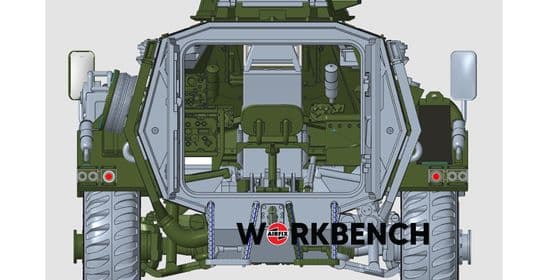
One of the most famous vehicles of its type, the Austin K2/Y Ambulance was used extensively by British and Commonwealth forces throughout WWII, both in the combat zones of the world and on the home front. Built around the chassis of the Austin K30 light truck, the casualty compartment was developed in conjunction with the Royal Army Medical Corps and therefore proved to be highly functional. Able to carry either four stretcher cases or ten seated casualties, one of the main reasons why the K2/Y was so successful was because it was so rugged and reliable, requiring only a minimum of maintenance - an ambulance should always be ready when you need it.
The rear cabin was typically constructed of painted canvas on a timber frame, with the highly visible red cross on a white disk positioned prominently on all sides to hopefully ensure the vehicles occupants didn’t come under fire. Once the K2/Y had delivered its latest casualty load to the field station, it would invariably head straight back into the combat zone, at speeds on open roads approaching 50 mph.
This magnificent new model proves that military vehicles don’t always have to be about 88mm guns and turret mantlets, as this ambulance will surely be a hugely popular addition to the range. During the course of the year, we will be bringing you full development details from this project and look forward to welcoming this most distinctive vehicle to our 1/35th scale world of tanks and tank destroyers.
As we know many Workbench readers have many years invested in the Airfix brand, we know you will love seeing this classic box artwork once more - it never fails to raise a smile! Didn’t everyone have a go at building the Dune Buggy?
When trying to provide an effective range overview in the blog immediately following the announcement of any new Airfix model collection, it really can be difficult to know where to stop, as there are always so many new products to discuss. Obviously, the main focus of enthusiasts attention will always centre on the new tooling projects, but an Airfix range is always much more than being about a handful of new tooling projects and really does require a little time spent discovering all its finer points. One section of the range which has become incredibly popular since its announcement back at the start of 2018, our Vintage Classics will once again be welcoming some much-loved kits from our illustrious history into the current range and causing a wave of modelling nostalgia to brake out across the country.
The Vintage Classics range is all about the joy of modelling, taking us back to a time when getting hold of the latest Airfix catalogue was just about the most important thing in our lives and making sure our parents were aware which new kits we wanted for Christmas and Birthdays was an exercise which had to be planned with military precision. All the kits released in this range will bring back happy memories for tens of thousands of modellers, with the sight of the iconic artwork, as well as the kits themselves, taking us back to our formative modelling years. To help identify where the individual kit appears in the production timeline of Airfix heritage, the box presentation used on each of the ‘Vintage Classics’ releases will include the year in which the model, or figure assortment was/were first introduced and whilst the classic box artwork is used as a major contributory feature of the appeal this range, the new heritage logo clearly identifies these kits as a modern twist on this classic theme.
Although only a small number of these magnificent aircraft were actually built, the Handley Page Heracles represents a time when air travellers were intrepid souls in their own right and only the most fortunate in society could ever hope to fly in one of these graceful aeroplanes
New models gracing the Vintage Classic range this year include the classic Beach Buggy, a kit which has to be regarded as one of the most fun products we have ever released and the triumphant return of the beautiful looking Handley Page Heracles. To delight civilian aviation modellers, we have the inclusion of the Hawker Siddeley Trident and let battle commence on living room floors everywhere, as no fewer than six different 1/32nd scale soldier packs are to be re-introduced to the range. With a kit producing heritage which spans back to the 1950s, there really is much more to being an Airfix modeller than attempting the latest CAD produced wonder!
With so many new, modified, re-issued (with new artwork and decals) and re-introduced models taking their place in the recently announced 2021 Airfix range, we really do hope that we have managed to include something for every modelling taste, whether you may be looking for a simple ‘first time’ kit to see if the hobby is going to be for you, or if you are a committed modeler looking for your next highly detailed build project. With something new to discover on almost every page of the new catalogue, or on the recently updated website, there really is no substitute for just heading straight over there and enjoying a pleasant few moments familiarising yourselves with all of the changes. Clearly, we fully intend to bring you all the latest product development information as it happens throughout the year within our Workbench blog, whilst at the same time bringing you a little more of the detail behind many of the individual releases we haven’t covered in this range overview.
With the Airfix website having to cope with significantly increased site traffic since the start of the year, we hope that you have managed to see everything you wanted to following range launch and that you weren’t frustrated too much by the slowdown caused by all this additional activity. Thankfully, everything should be running as normal by now, so if you haven’t discovered all the new models in the range as yet, now might be a good time.
For now, we will end this range launch overview by simply imploring everyone to go and see what modelling delights we have coming over the next twelve months and to spend a few moments in the product sections which interest you most. You can rest assured that your Workbench blog team will be looking to bring you all the exclusives from the world of Airfix as we head through the year, with our readers always being the first to hear about the most eagerly anticipated Airfix model project updates. In ending, may we please take this final, slightly belated opportunity to wish everyone a very Happy New Year from the entire Airfix team and to hope 2021 is another positive year for our beloved hobby, with many happy hours modelling ahead for all of us!
That’s all we have for you in this special Range Launch Edition of Workbench, however, we are pleased to report that there will be another edition of the blog posted NEXT FRIDAY, as we attempt to return to our normal blog scheduling over the next couple of weeks. As usual, if you have any suggestions for subjects you would like to see covered in a future edition, please use this workbench@airfix.com link to contact us.
In between new editions of our blog, the Airfix conversation continues over on our Airfix Forum Workbench thread, with further discussions taking place on both the official Airfix Facebook page and the Airfix Twitter channel – please do get involved in the discussions and let us know what you think about Workbench.
Whenever you decide to visit, the Airfix website is always the place to be for all the latest model availability information, previous editions of our blog, a selection of modelling tips and much more.
The next edition of Workbench will be published next week, on Friday 5th February, when we will be taking a detailed look at the early development stages of our new 1/48th scale de Havilland Chipmunk T.10 kit.
As always, we are incredibly grateful for the support you continue to give our Airfix Workbench blog.
The Airfix Workbench Team