

Welcome to this latest edition of our Workbench blog and all the news, updates, and modelling exclusives from the fascinating world of Airfix.
Any military modeller will tell you that behind the distinctive metal exteriors of some of the world’s most recognisable tanks, are fascinating stories which tell of a continual technological trade off between speed and mobility, and firepower and armour protection. Clearly, there is much more to this complex subject than initially meets the eye, but in the main, the design of every tank revolved around the role for which it was intended and once in service, if it would go on to be deployed in that intended role. What isn’t in doubt is the fact that every tank had its strengths and weaknesses, particularly when taking an objective view of the subject. That being the case, would any Workbench reader be brave enough to point us in the direction of the perfect tank?
The subject of this week’s new model project update is an impressive British tank which possessed enough noteworthy attributes to allow it to be considered a contender in any armoured vehicle conversation, fast, incredibly agile and boasting both good armour protection and a range of armament options to allow it to perform a variety of operational roles, the Cromwell Cruiser Tank. As we prepare to welcome our latest 1/35th scale kit tribute to the Cromwell into the current Airfix range, we will be taking a look at why some military modellers might see this capable cruiser tank as a potential candidate for the question posed above, but also why a tank proposed in at the beginning of the 1940s didn’t make its combat introduction until after the Allied invasion of Normandy and the D-Day landings.
After several weeks featuring aircraft subject updates, we will be enjoying our very own Workbench ‘Tankfest’ in the latest edition of our blog this weekend.
An exclusive first look at built sample models from this latest 1/35th scale Cromwell Mk.IV/MK.VI kit release, finished in both the included scheme options.
Before looking specifically at the history of the Cromwell Tank and indeed any British tank developed and introduced during the Second World War, it’s important to first consider the environment which British manufacturers were subjected to during the early months of the war. Following the defeat of the British Expeditionary Force in France during 1940, it quickly became apparent that the British Army needed tanks with both thicker armour and more powerful guns, but despite an acceptance of the general inadequacy of British tanks at that time, there was little that could be done.
The infrastructure behind the design, manufacture and procurement of British tanks at that time was disjointed at best and if a new design was to be developed in short order, a fully functioning, proven supply system would have to be in place and that simply wasn’t the case. In truth, the German tanks which rolled through the Low Countries and France were little better than their British counterparts, with the French heavy tanks defending their own country were actually the most effective machines in conflict at that time, however, the superior training and tactics employed by the Germans saw the Wehrmacht to a swift and decisive victory in France.
With defeat in France, Britain had lost a significant number of tanks, artillery pieces and military vehicles, and even though military planners had voiced their concerns about the effectiveness of current British tanks in service, the threat of impending invasion and an ineffective procurement system meant that little would be changing any time soon. The desperate need to make good the losses from France and the need to provide the RAF with as many fighter aircraft as possible had to take precedent, further delaying the much-needed reorganisation in the tank procurement process.
With a directive coming from the very top of government, existing manufacturers were instructed to produce as many of the existing designs so cruelly exposed in France as possible, to make good the crippling losses, a case of quantity over quality for the Army’s tank squadrons. British tank crews would have paid the price had the country been faced with attempting to repel invasion, but thankfully, the brave pilots of Fighter Command managed to stem the Luftwaffe tide which was the prelude to seaborne invasion.
The introduction of more capable, more powerfully armed British tanks would therefore be delayed still further, and it wouldn’t be until May 1942 that the 6 pdr gun would find its way into the turret of a British tank.
One of a series of fast, mobile and relatively well armed cruiser tanks developed by the British during the Second World War, the Cromwell tank can trace its development back to late 1940 and the need to find a replacement for the widely used Crusader tank in service at that time. Unfortunately, a painfully protracted development created some confusion regarding the different variants of these tanks and their denotations, as very similar looking machines were known by different names. All of these tanks were derived from the A24 Cruiser Mark VII Cavalier, the name given to the original intended Crusader replacement program, however, the main reason for the various names is a result of using different manufacturers, different hull designs and the use of three different engine types across the different vehicles.
Scheme A, Cruiser tank Mk.VIII, Cromwell Mk.IV, No.2 Squadron, 2nd (Armoured Reconnaissance) Battalion, Welsh Guards.
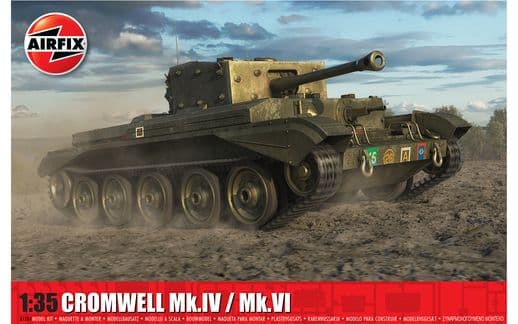
Full box artwork presentation for this latest release from our relatively new 1/35th scale Cromwell Mk.IV/MK.VI kit release.
Scheme B, Cruiser Tank Mk.VIII, Cromwell Mk.VI, B Squadron, 4th County of London Yeomanry.
The A24 Cromwell I (which would later be referred to as the Cavalier) was based around the Nuffield built tanks which were powered by an American 27L Liberty L-12 engine, a unit which could trace its lineage back to the end of the First World War. The A27L Cromwell II (which would later be referred to as the Centaur) was built by Leyland and was powered by an upgraded version of the Liberty engine developed by Morris Motors, also featuring an improved version of the gearbox used on the Churchill Tank.
The A27M was actually the Cromwell Tank as intended, one which used the excellent 600hp, V12 Meteor engine, a de-rated derivative of the Rolls Royce Merlin engine which was so successfully used across Britain’s aviation industry. What can make things a little confusing is that these tanks were intentionally designed to also use the older Liberty engine if required, as the War Department didn’t want a lack of Meteor engine availability to hold up the much-needed production of these tanks, as Britain was already preparing for D-Day.
To confuse matters further, once priority had been given to the production of the more promising Cromwell in early 1943, these tanks would then be further categorised into several different marks, which can essentially see some Cromwells actually being re-engined Centaurs. For the purposes of this update and the two scheme options on offer with this new kit, the Cromwell Mk.IV (which was built in greater numbers than the other variants) was either a new Cromwell, or a Rolls Royce Meteor re-engined Centaur armed with a 75mm gun. The Mk.VI was either a new Cromwell, or a Meteor re-engined Centaur armed with a 95mm infantry support howitzer.
Where fitted, the tank featured a quick firing 75mm gun, which was a re-bored version of the ubiquitous British 6 pounder gun, one which allowed the commander to have the option of using American produced armour piercing or high explosive rounds if desired. Further underlining the strategic effectiveness of the tank, its turret could traverse through 360 degrees in just 15 seconds, thanks to the impressive hydraulic system it employed.
Although originally introduced in November 1943, persistent problems with the new gun’s operation meant that the Mk.IV would not make its combat introduction until actions following the Normandy landings in June 1944, where its speed, mobility and general reliability would complement the more numerous Sherman tanks on the battlefields of northern Europe. Although this was the British Army’s latest tank at the time, the Cromwell does look like it is a design from much earlier in the war, with its tall, angular turret complete with protruding bolts and an almost complete lack of sloping armour.
Another built image exclusive featuring both of the scheme options included with this new release, both a Mk.IV and short barrelled Mk.VI.
Without doubt, the most impressive attributes of the Cromwell were within its hull, all of which endowed the tank with excellent battlefield performance. The powerful Rolls Royce Meteor engine combined with the tried and trusted Christie suspension allowed the Cromwell to travel at speeds in excess of 40mph on roads and not much slower than this when operating cross-country. It also had a much lower profile than the Sherman it fought alongside and possessed an impressive turret traverse rate which outclassed most of its opponents on the battlefield – adopting a shoot and scoot approach to armoured engagements, the Cromwell was an effective addition to the Allied inventory, especially when they eventually had Wehrmacht units on the run.
During the savage fighting in the narrow, hedgerow lined lanes of the Normandy countryside, the excellent mobility of the Cromwell was somewhat nullified and if they were forced to climb their steep banks to engage enemy tanks in combat, they exposed their vulnerable undersides to potential armour piercing Panzerfaust attack. In order to rectify this situation, the relatively rudimentary addition of a ‘hedge cutter’ blade to the front hull allowed the tank’s commander to scythe through the obstacle whilst keeping his tank level and still able to bring his guns to bear on any potential target. This simple addition could also provide some welcome natural foliage camouflage for the tank as it moved through the countryside, so long as the bushes it acquired didn’t obstruct the commander’s gun sighting optics.
It was originally intended that the Cromwell would be introduced in 1942 and had that been the case, it would arguably have been regarded as one of the more successful tanks of the Second World War and certainly been more than a match for the Panzer III and IV tanks it would be pitted against. As it turned out, two years of development delays meant that when the Cromwell did enter combat, it had been overtaken by the latest German medium and heavy tank designs, even though it could show both a clean pair of heels. An up gunned variant of the tank known as the Comet was introduced in early 1945 which was a match for all marks of Panzer IV and the Panther, but these were too few and too late to have any significant impact on the war.
New box artwork showing the British Cromwell Mk.IV tank in which Winston Churchill enjoyed a demonstration drive during an inspection visit in the spring of 1944.
Joining the Airfix 1/35th scale Military Vehicle kit range in 2020, the Cromwell featured all the latest design and manufacturing advances the hobby had to offer, resulting in the production of a beautiful kit which helps to tell the story of this impressive little tank and its unusual, protracted development. Some tank aficionados describe its predecessor, the Crusader, as the most handsome tank ever produced, but even the staunchest of Cromwell supporters would find it difficult to convince us that this aesthetic appeal carried through to its later war replacement.
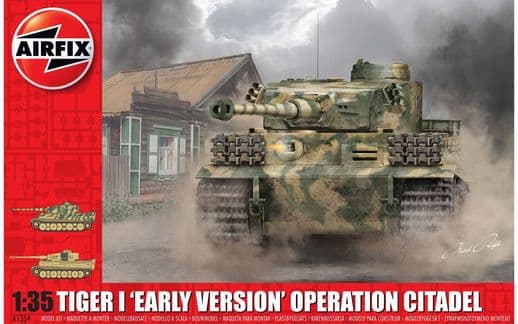
Nevertheless, they always say that beauty is in the eye of the beholder, and we can probably all agree that the Cromwell is actually rather easy on the eye. What would be an interesting display, however, would be to position a Cromwell next to something like a Tiger I to see the relative size difference between the two tanks. As both machines were engaged in combat during the Battle of Normandy, I know which one I would want to be in if it came to a tank versus tank face off.
Having the Tiger I and Cromwell displayed next to each other also underlines the point we raised at the beginning of this feature, how all tanks had their strengths and weaknesses and how each machine was usually introduced to perform a specific battlefield role. In the case of the Cromwell, adequate armour and a reasonable main gun may not seem like the attributes of a main battle tank, however, its speed, agility and low profile made this an excellent reconnaissance tank and one which could rush to the aid of infantry units if they were facing pockets of particularly stubborn enemy resistance, that is unless they themselves were supported by Tigers and Panthers, which would make that a very different story.
Let’s take a closer look at the two scheme options which accompany the release of this latest Cromwell Tank release.
The massive build up of Allied forces in advance of Operation Overlord and the D-Day landings resulted in the south of England playing host to arguably the most powerful army the world had ever seen, standing ready to make a decisive cross Channel blow in bringing the war to a close. Following months of intensive training and in an attempt to maintain the morale of his troops ahead of their ‘Great Crusade’, British Prime Minister Winston Churchill made several visits to units in the weeks leading up to invasion and their re-deployment down south, to remind them of the historic role they were about to play and to thank them for their incredible resolve.
On 30th March 1944, Churchill paid a visit to the 2nd Battalion Welsh Guards at their training base in North Yorkshire, where he was famously photographed in the turret of an immaculately presented Cromwell Mk.IV tank. The tank was not only resplendent in a pristine set of unit markings, but had also been adorned with the rather fitting name ‘Blenheim’ on the front of its hull, clearly in honour of their illustrious guest’s visit.
The Guards Armoured Division was due to go ashore following the D-Day landings on 16th June, however, the violent storms which battered the Channel around that date prevented their arrival until 22nd. Following a short period of acclimatisation where they took up defensive positions, they would be used as casual support on two offensive operations, before being heavily involved in ‘Operation Goodwood’ and the breakout from Normandy, where the impressive speed of their Cromwell Tanks would come into its own. The logistics associated with D-Day were simply astonishing and saw the amphibious delivery of 557,000 troops and 81,000 vehicles, between 6th and 16th June. The long-awaited Allied invasion of Europe would prove to be the springboard for ultimate victory.
Full scheme details for Winston Churchill’s Cromwell tank.
In this reconnaissance role, the Cromwell proved to be an excellent tank, much lower in profile than the more numerous Shermans and fast enough to get themselves out of trouble when detected by enemy armoured units. Unfortunately, the main gun of the Cromwell was not powerful enough to take on the heavy panzers of the Wehrmacht, or indeed to challenge German armour at long range, however, if they were operating in open country and were caught in the sights of a German 88mm gun, not even the Cromwell’s speed could come to its rescue. Thankfully, on clear weather days, the 2nd Tactical Air Force kept every serviceable panzer in concealed positions, fearful that they would be destroyed by bomb or rocket toting RAF Typhoons.
The shield of the Guards Armoured Division carried on the front of this Cromwell’s hull features an ‘ever open eye’, something which was rather fitting for a reconnaissance unit. It was inherited from the Guards Division of the Great War and was proudly taken into combat during the Battle of Normandy by the Welsh Guards.
Scheme B – Cruiser Tank Mk.VIII, Cromwell Mk.VI, B Squadron, 4th County of London Yeomanry.
Even though the new British A27M Cromwell Tank would not make its combat introduction until the Allied invasion of Normandy in June 1944, the speed and mobility of this excellent new tank would soon earn it an enviable reputation amongst Allied troops, who came to rely on the support they provided. The majority of Cromwell Tanks were armed with the standard 75mm ROQF gun, however, the less numerous Mk.VI variant would provide specialist infantry close support with its 95mm Howitzer and were consequently never too far away from the action. Firing a high explosive hollow charge shell, the tank was used to overcome fortified positions, such as concrete bunkers and pillboxes which stood in the way of the infantry’s advance and could even lay highly effective smokescreens if required.
With its distinctively short barrel, the Mk.VI also featured a large counterweight on its main armament, which was necessary in helping to balance the gun. Approximately 340 of these specialist tanks were eventually produced, which would prove to be extremely effective as Allied ground units pushed German forces back towards their homeland. Despite their impressive speed, the Cromwells were no match for the firepower of the German heavy tanks and would have to rely on speed and stealth for their battlefield survival.
As it was produced in huge numbers, the Sherman was the most numerous tank available to the Allies during the Battle for Normandy, with British Cromwells selected to equip the reconnaissance regiments of the three ‘standard’ armoured divisions. The Cromwell tanks were allocated at a rate of 40 gun tanks (75mm gun) and 6 close support tanks (95mm gun) per unit.
Full scheme details for a Cromwell Tank which took part in the battle of Villers Bocage during the post D-Day fighting in Normandy.
A beautifully built example of this famous Cromwell Tank.
With crews being specially trained in providing close infantry support under heavy enemy fire, they were never too far away from close contact fighting, with their destructive capabilities being in high demand. The 95mm gun could fire high explosive and high explosive anti-tank shaped charge rounds, which relied on kinetic energy rather than high velocity for their destructive capability. This meant that the recoil the gun generated was less than that on a traditional gun, something which allowed for the speedier reloading of the gun.
The 4th County of London Yeomanry were attached to the 7th Armoured Division ‘The Desert Rats’ during the Battle of Normandy, landing in France in Gold sector on 7th June. Quickly engaged in some of the heaviest fighting in the areas behind the landing beaches, including taking part in the famous Battle of Villers-Bocage, however, just a few weeks later, they had to be amalgamated with their parent unit as a result of the heavy losses they had sustained. The unit proud of the nickname they had earned, being known as the ‘Sharpshooters’ throughout the British Army.
By the end of August, the ever-increasing strength of the Allied forces allowed them to gain the upper hand in Normandy and as the Germans were now fighting retreating actions, the Cromwell Tanks of the British Army could really begin to show their worth. Speeding along roads and flat ground, Cromwells, particularly the infantry support 95mm equipped Mk.VI tanks could be called up to help dislodge the latest enemy stronghold in short order, with the more numerous Shermans and fearsomely effective Fireflys providing the protection they might need if enemy tanks were in the vicinity.
As the British Cromwell tank made its combat debut during the Battle of Normandy, this new kit would make for a fine build project with which to commemorate the 80th Anniversary of D-Day.
This latest release from our still relatively new 1/35th scale Cromwell Tank tooling allows modellers to replicate either one of the ubiquitous 75mm gun armed Mk.IV Cromwells, or the less numerous bunker busting Mk.VI, with both producing beautiful scale representations of this famous family of British cruiser tank. As we are still in the wake of this year’s D-Day anniversary commemorations and 80 years ago this weekend, British Cromwell tanks would have been engaged in heavy fighting across the Normandy region, could there be a more appropriate summer modelling project than one of these important British tanks?
Our new A1384 1/35th scale Cromwell Mk.IV/MK.VI tank kit is available now.
We are afraid that's all we have for you in this latest edition, but we will be back next Friday with more project development updates and the very latest Airfix kit exclusives. In the meantime, we are always keen to hear your views on all things Airfix and in particular, any thoughts and opinions you may have regarding our Workbench blog. If you would like to drop us a quick line, could we please ask that you use our workbench@airfix.com email for all correspondence.
To re-visit any of the Airfix blogs we have produced over the past seven years or so, please head to our main Workbench hub, where you will find our entire blog back catalogue and all the Airfix design projects we have already covered.
All our dedicated official social media sites can be accessed by clicking the respective link icons at the foot of this page, or by heading to the Airfix homepage. Other useful Airfix links are:
Facebook, YouTube, Twitter and Instagram official sites
Please join us for more Airfix updates next week and thank you for your continued support.