

Welcome to this latest edition of our Workbench blog and all the news, updates, and modelling exclusives from the fascinating world of Airfix.
How on earth can we already be almost halfway through the year …. where does the time go? Even though the weeks seem to be advancing at an ever faster pace these days, we still find ourselves reporting on one of the new tooling projects announced at the beginning of the year in this latest edition of Workbench, as it continues to negotiate the various stages of its development towards initial release. Making our final pre-release visit to a project which already has future Airfix classic written all over it, our subject this week is our new Boeing Chinook HC.1 tooling, our scale kit tribute to an impressive aircraft which first entered Royal Air Force service back in 1980, with the latest incarnations still going strong and likely to remain in service for at least the next two decades.
As modeller’s look forward to getting their hands on this impressive new kit for the first time in just a couple of weeks’ time, we will be taking this final pre-launch opportunity to showcase an exclusive selection of built sample model images which have been finished in both of the scheme options included in the first release of this new kit. They look fantastic and if you weren’t already looking forward to adding a Chinook to your current build schedule, you certainly will after seeing them.
Taking this final chance to enjoy something of a historic Chinook overview, we will be using the built model images to illustrate the details behind the two Chinooks scheme options on offer with this new kit, whilst also discussing why the Chinook remains such a favourite with the British public. As we find ourselves right in the middle of D-Day 80th Anniversary commemorations, we will also be pointing readers in the direction of an interesting series of short films we created in support of these commemorations, where our videographer and presenter Nathan takes us through some of the many fascinating details behind D-Day, both in terms of planning and the amphibious landings themselves.
We’re delighted to confirm that this may well be the final weekend without a new Airfix Chinook being available in your favourite model store, so let’s celebrate that development in this latest edition of Workbench.
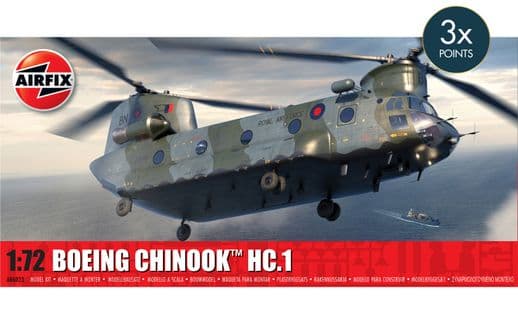
Box artwork befitting an aircraft possessing such incredible aviation heritage, our new scale tribute to the first Chinooks to enter Royal Air Force service features the lead scheme of two available with this new kit, an aircraft which is referred to as the ‘Survivor’.
When an RAF Boeing Chinook is the next act on any Airshow display schedule, this unique aircraft has its own way of announcing its arrival, with the ‘slap’ from its contra-rotating main rotors producing a sound which has now become synonymous with this mighty helicopter, effectively demanding that every set of eyes on the airfield looks in its direction – drop everything, you’re now on Chinook time. Over the course of the next six or seven minutes, prepare to be totally captivated by what this incredible helicopter can do, with pedal turns, the rollercoaster and enthusiastic wingovers all coming as standard, along with a massive pair of dayglo hands which allow the crew to acknowledge the adoration of the masses gathered below.
A Chinook display is nothing short of astonishing. The things they manage to do with this heavy-lift helicopter are truly amazing, almost appearing to defy the very laws of physics in the process, but with the power, agility and precision flying on display helping us to understand why the Chinook is regarded by many to be the most advanced helicopter in the history of flight.
The Chinook may well be a thrilling Airshow performer, however, these impressive demonstrations are intended to illustrate why this is such a vital asset to the many air forces which operate the aircraft, and why they represent such good value for the taxpayer as a result. What we are all actually looking at is the world’s most advanced battlefield tested heavy-lift helicopter ever produced, one which is always at the forefront of any military operation and the aircraft you want to see in the event of any humanitarian situation. Having already been in British service for 44 years and likely to be so for at least the coming two decades, is it any wonder that we all have a real appreciation for this magnificent aircraft.
As we currently find ourselves commemorating the 80th Anniversary of D-Day, it’s interesting to appreciate that whilst helicopter technology advanced significantly during the ten years prior to the end of the Second World War, it was the years which immediately following the end of WWII which saw the most dramatic development in helicopter technology, particularly in the production of effective, capable and reliable machines.
An impressive CAD screengrab taken during the design phase of the new Chinook HC.1 kit.
During the 1950s, the first reliable helicopter types began entering service across the world and immediately started to highlight the versatility which would make them invaluable in performing a multitude of military and civilian tasks. Proving equally effective in delivering troops and supplies into areas which were simply inaccessible to other aircraft types, as they were at rescuing grateful holiday makers from the sea when getting themselves into a spot of trouble, the helicopter has established itself in so many ways and whether operating in a military or a humanitarian role, really has no equal in the world of aviation.
An aircraft which possibly underlines the qualities of the modern helicopter more effectively than any other type, the mighty Boeing CH-47 Chinook has already been in military service for over sixty years and shows no sign of disappearing from our skies any time soon. The distinctive tandem twin rotor configuration of this heavy lift helicopter cleverly counteracts the effects of engine torque by having each of its huge rotor blade stacks turning in opposite directions, thus negating the need for the tail rotor we traditionally associate with helicopters.
An extremely impressive machine, the Chinook made its first flight back in 1961 and since that date, has gone on to become one of the most effective aircraft designs of the post war era, one which can operate in almost any environment, no matter how inhospitable the terrain. Clearly, this has made the Chinook invaluable when performing a great many roles and certainly when it comes to British military operations where troops are on the ground, they won’t go unless Chinooks are there to support them.
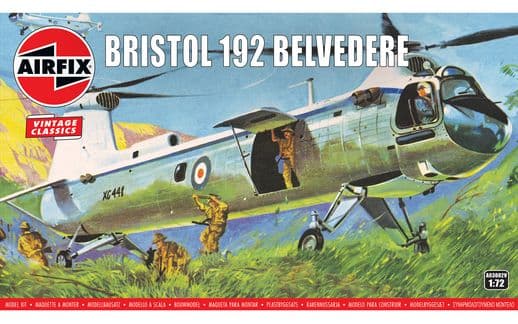
Britain’s links with this magnificent machine go all the way back to 1967, as the RAF’s admiration for America’s impressive new heavy lift helicopter led to an order being placed for 15 new aircraft to replace their own Bristol Belvedere tandem rotor military helicopters. As it transpired, this order would later be cancelled as a result of ongoing defence spending cutbacks and it would be a further ten years before this interest was revived.
Again using new Chinook design files, this one features a computer rendered representation which includes so much information that it always puts a strain on the Airfix office computers.
Now looking to replace, or upgrade the capabilities of the RAF’s Westland Wessex fleet, the British Government approached Boeing again in the late 1970s and this time, placed an order for 33 new Chinook aircraft, machines which were essentially equivalent to the US CH-47C variant. The honour of being the first Royal Air Force Squadron to operate the new Chinook was No.18 Squadron at Odiham, with British aircraft carrying the designation HC.1 (Helicopter Cargo Mk.1), and they would soon start to show the British public just what this incredible machine was capable of.
No sooner had Britain’s Chinooks entered service, that events on the other side of the world would result in an early overseas deployment for the helicopter, one which would be the start of an incredible story for one particular aircraft and indeed the wider reputation of the Chinook as a military aircraft. Five of the RAF’s new Chinooks were loaded aboard the requisitioned container ship Atlantic Conveyor for the Task Force voyage down to the South Atlantic, each one stored on the deck of the ship and wrapped in Driclad PVC covers as a protective measure. Chinook ZA707 was offloaded at Ascension Island prior to continuing the voyage to the Falkland Islands and famous ‘Survivor’ ZA718 was in the air when the Atlantic Conveyor was struck by Exocet missiles and destroyed, with the remaining Chinooks lost. ZA718 ‘Bravo November’ would be the only Chinook subsequently available to the British Task force, but her historic exploits are certainly the subject of a future edition of Workbench.
An indication of just how successful the RAF’s Chinook force had proved to be over the years, the fleet has benefitted from almost constant upgrade and additional procurement, with the aircraft unquestionably becoming an essential component of Britain’s military capabilities. This upgrading of capabilities has kept the Chinook at the forefront of world helicopter technology, and currently, it appears the only aircraft capable of replacing a Chinook is another Chinook, a situation which doesn’t seem likely to change for many years to come.
An exclusive first look at built sample models of the new Chinook, two very different looking schemes, same classic helicopter.
For an aircraft which has become such an important component of Britain’s military capabilities for so many years, the lack of an in-house designed Chinook kit has been something Airfix fans have been hoping will be addressed for quite some time and as a consequence, the announcement of this new tooling project was met with overwhelming positivity at the start of the year. The initial design overview edition of Workbench which showcased the new Chinook project is available by using this link and by visiting the main Workbench blog hub, but for this final pre-release update, we’re once again going to be concentrating on the details behind the two appealing scheme options included with the new kit.
One scheme commemorates arguably the most famous individual Royal Air Force aircraft of the post WWII era, whilst the other could hardly be more different from a visual perspective, but also marks another service achievement for this magnificent aircraft.
Let’s take another look at both now.
It is difficult to describe just how significant an aircraft Boeing Chinook ZA718 ‘Bravo November’ actually is within the annals of British Military aviation history and how it continually managed to overcome incredible adversity to ensure it was able to continue doing its vital duty. Part of an initial order for 33 Chinook heavy-lift helicopters placed by Britain in 1978, ZA718 joined a re-formed RAF No.18 Squadron at Odiham in late 1980, with British Chinooks taking the designation HC.1 (Heavy Cargo Mk.1). Almost before the aircraft had the chance to fully settle into Royal Air Force service, a dramatic development on the other side of the world would see ZA718, now coded ‘BN’ and referred to phonetically as ‘Bravo November’, sent as part of a small detachment of Chinooks to help a British naval Task Force re-take the Falkland Islands from Argentinean occupation.
Travelling aboard the requisitioned container ship Atlantic Conveyor, ‘Bravo November’ was one of five RAF Chinooks stored on the deck of the ship as it steamed towards the South Atlantic, protected against the elements by being wrapped in Dri-Clad covers and corrosion inhibitors. The Atlantic Conveyor would also be used to transport 6 Wessex helicopters, several Scout light helicopters, 8 Sea Harrier FRS.1s and 6 RAF Harrier GR.3s, in addition to assorted supplies of war and various types of ammunition.
As the ship approached the Falkland Islands and disembarked its complement of RAF and Fleet Air Arm Harriers, ‘Bravo November’ and one other Chinook had their protective coverings removed, rotor blades reattached and prepared to make their first post voyage test flight. In advance of the anticipated hectic schedule of supply transportation, Bravo November used her test flight on 25th May 1982 to pick up a load of cargo from HMS Glasgow, but whilst she was in the air, tragedy struck the Atlantic Conveyor – she was hit by two Exocet missiles fired from Argentinean Navy Super Etendard jets. Despite the heroic efforts of the crew, fire eventually engulfed the vessel and hastened the order to abandon ship, leaving the fire to destroy all the ships vital cargo, including all the remaining helicopters on her deck.
Aware of this tragic development and the fact that they were now the only British heavy lift helicopter available to the Task Force, the crew of ‘Bravo November’ landed their aircraft aboard HMS Hermes, knowing that she now had an incredibly heavy burden of work placed on her shoulders. What makes this story all the more incredible is that all of the aircraft’s support equipment was lost with the destruction of Atlantic Conveyor and during the several weeks of critical activity to come, the aircraft’s crew would have to operate her without the benefit of spare parts, technical manuals, specialist lubricants and dedicated toolsets. It is also important to remember that at that time, the Chinook had only been in Royal Air Force service for a few short months.
Built model images featuring the famous Falklands War ‘Survivor’ Chinook and one of the most famous individual aircraft of the post war era.
Performing heroically throughout her time in the South Atlantic, ‘Bravo November’ would also earn her pilot Squadron Leader Richard Langworthy a DFC for actions whilst flying the Chinook during a heavy snowstorm. Travelling at speed, the pilot attempted to fly under the storm, however, a faulty altimeter caused the aircraft to strike the sea, but thankfully, at a slight nose up attitude. With sea spray entering the engines, the pilot as able to coax the Chinook back into the air once he had received a damage report, returning to its temporary base, where a full damage assessment could be undertaken. Around this time, ‘Bravo November’ was to receive its nickname ‘The Survivor’, a mark of respect and term of endearment for a hard working helicopter which was making such a valuable contribution to the war effort in the South Atlantic. Incredibly, by the end of her lengthy service career, three other airmen would be awarded the Distinguished Flying Cross whilst flying this famous aircraft in various combat zones around the world.
On her return to the UK, there was to be no let-up in the workload for this now famous aircraft, as she helped to establish the new Chinook force into Royal Air Force service, until when in 1994, she was to become the first RAF Chinook to undergo upgrade to HC.2 standard.
As if she had not already established her service reputation in the RAF, ‘Bravo November’ would also go on to play a prominent role in the 2003 invasion of Iraq and is widely thought to have been the first British helicopter to land Royal Marines on Iraqi soil at the start of the conflict. She would also earn one of her pilots another DFC during Operation Telic, however, this magnificent machine was still not done yet.
2006 brought another overseas military deployment for ‘Bravo November’ this time as part of the coalition anti-terror operations in Afghanistan, where the aircraft would once again be placed in the combat zone, not only to deliver and re-supply troops, but also to evacuate those wounded in action. This venerable old warhorse continued to roll back the years and carry on the vital work she started back in the South Atlantic a quarter of a century earlier, providing heavy-lift support for troops fighting in extremely challenging circumstances. ‘Bravo Novembers’ Afghanistan service would see two more of her pilots awarded the DFC, one for Flight Lieutenant Craig Wilson in June 2006 and a final one for Flight Lieutenant Ian Fortune in 2010.
If you follow the lead scheme details, you might end up with a model which looks as spectacular as the one below.
In a glittering service career which spanned over 40 years, Chinook ZA718 ‘Bravo November’ earned the reputation as a heavy-lift helicopter workhorse which would not be beaten, keeping her troops safe and supplied, but when they were in need of medical assistance, coming to their aid no matter how intense the fighting might be around the landing zone, taking them to where they could receive the help they needed. Known as ‘The Survivor’, this magnificent aircraft has taken part in every major conflict where British forces have had boots on the ground during that time and has benefited from major upgrades on three separate occasions. Over that time, most of her parts have gradually been replaced, however, due to her famous history and ZA718 serial, her unrivalled reputation remained constant. She has to be considered the most significant individual RAF aircraft of the post war era, standing testament to the effectiveness of the modern helicopter and the bravery of the crews who flew them.
In a year which marked both 42 years of RAF Chinook operations and the 40th anniversary of the Falklands War, it was somehow fitting that this most famous of aircraft should be allowed to finally cash in her flying hours and enter a deserved retirement as a unique component of the nation’s rich aviation heritage. Her amazing story is such that there must have been quite a battle to secure her retirement home, but that struggle was won by the Royal Air Force Museum, who prepared a fitting home for ZA718 at their Cosford site.
‘Bravo November’ left her home at RAF Odiham for the final time on 16th March 2022, travelling by road to be unloaded and re-assembled by RAF Museum technicians and RAF engineers, in advance of a special media preview day, where she would be unveiled in her new display position. She is now a major attraction at the RAF Museum Midlands site, with visitors travelling from across the country to pay their respects to this quite remarkable helicopter.
The unrivalled versatility and load carrying capabilities of the Chinook has ensured this mighty beast of a machine is now one of the most famous aircraft to see post war service across the world and indeed with our own Royal Air Force. Equally at home on the battlefields of the Middle East as it is dropping ballast sacks to prevent a dam burst a little closer to home, the Chinook has now been in RAF service since 1980, with the latest variant of this magnificent machine further enhancing its already legendary operational flexibility still further. In addition to being one of the most important aircraft currently in service, the Chinook also happens to be the consummate Airshow performer and a real crowd favourite wherever it displays. Demonstrating the aircraft’s power and manoeuvrability to tens of thousands of Airshow-goers every summer, these impressive aircraft retain their operational status at all times and whilst crews practice in advance of their latest Airshow engagement, they never forget that they could be called away on international deployment at a moment’s notice, such is the reliance on their in-demand aircraft.
If you are fortunate enough to experience a Wokka display, there is nothing quite like seeing one of these huge helicopters being hurled around the sky in a manner which almost defies logic, with the sound of the Chinook’s iconic ‘blade slap’ leaving a lasting impression on any who hear it.
Following the legendary exploits of Bravo November during the Falklands Conflict, the Chinook would settle into Royal Air Force service over the next several years, all the time displaying its ability to take on more tasks than any other aircraft possibly could with power and versatility coming as standard. Able to carry more troops or more cargo than any other helicopter in RAF service, it came as no surprise that when British forces went to war again, the services of the RAF’s Chinooks would be needed once more.
When a military deployment overseas is required, you can be sure that the tyres of a Chinook will be amongst the first rubber on the ground, so important has this magnificent aircraft become.
Following the Iraqi invasion of Kuwait in 1990 the international condemnation which followed saw a mighty coalition military force amassing in Saudi Arabia, the size of which had not been seen since the end of the Second World War. The initial phase of the coalition response was to secure the airspace in the region before striking at opposing military facilities and infrastructure, all intended to neutralise the threat posed by Iraqi forces, and whilst this work was carried out by coalition fast jets, RAF Chinooks began their own operations which were perhaps less glamorous, but no less vital.
The first choice when it came to supporting British forces, Chinooks deployed to the Gulf transported troops and supplies before, during and after the ground phase of the war, moving men into some of the most advanced positions ahead of the main ground offensive. Chinooks were also the first choice for Allied Special Forces throughout the conflict, including the men of the SAS who mounted the famous long-range patrol deep into Iraqi territory known as Bravo Two Zero.
Once the fighting was over, Chinook operations showed no sign of reducing, with these superb aircraft simply adding to their growing reputation by turning their hands to even more tasks, transporting prisoners of war and delivering aid and supplies to the thousands of displaced refugees in the Gulf region. Perhaps the sentiment which best describes the continuing service reputation of this mighty heavy lift helicopter is the fact that the only aircraft crews thought capable of replacing a Chinook was another Chinook.
Full scheme details featuring the second, Gulf War scheme included with this first release from our new 1/72nd scale Boeing Chinook HC.1.
Aviation warrior or humanitarian sentinel, the Chinook has become an invaluable aircraft in the modern world.
Chinook ZA684 was produced for the RAF at the main Boeing Chinook plant at Ridley Park, Pennsylvania in early 1981 and later delivered to No.7 Squadron, who had only recently relinquished their Canberras and reformed at Odiham as the RAF’s second Chinook HC.1 squadron. One of two Chinook squadrons deployed to the Gulf in support of Operation Granby, amongst the many tasks allocated to No.7 Sqn aircraft was the delivery of Allied special forces, where the speed, range and load carrying capabilities of this tandem rotor made them ideal for this work.
In 2000, No.7 Squadron would become part of the recently formed Joint Special Forces Aviation Wing and in conjunction with other Chinook units, have seen several operational deployments over recent years, including Yugoslavia, Sierra Leone, Afghanistan and Iraq. With these aircraft always being in high demand, it seems the Chinook is also the ideal aircraft to support the specialist work of the SAS and SBS.
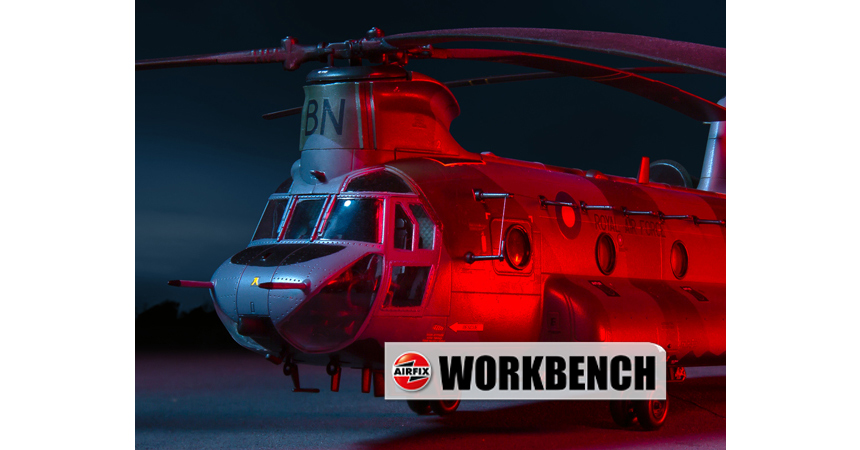
A fine close up image of our new Chinook kit finished in the lead ‘Bravo November’ scheme option, clearly illustrating why this new model will appeal to a great many modellers.
Aviation star under the stars, the new Chinook even encouraged our photographer Mike to get all creative and doesn’t it look great.
Throughout the 43-year service of the RAF’s Chinooks, they have been front and centre during some of the most historic occasions in the nation’s history and the two scheme options selected to be included in the initial release of this impressive new kit are a clear illustration of this. Two Chinook deployments a decade apart, it’s difficult to imagine two British Chinook schemes being so different from each other, but with both being equally iconic in their own right, how could we possibly choose between them. The only thing to do in situations such as these is to secure two kits and plan a dual build project to finish a kit in both scheme options.
A truly spectacular addition to the 2024 Airfix range, we’re delighted to confirm that this final update from our new Boeing Chinook HC.1 tooling project serves as its release introduction and by the time this update is posted on the Airfix website, a rather large space will have been prepared for its arrival in our warehouse. Those who already have their orders in place for the new Chinook can look forward to receiving their models over the next couple of weeks. Please keep an eye on the Airfix website for all the latest release information and to secure your own Boeing Chinook kit.
This week has seen the world and particularly the Northern coast of France commemorating one of the most momentous days in the history of humanity, when the combined Allied forces launched their long-awaited invasion of enemy occupied France, D-Day. With the world’s media supporting what may well be the final major anniversary commemoration of Operation Overlord where people who were actually there back on 6th June 1944 are able to take part, its now the responsibility of younger generations to honour the memory and sacrifices of those brave men and the French people who were forced to endure so much before, during and after D-Day.
Unfortunately, the majority of the events taking place will no doubt be attended by people of a certain age, with younger faces only making up a fraction of those paying their respects. Despite the fact that D-Day took place many years before they were born, it’s important to recognise the fact that the heroes of D-Day weren’t actually that much older than they are now and because of them, we continue to enjoy the freedom they earned for the generations to come.
To mark our own tribute to Operation Overlord and the invasion of Normandy, our Videography Team have produced a series of short videos which looked at different aspects of D-Day, from the meticulous preparation and crucial deceptions, through to invasion itself and they kept their armies on the move in the weeks and months which followed. The series is presented by one of our own bright young things, Nathan, who has worked hard to ensure the series contains as much interesting historical content as possible, whilst at the same time serving to commemorate the heroic actions of so many people who took part in what Eisenhower described as the ‘Great Crusade’.
Now available on the Airfix YouTube channel as a combined mini-series for the first time, we would be grateful if you would please give our Airfix D-Day 80th full mini-series a watch over this 80th Anniversary weekend.
For our tomorrow, they gave their today.
We are afraid that's all we have for you in this latest edition, but we will be back next Friday with more project development updates and the very latest Airfix kit exclusives. In the meantime, we are always keen to hear your views on all things Airfix and in particular, any thoughts and opinions you may have regarding our Workbench blog. If you would like to drop us a quick line, could we please ask that you use our workbench@airfix.com email for all correspondence.
To re-visit any of the Airfix blogs we have produced over the past seven years or so, please head to our main Workbench hub, where you will find our entire blog back catalogue and all the Airfix design projects we have already covered.
All our dedicated official social media sites can be accessed by clicking the respective link icons at the foot of this page, or by heading to the Airfix homepage. Other useful Airfix links are:
Facebook, YouTube, Twitter and Instagram official sites
Please join us for more Airfix updates next week and thank you for your continued support.