
Welcome to this latest edition of our Workbench blog and all the news, updates and modelling exclusives from the fascinating world of Airfix.
We return to the subject of new model tooling development details in this latest edition of Workbench, as we introduce yet another new project making its Airfix kit range debut in 2023. After the success of last week's Ferret Scout Car Mk.2 design overview, we are staying firmly on four wheels this week, even though our latest subject is very much of the moment. The Ferret may have had an enviable reputation for being quite the speedster, but when compared to the subject of this latest update, it was very much in the slow lane. Boasting a top speed of over 200 mph, everything about the McLaren 765LT is in the extreme, beautifully crafted, bred for speed and benefiting from McLaren's renowned motorsport heritage, not to mention the fact that this happens to be one of the most expensive and exclusive supercars ever produced. All ideal credentials for inspiring a new Airfix model tooling design projects and just the sort of challenge product designer Adam French was ready to put into overdrive.
For this latest development update, we will be joining Adam as he embarks on his journey to immortalise this most super of supercars into the latest Airfix model kit range and more specifically, as one of our new breed of Starter Set kits. Using an exclusive selection of CAD imagery from the project to illustrate the points raised, we will also have the opportunity to ask Adam how designing a new Starter Set kit differs from the Quickbuild projects with which he is so familiar, another interesting angle for this latest designer interview to take. As most of us could never even dream of owning the real thing, let's spend a little time emersed in the world of 'Airfixising' one of the world's most spectacular and expensive supercars.
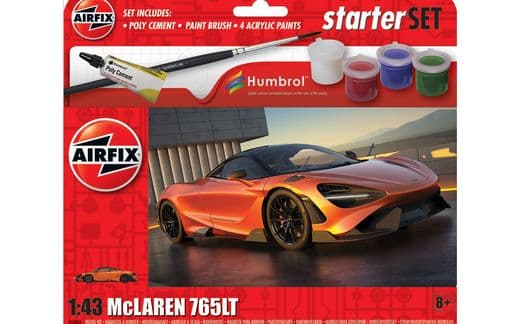
A stunning scale addition to the 2023 Airfix range, the new 1/43rd scale McLaren 765LT Starter Set will be enticing first time and novice modellers following its release.
Over the past couple of years, Workbench has published several editions highlighting the design ethos behind our new breed of Starter Set kits, models specifically aimed at a particular sector of the modelling hobby, inexperienced, or first time modellers. Many of us will remember with great fondness how much of our youth was spent working our way through the Airfix series 1 bagged and blister packed kits and how these models, being pocket money priced, were our direct introduction to the hobby and therefore played a significant role not only in our love of modelling, but also in establishing Airfix as a major hobby force.
Moving things forward a generation or two and the role played by entry level, introductory kits is perhaps even more important now than it was back then, with the hobby now competing for attention against many more distractions and pastimes than there were available back in the 1970s and 80s, and as such, had to evolve. The question of how a contemporary Airfix range can better support the first time or inexperienced modeller in taking their first steps in the hobby is one which has been on the minds of the Airfix design team for several years now and they thought they had the answer. They knew that having to work harder to gain the attention of a prospective new modeller brought with it some specific challenges and how the kits which effectively launched the brand in the previous century would have to be a little different if they were going to play a part in the future of the hobby.
Clearly, when it comes to Airfix kits, the one thing that can never be compromised is subject accuracy and whatever changes the design team made, the culmination of any kit assembly process has always got to be an appealing and accurate representation of the subject being modelled, irrespective of the experience level of the person building it. Quite a challenge for the design team to tackle, but one they were determined to overcome. Making full use of their combined industry experience and utilising all the very latest advancements in design and manufacturing technology, they created a new breed of Airfix kit, ones which incorporated all the features our kits are famous for, but in a much simplified format, with less parts to contend with and simple, intuitive assembly guidance. This was all intended to support the first time and novice modeller in spending an enjoyable couple of hours modelling and at the end of it, coming away having enjoyed the experience and with a beautifully finished model to admire.
You might think that producing a range of simplified kits was just a case of designing larger parts, or even dare we say dumbing down a traditional kit, however, nothing could be further from the truth. Once the team embarked on this project, they quickly found that designing kits with intentionally simplified assembly proved to be much more challenging than any of them had anticipated and how it took lots of effort and idea sharing in order to bring these new kits to market. At the end of the day, only the opinion of a first time modeller would matter when judging the effectiveness of their efforts and in that regard, the Airfix team were determined that they would be playing their part in introducing many more people to this fantastic hobby in the years to come.
A classic Airfix CAD screenshot from the new McLaren 765LT design project, which shows a fascinating exploded view of the new kit's design.
One thing the Airfix name has been renowned for over the years is subject choice and if this was to continue, our new range of kits would have to benefit from significant investment. If the new Starter Set range was to stand a chance of succeeding in its aim of attracting new modellers to the hobby, we couldn’t simply introduce one or two kits over the next few years, we would have to offer a mature range in a relatively short period of time and with a finite amount of development investment available at any one time, this would itself bring a further set of challenges.
On the matter of subject choice, again there would be something of a ticking clock when it came to adding additional new kits to the range, but which subjects would prove to be most popular with modellers who were coming to us potentially for the very first time? In keeping with Airfix tradition, aircraft and military vehicles would clearly be high on any list of subject priorities, but as our target audience was younger, we also knew that cars would be incredibly popular subjects for them, particularly when that subject was one of the world's most capable and desirable supercars.
With years of retail experience and sales statistics to call upon, we were only too aware that car kits are always amongst the best selling product lines in larger retail/hobby stores and how our reps were always being asked to feedback requests for new car kits to be added to the range. That being the case, with our new breed of Starter Sets being specifically aimed at first time and less experienced modellers, we always knew that car kits would have a significant role to play, something which has certainly been reflected in the investment the range has enjoyed to this point. Although we still have that appealing subject spread we are renowned for, the weighting is very much in favour of cars from the past 70 years of motoring, with a definite leaning towards Supercars.
Before we go on to look at the latest addition to this continually expending range and to see how Adam strove to bring a stunning new performance car to the range, let's take a moment to see why the Airfix team felt the McLaren 765LT was worthy of inclusion in our new Starter Set range.
Super in every respect, the McLaren 765LT is a thing of beauty and posed quite a challenge for Airfix product designer Adam French.
If motoring and motorsport excellence are subjects which are of interest to you, then you will no doubt be familiar with the astonishing credentials of the McLaren 765LT, a supercar which its designers describe as intoxicating, but one which the rest of us just see as being super in every sense of the word. Taking its design philosophies both from its immediate predecessor and from McLaren's significant motorsport heritage, the 765LT was produced to create the ultimate, the most exhilarating and the most intense driving experience anyone not in a Formula 1 race car could have, boasting performance which puts all other supercars in the shade. If speed and driving pleasure is your thing, this is definitely the car for you.
Defined by fearless engineering and intended to be experienced by those with a fearless spirit, the LT or Longtail is to all intents and purposes a hard core track prepared variant of its predecessor, which in itself was a capable and extremely desirable car. This latest incarnation incorporates a host of improvements which are all intended to save weight and increase performance, with a 750 hp 4 litre, twin turbocharged V8 engine providing its beating heart. With the extensive use of carbon fibre in its construction, performance enhancements include endowing the car with a longer, more aerodynamic shape, the use of an uprated braking system, a new fuel pump, better ventilation for both the engine and brakes and measures to increase the downforce applied to the car by an impressive 25%. All these improvements are intended to keep this ever eager performer exactly where you need it to be, with all four wheels on the track.
The 765 is an absolute flying machine and to truly appreciate its awesome capabilities, it really should be driven on a racing circuit. Capable of reaching 150 mph in less than ten seconds and boasting a top speed of 205 mph, the ultra-lightweight construction and race inspired aerodynamics ensure that once you have driven a McLaren 765LT, all other cars will seem tame by comparison. In addition to this, if you are ever lucky enough to own one yourself, you know you will be a member of a rather exclusive motoring club, as McLaren have confirmed that they will only be producing 765 examples of this eye-catching speedster.
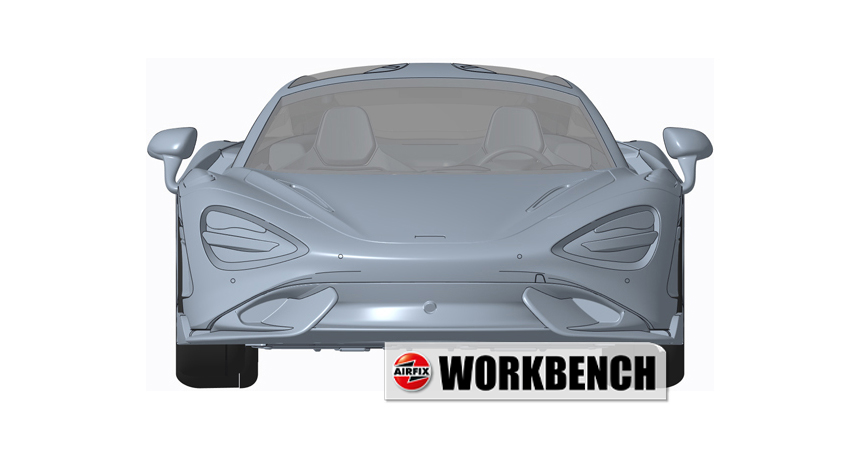
Classic supercar in Airfix form, this image has been produced from the CAD files Adam produced in support of this project.
Unfortunately, that means that if you want to be a member of this exclusive club, you are going to have to pay for the privilege, as this awesome car comes with and equally awesome price tag, £280,000 to be exact. Although you wouldn't want to weigh a car like this down by adding a host of comfort and entertainment extras, there is one upgrade you might want to consider, but again, it's a pricey one. If you decide to have your McLaren in unpainted carbon fibre finish, with the weave exposed in all its technological glory, this will set you back an additional £100,000, because in order to make this look as impactful a finish as it sounds, engineers will have to carefully align the weave of the material across the sweeping contours of the car, a process which is actually quite challenging and incredibly time consuming. If you do decide to go for this option, your McLaren will be particularly futuristic looking, almost sinister in appearance.
If the stars align and you ever find yourself with a McLaren 765LT in your driveway, then you really do need to consider driving this performance powerhouse around a race track and not constantly avoiding the potholes which are now such a feature of Britain's road network. Indeed, by nature of the fact that the 765 has such a low profile for maximum traction at speed, driving one of these beasts around a normal town would probably be anything but a pleasurable driving experience and just think about all that damage you could be doing to that poor carbon fibre!
Those already fortunate enough to have driven one of these cars describe the experience as exhilarating, an unrivalled driving experience fuelled by uncompromising performance. Once with your hands on the steering wheel and with the engine revving, the 765LT demands to be driven FAST and even if you do find some other performance car owners to share the track with you, they will probably all find themselves chasing your tail lights, or choking on your smoking tyre fumes.
Just one of the image formats a designer has access to when designing a new kit, this allows them to check shape data against the beautiful lines of the supercar he is replicating.
If your numbers ever come up and you are in the enviable position of calling yourself a McLaren 765LT owner, most motoring journalists recommend that you should also spend a little time under the tuition of a professional track experienced driving instructor, because if you don't unlock the potential of this incredible car, you really are doing it a huge disservice and missing out on the very reason why you bought it, driving exhilaration. One word which is regularly used to describe this most super of supercars is 'Outrageous', the very pinnacle of motoring technology and one which delivers the ultimate driving experience. It is very much a case of performance and handling in perfect motorsport union.
If the £250,000 price tag for the non-carbon fibre finish 765LT is just a little steep for you at the moment, but you would nevertheless like an example of this stunning car in your own home, then Airfix product designer Adam French believes he might just have what you are looking for, the same stunning design, but at a fraction of the price, his latest Starter Set kit design. The question is, do you want a single full size McLaren 765LT, or almost 17,000 scale Airfix alternatives? Maybe just go with a single Starter Set kit to start with and take it from there.
An image of Adam's McLaren 765LT skeleton model and an illustration of how he used this to design every part of the new kit.
When it comes to the subject of designing new Airfix products, Workbench readers have become quite familiar with the talents of Adam French over the years, but will probably more readily associate his name with Quickbuild projects, as we have featured his work in many previous editions of the blog. In a fascinating deviation from this norm, we are delighted to announce that this latest update will be bringing our readers details from one of the first new Starter Set design projects Adam has been involved with, a development which clearly provides an opportunity to ask some fascinating comparison questions, but we will get to that in a little while.
Initially, we wanted to ask Adam if moving on to designing a traditional Airfix model kit caused him any initial concerns and what research information he was presented with at the outset of the project. He told us that he would be lying if he said that he wasn't a little trepidatious at the start of the project, but how if there is one thing his time here at Airfix has taught him, it's that there is a design solution to every problem and if it's something he can't work out for himself, one of his colleagues will inevitably have the answer.
As our new generation of Starter Sets have such an important role to play in the future of Airfix, many of the initial group of designs actually started life as collaborative team projects, with some of the initial design work laid down by either our Design Manager, or another senior member of the team and that proved to be the case with this new McLaren 765LT project. That being the case, Adam's first task was to familiarise himself with what he was inheriting, before deciding how he was going to attack the actual design phase. He did have the huge benefit of inheriting CAD files supplied by McLaren themselves, so he was in no doubt that the shape and scaling data he had access to couldn't be more accurate, something which must be reassuring for any designer at the start of a new project. All he had to do now was to take this data and convert it into an accurate, easy to build scale model kit - simple really!
When it comes to the beautiful shape of this supercar, this was perhaps the most complex and demanding design representation Adam had come across in his career to date and he knew immediately that this was going to provide him with his greatest challenge, particularly as everything was now going to be designed in a smaller scale that he would usually be working with. Although the McLaren supplied CAD was of huge benefit to him, it wasn't in the format Adam uses when designing a new model kit, so he was going to have to convert this data into a format his design software would recognise. This would then be the design blueprint for every aspect of his design work, the creation of his base skeleton model and the subsequent splitting and design of individual component parts for the kit.
More CAD screenshots showing various stages of the design of the McLaren. As he is describing his work, Adam can peel back elements of his design from the complete structure on screen, right down to individually designed parts, if he so desires.
A similar image, but this time using different colours to highlight individual parts at this stage of the project.
The CAD design software used by the Airfix is an incredibly powerful tool and provides them with the ability to not only view and manipulate every aspect of their design but also to lock and disable sections to reveal even the smallest of individual parts, something which is really interesting to see. When we have the opportunity to discuss new tooling projects with our designers, they often illustrate the points they are making by opening up the CAD software and showing us the part or detail in question, navigating this complex piece of kit with consummate ease. Although we do have the opportunity to request individual screen grab images for inclusion in the blog, these are clearly just static representations of what we are seeing on their screen and can never illustrate either the power of the design software, or how proficient our designers are at using it, when featuring it in a blog.
Able to take any aspect of their design and view it from any angle imaginable, they can also drill down to the finest detail, showing how individual parts have been designed, highlighting shape data, wall thicknesses (the thickness of the actual plastic part) and how each part interacts with those next to it when under construction. If this wasn't fascinating enough, they can also view multiple layers, or individual parts, disabling viewpoint parameters with the click of a mouse button and manipulating the resultant image to give the optimum viewing angle for the matter under discussion, all really rather impressive. Even though we will all no doubt think it would be great to be an Airfix Product Designer, when you have the opportunity to see the team in their domain, it's probably better that we just leave this work to the experts.
How would a Quickbuild guru make the transition to designing a new generation of Starter Set?
Now on to the main event on this particular design feature - in the Red corner, Airfix Quickbuild with its 'pip' construction and self-adhesive stickers and in the Blue corner, a new Airfix Starter Set with its low part count and simplified assembly. For a man who is experienced in designing both types of kit, we were interested to ask Adam which is the easier kit to work on from a design perspective and what are the different challenges he faces when working on each of them?
As we expected, Adam didn't make too much of an issue about the transition between the two product types and simply described the situation as being a new, if slightly different design challenge. Clearly, the end result has to be the same, a faithful representation of the subject you are designing once the kit is constructed, even if the design challenges to get you to that stage are slightly different along the way.
When working on a Quickbuild design, individual parts are typically much larger than on a traditional kit and whilst you might think that makes a designer's life a little easier, that's not always the case. The requirement for each part to use 'pips' during construction, whilst at the same time providing the inherent strength the overall model is going to need really does call for some design skill and can be quite time consuming. In addition to this, the design of Quickbuild kits has to be aligned with the tooling splits for the different coloured components the model uses and certainly as we have seen on the latest releases, how clever design allows one coloured component to protrude through the different coloured part next to it, thus providing much greater levels of detail and accuracy, and a more visually appealing model as a result.
Not your usual McLaren supercar paint finish, this is another CAD screenshot image which helps to show the design of individual parts.
When working on a new Starter Set design, although the use of poly cement during assembly of the kit does mean that in general terms, the design of individual parts is a little more forgiving, especially when also considering the parts will be moulded in a single colour of plastic, there are other aspects where the design phase more than makes up for this. In addition to the Starter Set being in a smaller scale than a Quickbuild, it will also require greater levels of detail to be incorporated and whilst both kits still maintain the same design ethos, this is one area where the Starter Set kit proves much more of a challenge.
Staying with the design of the Starter Set, as these kits feature a lower part count and simplified construction, this again requires some different design thinking, but accepting this takes the kit into the realm of the novice/first time modeller, is still strangely similar to that of a Quickbuild. In summary, whilst the two types of kit share a similar target audience, a Quickbuild model is intended to be built in as little as 10 to 15 minutes, whilst a Starter Set is much more closely aligned to traditional modelling and will therefore take a little longer, even if that first experience should only take you a couple of hours to complete. From a design perspective, Adam described how the design and splitting of parts is the most crucial and time consuming aspect of a Quickbuild design project, however, if he had to do the same thing but in the same smaller scale as the new Airfix McLaren 765LT kit, including all that extra detail, how that would be quite the challenge and incredibly time consuming to achieve.
Designing a new Starter Set kit definitely offered the opportunity for Adam to work with much greater levels of detail, both externally and internally, however, the different method of construction does allow him a little more flexibility when it comes to the splitting of individual parts and laying out the tooling plan. The design of a Starter Set definitely brings with it some constraints, however if you manage to stick to the brief and produce something a first time modeller will enjoy building and be proud to show off to their family and friends, this really is quite an accomplishment for the designer behind it. Simplified by design doesn't actually mean simple for the designer to create, it can actually be quite the opposite.
Getting back to matters in hand and the actual McLaren 765LT kit, Adam described how the faithful representation of the beautifully sweeping contours of the car was definitely one of his biggest challenges. Clearly, this had to be absolutely spot on from an aesthetics perspective and must have been a nightmare to achieve. The main body shell would not only be the main focus of the kit during the assembly stage, but would also be the largest single component in the kit itself and much time was devoted to its design. Adam also had the pressure of knowing his design would also have to be passed by McLaren themselves, which is why we said earlier that it's probably best if we leave this pressured design environment to the experts.
Taking this a step further, as a new Starter Set, Adam also knew there would be a requirement to make individual parts larger than they would be in a standard kit and how each one of these parts would still need to include the detail associated with an Airfix kit. With a standard kit, detail is often built up using several different parts which all come together during assembly to product the desired detail effect, but on a Starter Set, most of this has to be included in the mould detail of much larger components. To make matters worse, by making these parts larger and potentially deeper, the designer always has to keep in mind manufacturing tolerances and to make sure these parts will mould efficiently when finally used in the production of the kit itself.
What a shape, the McLaren must have been a real challenge for Adam to replicate, but modellers will be the beneficiaries of his efforts.
Initially, Adam told us that he build his design around the panel placement of the real McLaren car, but how he later found that this would not be possible when converting it to this very unique type of introducer model kit. Once he had received his prototype components for checking and assembly, he immediately noticed several issues which had not come to light during the design phase, issues which saw him returning to his design files to make some changes. In constant consultation with the wider design team, he felt that in order to incorporate details modellers would expect to be included and to do so without introducing new potential problems, he redesigned some part thicknesses, modified his part split slightly and made some larger components even more robust, adding even greater levels of detail.
All the designers describe how their work can be described as a series of challenges and acceptable compromises and the McLaren was definitely a point in case. Part assembly integrity is always a major concern during the design phase and probably even more so with a Starter Set kit, as the larger, more detailed parts have to come together just as effectively as with a standard kit, even though they are often an amalgamation of several individual parts a standard kit would usually include. In this regard, it could be argued that a Starter Set can be more challenging to design than a standard kit, however, that is something of a generalisation and in every case, our designers will be looking to push the boundaries of what's possible in this fascinating world of model kit product design.
As cars are of particular interest to younger people, we made a conscious decision to include several new car projects in our new range of Starter Sets, in the hope they would encourage more youngsters to take their first experience of building a model kit.
As he has already described, there are some clear design differences when working on a Quickbuild model over a Starter Set project, but Adam did go on to say that it is more of a trade off between the two, with one requiring a little more effort in one particular area, whilst the other needs that effort to be directed in a different area, if that makes sense. The main differences are in the size of the parts each design requires and the levels if detail those parts must include, with each having their own design idiosyncrasies and each one bringing their own set of specific challenges.
We did go on to ask the million dollar blog question though, Which of the two product types would be the quicker project to work on, and Adam said Quickbuild, however, he did concede that this might just be down to his familiarity with the product and the incredible level of experience he has built up over years of design experience. He went on to tell us how much he enjoyed the challenge of designing the new McLaren 765LT kit and how some of the news skills he learned may just find their way into future Quickbuild designs, but how he hopes to be involved in many more traditional Airfix kit projects in the years to come.
Ever so slightly cheaper than the real thing, Adam thinks he has the answer for those who would like to own a McLaren 765LT, but can't quite afford the £250,000 price tag.
In his design role, Adam described how he is lucky to have quite an amount of creative freedom when it comes to his design work, but how like all members of the Airfix team, he always has the build experience of the modeller eventually building the kit at the forefront of his mind throughout the design process. With regard to a new Starter Set project, combining parts together whilst retaining detail accuracy certainly reduces the need to spend time designing and assessing several different parts to get to the same stage on a traditional kit, but how that time saving simply moves to a different section of the design, that being the need to ensure that these larger and more complex parts mould effectively during the kit manufacturing process.
When it comes to assembly and the production of the instruction leaflet, this is most definitely more structured when linked to a Starter Set as opposed to a Quickbuild kit and is something Adam will have to spend quite some time in collaboration with our Illustrator Richard on, but this is a subject for a future blog.
We wanted to end by simply asking Adam, from his time spent designing the new McLaren 765LT Starter Set, what does he think modellers building the new kit will most appreciate, once they get their hands on one? He told us that clearly, he wanted them to enjoy the experience of building the model, whether it was their first time modelling, or if they already had a few kit builds under their belt, but on a specific design point, he hoped they notice the level of interior detail he has managed to include in his design. Whilst he knows not all of this detail will be visible to those viewing the completed kit by looking through the clear parts, he hopes that seeing it during construction and therefore knowing it's actually there will make this feel like a real Airfix kit for them, in addition to being a faithful representation of this truly stunning supercar. Actually, he really does hope we all notice it, because it took him ages to replicate all that detail!
In full Starter Set presentation, the new McLaren 765LT will surely prove popular with huge numbers of modellers following its release, but first timers and those with a few builds under their belts.
Having now assembled several full test builds from different iterations of various tooling component runs, Adam said that he is delighted with how the McLaren has turned out and how the model looks great - He said that it even looks fast when it's just sat there on your desk! A really striking addition to our new generation of Starter Set designs, we would like to thank Adam for his time spent guiding us through his design busman's holiday (or should that be supercar holiday) and for supplying us with the fascinating selection of design imagery which is such an appealing feature of this overview. It has also been interesting to gain an insight into the different challenges he faces when working on this type of kit as opposed to the Quickbuild designs he is so expert in producing. He rather succinctly explained that whilst both kit types bring different design challenges, both are aimed at a similar audience and both are very much 100% Airfix.
Well said Adam and thanks again for your help.
We are afraid that's all we have for you in this latest edition, but we will be back next Friday with more project development updates and the very latest Airfix kit exclusives. In the meantime, we are always keen to hear your views on all things Airfix and in particular, any thoughts and opinions you may have regarding our Workbench blog. If you would like to drop us a quick line, could we please ask that you use our workbench@airfix.com email for all correspondence.
To re-visit any of the Airfix blogs we have produced over the past seven years or so, please head to our main Workbench hub, where you will find our entire blog back catalogue and all the Airfix design projects we have already covered.
All our dedicated official social media sites can be accessed by clicking the respective link icons at the foot of this page, or by heading to the Airfix homepage. Other useful Airfix links are:
Facebook, YouTube, Twitter and Instagram official sites
Please join us for more Airfix updates next week and thank you for your continued support.