
Welcome to this latest edition of our Workbench blog and all the news, updates, and modelling exclusives from the fascinating world of Airfix.
As we currently find ourselves on the cusp of the Christmas and New Year holidays, and as Christmas is all about the joy of giving, we thought we’d do something just that little bit different for this latest edition of Workbench, by looking at how our designers have thought long and hard about making every new modeller’s start in this hobby all the more enjoyable. Realistically, this is quite a departure from one of our usual review subjects, which are normally targeted at an audience which is as modelling proficient as they are knowledgeable, but we all had to start somewhere right, and a little look at how that feels for a novice modeller in current times will hopefully be of interest to many. In any case, we’ll all probably know a youngster or two who might be ready for that first modelling experience, so we could all probably benefit from knowing what’s actually out there for them.
As we can almost hear the sleigh bells ringing and are preparing to check our all-important Santa Tracker connection, we thought it might be festive of us to go with another dual blog posting this weekend, where our second blog will be looking at a lovely little kit which has proved to be a surprisingly popular release this year, one which is still attracting plenty of plaudits across many modelling social media sites, our latest RAF Jet Provost kit release. Although we posted a review of this kit earlier in the year, this re-visit will be adding a host of recently received built model imagery into the review, featuring both of the included scheme options. If you haven’t already discovered the delights of this fabulous little model, this blog reprise will hopefully have the Jet Provost on your build schedule as we head into the new year.
It's little Airfix kit classics all the way in this latest dual posting edition of Workbench.
If you were lucky enough to find an Airfix Superkit under your tree on Christmas Day, you knew you’d been incredibly good all year.
In fast approaching ten years of producing the Workbench blog, I really can’t help but allow some of by own modelling background and experiences to find their way into the lines of text produced, but having had the opportunity of meeting many thousands of our loyal readers over that time, it seems that we all share very similar experiences. Talking about our Christmases past, hoping for the model kits we’d been coveting all year was undoubtedly the last thing we thought about on Christmas Eve and the first thought in our minds as we checked the present filled football sock at the end of our beds, even though some of us may have been a little more proactive than that.
If our parents liked to visit the pub for a couple of hours with their friends on most Friday nights, this gave us the ideal opportunity to go rooting about, looking for presents. If they were just under their bed and unwrapped, well they could hardly complain if we found them, however, the real skill was thinking about where the most unlikely hiding place in the house was for a present, and coming up trumps when finding one there! The only problem was, the more successful you were, the less surprises you had to look forward to on Christmas morning, but if you had a decent selection of kits to unwrap, it was still going to be the biggest day of the year. I realise there isn’t much Christmas spirit and good will to all men in these actions, but kids will be kids, and modelling was an important part of our lives.
Moving on to look at the start of our own modelling journeys, those of us who have a few years under our belts can even remember the fantastic Airfix kit display in our local Woolworths store and how we begged to be allowed a kit when accompanying our mums on a weekend shopping trip. A little later than this, securing our weekly pocket money would usually see us heading off to our local modelling emporium to relieve them of yet another Series 1 Airfix kit, usually walking there and back, because the price of the bus fare would leave us short when it came to buying the kit. If you had managed to save up enough for a Series 2 model, you literally felt like a king as you walked back home with your purchase in hand, with an enjoyable few hours of modelling to look forward to.
Back then, these kits really were the centre of our little universes, with the different subjects fuelling our passion for knowledge and giving us subject interest which has stayed with us throughout our lives, even when life got in the way. If we’re being honest with ourselves, our early modelmaking exploits were probably a little hit and miss when it comes to quality of finish, with glue getting everywhere and the finished models probably not being painted, but still proudly wearing their decals. If we were lucky, we had an older brother to watch and learn from, or a father who would be more than happy to lend a helping hand when it came to our latest modelling project.
Once we progressed to painting, this introduced both a new area of knowledge and learning for us and an absolute necessity to ensure the dining room table, or other assigned workstation of choice, was completely covered in newspaper, just in case the unthinkable should happen and that full pot of Dark Earth got knocked over. After many attempts and probably going through a good few kits, once that first competently assembled and painted model kit had been finished and taken its place on a shelf in our bedroom, the sense of achievement was incredible and probably had us immediately reaching for the Airfix catalogue to earmark our next project.
Airfix model kits not only provided us with an enjoyable pastime, but gave us an interest in history and the machines which made it and for some of us, led directly to the careers we went on to have.
As enjoyable as this process was, we would all probably admit to being quite focussed and rather determined back then, with very few of the distractions youngsters of today have to contend with, even though we did have access to friends and relatives who completely captivated us with wartime stories and service tales featuring some of the subjects we were modelling – how could you not want to replicate those shared experiences in scale model form?
Taking those experiences many of us share and all hold dear, and accepting that the world today is a very different place to the one we remember back in the 1970s and 80s, how does today’s novice modeller go about taking their first steps into this hobby which has brought us so much pleasure over the years, and would they have the same resolve in following our exact hobby footsteps? The answer to this, with all the technological distractions the modern world offers, is probably no, which begs another important question, and one which has been facing the Airfix design team for some time – how do we get today’s youngsters to simply have a go at modelling and try to ensure they have an enjoyable and rewarding experience in doing so?
If our beloved hobby is to have a future, and younger, less experienced modellers are going to take that all important step towards spending time with a scale construction kit, they’re going to need some help, support and encouragement along the way. Today, that first step needs to be a much more considered one than the one we took ourselves back in the day, one which is easier to negotiate and one which comes with support and guidance. Thankfully, the Airfix team have been giving this a huge amount of thought over the past few years and we can now offer a range of new Starter Set kits which provide all the support we identified as being important, whilst at their very heart being faithful scale representations of the full-sized subjects on which they were based.
Utilising all the very latest advancements in design and manufacturing technology, whilst at the same time intentionally designing the kits to be easier and more logical to assemble than their famous predecessors, this new breed of kits might be easier for our novice modellers to tackle, but are actually quite challenging for our designers to create. From the second they take on one of these projects, they have to combine all their incredible design experience with putting their efforts in the hands of a complete modelling novice, and how can they best support their first attempt in the hobby with clever design.
Never a compromise on accuracy and authenticity, the reduced number of parts a new Starter Set requires brings a new set of challenges for the Airfix designer taking on the project.
With a lower part count and simplified construction as standard, not only do these impressive kits have to go together easily and intuitively, but the reduced part count requirement means that pieces which would usually be smaller, individual items in a traditional kit, have to be incorporated into larger, combined pieces with these kits. Clearly, this will make things easier for the modeller, but potentially much more challenging for the designer, when it comes to designing parts which don’t cause problems during the tooling/manufacturing stages, so there is much to be considered.
In addition to creating a new breed of Starter Set kits, the team wanted to go one, or two steps further, by introducing a couple of further levels of support for the inexperienced modeller taking this important first step in the hobby. Firstly, each of these kits now include a separate handy sheet of modelling tips, guidance and preparations, which will hopefully prove helpful, with our ‘Before you start’ sheet also showing what tools might be required in advance of their first model build.
New thinking has also been applied to the layout of the instruction booklet layout for these kits, where it guides the novice modeller more closely through their first build project. Acting like a modelling dot-to-dot in some respects, the parts are numbered in the order you will need them during construction, with the illustrations clearly showing a silhouette of the part in question and where you will find it on the part frame. The modeller is also given clear guidance on how these parts go together, and how when they’ve been used, how they no longer appear on the part frame image guidance, leaving them in no doubt as to what stage they’re at. Less chance for confusion, and reassuring guidance – the instructions even show when and where they should apply the glue.
Whether they have the support of a parent or older sibling with them during the build or not, the intention with these impressive little kits is that the novice modeller should feel confident throughout the process, almost as if the kit’s designer is looking over their shoulder, guiding them through the assembly process. We want them to have the confidence to simply get on and have a good old crack at it themselves.
Going right back to the beginning of this Starter Set project, this image shows three variations of how our designer Paramjit Sembhi approached the subject of displaying the built model. The right-hand option, or something close to it eventually got the call.
Starter Sets benefit from the additional guidance of a new style of instruction booklet, one intended to provide the novice modeller with the confidence to take on their first model build.
As we’re in thoroughly modern times now, we couldn’t let these young digital souls down without providing the additional support of some video guidance, so the Advice link in the Community section of the Airfix website includes a series of videos covering various sections of the build process, including walk-through videos which feature several of the new Starter Set kits themselves, so if you don’t really like to stray too far from your phone or tablet, we even have some help and support for you!
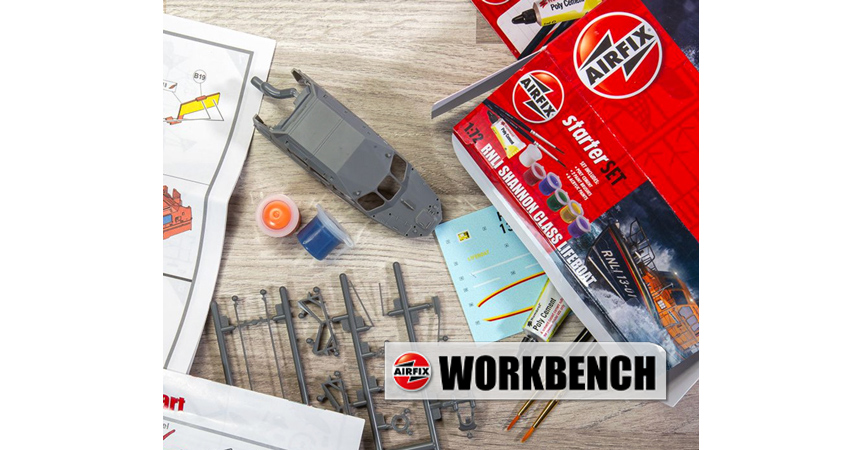
Finally, as these are Starter Sets and historically, are the latest incarnation of the introducer kits we older modellers cut our teeth on all those years ago, these kits are supplied complete with everything you’re going to need to finish your first model build, including poly cement, paints and paint brush. Back in the day, we had to buy all these essential items separately for ourselves, so we really are spoiling you in that regard.
Our new breed of Starter Sets really are impressive little kits and whilst designed with the novice modeller in mind, make no mistake, these kits can be enjoyed by modellers of all ages and abilities, building into stunning scale representations of cars, tanks, aircraft and boats on which they took their inspiration. In short, a Starter Set is not just for Christmas, although Christmas is the ideal time to share the gift of modelling enjoyment.
Let’s take a quick look at the new Starter Set kits which have joined the range over the past twelve months.
This year saw the further expansion of the Starter Set range and some classic model kit additions which offer even greater subject choice to someone looking to take their first steps on a modelling journey which will hopefully bring them as much pleasure as it has millions of others over the years. This year, we saw four new kits joining the range, with two classic fighters from the Second World War, the RAF’s current UK airspace defender and a modern lifeboat which has quite literally taken the hobby by storm. All have been produced in 1/72nd scale and each kit has its own particular modelling appeal.
The aircraft which is currently charged with protecting Britain’s airspace from unwanted airborne incursion is the Eurofighter Typhoon, a highly capable aircraft which was born from an international design collaboration which aimed to produce an agile air defence fighter (European Combat Fighter Project) for service with several European air forces. Such a collaboration held the prospect of keeping costs to more manageable levels for those involved, as they were being shared across the partner nations, although each would ultimately have their own requirements, something which would put a strain on both costs and working relationships.
The multinational consortium was made up of the aviation industries of Britain, Germany, Italy and Spain and as the project progressed, it was clear that the new Eurofighter was going to be an extremely advanced aeroplane indeed. Designed to be aerodynamically unstable at all speeds, the aircraft was controlled by a powerful suite of computers, which combined to endow the fighter with exceptional agility.
Making extensive use of composite materials, the aircraft was to be powered by a pair of Eurojet EJ200 engines which propelled the fighter to a maximum speed of Mach 2.35 and the ability to supercruise without the use of afterburner. These engines were just as advanced as the aircraft itself and were designed in 15 fully interchangeable modules, with everything monitored in real-time to ensure the early indication of any potential problems with the unit. This was all designed to keep the aircraft serviceable and ready for action.
Equipped with an impressive array of targeting and defensive technologies, the Typhoon can also carry a seemingly endless selection of ever more capable weapons, as it has developed from its original air superiority fighter designation, into an exceptional multi-role platform, one which is truly at the forefront of military aviation technology. Now at the midpoint of its service life, the Typhoon is expected to remain in service until 2040 and beyond.
The Typhoon era began in earnest on 27th March 1994, when the first prototype aircraft made its maiden flight from the EADS facility at Manching in Bavaria, to be followed six days later by the first flight of Britain’s first development Typhoon (ZH588) from the Bae facility at Warton in Lancashire. The name ‘Typhoon’ was officially adopted for the new fighter in September 1998, the same year that the first production contracts were signed, committing nations to purchasing an aircraft they had already been working on for five years at that point.
The first operational RAF Typhoon Squadron was No.3 Squadron, which was established at Coningsby on 31st March 2006 and by the summer of 2007, the unit were sharing national QRA (Quick Reaction Alert) responsibilities with the RAF’s existing Tornado F.3 force, initially on a rolling month on - month off basis, but working up to taking this important duty over entirely.
Now eighteen years on, the Typhoon is a mature combat aircraft, arguably one of the most capable aircraft in world service today and one which is now in service with the air forces of nine nations, with just under 700 aircraft ordered to date. Still the consummate Airshow performer, thousands of Airshow-goers will be looking forward to seeing next year’s Typhoon Display Team pilot putting this exciting aircraft through its paces and inspiring the next generation of future Royal Air Force recruits.
With its reputation as one of the finest fighting aeroplanes of the Second World War, it can be surprising to learn that the Packard Merlin powered variants of the North American Mustang only made their European Theatre combat debut from the end of 1943 and therefore posted all their wartime achievements in a short seventeen month period prior to VE Day. The Mustang started life following a British request for the North American Company to licence build Curtiss P-40 fighters for the Royal Air Force, but with this new company offering to produce their own design in the same time or less than it would to tool up for the Curtiss fighter, and one which would be better.
This was an incredibly bold move by a company which had never previously build a fighter aircraft, and even though the British were hardly in a position to argue, what they produced was an aviation classic, particularly when later married with the Rolls Royce Merlin engine. The rest, as they say, is the stuff of aviation legend, an ace-making aeroplane which had speed, range, performance and firepower, a true fighting thoroughbred of an aeroplane.
Determined to make their fighter as effective as it could be, North American were proactive in listening to the combat experiences of pilots flying their existing B and C razorback variants of the fighter, allowing them to suggest where the aircraft could be further improved. One of the main concerns pilots relayed back was the relatively poor field of view they had from the earlier framed canopy of the original Merlin powered aircraft, and as every experienced fighter pilot will tell you, vision is everything in combat.
Recent advances in plexiglass moulding technology allowed a single piece 'blown' teardrop canopy to be manufactured for the fighter, one which greatly enhanced the pilot's field of view from a Mustang’s cockpit. The design of the fighter was modified behind the cockpit to allow the new canopy to sit high on the fuselage, with this modification incorporated into all new D and K model Mustangs manufactured from 1944 onwards. Introducing a host of additional improvements, this ultimate Mustang also featured a modified wing, increased armament and the continued development of lightweight external fuel tanks, something which would further extend the operational range of this magnificent aircraft, and much to the dismay of the Luftwaffe.
Once again, production of this latest variant of Mustang was split between the two existing manufacturing plants at Inglewood and Dallas, although this time all aircraft manufactured would retain the same ‘D’ nomenclature. The only sub-variant of this 'Bubbletop' Mustang were aircraft equipped with a different propeller, due to the preferred Hamilton Standard unit being in such short supply. Mustangs fitted with the slightly smaller Aeroproducts propeller were subsequently referred to as P-51Ks.
The incredible dominance of the Mustang was clearly the result of several important factors, not all of which were linked to the aircraft’s production. When combining the ever-increasing number of Mustangs filling the skies over Germany during the latter stages of WWII with the terrible attrition rates being inflicted on the Luftwaffe at that same time, it was clear that this situation was only ever going to get worse for the Germans, particularly as the Allies could now escort their bombers all the way to their assigned targets and back home again.
This ability was not only a result of the incredible performance of the Packard Merlin engines which were available in such large numbers, but also an unlikely invention which was only ever intended for ‘single use’. Lightweight paper/cardboard drop tanks proved to be something of a revelation, not only providing Allied fighters with the additional fuel they needed for missions deep into Germany, but were cheap and easy to make, not requiring the use of any high demand materials.
When it comes to the subject of famous fighting aeroplanes, few possess the notoriety of the Messerschmitt Bf 109 series, the aircraft which is always regarded as ‘the enemy’ and the single engined fighter which formed the backbone of the Luftwaffe throughout the Second World War. Of course, the Messerschmitt will always be inextricably linked with the British Spitfire, almost as if the only aerial duals which took place during WWII were fought between these two aircraft, because in popular culture, these two old foes were forever locked in combat like airborne gladiators in a coliseum in the clouds – no wonder they became such a famous pairing.
Both the Messerschmitt Bf 109 and Spitfire came to represent a successful series of fighter aircraft which saw service throughout the Second World War, with both undergoing almost constant improvement and development during that time. In both cases, the aircraft variants which were still in service in 1945 were very different to the ones which fired their guns in anger for the first time in 1939, testament to the strength and adaptability of their original designs.
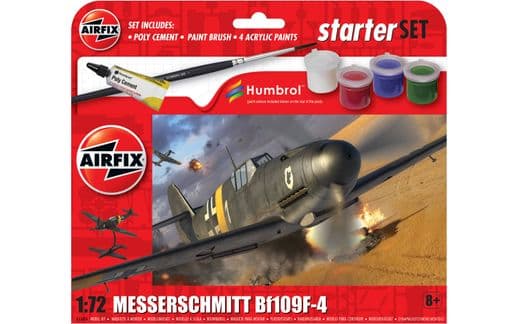
In what proved to be something of a coup for the Starter Set range, the variant of Messerschmitt Bf 109 the Airfix team decided to replicate for this release was the ‘Friedrich’, a more capable variant of the fighter which took part in the Battle of Britain, but one which rarely receives the recognition it deserves as a modelling subject.
Having enlisted the support of fighter pilots who served through the Polish campaign and onward to the strike westward, Messerschmitt designers began work on producing a new, more capable variant of the Bf 109 in early 1940 and by the end of the year, pre-production examples were already taking to the air. Powered by the latest 1175hp Daimler Benz DB601E engine, the ‘Friedrich’ also introduced a host of other improvements and design changes which were to give this variant a very different appearance.
Featuring a lengthened, more streamlined cowling to house the new engine, this was a much more refined design than its angular predecessor and with its much larger spinner, shorted propeller blades and retractable tail wheel, this new variant was definitely a more cultured Messerschmitt in every respect. The wings would also be the subject of redesign, with wing armament deleted completely on the new model to increase the strength of the wings and the square wing tip design of the ‘Emil’ replaced by rounded tips on the ‘Friedrich’. Fast, highly manoeuvrable and hard-hitting, the Bf 109F was a lightweight fighter pilot’s aeroplane and the Luftwaffe loved them. More than a match for the latest variant of Spitfire, the Bf 109F would become the mount of aces, a true dogfighting aeroplane in every sense of the word.
The ‘Friedrich’ joined combat units from the late spring of 1941 and would see extensive service on both the Western and Eastern Fronts, in addition to serving above the deserts of North Africa, with a great many pilots using this fighter to amass impressive victory tallies. In North Africa, celebrated ace pilot Hans Joachim Marseille used the ‘Friedrich’ to claim the majority of his 158 aerial victories and it was claimed that he was so attached to his Bf 109F fighter that he flatly refused to upgrade to the latest ‘G’ variant, until directly ordered to do so by his superiors. He felt the new aircraft was too heavy and less manoeuvrable, both differences which would remove his combat advantage.
The only aspect of the Messerschmitt Bf 109F’s design pilots wished could be improved was its lack of firepower, even though they realized that the subsequent increase in combat weight would adversely affect the aircraft’s almost legendary manoeuvrability. Unfortunately for the Luftwaffe, the war was evolving at quite a rate by this stage and with USAAF bombers now attacking targets deep int Germany itself, the Luftwaffe needed an even more powerful fighter, one which could operate at higher altitudes and be able to bring much greater firepower to bear, the Bf 109G ‘Gustav’.
The most manoeuvrable of all the Messerschmitt Bf 109 series of fighters would have to give way to a more ‘universal’ variant of the fighter on the production lines, one which may well have been more powerful in every respect, but one which was also significantly heavier than its agile predecessor. Although the ‘Gustav’ would become by far the most heavily produced variant of the Messerschmitt Bf 109 series of fighters, the most cultured, the most manoeuvrable and the best dogfighting variant of this famous fighting aeroplane was unquestionably the ‘Friedrich’.
Without doubt, the new Starter Set kit addition which went on to steal the show in 2024 was our Shannon Class Lifeboat kit, a model we are still finding hard to keep in stock. We knew that this exciting addition to the range would offer modellers something that little bit different, whilst also posing a very specific set of challenges to one of our designers, but we could hardly have envisaged just how popular this fabulous new kit has turned out to be. We would even go so far as to say that if you want to encourage the novice modeller to have a go at building a kit, then this is the one for you!
This impressive craft is an all-weather Lifeboat and when other inshore craft are forced to return to their home stations, Shannon Class boats can go out in some of the worst sea conditions imaginable. Fast and incredibly manoeuvrable, these lifeboats have clean hull bottoms and are powered by two 650hp Scania engines which drive a pair of Hamilton waterjet units, giving the helmsman incredible manoeuvrability when in a rescue situation. The vessel is quoted as being capable of attaining speeds of 30 knots, however, is usually limited to 25 knots in most situations, most likely for reasons of crew comfort and safety.
Each crew member’s seat is suspension dampened, a measure which allows them to perform their roles even if the lifeboat is being buffeted by heavy seas and in the most severe of circumstances, the Shannon has the ability to right itself should the need arise. Other operational features include fully sealed doors and windows against the ingress of water and almost indestructible windscreen wipers all go to make this a craft designed to perform in the most demanding of situations.
In a rescue situation, the Shannon Class Lifeboat can operate for 10 hours at full power and if required, has the space to accommodate up to 17 rescued souls, in addition to the six-man crew, whilst still retaining the ability to self-right in heavy seas. Up to 79 people could be carried in emergencies, however, the vessel would lose the ability to right itself in a capsize situation. Three different types of casualty stretcher can be utilised, allowing the doctor to administer immediate first aid to injured survivors, however this does take up space in the main wheelhouse.
The Shannon is also equipped with an impressive Systems and Information Management System, which allows each member of the crew to access all the vital information they might need when engaged in a rescue.
The Shannon Class is all about performance, a vessel built to perform a difficult task, but one it does arguably more effectively than any other vessel on the seas. Significantly, all this performance must be administered by volunteer crews from all walks of life and whilst they do train exhaustively on this vessel and its complex systems, everything has been designed to be as intuitive as possible. If you find yourself in peril at sea, you can breathe a sigh of relief if you see a Shannon Class lifeboat speeding to your aid.
Just one of a great many innovative features this incredible vessel can boast are the number of ways in which a Shannon Class can be operated. In addition to waterborne operation from the safety of a harbour, it can also be deployed from a standard slipway, or from any beach, something which allows them to be stationed at locations where other lifeboats simply couldn’t be. The water-jet power and control system and clean hull bottom allows the Shannon to be operated in extremely shallow water and when combined with an innovative tracked launch and recovery system developed by specialist firm Supacat, this is undoubtedly a no expense spared, lifesaving specialist platform.
Priced at well over £2 Million each and with around five vessels produced each year, currently around 41 of these magnificent machines are in service at stations around the UK coastline, with a further nine maintained as part of the RNLI reserve fleet. With a projected service life of around 50 years, the Shannon Class Lifeboat fleet will thankfully be keeping our coastline safe for many years to come.
As you can see, 2024 has been a particularly impressive year as far as additions to the Starter Set range is concerned, and it would be difficult to choose a favourite from this quartet of delights, although I suspect the Shannon Class Lifeboat would probably just pip the others to the post in any Workbench reader poll. Whilst each would undoubtedly make for an enjoyable build project in their own right, as this is the season for giving, the Airfix website is currently offering two Starter Set stocking filler bundles, both available at significant discounts and both making for ideal gift offerings.
The first set is an aircraft bundle which includes both the P-51D Mustang and Bf 109F featured above, along with a Spitfire, Red Arrows Hawk and impressive Lockheed Martin F-35B Lightning II. The other offering is our Super Car Starter Set quartet, featuring four spectacular cars which most of us will only ever own in scale kit form, as the real things would cost an arm and a leg to buy. Whether all the models in the stocking fillers end up in the hands of one lucky modeller, or you divide them up between several worthy recipients, both sets make for ideal gifts at this time of year.
As we said at the beginning, a Starter Set kit isn’t just for Christmas, and isn’t just for the novice modeller to enjoy, however, they are particularly impressive kits and do represent an exciting development in the continuing story of the scale modelling hobby and the Airfix brand.
As a bit of a Luftwaffe fan myself, I think I’ll be asking Santa for the Messerschmitt Bf 109F this year, or maybe two – I have been really good!
We are afraid that's all we have for you in this latest edition, but we will be back next Friday with more project development updates and the very latest Airfix kit exclusives. In the meantime, we are always keen to hear your views on all things Airfix and in particular, any thoughts and opinions you may have regarding our Workbench blog. If you would like to drop us a quick line, could we please ask that you use our workbench@airfix.com email for all correspondence.
To re-visit any of the Airfix blogs we have produced over the past seven years or so, please head to our main Workbench hub, where you will find our entire blog back catalogue and all the Airfix design projects we have already covered.
All our dedicated official social media sites can be accessed by clicking the respective link icons at the foot of this page, or by heading to the Airfix homepage. Other useful Airfix links are:
Facebook, YouTube, Twitter and Instagram official sites
Please join us for more Airfix updates next week and thank you for your continued support.