Welcome to this latest edition of Workbench and all the news, updates and exclusive announcements from the fascinating world of Airfix modelling.
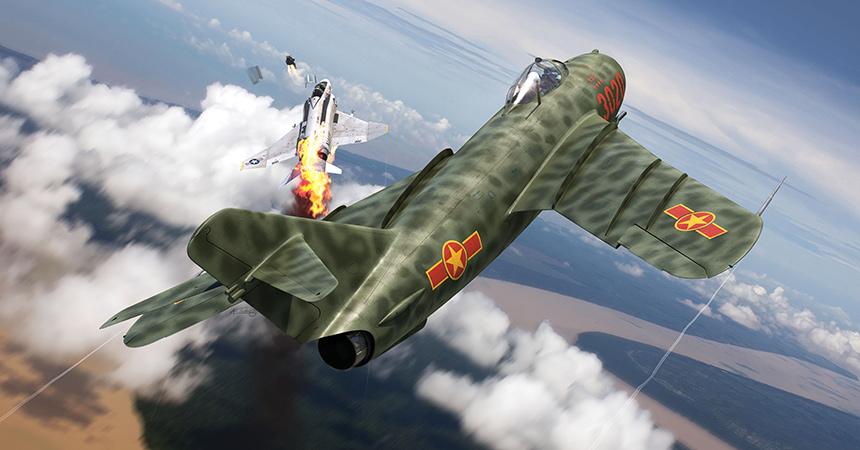
In this final edition of Workbench before our special (and to be slightly delayed) Scale ModelWorld announcement version of the blog, we have another feature packed modelling update for you, which includes our usual selection of exclusive images. As confirmed by the spectacular image above, we begin by marking the impending release of the newly tooled 1/72nd scale Mikoyan-Gurevich MiG-17F ‘Fresco’, before moving on to feature the latest build project undertaken by regular contributor and accomplished modeller Andreas Fey.
Again marking the impending arrival of a trio of classic Airfix kits, we also feature box artwork which will be familiar to millions of people, particularly if they have ever built a collection of scale model representations of some of the most interesting military vehicles of the Second World War. We end with something of a Telford Teaser, where we confirm details of how everyone can keep abreast of announcement developments at Scale ModelWorld as they are happening, whether you are at the show or not. We have much to inform you about, so let’s make a start.
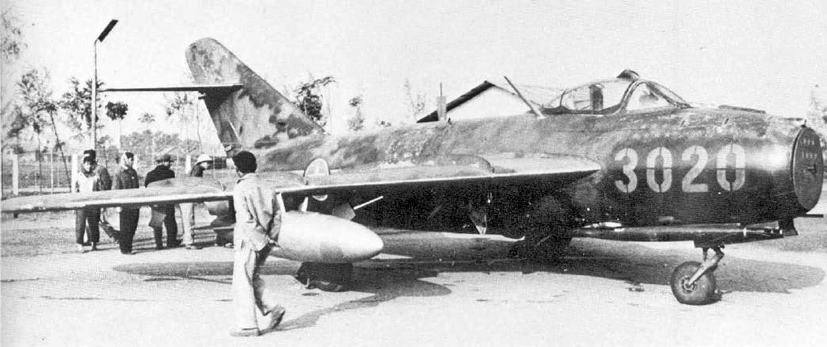
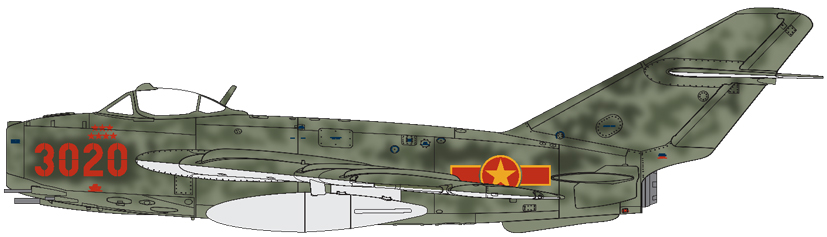
Original picture of MiG-17F (Shenyang J-5) ‘3020’, which was flown by North Vietnamese Air Force fighter ace Le Hai – was this the aircraft shot down by the US Navy pairing of Cunningham and Driscoll on 10th May 1972?
Certain to become a popular addition to our 1/72nd scale kit range, the new Mikoyan-Gurevich MiG-17F ‘Fresco’ tooling A03091 marks one of the most distinctive early jet fighters of the post war period and one which was tasked with engaging in combat with the latest US aircraft during the Vietnam War, aircraft which were considered significantly superior in both design and combat effectiveness. Using machine guns rather than the air-to-air rockets used by their opposition, airmen of the North Vietnamese Air Force were only too aware that they were operating technologically inferior aircraft, but quickly learned how best to use their fighters in this deadly aerial duel of classic jet aircraft.
Initially exploiting rather limiting US rules of engagement and radar coverage which did not extend as far as their operating bases, the aggressive tactics adopted by North Vietnamese pilots proved to be a rude awakening for US airmen, who were ill prepared for these slash and run, close quarters dogfights. Utilising the excellent manoeuvrability of the MiG 17 and avoiding exposing its technological weaknesses, they quickly began to score air combat victories against the very latest American aircraft, actions which would result in no fewer than 17 North Vietnamese fighter pilots achieving the coveted status of air ‘Ace’. In stark contrast to this figure, only 5 US airmen would achieve the same status during the Vietnam War.
The dramatic box artwork which will be used to mark the first release from this newly tooled kit has only recently been revealed and features a striking aircraft flown by Vietnam People’s Air Force ace pilot Le Hai, one of the two scheme options to be included with the kit. Officially credited with six air to air victories, including two against F-4 Phantoms, Le Hai’s aircraft was finished in an impressive, if rather sinister looking ‘snake’ camouflage scheme, which must have made for a fearsome sight if it ended up on your tail during a dogfight. Despite the prominent red 3020 nose markings applied to this aircraft, its eventual fate is unclear, with some sources claiming it was destroyed in combat with a US Navy Phantom, whilst others have it still on display in a Vietnamese military museum.
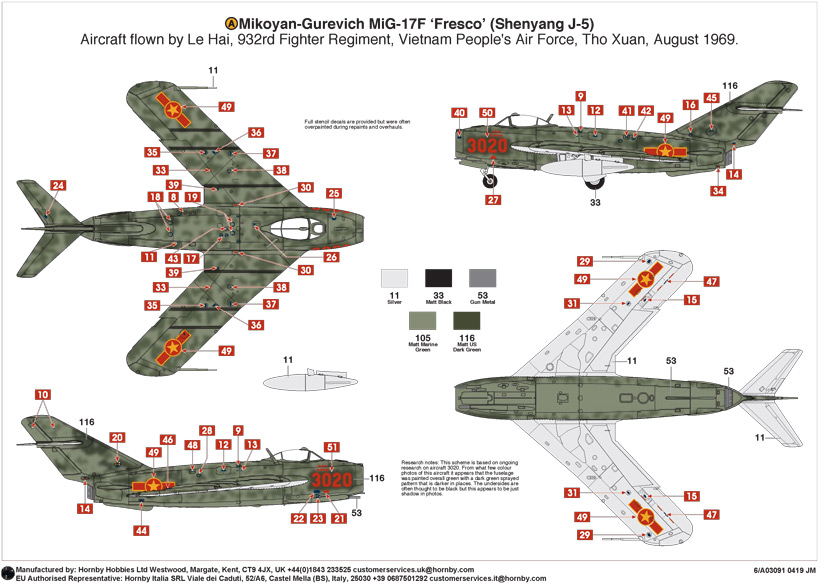
Launching Operation Linebacker in 1972, US forces in the Far East intended to inflict a crushing defeat on their North Vietnamese adversaries, by bringing the full weight of their awesome air power and advanced technology to bear. Supporting a sizeable bombing mission against the Hai Dong rail yards on 10th May 1972, successful US Navy pilot/navigator team Lt. Randy Cunningham and William Driscoll were flying their faithful F-4J Phantom, when the force came under attack by a large number of enemy MiG-17 fighters. As graduates of the US Navy’s Top Gun fighter school, the American duo had already scored victories during their Vietnam tour, but this would turn out to be by far their most eventful day in theatre and result in the pair achieving ‘Ace’ status.
Turning into a strong attacking force of MiGs, Cunningham quickly destroyed one of the fighters with a Sidewinder missile, immediately looking for his next target – he saw that his wingman was being pursued by several enemy fighters, each one seemingly looking to score an easy Phantom kill. He positioned his own aircraft behind the pursuing enemy fighters, but could not fire a missile for fear it would lock on the huge engines of his squadron mate. Calmly telling his wingman to break, he was now clear to fire his missile, which took out a second MiG and immediately force the others to break off the engagement.
With the US airmen at a significant numerical disadvantage, the Phantoms decided to disengage and hit the power for a high speed run for home, just as Cunningham noticed a MiG heading straight for him in a head on attack, firing its cannons as it came. The Phantom was not equipped with guns and if Cunningham was going to survive this dogfight, he would have to position his aircraft behind the MiG, before unleashing one of his missiles, however, his adversary was clearly no novice aviator and every move the US pilot made, it was countered by the Vietnamese airman, who by now was positioned on the Phantom’s tail.
In an encounter which lasted several frantic minutes, the aircraft passed close to each other on several occasions and Cunningham clearly recalled seeing the red number 3020 on the nose of the enemy fighter – as he was now engaged in combat with an extremely accomplished fighter pilot, could it be that they were facing the celebrated NVAF ace Le Hai? With neither airman giving any indication of breaking off the engagement, Cunningham attempted an extremely risky manoeuvre, cutting the throttles of his Phantom with the MiG still on his tail and moving in for the kill. The change of speed forced the Vietnamese fighter to speed past, but was initially too close to unleash a missile, however, this turning of the combat tables forced the MiG to dive for the ground at full speed, giving Cunningham the opportunity he had hoped for. One of his Sidewinder missiles struck home and sent the MiG plummeting to the ground. After claiming their third victory of the day, Cunningham and Driscoll set course for home, unaware that their eventful day was not over yet.
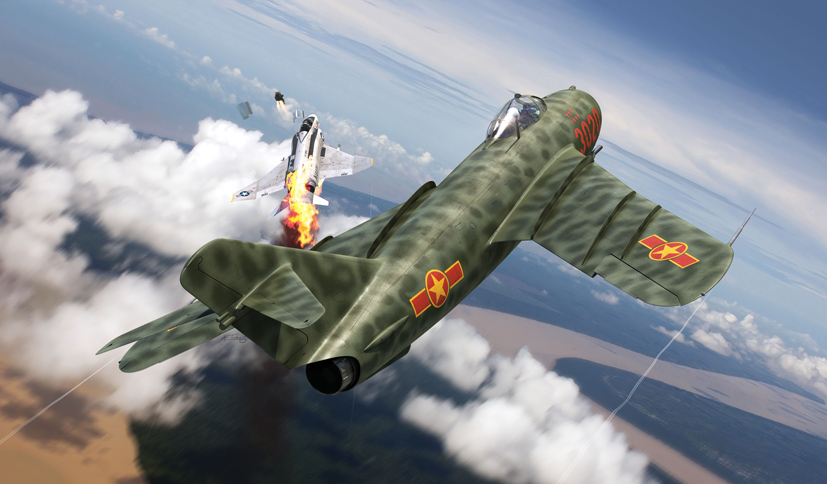
Just a short time after shooting down their third MiG of the day, their Phantom was hit by a surface to air missile, disabling their aircraft and setting it alight – nursing the aircraft back over the ocean, the pair managed to safely eject and were later picked up by a US Navy rescue helicopter and returned to their ship.
The unusual markings applied to Le Hai’s MiG and the fact that he was one of 17 North Vietnamese aces during the Vietnam War will ensure that this will be a popular choice with modellers following the release of our new MiG-17F kit, as it throws the modelling spotlight on this classic early Soviet jet design and its distinctive shape. A03091 is scheduled for a winter release and we will provide a more definitive arrival update as soon as we have shipping information available.
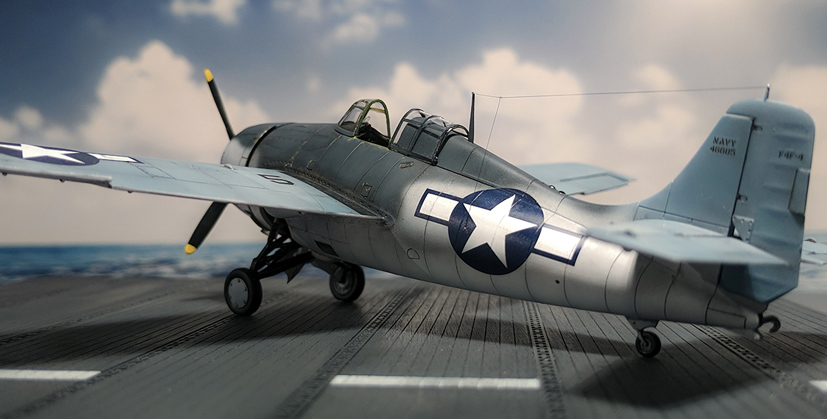
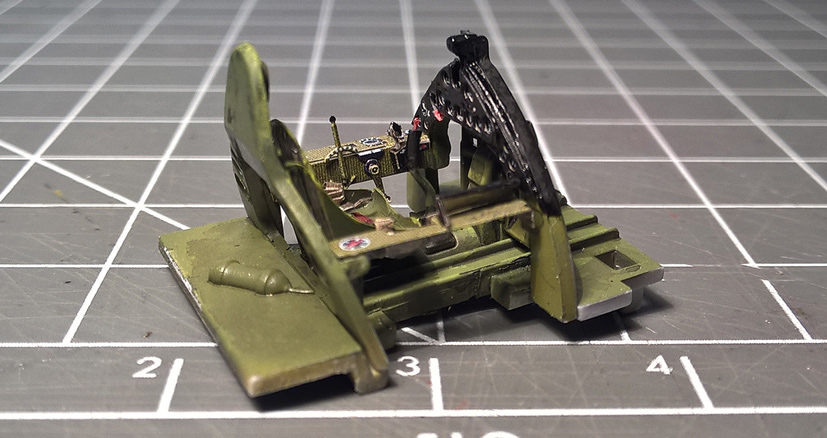
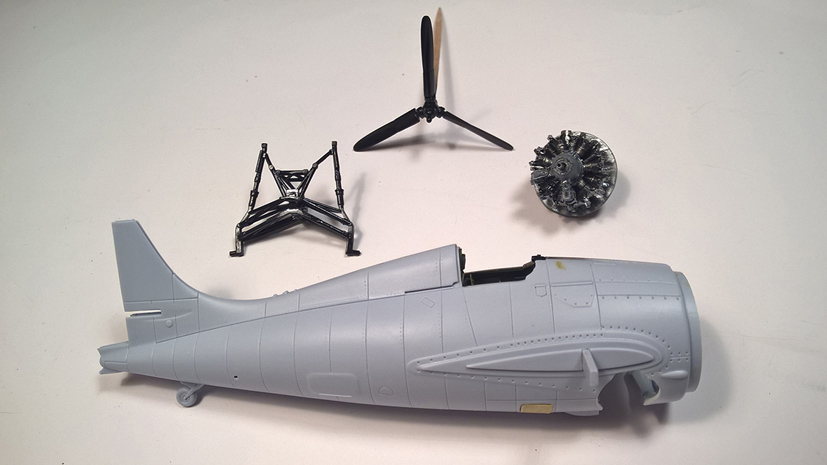
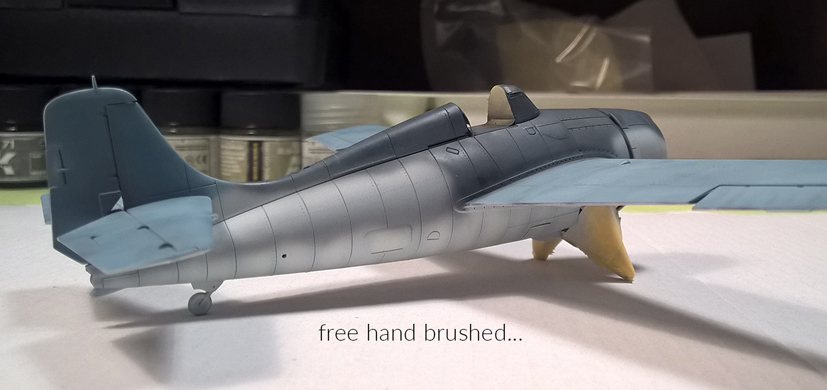
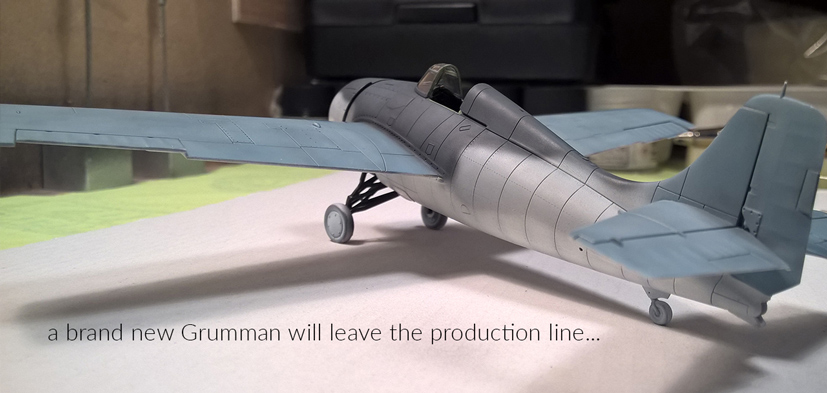
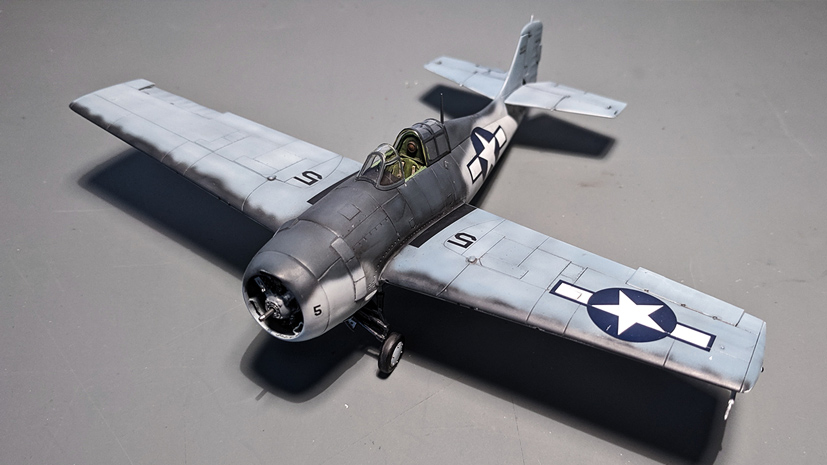
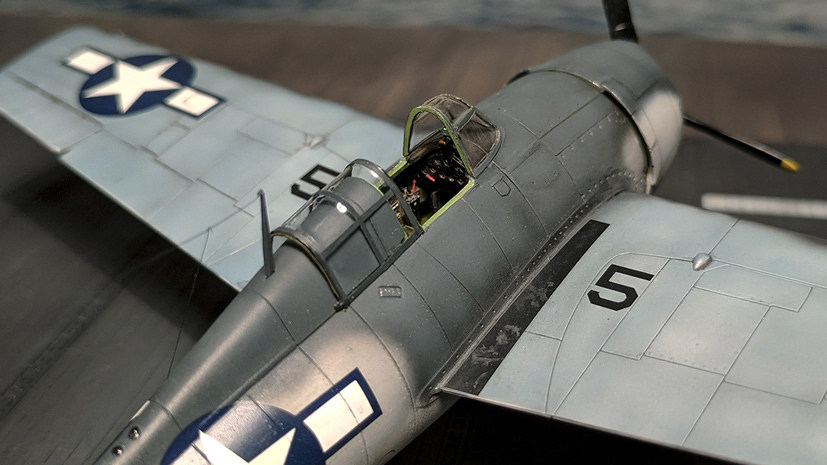
Workbench reader Andreas Fey took a break from modelling WWII Luftwaffe subject matter to tackle the relatively newly tooled Grumman F4F Wildcat and was good enough to share details of the project with us
Over the course of the last four years, have been fortunate enough to feature the prestigious modelling talents of Workbench reader Andreas Fey on a number of previous occasions, usually showcasing his passion for WWII German aviation subject matter. One of the most interesting features of his build projects is how he combines his love of modelling with a real flair for Photography, using his finished models as the main subject in a series of appealing diorama images. Well, Andreas has been at it again, but this time, a classic US Navy fighter from the early war years has been the focus of his attentions.
First released back in 2015, our newly tooled 1/72nd scale Grumman F4F Wildcat kit presents modellers with a highly detailed representation of one of the Second World War’s most important fighting aeroplanes and one which would see service throughout the conflict. Coming at the end of an impressive line of Grumman biplane fighters, the Wildcat was the company’s first attempt at providing the US Navy with an effective monoplane fighter and was designed around the company’s famed ethos of producing tough, rugged aeroplanes - this little fighter was intentionally designed to survive the rigours of operation at sea.
Initially relegated in favour of the Brewster Buffalo, the strength and combat survivability of the Wildcat would soon come to the fore, as the fighter would be heavily involved in action during the early months of America’s involvement in WWII, where US Naval strike units were forced to engage in combat with the feared and extremely agile Mitsubishi Zero, one of the world’s truly great combat fighting aircraft. The well trained US Navy pilots quickly learned to use the many positive attributes of their fighter during combat situations, avoiding tight turning dogfights with their nimble opponent and adopting high speed ‘hit and run’ tactics instead.
Benefiting from robust construction and the inclusion of armour protection and self-sealing fuel tanks, the Wildcat may have been heavier than its celebrated aerial opponent, but it also ensured many a US airman returned safely to his carrier after suffering combat damage, where Zero pilots in a similar predicament would be destined for a dip in the Pacific, if they were lucky. The Wildcat supported crucial American actions to check Japanese territorial expansion in the Pacific region during 1942/43 and made aces of many US Navy and Marine Corps pilots in the process.
Determined to improve on the design of their impressive little Wildcat, Grumman engineers were already hard at work on its successor, but called upon the combat experience of US ace pilots in perfecting their new aircraft. Asked what they wanted most from the next Grumman fighter, they said ‘Something as tough as the Wildcat, but faster and with more firepower’. That is exactly what they got and more besides, following the introduction of the F6F Hellcat, an aircraft which went on to be regarded as the ruler of Pacific skies.
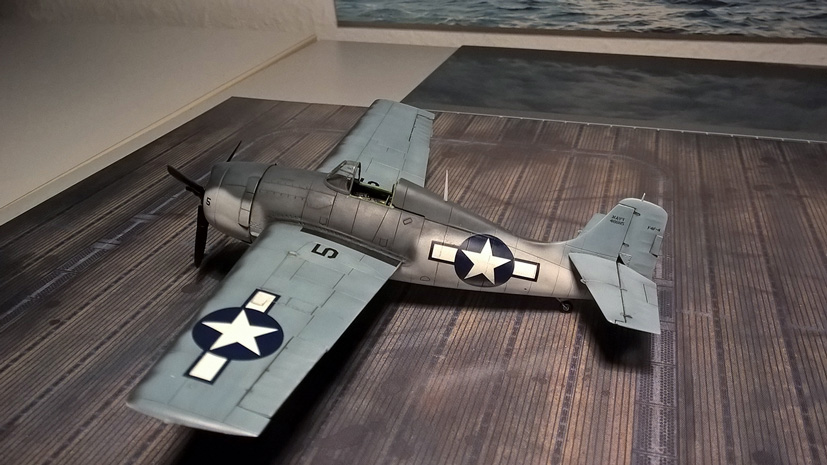
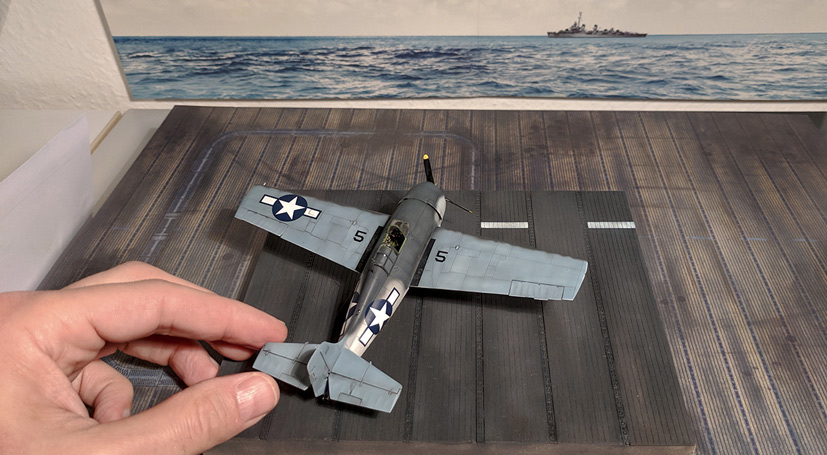
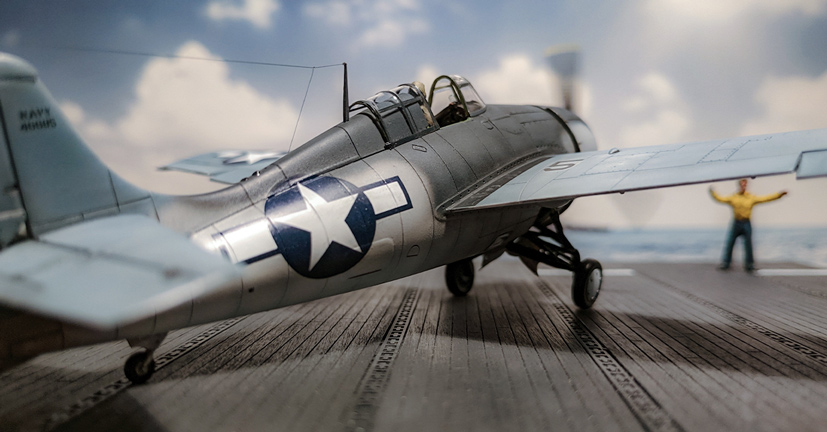
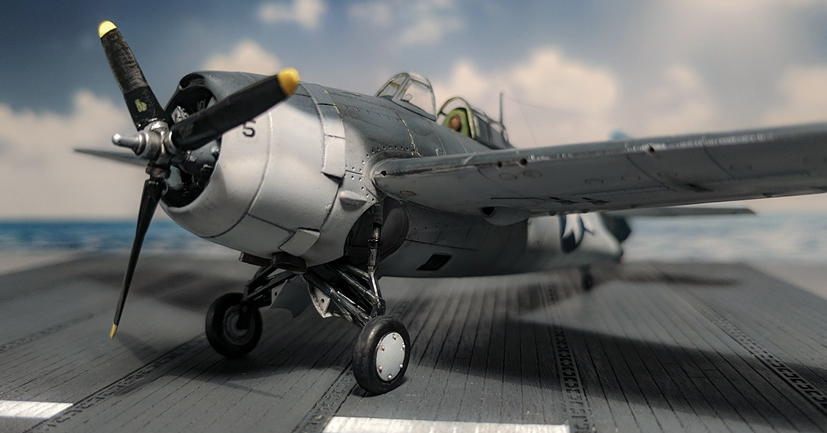
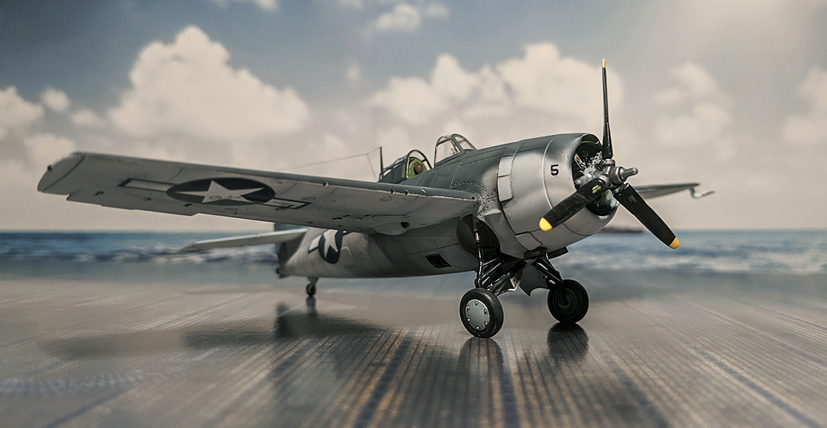
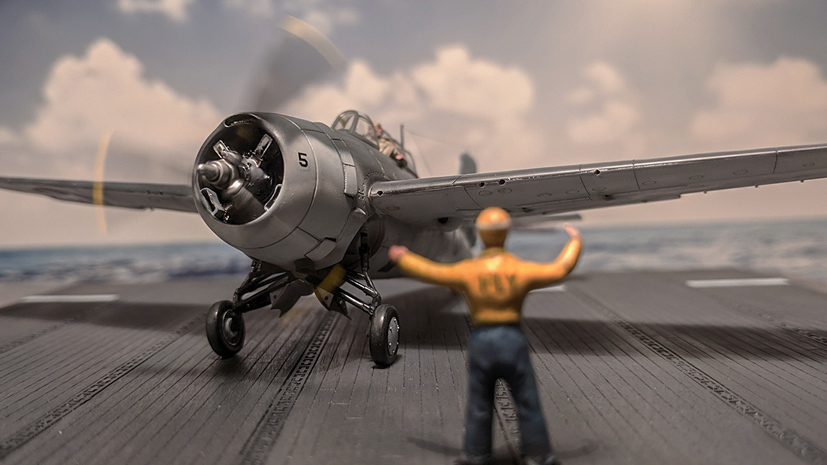
Andreas has managed to beautifully capture the rugged appearance of the diminutive Wildcat with his build, as well as showing how attractive the F4F actually was – it is deserving of much more attention than it usually gets. His photographic skills certainly bring the build to life and give the project real character, turning this from an impressive model build into something of an accurate historical representation – they almost look like they could have been taken on the deck of a US carrier. The scheme he decided to finish his model in is that of a Wildcat from VC-58 on board the US Escort Carrier (Baby Flattop) USS Block Island, which was engaged in Atlantic escort protection combat cruises from 1943 onwards.
It is important to add that Andreas used some additional after-market detail components during this build, which he enjoyed immensely – he told us that at least one more Wildcat will be flying off his workbench in the near future. We would like to thank Andreas for sending us this magnificent selection of images and for allowing us to share them with fellow Workbench readers.
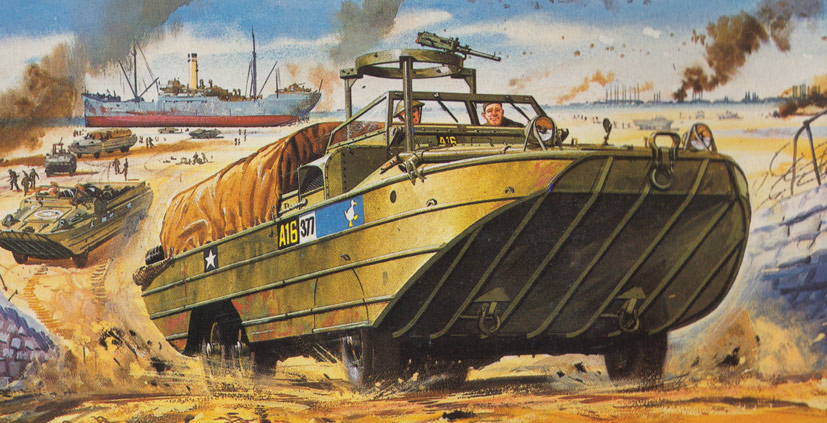
Serving as inspiration for many a model purchase over the years, the Airfix artwork which adorned kit boxes proved irresistible for millions of young modellers and the sight of these Vintage Classic releases brings back happy memories for many
In the previous edition of Workbench, we featured a quartet of nostalgic Vintage Classics aviation related model kits which are scheduled for imminent release and are destined to delight modellers who remember building these kits in their youth, as well as introducing a new generation to some of the classic kits of years past. In this latest blog, it is the turn of land warfare machines and a trio of scale military vehicle models which have all been involved in plenty of front room carpet ‘skirmishes’ over the years. The ability for armies to move men and equipment across the battlefield quickly and effectively is often the difference between victory or defeat and the Second World War would see many specialised vehicle developed for the purpose of battlefield domination, or the transportation of the weapons of war.
Even though tanks were the undisputed king of the battlefield during WWII, some of the most interesting vehicles of the Second World War did not have tracks, yet proved to be just as important in keeping any military advance moving. The Vintage Classics model range can boast several representations of such vehicles within its ranks, with tree due for imminent release.
As effective as tanks were at dominating the battlefield, getting them there was a different story altogether. Slow, heavy and incredibly fuel hungry, most were moved by rail, however, for more flexible, localised transportation of tanks, or the recovery of broken or damaged units, the tank transporter proved incredibly useful. Introduced before the start of WWII, the Scammell Tank Transporter was based on the 6X4 Pioneer tractor unit, an incredibly powerful vehicle which was ideally suited to military applications. Used both in Europe and the deserts of North Africa, the rather high fixed trailer of the unit was fine when transporting most British vehicles, however, the taller M3 Lee/Grant and M4 Sherman tanks produced by the Americans posed problems when negotiating bridges.
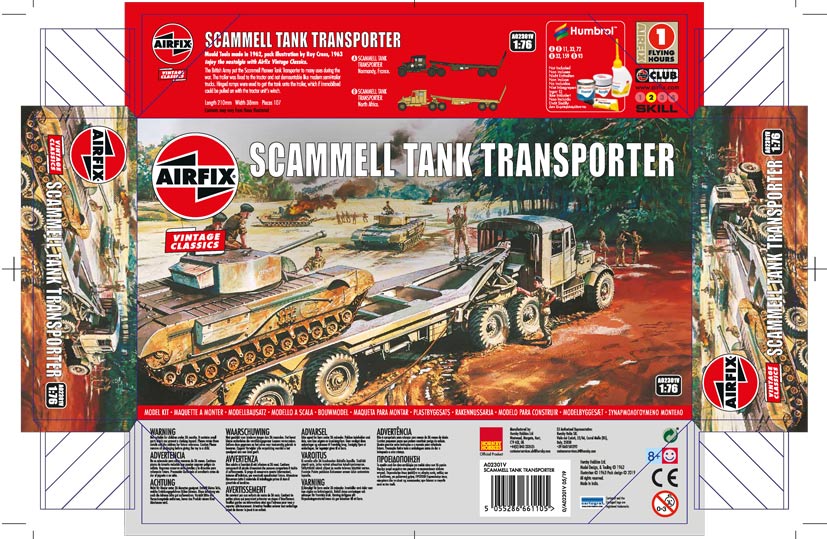
The box design of these impending military vehicle releases pay due respect to the classic artwork many Airfix modellers will be familiar with
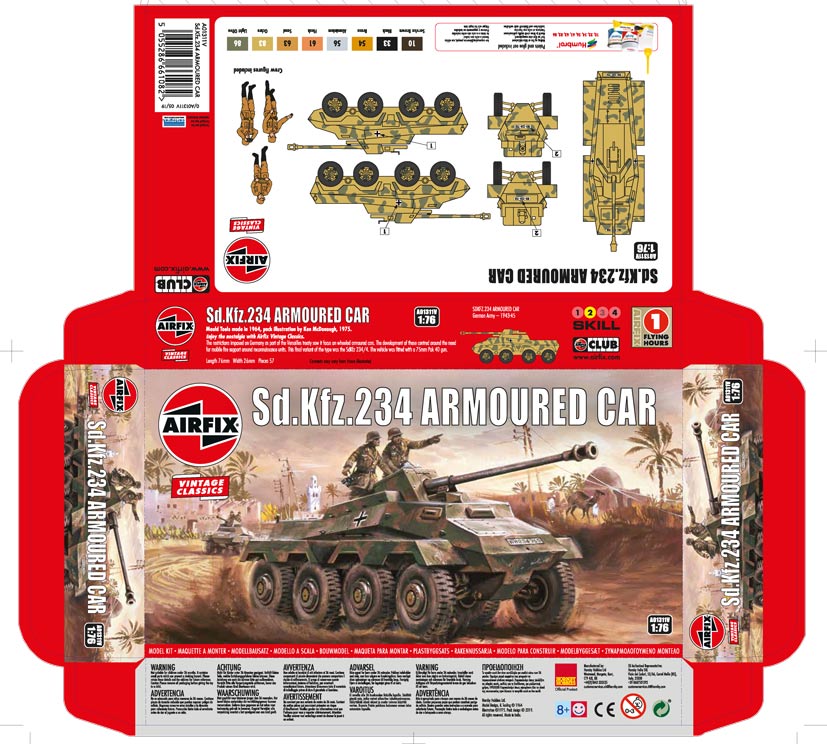
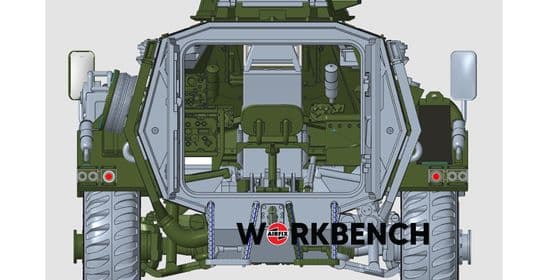
Illustrating Germany’s wartime search for the ideal blitzkrieg support vehicle, the Sd.Kfz (Special Purpose Vehicle) 234 series of eight wheeled armoured cars possessed the ability to travel at speed over any terrain and whilst only produced in relatively small numbers, was configured in four very different ways, each one based on the same chassis design. Featuring an innovative eight wheel steering mechanism, the Sd.Kfz.234 was initially produced with a small turret, which housed a 5 cm L/60 gun, however this was quickly replaced by an open topped version which proved much more effective in operation.
Other variants included an armoured car equipped with a short barrelled 7.5ch gun for infantry support duties and the version modelled here, which was a mobile anti-tank vehicle. Although this attractive armoured car was no match for Allied heavy armour, it was in production from 1943 until the end of the war and could be regularly found on the battlefields of Europe and the Eastern Front, where it used its impressive speed and mobility to report enemy ground movements to heavier armoured units behind.
Without doubt, the ingenious amphibious vehicles developed during WWII allowed the Allies a degree of armoured flexibility which was simply not available to Axis forces and offered the crucial ability to move men and equipment quickly and efficiently to and from the landing beachheads. Even though the six-wheel drive DUKW amphibious truck may have appeared somewhat ungainly and is often incorrectly dismissed as something of a military vehicle folly, this opinion could not be further from the truth. In addition to possessing a surprising level of general seaworthiness, the DUWK had exceptional on-road performance and would prove to be one of the most useful Allied vehicles following the successful D-Day landings.
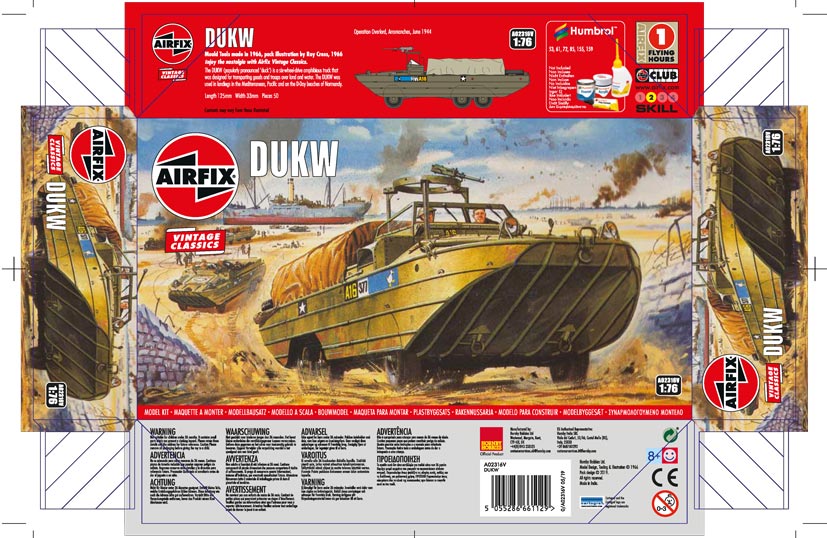
This trio of classic military vehicles are due to arrive in good model stores everywhere in the next few weeks and can still be pre-ordered on the Airfix website.

As we put the finishing touches to this latest blog, discussions amongst the Workbench team centred around how many of our readers we thought would head straight for this Telford section! Unfortunately, we have to tell you straight away that even though we would love to, we are unable to give you any clues as to what we have to tell everybody at Scale ModelWorld 2019, however, we can confirm that we will be making a BIG announcement. Since confirming this in our previous edition, social media and modelling websites have been rife with speculation regarding the subject matter for our new tooling and it will be interesting to revisit some of these suggestions following the announcement – we don’t have long to wait now.
For those readers who are unable to make it to Telford this year, or if the crowds around the Airfix stand are so large you can’t get a good spot, you will be pleased to hear that we have a contingency plan in place. The next edition of Workbench will be moving from its traditional Friday noon publication slot and will be delayed by 23 hours, to coincide with the planned new tooling announcement at Telford. Indeed, depending on how much tension our Brand Manager wants to create amongst the gathered masses, Workbench readers might actually find out before the official unveiling. Whatever the case, the next edition of Workbench will be published at 11am on Saturday 9th November and will include full details of the new model we will be announcing at Telford.
If you are intending to make the trip to the Scale ModelWorld show, please do come and say hello, not forgetting to mention you are a Workbench reader – it would be great to get your thoughts on the blog.
We are afraid that’s all we have for you in this latest edition of Workbench, however, we will be back as usual in two weeks’ time with a further selection of Airfix modelling delights for your enjoyment. If you have any suggestions for subjects you would like to see covered in a future edition, please use this workbench@airfix.com link to contact us.
In between new editions of our blog, the Airfix conversation continues over on our Airfix Forum Worbench thread, with further discussions taking place on both the official Airfix Facebook page and the Airfix Twitter channel - please do get involved in the discussions and let us know what you think about Workbench.
Whenever you decide to visit, the Airfix website is always the place to be for all the latest model availability information, previous editions of our blog, a selection of modelling tips and much more.
The next edition of Workbench is due to be published on Saturday 9th November at 11am Telford time, when we will have some BIG news to share with you.
On behalf of the entire Workbench team, thank you for your continued support our Airfix blog.
The Airfix Workbench Team
© Hornby Hobbies Ltd. All rights reserved.