

Welcome to this latest edition of our Workbench blog and all the news, updates, and modelling exclusives from the fascinating world of Airfix.
As we currently find ourselves on the cusp of actual modelling season, with the longer nights providing us with an excuse to spend much more time at our workstations, can you think of a better way of celebrating this than by announcing our latest 'secret' model release? On Wednesday this week, we announced details of just the third releases from our popular 1/72nd scale de Havilland Mosquito tooling, as the previously unannounced additions to the current range just keep on coming.
This new release announcement includes an additional frame of parts which allow several new Mosquito variant/ordnance options to be considered by the modeller, and in this latest edition of Workbench, we will be bringing you all the details you might need from this latest addition to the range. In a robust review, we have insights and development imagery direct from the kit designer’s computer, an impressive selection of built model images, and details behind the THREE new scheme options included with what’s sure to be a welcome addition to the range.
We’re spending time with the ‘Wooden Wonder’ in this latest edition of Workbench, or at least our scale plastic kit tribute to it.
The de Havilland Mosquito was one of the finest aircraft of the Second World War, but one which had to initially be developed as a private company venture.
For an aircraft which would go on to be regarded as one of the most capable of any type to take part in the Second World War, the initial development of the Mosquito proved to be something of a challenge for designers at de Havillands. Eventually posting performance which would leave all other aircraft in its wake, the fact that designers cleverly elected to use non-strategic materials in its construction, so as to leave existing fighter production unaffected almost backfired, as Air Ministry officials felt that this would be a step backwards in aviation technology terms. Nevertheless, Britain’s carpenters got to work, and the ‘Wooden Wonder’ would go on to become the British aircraft our enemies coveted most.
The aircraft we now know as the Mosquito was initially developed and tested as a private venture and as such, somewhat under the ‘official’ radar and therefore free from any interference from either the Luftwaffe, or the British Air Ministry. Taking place during the early stages of the Second World War, the de Havilland Company were fully committed at that time with either the repair of damaged aircraft, fitting the latest propellers to existing aircraft, or the construction of new Tiger Moths in support of RAF pilot training requirements. Indeed, with that being the case, it seemed as if they had little spare capacity with which to develop any new aircraft, let alone a radical high performance one.
The next series of images all feature CAD screenshots created during the development stage of this new Mosquito tooling addition, allowing modellers even more Mosquito variant choice.
In fact, this situation was so serious and war materials so precious, that the minister for aircraft production actually suggested that the D.H 98 project (which would go on to be the Mosquito) should be cancelled to allow the company to concentrate on their vital existing work commitments. Thankfully for the British war effort, this ‘opinion’ was not taken as a direct instruction by the de Havilland team, who simply moved this development part of their operation to a secluded location just 4 miles away from the main Hatfield site.
At Salisbury Hall, work on the new twin engined aircraft carried on in relative secrecy, something which would eventually allow the Mosquito to enter service much earlier than would have been the case had it been the subject of official scrutiny.
Once the new aircraft was ready for testing and was displayed for air ministry officials, the decision to proceed with its development proved to be fully justified, as de Havilland clearly had clearly created a very special aeroplane indeed. Possessing blistering performance and impressive handling characteristics, even at this early stage it was clear that their new aircraft had a big future ahead of it, and a now suitably impressed Air Ministry immediately placed an order for 150 aircraft.
Perhaps of even greater significance than this, they also placed a ‘priority status’ production requirement on the new Mosquito, meaning that it would now jump ahead of many aircraft currently in production. The fastest aircraft in the world at that time, the Mosquito would go on to prove to be something of an aviation phenomenon. Although initially intended to be used as a high speed bomber, Mosquitos would also operate as day and night fighters, pathfinders, night intruders, maritime strike and reconnaissance aircraft, because it would prove to be a true multi-role aircraft and a real war-winner in whichever role it was required to carry out.
Design screenshots showing some of the new parts which allow the target towing variant of the Mosquito to be modelled.
Once the first production aircraft started to reach Royal Air Force squadrons towards the end of 1941, the de Havilland Mosquito quickly showed itself to be one of the most valuable assets available to the force, an aircraft which was truly without equal. It would go on to serve with distinction for the remainder of the conflict.
Mosquitos would be used to shoot down V1 flying bombs, detect and photograph their launch sites, and fly pathfinder missions for bombers sent to obliterate those sites. Whether used in a bombing, fighter, strike or reconnaissance role, the Mosquito excelled, truly earning its nickname of the ‘Wooden Wonder’. Loved by RAF crews and loathed by Luftwaffe High Command, the Mosquito was unquestionably one of the great Allied aircraft of the Second World War, and absolute proof of the old adage that ‘If it looks right, it is right’ – the Mosquito was, and still is, extremely easy on the eye!
With several exciting Mosquito projects currently underway, and several new build Mosquitos already thrilling Airshow audiences around the world, how long will it be before one of these magnificent aircraft returns to British skies once more, something enthusiasts have been hoping for for many a long year now. One thing is absolutely certain, when that day arrives, the aircraft taking that honour will immediately be one of the most cherished aircraft to have ever appeared on the UK historic aircraft scene – we’re all excited to have a Mossie of our own!
Our latest kit ‘Secret Release’ presents the modeller with three new Mosquito scheme options to choose from.
For an aircraft which won so many wartime plaudits as the Mosquito did, its transition to becoming a scale model kit favourite was a seamless as it was predictable. From an Airfix perspective, that transition occurred in 1957 and in 1/72nd scale, but for many people for whom Airfix kits played a significant role in their lives, our association with the Mosquito probably came with the introduction with the Dogfight Doubles kit featuring the Mosquito. Even at that early stage, we all knew that two fantastic Airfix kits in the same box was always going to be better than one, and as this particular kit came with stunning Roy Cross box artwork, resistance was completely futile, we just had to have it.
In the case of this spectacular kit offering, many modellers pitted their steadily increasing modelling skills against this magnificent kit several times over the years, because it was just so appealing. As a standalone kit offering, the Mosquito was a perennial favourite in respective Airfix ranges, appearing many times over the years in different presentation guises, and coming in for new tooling attention in 1972 – the Mosquito just kept on selling.
As Airfix fans will be only too aware, classic kit subjects have regularly been selected for new tooling update over the years, as design and manufacturing technologies continue to advance, and we’re always looking to bring ever greater accuracy and detail to our kit range. In this regard, the Mosquito was very much on our radar and scheduled to come across the desk of one of our talented designers as something of a priority.
The new part frame includes a scale version of an RAF 4,000lb ‘Cookie’ bomb, something which is a significant feature of the third of the new scheme options.
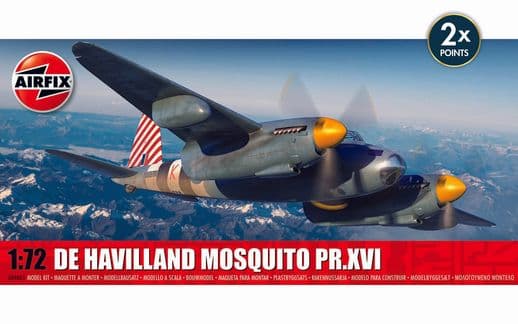
That project got underway in 2020, with the announcement of the new kit project’s existence being made with the launch of the 2021 Airfix kit range. Once again produced in the popular, some might say ‘traditional’ 1/72nd scale, the new Mosquito was initially introduced in late mark B.XVI bomber variant, but was followed in 2023 by a snooping PR.XVI Mosquito, which was employed on operations to discover all the secrets the Germans didn’t want the Allies to see.
As of 10am last Wednesday, we now have another Mosquito kit to consider, one which includes an additional frame of parts, and one which has made further interesting variants of this exceptional aeroplane to be modelled.
Once again, and in support of this latest ‘Secret Release’, we took the opportunity to speak with the designer assigned to this task, and we have a selection of exclusives which will hopefully be of interest to our readers.
We were told that this project was started after the release of the newly tooled Mosquito kit joined the range in 2021, and whilst it was initially intended to be a quick modification update to the existing tooling, it ended up being a more challenging, and more time consuming design task, one where he was asked to add additional features on a number of occasions. Something which was a short task intended to slip in between more robust new tooling design projects, this modification took him around five weeks to complete, with further periods needed for tooling and initial production shot assembly and checking.
The new part frame, and an exclusive first look at the tooling layout drawing designed in support of this Mosquito kit project.
Rather than using space in the existing tooling, this update required the production of a completely new tool, one which includes 21 new parts designed to add further options to the existing Mosquito kit, and additional parts to allow different variants of the Mosquito to be modelled, including both the B.35 and colourful Target Towing TT.35. Three new scheme options are included with this release, and with a 4000lb ‘Cookie’ bomb also included, this new release has to be considered quite a significant addition to the current range, and one which many will view as worthy of taking the latest ‘Secret Release’ spot.
The images featured above are all screenshots of development work carried out during the design phase of this additional Mosquito parts frame, one which is included in this third release from the 1/72nd scale Mosquito tooling, parts which allow different variants of this famous aircraft to be modelled. You will notice how they include both an image of the designer’s tooling layout, and a test frame produced from the tooling created from these files, details which are always so interesting for us modellers to see.
Let’s move on to look in a little more detail at the three new scheme options included with this recent ‘Secret’ Mosquito release.
With a heritage which goes back to the final year of the Great War and operation of the Bristol F2B Fighter, RAF No.139 (Jamaica) Squadron would fly its first missions of the Second World War using the Bristol Blenheim, an aircraft in which its pilots would have to endure plenty of adversity during the early stages of the conflict. With the purchase of aircraft supported by a Jamaican newspaper, the unit elected to adopt the nation in its title from 1940 onwards, as its crews fought valiantly against horrendous odds in taking the battle to the enemy.
The unit would be mauled at the hands of the Luftwaffe during the Battle of France, and when being sent to operate in the Far East later in the war, would suffer a similar fate at the hands of the Japanese in Burma. On returning to the UK, they would continue to use the Blenheim for a short while, before exchanging them for the de Havilland Mosquito, an aircraft they would use for the remainder of the war and into the port war era.
Initially mounting bombing raids into enemy occupied Europe, the unit would later become a specialist pathfinder unit, with its pilots helping to guide bombers to their targets for the remainder of the war.
Moving to the airfield at Hemswell in Lincolnshire, they operated the B.35 variant of the Mosquito from late 1948 until December 1953, an aircraft which was similar in configuration to the earlier B.XVI, but was powered by Rolls Royce Merlin 114 and 114A engines. Approximately 270 of this variant were eventually built, with the Mosquito coming towards the end of its development run. No.139 would eventually trade their Mosquitos for the English Electric Canberra, an aircraft which was itself something of an aviation classic.
This selection of images all feature a model finished in this lead scheme option of the three on offer.
The airfield at Hemswell would become inextricably linked with Bomber Command operations, and even though it was on the front line of the night air bombing fight against Germany, would also serve as the filming location for the ‘Night Bombers’ film documentary, which features actual raid footage from a Bomber Command attack against German targets. No.139 Squadron would mount more than 4,000 operational sorties during WWII, with more than 1,500 tons of ordnance leaving the bomb bays of their aircraft.
The airfield would later become a missile site and was selected as one of the airfields to be used by the new BAC TSR.2 strike aircraft once it entered RAF service, but as this was subsequently cancelled, so the need for the airfield disappeared, and like many others, was therefore earmarked for closure.
This beautifully presented Mosquito was actually the subject of some colour photographs taken around the time of this scheme change, the majority of which show it wearing her earlier natural metal colour scheme, carrying the fuselage codes XD-L, but retaining her smart red spinners. It does have to be said that even though the Mosquito has always been a looker, it looks particularly attractive in this presentation, and must have made for a handsome sight when operating in Lincolnshire skies.
Mosquito TK620 was the personal aircraft of Squadron Leader Rupert G.W. Oakley, a highly decorated RAF airman who it has been reported may have clocked up 1000 operational missions. This does seem to be rather a large figure, however, what isn’t in doubt is the fact that S/L Oakley continued to serve operationally well into the jet age, so you never know, this figure may be accurate.
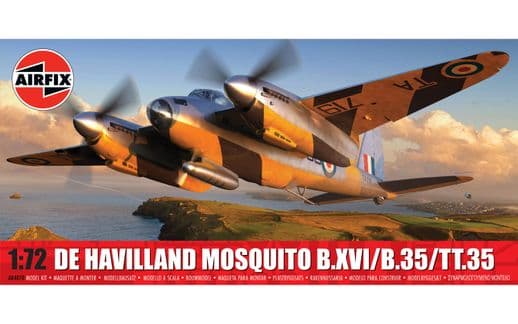
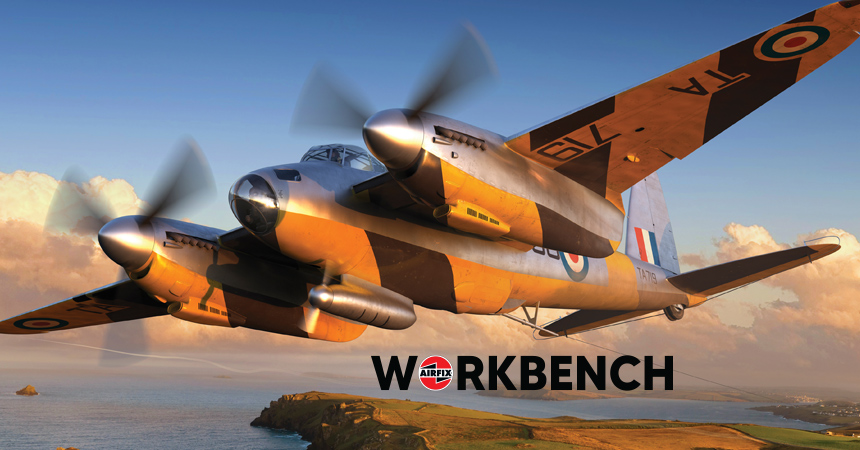
The stunning new box artwork features the TT.35 target towing variant of the Mosquito being presented in Airfix kit form for the first time.
Although this scheme option allows us to model the Mosquito in the unusual target towing configuration, and is quite flamboyantly presented as far as a British Mosquito goes, take a closer look at the aircraft itself. Whilst you will probably not associate this aircraft with one of the most famous films about de Havilland Mosquitos ever produced, if you are a UK based enthusiast, you will probably have seen this airframe many times over the years, that is if you’ve ever visited the IWM Museum at Duxford.
The Mosquito proved to be such a versatile aircraft that they would still be flying well into the jet age, with new and innovative uses for these impressive aircraft being found. Some of the final B.Mk.35 variant Mosquitos produced actually went straight into storage at RAF Shawbury, but would eventually find their way into service flying, courtesy of Brooklands Aviation Ltd. Based at Sywell airfield, they were contracted to convert the aircraft to Target Tug configuration, which included the fitting of target winch equipment, and a series of distinctive guides on the underside of the aircraft, which were intended to keep the target and towing wires away from the Mosquito’s airframe.
Initially, these aircraft were equipped with an ML Type G wind-driven winch, which whilst looking like a particularly impressive piece of kit, didn’t actually work all that well in practice. That being the case, many of the converted aircraft later received different, bomb bay mounted winch equipment, but not all of them.
The new Mosquito TT.35 will make for a fantastic build project, something just that little bit different.
These aircraft would receive taskings which saw them flying up and down the nation’s coastal firing ranges with their drogue target deployed behind them, allowing RAF fighter units to practice their air interception and targeting skills, hopefully with the distinctively marked Mosquito staying well out of the firing line. These aircraft would be operated by an unusual unit based down at Exeter Airport, the No.3 Civilian Anti-Aircraft Co-operation Unit, something of a hybrid unit which was established with help from the British military, but run as a civilian operation. They were manned by a great many crews who had previous RAF experience, but not exclusively.
Thanks to the impressive operational range of the Mosquito, these aircraft could fly from their base in Exeter to the north of Scotland to undertake a tasking with ease, taskings which may involve serving as a raid target for radar operators, being a moving target for Army anti-aircraft batteries, or mounting simulated attacks against Royal Navy vessels, with the agility of the Mosquito keeping everyone on their toes.
Mosquito TA719 was built as a B.35 variant at Hatfield in June 1945, but was delivered straight into store. She would remain in storage with several different units until she was flown to Sywell airfield in the middle of August 1953, where she underwent conversion to Target Tug configuration by airfield based Brooklands Aviation Ltd. She first saw service in this role with No.4 CAACU, but would be allocated to No.3 CAACU at the end of June 1954. She would remain in service here wearing the fuselage number Black 56 until she was retired at the end of March 1963.
After such a pedestrian start to her service career, TA719 was in no mood to go back into storage, and was flown to Bovingdon to be one of the aircraft used during the filming of the famous Mosquito movie 633 Squadron, where she was given the codes HT-G and serial HJ898. She would be used extensively during the filming, turning out to be quite the performer.
On completion of the filming, the aircraft was acquired by the Skyframe Museum, who planned to keep her in airworthy condition, however, a deadstick landing at Staverton in July 1964 put an end to such thoughts, as she suffered quite significant structural damage. Temporary repairs were subsequently made which allowed her to once again spend time in front of the camera, this time in the making of the movie Mosquito Squadron, however, part of her role involved the aircraft being used to simulate a crash landing, causing further damage to the airframe.
With the closure of the Skyframe Museum in 1978, an uncertain future for TA719 was avoided by moving her to IWM Duxford, where she would undergo repairs to bring her back to as close to her TT.35 configuration as possible, and to public display standard. Displayed for many years looking resplendent on her undercarriage, she will probably be best known by Workbench readers as the Mosquito which hangs from the roof girders at Duxford’s Airspace building, a high profile and extremely attractive example of this magnificent British aircraft.
Originally conceived as a high speed bomber for the Royal Air Force, the final major bomber variant of the de Havilland Mosquito was the B.XVI, with deliveries to front line squadrons taking place during 1944. This aircraft was a development of the earlier B.IX variant, one which had been optimised for high altitude operation by featuring the addition of a new pressurised cabin. Another unarmed version of the Mosquito, the B.XVI could carry a 3,000lb bomb load, however, all but the first 12 aircraft from a total production run of 402 machines underwent modification to allow a 4,000lb ‘Cookie’ or blockbuster bomb to be carried internally, a weapon which possessed devastating destructive capability.
Combining the power of these devastating weapons with the legendary speed and bombing accuracy associated with Mosquito operations, allowed Bomber Command to keep the pressure up on the enemy throughout the latter stages of Second World War. Interestingly, these huge bombs were exactly four times the weight of the original bomb load this exceptional aircraft was designed to carry, which further underlines the strength of the Mosquito’s laminated wood construction techniques.
It's also interesting to note that an RAF Mosquito could carry the same combat bomb load as a Boeing B-17 Flying Fortress taking part in a long-range bombing raid, but much faster and over a greater operating distance. The Mosquito really was an exceptional aeroplane.
RAF No.128 Squadron reformed at Wyton in Cambridgeshire on 5th September, equipped with the de Havilland Mosquito and assigned to Bomber Command Light Night Striking Force duties. They were tasked with flying night intruder bombing missions deep into Germany, spreading panic and confusion amongst the enemy, as they appeared to be able to attack any target within the country, with Luftwaffe night defences seemingly incapable of doing anything about the situation.
This RAF Mosquito Mk.XVI bomber features fascinating non-standard fuselage codes, and was one of the many examples of this variant able to carry the 4,000lb ‘Cookie’ blockbuster bomb.
This particular aircraft (MM199) was initially delivered to No.105 Squadron at Bourne in early November 1944, but transferred to No.128 Squadron at Wyton just two weeks later. She was the subject of a famous wartime photograph which shows her with bomb bay doors open and ready to receive her latest load for delivery over the Third Reich. In front of the aircraft, three RAF armourers are seen pushing a 4,000lb ‘Cookie’ bomb on its trolley towards the Mosquito, with the words ‘Happy Xmas Adolf’ chalked across it. Clearly, this dates the picture around Christmastime 1944.
This aircraft would be lost whilst taking part in a bombing mission against Hannover on 5th February 1945, having taken off from Wyton at 6.06 in the evening. She was hit by flak over the target area and came down on land near the town of Ronnenberg, with both crew members tragically lost as a result.
This Mosquito had completed 29 operational sorties with No.128 Squadron, with seven of these being to the German capital, with just two mission aborts. Although ultimately a tragic story, she does illustrate just how effective the Mosquito was in taking the war, and helping to achieve victory over the enemy, capable of performing several different roles as if the aircraft had been designed from the outset to undertake them. A true multi-role aircraft, the de Havilland Mosquito has to be considered one of the finest warplanes in the history of aerial warfare, and unquestionably, one of Britain’s greatest aircraft.
The secret’s out, and our latest de Havilland Mosquito kit is now revealed and available.
With new parts allowing different variants of the Mosquito to be built and with three appealing scheme options to choose from, this latest 1/72nd scale de Havilland Mosquito kit release will hopefully be seen as a valuable addition to the range, and a continuation of an Airfix kit story which goes all the way back to that first Mosquito kit release back in 1957.
In addition to this, we’re delighted to say that there’s no waiting around for this beauty, as you can get your hand on one right now – the new Mosquito is already in stock and available.
So, there you have it, our secret Mosquito release is secret no more. Just a little kit something we had up our sleeves to brighten these longer, darker nights for everyone.
We're afraid that's all we have for you in this latest edition of the Airfix blog, but we will be back next Friday with more project development updates and the very latest Airfix kit exclusives. In the meantime, we're always keen to hear your views on all things Airfix and in particular, any thoughts and opinions you may have regarding our Workbench blog. If you would like to drop us a quick line, could we please ask that you use our workbench@airfix.com email for all correspondence.
To re-visit any of the Airfix blogs we have produced over the past TEN years or so, please head to our main Workbench hub, where you'll find our entire blog back catalogue and all the Airfix design projects we have already covered.
All our dedicated official social media sites can be accessed by clicking the respective link icons at the foot of this page, or by heading to the Airfix homepage. Other useful Airfix links are:
Facebook, YouTube, Twitter and Instagram official sites
Please join us for more Airfix updates next week and thank you for your continued support.