
Welcome to the latest edition of our weekly Workbench blog, and all the news, updates, and modelling exclusives from the fascinating world of Airfix.
When it comes to important dates in the history of aviation, there can be few which command the significance of the one which took place on an airfield near Southampton 90 years ago today, so important in fact that it requires the early publication of this week’s edition of Workbench.
When a select number of people gathered at Eastleigh Aerodrome on 5th March 1936, they had done so to help facilitate, or possibly to document, the first flight of a new single seat fighter aircraft designed and constructed by the Supermarine company. What none of them could have realised, however, was that when they saw that rather tatty looking Supermarine Type 300 aircraft taking to the air for what proved to be a short eight minute maiden flight that day, they would all be witnesses to the birth of an aviation legend, an aircraft type which would still be flying in some numbers 90 years later, and one which would come to symbolise Britain’s defiance in the face of staggering adversity. Was it actually possible for an aeroplane to do that? The Spitfire certainly could.
In this latest, rather special edition of Workbench, we will be paying our own blog tribute to the maiden flight of the Supermarine Type 300, but rather than following suit with the multitude of other articles scheduled to be published on this subject over the coming few days, we will be taking ours in a rather personal direction, our enduring scale association with the magnificent Spitfire. In fact, it happens to be our opinion that no group has made more Spitfires than Airfix modellers over the years, and that’s not a bad place for us to start.
The 5th March 1936 witnessed the first flight of an aircraft which would go on to become an aviation icon, arguably the most famous aircraft to have ever taken to the skies.
As arguably the most recognisable aircraft in the history of flight, and a name which has become familiar to countless millions of people across the world over the years, there is an argument for claiming that the Supermarine Spitfire was destined for success from the moment the Supermarine design office decided to put pencil to paper, during the first half of the 1930s. Heralding from a long line of incredibly successful racing seaplanes which were the brainchild of Supermarine’s genius Chief Designer Reginald Joseph Mitchell, these aircraft were sponsored by the Air Ministry (initially at least), to capture the coveted Schneider Trophy for Britain, and show the world that the nation was at the forefront of world aircraft design and production.
At a time when the aviation world was still dominated by biplane designs, Mitchell held the strong opinion that future high speed flight would require strong, but relatively diminutive monoplane designs which would be married with the latest and most powerful engine technology available, with his S.4 being the initial embodiment of this philosophy. Bred for speed, the S.4 was a truly futuristic looking machine powered by a 700 hp Napier Lion engine, however, whilst showing great potential at the 1925 Schnieder Trophy competition in the US, the aircraft crashed into the sea during one of its runs.
Convinced he was on the right track, Mitchell continued to modify and perfect the design of the S.4, using ever more powerful engines and pilots from the RAF’s High Speed Flight in subsequent competitions. During the 1927 competition, Mitchell delivered for the nation, as his Supermarine S.5 design took first and second place in Venice, with the winning aircraft setting an average speed mark of 281.65 mph.
The competing nations agreed that the trophy would be contested every two years from that point forwards, but there was no let-up in the pace of development for the next competition. Mitchell continued to refine his design, however, engine technology was still at the forefront of his thinking. After a fatal S.5 crash during testing and the performance increases only proving to be relatively modest, he felt the limitations of the Napier engine were now impeding the project’s progress. He approached Rolls-Royce to adapt their new 37 litre ‘R’ engine for use in his racing seaplane, a powerplant which was capable of producing over 1,900 horsepower.
At the 1929 competition, Mitchell and Supermarine emerged victorious once again, as his redesigned S.6A won by posting an average speed of 328.6 mph. In the same aircraft just a few days later, Squadron Leader A.H. Orlebar captured the world speed record, by taking his S.6A to an impressive 357.7 mph. Now the pressure was really on – if Mitchell and his seaplane could prevail at the 1931 competition, the Schneider Trophy would be Britain’s outright, a significant achievement for him and the nation.
Bred for speed, the Supermarine S.6B enabled Britain to claim the Schneider Trophy outright for the first time, and start its parent company on a journey which would result in the production of the most famous aircraft in the history of aviation.
Incredibly, despite the stakes being so high for Supermarine, the Air Ministry chose not to sponsor Mitchell’s bid for glory at the 1931 competition, however, an extremely wealthy benefactor would pledge the £100,000 figure required to allow Britain’s attempt to take place, a figure which represents over £7 Million in today’s money. The Supermarine racer for this completion had undergone quite significant modification to accept the increased size of the latest Rolls-Royce ‘R’ series engine, which was now producing 2300hp and resulted in a further change in aircraft variant reference to S.6B.
Both Italy and France had indicated their intention to compete in this latest competition, with both nations hoping to unveil powerful and technologically advanced racers they hoped would stop the British in their tracks. In fact, one of the Italian aircraft was powered by a double-length 50 litre engine which was driving contra rotating propellers, however, in the end, both nations pulled out prior to sending aircraft to Britain. All Mitchell and the Supermarine S.6B had to do now was to take to the air and set a mark which didn’t breach the rules to take the trophy outright.
With tens of thousands of excited spectators lining the course on the Isle of Wight, the 13th of September 1931 would certainly turn out to be a significant day for British aviation. With almost perfect conditions, the first run of the day saw the Supermarine S.6B set an average speed mark of 340.08 mph and the Schneider Trophy was Britain’s outright, the first time a nation had done so in the 18 year history of this internationally contested aviation competition. Not content with this, in the afternoon of that same day, Wing Commander George Stainforth took his S.6B into the air and set a new absolute world speed record of 379.05 mph. By the end of the month, the same aircraft and pilot combination had made more history, by setting a new speed record of 407.5 mph, thus making him the first man in history to exceed 400 mph.
Supermarine and Britain were riding the crest of an aviation wave, with the development of their racing seaplanes providing plenty of information relating to high speed flight to support future development. As famous as the S series racing seaplanes now were, there was much more to come from Supermarine, and an aircraft which would quite literally eclipse all others.
The birth of a legend. When Supermarine Chief Test pilot Joseph 'Mutt' Summers took off from Eastleigh Aerodrome at 4.35 in the afternoon on Thursday 5th March 1936, he could hardly have known the place he would be taking in world aviation history. Image credit Air Historical Branch-RAF/MOD.
Despite the stunning success R.J Mitchell and the Supermarine team enjoyed with their Scheider Trophy winning seaplanes during the 1920s and 30s, the journey from the S.6B to the Spitfire would not be without its challenges, however, just as Mitchell had been convinced about this design philosophies when challenging for the Scheider Trophy, so he was equally convinced about his advanced fighter design for the Royal Air Force.
When the team charged with designing and producing a cutting-edge new fighter aircraft to defend Britain’s airspace during the mid 1930s set about their task, none of them could have imagined that they would be playing their part in also creating an aviation phenomenon which would still be a familiar sight to millions of people almost a century later. They did have access to extensive knowledge in the design and production of world leading racing aeroplanes, but what they were working on was a new monoplane fighter the like of which had never previously been seen, a genuine technological leap forward in aviation terms.
Despite all the many accolades the Supermarine Spitfire would subsequently capture, its development was essentially born out of the failure of its immediate predecessor, an aircraft which does possess more than a few visual similarities to the Spitfire, but ultimately served only as a technological stepping stone on the way to aviation greatness, the Supermarine Type 224. Developed in response to an RAF specification requirement for a new day fighter, the Type 224 may have been powered by the latest Rolls-Royce Goshawk II engine, however, its ungainly looking fixed spatted undercarriage and gull wing arrangement only allowed the aircraft to post relatively modest performance marks during trials.
In fact, the Type 224 wasn’t that great an aeroplane, despite the many hours of development work Mitchell and his team lavished on it, and could even be described as something of a missed step for Supermarine. Not particularly pleasing on the eye, the fighter employed an extremely complicated engine cooling system and would prove incredible challenging for a pilot to land, with this monoplane type eventually loosing out to the biplane Gloster Gladiator.
Thankfully, this knock-back only served to re-double the efforts of the Supermarine design team, who broke away from the constraints of Air Ministry requirements, and started work privately on a fighter design they felt could present the RAF with a world leading new aircraft. Political tensions in Europe at that time would provide another opportunity for Mitchell and Supermarine, with that story going on to be the stuff of aviation legend.
Construction work on the new Supermarine Type 300 fighter had started towards the end of 1934, but as the design made use of advanced materials and construction techniques, this was very much a hand-made, one-off aeroplane. When the new fighter (F37/34) was rolled out of the Supermarine factory at Eastleigh prior to making its first flight, it looked truly magnificent, a sleek monoplane fighter which could have hardly looked more different from the Gauntlet and Gladiator fighters which were now in service with the Royal Air Force. At that time, the aircraft was unpainted, other than the application of RAF roundels and the serial K5054, with the various shades of natural metal panelling making it look still rather unfinished – the undercarriage doors had not been attached at that stage.
When Supermarine's chief test pilot Joseph 'Mutt' Summers took off from Eastleigh Aerodrome at 4.35 in the afternoon on Thursday 5th March 1936 in the company's new Type 300 fighter (the fledgling Spitfire), he not only captured the undivided attention of the nation’s media gathered on the airfield that day, he was also embarking on his own association with an aircraft which at that time, he could have hardly known would not only become a commercial success for his company, but also one of the greatest fighting aeroplanes of all time.
What this day would all lead to. The introduction of arguably the most famous fighting aeroplane in the history of flight, one which would inspire a nation and its Commonwealth to victory.
A sleek and powerful new monoplane fighter, the Supermarine Type 300 represented the pinnacle of British aviation prowess at that time, featuring thin elliptical wings, retractable undercarriage and enclosed cockpit. Powered by the latest Rolls Royce aero engine, the Supermarine fighter was bred for speed, but whilst slipping through the air at these impressive speeds, had been designed to allow multiple machine guns to be fitted in that thin wing, making this a deadly dominator of the skies.
Similar to the Hawker Hurricane in many respects, where the Hurricane incorporated many traditional techniques in its design and construction, the all-metal Type 300 was unquestionably cutting edge, however, during the summer of 1940, Britain was glad they could rely on the capabilities of both.
During a brief eight-minute maiden flight, where the main undercarriage wasn’t even retracted, and under the full gaze of the nation’s media, when test pilot Mutt Summers landed back at Eastleigh and taxied back to his handling team, it was reputed that he barked, ‘I don’t want anything touched’, so pleased was he with the performance of the aircraft, or so history would have us believe.
It’s never been definitively ascertained what he actually meant by this now famous statement, but as the Spitfire went on to become such an aviation icon and possessed such stellar performance, should we even allow the truth to get in the way of a great Spitfire story?
What followed over the next few months was an exhaustive period of testing, perfecting and refining of the new aircraft, where the Supermarine team not only attempted to coax every ounce of performance from their new fighter, but also prepare it for mass production and its subsequent acceptance into Royal Air Force service. This would see K5054 change significantly over the next months, as she was not only fine-tuned, but also prepared for life as a front line fighter aircraft, with the installation of guns, ammunition and other military equipment.
Actually, it’s as good job the Spitfire managed to live up to the high expectations placed upon it, because the RAF placed an order for 310 fighters prior to the first flight of the prototype aircraft, so desperate was their need for the new fighter. Prior to her official presentation, prototype K5054 would be painted in a smart high-gloss blue/green finish, one which was subsequently replaced with the high-gloss ‘French Grey’ scheme which is so famously associated with this historic aircraft. As the Spitfire neared service entry, she received a further paint presentation change, this time to the standard RAF camouflage of the day, a very different look for this hardworking aircraft.
This only Spitfire prototype would eventually be developed to near operational fighter specification, but would be written off in an unfortunate fatal accident on 4th September 1939 at RAE Farnborough, the day after Britain had declared war against Germany. By this time though, eleven squadrons of Spitfires were in service with the Royal Air Force.
Just to complete the story of the Spitfire’s initial entry into service, the Air Ministry were so frustrated by the initial pedestrian rate of production of their new fighter, that they genuinely considered halting the program, reverting to just building more Hurricanes. Thankfully, Supermarine officials managed to convince them otherwise, with the promise of new production facilities and a streamlined production process.
The rest, as they say, is the stuff of aviation legend.
Before we move on though, let’s pause for a moment to look at some of the myths, legends and more unusual facts associated with the Spitfire and indeed, the first flight of the Supermarine Type 300.
Firstly, let’s take a look at the date of that first flight itself. Over the years, there have been several authors and commentators who claimed that the historic first flight of the Type 300 actually took place on 6th March 1936, remaining steadfast in their conviction to this day, however, as far as the majority of learned opinion is concerned, the previous day saw the first flight of the Spitfire.
What’s a day between such a significant aircraft’s birth date?
Next, we move on to the famous words uttered by Joseph ‘Mutt’ Summers following the completion of that first eight minute test flight. His comment, “I don’t want anything touched”, is often interpreted as the performance of the aircraft being so perfect that he didn’t want anything changed, but was that actually the case?
During the flight, even though he didn’t retract the main undercarriage, he did check many of the aircraft’s systems and cycle the flaps, and this was just the first of several planned flights for that day. Perhaps it was more likely that he was happy with his work to that point, and simply wanted to begin the next flight with exactly the same settings, with the word ‘perfection’ probably never even entering his head.
Next, we move on to the Spitfire’s famous elliptical wing, and how it may have been able to trace its origins to a German design. As the first Canadian to graduate from a Canadian University with a master’s degree in aeronautics, Supermarine’s Aerodynamicist Beverley Shenstone was an extremely talented man, and having spent time working in Germany with several leading manufacturing companies, he knew quite early on in the project that the new Supermarine fighter’s wings were going to need to be strong, packed with equipment and also house the main undercarriage.
That being the case, he knew that an elliptical wing would provide everything he needed in overcoming these design compromises, whilst still endowing the fighter with exceptional performance. Indeed, if you look closely at the wing of a Heinkel He-III, or the earlier He-70 Blitz, you will see that a Spitfire’s wing shares more than a passing resemblance to both.
The Heinkel He-70 Blitz featured an elliptical wing that was decidedly ‘Spitfire-like’.
Finally, we come to the subject of the name of the aircraft itself. Although the Spitfire would go on to become arguably the most famous aircraft to ever take to the skies, there was just a possibility that it may have been known by a very different name, one which may have proved much less iconic. When board members discussed the subject at the Supermarine works, they were invited to think of names beginning with ‘S’, as it was thought that this would create a hissing sound to the name.
The front-runner, and the name favoured by Mitchell himself was Shrew, however, other suggestions such as Scarab, Serpent and Shrike were also considered. Thankfully, Vickers-Armstrong Chairman Sir Robert MacLean would have the deciding vote, and he wanted to go with the affectionate nickname he used with his eldest daughter, who, being described as a spirited girl, was known as his ‘little spitfire’.
Despite initial official misgivings, the name stuck and the Type 300 was duly named ‘Spitfire’ on 28th July 1936, although it does have to be placed on record that RJ Mitchell thought it was a damned silly name for his new fighter.
The first Spitfires to enter RAF service marked the high-point of RAF expansion, but could Supermarine produce enough of them before they were engulfed in the flames of war?
As the world is now only too aware, but have everything reaffirmed over the coming few days, the Supermarine Type 300 was soon to become the Spitfire, the aviation name on everybody’s lips during the late 1930s, and with it, embarked on a glittering service career which began with delivery of the first production aircraft to RAF No.19 Squadron at Duxford on 4th August 1938. Spitfire Mk.I K9789 was delivered by Supermarine’s Chief Test Pilot Jeffrey Quill, and whilst this was a significant development in the history of British aviation, the complexity of the Spitfire in production meant that this was a full year later than originally anticipated.
At that time, No.19 Squadron were operating the RAF’s current front line fighter aircraft, the Gloster Gauntlet biplane and as the first Spitfire touched down on the grass airstrip at Duxford, those pilots who had not seen a Spitfire before, including the Auxiliary Force pilots of No.616 Squadron who were on their summer camp at that time, must have marvelled at this this thing of aviation beauty, if secretly also being slightly petrified at the prospect of taking one into the air themselves – it was just so different to any other aircraft they had seen.
No.19 Squadron would receive further Spitfires at a rate of approximately one new aircraft each week until taking the notable accolade of becoming the first operational Squadron in the Royal Air Force to be equipped with this incredible new fighter aircraft. As already mentioned, they had previously been operating the Gloster Gauntlet biplane fighter and whilst this was an extremely capable fighting aeroplane in its own right, it could hardly have been more different to a Spitfire. This biplane fighter featured an open cockpit, fixed undercarriage and a radial engine which propelled the fighter to a then impressive 230 mph.
The new Spitfire was a sleek, fast monoplane design, with a fully enclosed cockpit, retractable undercarriage and eight wing mounted machine guns. Significantly, it was over 130 mph faster than their previous fighter, representing a quantum leap in aviation performance terms, and posing more than a few challenges for the unit’s young pilots who would soon be converting to the Spitfire. Incredibly, despite the fact that the Spitfire represented a significant challenge for Duxford’s young pilots, that subsequent conversion proved extremely efficient with very few incidents. Indeed, the first accidental loss of a new fighter only occurred on 20th September 1938.
By the outbreak of war, it’s estimated that the RAF had just over 300 Spitfires in service, with around 70 held in reserve and over 2,000 machines still on order. An aircraft which was a sight to behold and too attractive to be sullied by the horrors of war, the Spitfire would prove as deadly as it was beautiful and would be instrumental in defending Britain in her darkest hour of need.
A case of constant development and upgrade
The first Spitfires to enter Royal Air Force service were subjected to almost constant upgrade, as they were prepared to be as ‘combat ready’ as they possibly could.
Following the service introduction of the first Spitfires, the aircraft would benefit from a host of modifications and improvements not only throughout its subsequent production run, but also retrospectively to those aircraft already in service. The changes were all intended to make the aircraft more combat capable and to wring every last ounce of speed from the fighter’s Merlin engine, which was similarly subjected to constant development.
The first Spitfires arriving at RAF Duxford in August 1938 were fitted with a twin-bladed fixed pitch propeller made of wood, a unit which whilst being effective, was a unit which limited the performance of the Merlin engine, in the same way that fitting a bicycle with just a single gear is less than ideal. From around the 80th production aircraft onwards, this first propeller was exchanged for a de Havilland three bladed, two pitch (position) propeller, which significantly enhanced the performance of the aircraft. This essentially allowed the aircraft to be configured for the challenging landing and take-off phases of flight, but then once in the air and increasing speed, alter the propeller pitch to obtain maximum performance from the engine.
Modifications were not just directed towards the performance of the fighter, but also to more effective operation of the Spitfire in general service/combat situations. The original ‘flat’ canopy which was a feature of the first Spitfires was replaced with a taller canopy, one which also featured ‘blown’ sides to allow for much improved visibility for the pilot. Later still, a quick release mechanism was introduced to the canopy design, making it easier for a pilot to exit the fighter in case of emergency. Initially a manual and bespoke modification, many pilots fitted a car mirror to the canopy frame in an attempt to give them some rearward vision when engaged in aerial combat.
When the aircraft was operating at higher altitudes, it was discovered that the Spitfire’s guns tended to freeze due to condensation, so small heaters were subsequently installed in the wings, and gun port openings were covered with fabric patches prior to each sortie, something which prevented any debris being ingested into the guns prior to them being fired. It was also discovered that early Spitfires were vulnerable to sustaining damage from even small calibre ammunition, and if struck in a vital component, would immediately be out of action. Further upgrades addressed this vulnerability, with the fitting of an armoured windscreen and additional armour protection for the engine, fuel tanks and pilot, along with a self-sealing coating for the fuel tanks.
Ooh La La – A model finished in the markings of the only Spitfire specifically built for the French Armée de I’Air.
Later production Mk.I Spitfires were supplied with the Rolls Royce Merlin III powerplant, a three bladed de Havilland constant speed propeller and even greater armour protection for the pilot, however, there was still one aspect of the Spitfire’s combat performance where it lagged behind that of its Luftwaffe adversary, and that was firepower. The Messerschmitt Bf 109E was equipped with a powerful 20mm cannon and in most cases, a single hit from one of these shells was enough to bring down any British fighter, even one which benefitted from all the latest armour modifications.
In order to redress this firepower imbalance, a number of Spitfires were equipped with a pair of wing mounted Hispano 20mm cannons and a reduced armament of four Browning .303 machine guns. Whilst this should have given cannon armed Spitfires a combat advantage, operation of the more powerful guns proved to be extremely problematic, with the guns constantly jamming, and when they did, leaving that Spitfire with just a reduced number of standard machine guns in combat situations. The poor performance of these heavier calibre guns proved so dire that some pilots refused to fly the cannon armed Spitfires, insisting that ground crews restore the original armament configuration of their fighters.
These concerns were immediately relayed back to Vickers Supermarine and the situation proved serious enough to halt production of cannon armed Spitfires until a solution could be found, with ‘working’ cannon armed Spitfires only entering squadron service in late 1940.
Eighty-six years later and at least 60 examples of this incredible aircraft are still flying across the world, with newly restored examples joining their ranks with each passing year, including Spitfires built especially for two. Not bad for a scruffy little prototype fighter in natural metal which made its first flight 90 years ago today.
Airfix have secured a proud reputation in helping to preserve the enduring heritage of this most famous fighting aeroplane.
As we mark today’s significant aviation anniversary, only Airfix can claim to have such an incredible association with the Spitfire, one which can trace its own origins back 70 years or so, and one which has seen Airfix modelling enthusiasts building more Spitfires than anyone else during that time.
With our tooling inventory heritage boasting many a Spitfire kit in various different marks and scales within it, no Airfix catalogue, or contemporary range launch, would ever be considered complete without at least a couple of Spitfire kits making up its number, and we’re delighted to say that this proud association continues to be something of a hobby phenomenon.
Wishing to include something just that little bit different for Spitfire 90, we have elected to include a visual antecedence of Airfix Spitfire box artwork imagery next, starting with the earliest marks, right through to the last. A Spitfire tribute which is unique to us here at Airfix, we will be restricting our selection to those kits featuring in the current range, and just one of each currently available variant. We hope it meets with your approval, and hope you think this a fitting way in which to mark this week’s historic anniversary – Chocks Away!
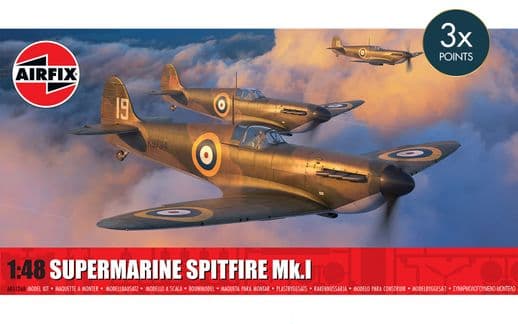
A05126B – Supermarine Spitfire Mk.I
A01071C – Supermarine Spitfire Mk.Ia
A05125A – Supermarine Spitfire Mk.Vb
A02108A – Supermarine Spitfire Mk.Vc
A17001A – Supermarine Spitfire Mk.IXc Flying Dray
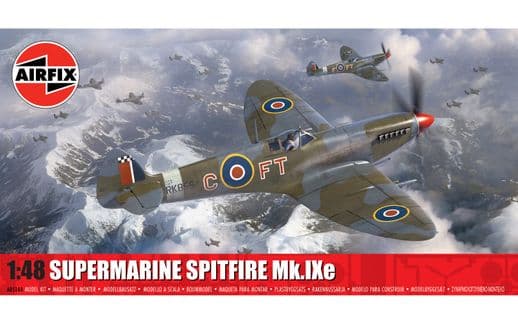
A05144 – Supermarine Spitfire Mk.IXe
A05140 – Supermarine Spitfire F Mk.XVIII
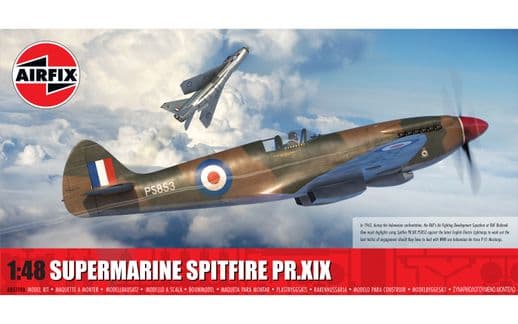
A05119A – Supermarine Spitfire PR.XIX
A05143 – Supermarine Spitfire Tr.9 – The ‘Flight Experience’ Spitfire
We bring this Spitfire anniversary tribute edition of Workbench to a close by featuring just one further Spitfire in scale model kit form, but for very good reason. To mark this occasion, and just because we know how much you all love Spitfires, the Airfix website is currently running a rather special deal whereby any order for in-stock items totalling £55 or more, qualifies for a free 1/48th scale Spitfire kit.
In addition to this, the kit in question features no ordinary Spitfire, as this one marks one of the aircraft flown by a high profile American volunteer pilot, one of the famed airmen of the RAF’s American ‘Eagle Squadrons’.
A young Dominic Salvatore Gentile had been fascinated by flying and aeroplanes from a very early age, but lacking the necessary college requirements for entry into the US military when coming of age, decided to head for Canada in search of a military flying career. On successfully gaining his wings, the young airman was posted to Britain, where he later joined RAF No.133 ‘Eagle Squadron’, the third and last of the famed American manned squadrons of the Royal Air Force.
Flying the Supermarine Spitfire Mk.V out of RAF Biggin Hill, Gentile would score his first aerial victories on 19th August 1942, when he claimed a Junkers Ju88 and Focke Wulf Fw190 whilst flying operations in support of the unsuccessful Dieppe Raid. Even though the Dieppe operation wasn’t the Alles finest hour when it came to WWII, it is interesting to note that ‘Operation Jubilee’ (the Dieppe Raid) was the only time that all three of the RAF’s ‘Eagle Squadrons’ saw action on the same operation.
In September 1942, the pilots of the three RAF Eagle Squadrons were allowed to transfer to the USAAF now operating in England, with the former RAF No.133 Squadron becoming the 336th Fighter Squadron, part of the 4th Fighter Group based at Debden. Initially retaining their Spitfires, Gentile’s fighter was known as ‘Buckeye Don’ and was adorned with rather distinctive nose artwork, which was based on the 4th FG badge, clearly illustrating the pilot’s his confident attitude to aerial combat.
An unusual Spitfire story, this US 4th Fighter Group Spitfire was used by the American ‘Ace of Aces’ Dominic Salvatore Gentile.
After only retaining their Spitfires for a few weeks, the pilots of the 4th FG were presented with something of a shock, as they were required to exchange their diminutive Spitfires for mighty Republic P-47 Thunderbolt – they must have thought you could fit three Spitfires into a single Thunderbolt!
Initially, those who had previously flown the Spitfire had some serious misgivings about this situation, particularly as the replacement aircraft was already referred to as ‘The Juggernaut’, however, once they had the opportunity to fly this beast operationally, they soon began to appreciate its own many impressive fighting qualities.
‘Don’ Gentile would go on to become a celebrated American fighter ace and national hero, becoming the leading USAAF ace in the European Theatre after scoring a ‘triple victory’ on 8th April 1944. Amongst his fellow pilots, he would be referred to as the ‘Ace of Aces’, by virtue of the fact his victory tally had overtaken the score posted by Great War US Ace Eddie Rickenbacker, but only because ground victories were also counted at that time.
Ultimately though, his attention grabbing tour of duty would end in a less than glorious manner, as he simply couldn’t resist the chance to show off his flying skills to any available audience. Whilst performing a demonstration flight at RAF Debden (US Station 356) for a crowd of USAAF dignitaries and gathered members of the press, Gentile flew his P-51B Mustang ‘Shangri-La’ in a series of ever faster, and ever lower passes over the airfield, with onlookers fearing an accident was almost inevitable.
Thankfully, Gentile didn’t use his former RAF mount when making his high profile low pass error in front of press and dignitaries.
Gentile’s Mustang struck the ground and ignominiously slid along the grass, coming to rest in a heap in the full gaze of the onlookers, but thankfully with the pilot somehow managing to escape unhurt from the crash, that is apart from his badly bruised ego. Apoplectic with rage, his commanding officer grounded him immediately, and later sent him back stateside, forcing him to work the war bond circuit.
Thankfully, he didn’t prang his Spitfire in this manner.
‘Don’ Gentile’s beautiful Spitfire is available on this really generous First Flight 90th Anniversary offer whilst existing stocks last, with this kit making for an ideal build project with which to mark the occasion in scale. It makes for a slightly more unusual angle to the Spitfire’s legacy we celebrate this in this significant year.