
Welcome to this latest edition of our Workbench blog and all the news, updates, and modelling exclusives from the fascinating world of Airfix.
It’s been quite a year for Supermarine Spitfire related developments, anniversaries and associated media content. With this year marking the 85th anniversary of the Battle of Britain, which was arguably the Spitfire’s finest hour, and the end of the war in Europe, with the Spitfire still an important aircraft in Royal Air Force inventory at that time, 2025 also marked 90 years since construction work started on the Spitfire Type 300 prototype K5054.
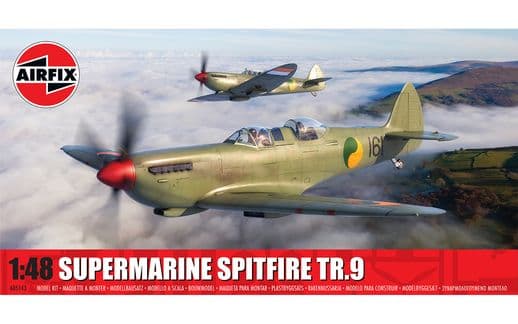
From an Airfix perspective, we have also seen the continuation of the incredible popularity of the aircraft in scale model form, with our modified ‘Flying Dray’ 1/24th scale Spitfire joining the recently released Mk.VIII export variant of the model in that same ‘Superkit’ scale, and two newly tooled models joining the range over the past twelve months. Our new 1/48th scale two seat Spitfire TR.9 was as unexpected as it has proved popular, but with so much going on over recent months, our new 1/48th scale Spitfire Mk.IXe kit appears to have slipped under the modelling radar somewhat, despite it actually being a really significant addition to the range. We intend to address this situation with this latest update.
The focus of our attentions this Workbench weekend is to provide an appropriate introduction to this new kit, even though it’s actually been available for a couple of weeks now. We will be looking at the importance of this stop-gap, but crucial variant of the Spitfire, in addition to bringing you all the relevant details related to this latest new tooling addition to the Airfix range. With stunning box artwork, scheme details and more, this latest update is definitely one for the Spitfire aficionados amongst our number.
A new model tooling project to develop a 1/48th scale model kit representation of this crucial variant of the Supermarine Spitfire.
It can sometimes be frustrating for the Airfix team when the release of a newly tooled or updated kit featuring one of the many variants of Spitfire to see service during WWII and beyond is met with perceived negativity in some quarters, particularly because as much development work will have gone into this model as any other new tooling project, and its creation will probably have been the result of much consumer insight information. The truth of the matter is that Spitfires have always been, and look likely to remain, popular build projects for the modelling community, and will definitely always be towards the head of any annual kit popularity chart. As design and manufacturing technologies continue to advance, it’s only right that existing, slightly older kits are considered to become new tooling projects to keep the hobby moving forwards, and as Spitfires have always been popular across all scales, surely it follows that they should also be up for consideration.
When attending events and Airshows in an official capacity throughout the year, we always like to speak with modellers to gauge their opinion on the state of the hobby and what part they would like Airfix to play in its future. A great many modellers over the years have told us that the 1/72nd scale kits they have enjoyed building over the years now pose them a few issues as their eyesight isn’t quite as good as it used to be, and they’re more than happy to rhyme off a long list of kits they would like to see us produce in larger scales, which for us (certainly when talking about aviation subjects) is 1/48th and 1/24th scale.
Spitfires have obviously been part of this conversation, and over the previous twelve months, we’ve seen the introduction of two newly tooled kits in 1/48th scale, the incredibly well received TR.9 trainer/experience flight variant of the aircraft, and the classic Mk.IX. The two-seater has already had its time under the Workbench spotlight, however, the Mk.IXe was released at a time when there was so much going on, and saw so many other kit releases vying for blog airtime, that it slipped under the radar somewhat. That really is a shame, because in truth, it’s a significant addition to the range, a beautiful new kit which will undoubtedly become a firm favourite with modellers, and one destined to attract classic kit status in the years to come.
The time has come to push the Airfix hangar doors open wide, and let the new 1/48th scale Spitfire Mk.IXe kit embark on its hobby assault on our modelling affections.
Airfix and the Spitfire have a long and successful relationship, one which has seen kit representations of this aircraft appearing across various scales and different marks over the years.
As arguably the most famous fighting aeroplane to have ever taken to the skies, and unquestionably the most important Allied fighter type of the Second World War, the legacy and achievements of the Supermarine Spitfire are now almost legendary, with it still remaining familiar to millions of people the world over, despite its first flight taking place almost 90 years ago. That being the case, perhaps the most remarkable aspect of the Spitfire’s heritage was its longevity and adaptability, the fact that the same basic airframe was able to evolve to match the changing demands being placed on its performance, and capabilities as the war progressed.
The mark IX variant of the fighter was arguably the most important mark of Spitfire in the entire production run, and was certainly the most heavily produced, so for this reason, it can be somewhat surprising to learn that it was actually considered something of a stop-gap development of the fighter. The arrival of the Luftwaffe’s fearsome new Focke Wulf 190 fighter in the skies over the Western Front in August 1941, resulted in a great many RAF Spitfire Mk.Vs operating over the Channel falling victim to the ‘Butcher Bird’. At first, reports of a capable new radial engined enemy fighter were dismissed as pilots mistaking captured French Curtiss P-36 Hawk fighters being pressed into Luftwaffe service as being the aircraft in question, but continued losses suggested otherwise.
The situation in the skies over France became so desperate that immediate action had to be taken, because from a strategic perspective, the Luftwaffe definitely had the upper hand with their new fighter. A major new Spitfire upgrade was in development at that time, however, the Mk.VIII variant was still some way off being ready for production, as manufacturing facilities still had to install new tooling jigs to support production of the latest Spitfire fighter, and this was going to take quite some time to achieve, something the RAF simply didn’t have the luxury of.
Our latest kit homage to the Spitfire finished in two of the three scheme options included with the first release of this newly tooled model.
With all resources now concentrated on finding a solution to this problem, one did appear to present itself, but it was something of a stop-gap, temporary one. The latest development of Spitfire was intended to be powered by the latest incarnation of the Rolls Royce Merlin engine, one which had been modified to include a two stage supercharger arrangement. It was proposed that marrying this powerful new variant of the engine to Mk.V airframes on existing production lines might provide the Spitfire with a welcome performance boost, one sufficient enough to help it meet the Focke Wulf challenge.
The idea was immediately explored, and whilst engineers and designers at both Supermarine and Rolls Royce had to work incredibly hard to enable this adoption to take place, the performance boost proved to be transformational, and crucially, existing manufacturing facilities required only modest alterations to support production of the new fighter.
It's interesting to note that the first 100 Spitfire Mk.IX fighters to be constructed were actually Mk.Vc airframes already in production adapted to take the new Merlin 61 two stage, two speed supercharged engine. Incredibly, this hybrid combination resulted in the introduction of an outstanding fighting aeroplane, one which was more than capable of holding its own against both the Focke Wulf FW190 and latest ‘Friedrich’ variant of the Messerschmitt Bf 109. In fact, this new variant of Spitfire was to prove so successful that the Mk.IX would become the second most heavily produced variant of the entire production run and if including the aircraft powered by licence built Packard Merlin 266 (Spitfire Mk.XVI) engines, even eclipsed the Mk.V in production number terms.
With further powerplant refinements taking place throughout the production life of this variant, the first Mk.IX Spitfires started arriving at RAF airfields from July 1942, with this famous mark of Spitfire going on to see service past D-Day, and on into the post war era. The last major Merlin engine powered variant of the Spitfire to be produced, this ‘emergency stop-gap development’ would actually go on to become something of an aviation classic, arguably the most successful, and most important variant of this most famous aeroplane.
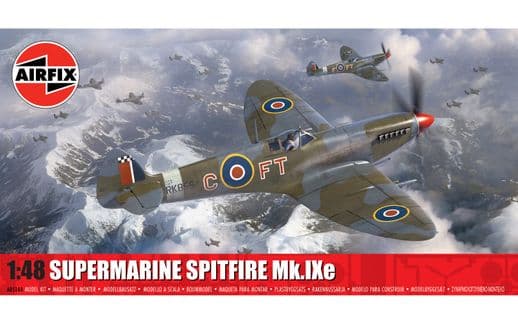
This stunning new artwork has been produced in support of this beautiful new Spitfire model, and features the aircraft which inspired the lead scheme option of three available with this kit.
The fighter Britain needed most in her hour of need, the Spitfire proved versatile enough to accept upgrade and modification throughout its service life, allowing it to remain competitive as a combat aircraft right up until the dawning of the jet age. Able to meet the challenge posed by any Luftwaffe aircraft it was sent to face, is it any wonder that the Spitfire managed to inspire a nation during times of war, and see Britain safely through to the relative peace we have enjoyed since.
That being the case, it’s therefore perhaps not all that surprising to accept the fact that today’s airworthy examples of the Spitfire continue to enthral and inspire current generations of people by the millions, the continuation of an aviation story which may well have started almost 90 years ago, but is still very much alive and kicking today.
Of the 20,351 Spitfires eventually produced, was any single variant more influential, and more desperately needed than the Mk.IX? Now that is a subject for some healthy aviation debate!
Our newly tooled 1/48th scale Supermarine Spitfire Mk.IX kit is our latest tribute to both the enduring legacy of this magnificent aircraft, and our own long heritage in producing scale construction kits of it. It comes complete with three interesting scheme options for us to consider completing our kits in, including a late war RAF ‘Fighting Cocks’ aircraft and two post war European liveries, one sporting clipped wings – let’s take a closer look now.
One of the most celebrated squadrons in Royal Air Force history, No.43 Squadron was formed at Stirling in April 1916 and after a period of training, would go on to distinguish themselves during operational service in France. Flying the Sopwith Camel, they would be one of the first units to carry out ground attack operations, whilst also having two of its pilots shoot down six enemy aircraft on the same day, and in doing so attracting the coveted title of becoming ‘Aces in a Day’.
The unit was referred to as the ‘Fighting Cocks’ in reference to the Squadron crest it adopted in 1926, when the unit was flying the diminutive Gloster Gamecock biplane fighter, one of the most capable aircraft in service at that time. The unit has always been proud of its fighting credentials, skills its pilots perfected during their participation in two world wars, but something which was upheld well into the 21st century, and their time spent flying the Tornado F.3.
During the Second World War, the Squadron were initially flying the Hawker Hurricane, and on 3rd February 1940, three of its fighters (led by Peter Townsend) brought down a Luftwaffe Heinkel He-111 at Whitby, the first German aircraft to land on English soil since the start of the Second World War. After flying defensive operations in the north of England during early 1940, the Hurricanes of No.43 Squadron moved south in May to support operations covering the Dunkirk evacuations, but remained there for the majority of the Battle of Britain, where a great many enemy aircraft would fall to their guns. They would move north again for recouperation and replenishment by the end of the year.
Operating from bases in the south once again to engage in fighter sweeps and night intruder operations over France during 1942, they would be sent to Gibraltar in November and would subsequently operate from the captured airfield at Maison Blanche, Algiers, during the successful North African campaign.
Full scheme details and built model images finished in this later war, Italian based Royal Air Force Spitfire Mk.IXe.
The Squadron traded their Hurricanes for Spitfires in early 1943, initially receiving Mk.V variants, but also taking the latest Mk.IX fighters from August that same year. They would be heavily committed supporting operations to capture Sicily and onward into the Italian mainland itself, but once these had seen Axis forces on the retreat, would also fly in support of actions in the South of France, before once again returning to Italy. The new box artwork shows this and other No.43 Squadron Spitfires flying top cover for USAAF B-25 Mitchells. In late 1945, the Spitfires of No.43 Squadron would be on the move again, this time to Austria, where they spent time flying out of both Zeltweg and Klagenfurt.
This aircraft was produced at the Castle Bromwich factory during 1944 and delivered to No.9 MU, which may actually have been operating out of that same location at that time. She moved on to No.222 MU just ten days later, where she was immediately prepared for transportation overseas, and operations in North Africa. She was loaded aboard the British cargo ship ‘Silverlarch’ at Liverpool in mid-November 1944 bound for Casablanca and operations in North Africa and the Mediterranean. She joined No.43 Squadron, where she was allocated the codes FT-C.
Not much is known about the aircraft’s wartime record, only that she would seem to have served for around two years before being struck off charge. Whilst based at Ravenna, she suffered damage when another Spitfire taxied into her, but the damage mustn’t have been too severe, as she was repaired and returned to operations just a few weeks later.
She was still with the Squadron when they moved to a new home in Austria, and would actually be the subject of some interesting photographs whilst there, which serve as fine records of Spitfire Mk.IX fighters during the final days of their RAF service.
If anyone has more information about the aircraft’s wartime service, or her Australian pilot, we would be delighted to hear from you.
Despite the undoubted fighting qualities of the Spitfire Mk.IX, by the end of the war, the world’s most powerful nations were already looking towards jet power for their interceptor aircraft, and this variant of Spitfire was no longer considered suitable as a front line fighter for the Royal Air Force. This situation certainly didn’t deter many European nations from coveting RAF Spitfire stocks, as they looked to establish their own air forces in the wake of a devastating war, particularly with money being in extremely short supply at that time.
The Danish Armed Forces made a request of the British Government that they be allowed to purchase a number of surplus Spitfires in late 1946, something which was duly granted as the Danish people had raised money to purchase RAF Spitfires to fight in their name during the Second World War, and many Danish pilots flew for the RAF during the conflict. During 1947, the Danes subsequently received 38 former Royal Air Force Spitfire Mk.IX fighters and three PR.Mk.XI reconnaissance variants of the aircraft, with an additional four airframes sent to serve as ground instructional aids for associated ground trades.
The fighter variants supplied were something of a mixed bag, with some supplied with full elliptical wings, whilst others were low altitude clipped wing variants and all still wearing their RAF serial numbers. All the aircraft were initially assigned to the Royal Danish Naval Aviation Service, who formed a new unit called the ‘Spitfire Group’ at Kastrup Air Base in August 1947. This was to serve as the centre for all pilot and ground crew training, however in early 1947, it moved to Karup Air Base, where it became known as the ‘Spitfire School’, and from June, all the Spitfires formed the Second Air Flotilla.
More scale Spitfire goodness, this time featuring an aircraft which was one of the machines purchased to help establish the Danish Air Force following the end of the Second World War.
All aircraft were subsequently transferred to either the 4th or 5th Eskadrille of the Danish Army Aviation force prior to the formation of the Royal Danish Air Force on the 1st October 1950, where they re-numbered Nos.722 and 725 Eskadrilles on that same date. No.722 would go on to operate both the Spitfire Mk.IX and the photo reconnaissance variant from January 1951 until 1955, when it became a search and rescue unit operating helicopters.
No. 725 Squadron went on to operate the Spitfire Mk.IX for a shorter period, only until September 1951, and by 1956, all the Danish Spitfires had been retired and most of them scrapped. Today, just a single example of these significant aircraft remains, one which is on public display in the museum at Stauning, although a full scale replica wearing the markings of aircraft No.427 is also displayed on a pole in flying configuration outside the entrance of the same museum.
Danish Spitfire No.422 was formerly RAF Spitfire HF Mk.IX, built at Castle Bromwich during 1944 and fitted with a Merlin 70 engine. She would see service with RAF No.124 Squadron at Manston, before becoming one of the aircraft supplied as part of the Danish order. The aircraft carries unusual artwork on its port engine cowling which appears to resemble an angry koala bear.
In a similar situation to the one described above in relation to a post war Danish Air Force, Belgium were looking to establish their own autonomous air force following the end of the Second World War, and ongoing discussions between the two governments resulted in an agreement to supply 28 former RAF Spitfire LF.IX fighters at the end of 1946. The aircraft were taken from surplus Royal Air Force stocks held in storage at Maintenance Units and once in Belgian service, were allocated serial numbers from SM 1 to SM 28.
These aircraft were needed to form the nucleus of a new advanced combat training unit for future fighter pilots, and in August 1947, the first of these machines started flying with the Advanced Flying Training School (EPA) operating out of the airfield at Brustem east of Brussels. Unfortunately, these operations suffered from relatively high attrition rates, as trainee pilots were learning in single seat variants of the Spitfire, losses which proved worrying enough to see the Belgians having to secure a further supply of Spitfires.
They would eventually obtain another 18 Spitfires, but not from the Royal Air Force this time, but war weary examples which had previously seen service with the Dutch Air Force, with these aircraft being allocated serial numbers SM 29 to SM 43. They did actually secure an additional three aircraft from the Dutch, however, these were in such poor condition that they were only suitable to be used for parts and would never fly in Belgian Air Force service.
In 1952, the Belgian Air Force considered the idea of establishing a flight demonstration team using several of their training Spitfires, however, following an accident during display work up, this idea was sadly shelved, and the world was denied this spectacle.
Full scheme details for this most attractively presented Belgian Spitfire.
Although not finished in this scheme, this image shows two of these new kits finished in both the A and B scheme options.
Following the Spitfire’s withdrawal from service, many of these aircraft would remain flying, but for a civilian company contracted to provide target tug support for the military. Beyond this, several would go on to appear during filming for the Battle of Britain movie in the summer of 1968, and beyond this, a number continue to fly to this day, as part of the world’s active historic aviation scene.
This aircraft was another to be constructed at the famous Castle Bromwich factory during the summer of 1944, given the serial PV189 and allocated to the RAF’s No.340 ‘Il de France’ Squadron (Free French). In service with this unit on the continent following the successful D-Day landings, it was reported to have suffered some structural damage, having performed a particularly enthusiastic dive bombing attack against German ground targets.
Purchased by the Belgian Air Force in November 1948 and allocated the serial SM 26, she was involved in a fatal mid-air collision with Spitfire SM 23 at Overrepen on the 25th June 1952, presumably the one which resulted in the cancellation of the proposed Spitfire demonstration flight.
This newly tooled addition to our continuing scale Spitfire association really is a delightful little kit, and already looks like being one of the most popular additions to the Airfix range for many a year. Released with three very different scheme finish options for us to consider, it will help tell the story of this most successful variant of Spitfire, both towards the end of its wartime service, and as it proved significant in helping to establish the post war air arms of several overseas nations. The two European Air Force scheme options are as appealing as they are unusual, and will make for interesting build projects to see us through the coming long winter nights.
This latest box artwork should already be gracing the shelves of your favourite model shop.
We're afraid that's all we have for you in this latest edition of the Airfix blog, but we will be back next Friday with more project development updates and the very latest Airfix kit exclusives. In the meantime, we're always keen to hear your views on all things Airfix and in particular, any thoughts and opinions you may have regarding our Workbench blog. If you would like to drop us a quick line, could we please ask that you use our workbench@airfix.com email for all correspondence.
To re-visit any of the Airfix blogs we have produced over the past TEN years or so, please head to our main Workbench hub, where you'll find our entire blog back catalogue and all the Airfix design projects we have already covered.
All our dedicated official social media sites can be accessed by clicking the respective link icons at the foot of this page, or by heading to the Airfix homepage. Other useful Airfix links are:
Facebook, YouTube, Twitter and Instagram official sites
Please join us for more Airfix updates next week and thank you for your continued support.