

Welcome to this latest edition of our Workbench blog and all the news, updates, and modelling exclusives from the fascinating world of Airfix.
Although range launch week will always stimulate the heaviest period of activity on the Airfix website, a relatively recent phenomenon can always be relied upon to push it quite close when it comes to numbers, a secret model kit release. As modelling enthusiasts, there’s nothing we like more than to hear about new model releases whatever the time of year, and over recent times, several secret releases have provided Airfix fans with some mid-year, between catalogue excitement. Last Tuesday saw the latest of these secret release announcements and as Workbench readers would expect, we will be taking this latest edition opportunity to bring you all the relevant details.
Following on from the 1/24th scale Supermarine Spitfire Mk.VIII announcement made earlier this year, our latest secret release reveal presents a kit in one of our larger scales, and will be only the third release from the particular tooling in question. One of the most accomplished of the early generation of jet powered fighters, the North American F-86 Sabre was a thoroughbred fighting aeroplane, one which has been described as a jet powered derivative of the wartime Mustang, a real jet powered gunslinger. This new kit benefits from the inclusion of two attractive new US Air Force scheme options, one based here in the UK and one which graced the skies of Alaska, and we will be looking at the details behind both as part of this review.
Our Sabre secret is now out, and we’re delighted to be in a position to bring you all the relevant details in this latest edition of Workbench.
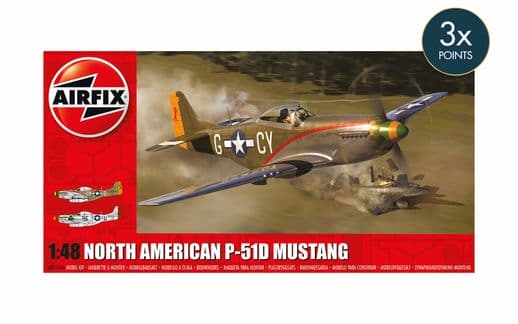
Before we get on to the new Sabre stuff, we wanted to give this previously released box artwork another airing, for no other reason than its just so appealing.
When enthusiasts hear the name ‘North American’ in any aviation discussion, most will undoubtedly think of the Mustang fighter produced during the Second World War, a magnificent aircraft which made a telling contribution to the Allied war effort, despite the Merlin powered variants only entering the fray towards the end of the conflict. The story of the Mustang and the North American Aviation Company itself is quite incredible, not only in how this young company managed to produce such a superlative fighting aeroplane in such a short space of time, but how they would also go on to have significant influence during the early years of jet powered aviation, producing a fighter which many observers describe as the jet powered Mustang.
Bearing in mind just how good a fighting aeroplane the Mustang was, it’s interesting to discover that the North American Aviation Company actually only won its first military aircraft construction contract in 1935, but how they would go on to become one of the world’s foremost aviation manufacturers, designing and producing several of the world’s most important military aircraft. Making their name as the producer of effective, all metal monoplane training aircraft, such as the BT-9, Harvard and T6 Texan, aircraft which would see service across the world, North American Aviation would also be responsible for producing the military aircraft these trainers were equipping pilots to go on and fly, such as the heavily produced B-25 Mitchell bomber and arguably the greatest fighting aeroplane of the Second World War, the P-51 Mustang.
It's a well-used wartime colloquialism that Hermann Göring is reputed to have told his senior advisors that he knew the war was lost once he saw Mustang fighters marauding unopposed in the skies over Berlin, something which only served to enhance the reputation of this magnificent aeroplane. As effective as their famous P-51 Mustang undoubtedly was by the end of the Second World War, the world of aviation was moving in an exciting new direction and whilst the qualities of the Mustang would see it remaining in service for many years, the Mustang’s creators were determined they would be part of this new jet era.
With the stellar performance of the Mustang as their blueprint, the design team at North American Aviation wasted little time in turning their attention to the production a new jet powered fighter even before the Second World War had ended. That first design was very much based on the Mustang and featured straight wings, the same high mounted bubble canopy, but a slightly portly fuselage to house the Allison J35 turbojet engine. That aircraft was the North American FJ-1 Fury produced for the US Navy, an aircraft which would earn the distinction of being the first US Navy jet type to serve onboard a carrier at sea, under operational conditions.
A most appealing addition to the current Airfix range, this latest Sabre kit includes two scheme options to finish your kit in US Air Force markings for the first time in this scale.
Only 33 of these distinctive little fighters were eventually build, primarily because the design team at North American had been given access to captured German high speed flight research data by then, and they were incorporating this into a radical new design. Their new fighter featured wings and horizontal stabilisers which were swept back at an angle of 35 degrees as they searched for ever greater speeds, with the German flight data highlighting how this helped an aircraft overcome the effects of compressibility, something experienced by aircraft capable of attaining higher speeds.
With greater speed being an important consideration for their new fighter, their design incorporated a beautifully streamlined fuselage which retained the exceptional all-round pilot visibility first introduced on the bubbletop ‘D’ variant of the successful Mustang. With three nose mounted .50 calibre machine guns positioned on either side of the aircraft’s beautifully sculpted forward fuselage, the new North American F-86 Sabre shared much of the design philosophies first seen on its famous piston powered predecessor, and whilst it was undoubtedly a beautiful thing to look at, make no mistake, this was a ruthlessly effective fighting aeroplane at its heart.
Immediately earning a reputation as one of the world’s foremost early jet powered fighters, the Sabre would go on to set an impressive new world airspeed record of 670.84 mph, using what was to all intents and purposes a production aircraft, with a full operational loading, something which was quite the achievement. It would ultimately be combat operations which would earn the Sabre its most significant accolades, as during the Korean War, the aircraft would face greater odds against it that any other front-line combat aircraft had in the history of aviation, however despite this, would post an incredible combat success record of 14:1, from pilot accounts at the time.
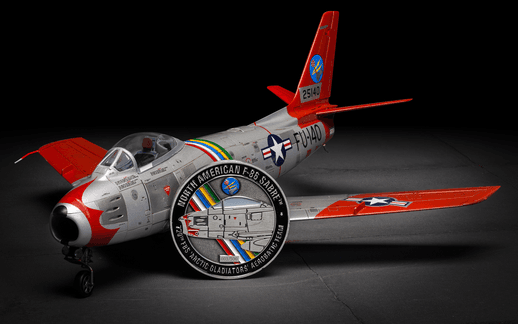
Now forming a little collection of its own, our series of limited edition coins grows further with the addition of this latest secret model release. Get one of these beauties in your sights before they disappear.
The North American F-86 Sabre is regarded as one of the world’s most impressive early generation jet fighters and one which would remain in service across the world for 45 years, with just short of 10,000 aircraft eventually being produced.
For an aircraft with the reputation of the Sabre and one which was produced in such large numbers, the design team at North American Aviation were constantly looking to improve the performance of their aircraft, and often called upon feedback from pilot’s operational experiences, when attempting to keep the aircraft at the forefront of world aviation technology. A major modification which resulted from combat experiences flying against the diminutive Mikoyan Gurevich MiG-15 was intended to improve the aircraft’s dogfighting capabilities. This was achieved by removing the aircraft’s wing leading edge slats, a feature which pilots felt was actually hampering the performance of the aircraft in close combat situations. Although the slats effectively reduced the landing and take-off speeds of the aircraft during these critical phases of flight, they also caused the aircraft to exhibit early pre-stall buffet and thus, a loss in airspeed and performance.
In 1952, the first of the ‘F’ variant Sabres started to be received by operational units, aircraft which featured the new larger solid “6-3” wing configuration and more powerful engines, with the promise of improved combat performance. The new wing featured increased surface area with the chord extended by six inches at the root and three inches at the tip. Significantly, it also saw the removal of the distinctive airspeed operated leading edge slats which pilots reported were affecting performance of the fighter in combat situations. These modifications did result in the expected performance increase, however, there were some operational anomalies these modifications also caused, particularly during critical phases of flight. More development research was immediately carried out and these modifications quickly underwent further modification.
We just can’t delay any longer – please enjoy the new artwork produced in support of this latest secret release, one which takes the lead ‘Arctic Gladiators’ scheme as its inspiration.
For an aircraft which possesses such international aviation pedigree, it can be surprising to learn that the North American Sabre is a relative newcomer to the Airfix range, considering the wider heritage of the brand. Whilst aircraft such as the Spitfire, Messerschmitt Bf 109 and Mustang have been released, re-tooled and released again numerous times over the years, we modellers had to wait until the early 2000s to have access to an example of this beautiful aircraft in kit form and that was in 1/72nd scale.
Many modellers have gained a real affection for kits produced in the slightly larger 1/48th scale over recent years, in large part because the resultant models help to display the power and majesty of some of the world’s most famous aircraft in a more effective manner than smaller scales. Having spoken to so many active modellers at this year’s Royal International Air Tattoo, it was also made clear to us that many people with quite a few years invested in the hobby also now find 1/48th scale kits a lot easier to work with now and were even asking us to upscale many Airfix classics to this larger scale – all in good time folks!
The F-86 Sabre joined the growing ranks of recent 1/48th scale releases for the first time in 2021 and if you’re looking for a build project which possesses real style and aesthetic presence when it’s eventually displayed amongst your collection of built models, then this most definitely qualifies – it’s an absolute beauty. One of the most appealing shapes in the world of post war aviation, our designer Tom managed to capture the classic lines of the Sabre perfectly and if you weren’t already a fan of this early jet powered gunslinger, you certainly will be after spending a little time with this fabulous kit.
The first release presented us with the Canadian built F.4 variant of the fighter which equipped the Royal Air Force for a short, but vital time during the Force’s history, with a second release the following year featuring new components to allow two international variants of the Sabre to be built. This latest release brings us into contact with classic US Air Force variants of the Sabre, both silver stunners, with both serving on opposite sides of the Atlantic Ocean. As has become usual practice, this third release will include all part frames this tooling has to offer, meaning that any unused decals from the two previous releases, or those available through the wider hobby market can all be considered when it comes to selecting your scheme choice.
Let’s take a closer look at the two new scheme options included with this impending not-so-secret new F-86 Sabre release now.
The 720th Bombardment Squadron can trace its lineage to the middle years of the Second World War, activated at Gowen Field on 1st May 1943, but quickly moving to train with B-24 Liberators at Clovis Army Airfield in New Mexico. Following a period of intensive training, the unit was sent overseas to fight in the Mediterranean Theatre of Operations, with ground units travelling by ship, whilst their aircraft made the long journey via the South Atlantic Ferry Route.
Once in theatre, the 720th would be heavily involved in Allied operations in preparation for D-Day and the eventual defeat of Germany, taking part in the strategic bombing of Axis targets across Europe. One of the early operations the unit took part in was ‘Big Week’, a combined USAAF and Bomber Command week of strategic bombing targeting the German aircraft industry and fighter production in particular. This was intended as a major preparatory operation in advance of D-Day and was specifically aimed at reducing Luftwaffe’s fighting capability, ensuring Allied air forces would have control over the skies over the invasion beaches on D-Day.
Also during 1944, the 720th BS flew missions in support of Operation Strangle and Operation Dragoon, but by the early summer of the following year, had returned to the US to retrain on the Boeing B-29 Superfortress. The end of the war brought about an immediate reduction in capacity requirement for the USAF and the squadron was inactivated on 15th October 1945.
Full scheme details for this most attractive display team Sabre
Built model completed in the markings of this 720th Fighter Bomber Squadron ‘Arctic Gladiators’ Aerobatic Display Team Sabre.
Redesignated the 720th Fighter-Bomber Squadron in December 1953, the squadron was assigned to Ladd Air Force Base in Alaska, where it would fly the North American F-86 Sabre. Unfortunately, this period would be one of great change for personnel assigned to this squadron, as they moved to Eielson Air Force Base in May the following year and were inactivated once again by August 1955. They would go through the process of reactivating and changing unit name several times over the next few years, before being redesignated the 720th Bombardment Squadron and going on to operate the mighty B-52H Stratofortress.
As you might expect having discovered the post WWII heritage of this particular unit, the 720th Bombardment Squadron is currently inactive.
In May 1954, the 720th Fighter-Bomber Squadron moved to Eielson Air Force Base in Alaska, which was formerly the satellite station for Ladd Air Force Base where they were reactivated late the previous year. Almost as soon as they had made the move, the Commanding Officer of the 720th, Lt. Col. Harold Graham decided to establish an air demonstration team, and enlisted the services of three of his best pilots. Following a period of intensive training, the team, which they named the ‘Arctic Gladiators’, were ready to entertain the masses and used their beautifully presented Sabres to display at both military and civilian events across the state of Alaska.
A model display pairing. As a limited edition, on-line offering, not many people will have the benefit of displaying their finished models with one of these rather smart Airfix coins.
What a stunner. Although short lived, seeing the Arctic Gladiators performing in Alaskan skies must have been a spectacular sight.
This particular aircraft was a late build F-86F-30-NA aircraft powered by the General Electric J47-GE-27 engine and featured the solid “6-3” wing with fences. A total of 660 of this variant of Sabre were built and even though the pace of aviation development was continuing to advance dramatically by 1955, these were still very capable fighting aeroplanes. Wearing what was essentially a standard unit scheme with a few embellishments, the ‘Arctic Gladiators’ Aerobatic Demonstration Team must have looked magnificent when displaying over snowy Alaskan landscapes.
Interestingly, the team’s supply officer had already served with, or would go on to serve with both the Skyblazers and Thunderbirds Demonstration Squadrons, at a time when the flying prowess of jet powered US aerial units was something encouraged by the military and enjoyed by the general public. Unfortunately, the ‘Arctic Gladiators’ proved to be a short lived US Demonstration Team, because in August 1955, just one display season after they were formed, the 720th Fighter-Bomber Squadron was re-designated the 455th FBS and with it, bringing about the disbandment of the former unit’s aerobatic display team.
Initially nothing more than a farmland relief landing ground for Great War aircraft finding themselves in a spot of bother, the Admiralty would soon establish an aerodrome at Manston in Kent, marking the growing importance of air power and the convenient location of the site. Once up and running, the airfield was used as a training base for Handley-Page 0/400 bomber crews, steadily growing in importance and gaining additional facilities as a consequence.
It would also become an important Royal Flying Corps airfield in the defence of Britain from German air attack and in this role, Manston based fighters would make a telling contribution, with their guns claiming many raiding fixed wing bombers and Zeppelin casualties. Its location close to the Kent coast would give Manston quite a position of prominence with regard to RAF operations and it would become an important station during the Battle of Britain and would suffer at the hands of the Luftwaffe as a consequence.
Manston’s location would also see the airfield being used as a regular temporary deployment for aircraft engaged in cross Channel operations, such as the Swordfish torpedo aircraft sent to attack the German Battleships Scharnhorst and Gneisenau during the ‘Channel Dash’ and as a staging point for ‘Agent Taxi’ Lysanders flying into enemy occupied France.
Full scheme details for this UK based USAF Sabre.
Such a handsome aircraft, displaying our finished Sabres next to a Mustang will not only be a real treat for the eyes, but will also show the design lineage of this famous aviation company.
Manston was also used by the Avro Lancasters of RAF No.617 Squadron as they practiced delivery of their Upkeep mines in preparation for the Dambusters Raid and both Hawker Typhoons and Gloster Meteors would also call Manston home before the end of the Second World War.
The Cold War period would see Manston being used extensively by the US Air Force, initially as a Strategic Air Command base for its bomber and fighter-bomber units. Once again, its position made it an ideal location for both training and the possible deployment of aircraft into Europe at short notice, in times of heightened international tension. This would be an extremely busy period of operations at Manston and continued development of the site for the ever-increasing numbers of personnel based there. It would also continue to be used as a convenient emergency landing ground for the region, something many a wartime bomber made use of.
Strategic Air Command rotations through Manston would see some of the most powerful strike aircraft in the world being based at the airfield during this period, as both bombers and their fighter escorts would spend several years operating from Manston. This period was not without its difficulties, as local records show that the area suffered more than its fair share of crashes and incidents during that time, something which serves as a reminder that military flying can be an extremely hazardous occupation.
Another built model look at how appealing a Sabre finished in this RAF Manston based scheme looks.
Although showcasing the lead scheme of the two, this is the artwork we will need to keep an eye out for following the release of this kit early next month.
In July 1952, the 406th Fighter-Bomber Wing arrived at Manston with their natural metal North American F-86 Sabre fighters. The unit was made up of three squadrons – the 512th, 513th and 514th Fighter-Bomber Squadrons, with the 514th being identified by the blue band its aircraft wore around their front fuselage, just behind the air intake. In several cases, this same blue was also used around the lower canopy framing of this squadron’s Sabres, making for quite an attractive sight. Initially equipped with ‘E’ variant Sabres, the 514th began receiving F-86F Sabres from August 1953 onwards.
A change in mission requirement for the 406th FBW came in April 1954, where they took on more of a Fighter Interceptor role, one which would gradually see them exchanging their F-86F Sabres for F-86D Sabre Dogs. As the new aircraft became available, their old aircraft were either transferred to other USAFE units, or allocated to other NATO nations.
In the early 1960s, USAFE squadrons left Manston for good and the airfield once again came under Royal Air Force control. In fact, it wouldn’t take long before Manston became a joint civilian/RAF airfield and although its fortunes have ebbed and flowed over the years since, there always seems to be something interesting going on at Manston Airfield. Thankfully, Manston can also boast the support of a committed group of enthusiasts and volunteers who are steadfast in their determination to preserve and promote the rich heritage of the airfield, both for the people of Kent and for anyone with an interest in aviation history.
The latest in our popular series of secret model releases which has become a feature of the past couple of years, this new F-86F Sabre kit was unveiled earlier in the week and is already proving to be a popular impending addition to the 2024 Airfix range. Those placing their pre-orders via the Airfix website may have also noticed this model currently also comes with the latest in our series of limited edition collector coins, a high quality collector’s item which takes its inspiration from the lead scheme of what will only be the third release from this appealing tooling.
Beautifully capturing this distinctive and colourful scheme in all its glory, this exclusive coin features the nose section of a North American F-86F Sabre of the USAF 720th Fighter Bomber Squadron’s ‘Arctic Gladiators’, also incorporating the aircraft’s five colour stripes and the squadron emblem represented above the Sabre’s canopy. As always with these special coins, the reverse side proudly displays the Airfix logo and as many of you have already told us, they make for an attractive item to display alongside your finished models.
As our collectable coins have now become quite a feature of these secret releases, despite the fact that the Sabre kit has only been available for a couple of days, over half of the coins have already been snapped up, and whilst there should still be stock available over the coming weekend, we don’t expect many to remain unallocated by the time the next edition of Workbench is published. If you have already started your own collection of these attractive coins, it might be a good idea to make your first job after reading this update to use this link to secure your own Sabre and coin bundle combination.
Sabretastic! The kit is appealing enough in its own right, but with a coin also on offer with the first 500 Airfix website orders placed, it would be rude not to grab one.
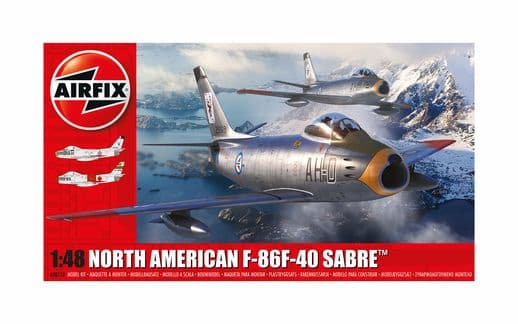
Full box artwork produced to allow this latest secret model release to break cover.
North American F-86F Sabre A08111 is now available for pre-order, and is expected to be in our warehouse by early next month, so we won’t have a long wait to get our hands on this recently announced not so secret model addition. As we prepare to welcome the shorter days of Autumn, can you think of a better model build to brighten our dark nights than a stunning natural metal F-86F Sabrejet?
We are afraid that's all we have for you in this latest edition, but we will be back next Friday with more project development updates and the very latest Airfix kit exclusives. In the meantime, we are always keen to hear your views on all things Airfix and in particular, any thoughts and opinions you may have regarding our Workbench blog. If you would like to drop us a quick line, could we please ask that you use our workbench@airfix.com email for all correspondence.
To re-visit any of the Airfix blogs we have produced over the past seven years or so, please head to our main Workbench hub, where you will find our entire blog back catalogue and all the Airfix design projects we have already covered.
All our dedicated official social media sites can be accessed by clicking the respective link icons at the foot of this page, or by heading to the Airfix homepage. Other useful Airfix links are:
Facebook, YouTube, Twitter and Instagram official sites
Please join us for more Airfix updates next week and thank you for your continued support.