Welcome to this latest edition of our Workbench blog and all the news, updates, and modelling exclusives from the fascinating world of Airfix.
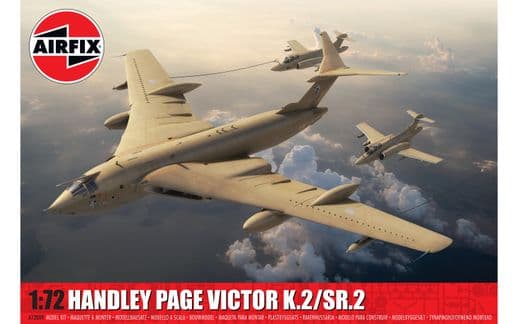
Our subject for this latest edition of Workbench is the heavily requested re-introduction of an incredibly popular kit, one which has to be regarded as one of the most impressive to have ever graced the Airfix range. The futuristic looking Handley Page Victor was the final aircraft of Britain’s trilogy of nuclear capable V-Bombers of the Cold War era, and arguably the one which was both the most advanced and the most versatile of the three. The aircraft was designed to wield incredible destructive power, but to ensure peace by the threat of the devastation it could bring, something of a dichotomy in terms, but one which helped to preserve an uneasy peace at one of the most volatile periods in world/European history.
A kit which was originally released to such widespread modeller acclaim back in 2016, and again in this particular release format two years later, it has become increasingly difficult to get your hands on one of these stunning kits over recent months, so we decided that we had to do something about that situation, hence this release return. In addition to looking at why the Victor makes for such an impressive modelling project, we will be looking at the details behind the three scheme/decal options included with this kit, will have a selection of images detailing how our latest exclusive collector coin release will delight those ordering via the Airfix website, and see why the aircraft linked to the lead scheme option has just benefited from a rather radical new application of paint.
We’re very much in the presence of one of Britain’s Cold War jet powered peacekeepers in this latest edition of Workbench.
A futuristic looking aircraft, many people consider the Handley Page Victor to be the most radical of Britain’s three V-bombers, from a design perspective.
As the world entered an uneasy peace at the end of the Second World War, the emergence of two new technologies dictated that whilst the world’s population wanted nothing more than to forget about conflict, their military planners were forced into a potentially devastating new arms race. Jet power and nuclear weapons were being developed by former allies who were now extremely wary of each other, and with both of these new technologies being coveted by the world’s most powerful nations, none of them felt they could be left behind, as this would be seen as a sign of weakness, and potentially leave them vulnerable to attack, or even worse, become bit part players on this new world stage.
The need to deliver Britain’s nuclear weapons effectively should future conflict dictate resulted in the Ministry of Supply issuing a design specification (B.35/46) to the nation’s aircraft manufacturing companies, encouraging them to submit proposals for an advanced and highly capable new aircraft type. They were looking to introduce a medium range jet bomber, capable of carrying a 10,000lb ‘Special gravity bomb’ (a conventionally launched free-fall nuclear weapon) to a target approximately 1,700 miles away. It would have to fly at a cruising speed of around 600 mph, and at altitudes between 35,000 and 50,000 ft. This was an important aspect of its specification requirement, as it would allow the aircraft to evade potential defensive fighter interception, particularly as there was no requirement for the new aircraft to be equipped with any defensive armament. It would have to rely on speed, altitude and stealth to evade the attentions of enemy fighters.
As this project advanced, the Air Ministry decided to proceed with three different aircraft types, from three different manufacturers, something which has been the subject of much debate over the years. Why did they not simply choose the option which best suited the requirement, cutting down on development time and allowing the economies of scale to see more aircraft into service?
We already mentioned how the world’s population had no stomach for conflict in the years which followed the end of WWII, but how their leaders knew that if they could not demonstrate resolve by military power, that war may well be their destiny. Britain had been instrumental in helping to develop the nuclear weapons which ended the war, but found themselves lagging behind both America and the Soviet Union in this new arms race, and needed to catch up as a matter of urgency.
Historic Handley Page drawings were used during the design stage of this impressive kit.
Britain found herself somewhat vulnerable, a situation which had to be addressed. As work on establishing a nuclear deterrent continued apace, a suitable delivery method had to be developed, and powerful new aircraft offered the most practical and deliverable solution. With no room for error, designs from three different manufacturers were ordered into production, with Vickers, Avro and Handley Page all working on spectacular new aircraft to deliver Britain’s nuclear deterrent effectively.
Each of the three new aircraft were very different in appearance, but with their impressive size and shared role being standard features. Each aircraft would be powered by different engine types, something which was intended to ensure that barring an absolute catastrophe, at least one of the three would make it through to squadron service and provide the deterrent threat Britain so desperately needed. It was also apparent that this decision undoubtedly provided the ailing British aviation industry with some much needed work, at a time when mergers and takeovers would have resulted in crippling delays.
We also have to accept that all three designs were ‘cutting edge’ in terms of the technologies being developed, so therefore having three projects proceeding simultaneously offered a greater chance of success, particularly when you consider that aircraft such as the piston engined Lancaster and Lincoln bombers were still in service at that time.
The first of Britain’s mighty V-Bombers to enter RAF service, the Vickers Valiant was very different to any aircraft which had gone before it, even though it has been described as the most conventional of the three nuclear bombers. Due to its historic position in British aviation, the aircraft would carry out much of the vital nuclear testing work in establishing this force, and remains the only British bomber to have ever dropped a live nuclear munition in anger.
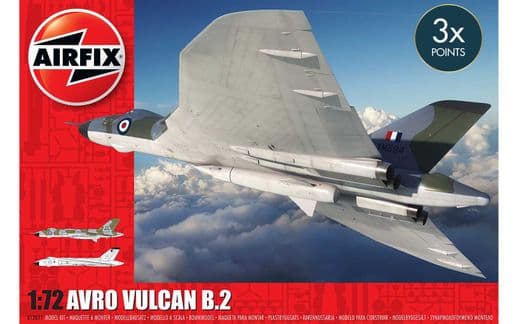
The second aircraft into service was arguably the most famous of the three, the mighty Avro Vulcan, an aircraft which may well have been a bomber, but was often flown like a much smaller aircraft type, it really was that capable. These aircraft mounted the famous Black Buck bombing raids of the Falklands War, which were the longest bombing raids ever attempted at the time, but required the support of airborne refuelling variants of the third aircraft type of this trio to allow the raids to take place.
The third of Britain’s V-bombers to enter service, the Handley Page Victor was a futuristic looking aircraft, one which was viewed as something of a radical option at the time, and one which was very different to any British aircraft that had gone before it. The Victor featured a sweeping, crescent shaped wing design, one which incorporated three stepped ‘kinks’ from the wing root to the wing tip, reducing in angle at each point, making it an imposing sight. Designed with high speed flight stability as a primary consideration, the Handley page aircraft also featured a high T-tail unit and pointed front fuselage, making it quite the looker.
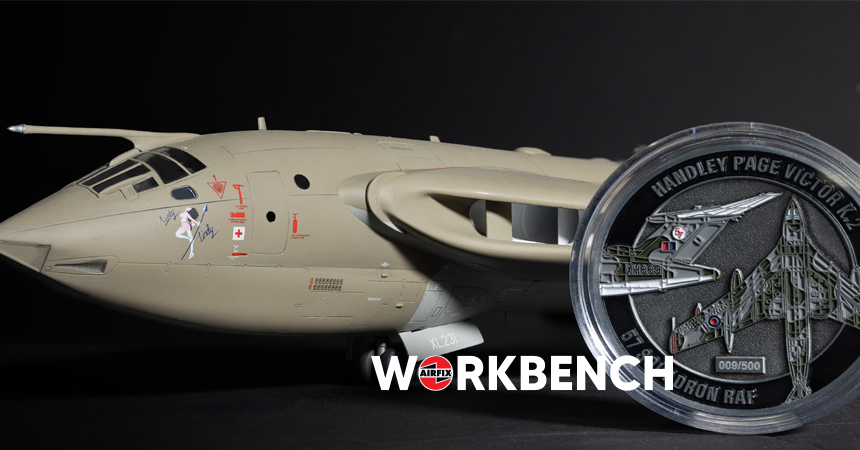
This latest kit addition to the 2025 Airfix range also saw the release of the latest in our series of website exclusive collector coins.
In November 1957, following ten years of development, the Handley Page Victor B.1 entered RAF service with No.232 Operational Conversion Unit at RAF Gaydon. In the spring of the following year, RAF No.10 Squadron at Cottesmore became the first operational Victor Squadron and Britain had her final V-bomber.
Almost as soon as the first Victors started to enter RAF service, Handley Page started work on a new and improved variant of the aircraft, convinced that they could create an aircraft possessing even greater performance, their ‘Super Victor’. The Victor B.2 featured a number of significant improvements over the original design, as designers looked to send the aircraft to even higher altitudes and at greater speeds. New Rolls-Royce Conway turbojet engines replaced the original Armstrong Siddeley Sapphires, however, their use did require significant re-design of the wing roots.
The intake inlets were increased in size to allow for greater airflow into these more powerful units, and additional wing modifications resulted in an overall span increase of some 10 feet. A host of internal equipment upgrades resulted in a more effective aircraft, and the inclusion of an auxiliary power unit in the right wing allowed the aircraft to self-start without the need for ground support units.
As the Victor showed itself to be a robust and flexible airframe, other modifications soon followed and the clean, sleek appearance of the early Victors soon disappeared beneath a multitude of probes, aerials and various lumps and bumps which covered all this new equipment. These additions were all intended to increase the operational effectiveness of service aircraft, as their role profile evolved, and more effective technology became available.
Handley Page Victor XL231 gave up some of her design secrets during the research gathering phase of this exciting project. Here we see her centreline drogue and housing.
Back in 2018, this kit was on the flightdeck just after the aircraft had thrilled crowds at the Yorkshire Air Museum with her latest engine run demonstration.
Almost as soon as the Victor B.2s entered service, significant modification was required to allow the aircraft to carry the ‘Blue Steel’ nuclear stand-off missile. This powerful weapon was carried in a semi-recessed housing under the fuselage of the Victor, with the missile adopting a distinctive nose down attitude when loaded. Wearing an all-over white anti-flash finish, these particular Victors were arguably some of Britain’s most distinctive aircraft, aircraft which served throughout a particularly volatile period in world history. These aircraft possessed such unimaginable destructive power that anything other than peace simply didn’t make sense.
History and the advancement of technology never stand still, and the introduction of more effective Soviet surface to air missile technology dictated that Britain’s V-Bombers could no longer operate in their intended high altitude environment, and a switch to low level operations was initiated. This saw the removal of the white anti-flash nuclear schemes and the adoption of camouflage on these mighty bombers, something which only served to make them even more visually striking.
Now required to operate at altitudes for which they were not designed, it wasn’t long before the submarines of the Royal Navy were charged with taking over the responsibility for administering and delivering Britain’s nuclear deterrent. Despite the loss of the Valiant, both the Vulcan and Victor would continue to serve with distinction in a conventional bomber role, but with the Victor also proving to be an exceptional airborne tanker aircraft, often used to support Vulcans engaged in strike missions, or on training sorties.
The flexibility of the Handley Page Victor’s design was to see the aircraft significantly outlast both the Valiant and Vulcan in Royal Air Force service, albeit by trading its original bombing role for that of an equally vital inflight refuelling platform. In this role, the mighty Victor would see operational service during the Falklands War of 1982 and the Gulf War of 1991, proving to be an invaluable asset to the Royal Air Force during both conflicts, and continuing through to their eventual withdrawal from service in 1993.
This Cold War nuclear bomber turned in-flight refuelling specialist was the product of a time when British aviation designs truly were the envy of the world, and is an example of one of the most distinctive aircraft to have ever taken to world skies. Every aircraft type has a story to tell, but the Handley Page Victor has more to tell than most.
As the latest B.2 variant of the Victor bomber began to enter Royal Air Force service at the beginning of 1962, earlier machines were considered obsolete for the role of strategic bombing. A feasibility study was established to see if these earlier aircraft could be converted to airborne tanker aircraft, an exercise which became all the more necessary following the grounding of all remaining Vickers Valiant tankers, after fatigue cracks were discovered in their airframes. As a result of this development, there was now no need to continue with these trials as such, and Victors duly underwent conversion.
Considered the definitive Victor tanker, the K.2 variant was developed following a change in the strategic bombing role of the RAF’s V-bomber force, from high altitude to low level strike operations, an environment which wasn’t particularly suited to the capabilities of the Victor, even though it was effective enough a design to cope admirably with its new role. Leaving the RAF’s remaining Avro Vulcans to fulfil the strike role, 24 former Victor B.2 bombers were converted to K.2 Tanker configuration, but with the demise of the Handley Page company, this work was actually carried out by Hawker Siddeley somewhat ironically at the old Avro factory at Woodford in Cheshire, the construction home of their Vulcan rival.
The K.2 tankers would use the probe and drogue method of delivering fuel in flight, using two refuelling HDUs (Hose Drum Units) mounted under each outer wing section, with a third unit mounted under the centreline of its fuselage – this unit possessed a much greater fuel flow rate than the wing mounted units. In operation, either the two wing drogues could refuel a pair of aircraft simultaneously, or a single (possibly larger aircraft, and even another Victor tanker) could take fuel from the centreline drogue. It was considered unsafe to refuel from the centreline station and either of the wing fuel points at the same time, so it was never practice for all three to be used at the same time.
Full scheme details for this most famous aeroplane.
Built by Handley Page at their famous Radlett factory in 1961, XL231 was the first Victor B.2 to be taken on strength by the newly re-formed No.139 (Jamaica) Squadron at Wittering early the following year, wearing the distinctive white ‘anti-flash’ scheme designed to protect the aircraft in the event of a nuclear delivery. The adoption of the ‘Blue Steel’ stand-off nuclear missile saw the aircraft returning to Handley Page for modifications to allow the aircraft to carry this mighty weapon in its bomb bay, and once returned to Wittering, it wouldn’t be long before her anti-flash white scheme was replaced with a camouflaged upper surfaces. This was because Britain’s V-Bomber force was required to change from high altitude to low level strike operations, as the latest breed of Soviet SAM missiles were so much more effective.
With the design of the aircraft not particularly suited to the rigors of this kind of flying, Victor XL231 was selected as the airframe to serve as the prototype K.2 tanker conversion aircraft and underwent trials at Woodford and Boscombe Down. She would prove significant in the subsequent conversion of 24 former RAF Victor B.2 bombers to airborne refuelling configuration, a role in which the Victor would excel. After undergoing full conversion herself, she joined the other Victors in the tanker fleet at RAF Marham.
Operational demands on these aircraft were extremely high and XL231 would go on to make significant contributions to both the Falklands War of 1982 and the Gulf War (Operation Granby) of 1991. Indeed, during the Gulf conflict, the Victors of No.55 Squadron were the only RAF aircraft to post a 100% serviceability record, something quite impressive for what were relatively old aircraft, and something Victor crews were incredibly proud of.
'Lusty Lindy' in a different guise back in 2018, in model form at least.
Taken on the very day this latest blog was posted – Handley Page Victor XL231 is now wearing very different plumage.
It was during her time serving during the Gulf War that XL231 acquired her now famous artwork, and a name by which she continues to be referred to to this day, ‘Lusty Lindy’. Reputedly applied in honour of the Crew Chief’s wife, the nose artwork inspired a number of other ground crews to similarly adorn their aircraft with artwork, something which resulted in one of the most popular (and heavily photographed) periods of aircraft presentation in the history of the Royal Air Force, particularly once these fascinating aircraft had returned home to the UK.
Time was eventually called on the Victor’s impressive Royal Air Force career in the autumn of 1993 and XL231 was to play a lead role in commemorations, as she took part in the final official RAF Victor flight, when she performed a station flypast at her Marham home on 15th October. Just ten days later, she was flown to the former RAF station at Elvington near York, where she was to be preserved for posterity and put on public display as one of the aircraft cared for at the impressive Yorkshire Air Museum.
Maintained by a group of dedicated volunteers at the museum, ‘Lusty Lindy’ has been maintained in serviceable, engine running condition, and for many years, regularly blasted along the length of the runway at this former bomber station. Unfortunately, those glory days now appear to be a thing of the past, however, visitors to Elvington can still experience the thrill of hearing the aircraft’s mighty Rolls-Royce Conway engines bursting into life, a unique Cold War experience in the surroundings of a preserved WWII bomber station.
Bringing her story right up to date, visitors to the Museum will now see a very different ‘Lindy’ on display, as she has just emerged from an extensive repaint operation, where she has traded her Desert Storm plumage for a stunning RAF camouflage scheme. She looks spectacular and is well worth a visit to the museum to see, particularly in her current freshly applied scheme state, before the winter weather gets to work on her stunning good looks.
The effectiveness and exceptional serviceability of the Victor Tanker force was never more apparent than during the Falklands Conflict of 1982. Even before the Task Force had arrived in the South Atlantic, Victors were performing reconnaissance flights over the region, gathering information on shipping using the area and assessing the general conditions for potential military operations over such vast expanses of ocean. Their most telling contribution, however, came when supporting Vulcan Bombers during their ‘Black Buck’ missions against the Argentine held airfield at Port Stanley.
The operations to deny Argentine forces the ability to use Port Stanley airfield as a base for operations and re-supply called for a single Vulcan bomber (with others acting as reserve aircraft) to attack the airfield and render the runway unusable. By achieving this, they would play a significant role in supporting British Task Force operations, saving a great many lives in the process.
With the nearest suitable airfield available to the British being on Ascension Island some 3,800 miles away, their Vulcans would have to rely on the in-flight refuelling support of Victor tankers operating from the same airfield, flying a complicated shuttle refuelling plan, if they were to successfully accomplish their offensive objective. This impressive feat of airmanship and aviation logistics would allow the longest bombing mission in history to be successfully completed, but not without a few scares along the way.
The complex refuelling plan to support the Port Stanley Vulcan attack would call upon the services of no fewer than eleven fully fuel ladened Victor tankers, each one taking off from Ascension at the same time and all needed to provide fuel for both the Vulcan and the other Victors, in what was a carefully orchestrated fuel management plan. Once the attack had been completed, five more Victors would be needed to bring the Vulcan home, with Victors both delivering and taking on fuel during their flight. The operation proved to be an incredible success, and even though incredible strain was placed on the men and machines of the UK tanker force, each aircraft played its part in writing a glorious page in aviation history, with each one returning safely to Wideawake Airfield on Ascension Island.
Full scheme details of this ‘Black Buck’ support aircraft.
Handley Page Victor XH669 was constructed as a B.2 in 1959, making her maiden flight at the beginning of August that same year. Prior to entering squadron service, the aircraft was loaned back to Handley Page, so they could display the Victor at the 1960 SBAC Farnborough show, where she was seen wearing a distinctive all-over anti-flash white nuclear V-Bomber scheme. She was later converted to B.2R standard, and modified to carry the ‘Blue Steel’ missile, going on to serve with the Victor Operational Conversion Unit at Wittering.
Victor XH669 was one of the 24 airframes selected for conversion to K.2 tanker configuration at Woodford, and would later join the rest of the tanker fleet at RAF Marham in the colours of No.57 Squadron, where like all the other Victor tankers, she traded her all-over white anti-flash scheme for camouflaged upper surfaces. One of the many Victors to take part in the Falklands War, XH669 had a rather dubious claim to fame during that time. Whilst taking part in one of the ‘Black Buck’ refuelling missions in support of Avro Vulcan XM607, this aircraft was taking on fuel from another Victor, with the intention of leaving her as the sole remaining fuel support for the Vulcan. Unfortunately, the aircraft’s fuel probe broke off during the transfer procedure, and the Victors were forced to trade places - XH669 now had to transfer fuel back to the other Victor (XL189), before making a hasty return to Ascension.
Handley Page Victor XH669 ended its RAF career with No.55 Squadron at Marham, but was not one of the eight aircraft which took part in Gulf War support operations. In June 1990, she made an emergency landing at RAF Waddington, after reporting an engine issue which resulted in damage to the flying controls. Although no engine fire actually broke out, the aircraft was not deemed cost efficient to repair, so was subsequently scrapped, with just the nose section being saved for preservation.
Collectors will be aware that the recent Airfix website release of this kit included the addition of our latest exclusive collector coin, one featuring XH669 in her ‘Black Buck’ support livery. Unfortunately, as we were putting the finishing touches to this latest blog, we were informed that all 500 kit/coin bundles had been fully allocated, so this option has now been removed as a purchase option.
Hopefully, those who collect the coins managed to secure one prior to publication of this latest update.
Another consequence of the fatigue cracks discovered in Britain’s Vickers Valiant fleet was the loss of the RAF’s strategic reconnaissance fleet, but a role for which the Victor B.2 had already been earmarked. The permanent grounding of the Valiant fleet in 1964 resulted in this work being accelerated and saw the first Victor SR.2 (reconnaissance variant) taking to the air in February 1965. Modifications applied to this variant included the adoption of ‘Yellow Aster’ radar and a combination of up to 15 F49, F89 and F98 film cameras in the altered bomb bay, along with 108 photo flash flares, carried in three bespoke containers.
These aircraft could also carry equipment housed in the front of the wing tanks, specifically designed to collect air samples whilst flying over the sites of nuclear interest. Only eight Victor B.2s were converted to this reconnaissance configuration, with an additional airframe proving to be something of a hybrid aircraft, having been only partially converted, whilst also retaining the ability to carry a ‘Blue Steel’ missile.
Handley Page Victor SR.2 XL193 was one of three RAF No.543 Squadron aircraft sent to operate out of Lima International Airport, Peru, in support of ‘Operation Attune’. Between 1966 and 1974, the French had been conducting atmospheric nuclear tests in French Polynesia, detonating devices on barges at sea, whilst suspended from helium balloons in the air, or dropped from aircraft. These denotations released clouds of radioactive particles into the atmosphere, with the prevailing winds carrying them towards the coast of South America.
Scheme details for this reconnaissance variant of the Victor.
These specially modified reconnaissance Victors were deployed to assess the contamination levels of these detonations, flying through the resultant dust clouds to gather samples in canisters designed by engineers at AWRE Aldermaston. As they could potentially be flying in hazardous conditions for crews, they also had the benefit of radiation sensors to warn them of dangerously high contamination levels, with their aircraft also fitted with additional air filtration for the cabin conditioning system.
The Lima airport detachment consisted of three Victor SR.2 aircraft and their support personnel, deployed for a 5 month period, and rotating at the halfway point. These reconnaissance Victors were extremely effective in this role, capable of conducting extremely long range sorties, gathering an incredible amount of information. It was claimed that a single Victor SR.2 could map an area the size of the Mediterranean region in one sample gathering sortie.
As far as impressive model kits go, the 1/72nd scale Handley Page Victor is arguably without equal, building into something which would make a stunning centrepiece to any display of historic aircraft. With this kit becoming increasingly difficult to find over recent months, this unexpected re-introduction will have come as a pleasant surprise to many, giving us all the opportunity to add one or two to our stashes just in case. With XL231 ‘Lusty Lindy’ having just received a smart new paint scheme at Elvington, something tells us that the lead scheme will prove even more popular than it was when this kit was originally released.
We're afraid that's all we have for you in this latest edition of the Airfix blog, but we will be back next Friday with more project development updates and the very latest Airfix kit exclusives. In the meantime, we're always keen to hear your views on all things Airfix and in particular, any thoughts and opinions you may have regarding our Workbench blog. If you would like to drop us a quick line, could we please ask that you use our workbench@airfix.com email for all correspondence.
To re-visit any of the Airfix blogs we have produced over the past TEN years or so, please head to our main Workbench hub, where you'll find our entire blog back catalogue and all the Airfix design projects we have already covered.
All our dedicated official social media sites can be accessed by clicking the respective link icons at the foot of this page, or by heading to the Airfix homepage. Other useful Airfix links are:
Facebook, YouTube, Twitter and Instagram official sites
Please join us for more Airfix updates next week and thank you for your continued support.