
Welcome to this latest edition of our Workbench blog and all the news, updates, and modelling exclusives from the fascinating world of Airfix.
Over the course of the next few weeks, we’re expecting several new Vintage Classics kit releases to arrive in our warehouse, as we move towards welcoming the final kits from the current range as we head towards the back end of the year. This seemed like the ideal opportunity of us to offer a little Workbench update support in this latest edition. Announced as a heritage addition to the Airfix range back in 2018, the enthusiast support for the Vintage Classics range has been nothing short of incredible, and whilst these kits may not always share the tooling finesse of a modern design project, they do possess modelling heritage and hobby nostalgia by the absolute bucket-load.
The kit we’ve selected for review this time around is a classic release which first appeared in an Airfix range back in 1970, an impressive new kit to match the exciting new international jet collaboration which was in its trials stage at that time, the Anglo-French SEPECAT Jaguar. Back then, the kit was marketed as the BAC Jaguar, but represented the pinnacle of model kit design and manufacture at that time, as we’re sure many a Workbench reader will attest to.
We will be featuring the Jaguar in this latest nostalgia fuelled update, but have already scheduled the Puma HC.1, British Army 4 ton truck and Lockheed Hudson for future inclusion, by which time, we hope to have a full suite of built model images available for our blog update use.
So, it’s one of the best loved Airfix kits of one of the best loved RAF aircraft of the Cold War era for your delectation in this latest edition of Workbench and a case of collaboration áeronautique avec nos amis d’outre-Manche.
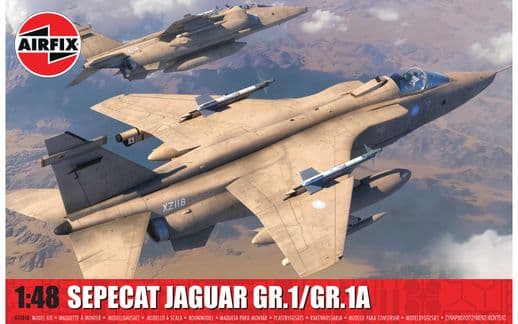
Such a handsome aeroplane, the SEPECAT Jaguar would make the transition from advanced trainer to strike backbone of the Royal Air Force with ease, and in the process, became a firm favourite with modellers. In the absence of built sample model images of the Vintage Classics model, this and the other two built models included in this update all feature its larger and younger 1/48th scale cousin.
As far as the Airfix team are concerned, 2025 will always be remembered as the ‘Year of the Big Cat’, as our much requested and incredibly popular new SEPECAT Jaguar kit in 1/48th scale was finally announced and released to modelling enthusiasts. As new tooling projects go, we had no doubts that the Jaguar would be well received, as it was definitely one of the most requested kit additions enthusiasts had been calling for over recent years, and gave one of our designers the opportunity to excel and innovate in a way that only they can, and didn’t they hit their design brief in style!
As popular as this new kit has proved to be, Workbench readers with a few more years invested in this hobby will be only too aware that this wasn’t the first time our tooling design paths had crossed with the Jaguar, as the 1970s saw our 1/72nd scale kit version of the kit starting on its journey to becoming a perennial favourite with the modelling community, a kit which many of us will remember as being something of a classic back then. This enduring affection for the Jaguar in kit form mirrors the affection in which this aircraft has always been held by enthusiasts, and as it was eventually withdrawn from RAF service after an impressive 34 years, it appears that a great many people still lament the passing of this Cold War aviation classic.
For an aircraft which looks every inch the Cold War strike warrior, it can be surprising to learn that the project which eventually led to the introduction of the SEPECAT Jaguar began as one looking to design a high-performance training aircraft. During the 1960s, Britain’s aviation industry was going through a period of great change, as the Royal Air Force were considering their needs for an uncertain future. There were some exciting projects in development at that time, such as the BAC TSR.2 and the P.1154 and in support of these, a new advanced training aircraft would also be needed, to produce a new generation of pilots ready to fly them. Looking for an aircraft to replace the diminutive Folland Gnat and ultimately, the Hawker Hunter, it was clear such a project would be expensive and place further strain on the nation’s finances.
Across the English Channel, the French found themselves with a similar need for a new training aircraft, but one which also possessed a light strike and battlefield support capability, and whilst both projects progressed independently at first, they did appear to be very closely aligned. With several projects later falling victim to cancellation and worries about spiralling costs being the most pressing concern, it appeared that the only way the RAF were going to get their new trainer was if they embraced the cost saving potential of a collaborative project. In a similar arrangement to several recent collaborations which had gone before it, BAC in the UK and Breguet in France came together to form the company SEPECAT.
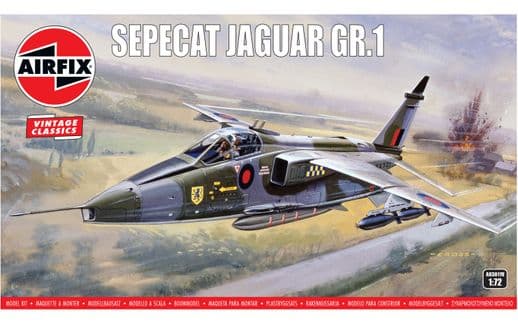
A cropped version of the 1975 box artwork created by Roy Cross. This was actually a rework of the artwork which accompanied the release of this kit five years earlier, a kit which presented the Jaguar with a pointed nose and without the addition of the Laser Ranger and Marked Target Seeker equipped ‘Chisel’ nose and fin mounted Radar Warning Receiver.
This arrangement really did appear to suit both parties with regard to their aircraft requirements, and clearly from an affordability perspective, however, it soon became apparent that the British and French had some differing role profile requirements for the new aircraft. As development got underway, five different variants were being proposed, with the French looking for single seat strike, trainer and naval variants, whilst the British needed a trainer and light strike variant. Running concurrently with this, Rolls Royce in the UK and Turbomeca in France were jointly developing the Adour engine which would power the new aircraft, something which would create its own problems and result in some protracted delays. This situation wouldn’t be helped when the British insisted the aircraft possess supersonic capability.
Nevertheless, both Britain and France placed sizeable orders for the new aircraft, with both committing to 200 aircraft each, with Britain’s order initially being weighted in favour of 110 trainer aircraft and 90 light strike variants.
The aircraft would endure a relatively protracted period in development and even as the first prototype aircraft was unveiled in April 1968, the operational landscape the aircraft was heading into was already beginning to change, and the RAF were about to change their order requirements. In 1970, they decided to abandon the trainer requirement for the new aircraft, other than for trainer variants destined to provide conversion support for the Jaguar in service, and subsequently modified their order requirements to 165 strike jets and just 35 two seat trainers. A separate project would be placed with Hawker Siddeley to develop a new training jet, one which would eventually result in the introduction of the highly successful Hawk.
Entering Royal Air Force service in 1973, the SEPECAT Jaguar GR.1 (Ground Attack/Reconnaissance Mk.I) would prove to be a more sophisticated and technologically advanced aircraft than their French counterparts, and immediately showed itself to be a potent performer. It would become one of the most important British aircraft throughout the Cold War era, with pilots always training for a role at the spearhead of any future military engagement and therefore, serving as a significant deterrent to possible Eastern Bloc aggression. A vital component of RAF Germany’s offensive inventory, they maintained four squadrons of Jaguars for strike and battlefield support operations, with a further squadron performing the tactical reconnaissance role. Further squadrons were based in the UK, and served as a deployment ready mobile force, should their services be required.
Desert Cat. RAF Jaguars would take part in the Gulf War, where this veteran aircraft posted an impressive score of 618 sorties completed, with just seven lost to maintenance related issues.
From a design perspective, the Jaguar’s distinctive undercarriage was specifically developed to allow this capable performer to operate from damaged airfields, roughly prepared grass strips and even larger roads, as the RAF assumed that in times of war, any first strike by the enemy would be directed towards known operational airfields. This ability was regarded as a valuable deterrent asset and was ably demonstrated to the nation’s media on 26th April 1975, when the second production development Jaguar GR.1 XX109 made a parachute assisted landing on the carriageway of the soon to be opened M55 motorway near Blackpool. Pushed under a bridge over the carriageway, the aircraft was fitted with bombs, before taking off again, demonstrating the impressive operability of the Jaguar.
The Jaguar would go on to enjoy an impressive 34 year service career with the Royal Air Force, undergoing regular upgrades to improve and perfect its operational capabilities during that time. It would earn a reputation as a hardworking and reliable strike and reconnaissance platform, something which was illustrated by its performance during the first Gulf War. The twelve Jaguars deployed during Operation Granby flew 618 combat sorties, with one Jaguar flying 47 missions, the most of any aircraft in theatre.
Although starting out as an Anglo-French training aircraft project, the RAF’s Big Cats certainly went on to live up to their name, showing themselves to be aircraft not to be messed with. If the Jaguar showed its offensive claws, you knew you were in big trouble.
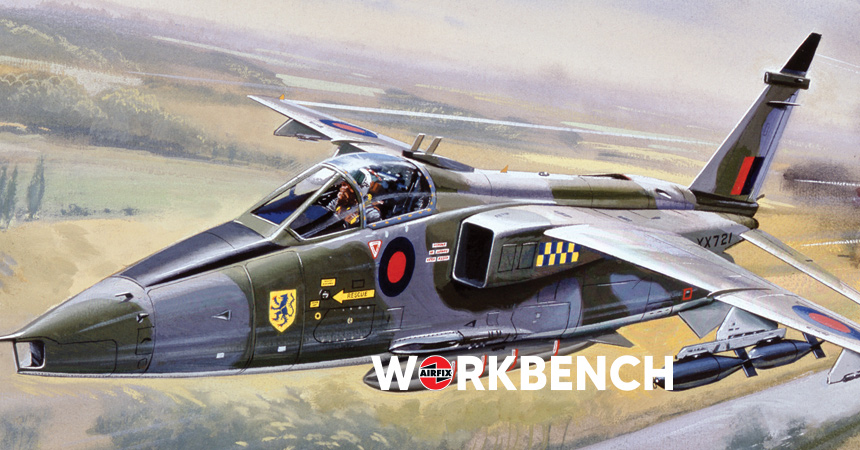
A classic model release deserves classic artwork. Here we have the full version of the modified artwork created by Roy Cross in 1975, complete with nose LRMTS and tail RWR equipment additions. It still shows the Jaguar down and dirty, where this warrior of an aeroplane felt right at home.
As mentioned earlier, the ultra-successful release of our new 1/48th SEPECAT Jaguar GR.1 kit was preceded by an earlier kit from 1970, one released in arguably the definitive scale for aircraft models at the time, and one which wears the ‘Classic kit’ title extremely comfortably. Our 1/72nd scale Jaguar kit started by presenting this exciting new Anglo French aircraft (at that time) in the configuration which British aircraft were first delivered, with the pointed nose and Radar Warning Receiver-less tail.
Interestingly, the box artwork created in support of this first release may well have been created by everybody’s favourite Airfix artist, the incomparable Mr Roy Cross, but he would be back to modify the artwork five years later to include a host of changes and additions to those original files. Although still retaining the overall feel of his original work, this modified box artwork features the Laser Ranger and Marked Target Seeker ‘Chisel’ nose, along with the fin mounted Radar Warning Receiver, changes to the air intakes and weapons loadout. This revised artwork also know shows the aircraft serial XX721 and is resplendent in RAF No.54 Squadron markings.
The differences between these two box artwork representations of the same kit only five years apart are just another of the fascinating details which made Airfix modelling such an interesting and all-encompassing hobby for so many people, but also begs another question to be asked. One of the things I remember most about my own early years of modelling was how absolutely nothing from any kit project was ever wasted. Once completed, the instructions were saved, any spare parts or decals were added to the spares box, and even the box artwork was cut out and added to my growing collection of magnificent Airfix artwork.
Was I alone in being so Airfix obsessive?
Before moving on to look at the two scheme options included in this Vintage Classics Jaguar release, I wanted to just remove any opportunity for confusion by stating that as we have still to receive built examples of this kit in the two schemes included in the kit, the built model images which have been used to illustrate this feature BOTH feature built examples of the new 1/48th scale kit, and as such, are being used for illustrative purposes only.
As this new kit receives several mentions within this update feature, and is still a major component of the 2025 Airfix range, we didn’t think anyone would mind, but please do just bear in mind that there is over 50 years between the tooling design of the two kits, with the most recent one being produced in the significantly larger 1/48th scale. We will, of course, endeavour to bring you built model images of the Vintage Classics Jaguar GR.1 once they become available.
Scheme A – SEPECAT Jaguar GR.1 XX721, RAF No.54 Squadron, Coltishall, 1975.
No.54 Squadron took the honour of becoming the first operational Jaguar unit in the Royal Air Force, initially under the ‘Designate’ title at the end of March 1974, and taking aircraft borrowed from the Jaguar Operational Conversion Unit, with some of their aircraft still lacking the Laser Ranger and Marked Target Seeker ‘chisel’ nose and fin mounted Radar Warning Receiver upgrade. By 1st July that same year, the other half of the squadron, which was still operating the McDonnell Douglas Phantom at RAF Coningsby, had passed their aircraft on to No.111 Squadron, at which point the ‘designate’ title for No.54 Squadron was dropped.
The unit re-located to RAF Coltishall on 5th August 1974, with Jaguars XX121, XX719, XX721 – 725 and XX732 initially on charge, where they would train hard with their new aircraft, as they were to be part of a NATO rapid reaction force, one intended to be used to mound devastating attack sorties in the event of war, striking fear into the hearts of the Warsaw Pact nations. The would be a force available in addition to the four Jaguar units destined to operate with RAF Germany.
SEPECAT Jaguar XX721 was built at BAC Warton during 1973, from where it also went on to make its first flight on 6th February 1974. The aircraft was subsequently delivered to the Jaguar Operational Conversion Unit at RAF Lossiemouth, but was transferred to RAF No.54 Squadron on 1st July 1974. This aircraft appeared to have been one of the most photogenic of the early Jaguars, as many fine studies of the aircraft can be found online, including some showing her in full 54 Squadron markings, but prior to receiving her LRMTS and RWR upgrades.
Full scheme details of this early RAF SEPECAT Jaguar.
With the type of mission profile flown by RAF Jaguars, XX721 was worked hard during her service career, one which was ultimately cut short in what proved to be a rather bizarre, but thankfully non-fatal incident for the pilot involved. Towards the end of June 1983, XX721 was one of twelve RAF No.54 Squadron Jaguars which arrived at Hahn Air Base in Germany to take part in a squadron exchange exercise with the new F-16 fighters of the US 10th Tactical Fighter Squadron.
The exchange itinerary was for the aircraft to fly morning and afternoon sorties with their US Air Force hosts for the duration of their stay, although the first day of operational flying would turn out to be memorable for all the wrong reasons. Taking off from Hahn in Jaguar XX721, Danish exchange pilot Capt. Nils Halvgaard blasted off in a particularly spirited manner, only to suffer a dual engine flame out whilst still at low altitude. Despite the low altitude, he attempted to re-light one, or both of the engines, whilst at the same time plotting an immediate return to base, however, the situation proved so severe that he was forced to eject from the stricken Jaguar within seconds.
Avoiding injury in becoming a member of the Martin Baker Ejection Tie Club, later investigations attributed the catastrophic flame out to the failure of a fuel transfer pump, but this certainly wasn’t an auspicious start to the exchange deployment.
Scheme B – SEPECAT Jaguar GR.1 XX726, RAF No.6 Squadron, Coltishall, 1975.
Re-forming at RAF Lossiemouth as the second British Jaguar squadron in late September 1974, No.6 Squadron also initially sported the ‘Designate’ title, but only until the other half of the unit, which was still operating McDonnell Douglas Phantoms at Coningsby, had passed their aircraft to the care of other units. Having previously operated in an air defence role, crews would now be flying the new SEPECAT Jaguar in a strike attack role, whilst at the same time developing operational tactics for those pilots destined to fly Jaguar over the months and years to come.
No.6 Squadron also moved to RAF Coltishall on 5th November 1974, initially with just six GR.1 aircraft, XX727, XX730, XX734, XX735, XX738 and XX740. They also operated a single T.2 trainer, which carried the serial number XX150. Research details to hand suggest that all these aircraft featured the LRMTS nose upgrade on their arrival at Coltishall.
Construction of the famous RAF station at Coltishall in Norfolk began in early 1939, with the completed airfield complex entering service in May the following year. The first aircraft type thought to have landed at the new airfield was a Bristol Blenheim, however, it would be the Hawker Hurricanes of No.242 Squadron and their famous commanding officer who grabbed all the early attention, as you might imagine it would if your name happened to be Douglas Bader.
After the war, the airfield was designated to serve as a V-Bomber dispersal airfield, and for a time, was also home to the much loved unit we now know as the Battle of Britain Memorial Flight.
When Jaguar XX726 rolled off the production line at BAC Warton in the spring of 1974, she was the first airframe completed featuring the new redesigned Laser Rangefinder ‘chisel’ nose.
From 1974 onwards, Coltishall would become the home of the RAF’s Big Cats, and would support Jaguar operations for well over 30 years, becoming a regular haunt for aviation enthusiasts keen on doing a little big cat spotting with their cameras. With the RAF taking delivery of the new Eurofighter Typhoon and the Jaguar selected for imminent retirement, the airfield was subsequently handed over to MoD Defence Estates at the end of November 2026.
When Jaguar XX726 rolled off the production line at BAC Warton in the spring of 1974, she was the first airframe completed featuring the new redesigned Laser Rangefinder ‘chisel’ nose, an upgrade which would also be retrospectively applied to most of the airframes which preceded it in RAF service. Making her first flight from Warton on 7th May 1974, she would join RAF No.6 Squadron at Lossiemouth at the end of that same month, and go on to see an active service life for around ten years or so.
After spending a period of time in storage at RAF Shawbury from 1985, XX726 would later be allocated to the RAF School of Technical Training at Halton, where she was used as an advanced, modern airframe to train the next generation of RAF engineering apprentices. At the end of September 1994, she was transferred to No.2 SoTT at RAF Cosford in the same role, a role in which she still serves, although the unit which cares for her these days has been renamed No.1 School of Technical Training, part of the Defence College of Aeronautical Engineering.
From the information we have at hand, it appears that during the aircraft’s time at both Halton and Cosford, XX726 was, for a while at least, retained as a war reserve airframe, meaning that in the event of war, she could effectively be returned to operational status.
With many of the former RAF Coltishall Jaguars making their final flights to Cosford, it’s somehow fitting that XX726 can still be seen at this ‘other’ RAF Big Cat sanctuary to this day, with her day job being to allow apprentice engineers to paw all over her classic and well cared for airframe.
A fantastic addition to the Vintage Classics range, our 1/72nd scale Jaguar GR.1 will bring back happy modelling memories for many a Workbench reader.
Sure to be a popular addition to the Vintage Classics range, we’re expecting the SEPECAT Jaguar GR.1 kit to be available over the next few days, but with order numbers already being extremely healthy, we don’t expect this smallest of our two RAF Big Cat kits to be around for long.
Bringing an enjoyable piece of Airfix kit nostalgia to the current range in time for this year’s modelling season, will your stash qualify as a scale ‘Big Cat sanctuary’ this coming autumn?
We're afraid that's all we have for you in this latest edition of the Airfix blog, but we will be back next Friday with more project development updates and the very latest Airfix kit exclusives. In the meantime, we're always keen to hear your views on all things Airfix and in particular, any thoughts and opinions you may have regarding our Workbench blog. If you would like to drop us a quick line, could we please ask that you use our workbench@airfix.com email for all correspondence.
To re-visit any of the Airfix blogs we have produced over the past TEN years or so, please head to our main Workbench hub, where you'll find our entire blog back catalogue and all the Airfix design projects we have already covered.
All our dedicated official social media sites can be accessed by clicking the respective link icons at the foot of this page, or by heading to the Airfix homepage. Other useful Airfix links are:
Facebook, YouTube, Twitter and Instagram official sites
Please join us for more Airfix updates next week and thank you for your continued support.